
By Clay Shumate
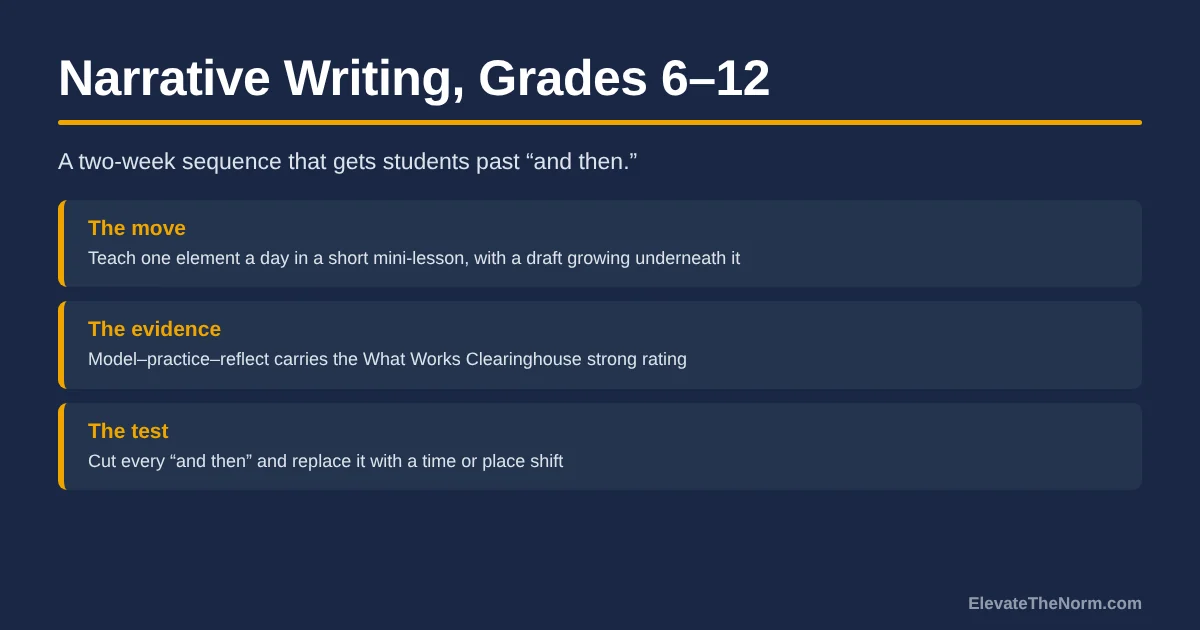
Narrative writing tells a real or imagined experience as a sequence of events, using techniques like dialogue, pacing and sensory detail, and ending in a way that follows from what happened. To teach it in grades 6–12, run short mini-lessons on the lead, pacing, dialogue, showing instead of telling, and the ending, each with a mentor text, a model and practice.
Key Takeaways
- The Common Core lists five parts of a narrative at every grade. An opening that orients the reader, narrative techniques, transitions, precise and sensory language, and a conclusion.
- “And then” is a transitions and pacing problem. Standard W.3c asks for varied transitions that signal shifts in time and setting; by grades 9–10, events must build on one another.
- Reflection arrives in middle school. From grade 7 the conclusion should reflect on the events, and from grade 8 reflection is listed as a narrative technique.
- Model, practice, reflect is the best-supported routine. A federal practice guide rates explicit strategy teaching through that cycle as backed by strong evidence.
- Social studies teachers have a stake in this. The history literacy standards expect students to work narrative accounts into their analyses of historical people and events.
What is narrative writing?
Narrative writing tells what happened, to whom, and why it mattered. It can be a personal narrative, a short story, a memoir excerpt, or a historical narrative built from evidence. What separates it from a summary is that a narrative puts the reader inside the events instead of reporting them from a distance.
Most secondary students can produce a sequence of events. The trouble is that every event gets the same weight. The walk to the bus stop gets three sentences and the moment that changed everything gets three sentences too, joined with “and then.” The teaching sequence below is built to fix that one habit from several directions.
What do the Common Core standards require in narrative writing?
Writing standard 3 (W.3) covers narratives from grade 6 through 12, with the same five parts each year. The expectations get more demanding in specific places, which helps you decide what to teach first.
| Element | Grade 6 | Grades 7–8 | Grades 9–12 |
|---|---|---|---|
| (a) Opening and sequence | Establish context, introduce narrator and/or characters, events unfold naturally and logically | Adds establishing a point of view | Set out a problem, situation or observation; establish point of view; create a smooth progression of events |
| (b) Techniques | Dialogue, pacing, description | Grade 8 adds reflection | Dialogue, pacing, description, reflection and multiple plot lines |
| (c) Transitions and structure | Varied transitions to convey sequence and signal shifts in time or setting | Grade 8 adds showing the relationships among experiences and events | Sequence events so they build on one another into a coherent whole; grades 11–12 build toward a particular tone and outcome |
| (d) Language | Precise words, relevant descriptive details, sensory language | Same, aimed at capturing the action | Precise words, telling details, sensory language for a vivid picture |
| (e) Conclusion | Follows from the narrated experiences or events | Follows from and reflects on the events | Follows from and reflects on what was experienced, observed or resolved |
Two shifts are worth naming to students. In middle school, the ending stops being “and then I went home” and starts saying what the experience meant. In high school, the order of events becomes a choice the writer makes on purpose, not just the order things happened.
How do I teach narrative writing step by step?
Teach one element at a time in short mini-lessons, and run each one through the same cycle. The What Works Clearinghouse guide Teaching Secondary Students to Write Effectively gives its strong evidence rating to explicitly teaching writing strategies with a model-practice-reflect cycle: the teacher demonstrates and thinks out loud, students apply the strategy, then students evaluate their writing and explain how their revisions improved it.
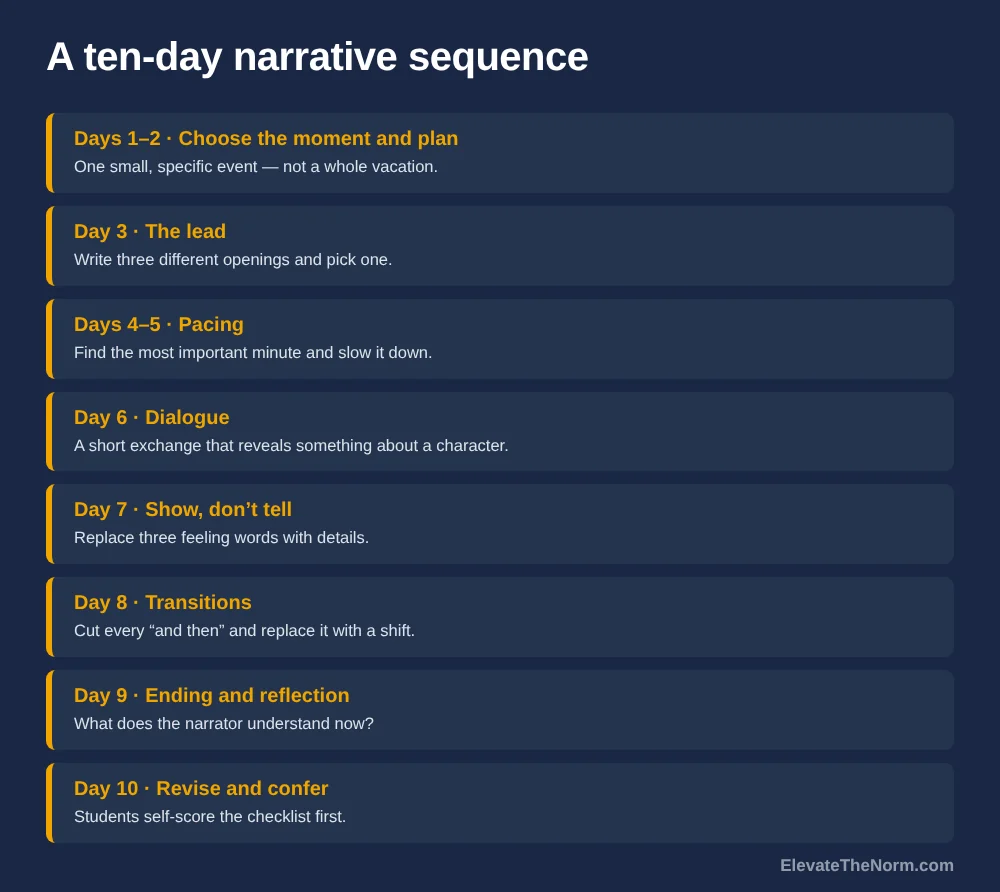
Here is a sequence that fits about two weeks, with one mini-lesson a day and a draft growing underneath it:
- Day 1–2: Choose the moment and plan. Students pick one small, specific event, not a whole vacation, and fill in the planning organizer below.
- Day 3: The lead. Write three different openings and pick one.
- Day 4–5: Pacing. Find the most important minute and slow it down.
- Day 6: Dialogue. Add a short exchange that reveals something about a character.
- Day 7: Show, don’t tell. Replace three feeling words with details.
- Day 8: Transitions. Cut every “and then” and replace it with a time or place shift.
- Day 9: The ending and reflection. Write what the narrator understands now that they didn’t before.
- Day 10: Revise with the checklist and confer.
The Writing Next meta-analysis by Steve Graham and Dolores Perin lists prewriting, meaning activities that generate or organize ideas before drafting, among its eleven effective elements of adolescent writing instruction. Days 1 and 2 are not wasted time.
What should each narrative mini-lesson cover?
The lead. A lead orients the reader: who, where, and what’s at stake. Show students four types, then have them try two on their own draft: start with action, start with dialogue, start with the setting, or start with a thought. Frederick Douglass opens his 1845 Narrative with a plain setting lead: “I was born in Tuckahoe, near Hillsborough, and about twelve miles from Easton, in Talbot county, Maryland.” Ask students what that flat, factual first sentence does for a reader who might doubt him. One answer: it signals precision, a narrator who can name exactly where his story starts.
Pacing. Pacing is how much page time an event gets compared to how much clock time it took. Have students put a star next to the single most important moment in their draft. Everything before it can be summarized in a sentence or two; the starred moment gets a full paragraph of action, sensation and thought. This is the direct fix for “and then.”
Dialogue. Dialogue should do work: reveal a character or move the plot. Teach the mechanics once (new speaker, new paragraph; punctuation inside the quotation marks), then focus on cutting. Three lines of speech that show an argument beat a page of “Hi.” “Hi.” “How are you?”
Show, don’t tell. Telling names the feeling; showing gives the detail that makes a reader feel it. Jack London’s “To Build a Fire” is public domain and has a model sentence about extreme cold: “He knew that at fifty below spittle crackled on the snow, but this spittle had crackled in the air.” London never writes “it was colder than he thought.” Students can find the word that does the work (in the air) and then rewrite one of their own “I was nervous” sentences as a physical detail.
The ending and reflection. From grade 7 the standard asks the conclusion to reflect on the events. A quick frame: “Before this happened, I thought ________. Now I know ________.” Students then rewrite the frame in their own voice so it doesn’t read like a frame.
Which mentor texts work for narrative writing in grades 6–12?
Use short pieces students can read in one sitting and return to for one craft move at a time. Public domain texts can be copied and handed out freely; modern texts you own or have in an anthology can be read together and discussed.
- Public domain: Frederick Douglass’s Narrative (opening chapter, for leads and voice); Jack London’s “To Build a Fire” (sensory detail, pacing toward a climax).
- Modern short stories to read, not reproduce: Sandra Cisneros’s “Eleven” (a single day, a strong narrator’s voice) and Gary Soto’s “Seventh Grade” (a small moment given full attention).
- Student and teacher exemplars: The WWC guide recommends using a variety of exemplars, including published, teacher-written and peer-written pieces, and showing strong, average and weak examples so students can tell them apart.
Keep expectations for mentor texts realistic. Writing Next found the study of models had a small positive effect (0.25), well below the 0.82 for explicitly teaching writing strategies. Mentor texts work best as the “model” step inside strategy instruction, not as a substitute for it. A deeper reading of one passage pairs well with close reading in grades 6–12.
What does a narrative planning organizer look like?
Copy this into a handout or a slide. It takes about one class period to complete.
| Box | Prompt for the student |
|---|---|
| The moment | What one event, lasting less than an hour, is this story about? |
| Narrator and point of view | Who is telling it? First person or third? What does the narrator want? |
| Setting | Where and when? Two details you can see, hear or smell. |
| Problem | What goes wrong, or what is at stake? |
| Before | One or two sentences of what leads up to it. |
| The starred moment | The most important minute. What happens, what does the narrator notice, think and feel? |
| After | How does it resolve, or not? |
| Reflection | What does the narrator understand now that they didn’t before? |
How do I grade narrative writing?
A checklist rubric keyed to the five W.3 elements keeps grading focused on craft rather than length or neatness. The WWC guide also recommends that students use checklists or rubrics to check whether they used the features they studied, so give this out on day one and have students self-score before you do.
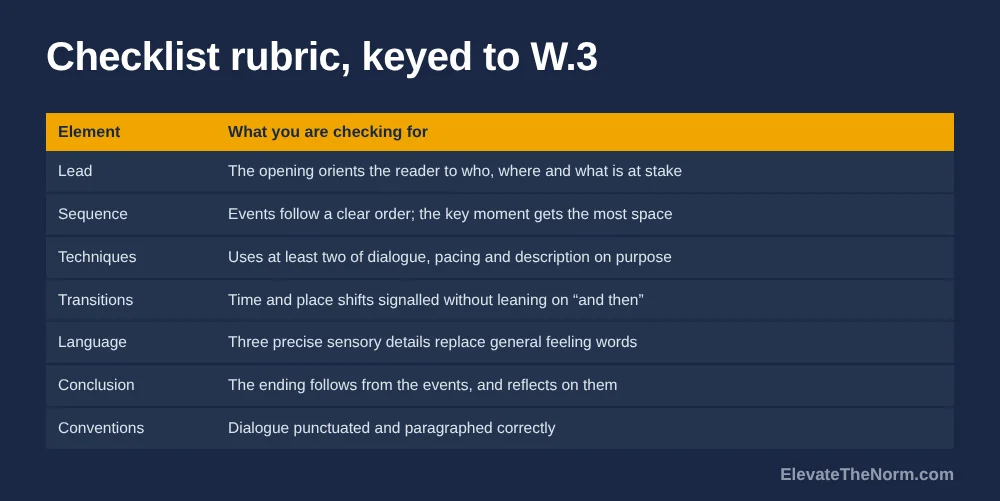
| Check | Yes / Not yet |
|---|---|
| Lead: The opening orients the reader to who, where and what’s at stake. | |
| Sequence: Events follow a clear order, and the most important moment gets the most space. | |
| Techniques: Uses at least two of dialogue, pacing and description on purpose. | |
| Transitions: Time and place shifts are signaled without leaning on “and then.” | |
| Language: At least three precise, sensory details replace general feeling words. | |
| Conclusion: The ending follows from the events (grades 7–12: and reflects on them). | |
| Conventions: Dialogue is punctuated and paragraphed correctly. |
For a draft where you want comments rather than a score, these same lines fit a single-point rubric.
How can social studies teachers use narrative writing?
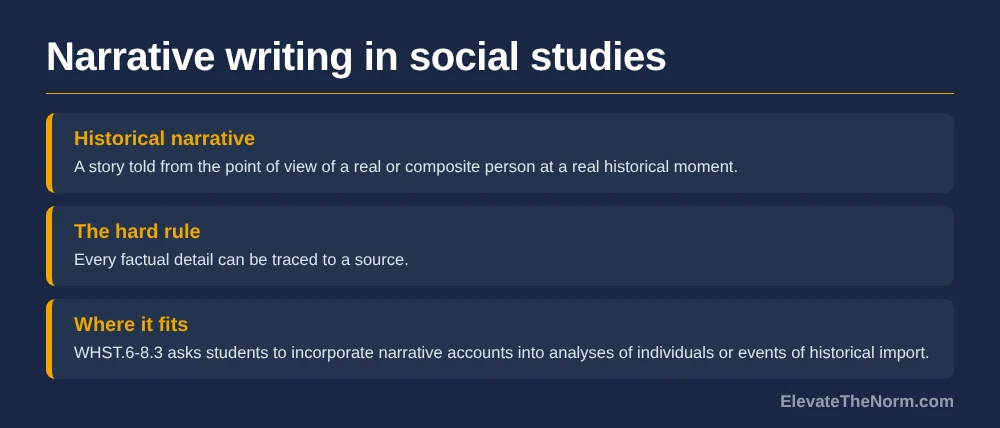
Use historical narrative: a story told from the point of view of a real or composite person at a real historical moment, where every factual detail can be traced to a source. The Common Core literacy standards for history (WHST.6-8.3) do not set narrative as a separate requirement, but their note says students must be able to “incorporate narrative accounts into their analyses of individuals or events of historical import.”
- Give a document set first. Letters, diaries, photographs and newspaper accounts from the period. Students work through them using primary source analysis before they write a word of story.
- Require an evidence log. Every concrete detail in the narrative (what people wore, ate, said, feared) gets a source next to it in a two-column log.
- Mark what’s invented. Students highlight what they imagined (thoughts, dialogue) so the line between evidence and invention stays visible.
- Finish with a short historian’s note. One paragraph explaining what the sources show and where the story goes beyond them.
The historian’s note is where the analysis lives, and it keeps the assignment from becoming a creative writing exercise with a costume on. It also fits well inside a longer unit; see project-based learning in social studies for ways to make a narrative one product among several.
Clay’s take: shrink the story
Most weak narratives are weak because the topic is too big. “My summer” or “the best day of my life” invites a list of events, and a list of events invites “and then.” The single most useful instruction in a narrative unit is “pick ten minutes, not ten days.” Once students are writing about one small moment, pacing, detail and reflection all have room to happen.
The second recommendation is to give students the choice of what to share. A personal narrative asks a teenager to put something real on paper for an adult to grade. Let them pick a moment they’re willing to have read, offer a fictional or historical option as an equal alternative, and never require that the story be sad to count as meaningful.
Where the evidence on narrative writing runs out
Be careful what you claim for this. Writing Next (Graham & Perin, 2007) and the What Works Clearinghouse guide both evaluate writing instruction broadly, with most of their strongest effects coming from strategy instruction, summarization and collaborative writing studied across argumentative and informational tasks. Neither isolates narrative and reports a clean effect size for it. The model-practice-reflect cycle has a strong rating; “a two-week narrative unit raises writing scores by X” is not a finding either document supports, and you should not repeat it. What the research does support is narrower and still worth having: students write better when a teacher shows the move, names it, and has them evaluate their own revision against it. That is the whole reason this sequence teaches one element a day instead of assigning a story and grading it.
What to do next week
Pick one class and run days one through three only. Have every student choose a single moment that took less than ten minutes in real life, fill in the planning organizer, and write three leads. Do not assign the full draft yet. You will learn more from reading thirty leads than from reading thirty finished stories, because the lead tells you immediately who understood “small and specific” and who still wrote a summary of a vacation. Hand back the checklist rubric the same week so students see what they are aiming at before they have written anything you intend to grade. If the leads come back strong, run the rest of the sequence; if half of them are still “and then,” spend another day on choosing the moment before you go on.
Frequently Asked Questions
What are the elements of narrative writing?
The Common Core lists five for grades 6–12: an opening that orients the reader and sets up the sequence of events, narrative techniques like dialogue, pacing and description, transitions that signal shifts in time or setting, precise and sensory language, and a conclusion that follows from the events. From grade 7 the conclusion should also reflect on what happened.
How do I get students to stop writing and then?
Teach pacing and transitions together. Have students star the single most important moment and give it a full paragraph while summarizing the rest in a sentence or two. Then have them replace each and then with a time or place shift, such as By lunch or Back at the house. Fewer events, with more weight on one, removes most of the problem.
What is the difference between a narrative and a personal narrative?
A narrative is any story told as a sequence of events, real or imagined. A personal narrative is a true story from the writer’s own life, told in first person. Both use the same elements under the Common Core standards. Short stories, memoir and historical narratives are other common forms in grades 6–12.
What is show, don’t tell in writing?
Telling names a feeling or condition directly, such as it was cold or I was nervous. Showing gives the concrete detail that lets the reader feel it. Jack London does this in To Build a Fire when spittle crackles in the air before it hits the snow. Have students find three feeling words in their draft and replace each with a detail.
Do mentor texts improve student writing?
They help, but modestly on their own. The Writing Next meta-analysis found the study of models had a small positive effect size of 0.25, compared with 0.82 for explicitly teaching writing strategies. Mentor texts work best as the modeling step inside strategy instruction, paired with practice and reflection, and with strong, average and weak examples side by side.
How can narrative writing be used in social studies?
Assign a historical narrative based on a document set. Students analyze primary sources, keep an evidence log for every factual detail, mark what they invented, and end with a short note explaining what the sources show. The Common Core history literacy standards expect students to incorporate narrative accounts into their analyses of historical people and events.
How long should a middle school narrative be?
The standards do not set a length. A focused one-to-two-page narrative about a single moment is a good target for a first unit, because it leaves room for pacing, dialogue and reflection without turning into a list of events. Grade the craft elements on the checklist rather than the page count.
Sources
- National Governors Association Center for Best Practices & Council of Chief State School Officers (2010). Common Core State Standards for English Language Arts: Writing, grades 6, 7, 8, 9–10 and 11–12. Used for the W.3 elements and how they change by grade.
- National Governors Association Center for Best Practices & Council of Chief State School Officers (2010). Writing Standards for Literacy in History/Social Studies, Science, and Technical Subjects, Grades 6–8. Used for the note on narrative accounts in historical analysis.
- Graham, S., Fitzgerald, J., Friedrich, L. D., Greene, K., Kim, J. S., & Booth Olson, C. (2016). Teaching Secondary Students to Write Effectively. What Works Clearinghouse, Institute of Education Sciences. Used for the model-practice-reflect cycle, exemplar advice and student checklists.
- Graham, S., & Perin, D. (2007). Writing Next: Effective Strategies to Improve Writing of Adolescents in Middle and High Schools. Alliance for Excellent Education. Used for prewriting as an effective element and the effect sizes for study of models and strategy instruction.
- Douglass, F. (1845). Narrative of the Life of Frederick Douglass, an American Slave. Project Gutenberg (public domain in the USA). Used for the opening sentence as a mentor lead.
- London, J. (n.d.). Lost Face (collection including “To Build a Fire”). Project Gutenberg edition. Used for the show-don’t-tell model sentence.

