Category: Relationships & Culture

Building trust with students, and the school culture that follows from it.

  • Choice Boards: How to Give Students a Real Choice Instead of a Decorative One

    Choice Boards: How to Give Students a Real Choice Instead of a Decorative One

    By Clay Shumate

    A choice board is a grid of options that all assess the same learning target, letting students pick how they show what they know. The format varies; the thinking does not. Built well, it is a small, well-evidenced motivational lever. Built badly, it is nine squares of unequal busywork wearing the word “choice” as a costume.

    The research on student choice is better than most classroom practices can claim and smaller than most people quoting it assume. Both halves matter, so the numbers come before the grid.

    Key Takeaways

    • Choice has a real but modest effect. Across 41 studies, offering choice raised intrinsic motivation by d = 0.30 to 0.36. On subsequent learning the same meta-analysis found d = 0.10 with a confidence interval crossing zero.
    • Two to four options, not nine. The effect was strongest with 2–4 successive choices. A full tic-tac-toe grid is usually three squares of real options and six of filler.
    • Merely offering a choice is not motivating. It has to connect to something the student cares about, sit inside what they can do, and not cost them standing with their family or community.
    • Do not justify a choice board with learning styles. The matching hypothesis has been tested and does not hold. You have a better reason available — use it.
    • One target, one rubric. If two squares need different criteria to grade, you have two assignments, not one board.

    What Is a Choice Board?

    It is a set of options — usually displayed as a grid — that each assess the same standard through a different product or route. A student picks one, or sometimes picks a path of three. The teacher sets the target and the criteria. The student sets the format.

    That definition is narrower than how the term usually gets used. A board where one square asks for a written argument, another a poster and a third a “creative response” is not a choice board. It is three different assignments printed on the same page, and no rubric fixes that.

    Choice boards sit inside a larger family of practices. The broader question of how much control students should have, and where adults keep it, belongs to student voice and choice; the gradual-release version is student autonomy. This article is about one tool: the board itself, how to build it, and how to grade it.

    What the Research on Choice Actually Shows

    Choice raises motivation by a modest, real amount and does not by itself improve later learning.

    The anchor study is a 2008 Psychological Bulletin meta-analysis by Erika Patall, Harris Cooper and Jorgianne Civey Robinson. Across 41 studies, 46 samples and 91 effect sizes, choice raised intrinsic motivation by d = 0.30 (fixed effects) to d = 0.36 (random effects). Accounting for publication bias, the effect stayed positive and significant but shrank by about a third.

    Then the part nobody quotes. On subsequent learning, the same meta-analysis found d = 0.10, with a 95 percent confidence interval of −0.02 to 0.21. That interval contains zero. Choice made students more willing; it did not, in this body of work, make them learn more afterwards.
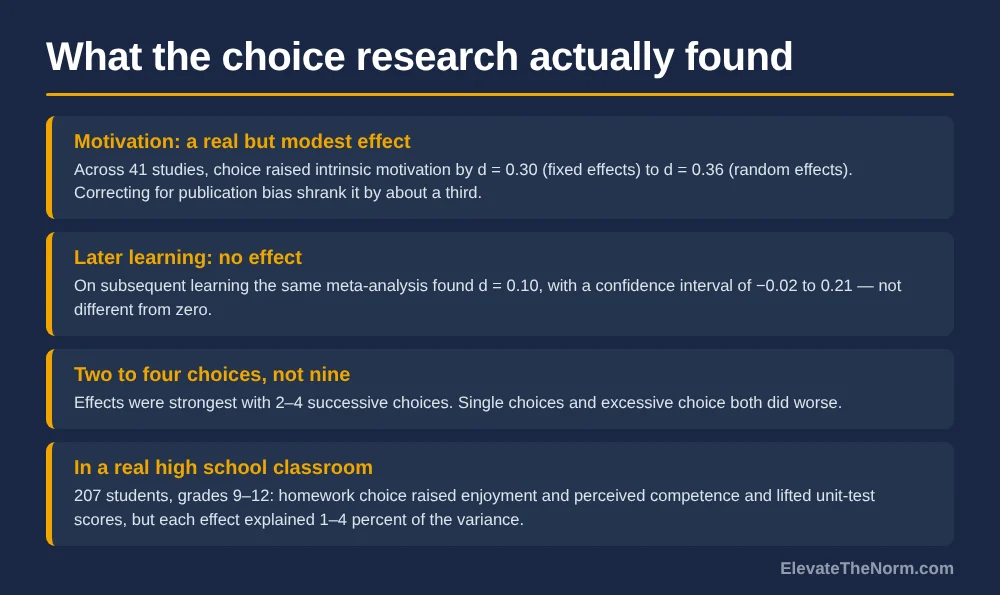
    Four-row research graphic: choice raised intrinsic motivation d equals 0.30 to 0.36 across 41 studies, had no effect on subsequent learning at d equals 0.10, worked best with two to four choices, and in a 207-student high school study explained one to four percent of variance
    What the choice research supports, and what it does not.

    Three of their moderator findings change how you build a board. Choice worked best with two to four successive choices rather than a single choice or an overwhelming array. The benefit shrank when rewards were involved — so stapling a points bonus onto the “fun” square works against you. And the effect was stronger for children than adults, which is a caution for a grades 6–12 audience sitting between those categories rather than a license.

    There is one finding here that ought to make every choice-board advocate uncomfortable, including me. The authors report that instructionally irrelevant choices — picking a game icon, choosing which pen to use — produced stronger effects than choices between task versions or activities. The motivational lift may be coming from the act of deciding rather than from the educational substance of what was decided. That does not mean choice boards are worthless. It does mean the honest claim is “this is a cheap way to raise willingness,” not “this is how students learn better.”

    What Happened When Someone Tried It in a Real High School

    Modest gains across the board, including on the unit test, with each effect explaining one to four percent of the variance.

    Patall, Cooper and Susan Wynn ran a within-subjects experiment in the Journal of Educational Psychology in 2010: 207 students, 14 classrooms, two urban high schools, with homework choice for two units and no choice for two others, conditions reversed. The results:

    • Interest and enjoyment rose in the choice condition (β = 0.22, p < .01), accounting for about 4.3 percent of the variance.
    • Perceived competence rose (β = 0.19, p < .05), about 2.2 percent of variance.
    • Unit test scores rose (β = 2.56, p < .05), about 1.3 percent of variance.
    • Homework completion was only marginal (β = 4.80, p < .10), about 1 percent.
    • No significant effect on perceived effort, task value, or pressure.

    Real high school students doing real homework, which makes it unusually relevant here. It is also a study where the biggest effect explained under five percent of the variation between students. Treat choice as a worthwhile adjustment rather than a turnaround strategy and you are reading it correctly.

    The Three Conditions a Choice Has to Meet

    Idit Katz and Avi Assor put it plainly in their review: merely offering choice is not in itself motivating, and in some cases it can even reduce motivation. They distinguish choosing, which involves a preference, from picking, which is just selecting. A board full of options a student has no preference among produces picking.
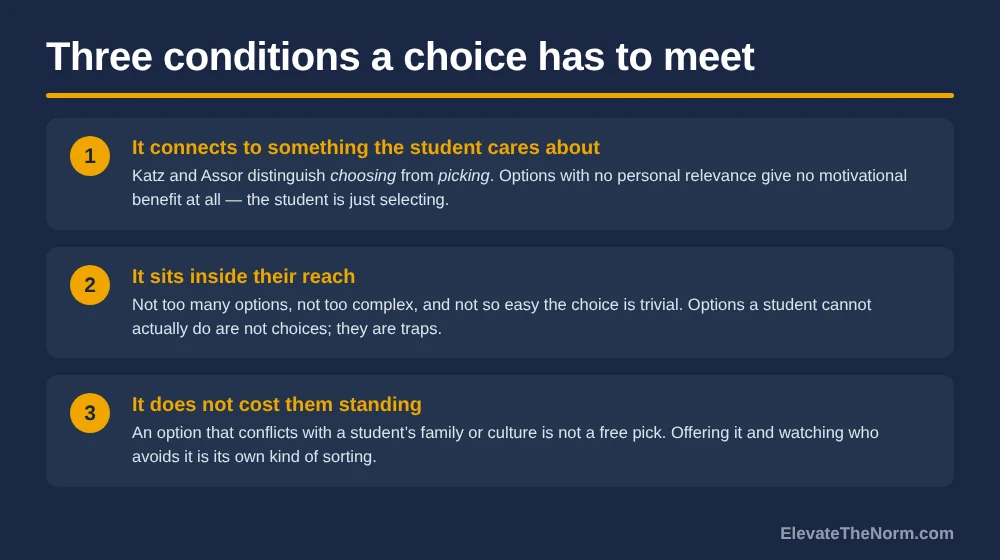
    Three-card graphic listing the conditions a choice must meet to motivate: it connects to something the student cares about, it sits inside their reach, and it does not cost them standing with family or culture
    Katz and Assor’s three conditions, applied to a choice board.

    Their three conditions map directly onto board design.

    1. Relevance to the student’s interests and goals. If every square is a format the student is indifferent about, you have given them a menu in a language they do not read. The fix is usually fewer, better squares built from what you know about the class in front of you — not a template downloaded in August.
    2. Options that fit their competence. Not too numerous, not too complex, not so easy the choice is trivial. Katz and Assor cite the choice-overload work showing people are more satisfied choosing from a small array than a large one. A student who cannot realistically do four of your six squares has a two-option board that you have made them feel bad about.
    3. Congruence with the student’s family and culture. This one gets skipped in American classrooms and it should not be. An option that conflicts with a student’s home values is not a free pick; it is a square they must avoid in front of everyone. The fix is in the design, not in the assigning. Build squares that require no student to disclose or perform anything personal — and never pre-assign a student to a square because of what you assume about their background. That is not accommodation, it is sorting with good intentions.

    Do Not Justify a Choice Board With Learning Styles

    Because the matching hypothesis has been tested and it does not hold.

    Rogowsky, Calhoun and Tallal tested the matching hypothesis directly in a study published in Frontiers in Psychology in 2020 and found no support for it: matching instruction to a student’s auditory or visual preference had no effect on achievement, with no sign of the crossover interaction the hypothesis requires. Their sample was 125 fifth graders in one rural Pennsylvania public school, which is below the grade band this site writes for, so read it as consistent with the wider literature rather than as the last word on teenagers. They also cite survey work finding that 93 percent of UK teachers and 96 percent of Dutch teachers agreed that individuals learn better when taught in their preferred style. Nearly everyone believes it. That is why saying it out loud in a meeting feels safe.

    You have a better justification sitting right there and it costs you nothing to switch to it: offering a real choice raises willingness by a measured amount, and all the routes assess the same standard. That argument survives contact with a skeptical administrator. “Visual learners” does not, and it sorts students into categories the evidence does not support.

    How to Build a Choice Board That Holds Its Shape

    One target, three to six options, equal intellectual load, nothing that has to be bought, and a single shared rubric.
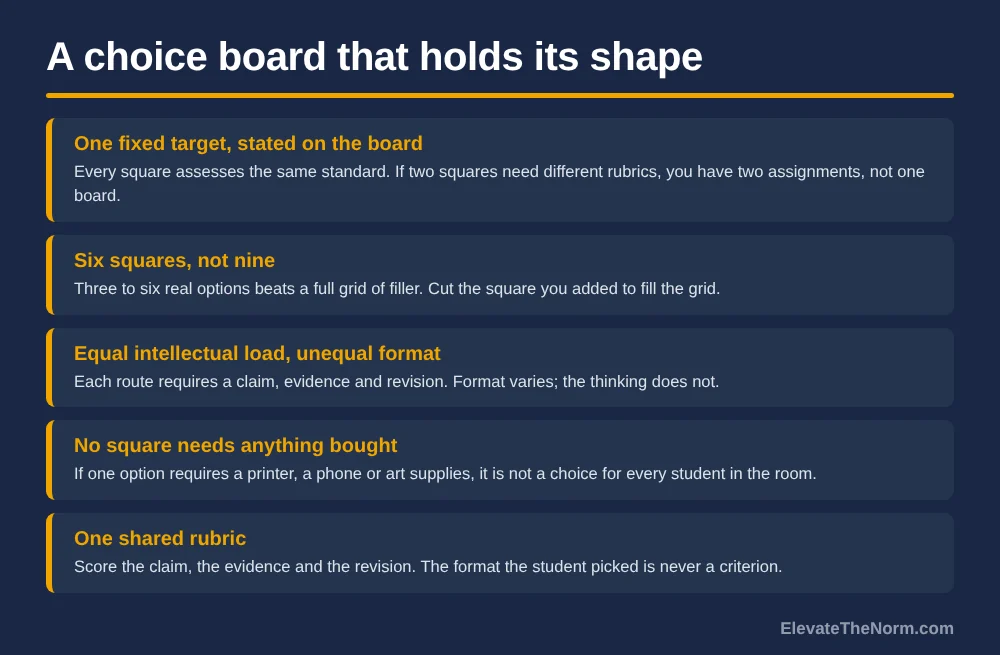
    Five-row graphic on choice board structure: one fixed target stated on the board, six squares rather than nine, equal intellectual load with unequal format, no square requiring anything bought, and one shared rubric
    Five structural rules that keep a choice board from becoming a menu of busywork.

    Work in this order.

    1. Write the target first, as a sentence, and put it on the board. “You will explain how two causes of the same event competed, using evidence from at least two sources.” Every square now has to serve that sentence.
    2. Write the rubric second — before the squares. If you can write one rubric that fairly scores every option you are imagining, the board is coherent. If you cannot, you have multiple assignments and you should pick one.
    3. Generate more squares than you need, then cut to six. The square you added to complete a 3×3 grid is almost always the weak one. Cut it. Nobody has ever complained about a board with five good options.
    4. A choice board does not replace an accommodation. If a student has a documented plan, that plan still governs, and “they could have picked a different square” is not compliance. Build the board, then check it against the plans you are responsible for. The same goes for multilingual learners: a choice of format is not a substitute for language support.
    5. Check every square for a hidden cost. Printing, poster board, a phone with a working camera, software at home, a quiet place to record. Any square carrying one of those is not a choice for every student in your room, and the students it excludes will not tell you.
    6. If a square involves recording, check the policy first. A video of a minor is not ordinary student work. Confirm your district’s rules, keep the file out of shared drives, and give students a non-recorded route that scores identically.
    7. Check that every route requires the same hard part. If the essay square demands a claim with evidence and the infographic square demands six facts in a nice layout, the board is a trap with a difficulty gradient and the students will find it before you do.

    Is a Choice Board the Same Thing as Differentiation?

    Not quite, and the difference is worth getting straight before a coach asks you about it.

    Differentiating by readiness means deliberately varying the difficulty of the work so students are each working at the edge of what they can do. A choice board as described here does the opposite — it holds difficulty constant and varies only the route. Those are two different designs and they pull against each other. If you build a board where one square is clearly easier, you have differentiated by readiness while calling it choice, and the predictable result is that the students who most need the hard version select the easy one.

    You can do both, but do them separately and say which you are doing. Vary the scaffolding — a sentence stem, a partially completed organizer, a model paragraph — while keeping the target and the criteria identical. That gets you readiness support without turning a choice into a difficulty setting. What you should not do is let a choice board quietly become the mechanism by which some students are assessed on less.

    Choice Board Examples for Grades 6–12

    These are structures rather than worksheets. Each row holds the target fixed and varies only the route.

    SubjectFixed targetOptions (pick one)Shared rubric scores
    Social studiesExplain how two causes of one event competed, using two sourcesWritten argument · recorded three-minute explanation · annotated timeline with a written claim · letter in the voice of a named historical figure, with a source noteClaim, use of evidence, accuracy, revision after feedback
    ELAArgue how one character’s choice changes the meaning of the endingEssay · podcast-style script · annotated passage set with commentary · alternate-ending scene plus a paragraph defending itClaim, textual evidence, reasoning, revision
    ScienceUse your data to make a recommendation and defend it against one objectionLab report · a chart plus a written interpretation · three-minute explanation to a non-scientist · a one-page brief for a named decision-makerClaim, data use, handling the objection, accuracy
    MathModel a real situation, then explain where your model breaks downWorked solution with written commentary · recorded walkthrough · comparison of two models with a recommendation · a problem you wrote plus its solutionCorrect modelling, reasoning, naming the limitation, precision
    Four choice boards for grades 6–12. One target per row, one rubric per row, format free.

    Notice what is absent: no square asks for a collage, a diorama, a song or a poster with a quotation on it. Those are not banned because they are creative. They are absent because none of them requires a claim defended with evidence, which is the fixed target in every row.

    What It Actually Costs You

    More prep the first time, more grading every time, and a real constraint if your department runs common assessments.

    I am not going to pretend this is free. Six different products take longer to grade than thirty copies of the same essay, because your eye never settles into a rhythm. Budget for that, or run choice boards on formative work and keep the common summative assessment uniform — which is also the answer if your department or district requires a common assessment for a unit. A pacing guide and a shared test are not obstacles to work around quietly; if the summative is fixed, put the choice earlier in the unit where it belongs anyway.

    The prep cost is front-loaded and non-recurring. Writing the target and the rubric before the squares takes one planning period. Piloting each square for time takes another. After that the board is reusable, and the second board for the same course takes about twenty minutes because you already have the shape.

    Grading a Choice Board Without Writing Nine Rubrics

    Score the target, not the product. Three to five criteria, identical across every option: the claim, the evidence, the reasoning, and the revision after feedback. The format the student picked is never a criterion.

    Say this to the class on the day you hand out the board, in these words: every square is graded on the same four things, so no option is an easier grade. Students assume the written square is safest because it is the one teachers usually reward. Until you say otherwise out loud, half the room will pick on grading superstition rather than on preference, and you will have measured nothing.

    Two failure modes worth naming. The first is scoring effort or creativity, which quietly rewards whoever had time and materials. The second is letting the format carry points — an infographic that looks professional scoring above an unformatted but sharper written argument. If a criterion cannot be applied to all six squares, delete it.

    The individual-and-group grading problem, which choice boards run into whenever students pick a collaborative option, is worked through in the project based learning rubric. The same rule applies: a criterion can describe collaboration, but it cannot rescue a grade from weak content.

    Where Choice Boards Go Wrong

    The most common failure is not a bad square. It is the teacher stepping back after handing out the board.

    Johnmarshall Reeve and Sung Hyeon Cheon, reviewing 38 randomized controlled trials of autonomy-supportive teaching, warn specifically that autonomy support gets misapplied as a laissez-faire style. The difference shows up at the moment a student struggles: an autonomy-supportive teacher takes the student’s perspective and supplies resources, while a laissez-faire teacher leaves them to figure it out. Their review reports that students of laissez-faire teachers show high amotivation and poor self-regulation. Giving choice and then going quiet is not the practice. It is the absence of it.

    Four more ways boards fail, all fixable:

    • The novelty square. Half the class picks the option that looks most fun and least like school, then discovers it is the hardest one. Pilot each square yourself for time before you offer it.
    • Choice paralysis. Students who spend a class period deciding have been given a decision without criteria. Say out loud which square is fastest and which goes deepest.
    • Same pick every time. A student who selects the written option for the ninth straight board is not exercising choice, they are avoiding risk. Require a different route once per quarter — that is still choice, with a floor.
    • The board instead of the teaching. A choice board is a delivery format. It does not teach a student how to write a claim. If nobody in the room can do the fixed target yet, the board is premature and you need the lesson first. The cheapest bridge is one worked exemplar — show a finished example on one route, and name which parts of it are the target rather than the format. Students transfer that to the other squares faster than they transfer a rubric.

    If engagement rather than format is the actual problem you are solving, the board may be the wrong tool entirely. Motivating students covers what tends to work when rewards and speeches have stopped working, and the choice-board-sized version of that answer is usually relevance, not more options.

    What to Do Next

    Take an assignment you already give, write its target as one sentence, and build three alternate routes to it that your existing rubric could score unchanged. Three. Not nine. Offer it once, watch which square gets picked and which gets avoided, and ask two students who picked the same square why.

    Send one line home with it, too: “Students chose how to present this; every option was graded on the same four criteria, and the standard did not change.” That sentence answers the only question a parent actually has when their kid submits a recording instead of an essay, and it answers it before they have to ask.

    Then keep the honest claim in your pocket for when someone asks: this raises willingness by a measured and modest amount, every route assesses the same standard, and it costs nothing. That is a good enough reason. It does not need “visual learners” propping it up.

    If you want the wider set of practices this sits inside — inquiry stations, seminars, peer critique, project roles — the guide to activities for student centered learning covers the whole family, with choice boards as one member of it.

    Frequently Asked Questions

    What is a choice board?

    A set of options, usually laid out as a grid, that each assess the same learning target through a different product or route. The teacher fixes the target and the criteria; the student picks the format. A board where the squares require different kinds of thinking is not a choice board — it is several different assignments printed on one page, and no single rubric will grade it fairly.

    Do choice boards actually improve learning?

    The evidence supports a motivation effect, not a learning effect. Patall, Cooper and Robinson’s meta-analysis of 41 studies found choice raised intrinsic motivation at d = 0.30 to 0.36. On subsequent learning the same analysis found d = 0.10 with a confidence interval of −0.02 to 0.21, which contains zero. A separate high school study did find a small unit-test gain, but it explained about 1.3 percent of the variance. Treat choice as a cheap way to raise willingness, not as an achievement strategy.

    How many options should a choice board have?

    Three to six. The meta-analysis found the strongest effects with two to four successive choices, with both single choices and excessive arrays doing worse. A nine-square grid is almost always three good options and six added to fill the shape. Cut the squares you invented for symmetry — nobody has ever complained about a board with five real choices.

    Are choice boards good for visual learners?

    Do not use that justification. Rogowsky, Calhoun and Tallal tested the learning-styles matching hypothesis directly and found no support for it — matching instruction to an auditory or visual preference had no effect on achievement. Their sample was 125 fifth graders in one school, so read it alongside the wider literature rather than as the final word. Use the better argument: a real choice raises willingness by a measured amount, and every route assesses the same standard. That one survives a conversation with an administrator.

    How do you grade a choice board?

    With one rubric that applies identically to every square: typically the claim, the evidence, the reasoning, and the revision after feedback. The format the student chose is never a criterion. If a criterion cannot be applied to all the options, delete it. And tell the class out loud that every square is graded on the same things, or students will pick on grading superstition rather than preference.

    Is a choice board the same thing as differentiation?

    No, and they can work against each other. Differentiating by readiness varies the difficulty of the work; a choice board holds difficulty constant and varies only the route. If one square is visibly easier, the students who most need the harder version will choose the easier one. Do both if you want, but keep them separate: vary the scaffolding — sentence stems, partial organizers, a worked model — while the target and the criteria stay identical.

    What if a student picks the same option every time?

    That is usually risk avoidance rather than preference, and it is worth naming without punishing. Requiring a different route once a quarter is still choice, just with a floor under it. It also tells you something: a student who will only write may need a low-stakes rehearsal of another format before they will risk it on a graded one.

    Do choice boards take more work than a normal assignment?

    Yes, and it is worth being honest about where. Six different products take longer to grade than thirty copies of the same essay because your eye never settles into a rhythm. The prep cost — writing the target and the rubric before the squares, then timing each option yourself — is front-loaded and does not recur; the second board for the same course takes about twenty minutes. If your department runs a common summative assessment, put the choice earlier in the unit rather than working around the shared test.

    Sources

    1. Patall, E. A., Cooper, H., & Robinson, J. C. (2008). The Effects of Choice on Intrinsic Motivation and Related Outcomes: A Meta-Analysis of Research Findings. Psychological Bulletin, 134(2), 270–300. 41 studies, 46 samples, 91 effect sizes; intrinsic motivation d = 0.30 (fixed) / 0.36 (random); subsequent learning d = 0.10, 95% CI −0.02 to 0.21 — not different from zero; strongest with 2–4 successive choices; weaker when rewards were present; stronger for children than adults; instructionally irrelevant choices produced stronger effects than choices between task versions. https://selfdeterminationtheory.org/wp-content/uploads/2019/10/2008_PatallCooperRobinson_PsychBulletin.pdf
    2. Patall, E. A., Cooper, H., & Wynn, S. R. (2010). The Effectiveness and Relative Importance of Choice in the Classroom. Journal of Educational Psychology. Within-subjects experiment, 207 students, 14 classrooms, two urban high schools. Interest/enjoyment β = 0.22 (p < .01); perceived competence β = 0.19 (p < .05); unit test β = 2.56 (p < .05); homework completion marginal (p < .10). No significant effect on perceived effort, task value or pressure, and each significant effect explained 1–4.3 percent of variance. https://selfdeterminationtheory.org/wp-content/uploads/2019/10/2010_PatallCooperWynn_JEP.pdf
    3. Katz, I., & Assor, A. (2007). When Choice Motivates and When It Does Not. Educational Psychology Review, 19(4), 429–442. Choice supports motivation only when options are relevant to students’ interests and goals, fit their competence (not too numerous or complex, not too easy), and are congruent with family and cultural values. “Merely offering choice is not in itself motivating. In fact, in some cases it can even reduce motivation.” https://selfdeterminationtheory.org/wp-content/uploads/2014/04/2006_Katz-et-al_when-choice.pdf
    4. Reeve, J., & Cheon, S. H. (2021). Autonomy-Supportive Teaching: Its Malleability, Benefits, and Potential to Improve Educational Practice. Educational Psychologist. Review of 38 randomized controlled trials. Warns explicitly that autonomy support is mis-applied as a laissez-faire style, and that students of laissez-faire teachers report high amotivation and poor self-regulation. Reported student effect sizes ranged widely, from d = 0.18 to d = 2.92. https://selfdeterminationtheory.org/wp-content/uploads/2021/05/2021_ReeveCheon_AutonomySupportive.pdf
    5. Rogowsky, B. A., Calhoun, B. M., & Tallal, P. (2020). Providing Instruction Based on Students’ Learning Style Preferences Does Not Improve Learning. Frontiers in Psychology, 11:164. No support for the matching hypothesis. Sample: 125 fifth graders (ages 10–11) in one rural Pennsylvania public school — below this site’s grades 6–12 band. Cites Dekker et al. (2012) finding 93 percent of UK and 96 percent of Dutch teachers endorsed the learning-styles claim. https://www.frontiersin.org/journals/psychology/articles/10.3389/fpsyg.2020.00164/pdf
    About Clay Shumate

    Clay Shumate is a certified secondary Social Studies teacher in the public schools of West Alabama, with seven years of classroom experience, a B.A. in History, and an M.Ed. in Secondary Education. He writes about project-based learning, student responsibility, respect, and practical ways to hold young people to a higher standard while giving them room to learn from mistakes. He is a member of the Society of Professional Journalists and writes to its Code of Ethics; this site’s editorial standards and corrections policy are published in full. More about Clay.

  • Responsive Classroom vs PBIS vs Conscious Discipline: Which Fits Grades 6–12?

    Responsive Classroom vs PBIS vs Conscious Discipline: Which Fits Grades 6–12?

    By Clay Shumate · Prices checked October 2026

    Short answer: PBIS is a free, schoolwide system for teaching and acknowledging behavior. Responsive Classroom is a paid set of daily classroom practices, like Morning Meeting and Interactive Modeling, that builds community. Conscious Discipline is a paid program that starts with adult self-regulation, and it is written for PreK through grade 5. For grades 6–12, PBIS is the only one of the three with a real secondary track, and Responsive Classroom is the only one with randomized-trial evidence on achievement (in grades 2–5, with gains only when teachers used it faithfully). Many schools run PBIS as the system and a classroom-level approach inside it.

    This page compares the three on what they do, what they cost, what the research shows, and how well each fits a middle or high school room. Every figure links to its source. For the broader list of frameworks, see the classroom culture frameworks Q&A hub.

    Responsive Classroom vs PBIS vs Conscious Discipline at a glance

    Responsive ClassroomPBISConscious Discipline
    Run byCenter for Responsive Schools (nonprofit)Center on PBIS (federally funded)Loving Guidance / Dr. Becky Bailey
    What it isDaily classroom practices and teacher languageSchoolwide, three-tier system with dataAdult self-regulation plus a “School Family” culture
    GradesPreK–8 (middle school course since 2016)K–12, with a dedicated high school trackEarly childhood through grade 5
    Core piecesMorning Meeting / Responsive Advisory Meeting, Interactive Modeling, Teacher Language, Logical Consequences, Academic ChoiceDefined and taught expectations, acknowledgment system, tiered supports, data-based decisionsBrain State Model, Seven Powers for Adults, Seven Skills of Discipline, School Family
    How it motivatesReinforcing teacher language; avoids token rewardsAcknowledgment, often tickets, points or privilegesConnection and regulation before consequences
    Cost to startBooks $29–$35; one-day virtual workshop $219–$259 per seatFree framework; costs are staff time and trainingCore book $44; onsite training by quote
    Best evidenceRandomized trial, 24 schools, grades 2–5Randomized trials, 37 elementary schoolsQuasi-experimental, Pre-K
    Fit for grades 6–12Moderate (middle school yes, high school limited)StrongWeak (not written for secondary)
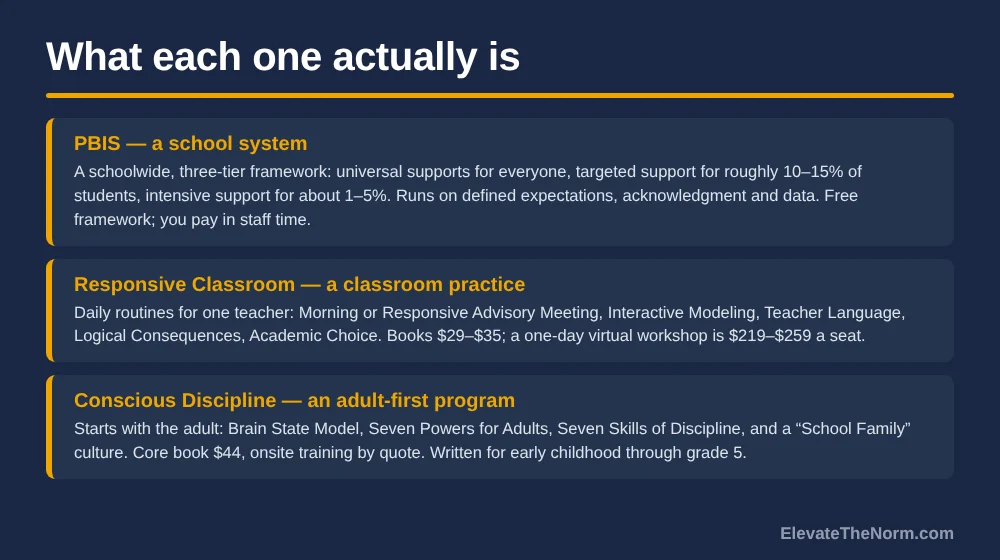
    Three-panel graphic describing PBIS as a schoolwide three-tier system, Responsive Classroom as daily classroom practices for one teacher, and Conscious Discipline as an adult-first program for early childhood through grade 5, each with its starting cost.
    PBIS is a school system, Responsive Classroom is a classroom practice, and Conscious Discipline starts with the adult.

    What is the difference between Responsive Classroom and PBIS?

    PBIS is a school system. Responsive Classroom is a classroom practice. PBIS tells a school how to organize behavior support across three tiers: universal supports for everyone, targeted support for roughly 10–15% of students, and intensive support for about 1–5% (Center on PBIS). It runs on defined expectations, acknowledgment and data.

    Responsive Classroom gives one teacher a set of daily routines: a morning (or advisory) meeting, modeling a routine before expecting it, and specific language for redirecting and reinforcing. The Center for Responsive Schools describes the split this way: PBIS supplies the schoolwide systems and data, and Responsive Classroom supplies the daily practices that help students internalize the behavior (Responsive Classroom, Sept. 2025).

    The real disagreement is about rewards. PBIS schools often use token systems, like tickets, points or prizes. Responsive Classroom steers teachers away from those and toward reinforcing language that names what a student did and why it helped the group.

    Can a school use Responsive Classroom and PBIS together?

    Yes, and it’s common. PBIS is a framework, not a curriculum, so it doesn’t compete with a classroom approach. Responsive Classroom says it’s compatible with PBIS. The friction point is the acknowledgment system. If your PBIS team runs a schoolwide ticket economy and your classroom uses Responsive Classroom language, decide ahead of time which one a student hears first. Usually it’s specific praise first, with the token given as the record of it.

    What is Classroom PBIS?

    Classroom PBIS is the PBIS framework applied inside one teacher’s room. The Center on PBIS describes it as evidence-based practices that make classrooms “predictable, positive, effective, and equitable,” with differentiated support across the same three tiers (Center on PBIS, Classroom PBIS). Its free materials include a classroom teaching matrix, a guide to the evidence-based practices behind it, and guides for supporting teachers who are implementing it.

    If your school doesn’t run PBIS, you can still use Classroom PBIS on your own. In practice that means posting three to five expectations, teaching them like content, acknowledging them often, and correcting calmly and briefly.

    Conscious Discipline vs Responsive Classroom: which should a school buy?

    Buy for your grade band first. Conscious Discipline lists its market as early childhood and PreK–5 schools (Conscious Discipline, About). Its distinctive idea is that discipline starts with the adult’s own regulation, built through the Brain State Model and the Seven Powers for Adults. That makes it a strong fit for early grades and for staff working with students who have experienced trauma.

    Responsive Classroom covers PreK–8. It added a middle school course in 2016 built around Responsive Advisory Meeting, Interactive Modeling and teacher language (THE Journal). It also has the stronger research base.

    • PreK–2, or a staff struggling with its own stress responses: Conscious Discipline.
    • K–8, with a goal of community plus academics: Responsive Classroom.
    • Grades 9–12: neither is a natural fit. Look at PBIS, restorative practices, or a secondary-built approach.
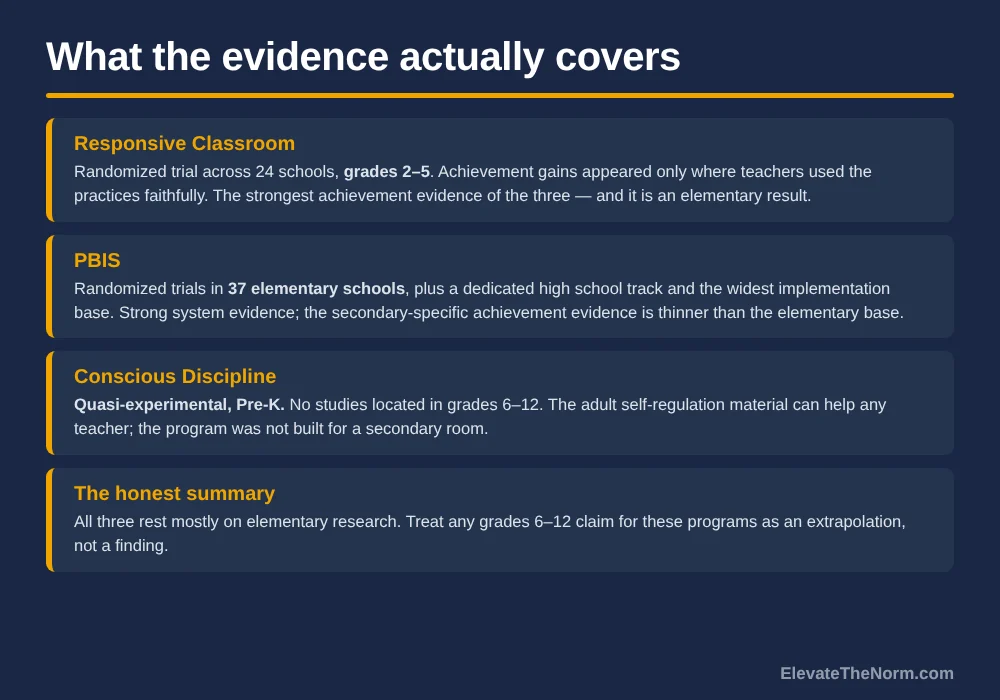
    Graphic summarising the research base for each framework: Responsive Classroom randomized trial in 24 schools grades 2-5, PBIS randomized trials in 37 elementary schools plus a high school track, Conscious Discipline quasi-experimental at Pre-K, with the note that all three rest mostly on elementary research.
    All three frameworks rest mostly on elementary research, which matters for a grades 6-12 decision.

    What does the research actually show for each one?

    All three have some evidence. None has strong evidence for high school. Here is what the largest studies found, in plain terms.

    Responsive Classroom

    A three-year randomized controlled trial covered 24 schools and 2,904 students from the end of grade 2 through grade 5. Students in Responsive Classroom schools did not outperform control schools in math or reading. But within those schools, teachers who used the practices faithfully saw gains: effect sizes of 0.26 in math and 0.30 in reading, and 0.89 in math for students who started low (Rimm-Kaufman et al., American Educational Research Journal, 2014). The lesson is that buying it does nothing; doing it does. Evidence for ESSA rates its reading impact “Promising” for grades 1–5 (Evidence for ESSA).

    PBIS

    In a randomized trial of 37 elementary schools and 12,344 children, students in schoolwide PBIS schools were 33% less likely to receive an office discipline referral. They also showed small improvements in disruptive behavior (effect size 0.12), concentration (0.08), prosocial behavior (0.17) and emotion regulation (0.11). That analysis found no significant difference in suspensions (Bradshaw, Waasdorp & Leaf, Pediatrics, 2012). CrimeSolutions rates schoolwide PBIS “Effective” for ages 5–11 (CrimeSolutions). High school PBIS is supported by implementation guidance, but we did not find a high school randomized trial.

    Conscious Discipline

    The main published evaluation is quasi-experimental, a 2012–13 study of 1,386 Pre-K students that reported positive gains (CASEL program profile). We found no randomized trial and no study in grades 6–12.

    Evidence by grade band

    This is the comparison most reviews skip: where the strongest study for each program was actually run.

    ProgramGrades in strongest studyRandomized trial?Any randomized evidence in grades 6–12?
    Responsive Classroom2–5YesNo
    PBIS (schoolwide)ElementaryYesNone found at high school
    Conscious DisciplinePre-KNoNo
    CHAMPS (for comparison)6–8Yes (102 teachers, 1,450 students)Yes, middle school
    Restorative practices (for comparison)K–12Yes (RAND, Pittsburgh)Yes, mixed: fewer suspensions, but grades 6–8 academics worsened

    Sources: IES, CHAMPS evaluation; RAND, Augustine et al., 2018. More on restorative work in restorative practices in schools.

    Which one works best for middle and high school?

    For grades 6–12, start with PBIS as the system and add a classroom layer built for teenagers. PBIS is the only one of the three with a dedicated high school track, covering student voice and the freshman transition (Center on PBIS, High School). Responsive Classroom works in middle school through Responsive Advisory Meeting. Conscious Discipline wasn’t written for secondary.

    Secondary classrooms have needs elementary frameworks don’t plan for. A teacher may see 150 students a day instead of 25, there’s no single homeroom where community gets built, and older students notice right away if praise is generic or a reward feels babyish. The approaches with middle school trial evidence, like CHAMPS, put a lot of weight on clear expectations, more specific praise, and more chances for students to respond. You can read how that plays out in a real secondary room in classroom management strategies that work in grades 6–12.

    What does each one cost?

    PBIS is free to adopt. Responsive Classroom costs about $30–$35 per book and $219–$259 per seat for a one-day virtual workshop. Conscious Discipline’s core book is $44, and onsite training is quoted.

    • PBIS: the framework, practice briefs and the Tiered Fidelity Inventory are free from the Center on PBIS. Real costs are team meeting time, coaching through your state network, and whatever your acknowledgment system buys.
    • Responsive Classroom: The First Six Weeks of School (3rd ed.) $35.00; The Power of Our Words (2nd ed.) $34.80; Interactive Modeling $31.20 (CRS bookstore). A live-virtual one-day workshop was listed at $259 a seat for 1–4 seats, $239 for 5–9 and $219 for 10 or more (CRS). Multi-day institutes cost more.
    • Conscious Discipline: Building Resilient Classrooms is $44 (Conscious Discipline store). Onsite trainings for up to 150 people are priced by quote (onsite training sheet).

    Prices change. Confirm on the publisher’s site before you put anything in a budget request.

    Token rewards or teacher language: which motivates students better?

    Specific praise does the heavy lifting. Rewards help when they’re predictable and earned, and they can backfire when they’re a surprise. Three findings matter here.

    • More praise than reprimands helps, with no magic ratio. In 151 elementary classrooms, on-task behavior rose steadily as the praise-to-reprimand ratio rose, with no threshold. Even reaching 1:1 helped (Caldarella et al., Educational Psychology, 2020).
    • It holds in middle school. In 28 middle school classrooms, teachers started out reprimanding four to nine times more than they praised. After they shifted to at least 1:1, class-wide on-task behavior improved 60–70%, and high-risk students’ grades rose a full letter grade (BYU, Journal of Positive Behavior Interventions).
    • Surprise awards can backfire. In a study of 15,329 students in grades 6–12, students given a surprise award for past perfect attendance were absent 8.3% more the following month (Robinson, Gallus, Lee & Rogers, Organizational Behavior and Human Decision Processes, 2019). The researchers think the award signaled that perfect attendance wasn’t the norm.

    The takeaway for any of these frameworks: make the criteria public ahead of time, reward effort and consistency rather than rare perfection, and pair every token with specific words.

    Where does Elevate the Norm fit?

    Elevate the Norm is a free, grades 6–12 classroom approach. It works as the classroom layer inside a school’s PBIS, or on its own where a school has no system. Full disclosure: it’s this site’s own framework, built by Clay Shumate, a certified 6–12 social studies teacher. It has not been independently evaluated, and every research claim on this site is cited so you can check it.

    • Three recognition tiers: immediate recognition, Student of the Week and Student of the Month. Criteria are announced in advance and based on consistency and self-improvement, not perfection, which lines up with the awards research above.
    • A class-vs-class point system for transitions, written up in the 3-2-1-Done method, including the honest note that it took six weeks to work.
    • Firm follow-through alongside the positives, as covered in positive discipline for teens and classroom expectations for grades 6–12.
    • Cost: free materials with no email gate on the free resource library. Prizes run about $81 a year for one teacher.
    • Built for project-based learning, where students lead and collaborate. See student leadership roles.

    If your school already runs PBIS, Elevate’s recognition tiers can serve as your classroom acknowledgment system. If you’re in grades 6–12 with no budget and no schoolwide system, it’s a place to start this week. The principles behind it are on the what we believe page.

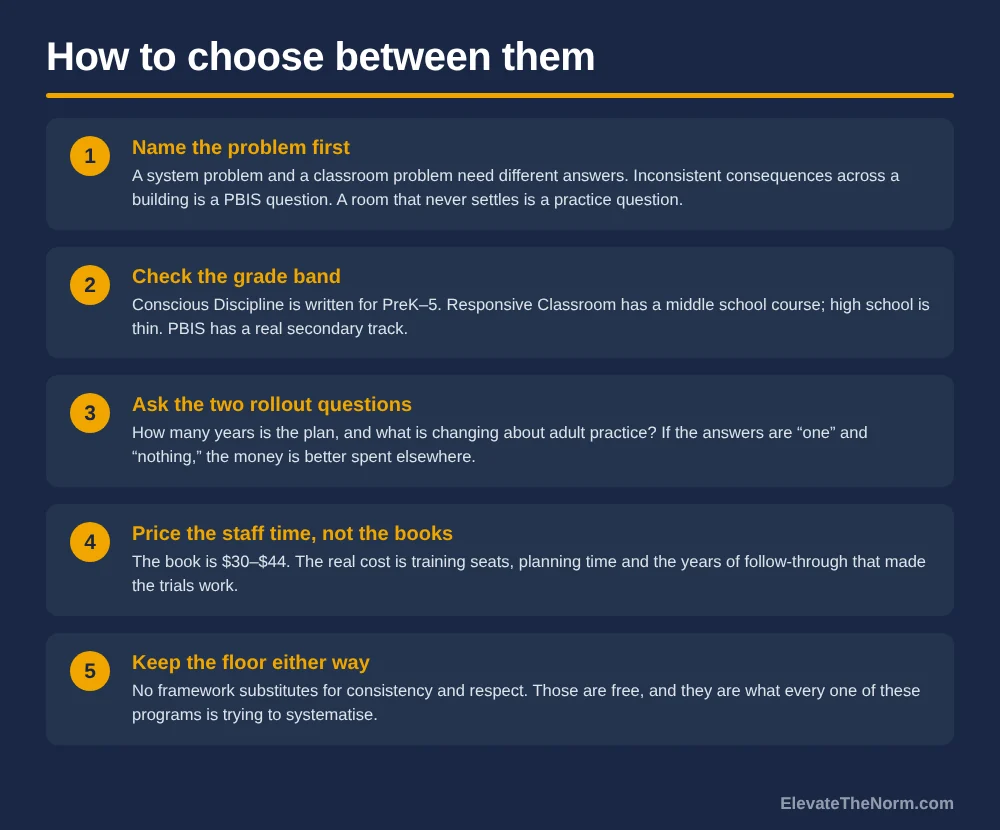
    Five numbered steps for choosing a framework: name the problem first, check the grade band, ask the two rollout questions, price the staff time rather than the books, and keep consistency and respect as the floor either way.
    Five questions worth answering before a school buys any behavior framework.

    How should you choose?

    1. Name the level. If you’re choosing a whole-school system, look at PBIS. If you’re choosing what one teacher does every day, look at a classroom approach.
    2. Match the grade band. Don’t buy an elementary program for a high school and hope it adapts.
    3. Budget for coaching, not binders. The Responsive Classroom trial showed gains only with faithful use, and the CHAMPS trial paired a workshop with monthly coaching.
    4. Decide your reward philosophy in writing: tokens, language, or both, and in what order.
    5. Pick two measures before you start, such as office referrals and observed on-task time, and check them each quarter.

    For a one-page planning tool, see what a classroom management plan looks like when it actually runs.

    Frequently Asked Questions

    Is Responsive Classroom part of PBIS?

    No. They come from different organizations. PBIS is a federally supported schoolwide framework, and Responsive Classroom is a classroom approach from the Center for Responsive Schools. Many schools use both together.

    Is PBIS free?

    Yes. The framework and the Center on PBIS materials are free. Schools pay in staff time, training and whatever they spend on acknowledgments.

    Does Conscious Discipline work in middle school?

    It’s written for early childhood through grade 5, and we found no studies of it in grades 6–12. Its emphasis on adult self-regulation can still help any teacher, but older students usually need a different structure.

    Which framework has the best research?

    PBIS and Responsive Classroom both have randomized trials, but both were run in elementary schools. For middle school specifically, CHAMPS has a randomized trial with 102 teachers.

    What’s the cheapest way to start?

    Adopt PBIS-style expectations for free, use one core book (about $30–$55), and aim for at least one specific praise for every correction. Elevate the Norm’s grades 6–12 materials are free.

    How this page is maintained

    Prices come from each publisher’s site as listed in October 2026. Study figures come from the original papers or official summaries linked inline. Elevate the Norm is labeled as this site’s own framework wherever it appears. Corrections follow the editorial standards and corrections policy. Comparing a program not listed here? Send the question in.


    About Clay Shumate

    Clay Shumate is a certified secondary Social Studies teacher in the public schools of West Alabama, with seven years of classroom experience, a B.A. in History, and an M.Ed. in Secondary Education. He writes about project-based learning, student responsibility, respect, and practical ways to hold young people to a higher standard while giving them room to learn from mistakes. He is a member of the Society of Professional Journalists and writes to its Code of Ethics; this site’s editorial standards and corrections policy are published in full. More about Clay.

  • Student Leadership Skills: 12 Abilities Schools Should Actually Develop

    Student Leadership Skills: 12 Abilities Schools Should Actually Develop

    By Clay Shumate

    Student leadership skills are the specific, teachable abilities a teenager uses to move a group forward — listening, explaining, planning, deciding, delegating, taking feedback, handling conflict, following through, and knowing what is not theirs to decide. They are not personality traits. They are behaviours you can name, practise and check, which is the only reason a school can teach them at all.

    The twelve below are chosen because each one has an observable behaviour attached. If you cannot describe what it looks like from across the room, it does not belong on a skills list.

    Key Takeaways

    • A skill is not a trait. “Confident,” “natural leader” and “takes initiative” cannot be taught or fairly assessed. “Restates the other person’s point before answering it” can.
    • School-based skill programs do move these outcomes, and implementation is the variable that decides it. A meta-analysis of 213 programs and 270,034 K–12 students found improved social and emotional skills, attitudes, behaviour and academic performance — an 11-percentile-point achievement gain — with implementation problems moderating the result.
    • Do not grade these on a student’s self-rating. In the one cluster randomized trial of a school leadership program, teachers rated leaders markedly more effective while the leaders’ own self-ratings moved by exactly zero.
    • Feedback is not automatically good for you. The landmark meta-analysis of 607 effect sizes found feedback improved performance on average (d = 0.41) and made it worse in over a third of cases — which is why “receives feedback well” is a skill and not a courtesy.
    • Teaching is the cheapest practice ground you have. Peer tutoring shows moderate-to-large academic benefits across grades 1–12, and the student doing the explaining is practising four of these twelve skills at once.

    Free Download · PDF

    The 12 Student Leadership Skills Observation Sheet (2 pages)

    Page 1 is a blank observation sheet carrying the observable behaviour for all twelve skills. Page 2 gives one way to practise each skill inside a lesson you were already going to run, and a check two adults could agree on.

    Download the free PDF

    Free. No email address required. Designed for grades 6–12. Browse every printable in Your Free Library.

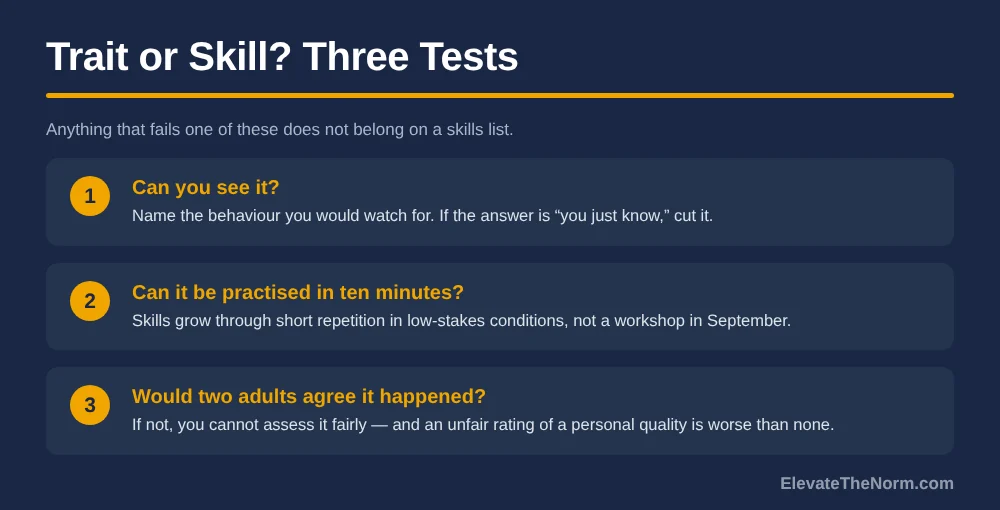
    Numbered three-step graphic titled Trait or Skill Three Tests: can you see it, can it be practised in ten minutes, and would two adults agree it happened
    Three tests that keep traits off a skills list.

    What Are Student Leadership Skills?

    A student leadership skill is a repeatable behaviour that makes a group’s work go better, which a student can get visibly worse or better at. That last clause does the filtering.

    Most published lists fail it. “Vision,” “charisma,” “integrity” and “confidence” are either traits, values, or descriptions of how a student comes across — none of them tells a fourteen-year-old what to do differently on Thursday, and none of them can be assessed without turning into a popularity judgement in a rubric costume.

    Three tests for anything you want to put on a skills list:

    • Can you see it? Name the behaviour you would watch for. If the answer is “you just know,” cut it.
    • Can it be practised in ten minutes? Skills get better by repetition in low-stakes conditions, not by a workshop in September.
    • Would two different adults agree on whether it happened? If not, you cannot assess it fairly, and an unfair assessment of a personal quality is worse than no assessment at all.

    These skills are the what. The roles students hold while practising them are the where — there are 25 of those in the companion guide to student leadership activities for grades 6–12, and the broader argument about what real responsibility requires is in the guide to giving teenagers authority that carries weight. This article stays on the abilities themselves.

    Three-row graphic summarising research on student leadership skills: a meta-analysis of 213 school programs and 270,034 students showing an 11-percentile-point achievement gain, a randomized trial where teacher ratings rose d equals 0.39 while student self-ratings moved 0.00, and a feedback meta-analysis of 607 effect sizes where performance fell in over a third of cases
    Three findings that shape how these skills get taught and checked.

    Can Leadership Skills Actually Be Taught?

    Yes, with two honest qualifications: the strongest evidence is for structured skill programs rather than leadership programs, and the quality of delivery moves the result more than the curriculum does.

    The broadest evidence comes from Durlak, Weissberg, Dymnicki, Taylor and Schellinger’s 2011 meta-analysis in Child Development — 213 school-based universal social and emotional learning programs covering 270,034 students from kindergarten through high school. Participants showed significantly improved social and emotional skills, attitudes, behaviour and academic performance, “that reflected an 11-percentile-point gain in achievement.” Two details matter more than the headline. School staff ran the programs successfully, so this is not a specialist-only result. And the authors report that the use of four recommended skill-development practices and the presence of implementation problems moderated outcomes. Translation: a well-run ordinary program beats a badly run excellent one.

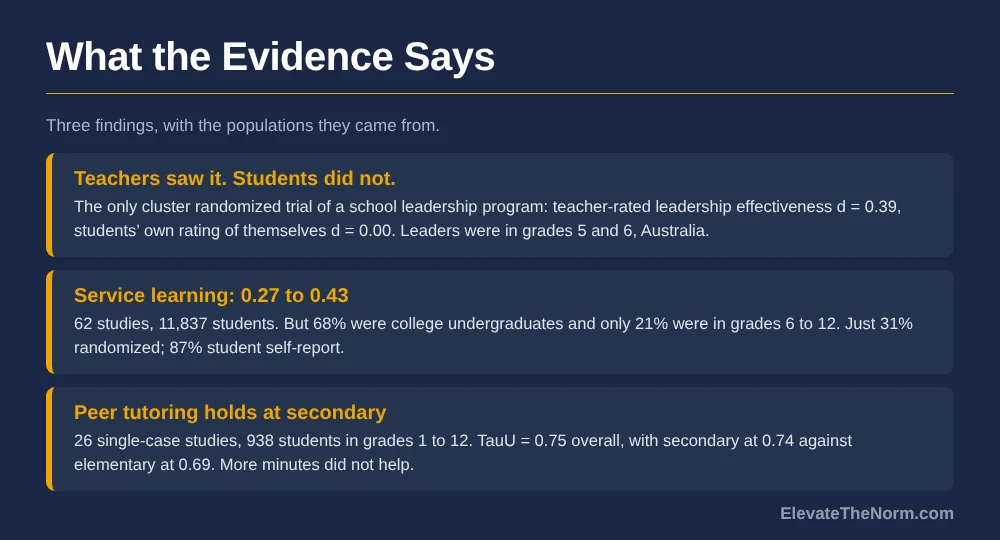
    Leadership-specific evidence is thinner. The Learning to Lead cluster randomized controlled trial (Contemporary Educational Psychology, 2026) ran across 20 schools and 1,898 students. Teachers rated the trained student leaders significantly more effective afterwards (d = 0.39) and their classroom time on task rose seven percentage points. Those leaders were in grades 5 and 6, in Australia — it is not a secondary result, and the effect sizes do not transfer automatically. The design lesson does: the leaders spent twelve sessions actually teaching younger students, not sitting in leadership lessons.

    That matches the peer-tutoring evidence, which is the best-evidenced vehicle for this grade band. Bowman-Perrott and colleagues (2013) synthesized 26 single-case studies covering 938 students in grades 1 through 12 and reported moderate-to-large academic benefits (TauU = 0.75), with secondary students at 0.74 slightly ahead of elementary at 0.69. Dosage made no difference — twelve focused minutes beat forty vague ones.

    And service work carries a wider but weaker signal. Celio, Durlak and Dymnicki’s 2011 meta-analysis of 62 studies and 11,837 students found effects of 0.27 to 0.43 across attitudes, civic engagement, social skills and achievement — but 68% of that sample was college undergraduates and only 21% was in grades 6–12, with 87% of studies relying entirely on student self-report. Useful direction, soft numbers.

    Four-row graphic grouping twelve student leadership skills: being in the room covering skills one to three, getting work done covering four to six, when it goes sideways covering seven to nine, and judgement covering ten to twelve
    The twelve skills, grouped by what they are for.

    The 12 Student Leadership Skills Schools Should Actually Develop

    Four groups of three. Each row names the behaviour you would watch for, one way to practise it inside an ordinary lesson, and a check that two adults could agree on.

    Being in the Room

    SkillWhat you would seeOne way to practise itA fair check
    1. Listening to understandRestates the other person’s point, in their terms, before answering itTwo-minute paired protocol: you may not reply until you have summarised and the other person agrees your summary is rightThe partner confirms the summary was accurate
    2. Explaining one thing clearlyPicks an entry point, checks for understanding, stops when the other person has itReteach one skill to two or three classmates after you have checked they hold it themselvesA short check on the students who were taught, not on the explainer
    3. Giving usable feedbackNames one specific change, tied to the criteria, with the reasonFixed critique protocol with a sentence frame and a cap of two itemsThe receiver can state what to change without asking a follow-up

    Getting Work Done

    SkillWhat you would seeOne way to practise itA fair check
    4. Planning backwardsStarts at the due date and works back to today, with dates attachedBuild the team timeline on day one of a project, on paper, before any work startsThe written timeline against what actually happened
    5. Deciding without complete informationMakes a call, states the reason, names what would change their mindForced-choice rounds: two defensible options, ninety seconds, one sentence of reasoningWas a reason given, and was it about the task rather than about who suggested it
    6. Delegating and asking for helpHands off a piece of work with the standard attached, or asks a direct question earlyRule the group to a hard split — nobody may do more than their share — and require one question asked outside the groupWhether the work was actually distributed, and whether the question got asked before the deadline

    Skill 6 is the one adults quietly model badly. I learned a review format I still use from another teacher on my hall, in my first year, because I asked — she had noticed I was short on engaging review games and I went and asked her how hers worked. Keeping your ears open helps. Asking questions helps more. That is a usable thing to say out loud to a fifteen-year-old who thinks a leader is supposed to already know.

    When It Goes Sideways

    SkillWhat you would seeOne way to practise itA fair check
    7. Taking feedbackAsks a clarifying question instead of defending or going silentReceive-only drill: the receiver may ask questions but may not explain themselves for sixty secondsDid the next draft change in the direction of the feedback
    8. Navigating a disagreementSeparates the issue from the person; proposes something rather than repeating a positionRehearsed scripts for the three disputes your room actually produces — workload, credit, and a missed deadlineDid the group keep working, and did an adult have to intervene
    9. Following through and repairingSays in advance that it will be late; names what is owed, to whom, by whenA standing one-line repair sentence any student can use, modelled by you firstThe repair happened, on the date the student named

    Skill 8 is worth money and worth caution in equal measure. School-based conflict resolution education is rated “promising” by the U.S. Office of Justice Programs, whose profile cites a meta-analysis of 36 studies in which participating students reported fewer antisocial behaviours (effect size 0.26), with fights falling from roughly 14% to 9.5%. Those are trained programs with adults running them. Teaching a student to de-escalate their own group’s argument about workload is a reasonable thing to do; handing a student somebody else’s serious conflict is not. If you want prewritten language to teach from, there are a hundred of them in the De-escalation Scripts set in my store.

    Judgement

    SkillWhat you would seeOne way to practise itA fair check
    10. Knowing what is not yours to decideStops and hands something to an adult instead of ruling on itSorting exercise: ten situations, three piles — mine, ours, not mineDid the student escalate the ones that belonged to an adult
    11. Running a short meetingKeeps to an agenda, closes with who does what by whenFive-minute checkpoint with a fixed four-item agenda you supplyMeeting notes listing decisions and owners
    12. Reflecting so it changes the next attemptNames one thing to do differently and then actually does itTwo questions after any role: what worked, what you will change next timeCompare this reflection to the previous one — did the named change appear

    Skill 10 carries more weight than its position suggests, and it is mostly your job rather than theirs. My position on this is blunt: if a student can wreck something badly enough to matter, that is poor planning and the adult was not paying attention. Teaching a teenager to recognise the edge of their own authority is part of the skill. Building a room where the edge is a long way from anything catastrophic is the other part, and it is the part you own. For skill 12, a two-question routine at the end of a role is enough — the mechanics of making that stick are the same ones in the guide to student self-assessment as a routine rather than an event, and the Daily Bell Ringers I sell are built around that kind of short prompt.

    How Do You Assess a Leadership Skill Fairly?

    Assess the behaviour, not the student, and never let a self-rating be the measure. Those two rules remove most of the ways this goes wrong.

    The self-rating problem is not a hunch. In the Learning to Lead trial, teacher-rated leadership effectiveness rose significantly while the leaders’ own self-reported effectiveness moved by exactly nothing — d = 0.00, p = 0.999 — and their leadership self-efficacy did not reach significance either. The adults saw growth the students did not feel. If your rubric is a student rating themselves out of four, you are measuring how a teenager feels about themselves that week, which is a real thing but is not the skill.

    Use self-report for one purpose only: as the student’s own evidence to discuss, next to yours. “You rated yourself a 2 on taking feedback. Here are the two drafts. Talk me through it.” That conversation is worth more than either rating.

    The second trap is feedback itself. Kluger and DeNisi’s 1996 meta-analysis in Psychological Bulletin — 607 effect sizes across 23,663 observations — found feedback improved performance on average (d = 0.41) and made performance worse in over a third of cases. Their explanation is that effectiveness drops as attention moves away from the task and toward the self. For a skills rubric that is a direct instruction: say “the summary missed her second point” and not “you are not a good listener.” The first is a task. The second is an identity, and identity feedback is the kind that backfires.

    Three practical rules that follow:

    • Assess one skill at a time. A twelve-row rubric read in one sitting becomes a general impression of the student with numbers attached.
    • Score the artifact, not the performance. A written timeline, a set of meeting notes, a partner’s confirmation that the summary was accurate. Those exist after the fact and two adults can read them the same way.
    • Keep it out of the course grade unless your standards actually include it and your district’s grading policy allows it. Most do not, and a leadership score smuggled into an academic grade is a fairness problem waiting for a parent email.
    • Sample rather than collect. With 150 students you cannot read an artifact from everyone every week. Read six a week, rotate, and tell students that is what you are doing.

    Two more things, both about being open about it. Put the observable behaviours on a sheet students can read — a skill you are watching for in secret is a trap, not a lesson. And when a family asks, the honest answer is short: these are behaviours we practise and talk about, they are not in the course grade, and they do not replace the school’s discipline policy. Skill 9 is about repairing a missed deadline inside a group project. It is not an alternative to whatever your handbook already requires.

    What This Looks Like Over a Semester

    Do not try to teach twelve skills. Pick three.

    A workable semester: skill 1 and skill 3 in the first six weeks, because listening and feedback make everything else cheaper; skill 4 when the first long project starts; skill 9 whenever the first deadline is missed, which it will be. Teach each one the way you would teach anything — model it, name it while you are doing it, give a short low-stakes rep, then use it for real.

    Scope the rep, not the standard. The paired listening protocol is hard for a student who is new to the language, and the receive-only feedback drill is hard for a student who finds being looked at difficult. Written versions of both work — summarise in two sentences on paper, pass it back, let the partner mark it accurate or not. Same skill, same evidence, different load.

    Two things to expect. The first reps will be stilted, because a sentence frame always is, and a fifteen-year-old restating somebody’s point out loud feels ridiculous for about a week. The second is that students will not report feeling more capable even when they are visibly better — that is the L2L finding again, and it is the main reason teachers abandon this work too early. Tell them plainly what you saw them do. Do not wait for them to look pleased about it.

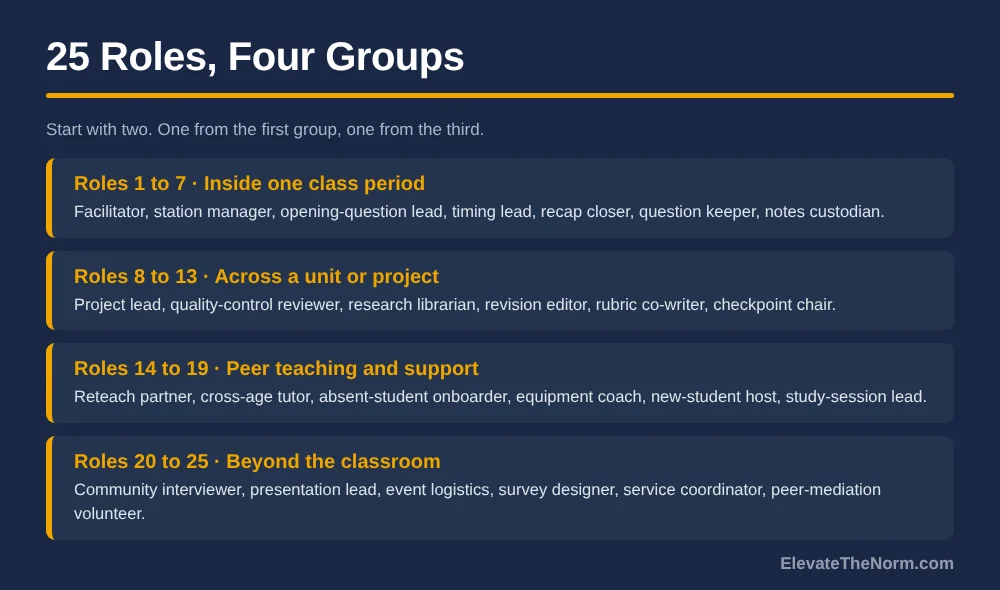
    If you want the specific roles to practise these in, every one of the twelve maps onto something in the 25 leadership roles — the facilitator job is skills 1 and 11, the reteach partner is 2 and 3, the project lead is 4, 6 and 9. And when a role goes badly, that is skill 9 territory, which is the same ground as holding a student accountable and giving them a way back.

    What to Do Next

    Pick three skills from the twelve. Write the observable behaviour for each on one sheet and put it where you plan, not where you display. Teach the first one inside a lesson you were already going to run — the paired listening protocol fits in two minutes of any discussion. Then collect one artifact per skill per student, and resist building a rubric until you have read a dozen of them.

    The check that tells you it is working is not a score. It is whether a student uses the behaviour when you did not ask for it — the day somebody restates a classmate’s point before disagreeing with it, without a sentence frame on the board.

    Before you go: grab the free 12 Student Leadership Skills Observation Sheet (2 pages) (PDF) — ElevateTheNorm.com branded, printable, no email required.

    Frequently Asked Questions

    What is the difference between a leadership skill and a leadership trait?

    A skill is a behaviour a student can get visibly better at; a trait is a description of the student. “Confident,” “charismatic” and “natural leader” cannot be taught on a Thursday and cannot be assessed without turning into a popularity judgement with a rubric around it. “Restates the other person’s point before answering it” can be taught, practised in two minutes, and checked by asking the partner whether the summary was accurate.

    Can student leadership skills be graded?

    They can be assessed; they usually should not be graded. Keep them out of the course grade unless your standards genuinely include them and your district’s grading policy allows it — a leadership score smuggled into an academic grade is a fairness problem waiting to happen. Assess one skill at a time, score the artifact rather than the performance, and tell students and families plainly what you are watching for.

    Why should I not use a student self-rating?

    Because the evidence says it will not track what you are trying to measure. In the only cluster randomized trial of a school leadership program, teacher-rated leadership effectiveness rose significantly while the students’ own self-ratings moved by exactly zero. Self-report still has a use — put the student’s rating next to your evidence and talk about the gap. That conversation is worth more than either number.

    Which three skills should I start with?

    Listening to understand, giving usable feedback, and planning backwards from a deadline. The first two make every group task cheaper to run, and the third is the one that prevents the week-before panic on a long project. Add following through and repairing when the first deadline gets missed, because it will, and the lesson lands best right then.

    Do these skills work the same in middle school and high school?

    The skills are identical; the scope changes. In middle school, keep each rep inside one class period and use sentence frames openly. In high school, the planning, delegating and meeting skills become realistic over a multi-week project, and the frames can come off the board. In both bands the first few repetitions feel stilted, and that is normal rather than a sign it is not working.

    What about students who find the speaking protocols hard?

    Scope the repetition, not the standard. Written versions of the listening and feedback drills carry the same skill and the same evidence: summarise in two sentences on paper, pass it back, let the partner mark it accurate or not. A student new to the language or uncomfortable being looked at can do the identical thinking with a different load.

    Does any of this actually raise achievement?

    Partly, and the honest version has caveats. A meta-analysis of 213 school-based social and emotional learning programs covering 270,034 students found improved skills, attitudes, behaviour and academic performance amounting to an 11-percentile-point achievement gain, with implementation problems moderating the result. Peer tutoring has solid grades 6–12 evidence. The leadership-specific trial measured leadership and time on task, not grades. Treat achievement as a plausible side effect of doing this well, not as the reason to do it.

    Sources

    1. Durlak, Joseph A., Roger P. Weissberg, Allison B. Dymnicki, Rebecca D. Taylor, and Kriston B. Schellinger. “The Impact of Enhancing Students’ Social and Emotional Learning: A Meta-Analysis of School-Based Universal Interventions.” Child Development, vol. 82, no. 1, 2011, pp. 405–432. 213 programs, 270,034 students from kindergarten through high school; improved social and emotional skills, attitudes, behaviour and academic performance “that reflected an 11-percentile-point gain in achievement”; school staff ran the programs successfully; four recommended skill practices and the presence of implementation problems moderated outcomes. Abstract read via the U.S. Office of Justice Programs NCJRS record rather than the publisher, and cited accordingly; the record states no limitations. https://www.ojp.gov/ncjrs/virtual-library/abstracts/impact-enhancing-students-social-and-emotional-learning-meta
    2. Kluger, Avraham N., and Angelo DeNisi. “The Effects of Feedback Interventions on Performance: A Historical Review, a Meta-Analysis, and a Preliminary Feedback Intervention Theory.” Psychological Bulletin, vol. 119, no. 2, 1996, pp. 254–284. 607 effect sizes, 23,663 observations. Feedback interventions improved performance on average (d = .41) but “over 1/3 of the FIs decreased performance,” with effectiveness falling as attention moved from the task toward the self. Not a school-only sample; it spans workplace and laboratory studies as well as education. https://cris.huji.ac.il/en/publications/the-effects-of-feedback-interventions-on-performance-a-historical/
    3. Wade, Levi, Mark R. Beauchamp, Nicole Nathan, Jordan J. Smith, Angus A. Leahy, Ran Bao, Sarah G. Kennedy, Jed Boyer, Thierno M. O. Diallo, Sam Beacroft, and David R. Lubans. “Effects of a School-Based Leadership Program on Student Leaders and Their Peers: The Learning to Lead Cluster Randomized Controlled Trial.” Contemporary Educational Psychology, vol. 84, 2026, article 102444. 20 schools, 1,898 students. Teacher-rated leadership effectiveness d = 0.39; self-rated effectiveness d = 0.00 (p = 0.999); leadership self-efficacy not significant; on-task time +7 percentage points. Leaders were in grades 5–6 and peers in grades 3–4, in New South Wales, Australia — not a secondary-school result. https://www.sciencedirect.com/science/article/pii/S0361476X26000020
    4. Bowman-Perrott, Lisa, Heather Davis, Kimberly Vannest, Lauren Williams, Charles Greenwood, and Richard Parker. “Academic Benefits of Peer Tutoring: A Meta-Analytic Review of Single-Case Research.” School Psychology Review, vol. 42, no. 1, 2013, pp. 39–55. 26 studies, 938 students in grades 1–12; TauU = 0.75 overall; secondary 0.74 against elementary 0.69; no dosage effect above or below the 480-minute median. Single-case research designs, not group randomized trials. https://cdd.tamu.edu/wp-content/uploads/sites/33/2019/11/BowmanPerrott_SPRAcademicMeta.pdf
    5. Celio, Christine I., Joseph Durlak, and Allison Dymnicki. “A Meta-Analysis of the Impact of Service-Learning on Students.” Journal of Experiential Education, vol. 34, no. 2, 2011, pp. 164–181. 62 studies, 11,837 students; mean effects 0.27 to 0.43 across five outcomes. 68% of participants were college undergraduates, 16% high school and 5% middle school; only 31% of studies randomized and 87% relied entirely on student self-report. https://www.tamiu.edu/profcenter/documents/Meta-AnalysisoftheImpactofSLonStudentts_2011.pdf
    6. “Practice Profile: School-Based Conflict Resolution Education.” CrimeSolutions, National Institute of Justice, U.S. Office of Justice Programs. Rated Promising; draws on Garrard and Lipsey’s 2007 meta-analysis of 36 studies, reporting an effect size of 0.26 on self-reported antisocial behaviour and fights falling from about 14% to 9.5%. Cited as a federal practice profile summarising a meta-analysis, not as the meta-analysis itself; the profile states no cautions on study quality or publication bias. https://crimesolutions.ojp.gov/ratedpractices/48

    About Clay Shumate

    Clay Shumate is a certified secondary Social Studies teacher in the public schools of West Alabama, with seven years of classroom experience, a B.A. in History, and an M.Ed. in Secondary Education. He writes about project-based learning, student responsibility, respect, and practical ways to hold young people to a higher standard while giving them room to learn from mistakes. He is a member of the Society of Professional Journalists and writes to its Code of Ethics; this site’s editorial standards and corrections policy are published in full. More about Clay.

  • Student Leadership Activities: 25 Real Roles for Middle and High School

    Student Leadership Activities: 25 Real Roles for Middle and High School

    By Clay Shumate

    Student leadership activities are tasks where a middle or high school student holds a real decision, a real deadline, and a real audience — not a title. The test is simple: name what the student actually gets to decide. If you cannot, you have a chore with a nicer word attached. The 25 roles below each pass that test, and each one names the adult guardrail that keeps it honest.

    Key Takeaways

    • A leadership activity needs a decision in it. Line leader, paper passer and “class representative” with no agenda are not leadership. A role that changes an outcome is.
    • The only cluster-randomized trial of a school leadership program found something uncomfortable. Teachers rated the student leaders meaningfully more effective (d = 0.39), while the leaders’ own ratings of themselves moved exactly nothing (d = 0.00). Adults saw a change the students did not feel.
    • The strongest evidence is for service and peer teaching, not for leadership programs. A meta-analysis of 62 service-learning studies found effects of 0.27 to 0.43 across five outcomes — but 68% of those studies were college undergraduates and only 21% were in grades 6–12.
    • Peer tutoring works about as well at secondary as it does at elementary. Across 26 single-case studies of 938 students in grades 1–12, the academic benefit was moderate to large, and secondary students did slightly better than younger ones.
    • A student should never be able to fall off a cliff you built. If a teenager can wreck something badly enough to matter, that is a planning failure, not a learning experience. Every role below is bounded by adult presence, not by lowered expectations.

    Free Download · PDF

    The Student Leadership Role Card and 25-Role Planner (2 pages)

    Page 1 is a blank five-line role card plus the rotation grid that stops the same four students getting every role. Page 2 is all 25 roles as a checklist, with the four ways they go wrong.

    Download the free PDF

    Free. No email address required. Designed for grades 6–12. Browse every printable in Your Free Library.

    What Counts as a Student Leadership Activity?

    A student leadership activity is any structured task in which a student makes a decision that other people depend on, inside limits an adult set on purpose. Three parts, and all three have to be there.

    A decision. Not a preference — a decision. Which three sources the group cites. What order the presentation runs in. If the answer to “what does this student decide?” is “nothing, they just help,” redesign it.

    Dependence. Somebody’s work gets easier or harder depending on how the role is done. That is what makes it leadership instead of homework.

    Limits you wrote down in advance. Most lists skip this, and it is the part that protects both of you. A role without a written limit eventually reaches something a fifteen-year-old should not be holding — a grade, a discipline decision, somebody’s private business.

    The longer argument about why symbolic titles fail, and why the same four kids keep getting them, is made in the guide to giving teenagers responsibility that actually carries weight. This is the implementation half: the roles, and how to set one up so it survives a Tuesday.

    Three-row graphic summarising research behind student leadership activities: a cluster randomized trial where teacher-rated effectiveness rose by d equals 0.39 while student self-ratings moved 0.00, a service-learning meta-analysis of 62 studies with effects from 0.27 to 0.43, and a peer tutoring synthesis with TauU of 0.75
    What the research supports, and the population each number came from.

    What Does the Research Actually Show?

    Short answer: the evidence for peer teaching and service work is reasonably good, the evidence for “leadership programs” is thin, and the one rigorous trial of a leadership program produced a split result that is worth sitting with.

    That trial is Learning to Lead, a two-arm cluster randomized controlled trial across 20 schools and 1,898 students, published in Contemporary Educational Psychology in 2026. Leaders got six leadership lessons, then taught twelve movement-skill sessions to younger peers. Teachers rated them significantly more effective afterwards (d = 0.39) and their classroom time on task rose 7 percentage points.

    Then the uncomfortable half. The leaders’ own self-reported effectiveness moved by exactly zero (d = 0.00, p = 0.999) and their self-efficacy missed significance too. On the peer side, the younger students’ perceived motor competence improved (d = 0.17) while their actual measured competence did not (d = 0.03, not significant).

    And the caveat that matters most on a grades 6–12 site: those leaders were in grades 5 and 6, their peers in grades 3 and 4, in New South Wales, Australia. This is not a secondary result. The design logic transfers; the effect sizes do not come with it.

    The service-learning evidence is broader. Celio, Durlak and Dymnicki’s 2011 meta-analysis of 62 studies and 11,837 students found mean effects on attitudes toward self (0.28), attitudes toward school (0.28), civic engagement (0.27), social skills (0.30) and academic achievement (0.43). Read the sample before quoting the numbers: 68% of those students were college undergraduates, 16% high school and 5% middle school. Only 31% of the studies randomized, and 87% relied entirely on student self-report — which the authors flag themselves, noting ratings of community commitment “could be biased by social desirability.”

    Peer teaching holds up better for our grade band. Bowman-Perrott and colleagues (2013) synthesized 26 single-case studies covering 938 students in grades 1 through 12 and reported a moderate-to-large academic benefit (TauU = 0.75), with secondary students (0.74) marginally ahead of elementary (0.69). Dosage made no difference — studies above and below the 480-minute median produced identical effects. More minutes is not the lever.

    Dana Mitra’s 2004 study in Teachers College Record is the one worth reading in full. It followed student voice work at a struggling high school and found growth in three things — agency, belonging and competence — concentrated in students “who otherwise do not find meaning in their school experiences.” It is qualitative and establishes no cause. It does tell you where to aim.

    One honest note on all of it. Teenagers probably do not respond because leadership is intrinsically motivating. Yeager, Dahl and Dweck argued in a 2017 theory review that adolescents are unusually sensitive to status and respect, and that interventions work when a teenager feels “competent, [has] agency and autonomy, and [is] of potential value to the group.” That is a framework, not a finding — but it predicts what the roles below do and do not accomplish.

    Numbered five-step graphic titled The Five-Line Role Card: the decision, the limit, the deadline, the guardrail, and the evidence, each with a one-line explanation
    Ninety seconds per role. All five lines, or the role is not ready.

    The Five-Line Role Card

    Before a student takes any role, write five lines. If you cannot fill all five, the role is not ready. This takes about ninety seconds per role and it is the difference between a leadership activity and an unpaid chore.

    1. The decision. One sentence naming what this student gets to decide. “You choose which two sources we cite in the final draft.”
    2. The limit. What is not theirs. Grades, discipline, anybody’s private information, and anything that requires an adult signature.
    3. The deadline. When it is due, and who is inconvenienced if it is late. Naming the second part is what makes the first part real.
    4. The guardrail. What you are watching, and the point at which you step in. Not a threat — a promise that the floor exists.
    5. The evidence. What you will look at to decide whether it worked. One artifact, not a feeling.

    Two things that are not lines on the card but matter as much. Model the role once before handing it over — run the facilitator job yourself for one discussion, naming out loud what you are deciding. And give the student the card. One that lives only in your planner is a role the student has to guess at; families should be able to read it too.

    Do not grade the role. Most of the artifacts in the tables below are read in seconds — a reset station, a source list, a 60-second summary — and the moment a role becomes another graded assignment it stops being a role.

    Line four is the one people skip, and skipping it is how a good idea becomes a bad week. My own position on this is blunt: if a student can wreck something badly enough to matter, that is poor planning and the adult was not paying attention. Real responsibility and real stakes are not the same thing. Students can struggle, do it badly, need help, and be held to the standard afterward. What they cannot do is fall off a cliff you built.

    25 Student Leadership Activities for Grades 6–12

    Four groups, running from a single class period out to the community. Every row names the decision the student holds, the guardrail, and the artifact you read. Pick two or three to start — not twelve.

    Scope a role to the student, not to an average. A role is a set of decisions and you can hand over two instead of five without making it fake. “You decide the order, I will handle the timing” is still a real decision, and it is often the right first version for a student who is new to the language, new to the school, or working with support.

    Inside One Class Period

    RoleWhat the student decidesGuardrailEvidence
    1. Discussion facilitatorWho speaks next and when to move onYou keep the right to call on anyone; you stop the clock if it stallsA participation map plus the facilitator’s one-line debrief
    2. Station managerHow their station is explained and resetYou wrote the task; they own the deliveryStation reset on time, three classmates can state the task
    3. Opening-question leadThe warm-up question, tied to yesterday’s lessonYou approve it the day before, in writingThe question, and whether the room could answer it
    4. Timing leadWhen to call each transition inside the posted planYou overrule on safety or if a group needs more timeActual times against the posted budget
    5. Recap closerWhich two ideas get the 60-second summaryYou correct anything wrong before the bellThe summary itself, delivered without notes
    6. Question keeperWhich unanswered questions go on the board and stay thereNothing naming a student goes on the listThe running list, and how many got closed
    7. Shared-notes custodianFormat and structure of the class’s running notesYou check accuracy weekly; it is a supplement, not the recordThe notes, and whether a returning absentee could use them

    Roles 1 through 7 cost nothing but the ninety seconds of the role card. Role 1 pairs naturally with a text-based seminar where students carry the discussion, because the facilitator job only has a decision in it when the discussion is genuinely theirs. For roles 2 and 4 I keep reusable station frames and recording sheets on hand so the paperwork is not the obstacle — the Station Rotation Toolkit in my store is the version I use.

    Across a Unit or a Project

    RoleWhat the student decidesGuardrailEvidence
    8. Project leadTask split and internal deadlinesYou set scope and the final date; you attend checkpointsThe team’s own timeline versus what happened
    9. Quality-control reviewerWhether the work is ready to submit against the rubricThey review; they never grade, and only inside their own groupA signed pre-submission checklist with flagged items
    10. Research librarianWhich sources survive and which get cutYou spot-check one citation per roundThe source list with a one-line reason per cut
    11. Revision editorWhich two changes the group makes firstCritique protocol is fixed; tone is not negotiableBefore-and-after on one paragraph or section
    12. Rubric co-writerThe wording of one criterion, before the project startsYou own the other criteria and the final weightingThe criterion, and whether students scored themselves on it accurately
    13. Checkpoint chairAgenda order and who reports at the mid-project meetingFixed agenda template; you are in the roomMeeting notes and the decisions made

    Roles 8 through 13 earn their keep on group projects, which is where leadership language usually collapses into “one kid does everything.” If that is the failure mode you are fighting, the mechanics in the guide to splitting group work so every member has something only they can do matter more than any title.

    Four-row graphic grouping 25 student leadership activities: roles 1 to 7 inside one class period, roles 8 to 13 across a unit or project, roles 14 to 19 in peer teaching and support, and roles 20 to 25 beyond the classroom
    The four groups, and which roles sit in each.

    Peer Teaching and Peer Support

    RoleWhat the student decidesGuardrailEvidence
    14. Reteach partnerHow to explain one skill to two or three classmatesYou confirm they have the skill first; you stay within earshotA short check on the students who were taught
    15. Cross-age tutorPacing and examples with a younger classTrained first, scheduled with the receiving teacher, never unsupervisedTutor log plus the receiving teacher’s read
    16. Absent-student onboarderWhat a returning classmate needs firstNo grades, no reasons for the absence, no commentaryWhether the returning student submitted the right thing
    17. Equipment or software coachHow the training is run and in what orderYou handle anything with a safety procedure attachedClassmates completing the task without asking you
    18. New-student hostWhat to show, in what order, over two weeksVolunteer only; you check in with both students in week oneA two-week check-in with the new student
    19. Study-session leadWhich five items the pre-assessment review coversYou see the item list beforehand; no leaking the actual testThe item list and attendance, nothing more

    This group has the best evidence behind it, and roles 14 and 15 apply the peer-tutoring finding directly. One practical note from that same research: the benefit did not scale with minutes. A twelve-minute reteach with a clear target beats forty minutes of vague “help each other.”

    Beyond the Classroom

    RoleWhat the student decidesGuardrailEvidence
    20. Community interviewerQuestions, order, and what gets usedYou approve the questions and the contact; school policy on outside contact governsTranscript or notes plus the consent record
    21. Public-presentation leadHow the group presents to the outside audienceYou rehearse it once with them, no exceptionsAudience questions answered without you stepping in
    22. Event logistics leadOne concrete slice of a real event — setup, signage, running orderOne slice only; an adult owns anything involving money or facilitiesThe slice ran, on time, without rescue
    23. Survey designerQuestions and how results are reportedAnonymous, no sensitive items, administrator approval firstThe instrument and a written summary of findings
    24. Service-project coordinatorOne measurable commitment and how it is trackedPartner organisation vetted by an adult; nothing open-endedThe number committed to versus the number delivered
    25. Peer-mediation volunteerWhich low-level disputes they help talk throughTrained only, minor conflicts only. Anything involving safety, harassment or a protected category goes to an adult immediatelyProgram-level data only — never a write-up on a classmate

    Role 25 needs its own warning. School-based conflict resolution education is rated “promising” by the U.S. Office of Justice Programs, whose profile cites a meta-analysis of 36 studies in which participating students reported fewer antisocial behaviours (effect size 0.26), with fights falling from roughly 14% to 9.5% and bullying from 28% to 20%. Those are real numbers from trained programs. They are not a licence to hand an untrained ninth grader a fight between two of their friends. Past a minor disagreement the adult does it, using a script written for the purpose.

    Who Gets a Role, and How Often?

    Use a roster grid, not your judgement in the moment. One sheet per section: write every student’s name down the left side and the roles you are actually running across the top. Every student holds two roles per term. No role gets repeated by anyone until everybody has held one.

    That does more than any speech about inclusion, because it takes the decision away from the part of your brain that reaches for the reliable kid at 7:40 in the morning. It also makes you notice when a role has quietly become somebody’s permanent job.

    Two adjustments. Let a student decline once, without explanation and without losing the next rotation — a role refused is not a role failed. And do not save the interesting roles for students who already hold titles elsewhere. Mitra’s growth showed up in the students who were not already finding meaning at school, and you do not get that by handing the facilitator job to the student council president again.

    If you want students weighing in on which roles exist at all, that is a different and larger question, and the line between genuine input and decoration is drawn in the guide to how much control students should actually have.

    Where Student Leadership Activities Go Wrong

    Four failure modes, in the order I see them cause trouble.

    1. The role with no decision in it. Attendance taker, paper passer, “class rep” with no agenda. The student knows immediately. They will do it, politely, and learn that your word for leadership means errands.

    2. The role that is really your work. Grading, filing, chasing missing assignments, policing other students. If you would otherwise do it yourself and it teaches nothing, it is labour. The clean test: would you describe this role honestly to the student’s family?

    3. The role used as a reward for compliance. This is the one that quietly undoes the whole thing. The moment roles go to the best-behaved students, every student in the room correctly reads leadership as a prize for being easy to teach rather than a thing you learn by doing. Roles are curriculum. Behaviour is handled separately, through whatever responsibility structure you already run.

    4. The role with nobody watching. A student holding a real decision needs an adult present and paying attention — circulating, dropping into checkpoints, reading the artifact. That is not distrust. It is why the role is safe to hand over at all.

    A fifth thing, and this is the L2L trial speaking: teachers saw real growth while the students reported feeling no more capable. Do not read a flat teenager as a failed role. My own students once voted on getting a class pet, and the lesson stuck with me — high school students want recognition, they want a say, they even want cheap prizes. They just may not show it on the outside. Tell them plainly what they did well and do not wait for them to look pleased about it.

    What to Do Next

    Keep every role doable inside the school day. Roles 15, 20, 22 and 24 can drift past the final bell, and a role that quietly requires a ride home is only available to some families. If one is worth running anyway, make it optional and say so.

    Pick two roles from the lists above — one from the single-period group and one from peer teaching, because those are the cheapest and the best evidenced. Write the five-line role card for each. Build the roster grid. Run them for three weeks before adding a third.

    None of this needs a budget line, a program, or a schedule change, which is the main argument for doing it. If you teach six sections, keep one grid per section and expect the rotations to run at different speeds.

    Then check one thing: can the student say what they decided, unprompted? If yes, you have a leadership activity. If they say “I helped,” go back to line one.

    The roles are the practice; the abilities are what the practice is for. If you want the companion list, twelve leadership skills with the behaviour you can actually observe sets out what each role is building and how to check it without asking a teenager to rate themselves.

    Before you go: grab the free Student Leadership Role Card and 25-Role Planner (2 pages) (PDF) — ElevateTheNorm.com branded, printable, no email required.

    Frequently Asked Questions

    What is the difference between a student leadership activity and a classroom job?

    A job is a task. An activity is a task with a decision inside it. Passing out papers, taking attendance and tidying the lab are jobs — useful, but the student decides nothing. A leadership activity names something the student gets to decide that other people depend on: which two sources survive the cut, what order the presentation runs in, when the transition gets called. If you cannot write that sentence, you have a job.

    How do I stop leadership roles going to the same four students?

    Use a roster grid instead of your judgement in the moment. One sheet per section: every name down the left, the roles you actually run across the top, two roles per student per term, and no repeats for anybody until everyone has held one. Let a student decline once without explanation and without losing the next rotation. Mitra’s 2004 study found the growth concentrated in students who were not already finding meaning at school, which is exactly the group a gut-feel system skips.

    Should student leadership roles be graded?

    No. Grade the work the role produced, if you grade anything at all. The moment a role becomes another graded assignment it stops being a role and becomes an assignment with a title. Most of the evidence artifacts here — a reset station, a source list, a 60-second summary, a tutor log — are read in seconds and are there to tell you whether the role worked, not to generate a score.

    Do student leadership activities actually raise achievement?

    The honest answer is that the evidence is mixed and mostly indirect. Service-learning studies report an academic effect around 0.43, but 68% of that sample was college undergraduates and 87% of the studies used self-report. Peer tutoring has better evidence for grades 6–12 specifically, with a moderate-to-large academic benefit and secondary students doing slightly better than elementary. The one cluster randomized trial of a leadership program measured leadership and on-task time, not grades. Treat achievement as a possible side effect, not the promise.

    Which leadership activities work best in middle school versus high school?

    The roles are the same; the scope changes. In middle school, keep the decision inside one class period and make the deadline short — roles 1 through 7 and the reteach partner role are the natural starting set. In high school, the project-length roles become realistic: a project lead holding internal deadlines, a research librarian cutting sources, a presentation lead facing an outside audience. The failure mode in both bands is identical — a role with no decision in it.

    Is it safe to let students run peer mediation?

    Only with training, only for minor disputes, and only inside a program an adult runs. School-based conflict resolution education is rated promising by the U.S. Office of Justice Programs, whose profile cites a meta-analysis of 36 studies finding fewer self-reported antisocial behaviours among participants. Those results came from trained programs with adult oversight. Anything touching safety, harassment or a protected category goes straight to an adult, and a student volunteer never writes up a classmate.

    How do I do this without adding work for myself?

    Three habits. Write the five-line role card once per role and reuse it every term — it takes about ninety seconds. Pick roles whose evidence is something you would have looked at anyway. And start with two roles, not twelve. If a role is costing you time every week, it is almost certainly a role where you kept the decision and gave away the labour.

    Sources

    1. Wade, Levi, Mark R. Beauchamp, Nicole Nathan, Jordan J. Smith, Angus A. Leahy, Ran Bao, Sarah G. Kennedy, Jed Boyer, Thierno M. O. Diallo, Sam Beacroft, and David R. Lubans. “Effects of a School-Based Leadership Program on Student Leaders and Their Peers: The Learning to Lead Cluster Randomized Controlled Trial.” Contemporary Educational Psychology, vol. 84, 2026, article 102444. Two-arm cluster RCT, 20 schools, 1,898 students. Teacher-rated leadership effectiveness d = 0.39; self-rated effectiveness d = 0.00 (p = 0.999); on-task time +7 percentage points; peers’ perceived motor competence d = 0.17 but actual motor competence d = 0.03, not significant. Leaders were in grades 5–6 and peers in grades 3–4, in New South Wales, Australia — not a secondary-school result. https://www.sciencedirect.com/science/article/pii/S0361476X26000020
    2. Celio, Christine I., Joseph Durlak, and Allison Dymnicki. “A Meta-Analysis of the Impact of Service-Learning on Students.” Journal of Experiential Education, vol. 34, no. 2, 2011, pp. 164–181. 62 studies, 11,837 students. Mean effects: attitudes toward self 0.28, attitudes toward school 0.28, civic engagement 0.27, social skills 0.30, academic achievement 0.43. 68% of participants were college undergraduates, 16% high school, 5% middle school; only 31% of studies used a randomized design and 87% relied entirely on student self-report. https://www.tamiu.edu/profcenter/documents/Meta-AnalysisoftheImpactofSLonStudentts_2011.pdf
    3. Bowman-Perrott, Lisa, Heather Davis, Kimberly Vannest, Lauren Williams, Charles Greenwood, and Richard Parker. “Academic Benefits of Peer Tutoring: A Meta-Analytic Review of Single-Case Research.” School Psychology Review, vol. 42, no. 1, 2013, pp. 39–55. 26 single-case studies, 938 students in grades 1–12, 195 phase contrasts. Overall TauU = 0.75 (95% CI 0.71–0.78); secondary 0.74 against elementary 0.69; no dosage effect above or below the 480-minute median. Single-case research designs, not group randomized trials. https://cdd.tamu.edu/wp-content/uploads/sites/33/2019/11/BowmanPerrott_SPRAcademicMeta.pdf
    4. Mitra, Dana L. “The Significance of Students: Can Increasing ‘Student Voice’ in Schools Lead to Gains in Youth Development?” Teachers College Record, vol. 106, no. 4, 2004, pp. 651–688. Found consistent growth in agency, belonging and competence, concentrated among students “who otherwise do not find meaning in their school experiences.” Qualitative and sociocultural; it describes where growth appeared and does not establish cause. https://pure.psu.edu/en/publications/the-significance-of-students-can-increasing-student-voice-in-scho/
    5. “Practice Profile: School-Based Conflict Resolution Education.” CrimeSolutions, National Institute of Justice, U.S. Office of Justice Programs. Rated Promising; draws on Garrard and Lipsey’s 2007 meta-analysis of 36 studies, reporting an effect size of 0.26 on self-reported antisocial behaviour, fights falling from about 14% to 9.5% and bullying from 28% to 20%. Cited as a federal practice profile summarising a meta-analysis, not as the meta-analysis itself; the profile states no cautions on study quality or publication bias. https://crimesolutions.ojp.gov/ratedpractices/48
    6. Yeager, David S., Ronald E. Dahl, and Carol S. Dweck. “Why Interventions to Influence Adolescent Behavior Often Fail but Could Succeed.” Perspectives on Psychological Science, vol. 13, no. 1, 2017, pp. 101–122. Argues adolescents are unusually sensitive to status and respect, and that people “feel respected and high status when they are treated as though they are competent, have agency and autonomy, and are of potential value to the group.” A theory review and integration paper, not an empirical test of leadership roles. https://pmc.ncbi.nlm.nih.gov/articles/PMC5758430/

    About Clay Shumate

    Clay Shumate is a certified secondary Social Studies teacher in the public schools of West Alabama, with seven years of classroom experience, a B.A. in History, and an M.Ed. in Secondary Education. He writes about project-based learning, student responsibility, respect, and practical ways to hold young people to a higher standard while giving them room to learn from mistakes. He is a member of the Society of Professional Journalists and writes to its Code of Ethics; this site’s editorial standards and corrections policy are published in full. More about Clay.

  • Questions to Ask at a Parent Teacher Conference in Middle and High School

    Questions to Ask at a Parent Teacher Conference in Middle and High School

    By Clay Shumate

    The best questions to ask at a parent teacher conference in middle or high school are the ones that produce something your kid can act on by Monday. Not “how is he doing,” which gets you “he’s doing fine.” Ask what specifically is going wrong, what it would look like fixed, and who is responsible for which part.

    Most conference question lists online were written for the parent of an eight-year-old with one teacher. At thirteen and sixteen the event is different, and the research on what parent involvement does at this age points somewhere those lists do not go.

    Key Takeaways

    • The involvement that correlates best with achievement in middle school is not the kind most conferences produce. In a meta-analysis of 50 studies, academic socialization — helping a teenager connect schoolwork to where they are going — had the strongest positive association. Homework help had the strongest negative one.
    • Ask for specifics, because vague questions get vague answers. “What does a 4 look like on the next project?” is a different question from “how’s she doing?” and it is the only one of the two a teacher can answer usefully in fifteen minutes.
    • Bring your kid. In a four-school study of student-led conferences, parent attendance was at least 92% at every site. Whatever else changes, more families show up when the student is running the meeting.
    • What happens after the conference is what decides whether it mattered. A randomized trial of weekly one-sentence teacher-to-parent messages cut the share of high school students failing to earn credit by 41%. Fifteen minutes in October does not do that on its own.
    • Specific, improvement-focused messages beat warm general ones. In the same trial, messages about what a student needed to improve produced a significant gain. Messages about what the student was doing well did not.

    Free Download · PDF

    The Parent-Teacher Conference Question Card (2 pages)

    Page 1 is the ten questions with what each one is for, the four to ask when the news is bad, and the five that waste the slot. Page 2 is a notes grid for up to seven teachers, with a column for the follow-up date you should not leave without.

    Download the free PDF

    Free. No email address required. Designed for grades 6–12. Browse every printable in Your Free Library.

    Two-column graphic comparing forms of parent involvement in middle school: academic socialization and school-based involvement listed as positive, home-based involvement as not statistically significant, and homework help as the strongest negative association
    Hill and Tyson’s meta-analysis of 50 studies, sorted by what actually tracks with achievement.

    What Should You Actually Ask at a Parent Teacher Conference?

    Ask four things: what the specific problem is, what fixed looks like, what the student does next, and how you will both know whether it worked. Everything else is a variation on those four.

    The reason to be that blunt is arithmetic. A secondary conference is ten to fifteen minutes, and a teacher with five sections sees north of a hundred students a day. Teachers are not being evasive when they say “she’s doing great.” They are answering the question you asked.

    Why the Middle and High School Conference Is a Different Event

    You now have six or seven teachers instead of one, less time with each, and a student old enough to have a position on being talked about. Those three changes break most of the standard advice.

    In elementary school one adult sees your child all day and can describe them whole. In seventh grade nobody has that view. Each teacher sees your kid for fifty minutes in one subject, often in one mood. That is the structure, not a flaw in the teachers — but it means six teachers asked “how is she doing” will give you six fragments and no picture.

    So decide in advance what you are trying to find out and ask the same focused question in every room. Patterns show up fast. Behind in one class is a problem with that class. Behind in five is a problem with time, sleep, or something nobody has named yet.

    What Does the Research Say Parent Involvement Should Look Like at This Age?

    It says the most effective thing a parent can do with an adolescent is help them see the point. Nancy Hill and Diana Tyson’s meta-analysis of 50 studies of parental involvement in middle school, published in Developmental Psychology in 2009, found an average correlation of r = .18 between involvement overall and achievement. Underneath that average, the types split sharply.

    Academic socialization had the strongest positive association. That is the clumsy research name for an ordinary thing: talking with your kid about why school matters, what they want, what their plans require, and how the work in front of them connects to it. Communicating expectations, discussing learning strategies, linking coursework to goals.

    School-based involvement — volunteering, showing up, attending events — was positive and significant but smaller. Home-based involvement was not statistically significant. And helping with homework had the strongest negative association of anything they measured.

    Read that last one carefully, because it is easy to turn into a slogan it does not support. This is correlational, and parents help most with homework when a student is already struggling, so some of that negative number is parents responding to a problem rather than causing one. The honest reading is not “helping with homework hurts your child.” It is that there is no evidence more homework help is the lever, and a conference spent negotiating who checks the math packet is spent on the form of involvement with the least support behind it.

    Which gives you a sorting rule. A question that ends with you doing more of your teenager’s work is a weak question. A question that ends with your teenager understanding what the work is for is a strong one.

    Numbered list of six questions to ask at a parent teacher conference, each with a one-line explanation of what that question is for
    Pick four or five and ask the same ones in every room so the answers can be compared.

    The Ten Questions, and What Each One Is For

    Pick four or five — you will not get through ten — and ask the same ones in every room so you can compare.

    Ask thisWhat it is actually for
    “What is the one thing you’d change about how she works in your class?”Forces one specific answer instead of a summary. Teachers almost always have one.
    “Is this a skill problem or a habit problem?”Separates “doesn’t understand it” from “isn’t doing it.” The fixes have nothing in common.
    “What does strong work look like on the next big thing?”Gets the standard in concrete terms your kid can aim at.
    “What would you want him to do differently tomorrow?”Converts a judgment into an action with a date on it.
    “When is the best time for her to come see you?”Hands the relationship to the student, which is the point at this age.
    “What is he like in class when I’m not there?”You know your kid at home, not at 10:40 in a room of thirty.
    “Is anything I’m doing at home making this harder?”Rarely asked, often answerable, and it signals you are not here to litigate.
    “How will we both know in six weeks whether this worked?”Sets a measure before anyone has reason to argue about one.
    “What’s the fastest way to reach you, and how fast is realistic?”Prevents the two-week silence that turns into a grievance.
    “What should she be doing now if she wants that next year?”The academic socialization question — the one with research behind it.

    Write the answers down in the room. Not because you will forget — because a teenager reads a parent taking notes as evidence the meeting was real.

    What About the Homework Question?

    Ask about homework, but ask about the system rather than the assignment. “Where does she find out what’s due?” and “what happens when something comes in late?” are system questions. “Can you send me the list every week so I can check it” is an assignment question, and you have just volunteered to be your kid’s secretary for the rest of the year.

    The distinction tracks the research. Knowing how the class works is information your teenager can be handed. Doing the tracking yourself is the form of involvement with the weakest evidence behind it and the highest cost to the thing you are supposedly building, which is a kid who can run their own week — and every piece of that you take over is a piece they do not get to practice.

    Should Your Teenager Be in the Room?

    Yes, and it is the single highest-leverage change available to most families. Conferences held about a student who is standing in the hallway teach that student that their education is a negotiation between adults.

    The clearest evidence comes from a four-school program evaluation by Christine Tuinstra and Diana Hiatt-Michael, published in The School Community Journal in 2005, covering 524 middle school students and 523 parents across California, Oregon, Texas and Washington. Parent attendance reached at least 92% at every one of the four schools. Over 94% of students reported revising work and 90% reported setting academic goals.

    Be careful with the rest of it. This was a program evaluation with surveys and interviews, not a controlled trial, and there was no comparison group. Administrators reported higher test scores and fewer discipline problems, but those are reports rather than measured outcomes. The attendance figure is the hard number here. The satisfaction data says people liked it, which is worth something and is not proof it raised achievement.

    Even so, 92% is a result most schools would take — and bringing your own kid to your own conference requires no program at all. If your school runs student-led conferences, go. If not, bring your kid anyway and let them answer first. Hand them the opening question — “tell Mr. Reed what you think is going on in here” — and watch what the teacher does with it.

    Two exceptions, and they are real. Anything touching a disability, a mental health concern, or a formal plan belongs in a different meeting with different people, not a crowded cafeteria at 6pm — ask for it separately. And if a parent genuinely needs to say something without their kid hearing it, say it in the last two minutes after the student steps out, openly, rather than arranging to have the real conversation behind them.

    Give the student the right of reply. If a teacher describes something and the student thinks it is wrong, they get to say so in the room. Not to win — to be corrected, or to correct the record, which is what we claim to want from them everywhere else. A meeting where a sixteen-year-old sits silently while two adults characterize them is not teaching accountability. It is teaching that accountability happens to you.

    List of five parent teacher conference questions that waste time, each with the reason it produces no useful answer
    Each of these gets you a sentence you already knew.

    What Do You Ask When the News Is Bad?

    Ask what the recovery path is, and ask it before you ask anything about blame.

    Bad news usually arrives as a number — a 58, four missing labs, a referral. The number is not the useful part. These four questions are, in this order:

    1. “What is recoverable and what isn’t?” Some of it can be fixed; some is arithmetic that has already happened. Know which before you plan anything.
    2. “What is the first thing, and when is it due?” One task with a date. A list of eleven is a list a struggling teenager will not start.
    3. “What do you need from me, specifically?” Sometimes it is a quiet place and a bedtime. Sometimes it is nothing. Let the teacher say.
    4. “What do you need from him?” Asked with the student in the room, out loud, so the agreement has a witness.

    Then stop. Spending the last six minutes on whose fault it is has never once changed a grade. And if the real issue is that your kid has decided the class is pointless, that belongs to the longer conversation about a student who appears not to care, not to fifteen minutes in a cafeteria.

    What If You Can’t Get There?

    Then it happens on the phone, and that is not a lesser version of the meeting. Conference night is scheduled for the convenience of the building, not of a family working second shift, and a parent missing from the sign-in sheet has not declined to be involved.

    Email the two teachers who matter most this term, ask for ten minutes by phone, and send the same focused question you would have asked in person.

    If English is not the language you want this conversation in, ask the school for an interpreter, in writing. Districts receiving federal funds are required to communicate with families in a language they understand. A bilingual student translating a conversation about their own grades is not meaningful access and puts a teenager in an impossible position. Schools generally arrange it when asked; the asking is the part that often does not happen.

    For the school side: if attendance at your conference night is 30%, the answer is not a sterner reminder letter. It is finding out what the other 70% are doing between four and eight on a Thursday.

    What Teachers Should Do With Fifteen Minutes

    First, a reality check. Plenty of secondary schools run conference night arena-style — every teacher at a table in the gym, a line at each one, ninety seconds a family. The structure below assumes a scheduled slot. For the arena, cut it to three sentences: one specific thing going well, one specific problem with a number attached, one next step and a date. Then hand over your email and mean it.

    Second, for whoever runs the building: if a conference in October is the first a family has heard about a problem that started in August, the conference is not the failure. The communication system is. A conference should confirm what a parent already knows, not break news.

    Open with one specific observation, not a summary. “She’s a pleasure to have in class” costs you thirty seconds and tells a parent nothing. “She writes a better argument than almost anyone in that period and she has turned in four of seven” tells them everything, and it takes the same thirty seconds.

    A workable structure for a short conference:

    • Minute 1 — one thing genuinely going well, named specifically. Not flattery. Something you could show them.
    • Minutes 2–4 — the one problem, with evidence in front of you. A gradebook screen, a piece of work, a count. One problem, not five.
    • Minutes 5–9 — the student talks. Ask what they think is happening and let the silence sit.
    • Minutes 10–13 — the plan. One action for the student, one for you, one for the family if there is one. Dates on all of them.
    • Minutes 14–15 — how you will follow up, and when. Then actually do it.

    The preparation that makes this work across a whole evening is a student self-assessment filled out before the conference. It gives the student something to say and means the first voice in the room is not yours.

    Two lines not to cross. Do not discuss another student, even when the parent in front of you has clearly been told a name at home — “I can’t talk about anyone else’s child” is a complete sentence and parents accept it. And do not improvise a plan that belongs to a formal process. If a parent asks for something requiring a 504, an IEP, or an administrator’s signature, say it is a real question that needs the right meeting, then make sure that meeting gets requested. Promising something at a table in a gym that you cannot deliver in a classroom does more damage than saying you do not know.

    What Happens After the Conference Decides Whether It Mattered

    The follow-up is where the measurable effect is, and there is a randomized trial that says so.

    Matthew Kraft and Todd Rogers ran a blocked randomized experiment on 435 high school students in a five-week summer credit recovery program in a large urban Northeastern district, published in Economics of Education Review in 2015. Teachers sent parents a brief individualized message each week. Students whose parents got messages were 6.5 percentage points more likely to earn course credit — 84.2% to 90.7% — a 41% reduction in the share failing to earn credit. The gain came mostly from preventing dropout rather than from improving work.

    The part worth sitting with: they tested two kinds of message. Messages about what the student needed to improve produced an 8.8 percentage point gain and were statistically significant. Messages about what the student was doing well produced 4.5 points and were not. The authors attribute the difference to actionability — an improvement message tells a parent something specific to do.

    Two limits, plainly. This was a summer credit recovery population — students already behind, 58% African-American and 32% Hispanic, over 80% free or reduced-lunch eligible. Lots of room to move. Do not expect a 41% reduction in your honors section. And it is evidence for weekly contact, not for one conference. The conference’s job is to set up the contact that follows it, which is the argument for an actual parent-teacher communication plan rather than improvising one family at a time.

    So the last thing said in the room, by either party, is a date.

    Questions That Waste the Fifteen Minutes

    • “How is he doing?” You will get “good.” Every time.
    • “Does he behave?” If he did not, you would know. Ask what he is like when the work gets hard.
    • “Is she one of your better students?” Invites a comparison that helps nobody and that the teacher cannot answer honestly anyway.
    • “Can he get extra credit?” Asked before the real work is finished, this substitutes volume for learning. Ask what unfinished work can still be completed first.
    • Anything that is really about a different teacher. Take it to that teacher or to an administrator.

    What to Do Next

    Before the next conference: pick the one question you most need answered and write it on your phone, ask your teenager what they think each teacher will say, and bring them with you.

    If you are the teacher, use the structure above, put a gradebook on the screen, and let the student talk in the middle of it. Set the follow-up date out loud, because the evidence says the five minutes a week after October does more work than the fifteen minutes in it. The wider version of that argument is in the guide to effective parent-teacher communication, and what a conference should hand a student at the end is a goal they wrote themselves — which is what student goal setting is for.

    Before you go: grab the free The Parent-Teacher Conference Question Card (2 pages) (PDF) — ElevateTheNorm.com branded, printable, no email required.

    Frequently Asked Questions

    What are the best questions to ask at a parent teacher conference?

    The four that do the most work are: what is the specific problem, what does fixed look like, what does my student do next, and how will we both know in six weeks whether it worked. Everything else is a variation. Vague questions get vague answers — "how is he doing?" reliably returns "good." Pick four or five specific ones and ask the same ones of every teacher so you can compare instead of collecting impressions.

    How many questions can I realistically ask in a middle or high school conference?

    Four or five. A secondary conference is usually ten to fifteen minutes, and plenty of schools run them arena-style in a gym with ninety seconds per family and a line behind you. Decide in advance what you are trying to find out and ask that. If you need more time, ask for a phone call rather than trying to extend the slot while five families wait.

    Should my teenager come to the parent teacher conference?

    Yes, and it is probably the single highest-leverage change available to a family. A four-school evaluation of student-led conferences covering 524 middle school students found parent attendance of at least 92% at every site. Even without a formal program, bringing your kid and letting them answer first changes the meeting from something adults negotiate about them into something they participate in. Two exceptions: anything touching a disability, a mental health concern, or a formal plan belongs in a separate meeting.

    What should I ask if my child is failing a class?

    Four questions, in this order. What is recoverable and what is not? What is the first thing and when is it due? What do you need from me, specifically? And — asked with the student in the room — what do you need from him? Then stop. Spending the last six minutes on whose fault it is has never changed a grade.

    Is it true that helping with homework hurts my child’s grades?

    That overstates it. In Hill and Tyson’s 2009 meta-analysis of 50 studies of middle school parent involvement, homework assistance showed the strongest negative association with achievement of anything they measured — but the design is correlational, and parents help most with homework when a student is already struggling. The defensible reading is not that helping hurts. It is that there is no evidence more homework help is the lever, and that the involvement with the strongest positive association was academic socialization: talking with your teenager about why the work matters and what their plans require.

    What if I can’t attend conference night?

    Then it happens by phone, and that is not a lesser version of the meeting. Email the two teachers who matter most this term, ask for ten minutes, and send the same focused question you would have asked in person. If English is not the language you want this conversation in, ask the school for an interpreter in writing. Districts receiving federal funds are required to communicate with families in a language they understand, and a bilingual student translating a conversation about their own grades is not meaningful access.

    What should I ask when everything seems fine?

    Ask the forward-looking one: what should she be doing now if she wants that next year? That is the academic socialization question, and it is the form of involvement with the strongest research behind it at this age. Also worth asking: what is he like in class when I am not there? You know your kid at home. You do not know your kid at 10:40 in a room of thirty.

    What should teachers do differently in a fifteen-minute conference?

    Open with one specific observation rather than a summary — "she writes a better argument than almost anyone in that period and she has turned in four of seven" costs the same thirty seconds as "a pleasure to have in class" and tells a parent everything. Then one problem with evidence on the screen, the student talking in the middle, a plan with dates, and a stated follow-up. And if a conference in October is the first a family has heard of a problem that started in August, the conference is not the failure. The communication system is.

    Sources

    1. Hill, Nancy E., and Diana F. Tyson. “Parental Involvement in Middle School: A Meta-Analytic Assessment of the Strategies That Promote Achievement.” Developmental Psychology, vol. 45, no. 3, 2009, pp. 740–763. Meta-analysis of 50 empirical studies. Overall involvement r = .18. Academic socialization showed the strongest positive association; school-based involvement positive and significant; home-based involvement not significant; homework assistance showed the strongest negative association. The authors note the correlational design limits causal inference. https://courses.edx.org/assets/courseware/v1/afb13fe949b60e70e83a2d18c32dacc0/asset-v1:HarvardX+GSE4x+1T2020+type@asset+block/ParentalInvolvementinMiddleSchoolAMeta-Analysis.pdf
    2. Kraft, Matthew A., and Todd Rogers. “The Underutilized Potential of Teacher-to-Parent Communication: Evidence from a Field Experiment.” Economics of Education Review, vol. 47, 2015, pp. 49–63. Blocked randomized trial, 435 students in a five-week high school summer credit recovery program, large urban district in the Northeastern United States. Credit earned rose from 84.2% to 90.7%, +6.5 percentage points, a 41% reduction in the share failing to earn credit, driven primarily by reduced dropout. Improvement-focused messages +8.8 points (significant); positive messages +4.5 points (not significant). Population was students already behind; 58% African-American, 32% Hispanic, over 80% free/reduced-lunch eligible. https://scholar.harvard.edu/files/todd_rogers/files/empirical_in_press.kraft_rogers.pdf
    3. Tuinstra, Christine, and Diana Hiatt-Michael. “Student-Led Parent Conferences in Middle Schools.” The School Community Journal, vol. 15, no. 1, 2005, pp. 59–80. Mixed-methods program evaluation at four middle schools in California, Oregon, Texas and Washington; 524 students (mostly 7th grade), 523 parents, 30 teachers, 7 administrators. Parent attendance at least 92% at all four sites. Over 94% of students reported revising work; 90% reported setting goals. No control group; the achievement and discipline claims are administrator reports rather than measured outcomes. https://www.adi.org/journal/ss04/Tuinstra & Hiatt-Michael.pdf
    4. Harvard Family Research Project. “Parent–Teacher Conferences: A Tip Sheet for Parents.” October 2010. Distributed by state education agencies including the Texas Education Agency and the Nebraska Department of Education. Practical guidance, not research: review work and progress reports beforehand, bring a written list of questions, treat the meeting as a two-way conversation, record action items for both sides, schedule a follow-up, and share the outcome with the child — “don’t forget to include him or her.” https://education.ne.gov/wp-content/uploads/2017/07/Parent-Teacher-ConferenceTipSheet-100610-2.pdf
    5. Weiss, Heather B., quoted in “A New Look at the Parent-Teacher Conference.” Usable Knowledge, Harvard Graduate School of Education, 2014. Argues conferences should be “accessible, understandable, and actionable” and should cover both strengths and difficulties using student data. Cited here as professional guidance: the piece reports an interview and does not present original research. https://www.gse.harvard.edu/ideas/usable-knowledge/14/09/new-look-parent-teacher-conference

    About Clay Shumate

    Clay Shumate is a certified secondary Social Studies teacher in the public schools of West Alabama, with seven years of classroom experience, a B.A. in History, and an M.Ed. in Secondary Education. He writes about project-based learning, student responsibility, respect, and practical ways to hold young people to a higher standard while giving them room to learn from mistakes. He is a member of the Society of Professional Journalists and writes to its Code of Ethics; this site’s editorial standards and corrections policy are published in full. More about Clay.

Teacher Emergency Toolkit — practical resources, real classroom support. Shop on TPT.Teacher Emergency Toolkit — practical resources, real classroom support. Shop on TPT.