
By Clay Shumate
A think aloud is a teacher narrating their own reasoning out loud while reading or solving, so students can hear the moves an expert normally makes in silence. Federal reviewers rate the evidence for explicit comprehension-strategy instruction with adolescents as strong, and thinking aloud is the method they name for delivering it.
Key Takeaways
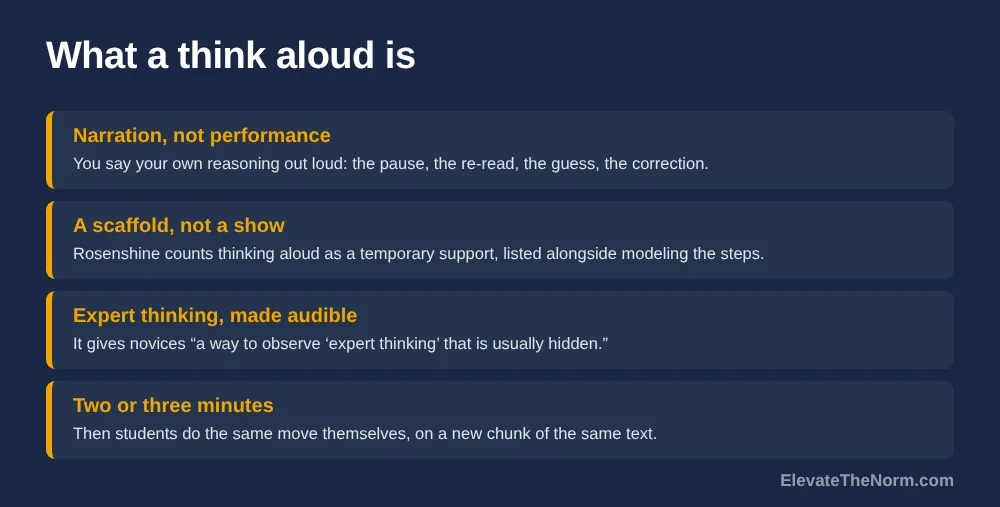
- A think aloud is narration of your own thinking, not reading aloud well. Barak Rosenshine put the purpose plainly: thinking aloud gives novices “a way to observe ‘expert thinking’ that is usually hidden”. If a student could have got the same thing from a recording of the text, it was not a think aloud.
- There is no effect size for a think aloud, and anyone quoting one is quoting something else. The numbers belong to comprehension-strategy instruction as a package. The What Works Clearinghouse rates that package strong for adolescent readers; the think aloud is the delivery mechanism inside it.
- The one head-to-head test came back empty. When researchers pitted a narrated model against a silent written worked example with 13- and 14-year-olds, the format made no difference to learning — and the authors flag near-ceiling scores that weaken even that.
- The teachers best equipped to do it find it hardest, and the federal panel says so itself. Its roadblocks section warns that teachers “will need to become conscious of many of the reading processes that are automatic for them.” Expertise is what makes the moves worth hearing and what makes them hard to narrate.
- Name the population before borrowing the result. The federal guides behind this evidence counted fourth and fifth graders as adolescents and, in the 2022 update, rested a strong rating on 34 studies of students with reading difficulties. That is not a general grades 6–12 claim.
What is a think aloud?
A think aloud is a teacher speaking their own reasoning out loud while working through a text or a problem in front of students. The point is not the content. The point is the decision-making — the pause, the re-read, the guess, the correction.
Reading Rockets describes the strategy as “eavesdropping on someone’s thinking” and traces it to Beth Davey’s 1983 article in Journal of Reading. That paper is paywalled and was not read for this article, so it is credited as the origin point and nothing more.
Rosenshine’s framing is the useful one. In Principles of Instruction, he lists thinking aloud twice: once under “provide models,” where he writes that “students need cognitive support to help them learn to solve problems”, and once under scaffolding, where he counts “thinking aloud by the teacher as he or she solves the problem” as a temporary support. A support, not a performance.
The thing most often called a think aloud is usually one of three near neighbours. The difference is what the student actually hears.
| Move | What the student hears | What it teaches | Evidence it rests on |
|---|---|---|---|
| Think aloud | Your reasoning, including the uncertainty and the correction | The decision an expert makes and why | Named by the IES panel as how to deliver strategy instruction rated strong |
| Reading aloud | The text, well performed | Fluency and phrasing, at best | Shanahan calls it “poor modeling” if the goal was comprehension |
| Worked example | Nothing — it is written | The steps that survived | No worse than narration in the one head-to-head test |
| Explaining a strategy | A description of what good readers do | The label for the move | The IES guide treats defining a strategy as the step before modeling it |
Is the think aloud strategy research based?
The instruction it delivers is strongly evidenced. In the IES practice guide Improving Adolescent Literacy, the panel states that for direct and explicit comprehension-strategy instruction, “the level of evidence supporting this recommendation to be strong.”
That guide rates five recommendations. Explicit vocabulary instruction: strong. Explicit comprehension-strategy instruction: strong. Extended discussion of text meaning: moderate. Motivation and engagement: moderate. Intensive individualized intervention from trained specialists: strong.
And the guide names the method. Teachers are told to “model how to use the strategies by thinking aloud with a text,” with explaining and modeling described as beginning with “defining each of the strategies for students.” The think aloud is not a nice extra inside that recommendation. It is how the recommendation gets carried out.
The 2022 update, Providing Reading Interventions for Students in Grades 4–9, is more specific about what the rating rests on: “The WWC and the expert panel assigned a strong level of evidence to this recommendation based on 34 studies of interventions for improving reading comprehension in students with reading difficulties.” Twenty-three met WWC standards without reservations and eleven met them with reservations.
What there is not, anywhere, is an effect size for a think aloud. Every available number measures a larger package that contains the narration — strategy instruction, or a comprehension intervention. Isolating narration from the strategy it teaches has not been done at scale.
The best quantified figure sits with the Education Endowment Foundation, which puts reading comprehension strategies at “+7 months” additional progress across 184 studies, summarised as “high impact for very low cost based on moderate evidence.” The EEF also says the approach “is effective across both primary and secondary schools,” which is the line that makes any of this relevant to a grades 6–12 room.
Read the caveats the EEF publishes alongside it, because they are the reason to trust the rest. “The topic lost a padlock because a large percentage of the studies were not independently evaluated.” “Another padlock was lost because there is a large amount of unexplained variation between the results.” And the sentence every teacher should staple to every toolkit figure: “All reviews contain some variation in results, which is why it is important to look behind the average.”
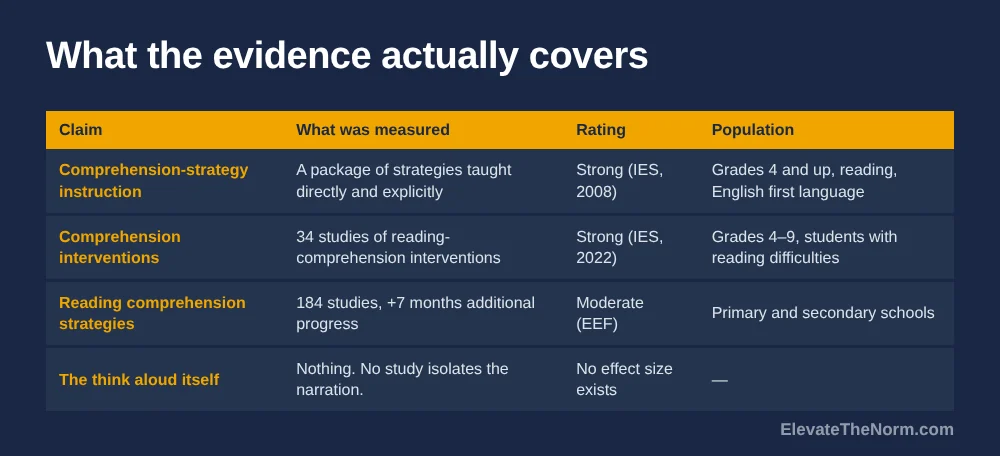
Note what that +7 months is attached to. The EEF page does not use the phrase “think-aloud” either. It says modelling, and “teachers often use metacognitive talk to model strategies.” So the honest sentence is this: comprehension-strategy instruction has a strong, quantified evidence base, and thinking aloud is how it is delivered. There is no think-aloud effect size, and a page that gives you one has made it up or mislabelled something else.
Does narrating out loud beat a silent worked example?
On the one direct test available, no. Vincent Hoogerheide, Sofie Loyens and Tamara van Gog compared a narrated model against a written worked example with Dutch secondary students and found no difference in learning. Nobody has shown narration wins, and nobody has shown it loses.
The design: three conditions on a probability task — a written worked example with pictures of each problem state, a modeling example with a visible person narrating and demonstrating, and the same narration with pictures instead of a visible model. In the first experiment, 78 students averaging 14.3 years old in the highest Dutch secondary track, cut to 62 after removing students who already knew the content. On total test score there was no main effect of condition, F < 1, and no interaction with test moment, p = .268. Mental effort did not differ. A second experiment with 134 students replicated it.
The authors’ own caution belongs in the same breath: performance was near ceiling on the posttests, so the comparison is weaker than a clean null. Their published summary says only that “the format of examples does not affect learning outcomes for this task.” One task, one country, one academic track.
So the case for thinking aloud is not that talking is magic. Rosenshine lists worked examples as a separate, equally legitimate form of modeling. The case is narrower and sturdier than the usual pitch: somebody has to make the invisible move visible, and in most classrooms nobody else can.
Why is thinking aloud harder for experienced teachers?
Because the moves worth narrating have gone automatic. The IES panel puts this in its own roadblocks section: teachers “may find it particularly challenging to model their own thinking,” and “will need to become conscious of many of the reading processes that are automatic for them.”
There is a research name for the wider problem. Mitchell Nathan, Kenneth Koedinger and Martha Alibali call it the expert blind spot: because of advanced content knowledge, teachers make assumptions about student learning that “turn out to be in conflict with students’ actual performance.”
Their numbers are uncomfortable. Asked to rank algebra problems by difficulty, the 39 high school teachers in their sample ranked story problems hardest. Students did the opposite: two samples of ninth graders who had finished a year of algebra solved equations correctly less than 30 percent of the time and verbal problems more than 50 percent, a gap significant at p < .01. The high school teachers’ rankings bore no relationship at all to student performance — a rank correlation of zero. The 30 middle school teachers in the same study were accurate.
Be precise about what that shows. It is mathematics problem-difficulty judgment, not reading, and it is not a study of think alouds. What it establishes is that subject expertise does not automatically produce an accurate model of student thinking — which is exactly the thing a think aloud is supposed to supply. The guide’s own fixes are unglamorous: coaching, professional development, and practising the think aloud on your own text before you teach it.
What do you actually say during a think aloud?
You say the part you would normally only think: naming confusion out loud, stating a guess before you know it is right, correcting yourself in front of the class. Five steps cover the routine, and the preparation matters more than the delivery.
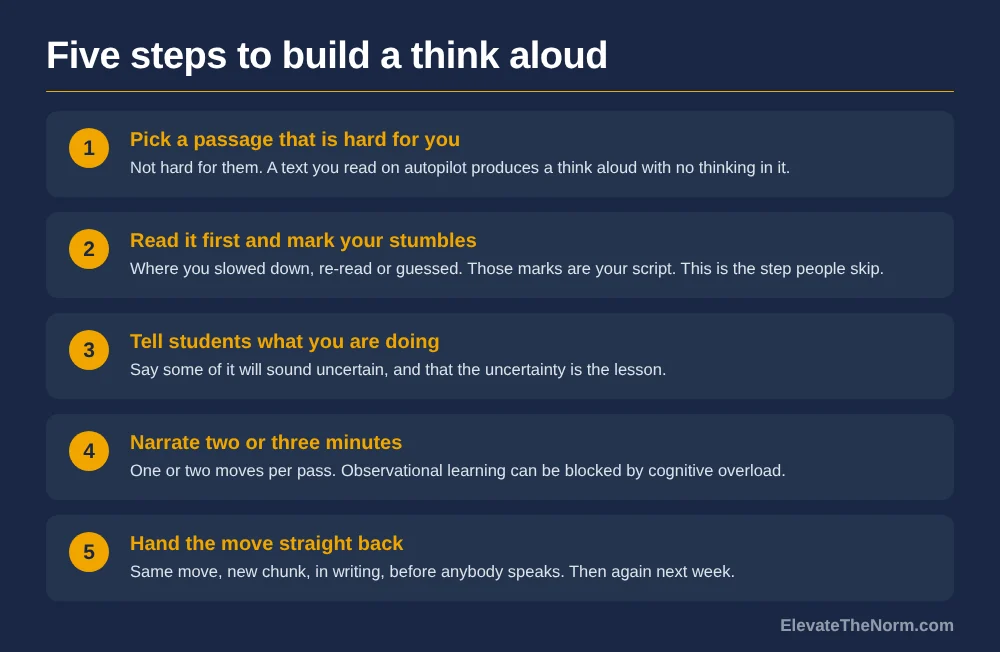
- Pick a passage or problem that is genuinely hard for you. Not hard for them — hard for you. A text you can read on autopilot will produce a think aloud with no thinking in it, which is the roadblock the federal panel names.
- Read it in advance and mark your own stumbles. Where did you slow down, re-read, look something up, or guess? Those marks are your script. This is the step most people skip, and skipping it is why most classroom modeling is a recap rather than a demonstration.
- Tell students what you are about to do and why. Say that you are going to talk through your own reading, that some of it will sound uncertain, and that the uncertainty is the lesson. Teenagers read an adult thinking out loud as either honesty or incompetence, and which one depends on whether you framed it.
- Narrate two or three minutes, not ten. Keep it to one or two moves per pass. Observational learning, as Timothy Shanahan puts it, “can be blocked by cognitive overload”; a long narration is a lecture about reading.
- Hand the same move to them immediately, on a new chunk of the same text. One move, one chunk, in writing, before anybody speaks. Then do it again next week on different material, because, as Shanahan notes, “even when teachers do model for their students, it is often a one-time affair.”
One refinement worth testing: Shanahan reports research suggesting that contrasting an expert model with a flawed one beats expert models alone, citing Rohbanfard and Proteau (2011). That study was not read for this article, so treat it as his reading rather than a settled finding. In practice it means thinking aloud badly on purpose, then well, and asking students what changed.
Does the think aloud work outside English class?
Yes, and the strongest secondary content-area evidence is in history. Rosenshine states that modeling and worked examples “have been used successfully in mathematics, science, writing, and reading comprehension,” and he describes teachers asking students to think aloud during mathematical problem solving as a way of checking understanding.
The cleanest study is Susan De La Paz and colleagues’ 18-day historical reading and writing curriculum, built on cognitive apprenticeship — the modeling, coaching and fading sequence Rosenshine names in his scaffolding principle. Taught across a school year with culturally and academically diverse adolescents, it produced positive and significant results on every writing outcome. For students described as basic readers, the effect sizes against control were 0.45 for historical writing, 0.32 for overall writing quality and 0.60 for essay length. The record states no sample size, so none is claimed here.
What that study does not do is isolate the think aloud. It tests a whole curriculum in which modeling is one component, which is the same limitation as every number on this page. Treat it as evidence that teaching disciplinary thinking explicitly pays in a content classroom, not as a measured return on narration.
If you teach a content subject, the moves worth narrating are yours, not an English teacher’s. How you decide whether a source is trustworthy. How you read a graph before its caption. How you notice that an equation and a word problem are the same question. Those are not generic reading strategies, and nobody else is going to model them.
Can students do think alouds themselves?
They can, in pairs, with training and a familiar task — and the evidence is thin and mostly not about teenagers. The one controlled study found real gains that did not survive the removal of prompting.
Michael Pate, George Wardlow and Donald Johnson randomly assigned 30 undergraduates in a power technology course to think-aloud pair problem solving or to a control, then had them diagnose faults in small engines. On the electrical task, 16 of 18 in the experimental group succeeded against 5 of 12 controls, χ²(1) = 5.56, p ≤ .02. On the fuel and intake task, 10 of 12 against 8 of 18, χ²(1) = 4.54, p ≤ .03. Completion times did not differ.
Two limits, and the second matters most. These were 30 undergraduates in one hands-on course at one institution, published in a student research journal. And the authors noted the skills did not appear to transfer once the external prompting was taken away. A structure that only works while you are running it is a scaffold, not a skill.
If you do try it, the structure matters more than the prompt. Everyone writes their reasoning before anyone speaks, students narrate in pairs rather than to the room, and the student who reads worst does not go first. Saying “I don’t understand this” out loud in front of people you sit with all year costs something real, and a teenager who declines is making a rational trade, not refusing to work.
Jennifer Branch’s work with junior high and grade 9 students is the useful warning. She found think alouds “work well with students who are already familiar with the task being assigned”, that some students were “not experienced in problem-solving aloud” and found the method “strange and awkward,” and that in one case the adult present became “a mental crutch.” She was using think alouds as a research method rather than as instruction, but the lesson transfers: do not ask a class to think aloud cold. If you want students reasoning out loud inside a structure that has been studied as instruction, reciprocal teaching is the better-evidenced route, and it gives every student a named job instead of a turn.
How do you know whether the think aloud worked?
By what students produce on the next chunk of text, not by how the narration felt. The check is whether the specific move you narrated shows up in their work within the same period.
Make it small and written. If you modeled using surrounding sentences to work out an unfamiliar word, give them one unfamiliar word in the next paragraph and ask for the clue they used, not just the meaning. If you modeled deciding whether a source is reliable, give them one source and ask for the sentence that made them trust it or not. You are marking the move, not the answer.
Rosenshine points at the symmetric check: “Teachers also can study their students’ thought processes by asking them to think aloud during problem solving.” Have one student narrate while you listen. Two minutes of that tells you more than an exit ticket, and it usually tells you the step you considered obvious is the one that never landed — the expert blind spot, arriving in person.
Do not grade the narration itself. A student assessed on how articulate their thinking sounds will perform confidence instead of reporting confusion, and the confusion is the whole content of a think aloud. Grade what they do with the move afterwards.
Where does the evidence run out?
Sooner than the strategy’s popularity suggests. The evidence base behind thinking aloud is overwhelmingly about reading comprehension, drawn largely from upper-elementary and middle grades, and in its strongest modern form from students with reading difficulties rather than a general population.
The 2008 federal guide says so in its own front matter: “The panel purposefully included students in 4th and 5th grades within the realm of adolescents.” Its search “focused only on studies of reading programs conducted within a school or clinical setting,” and covered students “whose first language was English.” The 2022 guide covers grades 4–9, and its strong rating rests on interventions for struggling readers.
And the practice is close to absent from real lessons. Timothy Shanahan, a reading researcher, judges modeling “used so rarely and so poorly” in classrooms — practitioner commentary rather than a trial, but it has company in the research. Avishag Reisman’s study of document-based history instruction across five San Francisco high schools reports that “only nine whole-class text-based discussions were identified in over 100 videotaped classroom lessons.” That is about discussion rather than modeling, and her intervention was not a think-aloud trial. But the shape of the finding is the point: the talk we recommend most confidently is the talk that happens least.
What does not exist: a think-aloud effect size, a grades 9–12 trial of teacher narration, and any evidence that narrating beats demonstrating silently. If a professional development slide gives you one of those, ask where it came from.
Clay’s take: it is the cheapest thing on the list and the most avoided
A think aloud costs nothing, needs no materials, and fits in three minutes. It is also the one instructional move that requires you to be visibly uncertain in front of thirty teenagers, which is why it does not happen.
The honest argument for it is not the evidence base, because the evidence base belongs to the package it sits inside. The argument is structural. Every subject has moves experts make without noticing, students are graded on those moves, and nobody has ever said one of them out loud. A worked example on the board shows the steps that survived. It does not show the three you abandoned, and the abandoning is the skill.
What I would push back on is how this gets taught to teachers. “Model your thinking” shows up on observation rubrics as though it were a thing you either do or do not do. The federal panel’s own roadblocks section is more honest than most training: it says you will have to make your automatic processes conscious first, and it recommends coaching to get there. A teacher who tries it cold and produces a lifeless recap has not failed at teaching — they have run into the thing the research predicted. I would rather see one prepared three-minute think aloud a week, on a text the teacher genuinely found hard, than a rubric line satisfied by reading aloud with feeling.
What to do next week
Pick one text you teach that you have never found easy. Read it with a pen and mark every place you hesitated. Those marks are a script you did not have to write.
Then do three minutes of it out loud, once, naming one move. Hand that move straight back to students on the next paragraph and make them write the clue they used. If what comes back is blank, the step you thought was obvious is the one to narrate next time — and you have just found your own blind spot for the price of one paragraph.
If you want the surrounding structure, scaffolding strategies covers building a support and taking it away again, annotation strategies covers what students do in the margin once they know the move, productive struggle covers how long to wait before you narrate anything at all, and dual coding covers what to put on the screen while you talk.
Frequently Asked Questions
What is a think aloud in teaching?
A think aloud is a teacher narrating their own reasoning out loud while reading a text or solving a problem, so students can hear the decisions an expert normally makes in silence. The content is not the point; the pause, the re-read, the guess and the correction are. If a recording of the text would have given students the same thing, it was not a think aloud.
What is the difference between a think aloud and reading aloud to the class?
Reading aloud performs the text. A think aloud narrates the thinking around the text. Timothy Shanahan is blunt about the confusion: reading a passage aloud without narrating any thought is, in his words, “poor modeling” if the goal was comprehension. The test is simple. Did students hear a decision being made, or only hear the words?
How long should a think aloud be?
Two or three minutes, then student work. The limit is working memory, not attention span: a student listening to extended narration has nothing left over to notice the move being made. Shanahan’s advice is to keep demonstrations “brief and to the point” so they do not overwhelm the rest of the lesson. Narrate one or two moves per pass, not everything you notice.
Is the think aloud strategy research based?
The instruction it delivers is. The IES practice guide on adolescent literacy rates direct and explicit comprehension-strategy instruction as strong evidence, and tells teachers to model the strategies by thinking aloud with a text. The 2022 update assigned a strong rating based on 34 studies of comprehension interventions for students with reading difficulties. There is no separate effect size for the narration itself.
Does a think aloud work in math, science or history?
Yes, and the moves worth narrating are subject-specific. Rosenshine reports that modeling and worked examples “have been used successfully in mathematics, science, writing, and reading comprehension,” and the strongest secondary content-area study is a history writing curriculum built on cognitive apprenticeship, which produced significant gains on every writing outcome. How you judge a source or read a graph is nobody else’s job to model.
How do I model my thinking when the task feels automatic to me?
Pick material that is genuinely hard for you, then read it in advance with a pen and mark every place you hesitated. Those marks are your script. The federal guide names this exact problem in its roadblocks section: teachers “will need to become conscious of many of the reading processes that are automatic for them,” and it recommends coaching rather than willpower.
My child says the teacher just talks through the reading. Is that teaching?
If the teacher is narrating how they decide what a passage means, yes, and it is one of the better-evidenced things a teacher can do. Reading tests ask students to make those decisions, and most students have never seen an adult make one out loud. The check is what happens next: a good think aloud is short and is followed by students doing the same move themselves.
Can students do think alouds themselves?
They can, in pairs, with training and a familiar task. The one controlled study found real gains for think-aloud pair problem solving, but with 30 undergraduates, and the authors noted the skills did not transfer once prompting stopped. With teenagers, have everyone write their reasoning before anyone speaks, keep it to pairs, and never start with the student who reads worst.
Sources
- Kamil, M. L., Borman, G. D., Dole, J., Kral, C. C., Salinger, T., & Torgesen, J. Improving Adolescent Literacy: Effective Classroom and Intervention Practices (NCEE 2008-4027). Institute of Education Sciences, National Center for Education Evaluation, What Works Clearinghouse practice guide, August 2008. Full text. Source of the strong level of evidence for direct and explicit comprehension-strategy instruction, the five recommendation ratings, the instruction to model strategies by thinking aloud with a text, the roadblock about processes that are automatic for teachers, and the population limits quoted here.
- Vaughn, S., Kieffer, M. J., McKeown, M., Reed, D. K., Sanchez, M., St. Martin, K., & Wexler, J. Providing Reading Interventions for Students in Grades 4–9 (WWC 2022007). Institute of Education Sciences, National Center for Education Evaluation, March 2022. Full text. Source of the strong evidence rating based on 34 studies of students with reading difficulties, the 23-and-11 standards split, and the scripted teacher modeling example quoted here. Only the first third of the guide was read for this article.
- Rosenshine, B. “Principles of Instruction: Research-Based Strategies That All Teachers Should Know.” American Educator, Spring 2012, p. 12. American Federation of Teachers. Full issue. Source of the expert-thinking-that-is-usually-hidden line, thinking aloud as a cognitive support and as a scaffold, worked examples as a separate form of modeling, the list of subjects in which modeling has been used successfully, and asking students to think aloud as a check for understanding. Rosenshine reports no effect size for modeling.
- Education Endowment Foundation. Reading comprehension strategies, Teaching and Learning Toolkit, last updated October 2025. Toolkit entry. Source of the +7 months figure, the high-impact-for-very-low-cost-based-on-moderate-evidence summary, the 184 studies, the statement that the approach is effective across primary and secondary schools, the two reasons padlocks were lost, and the guidance on programme duration.
- Hoogerheide, V. Effects of Observing and Creating Video Modeling Examples on Cognitive and Motivational Aspects of Learning. Doctoral dissertation, Erasmus Universiteit Rotterdam, 2016; chapter 2 published as Hoogerheide, Loyens & van Gog, Computers in Human Behavior, 41, 80–91 (2014). Full text. Source of the three example formats, the Dutch secondary samples and ages, the null effect of condition, the non-significant interaction, the replication in experiment 2, and the authors’ near-ceiling caution.
- Nathan, M. J., Koedinger, K. R., & Alibali, M. W. “Expert Blind Spot: When Content Knowledge Eclipses Pedagogical Content Knowledge.” Proceedings of the Third International Conference on Cognitive Science, USTC Press, 2001. Full text. Source of the expert blind spot description, the ninth-grade equation-versus-verbal-problem performance gap, and the finding that the 39 high school teachers’ difficulty rankings were unrelated to student performance while the 30 middle school teachers’ were accurate. This is mathematics problem-difficulty judgment, not reading, and not a study of think alouds.
- Shanahan, T. “Does ‘Modeling’ Have a Place in High Quality Literacy Teaching?” Shanahan on Literacy, 4 January 2020. Post and comments. Source of the used-so-rarely-and-so-poorly judgment, the cognitive-overload caution, the one-time-affair observation, the poor-modeling line about reading aloud for fluency, the preference for demonstration over model, and his report of Rohbanfard and Proteau on flawed versus expert models. This is practitioner commentary by a reading researcher, not a trial, and the studies he cites were not read for this article.
- De La Paz, S., Monte-Sano, C., Felton, M., Croninger, R., Jackson, C., & Worland Piantedosi, K. “A Historical Writing Apprenticeship for Adolescents: Integrating Disciplinary Learning With Cognitive Strategies.” Reading Research Quarterly, 52(1), 31–52 (2017). Repository record with abstract. Source of the 18-day cognitive-apprenticeship history curriculum, the positive and significant results on all writing outcomes, and the basic-reader effect sizes of 0.45, 0.32 and 0.60. The record states no sample size, so none is given here; the full text would not render and only the record was read.
- Pate, M. L., Wardlow, G. W., & Johnson, D. M. “Effects of thinking-aloud pair problem solving on the troubleshooting performance of undergraduate students in a power technology course.” Discovery (Dale Bumpers College, University of Arkansas), Vol. 5, Art. 14, 59–64, Fall 2004. Full text. Source of the 30-undergraduate random assignment, both success-rate comparisons with their chi-square statistics, the non-significant completion times, and the authors’ observation that the skills did not appear to transfer without prompting.
- Branch, J. L. “Using Think Alouds, Think Afters, and Think Togethers to Research Adolescents’ Inquiry Experiences.” Alberta Journal of Educational Research, 52(3), 148–159, Fall 2006. Full text. Source of the finding that think alouds work well with familiar tasks, the difficulty of balancing familiarity and automaticity with junior-high-aged adolescents, students finding the method strange and awkward, and the mental-crutch observation. Branch studies think alouds as a research method rather than as instruction.
- Reisman, A. Reading Like a Historian: A Document-Based History Curriculum Intervention in Urban High Schools. Doctoral dissertation, Stanford University School of Education, 2011. Record with abstract. Source of the nine whole-class text-based discussions in over 100 videotaped lessons, and of the significant main effects on all four outcomes across five San Francisco high schools. The record reports no effect sizes and does not mention teacher modeling; only the record and abstract were read.
- Reading Rockets (WETA). Think-Alouds, classroom strategy page, and Meier, J., “How much is too much strategy instruction?”, Sound It Out blog, 3 May 2012. Strategy page. Source of the eavesdropping description, the Davey (1983) citation, the Willingham collateral-damage objection as relayed by Reading Rockets, and the statement that strategies are learned quickly and can provide a short-term boost. The eavesdropping phrase is unattributed on that page; Davey (1983) is paywalled and was not read.

