By Clay Shumate
Reciprocal teaching is a structured dialogue in which students take turns leading a small group through predicting, questioning, clarifying and summarizing a text. It works, but the size of the effect depends on who wrote the test — reviews report about .87 on researcher-made comprehension tests and .32 on standardized reading tests.
Key Takeaways
- The measure decides the number. Rosenshine and Meister’s review of 19 studies found es = .87 on experimenter-developed tests and es = .32 on standardized tests. A meta-analysis 25 years later found the same split: d = .431 against d = .186.
- The original evidence is two small studies. Palincsar and Brown (1984) taught reciprocal teaching to six students in the first study and 21 in the second, all of them weak comprehenders in grade 7 or 8.
- Whole-class delivery is where the effect goes missing. A year-long randomized trial with 369 students in grade 7 found no significant difference between the treatment and control classes.
- The federal verdict is “mixed effects,” not “proven.” The What Works Clearinghouse reviewed six qualifying studies, found one with a statistically significant positive effect, and put the comprehension domain average at 0.16.
- What predicted results was the quality of the instruction, not the structure. In the whole-class trial, strategy-instruction quality explained an additional 37 percent of the variation between classes.
What is reciprocal teaching?
Reciprocal teaching is a reading routine where a small group works through a text together using four strategies — predicting, questioning, clarifying and summarizing — and students take turns running the discussion instead of the teacher running all of it.
It was developed by Annemarie Palincsar and Ann Brown in the early 1980s for students who could decode fine and still understood almost nothing they read. The teacher models each strategy, then hands the role over a bit at a time, until a student is leading the segment and the teacher is coaching from inside the group rather than from the front.
The dialogue is not decoration. Palincsar’s own later article for teachers says only the version that incorporated dialogic instruction was effective, and that the strategies must not be taught “as an end in themselves.” A worksheet with four boxes on it is not reciprocal teaching.
It belongs to the same family as structured group work with assigned responsibilities, and its closest relative on this site is the jigsaw, where each student owns a different piece of the material. The difference is that in reciprocal teaching every student does every job, in turn, on the same text. Before students can run the clarifying step themselves, they usually need to hear it done out loud first, which is what a teacher think-aloud is for.
What are the four reciprocal teaching strategies?
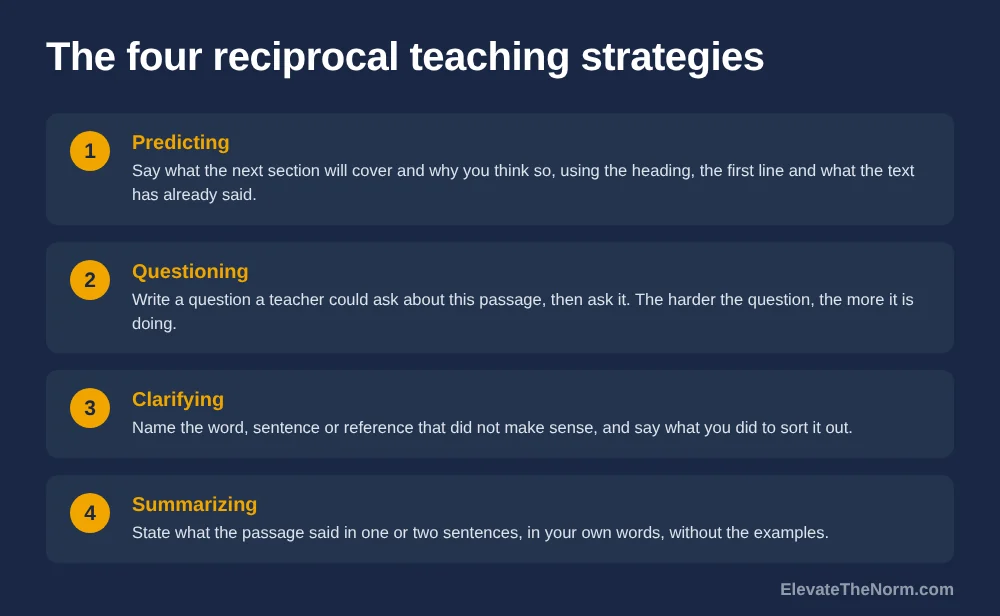
Predicting, questioning, clarifying and summarizing. In the original study they are described as summarizing, questioning, clarifying and predicting, and the order matters less than the fact that all four run on the same passage, out loud, with students taking the lead.
- Predicting. Say what the next section will cover and why — from the heading, the first sentence, and what the text has already established.
- Questioning. Write a question a teacher could ask about this passage and ask it. This is the role that does the most work and the one most likely to collapse into asking for a date or a name.
- Clarifying. Name the word, sentence or reference that did not make sense, and say what you did about it.
- Summarizing. State what the passage said in a sentence or two, in your own words, with the examples left out.
Whether all four are strictly necessary is not settled. Palincsar reports that teaching only questioning or only summarizing was less effective than the full version, which is not the same as proving each one is load-bearing. Of the four, summarizing is the one with its own separate literature, and why that literature scores it at both .82 and .44 is worth knowing before you weight it. A dissertation that ran a two-strategy version alongside the full one found all of its groups improved.
Is reciprocal teaching evidence based?
Yes, with a caveat that changes what you should expect from it. Four decades of studies find gains on comprehension, and the gains shrink as the studies get larger, more controlled and less researcher-led.
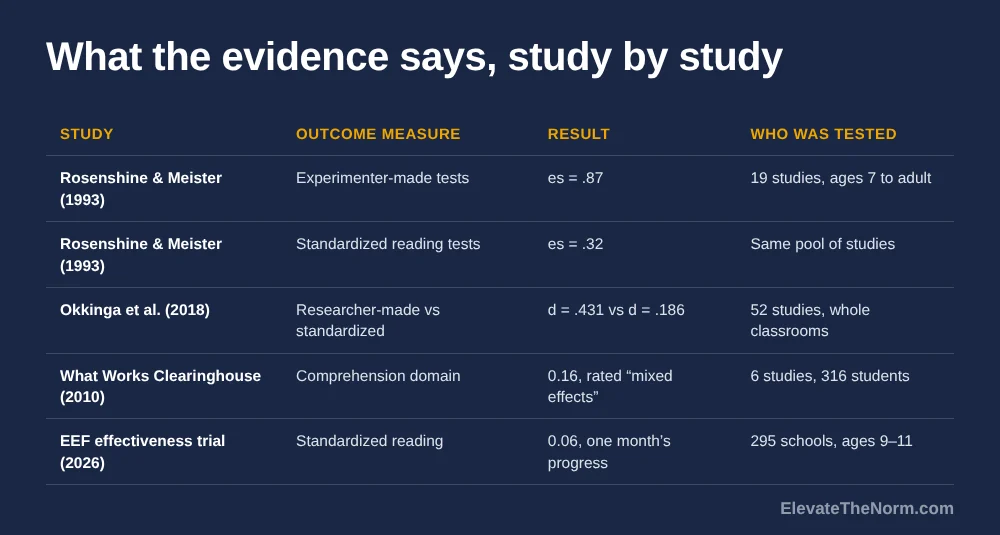
The anchor review is Rosenshine and Meister (1993), covering 19 experimental studies from ages 7 to adult. On experimenter-developed comprehension tests, es = .87. On standardized reading tests, es = .32. The published 1994 version of that review, which I could not open directly, is quoted in a later critical review as reporting median effect sizes of .88 and .32 for the same split.
The federal picture is cooler. The What Works Clearinghouse intervention report found six studies that met its standards, one with a statistically significant positive effect, a comprehension domain average of 0.16, and one study that came out negative at −0.48. Its rating is “mixed effects.” And the largest trial ever run on it, the Education Endowment Foundation’s 295-school effectiveness trial published in 2026, found an effect size of 0.06 and one additional month’s progress, which did not reach significance.
Why do the effect sizes disagree so much?
Because the outcome measure is doing most of the work. Studies that test comprehension with an instrument the researchers built report effects two to three times larger than studies using a standardized reading test, and this pattern has held for thirty years.
Rosenshine and Meister found .87 against .32 in 1993. Okkinga and colleagues (2018), pooling 52 studies of whole-class reading-strategy instruction, found d = .431 on researcher-developed tests against d = .186 on standardized ones. The 2026 trial above reported gains on sentence-level accuracy and comprehension but not on passage comprehension, which was the programme’s own main target.
There is a charitable reading and an unkind one, and both are probably true. The charitable one is that a standardized reading test is a blunt instrument that will not detect twelve weeks of anything. The unkind one, which Park’s review makes, is that researcher-made tests are easier and tend to be used with the stronger decoders. For a teacher the practical consequence is the same: expect students to get better at talking about a text well before you see it in a reading score.
What did the original studies actually find?
Large gains, on very few students, taught by the researcher. It is worth knowing the size of the base the whole field rests on before quoting it in a meeting.
In the first study, 37 students in grade 7 were screened as adequate decoders whose comprehension sat about two years below grade level. Six of them received reciprocal teaching, working in pairs with the first author herself. Four of the six reached a stable 80 percent correct, classroom comprehension scores moved from roughly 20 percent to 60 percent, and the average gain on a standardized measure across all six was 15 months.
The second study handed the routine to volunteer classroom and resource teachers after three training sessions. Twenty-one students in grades 6 to 8 went from about 40 percent to about 80 percent correct, most reaching criterion within 15 days. The eight-week follow-up showed a five-point decline. Twenty-seven students in total, all white, rural central Illinois, and no effect size reported anywhere in the paper.
Does reciprocal teaching work with a whole class?
The best evidence says not on its own. The structure was built for small groups with an adult inside each one, and the attempts to scale it to whole classes have produced much smaller effects or none at all.
The strongest test is Okkinga’s randomized trial: 369 students in grade 7 in lower-track classes, 10 treatment classes against 10 control classes, weekly lessons across a school year, teachers given three hours of training plus six coaching visits. No significant difference on the comprehension post-test, and a two-year follow-up found no differential growth either. Her meta-analysis found effects larger when the trainer was a researcher rather than a teacher.
One honest complication: Rosenshine and Meister found the opposite pattern on group size. They report significant results with groups of 18 and 19, and note that if there is any pattern it is for non-significant results to come from smaller groups. They also detected no difference between teacher-led and experimenter-led lessons. The later, larger evidence points the other way, but the literature does genuinely disagree here and anyone telling you it is settled has read one half of it.
Cost is worth naming while you are deciding. The packaged programme in the 2026 trial ran about £2,759 per school across three years, roughly £77 per pupil per year. The structure itself is free. If a department is going to be told to run this, the training is the budget line, not the role cards — every study where it failed had thin training behind it.
What did predict outcomes in the whole-class trial was the quality of the strategy instruction, which explained an additional 37 percent of the variation between classes. That is the finding a secondary teacher should take away. The structure is a container. What goes into it is the intervention.
What about the 0.74 effect size everyone quotes?
Leave it alone. Reciprocal teaching appears in the Visible Learning ranking at d = 0.74, 27th of 252 influences, and the published ranking does not disclose how many meta-analyses, studies or effects that figure aggregates.
That is not a claim that the number is wrong. It is a claim that you cannot check it, which matters when the same table is quoted in staff meetings as though it were a measurement. The method behind those rankings has a published statistical critique in the McGill Journal of Education, which argues the averages pool incompatible dimensions — a critique of the aggregation method generally, not of this row specifically.
Rosenshine and Meister’s two numbers are more useful anyway, precisely because they are separated by the thing that turned out to matter.
How do you run reciprocal teaching in a secondary class period?
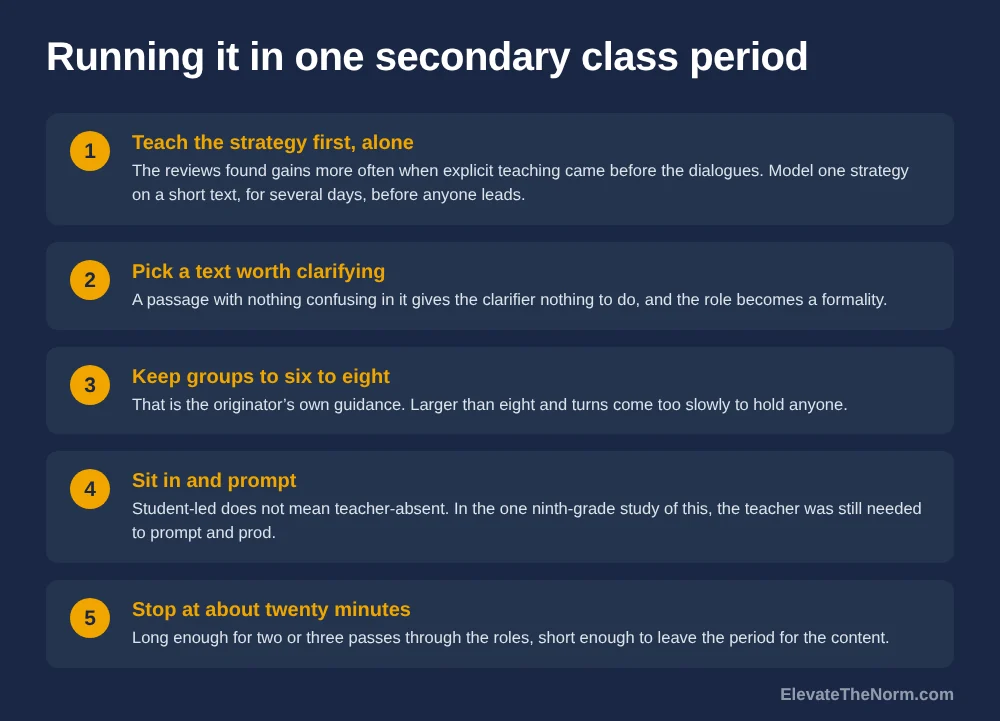
Teach the strategies first, then hand over the roles, and keep the groups small enough that turns come round quickly. The reviews found gains more often where explicit teaching came before the dialogues.
- Model one strategy at a time, for days, not minutes. Rosenshine and Meister found that when the dialogues ran without explicit teaching first, only three of nine studies got significant results.
- Write the four jobs on four cards and stop there. The four descriptions in the graphic above are the whole of what belongs on a role card. Nothing here requires a purchased kit, and this site does not put anything behind an email address.
- Pick a passage that is actually hard. A text with nothing confusing in it gives the clarifier nothing to do, and the role turns into a formality that students see through immediately.
- Keep groups to six to eight. That is Palincsar’s own guidance — bigger than eight and turns come too slowly to hold anyone’s attention.
- Sit inside a group and prompt. Student-led does not mean teacher-absent. In the one grade 9 content-area study of this, the teacher was still needed to prompt and prod, and student-led sessions had mixed results depending on who was in the group.
- Stop at about twenty minutes. Long enough for two or three passes through the roles, short enough to leave the rest of the period for the content. That is roughly the session length the original studies used.
One thing the sequence above hides: going first is expensive. The students this was built for are weak comprehenders, and you are asking one of them to summarize a hard passage out loud in front of peers. Let everyone write their question or summary before anybody says one, and do not open with the student who reads worst. The writing makes the turn survivable.
Expect to cover less material at first. Palincsar says plainly that the primary objective is teaching reading processes and that content coverage grows back as students get better at it. If your department head needs to know why week two is slower than usual, that is the answer and it is in print.


What goes wrong with reciprocal teaching?
The roles become a ritual. Students learn the shape of each turn and perform it without doing the thinking underneath, and from the front of the room a class doing this looks exactly like a class doing it properly.
The evidence for that is not anecdotal. A dissertation studying grade 9 readers in a social studies setting recorded clarification turns that went “Does anyone need anything clarified? No. OK”, questions that asked only for a date, a place or a person, and predictions that restated the subheading back to the group. Some roles were more sought after than others, and the teacher was still needed to prompt and prod.
It is worth being fair about why that happens. From a desk, “no, nothing to clarify” is the rational answer, because saying you did not understand the paragraph is an admission in front of people you sit with all year. The role does not fix that by existing. A text with something genuinely confusing in it does, because then not understanding is the text’s fault rather than yours.
The second failure is logistics, not pedagogy. In the 2026 trial, the obstacles teachers named were timetabling (65 percent), not enough staff (32 percent) and nowhere to put the groups (29 percent). The third is that the training is usually thinner than the studies’ own training, which was itself thin: three sessions in the original, three hours plus six coaching visits in the trial that found nothing.
And the one the federal practice guide warns about directly: strategies can crowd out the reading. Its panel writes that “the goal should always be comprehending texts—not using strategies” and that too much focus on the process “can take away from students’ understanding of the text itself.” That is the same trap as turning marking up a page into a compliance exercise, and it is the reason this site is sceptical of techniques that feel like studying without being studying.
Does it work in content-area classes like history and science?
The evidence there is thin and what exists is not encouraging about fidelity. Most reciprocal teaching research happens in reading classes or pull-out groups, not in a content-area room with a curriculum to cover.
The clearest look at what happens in a subject classroom comes from a study of nine experienced history teachers in four Dutch secondary schools, working with classes in grade 7. After training, the researchers found teachers “often did not fully or correctly implement” the practices, that reading texts “occurred sparingly during regular lessons,” and that the instruction that did happen focused on how to study rather than how to read. One teacher wrote “I have no time to do this” in the manual. Another said “I really prefer telling stories.” The authors concluded that positive teacher attitudes were not enough.
For English learners the picture is similarly unfinished. A systematic review of 18 studies covering 1,674 ESL and EFL students found six studies at secondary level and no pooled effect size at all, with several studies showing gains only in attitude. The best secondary-specific randomized trial, 315 students in Year 7 across 14 schools, found a significant gain on sentence completion (+0.25) but not on passage comprehension (+0.13), with the overall reading measure at p = 0.06.
Clay’s take: it is a discussion structure, and that is enough
I would use this and I would stop calling it a reading intervention.
What reciprocal teaching reliably produces is students talking about a text in a way that makes their thinking visible, which is worth a great deal in a room where the alternative is nodding. What it does not reliably produce is movement on a reading score, and the honest version of the pitch says so. The four roles give a quiet student a job and a reason to speak, and they give me something to listen to besides whether the homework got done.
The part I would not skip is the modeling. Every study where this failed had thin training behind it, and the one thing the whole literature agrees on is that the dialogue has to be taught before it is handed over. Give it a week of your own modeling before you give a student a role card, or you will get four students performing four rituals on a text nobody read.
What to do next week
Pick one passage you already assign that students routinely misread, and teach the questioning role on it — just that one, with you doing it out loud.
Ask students to write a question a teacher could ask, then compare the questions as a class and sort them into the ones that need the text and the ones that need only a memory. That single sort is the whole point of the role, it takes fifteen minutes, and it tells you whether this class is ready to run the other three. If it goes well, pair it with a second pass through the same passage rather than a new text.
Frequently Asked Questions
What are the four steps of reciprocal teaching?
Predicting, questioning, clarifying and summarizing, all applied to the same passage with students taking turns leading the discussion. The teacher models each one first, then hands the role over gradually. Palincsar and Brown’s original paper lists them as summarizing, questioning, clarifying and predicting, and the order is less important than the dialogue itself.
Is reciprocal teaching evidence based?
It has four decades of studies behind it and a mixed record. Rosenshine and Meister reported es = .87 on researcher-made tests and .32 on standardized tests. The What Works Clearinghouse rates it ‘mixed effects’ across six qualifying studies. The largest trial, across 295 schools, found 0.06 and one month’s additional progress.
Does reciprocal teaching work in a whole class?
The evidence is weaker there than in small groups. A year-long randomized trial with 369 students in grade 7 found no significant difference between treatment and control classes, and a meta-analysis found larger effects when a researcher rather than a teacher ran the training. What predicted results was the quality of the strategy instruction itself.
How long does it take to see results from reciprocal teaching?
In the original studies most students reached criterion within about 15 days of daily sessions, but those were small groups taught by researchers or closely trained teachers. Larger trials running 12 to 16 weeks have produced much smaller gains. Expect better discussion quickly and movement on reading scores slowly, if at all.
What group size works best for reciprocal teaching?
Palincsar recommends six to eight students, because larger groups make turns come too slowly to hold attention. Rosenshine and Meister complicate this: they recorded significant results with groups of 18 and 19, and found non-significant results tended to come from smaller groups. Six to eight is the safer starting point for a secondary class.
Why do students treat the reciprocal teaching roles as a ritual?
Because the shape of each turn is easy to perform without the thinking underneath. A study of grade 9 readers recorded clarification turns answered with a flat no, questions asking only for a date or a name, and predictions that restated the subheading. Choosing a text with something genuinely confusing in it is the main fix.
Can reciprocal teaching be used in history or science classes?
It can, but the content-area evidence is thin and fidelity is the problem. In a study of nine experienced history teachers, researchers found the practices often were not implemented correctly, that reading happened rarely in regular lessons, and that instruction drifted toward how to study rather than how to read. Training time was the constraint.
Is reciprocal teaching the same as a literature circle?
No. Both assign roles to students in small groups, but reciprocal teaching uses four fixed comprehension strategies on a single passage and is designed as strategy instruction, with the teacher modeling each role before handing it over. Literature circles are organized around discussion of a longer text and vary widely in structure.
Sources
- Palincsar, A. S., & Brown, A. L. (1984). Reciprocal teaching of comprehension-fostering and comprehension-monitoring activities. Cognition and Instruction, 1(2), 117–175. Full text. Source of the two original studies, their sample sizes and grade levels, the four strategies, the 15-month average gain and the eight-week decline.
- Rosenshine, B., & Meister, C. (1993). Reciprocal Teaching: A Review of 19 Experimental Studies. Technical Report 574, Center for the Study of Reading, University of Illinois. Full text. Source of es = .87 and es = .32, the explicit-teaching finding, the group-size finding and the age range. The report is internally inconsistent about how many studies used each test type.
- Park, H. (2007–08). Critical review: reciprocal teaching. University of Western Ontario. Review. Cited as a secondary source for the published 1994 figures of .88 and .32, because that article could not be opened, and for the argument that experimenter-made tests were easier.
- Okkinga, M., van Steensel, R., van Gelderen, A. J. S., van Schooten, E., Sleegers, P. J. C., & Arends, L. R. (2018). Effectiveness of reading-strategy interventions in whole classrooms: a meta-analysis. Educational Psychology Review. Publisher record. Source of d = .186 and d = .431 across 52 studies and of the researcher-versus-teacher moderator.
- Okkinga, M. (2018). Teaching Reading Strategies in Classrooms: Does It Work? Doctoral thesis, University of Twente. Full text. Source of the 369-student randomized trial, the null result, the two-year follow-up and the 37 percent of class-level variance explained by instruction quality.
- What Works Clearinghouse, Institute of Education Sciences (2010). Reciprocal Teaching intervention report appendix. Report. Source of the “mixed effects” rating, the 0.16 domain average, the six study populations and the −0.48 negative result.
- Institute of Education Sciences (2008). Improving Adolescent Literacy: Effective Classroom and Intervention Practices. NCEE 2008-4027. Practice guide. Source of the Strong rating for comprehension strategy instruction generally, and of the warning that strategies can displace comprehension. Reciprocal teaching is named once, under the intensive-intervention recommendation.
- Behavioural Insights Team for the Education Endowment Foundation (2026). Reciprocal Reading: effectiveness trial evaluation report. Report. Source of the 295-school, 4,263-pupil result: 0.06, one month’s progress, p = 0.117, and the timetabling, staffing and space obstacles. The pupils were aged 9 to 11.
- Thurston, A., Cockerill, M., Taylor, A., Chiang, T.-H., & O’Keeffe, J. (2020). An efficacy randomized controlled trial of Reciprocal Reading in secondary schools. Queen’s University Belfast. Scientific report. Source of the 315-student Year 7 trial and its subscale results.
- Palincsar, A. S. (2017). Using reciprocal teaching to support strategy instruction and language use among second language learners. Contact, TESL Ontario. Article. Source of the six-to-eight group size, the statement that only the dialogic version was effective, and the note about content coverage.
- Hogewood, R. H. (2004). Building a Reading Bridge: The Impact of Reciprocal Teaching on Poor Readers in Ninth Grade Social Studies. Doctoral dissertation, University of Maryland. Full text. Source of the transcript evidence of ritual role performance and of the time-on-task figures. It had no control group, and no effect sizes were legible in the copy read, so none is quoted.
- ter Beek, M., Opdenakker, M.-C., Deunk, M. I., & Strijbos, J.-W. (2019). Teaching reading strategies in history lessons: A micro-level analysis of professional development training and its practical challenges. Studies in Educational Evaluation, 63. Full text. Source of the fidelity findings and the teacher quotations.
- Ting Pick Dew, Swanto, S., & Pang, V. (2021). The Effectiveness of Reciprocal Teaching as Reading Comprehension Intervention: A Systematic Review. Journal of Nusantara Studies, 6(2). Full text. Source of the 18-study review, the 1,674 students and the six secondary-level studies. It reports no pooled effect size.
- Visible Learning. Hattie Ranking: 252 Influences And Effect Sizes. Ranking page. Source of the d = 0.74 listing, and of the fact that the page discloses no study or meta-analysis count for it.
- Bergeron, P.-J., with Rivard, L. How to engage in pseudoscience with real data: A criticism of John Hattie’s arguments in Visible Learning from the perspective of a statistician. McGill Journal of Education, 52(1). Full text. Cited for the critique of the aggregation method; it does not discuss reciprocal teaching.