By Clay Shumate
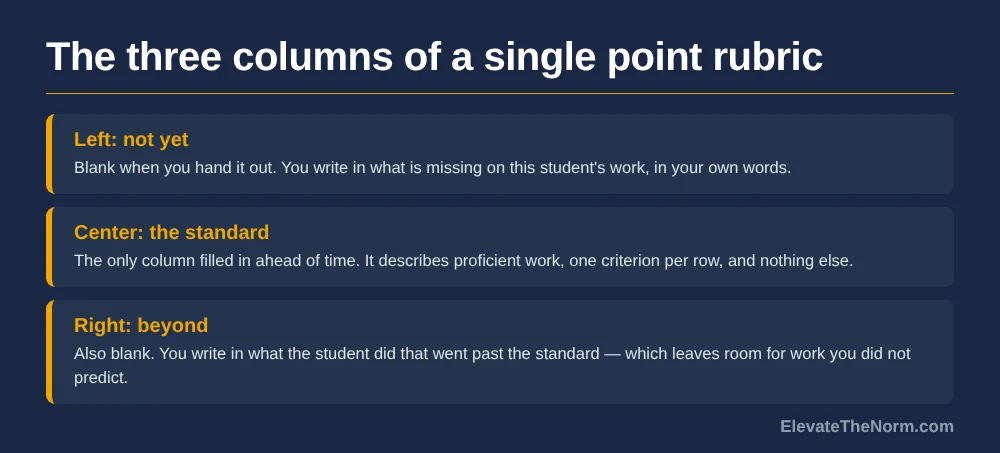
A single point rubric describes only one level of performance — proficient — in a center column, with blank space on either side where the teacher writes what is missing and what went beyond. It replaces the grid of performance levels with one clear target plus room for feedback written for that specific student.
That is the format. You will also see it called a one point rubric or a one-point rubric; it is the same tool with the same layout. The harder question is whether it works better than the four-column grid it replaces, and the honest answer is that nobody has shown it does. What the research supports is narrower and still worth knowing, and it is the reason I think the format earns its place anyway. This page covers the layout, the evidence, how to grade one, and when not to use it.
Key Takeaways
- A single point rubric fills in one column, not four. The center column states the standard, one criterion per row. The left and right columns stay blank until the teacher writes in what fell short and what went past it.
- 🔴 There is no controlled evidence that the single point format beats a multi-level one. The foundational article is a collective case study of ten teacher action-research reports — no control groups, no effect sizes, and the classrooms ranged from second grade to eleventh.
- Rubrics in general do help, moderately. A meta-analytic review of 23 studies found a corrected effect of about 0.45 on academic performance, a non-significant effect on self-regulated learning, and a small effect on self-efficacy.
- 🔴 The number of performance levels was not a significant moderator in that review, and a separate review of rubric studies found no relationship between the type or quality of rubric and the result. Format is not where the gain lives.
- What the format actually buys you is teacher time and feedback space — you stop writing descriptions of every way a student could fail, and you get a blank column to write what this student actually did.
Free Download · PDF
Single Point Rubric: Blank Template and Build Guide
A two-page printable: a blank five-row single point rubric, a worked document-based writing example, the five build steps, and the four situations where an analytic rubric is the better tool.
Free. No email address required. Designed for grades 6–12. Browse every printable in Your Free Library.
What is a single point rubric?
A single point rubric is an assessment tool with one column of criteria describing proficient work, flanked by two blank columns where a teacher records evidence of falling short and evidence of exceeding the standard. Only the middle column is written in advance. The other two are filled in per student, by hand, in the teacher’s own words.
The original version used four headings: a “Proficient” criteria column under the subheading “Performance Standards,” a “Not Yet” column for areas needing work, an “Evidence” column for how the student met the standard, and an “Advanced” column for work that went beyond the basics (Fluckiger). Most versions you will find today collapse that into three.
How is a single point rubric different from an analytic rubric?
An analytic rubric describes every criterion at every performance level, so a four-level rubric with five criteria contains twenty written descriptions. A single point rubric writes five — one per criterion, all at proficient — and leaves the rest as blank space for feedback. The student sees one target instead of a menu.
That difference has a second effect that matters more than it sounds. On an analytic rubric, the top level is a described destination, so students aim at the description and stop there. On a single point rubric, “beyond” is an empty box, which means the teacher has not predicted what exceeding the standard looks like and the student is not limited to the prediction. Fluckiger makes exactly that argument: a single standard leaves room for work the rubric did not anticipate.
| Analytic rubric | Holistic rubric | Single point rubric | |
|---|---|---|---|
| Descriptions written in advance | Criteria × levels (often 16–25) | One per overall level | One per criterion, proficient only |
| What the student sees | A menu of levels | A paragraph per grade band | One target |
| Where feedback goes | Margins, if there is room | A comment at the end | Two blank columns, by design |
| Time to build | Highest | Lowest | Low |
| Time to score | Fast — circle and total | Fastest | Slowest — you have to write |
| Converts to points cleanly | Yes | Roughly | Not without adding a scale |
| Best for | Large batches, shared scoring | Quick overall judgments | Drafts, revision, open-ended work |
If you want the version of this argument applied to a specific assignment type, the presentation rubric and the PBL rubric pages both work through full analytic rubrics you can compare against.
Does a single point rubric actually improve learning?
There is no controlled study showing that the single point format outperforms a multi-level rubric. What the evidence supports is that rubrics in general have a moderate positive effect on performance, and that the specific design choices researchers have tested — including the number of performance levels — have not predicted the size of that effect.
The best current number comes from a meta-analytic review of 23 studies in Educational Psychology Review. Correcting for publication bias, rubrics produced an effect of about 0.45 on academic performance. The same review found a non-significant effect on self-regulated learning (0.23, with a confidence interval crossing zero) and a small effect on self-efficacy (0.18). So rubrics help students produce better work; the claim that they turn students into self-regulated learners is not yet supported.
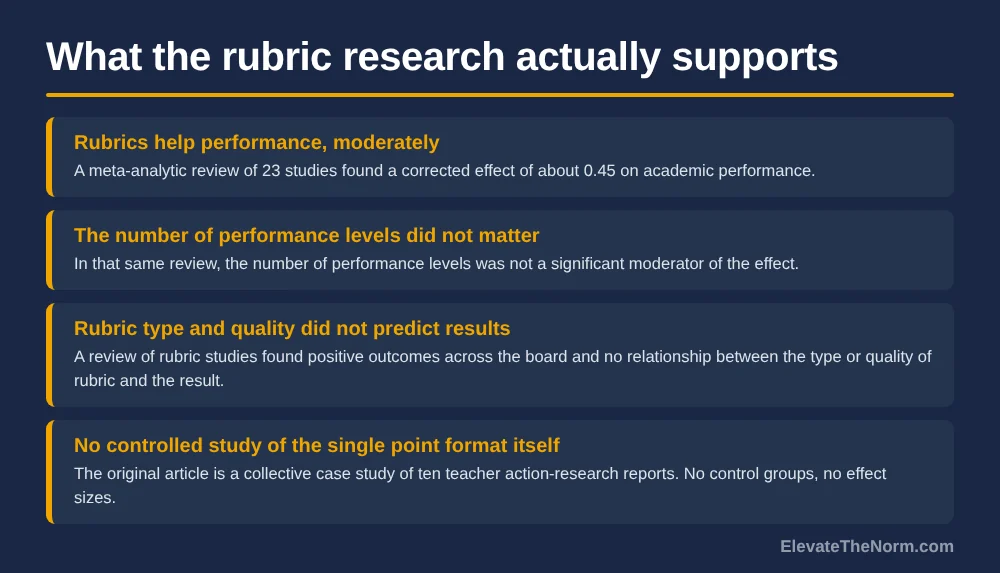
Two findings in that literature deserve more attention than they get. First, in the meta-analysis most moderators were not significant, and the number of performance levels was one of them. Second, Brookhart’s review of rubric studies reports that all the studies described positive outcomes but found no relationship between the type or quality of rubric and the study results. Taken together, that is a warning to anyone selling a rubric format as the lever.
Both findings come with limits. The meta-analysis notes that several of its moderator results rest on very few studies, and that many of the original reports did not describe their rubrics well enough to code. Brookhart’s review covers higher education studies and notes that some of them called rating scales “rubrics,” which muddies the comparison further. Neither one tested a single point rubric against anything.
There is one more caveat worth naming, because it cuts against the format. Brookhart argues that a true rubric needs both criteria and descriptions of performance across a continuum of levels, and that having only criteria is what makes something a checklist or a rating scale instead. By that definition a single point rubric is not really a rubric. She also notes that tools which count elements rather than describe quality “may be expected to be more useful for grading than for learning.” A single point rubric describes quality, so it clears that bar — but it clears it as a criteria sheet with feedback space, not as a rubric in her sense.
Where did the single point rubric come from?
The name came from a conference presentation by Mary Dietz around 2000, and the format reached most teachers through a 2010 article by Jarene Fluckiger and a widely shared blog post five years later. There is no large research program behind it. There is one case study and a very effective piece of teacher writing.
Fluckiger’s article in The Delta Kappa Gamma Bulletin is a collective case study of ten teacher action-research reports collected over several years from her graduate assessment course. Each teacher used a single point rubric for the first time and gathered student work, surveys and observation notes. The reported results are real but modest and self-reported: a sixth-grade teacher found work quality the same or better, a fourth-grade teacher reported more honest self-assessment and more useful peer feedback, and an eleventh-grade teacher reported a marked increase in content mastery and a shift in student attention from grades to learning. No control groups. No effect sizes. Classrooms from second grade to eleventh, which means the secondary evidence inside it is a small handful of rooms. To convert a rubric level to a grade, see the 1-4 grading scale chart.
The post that actually spread it is Jennifer Gonzalez’s “Meet the Single Point Rubric” at Cult of Pedagogy, which describes the format as having “just a single column of criteria, rather than a full menu of performance levels.” She credits Dietz and Fluckiger, and makes three practitioner claims: the rubrics are quicker to build because you are not inventing every way a student could fail, students are more likely to read one set of expectations than four, and feedback quality rises because you have to name this student’s problems and strengths specifically. That is practitioner reporting, not research, and she presents it that way.
A related point from the self-assessment literature is worth keeping honest too. Andrade and colleagues studied rubric-referenced self-assessment with 268 elementary and middle school students and found self-efficacy for writing rose in both conditions, with the larger treatment gain appearing among girls. That is a mixed-age sample measuring confidence rather than achievement, and the effect was gender-specific. It is supportive context, not proof.
How do you grade a single point rubric?
You do not, directly — the format has no levels to total. To put a grade on one you either attach a point value or a proficiency level to each row after you write the feedback, or you use the rubric for the draft and a separate scale for the final. Deciding which before you hand it out is the part people skip.
- Decide whether this piece is being scored at all. The format is built for developmental feedback and revision. If the assignment has no revision step, a single point rubric is doing less for you than an analytic one would.
- If it is scored, add one scale, not two. Mark each row Not Yet, Meets, or Beyond, and set in advance what a page of “Meets” is worth. Do not invent the conversion while you are grading, and never after you see whose paper it is.
- Write in the side columns before you assign the mark. The writing is the assessment. The mark is bookkeeping that follows it.
- Keep the comments shorter than you want to. One specific sentence per row that a student can act on beats a paragraph they will not read.
- Return it with time to use it. A rubric that arrives attached to a final grade is a receipt.
If your school runs a standards-based system, the rows map onto proficiency levels fairly cleanly, and that is the conversion I would default to. The standards-based rubric starter pack has the four-level version if you need to show both.
How do you build one for a grades 6–12 assignment?
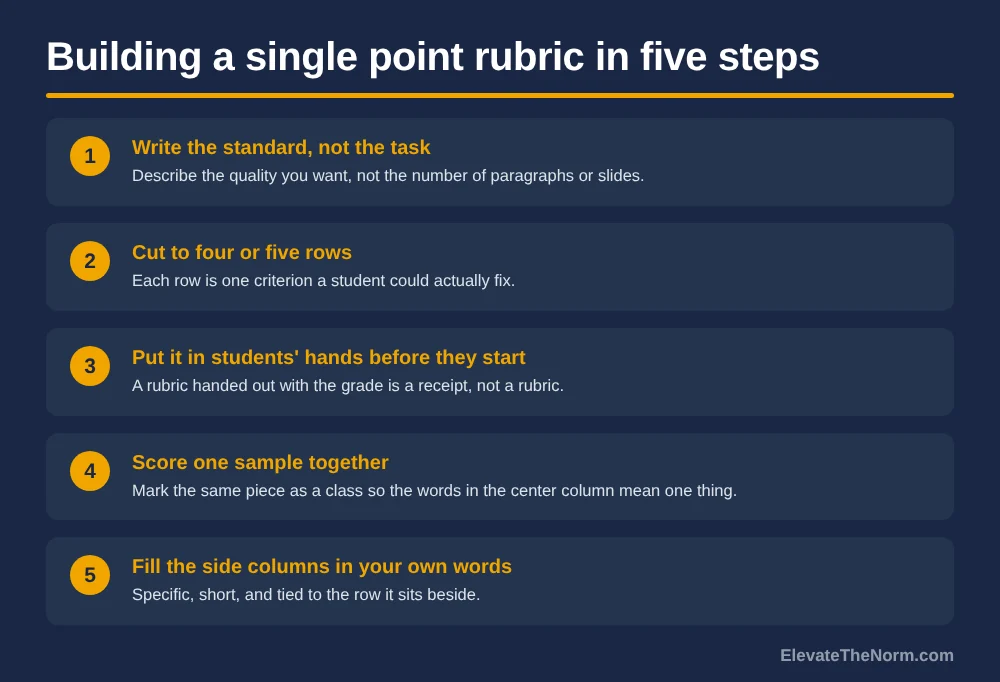
Write four or five rows describing proficient work on the standard rather than the task, put the rubric in students’ hands before they start, score one sample piece together as a class, then fill the side columns in your own words when you read their work. Five steps, and the third and fourth are the ones that make it work.
One step in the original version is routinely dropped and should not be: students help create or revise the criteria and practise on sample work before their own is scored. Fluckiger organises the whole process around four student statements — I know where I am going, I know where I am now, I know how to get there, and I know how to go beyond. If students had no hand in the wording and never scored a sample, the first two of those are not true and the rubric is just a shorter worksheet.
Writing the standard rather than the task is the hard discipline. “Three paragraphs with five sources” is a task description; a student can satisfy it completely and write something worthless. “Uses evidence that actually supports the claim it is attached to” is a standard, and it is fixable. If you are not sure your rows clear that bar, the page on learning targets covers how to write the underlying statement.
There is a side effect worth knowing about before you try it. An analytic rubric can hide a weak criterion behind four levels of adjectives — “excellent organization” down to “poor organization” looks like a rubric row and says nothing. A single point rubric gives that row one line and nowhere to hide. If a row is vague, you find out the first time you try to write feedback against it, which is the most useful thing this format does for a teacher who is still learning to write criteria.
Here is the shape, using a document-based writing task as the example:
| Not yet (blank — teacher writes) | The standard: proficient work | Beyond (blank — teacher writes) |
|---|---|---|
| Claim. States a position that could be argued against, not a summary of the topic. | ||
| Evidence. Each piece of evidence supports the specific sentence it sits next to. | ||
| Sourcing. Names who produced each source and when, and says why that matters to the claim. | ||
| Counterargument. States the strongest objection fairly, then answers it. | ||
| Clarity. A reader can follow the argument without rereading a sentence. |
Five rows. Twenty words each, roughly. Compare that to the twenty boxes an analytic version of the same rubric would need, and you can see where the time saving comes from — and also where it goes, because you now owe every student two columns of writing.
When should you not use a single point rubric?
Skip it when you are scoring a large batch quickly, when several teachers must score the same work consistently, when the assessment is high-stakes, or when students genuinely do not yet know what the quality words mean. In all four cases the described levels of an analytic rubric are doing real work that blank columns cannot.
- Volume. A hundred and thirty short assignments is not a single point rubric job. Writing two columns of comments per student is the cost of the format, and it is a real one.
- Shared scoring. If three teachers are scoring the same common assessment, the described levels are the thing that holds their judgments together. Take them out and you get three different standards, and no way to tell whether a department-wide score moved because students improved or because somebody got more generous.
- High stakes. A student arguing about a grade has firmer ground to stand on when the levels are written down in advance. That protects the student, not just you. It also travels better: a parent who did not sit in your class can read four described levels and see where the work landed, where a page of your handwriting asks them to take your word for it.
- Novices. A student who has never seen proficient work cannot calibrate against a one-line description. That is what the class scoring session in step four is for, and if you are not going to run it, use the fuller rubric.
- Unequal starting points. A one-line criterion assumes the reader already shares your sense of what the words mean. Students still building academic English, students new to the school, and students who have never been taught the genre are the ones who lose most when the described levels disappear. Scored samples and a glossary of the criteria words are not optional for them.
My read, as a grades 6–12 teacher: the single point rubric is a feedback tool that happens to look like a grading tool, and most of the disappointment with it comes from using it as the second thing. On a draft that will be revised, it is excellent, because the blank columns force you to say something true about one kid’s work. On a final exam essay scored in a weekend, it is the wrong tool and the research gives you no cover for pretending otherwise.
What to do next
Pick one assignment you already assign that has a revision step, and rewrite its rubric down to five rows of proficient-only criteria. Hand it out at the start, score one sample with the class, and then write in the side columns when you read the drafts. One assignment. You will know within a week whether the writing cost is worth what you get back.
If you are a student who has been handed one of these: the middle column is the whole deal, and it is the clearest thing a teacher will give you all term. Read it before you start, not after. If the left column comes back with something written in it, that is not a judgment about you — it is a list of what to fix, which is more than a number ever tells you. And if you cannot tell what one of the rows means, ask before you write, because that question is free in advance and expensive afterward.
And if your department is arguing about rubric formats, the useful thing to say is that the evidence does not pick a winner. Spend the argument on whether the criteria describe quality instead.
Want this as a printable? A blank five-row template, a worked writing example, the five build steps and the when-not-to table, on two printable pages. Download the free PDF — no email address required.
Frequently Asked Questions
What is a single point rubric?
It is an assessment tool with one written column describing proficient work, one criterion per row, and two blank columns on either side. The teacher writes in what fell short on the left and what went beyond the standard on the right, for that specific student. Only the center column exists before students begin the assignment.
How is a single point rubric different from an analytic rubric?
An analytic rubric describes every criterion at every level, so five criteria across four levels means twenty written descriptions. A single point rubric writes five, all at proficient, and leaves the rest blank for feedback. Students see one target rather than a menu, and the teacher writes comments instead of circling boxes.
How do you turn a single point rubric into a grade?
The format has no levels to total, so you add a scale. Mark each row Not Yet, Meets or Beyond after you write the feedback, and set what a full page of Meets is worth before you hand the assignment out. Deciding the conversion while grading, or after seeing whose paper it is, is how the scale stops being fair.
Is there research proving single point rubrics work better?
No. No controlled study has compared the single point format against a multi-level rubric. A meta-analytic review of 23 studies found rubrics generally produce a moderate effect of about 0.45 on academic performance, but the number of performance levels was not a significant moderator, and a separate review found no relationship between rubric type and results.
Who invented the single point rubric?
The name traces to a conference presentation by Mary Dietz around 2000. Jarene Fluckiger published the article that described and tested the format in 2010, as a collective case study of ten teacher action-research reports. Jennifer Gonzalez’s Cult of Pedagogy post five years later is what carried it to most classroom teachers.
When should you not use a single point rubric?
Skip it for large batches scored quickly, for common assessments several teachers must score consistently, for high-stakes work where a student may contest the grade, and for students who have never seen proficient work in that genre. In each case the described levels of an analytic rubric are doing work that blank columns cannot.
What does a parent see on a single point rubric?
A list of what proficient work requires, plus the teacher’s handwriting in one or both side columns. That is more specific than a letter grade and harder to interpret cold, because there are no described levels showing where the work sits. If you send one home, include the criteria sheet and a line explaining that the middle column is the target.
Sources
- Fluckiger, J. (2010). “Single Point Rubric: A Tool for Responsible Student Self-Assessment.” The Delta Kappa Gamma Bulletin, 76(4), 18–25. The foundational article. A collective case study of ten teacher action-research reports; no control groups and no effect sizes, with classrooms ranging from second to eleventh grade. Full text via DigitalCommons@UNO. digitalcommons.unomaha.edu
- Panadero, E., Jönsson, A., Pinedo, L., et al. (2023). “Effects of Rubrics on Academic Performance, Self-Regulated Learning, and Self-Efficacy: A Meta-analytic Review.” Educational Psychology Review, 35, 113. 23 studies. Source for the 0.45 corrected effect on performance, the non-significant self-regulated learning effect, the small self-efficacy effect, and the finding that the number of performance levels was not a significant moderator. link.springer.com
- Brookhart, S. M. (2018). “Appropriate Criteria: Key to Effective Rubrics.” Frontiers in Education, 3, Article 22. Source for the definition of a true rubric as criteria plus performance-level descriptions, the warning about tools that count elements, and the finding of no relationship between type or quality of rubric and study results. Covers higher education studies. frontiersin.org
- Gonzalez, J. “Meet the Single Point Rubric.” Cult of Pedagogy. Practitioner reporting, not research. Source for the “single column of criteria” description, the build-time and feedback-quality claims, and the account crediting Mary Dietz with the name and Fluckiger with the 2010 article. cultofpedagogy.com
- Andrade, H., Wang, X., Du, Y., & Akawi, R. (2009). “Rubric-referenced self-assessment and self-efficacy for writing.” The Journal of Educational Research, 102(4), 287–302. 268 elementary and middle school students; measures self-efficacy rather than achievement, and the treatment gain was found among girls. scholarsarchive.library.albany.edu