By Clay Shumate
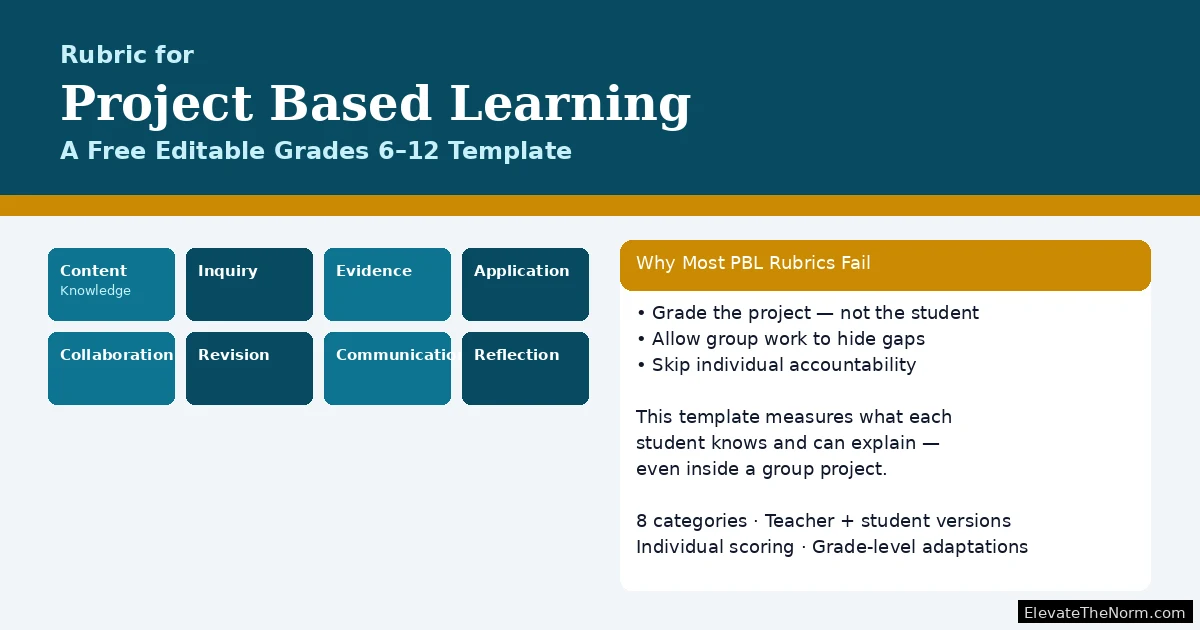
A rubric for project based learning is a scoring guide that separates what a student personally understood and produced from what the group turned in. A good one measures content knowledge, inquiry, evidence, application, collaboration, revision, communication, and reflection — and never lets teamwork points cover for weak academic understanding.
A seventh-grader stood across my trapezoid table three days before her team’s final presentation. I asked her one question: “Tell me why you chose this solution instead of the other one your group was considering.”
She paused. Then she started talking about the other group members—who did what, who didn’t do what. She never answered the question.
That’s the moment I knew my rubric was broken. Not hers. Mine. I had built a rubric that let a student disappear into a group product and earn a grade based on what her teammates produced. The rubric was measuring the project, not the learning.
This is the problem most PBL rubrics share: they grade the thing, not the student who made it. This free editable template fixes that. It measures what each student knows and can do—even inside a group project—and it includes a student-facing version your class can use for self-assessment and peer feedback before the final day.
Before using this rubric, it helps to understand what project-based learning actually requires from students—because a rubric built for worksheets will produce worksheet behavior even inside a PBL unit.
What a PBL Rubric Has to Measure
A PBL rubric that only grades the final product is an audience-review form dressed up as assessment. The eight categories below are what actually tell you whether a student learned something—and they map directly onto the seven steps of a complete PBL unit, particularly the critique, revision, and public product phases.
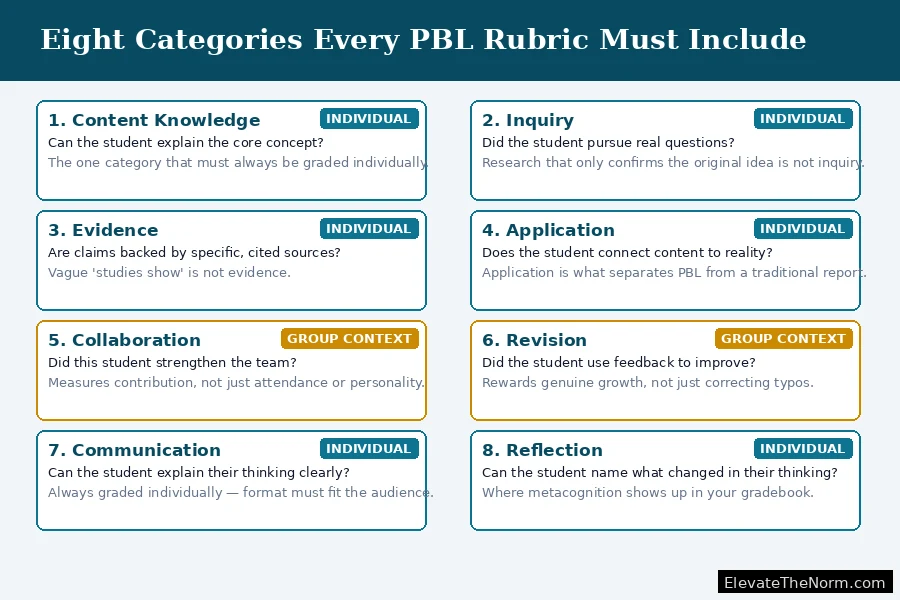
Content knowledge. Can the student explain the core concept or answer the driving question accurately? This is the one category that must always be graded individually. A group can produce a beautifully designed poster for the wrong answer.
Inquiry. Did the student identify meaningful questions, pursue credible sources, and change their thinking based on what they found? Research that only confirms the original idea is not inquiry.
Evidence. Does the student support claims with specific, accurate, properly cited evidence? Vague gestures toward “studies show” are not evidence.
Application. Does the student connect the content to a real situation, a genuine problem, or something outside the classroom? Application is what separates PBL from a traditional research report, and it is the category where the evidence on traditional instruction versus project based learning shows the clearest difference.
Collaboration. Did the student contribute to the group in ways that made the team stronger? This category can be informed by group dynamics, but it should measure individual contribution—not just “got along” or “showed up every day.” The same trap shows up in discussion scoring, where “participated” usually means “spoke often” — a seminar rubric that scores preparation and reflection instead of talking turns is the version that survives a parent asking how it was graded.
Revision. Did the student use critique and feedback to make substantive improvements? A student who adds one sentence after three rounds of feedback did not revise. This category rewards genuine growth, not just correcting typos.
Communication. Can the student explain their thinking clearly—in writing, verbally, or visually—in a format appropriate for the actual audience? Communication is always graded individually.
Reflection. Can the student honestly name what they learned, what they would do differently, and what they still don’t understand? Reflection is where metacognition shows up in your gradebook.
The Problem Most PBL Rubrics Create
When teamwork is scored as one unified category—“worked well with others, 25 points”—students learn that group membership earns a grade. A student who contributes nothing to the actual thinking gets protected by the students who did. A student who carried the group gets penalized by the teammates who didn’t.
There is a straightforward fix: cap the collaboration and revision categories together at no more than 20% of the total score, keep content knowledge and application as individual-only categories, and require each student to complete the reflection independently. That structure makes it impossible for teamwork—positive or negative—to determine whether a student earned a passing grade on their own understanding. If your school is also moving toward reporting proficiency on named standards instead of accumulated points, it is worth understanding what a standards-based grading system actually is and what the evidence supports before you rebuild the rubric around it. If your school uses a 4-point scale, the 1-4 grading scale percentages chart shows how levels convert.
This connects directly to holding high expectations for students—the rubric is the vehicle for those expectations. When the rubric doesn’t distinguish individual understanding from group output, the expectation becomes meaningless.
The Complete Teacher Version
Use this version for formal grading. Each category has four performance levels: Exceeds (4 pts), Meets (3 pts), Approaching (2 pts), and Beginning (1 pt). Total possible: 32 points. If filling in four columns for every criterion is more than an assignment is worth, the one-column alternative that states only the proficient target trades the grid for blank feedback space — though no controlled study has shown that format scores any better.
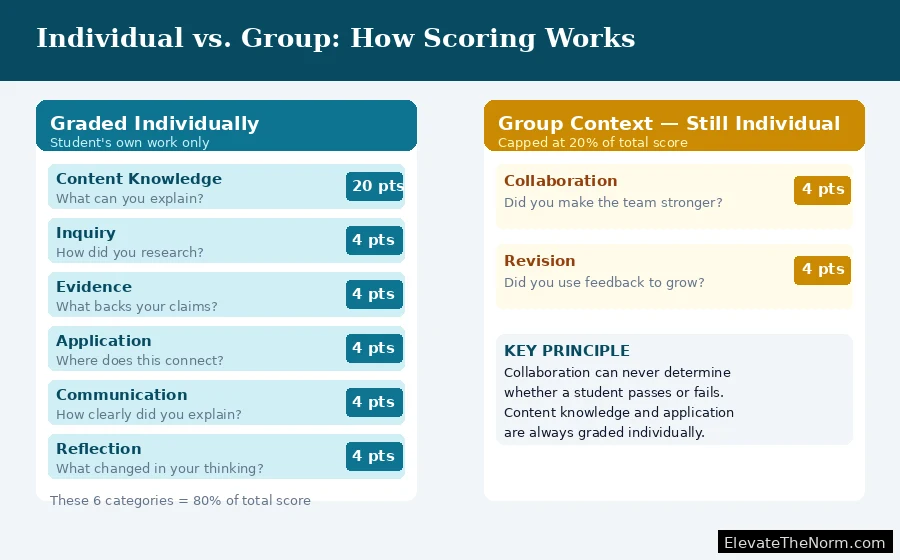
- Grade individually (student’s own evidence only): Content Knowledge, Inquiry, Evidence, Application, Communication, Reflection — 6 categories × 4 pts = 24 pts (75% of total)
- Grade individually using group work as context: Collaboration, Revision — 2 categories × 4 pts = 8 pts (25% of total, capped)
| Category | Exceeds (4) | Meets (3) | Approaching (2) | Beginning (1) |
|---|---|---|---|---|
| Content Knowledge (Individual) | Accurate, detailed, nuanced explanation; anticipates misconceptions or hard questions | Accurate, complete explanation of the core concept | Partially accurate; some gaps or misunderstandings | Inaccurate or missing; student cannot explain the core concept |
| Inquiry (Individual) | Self-directed questions; adjusts approach based on findings; uses multiple source types; shows changed thinking | Purposeful questions; uses credible sources; shows some revision of initial thinking | Questions are vague or teacher-prompted; sources are limited or uncritical | No meaningful questions; relies on first source found or prior knowledge only |
| Evidence (Individual) | Specific, accurate, properly cited evidence for every claim; evaluates source quality | Most claims supported with accurate evidence; citations present | Some claims unsupported; evidence vague or unverified | Claims not supported by evidence; no citations or inaccurate citations |
| Application (Individual) | Makes insightful, specific connection to a real context; anticipates real-world implications | Makes a clear connection to a real problem or situation | Connection is vague or generic (“this relates to real life”) | No meaningful connection to context outside the classroom |
| Collaboration (Group context) | Consistent, substantive contribution throughout; visibly strengthened others’ work | Contributed regularly; met responsibilities; helped the group succeed | Inconsistent contribution; needed reminders; didn’t hurt but didn’t strengthen the group | Did not contribute meaningfully; group worked around this student |
| Revision (Group context) | Made substantive, documented changes based on specific feedback; can explain why each change was made | Made meaningful improvements after receiving feedback | Made surface-level changes; did not address the core feedback received | Did not revise, or changes made no meaningful difference to the work |
| Communication (Individual) | Clear, precise, audience-appropriate; engages the real audience with confidence and purpose | Clear, organized; audience can follow; format is appropriate | Partial clarity; audience needs to ask for clarification to follow the work | Hard to follow; format doesn’t fit the audience; major content gaps |
| Reflection (Individual) | Honest, specific, forward-looking; identifies what changed in thinking and what remains open | Identifies what was learned and names at least one specific thing to do differently | Surface-level (“I learned teamwork”); vague or formulaic response | Reflection absent, off-topic, or entirely positive without any specificity |
Weighting for different courses: For content-heavy courses (history, science, ELA), double the Content Knowledge category to 8 pts and reduce Collaboration to 2 pts. For interdisciplinary or design-challenge projects, double the Application category to 8 pts while keeping all individual columns at full weight. Make the weights explicit to students before the project launches—never change them mid-project.
How to Use Individual Grades in Group Projects
The most common pushback: “It’s a group project—how do I give individual grades?”
The answer is already built into the template. Six of eight categories are graded individually using evidence the student produces—their written section, their explanation during a check-in conversation, their cited sources, their reflection. The grade reflects what that student can show and explain, not what the group turned in. You can see more of this in action in our examples of project-based learning, where individual and group contributions are visible throughout.
For presentations, have each student speak to their own section rather than dividing presentation duties randomly or letting the most confident student present everything. That isn’t more work—it’s more fair. A student who can’t explain their own part during the presentation has revealed something the rubric needs to capture.
Rubric-based scoring sits close to standards-based grading, and it inherits some of the same arguments. Before you move a whole gradebook that direction, it is worth reading the objections teachers and students actually raise — the retake and no-zero complaints, the fairness problem secondary students name most often, and the conditions under which waiting is the better call.
Contribution logs can supplement the rubric for Collaboration: a one-page document each student submits independently (who did what, by which date) creates a paper trail for conversations that the rubric score alone won’t support. Find templates and other assessment tools on the project-based learning resources page.

The Student-Friendly Version
This version uses the same eight categories in plain language. Students complete it before their presentation day, then revisit it after receiving peer and teacher feedback. The goal is to build the habit of honest self-assessment—not to generate a second grade.
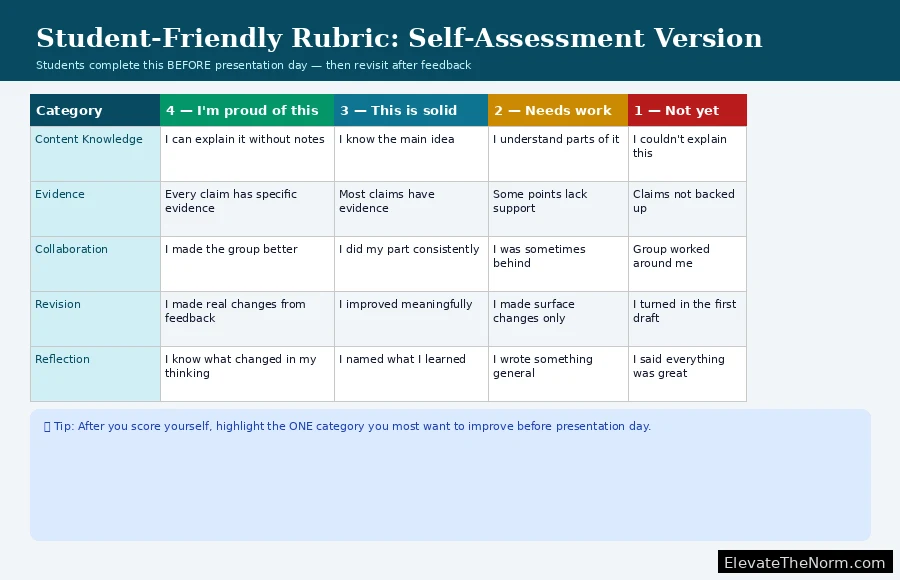
| Category | 4 — I’m proud of this | 3 — This is solid | 2 — This needs work | 1 — I haven’t done this yet |
|---|---|---|---|---|
| I know the content | I can explain it clearly and answer hard questions without looking at notes | I can explain the main idea | I understand parts of it but have gaps | I’m not sure I could explain this to someone who wasn’t in the class |
| I asked real questions | I changed my mind based on what I found; I used more than one type of source | I had a real question and found credible answers | My question was kind of vague, or I didn’t look hard enough | I mostly used what I already knew going in |
| I used evidence | Every claim I made has specific, cited evidence behind it | Most of my claims have evidence; I cited my sources | Some of my points don’t have evidence behind them | I made claims without backing them up |
| I applied it | I made a real, specific connection—not just “this relates to real life” | I connected the content to a real problem or situation | The connection feels kind of general | I stayed inside the classroom on this one |
| I contributed | I made the group’s work better than it would have been without me | I did my part and showed up consistently | I got distracted or fell behind sometimes | The group worked around me more than with me |
| I revised | I made real, substantive changes based on the feedback I received—and I can explain why | I made meaningful improvements after getting feedback | I made some small changes; I didn’t really address the core feedback | I turned in the first version |
| I communicated clearly | The audience understood it and I made it worth their time | It was clear and organized; the audience could follow | Some parts were hard to follow | It wasn’t clear or didn’t match the audience |
| I reflected honestly | I know exactly what changed in my thinking and what I’d do differently next time | I identified what I learned and named one thing to change | I wrote something general—mostly summary, not reflection | I said everything was great, or I didn’t write anything real |
After students complete the self-assessment, have them highlight the one category they most want to improve before presentation day. That single action turns the rubric from a grading form into a revision prompt.
Adapting the Rubric by Grade Level
Grades 6–7
Add a fifth option to the student-facing version: “I’m not sure what this means yet—I need to ask.” Middle schoolers need a landing spot that isn’t a failing score. Remove it once they’ve used the rubric two or three times and the language is familiar.
For the teacher version, weight Inquiry more heavily early in the year when you’re still building research habits. Lower-stakes projects can use five categories: Content Knowledge, Evidence, Application, Communication, and Reflection. Add Collaboration and Revision once students have completed at least one group cycle.
Grades 8–10
Use the template as written. This range benefits most from the clear structure—the table is the scaffold. Introduce the student version first, have students score a sample project with it, then reveal the teacher version. The gap between self-assessed and teacher-assigned scores is where the learning begins. When that gap stays wide, the problem is usually the habit rather than the rubric — teaching students to judge their own work against criteria they understand is the part that has to come first.
Grades 11–12
Reduce the rubric to five categories (Content Knowledge, Application, Evidence, Communication, Reflection) and remove the point totals from the student version. Have students co-develop the performance descriptors at the start of the project—the rubric becomes part of the learning. Upper-secondary students who helped write the “Exceeds” descriptor almost always aim for it.
How to Introduce the Rubric to Students
Give students the rubric on the first day of the project, not the last. A rubric revealed at the end is a grading sheet. A rubric revealed at the beginning is a roadmap.
Walk through each category out loud and ask students to find the difference between a 2 and a 3 in one category—then justify their reasoning. That conversation is usually more useful than any lecture about expectations. Follow it with a brief look at a past project (real or hypothetical) and have students practice applying the rubric before their own work begins.
On a group project the rubric covers the product, and contribution needs its own short instrument — the guide to self assessment in group work covers what to ask and what to leave off the form. For the self-assessment version, model honest scoring first. Show students a sample of work you’d give yourself a 2 on and explain why. Students who have only seen rubrics used to assign grades are reluctant to score themselves honestly. The goal is accurate self-assessment, not strategic underscoring to avoid accountability.
This is also where student voice matters: invite students to identify any category they think is unclear or unfair before the project launches. That conversation catches rubric design flaws early and builds buy-in. The full bank of PBL project ideas shows how this rubric scales across different content areas and formats.
Frequently Asked Questions
Can I use this rubric for a major grade?
Yes, but check it against your district’s grading policy first. If your school requires a specific point scale, convert the 32-point total to a percentage (for example, 24/32 = 75%). The eight categories and the individual-versus-group structure survive the conversion. What you want to preserve is the weighting: individual understanding must account for most of the grade.
What do I do when one student carries the whole group?
The individual columns already protect that student—their content knowledge, evidence, communication, and reflection scores reflect their own work regardless of what the group produced. For documentation, add a one-page contribution log each student submits independently (who did what, by which date). That log also gives you something concrete to use in a conversation with the group about what happened.
Is it fair to grade collaboration when some students have IEPs or 504 plans that affect communication?
Collaboration in this rubric measures contribution, not communication style or personality. A quiet student who prepared consistently, shared ideas in small-group settings, and met every deadline would score a 3 or 4—not a 1 for being quiet. If a student has an IEP or 504 that limits communication in specific ways, modify the collaboration descriptor to match what the accommodation allows. Document the modification before the project launches.
How many points should content knowledge be worth?
That depends on your course’s core purpose. For a course built around disciplinary content (history, biology, literature), weight Content Knowledge at 8 to 10 points and reduce Collaboration to 2. For a project-based capstone or interdisciplinary course where application is the primary competency, weight Application more heavily instead. Make the weights explicit to students at the start of the project and do not change them midway through.
Can students improve their scores after the initial grade?
If your school’s grading policy allows revision for credit, attach a condition: the student must submit the self-assessment version with specific evidence of what changed and why the change addresses the feedback they received. That prevents a resubmission that is cosmetically different from the original. The Revision category already captures this habit—a student who revises well should already be earning a 3 or 4.
What is the difference between this and a traditional rubric?
A traditional rubric grades the product. This rubric grades what the student knows and can do. That distinction matters most in group projects, where a polished product can hide a student who contributed nothing to the thinking. The eight categories here require each student to demonstrate understanding individually, even when the final work was produced with a team.
Sources
- Buck Institute for Education / PBLWorks. (2021). Gold Standard PBL: Essential Project Design Elements. https://www.pblworks.org/what-is-pbl/gold-standard-project-design
- Berger, R., Rugen, L., & Woodfin, L. (2014). Leaders of Their Own Learning: Transforming Schools Through Student-Engaged Assessment. Jossey-Bass.
- Wiggins, G., & McTighe, J. (2005). Understanding by Design (2nd ed.). ASCD.
- Hattie, J., & Timperley, H. (2007). The power of feedback. Review of Educational Research, 77(1), 81–112. https://doi.org/10.3102/003465430298487
- Condliffe, B., et al. (2017). Project-Based Learning: A Literature Review. MDRC. https://www.mdrc.org/sites/default/files/Project-Based_Learning-LitRev_Final.pdf
- Ravitz, J. (2010). Beyond changing culture in small high schools: Reform models and changing instruction with project-based learning. Peabody Journal of Education, 85(3), 290–312.
About Clay Shumate
Clay Shumate is a certified secondary Social Studies teacher in the public schools of West Alabama, with seven years of classroom experience, a B.A. in History, and an M.Ed. in Secondary Education. He writes about project-based learning, student responsibility, respect, and practical ways to hold young people to a higher standard while giving them room to learn from mistakes. He is a member of the Society of Professional Journalists and writes to its Code of Ethics; this site’s editorial standards and corrections policy are published in full. More about Clay.
Comments
One response to “Rubric for Project Based Learning: A Free Editable Grades 6–12 Template”
[…] — including rubrics for group projects and presentations — see this guide to building a rubric for project-based learning. If your school uses standards-based grading, these standards-based grading rubrics show how to […]