
By Clay Shumate
Parent-teacher communication logs matter most when a call or message becomes hard to remember accurately weeks later. This free pack gives secondary teachers four short documents: a family communication plan you fill out once at the start of the year, a positive-contact tracker for recording specific praise instead of vague character labels, a concern-call preparation form that separates observable facts from interpretation, and a follow-up log that closes the loop after a difficult conversation. Every page is built to be factual and brief — not a diary, a record.
Free. No email address required. Built for grades 6–12. Print it, adapt it, and use it tomorrow.
If you are still deciding how to reach families in the first place, choosing a parent-teacher communication app you can defend covers the approval question, what these tools do with student data, and which families they quietly fail to reach. What to say once you have reached them — how often, what the message should contain, and what the randomized trials actually found — is the wider question of how a teacher talks to families across a whole year.
A log tracks the contact. If you want the family conversation itself to carry more weight, letting the student lead the conference puts the person who did the work in front of the people discussing it.
What’s in the Pack
Four pages, printable on US Letter paper, branded ElevateTheNorm.com on every page.
- Family communication plan covering contact methods, translation needs, and escalation triggers
- Positive-contact tracker recording date, student, observable action, method, and follow-up
- Concern-call preparation form separating observable concern from family context and next action
- Follow-up log for tracking whether an agreed next step actually happened
Recording Facts, Not Impressions
The positive-contact tracker and the concern-call prep form both push toward the same discipline: write what was observed, not what you concluded from it. “Missed three assignments in eight days” survives a follow-up conversation. “Doesn’t care about the class” does not — it’s a guess dressed up as a fact, and it’s the kind of note that becomes a liability if a family disputes it later.
Bringing Students Into the Conversation
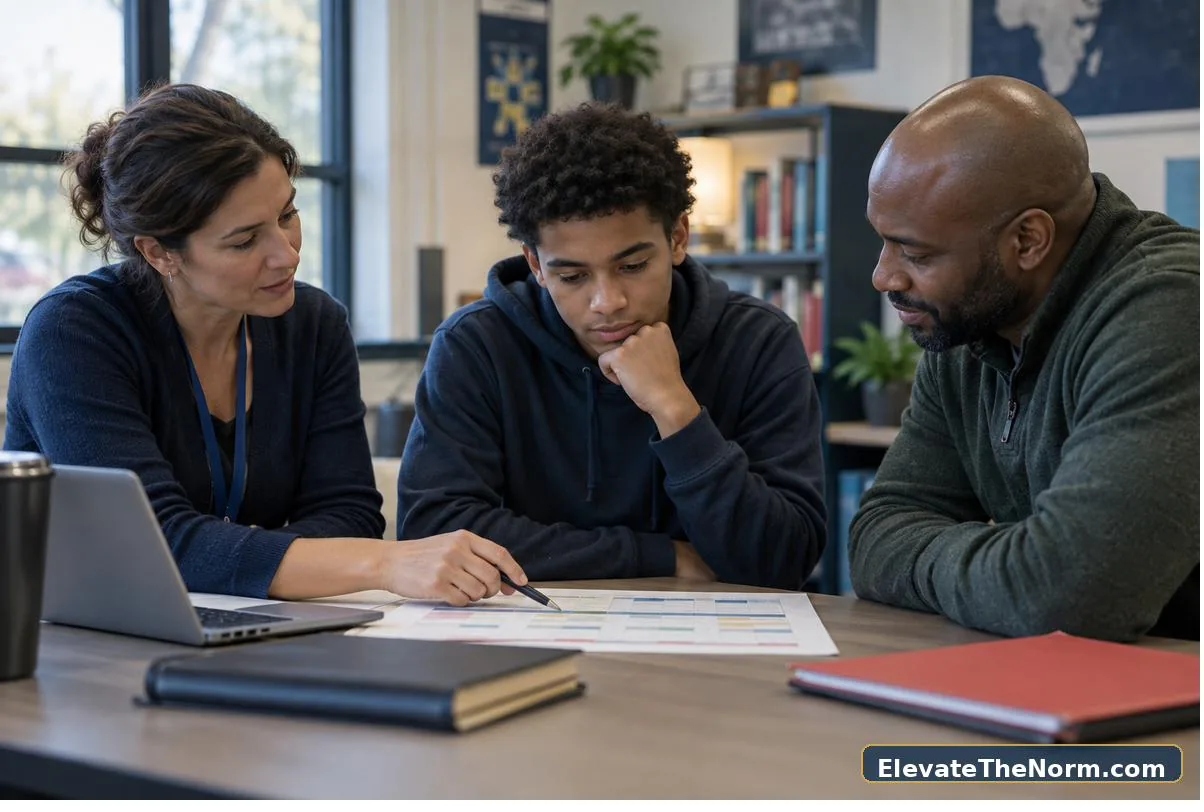
Where possible, use the concern-call prep form’s “question I need to ask the family” field to invite context rather than announce a verdict — and consider whether the student should be part of the conversation rather than the subject of it. A next step that the student helped agree to tends to hold up better than one that was decided about them.
A Caution Worth Repeating
These logs are documentation tools, not legal advice — check your district’s policy on what must be recorded, how long records are kept, and who else needs to be notified for certain kinds of concerns. They also assume you already know your school’s approved contact methods; the plan page has a field for that rather than assuming one. If you have not decided the rotation these logs are meant to record, start with the seven-line communication plan — the log is the sixth line of it.

Want this pack plus the other nine, each with a one-page guide on how to use it? Grab one free classroom systems ebook. Same deal: no email, no sign-up.
For more on the ideas behind this pack, see the site’s guides to why respect has to go both ways, building relationships with students, what actually brings students back to class, and accountability and second chances.
Browse every free, no-email classroom download on the Elevate the Norm resource hub.
Frequently Asked Questions
Are these communication logs legally required documentation?
That depends on your district and state, not on this pack. Treat these as a strong default structure and check your district’s specific documentation policy for anything involving discipline, safety, or legal concerns.
How do I handle a family that prefers a different contact method?
Record it in the family communication plan’s “primary contact methods” field at the start of the year, and note any translation or accessibility needs in the same place so you’re not improvising during a time-sensitive call.
Should students see what I write in these logs?
That’s a judgment call based on your school’s policy and the specific situation, but the fact record fields are written to hold up if a student or family asks to see them — because they record observable actions, not private conclusions about the student.
What if a family doesn’t respond to a concern call?
Note the attempt and the date in the follow-up log, then use your school’s escalation path — the field for escalation triggers in the family communication plan exists so you’ve already decided what that path is before you need it.
Is this pack only for concerns, or for good news too?
Both, deliberately. The positive-contact tracker exists so good news gets the same documentation habit as concerns — most teachers only build a paper trail for problems, which this pack is built to correct.
Can I adapt this for text or app-based communication platforms?
Yes. The forms record what was said and when, not the channel — the “method” field on the tracker and the “primary contact methods” field on the plan both work whether you’re calling, emailing, or using a school messaging app.
About Clay Shumate
Clay Shumate is a certified secondary Social Studies teacher in the public schools of West Alabama, with seven years of classroom experience, a B.A. in History, and an M.Ed. in Secondary Education. He writes about project-based learning, student responsibility, respect, and practical ways to hold young people to a higher standard while giving them room to learn from mistakes. He is a member of the Society of Professional Journalists and writes to its Code of Ethics; this site’s editorial standards and corrections policy are published in full.