By Clay Shumate
The Classroom Systems Playbook is a free classroom management ebook for grades 6–12 teachers. The 43-page PDF holds ten printable toolkits, covering routines, transitions, seating, assessment, grading, conferences, family contact, academic integrity and reflection. It downloads directly, with no email and no sign-up. Pick one chapter, use it for two weeks, then judge it.
Key Takeaways
- The Classroom Systems Playbook is one free 43-page PDF with no email and no sign-up.
- The ebook holds ten toolkits and 30 printable pages, three for each toolkit.
- Chapters 2 through 10 each open with one page of plain talk on why the system matters, how to use the pack and where it usually goes wrong.
- Teachers get the most from the ebook by testing one pack for two weeks, then keeping it, changing it or dropping it based on evidence.
- Teachers can print, adapt and share the ebook for classroom and school use, but can’t resell it or present it as their own work.
What’s inside the Classroom Systems Playbook?
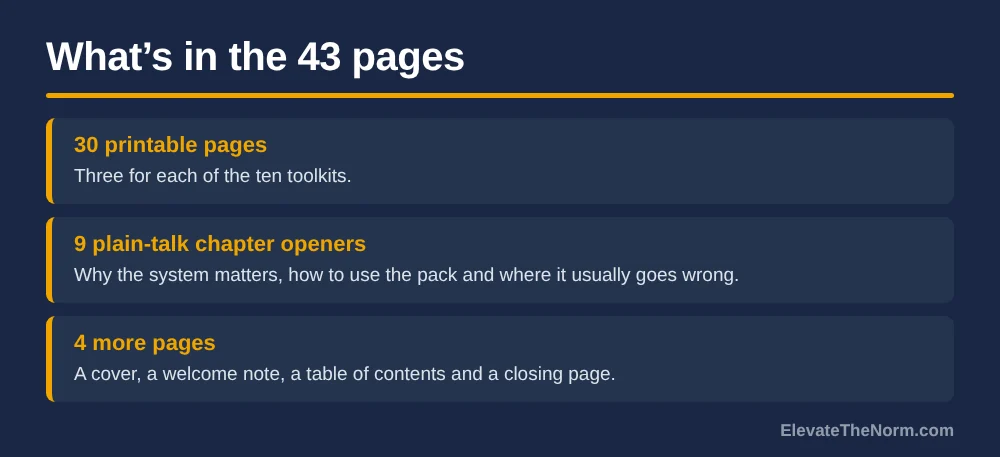
The Classroom Systems Playbook holds ten toolkits, and each toolkit has three printable pages. That’s 30 pages you can use with a real class. The rest of the 43 pages are nine plain-talk chapter openers, a cover, a welcome note, a table of contents and a closing page.
A classroom system is a planned, repeatable way of handling something that comes up all the time, like starting class, moving between activities or calling home.
| Chapter | Printable pages |
|---|---|
| 1. Classroom Routines That Protect Learning Time | Routine Design Sheet; Entry and Closing Checklists; Transition Rehearsal and Repair |
| 2. Classroom Transitions Students Can Run Themselves | Transition Audit; Transition Procedure Planner; Cue and Repair Guide |
| 3. Seating Plans Built on Evidence | Blank Seating Plans; Placement Decision Matrix; Two-Week Seating Observation Log |
| 4. Formative Assessment That Changes Tomorrow | Choose the Right Check; Class Evidence Tracker; Four Exit Tickets |
| 5. Student Self-Assessment That Requires Evidence | Evidence-Based Self-Assessment; Project and Revision Reflection; Group-Work Accountability |
| 6. Standards-Based Grading Without Rebuilding Everything | Four-Level Proficiency Scale; Assessment Evidence Planner; Implementation and Reassessment Check |
| 7. Student-Led Conferences Students Actually Own | Conference Readiness Checklist; Evidence and Portfolio Planner; Student Conference Script and Next Step |
| 8. Parent-Teacher Communication That Builds Trust | Family Communication Plan; Positive Contact Tracker; Concern Call and Follow-Up |
| 9. Academic Integrity: Prevent, Document, Repair | Prevent Before You Police; Academic Integrity Fact Record; Conversation and Repair Plan |
| 10. Teacher Reflection That Leads to One Better Move | After-Lesson Reflection; Weekly Pattern Review; Midyear Reset and Small Experiment |
Each chapter name above links to its own page on this site, which leads to the research and sources. Every pack is also available on its own if you only need one.
Who is this free classroom management ebook for?
This free classroom management ebook is for middle and high school teachers who want systems that hold students to a real standard while treating them like the developing young adults they are. It works for a first-year teacher building a room from scratch and for a veteran who wants to fix one thing that keeps leaking time.
The packs lean on structure, real ownership and a clear way back after a mistake. They don’t lean on manufactured stakes or slogans. The pages are written for teenagers, so an elementary teacher would need to adapt them.


Which chapter of the Classroom Systems Playbook should I start with?
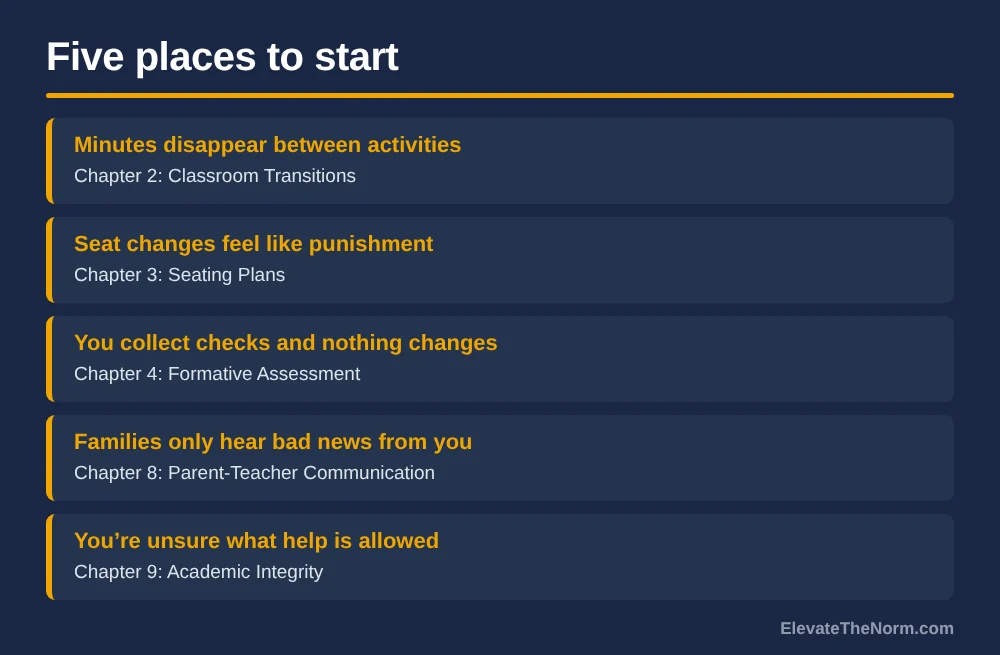
Start with the Classroom Systems Playbook chapter that fixes whatever is bugging you most this week. You don’t need all ten. Find your problem in the left column, then go to that chapter.
| If this is the problem | Start here |
|---|---|
| Class starts and ends in a scramble | Chapter 1, Classroom Routines |
| Minutes disappear between activities | Chapter 2, Classroom Transitions |
| A seat change feels like a punishment | Chapter 3, Seating Plans |
| You collect checks and tomorrow’s lesson stays the same | Chapter 4, Formative Assessment |
| Students rate their work with no proof | Chapter 5, Student Self-Assessment |
| You want skill-based grading but can’t rebuild the course | Chapter 6, Standards-Based Grading |
| Conferences turn into a kid reading a script | Chapter 7, Student-Led Conferences |
| Families only hear from you when there’s bad news | Chapter 8, Parent-Teacher Communication |
| Students aren’t clear on what help is allowed, AI tools included | Chapter 9, Academic Integrity |
| A hard class rewrites how you feel about the whole week | Chapter 10, Teacher Reflection |
Each chapter after the first also warns you where its pack usually goes wrong, and those warnings are worth reading before you print anything. Don’t launch five new transition cues in one week. Don’t let a low self-rating cost students points, or you’ll stop getting honest ones. Don’t change three things at once, because if it works, you won’t know why.
How do I use the Classroom Systems Playbook?
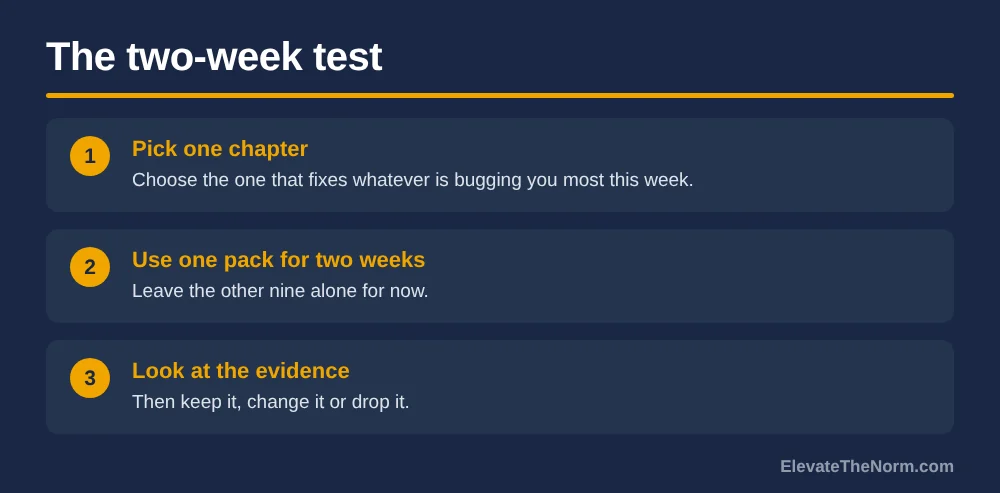
Use the Classroom Systems Playbook one chapter at a time, as a two-week test. Don’t try to run all ten. These three steps are the whole method:
- Pick the chapter that fixes whatever is bugging you most this week.
- Use that one pack for two weeks.
- Look at the evidence, then decide whether to keep it, change it or drop it.
Clay’s take: high expectations and real respect aren’t opposites. Students can handle a lot more responsibility than most systems give them, as long as the adults plan well and stay present. That’s what these pages are for.
Can I print, change or share the Classroom Systems Playbook?
Yes. Teachers can print the Classroom Systems Playbook, adapt it and share it with another teacher, free, for classroom and school use. The limits are simple: don’t resell it, and don’t present it as your own work.
More free downloads are on the Teacher Resources page.
Frequently Asked Questions
Is the Classroom Systems Playbook really free?
Yes. The Classroom Systems Playbook costs nothing. It’s a 43-page PDF that downloads directly from this page, and everything on ElevateTheNorm.com is free. The banners on this page point to a separate paid store on Teachers Pay Teachers, but you don’t need anything from that store to use the ebook.
Do I need an email address to download this free classroom management ebook?
No. This free classroom management ebook has no email gate, no form and no sign-up. Click the download button and the PDF is yours. You won’t land on a mailing list and you won’t need an account. If you only want one toolkit, each pack can also be downloaded on its own from its chapter page.
How many pages of the Classroom Systems Playbook can I print?
The Classroom Systems Playbook has 30 printable classroom pages out of 43, three for each of the ten toolkits. The other 13 are nine chapter openers, a cover, a welcome note, a table of contents and a closing page. You can print one pack without printing the rest, because each toolkit sits together in the PDF.
Does the Classroom Systems Playbook work for middle school and high school?
Yes. The Classroom Systems Playbook was written for grades 6–12, and the printables assume real teenagers who can carry real responsibility. Student-led conferences, evidence-based self-assessment and the group-work form all ask students to do the thinking themselves. An elementary teacher could borrow ideas, but would need to adapt the language and the amount of student control.
Can a whole school or department use the Classroom Systems Playbook?
Yes. The Classroom Systems Playbook is free for classroom and school use, so a department or a whole staff can print and share it. Just don’t resell it or present it as your own work. Before adopting a chapter, check it against local rules. The grading and academic integrity chapters both say to check your district or school policy first.
Is there research behind the Classroom Systems Playbook?
The research sits on the chapter guides, not inside the ebook. Each chapter links to free pages on ElevateTheNorm.com that give the sources. This site doesn’t claim that any study tested the ebook as a whole. Treat each pack as a practical tool, and judge it by your own two weeks of evidence.
How do students fit into the systems in this ebook?
Students carry real responsibility in these systems. They run transitions, back up self-ratings with evidence, pick their own conference evidence and name their own next step. The academic integrity chapter gives students a repair plan with a deadline and restored standing at the end. The point is ownership and a clear way back after a mistake, not slogans or manufactured stakes.
How long should I try one pack before changing it?
Try one pack for two weeks before you decide. That’s the test the Classroom Systems Playbook recommends: pick one chapter, use one pack, then look at the evidence and keep it, change it or drop it. The two weeks are the ebook’s own working rule, not a research finding, so stretch it if your schedule breaks up the stretch.
Sources
This page makes no outside research claims. Everything on it comes from the ebook itself. The research behind each system is cited on the chapter guides linked in the table above.
- The Classroom Systems Playbook (PDF, 43 pages), by Clay Shumate, Elevate the Norm