Student-led conferences are meetings where the student — not the teacher — presents their own work to their family, explains what it shows, names what went wrong, and says what they plan to do next. The adults are there to listen and respond. For grades 6–12 the format works because it moves the accounting onto the person who actually did the work.
The usual conference has a structural problem nobody names: the student is the only person in the building with first-hand knowledge of what happened, and they are the one person not in the room. Two adults discuss a third party who is somewhere else, and then somebody reports back a summary.
Student-led conferences fix that. They are also more work than they look, they fail in specific and predictable ways, and the evidence behind them is thinner than the enthusiasm around them. All of that is below.
Key Takeaways
- The student runs the meeting. Not a presentation about the student — a presentation by the student, from evidence they selected.
- Attendance is the most reliable gain. One middle school went from 85 traditional conferences to 565 student-led ones in a single year.
- The preparation is the curriculum. Four weeks of collecting, choosing, writing and rehearsing is where the learning happens. The 25 minutes is just the assessment.
- Be honest about the evidence. Most of what is published is descriptive, from elementary and middle grades, and the strongest recent study explicitly did not measure achievement.
- Plan for the families who do not come. A format that only works for students with an adult in the chair will quietly punish the students who need it most.
- This is a writing and speaking unit. Treat it as one, mark it as one, and the workload argument mostly disappears.
What Are Student-Led Conferences?
A student-led conference is a scheduled meeting, usually 20–25 minutes, in which a student walks their family through a portfolio of their own work using a script they wrote. The teacher is in the room — often supervising several conferences at once — and speaks when asked or when something needs correcting. The student does the rest.

Faulkner and Cook, writing for the Association for Middle Level Education, put the shift in one line from a teacher who had made the change: “It’s not me telling the parents that Johnny is failing because he won’t turn in his work.” The student says it. That sentence lands differently when it comes out of the student’s own mouth, in front of the person whose opinion they care most about.
What it is not: a showcase. If students only present their best work, you have built an awards ceremony. The format earns its keep when the folder includes the assignment that did not get done, and the student has to say why.
Why Student-Led Conferences Work — and What the Evidence Actually Shows
Start with the claim that holds up best, because it is the one with numbers attached: families turn up.
Faulkner and Cook report a school that went from 85 traditional conferences to 565 student-led conferences in the first year of the change. A research brief from The Principals’ Partnership describes Mead High School’s first round of student-led conferences, where over 98 percent of parents, 84 percent of students and 100 percent of advisors said the conferences were worthwhile.
That is a real effect and it is not trivial. A conference nobody attends teaches nobody anything.
Where the evidence thins out
Now the honest part. The same Principals’ Partnership brief says plainly that most of what is written about student-led conferences describes elementary or middle-level implementation, and it is a 2005 document summarising practice rather than a controlled study.
The most substantial recent study is Şişman and Bahadır’s, covering 249 students, 280 parents and 22 teachers across fourth grade through high school in a single private school. It found positive effects on responsibility, self-management, self-expression, communication and leadership — and the authors themselves note that future research should look at the effects on student achievement, which is a polite way of saying this one did not. One private school also limits how far the result travels.
So the defensible version is this. Student-led conferences reliably increase family participation, and the people who do them report gains in student ownership and communication. Whether they raise achievement is genuinely unstudied. Anyone telling you otherwise is selling something.
That is still a good enough reason to run them. Getting a fourteen-year-old to account for their own work in front of their family is worth doing whether or not it moves a test score, and it fits the same logic as raising the standard without removing grace.
What the Student Actually Says
Give every student the same four-part spine. Without it, most of them freeze in the first minute and the parent starts asking you questions instead — and the conference quietly reverts to the old format while everyone pretends otherwise.
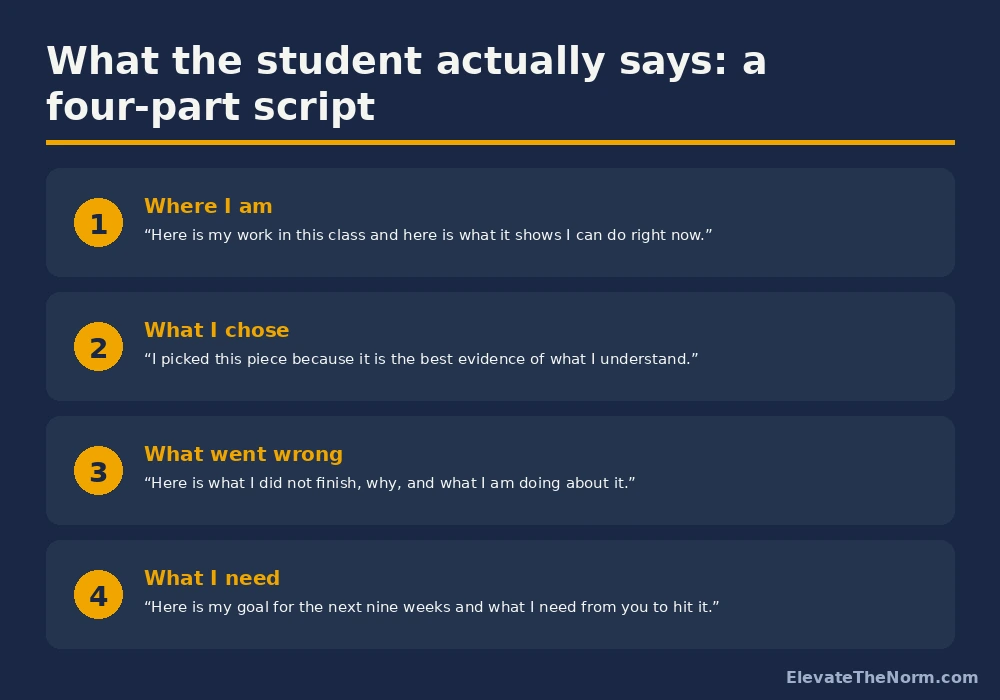
The four parts, in order: where I am, what I chose and why, what went wrong, and what I need. Each one is a short paragraph the student drafts, revises and rehearses.
The third part is the one that matters and the one schools soften. “What went wrong” is where a student says out loud that they did not turn in three assignments in October, and then says what they are doing about it. Peter Neeves, writing in Edutopia, describes handling missing work not with punishment but with a written reflection and an assistance plan that names the underlying issue — organisation, attendance, whatever it actually is. That is the right instinct. The student still has to say it.
The fourth part keeps the meeting from ending in vague agreement. “What I need” forces a specific, checkable ask: a weekly check-in, a quieter place to work at home, a reminder on Sunday nights. Families leave with a job, which is what most of them wanted in the first place.
Who Is Doing What While the Student Talks
Everyone in the room needs a job, or the adults will invent one. The job they invent is usually talking.
The student runs the meeting and owns the account of their own term. The family member listens first and asks questions second — hand them a printed card with three prompts on the way in, or the default question becomes some version of “so are you behaving?” The three that work: what surprised you about your own work, what would you do differently, and what is one thing I could do at home that would actually help.
The teacher stays out of it unless invited, then adds one piece of context the student could not supply — nine times out of ten something the student undersold. Counsellors and administrators moving between conferences should be listening for patterns across students rather than evaluating individual ones. An instructional coach watching a colleague’s first round has one genuinely useful measurement to take: how much of the twenty-five minutes the teacher spent talking. Above a fifth of it and the thing that needs tightening is the script, not the teacher.
A Four-Week Run-Up That Fits an Ordinary Term
The preparation is the part that gets skipped and the part that decides whether this works. Four weeks, one thing per week, all of it inside lessons you were teaching anyway.

- Collect. Every student starts a folder. Every graded piece goes in, good or bad, dated. No curation yet — curation is next week’s skill and doing it now defeats the point.
- Choose. Two pieces of evidence per class, plus one sentence each on why that piece was chosen. Neeves describes teachers offering three eligible samples and letting the student pick one; that constraint helps students who would otherwise pick at random.
- Write. Students draft the script. This is a writing lesson — audience, purpose, evidence, concision — so teach it and mark it as one. It is also the week you find out who has been quietly hiding.
- Rehearse. Twice, on a partner. The first run is a disaster for almost everyone. The second is the one that works, which is the entire argument for rehearsing.
Neeves puts the whole cycle at roughly one month with benchmark dates published to staff, which matches what the four weeks above ask for. Faulkner and Cook are blunt that the first run is labour-intensive for faculty. Both are true. The second year costs a fraction of the first.
Build one adaptation in from the start rather than improvising it later: for a student who genuinely dreads speaking in front of people, let them write the conference as a letter to their family and read it aloud. The structure still does its work — evidence, an honest account of what went wrong, a stated next step — and it is a far better outcome than a student who freezes and a parent who ends up looking at you instead. Decide that in the writing week, not on the night.
If you want the forms rather than the argument, the free student-led conference toolkit has the portfolio cover sheet, the script frame and the reflection prompts, with no email required.


Watching a Student Defend Their Own Decisions
The closest thing I run to this on an ordinary week is a project check-in where the student has to defend the choices they made — not report what they did, but explain why they did it that way and why the alternative was worse.
It changes what students pay attention to. When you know you will have to justify a decision out loud to somebody who will ask a follow-up question, you make the decision differently in the first place. The check-in is not really an assessment of the work. It is the thing that makes the work get thought about.
A student-led conference is that same move, scaled up and pointed at a harder audience. A teenager explaining a rubric decision to me is practising. A teenager explaining a term’s worth of work to their own family is doing the real version, and they know the difference.
Which is also why the preparation cannot be skipped. Handing a student that audience with no script is not raising the standard — it is setting them up, and the students most likely to be embarrassed by it are the ones already having the worst term.
The Families Who Do Not Come
Plan for this before you launch, not on the night. Faulkner and Cook name it directly: not all parents attend, and schools need a contingency. If your entire format depends on an adult sitting in that chair, then the students whose families work nights, lack transport, or simply will not come get a worse version of school than everyone else — and those are frequently the students the format was supposed to help.
Workable contingencies, roughly in order of preference:
All of these depend on being able to reach the family at all, which is worth checking before conference week rather than during it — a running log of family contact will show you quickly which families you have not actually reached. If you are still deciding what to keep that log in, choosing a parent-teacher communication app is more a question of approval and student data than of features.
- A different adult from the building. A coach, a counsellor, a teacher from another department. Arrange it quietly in advance so the student is not visibly the one nobody came for.
- A phone or video slot on another day. Costs nothing and solves the shift-work problem for a lot of families.
- A recorded conference. The student delivers the script to camera and it goes home. Weaker, because the follow-up questions are the valuable part, but far better than nothing.
- Never: skip the student. If a student prepared for four weeks, they present. The audience can change; the presentation happens.
Schedule the alternatives at the same time you schedule the main round. A contingency invented at 6pm on conference night is not a contingency, it is an apology.
Where Student-Led Conferences Go Wrong
- Skipping rehearsal. The single most common failure. An unrehearsed student reads the script at the table in a monotone and everyone concludes the format does not work.
- Turning it into a showcase. Best-work-only conferences are pleasant and teach nothing. The missing assignment belongs in the folder.
- The teacher taking over. Usually well meant, usually triggered by a silence the teacher finds uncomfortable and the student does not. Let the pause sit.
- Running it once. The first round is the expensive one. Schools that quit after year one pay the full cost and collect none of the return.
- No plan for absent families. Covered above, and it is the failure with the worst distribution of harm.
- Treating it as an add-on. If the preparation is not inside your teaching time, it will not survive contact with an ordinary term.
The Follow-Up Almost Nobody Runs
Six weeks after the conference, pull the students’ stated next steps back out and spend one lesson having them write a short progress note against their own commitment. Not a grade, not another form for the family — just the student, in writing, on whether they did the thing they said they would do in front of their mother.
That one lesson is most of the difference between a format and an event. The commitment was public, it was theirs, and now it has a check-in attached to it. Skip it and the conference becomes a very well-organised twenty-five minutes that nothing follows.
What to Do Next
Do not start with the whole school. Start with one section, one term, and the four-week run-up. Tell families in writing what will be different and why, so nobody arrives expecting the usual five minutes with you. Build the alternate-audience list before you need it.
Then judge it on the thing you can actually see: whether students can account for their own work in front of somebody who matters to them. That is the skill the format teaches, it is measurable in the room, and it is worth having whether or not anyone ever proves it moves a grade. It also sits naturally alongside expecting a lot and backing it with support rather than pressure. It also pairs naturally with assigning students genuine leadership roles inside the classroom — the conference is the most visible of them, because the audience is the student’s own family.
Frequently Asked Questions
How long should a student-led conference be?
Twenty to twenty-five minutes is the standard, and it is about right for grades 6–12. Shorter than fifteen and students rush the part where they explain what went wrong, which is the part worth having. Longer than thirty and families with several children cannot make the schedule work. If you are running several conferences at once in one room, build in five minutes of slack between slots.
What if the student is failing? Is this not humiliating?
It is the opposite, if you prepare it properly. The humiliating version is the one where two adults discuss a student’s failure while the student waits outside. In a student-led conference the student names the problem themselves, in their own words, with a plan attached. What makes it cruel is skipping the preparation — handing a struggling student that audience with no script and no rehearsal. Do the four weeks and this becomes the most useful conversation a failing student has all year.
Do student-led conferences replace traditional parent-teacher conferences?
Not necessarily, and the research summaries treat the model as a supplement rather than a straight replacement. Some parents genuinely want a private conversation with the teacher, and there are situations — a safeguarding concern, a possible referral, a dispute — that should never be run through a student. A common arrangement is student-led as the default with a signup option for a separate adults-only conversation.
How much extra work is this for teachers?
The first round is genuinely heavy; the sources describing it say so plainly. After that it drops sharply because the portfolio structure, the script frame and the schedule already exist. The way to keep it sustainable is to stop treating the preparation as extra. Collecting, selecting evidence, writing to an audience and rehearsing a spoken presentation are all things you were supposed to be teaching anyway. Run them as the unit they are and mark them.
What does the teacher actually do during the conference?
Supervise, and stay out of it. You are usually overseeing several conferences in one room, which is part of why this scales. Answer direct questions, correct anything factually wrong, and otherwise let silences happen. The most common teacher error is filling a pause that the student was about to fill themselves.
At what grade can students start leading their own conferences?
Middle school is where most of the published practice sits, and sixth or seventh grade is a reasonable starting point with a tighter script and a shorter portfolio. High school students can carry a much longer conference and a far more honest one. The evidence base skews younger — a lot of what is written describes elementary and middle-level implementation — so treat high school adaptations as your own professional judgment rather than something the literature has settled.
How do we handle a family that speaks a language other than English?
Arrange interpretation the same way your school does for any other family meeting, and arrange it in advance rather than on the night. Do not use the student as the interpreter for their own conference — it collapses the whole point, because the student ends up translating a conversation about themselves instead of leading one. If a sibling or relative normally interprets, confirm that the family actually wants that here.
Sources
- Faulkner, S. A., & Cook, C. M. (2009, October). Student-led conferences: Involving the most important player. Middle Ground, Association for Middle Level Education. Read the article
- The Principals’ Partnership (2005, January 31). Research brief: Student-led conferences. Sponsored by the Union Pacific Foundation. Read the brief (PDF) — the source for the Mead High School figures, and for the caution that most published material describes elementary and middle-level implementation.
- Şişman, C., & Bahadır, E. The effects of student led conferences on the improvement of 21st century career and life skills. International Journal of Learning, Teaching and Educational Research. Journal record — 249 students, 280 parents and 22 teachers in one private school; the authors state that effects on achievement were not measured.
- Neeves, P. (2025, December 3). How to successfully institute student-led conferences at your school. Edutopia. Read the article
- ERIC Digest (1997, May). Student-led conferences at the middle level. ED407171. ERIC record
Every link above was checked on September 12, 2026. Where a figure comes from a practitioner report rather than a controlled study, the text says so.