
By Clay Shumate
The Frayer Model is a four-box graphic organizer for teaching one concept: definition, characteristics, examples, and non-examples. It works best on a handful of load-bearing terms per unit, not on every vocabulary word. The organizer itself has never been tested in a controlled trial in grades 6–12, so treat it as a sound structure rather than a proven intervention.
Key Takeaways
- The Frayer Model asks a student to define a concept in their own words, list its characteristics, and supply both examples and non-examples with reasons attached.
- The non-example box is the part that does work no definition list can do, because it forces a student to locate the edge of a concept rather than its center.
- Explicit vocabulary instruction in content-area classes is rated as having strong evidence by the federal What Works Clearinghouse panel, but that rating covers the practice in general and not this organizer in particular.
- The only peer-reviewed study of the Frayer Model at the secondary level involved five students, used no control group, and reported no effect sizes or p-values.
- Reserve the organizer for a small number of concepts the rest of a unit depends on; using it on a twenty-word list converts thinking into transcription.
The Frayer Model shows up in every instructional-coaching deck and almost never gets interrogated. Four boxes, a word in the middle, done. It is easy to photocopy and easy to assign, which is exactly why it gets used on days it has no business being used.
It is also genuinely good at one specific job. The trick is knowing which job that is, and being honest about how much the research actually supports. For the wider question of how to build vocabulary work into a course, this site already covers the broader routine for teaching vocabulary in a content class. This page is narrower on purpose: one named organizer, and when it earns its minutes.
What is the Frayer Model?
The Frayer Model is a graphic organizer that surrounds a single concept with four prompts: a definition, the concept’s characteristics, examples, and non-examples. A student fills in all four and ends with a one-page account of the concept’s meaning and its boundaries.
That last word is the point. Most vocabulary tasks ask what a word means. The Frayer Model asks where the word stops being true. A student can produce a serviceable definition of revolution or mitosis or irony and still have no idea which cases fall inside it. The non-example box is where that gap becomes visible.
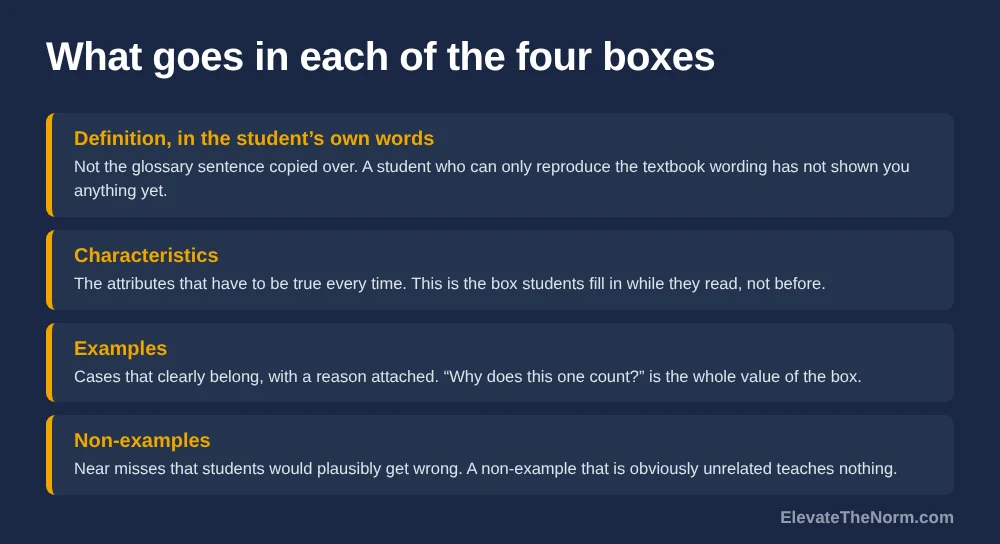
The boxes are not interchangeable and they are not meant to be filled in one sitting. The definition and the characteristics are the front end, built as students meet the concept. Examples and non-examples work better once students have enough content to argue about, which usually means partway through a unit rather than on day one. The Middle School Matters Institute, a project of the George W. Bush Institute with the Meadows Center at the University of Texas at Austin, recommends exactly that sequencing: background and definition at the start of a unit, characteristics gathered during reading, examples and non-examples added once students have more experience with the content.
Where did the Frayer Model come from?
The Frayer Model comes from a 1969 technical report by Dorothy Frayer, Wayne Frederick and Herbert Klausmeier at the University of Wisconsin, titled A Schema for Testing the Level of Concept Mastery. It was built to test whether someone had mastered a concept, not as a worksheet.
That origin explains a lot about how the model behaves in practice. The original schema ran to more steps than four, and the familiar four-square handout is a later simplification of it. A widely used adaptation credited to Graves walks through six moves: define the concept and its essential attributes, distinguish it from similar concepts, give examples with reasons, give non-examples with reasons, have students sort cases you supply, and then have students generate and discuss their own.
Read that list and the time cost stops being a surprise. When teachers say the Frayer Model takes too long, they are usually right — they have just applied it to a word that did not need it.
Does the Frayer Model actually work?
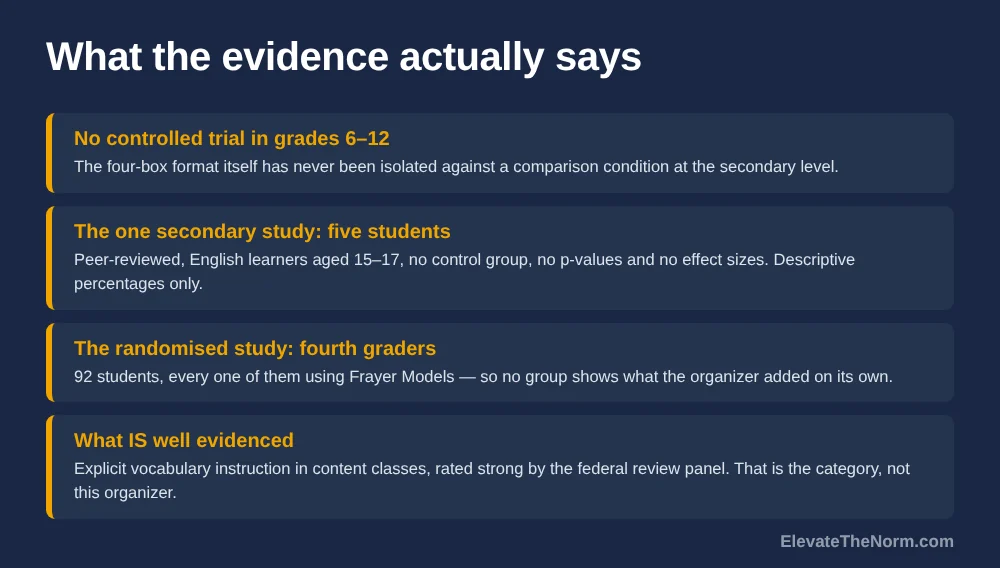
No controlled trial has isolated the Frayer Model against a comparison condition in grades 6–12. Evidence cited for the organizer is almost always evidence for explicit vocabulary instruction in general, which is a different and far better-supported claim. Keeping those two apart is the whole job here.
What is well evidenced
The federal What Works Clearinghouse practice guide Improving Adolescent Literacy: Effective Classroom and Intervention Practices (Kamil and colleagues, NCEE 2008-4027) makes “provide explicit vocabulary instruction” its first recommendation and rates the level of evidence as strong. The guide covers upper elementary through high school. It is the firmest ground in this whole area.
It is also worth noting what that guide does not say. It does not mention the Frayer Model, graphic organizers, or word maps anywhere in that recommendation. Its four implementation steps are about dedicating class time, repeated exposure across contexts, varied opportunities to use words, and teaching students independent word-learning strategies. A teacher who does all four with no graphic organizer at all is following the strong-evidence recommendation.
What the organizer research shows, and on whom
The closest thing to a quantitative base is a meta-analysis of graphic organizers by Dexter and Hughes in Learning Disability Quarterly. Across 16 studies, 55 effect sizes and 808 participants in grades 4–12, it reports a posttest effect size of 0.91 (95% CI 0.79 to 1.03) and a maintenance effect of 0.56 (0.41 to 0.70) one to four weeks later. Science and social studies ran around 1.04–1.05; mathematics was significantly smaller at about 0.59.
Those are strong numbers, and they come with limits the authors state themselves. Every participant was a student with a learning disability, and all of the studies ran in self-contained resource rooms. Nearly every outcome measure was researcher-made rather than standardized, and control conditions were typical classroom practice rather than a competing organizer. Most importantly for this page: the Frayer Model is not among the organizer types that meta-analysis covers. It examined cognitive maps, semantic maps and semantic feature analysis. Borrowing 0.91 for a Frayer Model is not a citation, it is a swap.
The two studies that are actually about the Frayer Model
The only peer-reviewed study at the secondary level is Hulderman, Wageman, Duffield and Nyachwaya in TESL-EJ (ERIC EJ1477809). It followed five English learners aged 15 to 17 through 24 academic vocabulary words. Group totals moved from 51% to 81% on a teacher-made multiple-choice test, and the average writing-assessment score was 69%. The authors report no p-values, no effect sizes and no standard deviations, and they name the small sample as their first limitation. The paper also describes its own length as six weeks in the abstract and one semester in the limitations section.
The one randomized study is Reed, Jemison, Folsom and Weber, summarized here from the Iowa Reading Research Center’s research brief rather than the Journal of Experimental Education paper itself. It randomized 92 students across 15 science terms and 30 lessons. Both conditions grew, with within-group effect sizes of 0.60 and 0.61, and the difference between partner discussion and independent work was not statistically significant (d = 0.176). Two things about it matter here. Those students were fourth graders, which is outside this site’s grade band and outside the range where content-area reading demands bite hardest. And every student in the study used Frayer Models, so the design cannot say what the organizer itself contributed. The brief says so directly.
The Middle School Matters write-up reaches the same conclusion from the practitioner side: the four-square format itself has not been directly tested. So the honest summary is that the Frayer Model is a well-reasoned structure sitting inside a well-evidenced category, carried mostly by the strength of the category. That is a reasonable basis for using it. It is not a basis for mandating it.
How does the Frayer Model compare to other vocabulary tools?
The Frayer Model goes deep on one concept and costs real class time. A definition list, a word wall and a concept map each trade that depth for breadth, speed or connection. Choosing between them is a question of what the task needs to produce, not which tool is best.
| Tool | Typical class time | What it actually produces | Best for | Main drawback |
|---|---|---|---|---|
| Frayer Model | A meaningful slice of a period, often built across several days | One concept with its boundary made explicit, in the student’s own words | A load-bearing concept the rest of the unit depends on | Far too slow for more than a few terms; fails on words with no plausible near miss |
| Definition list | Five to ten minutes | A record that a term exists and roughly what it means | Terms students only need to recognize | Copying is indistinguishable from understanding |
| Word wall | Setup time, then near zero | A persistent, shallow reference for many terms at once | Keeping a unit’s language visible and in circulation | Becomes wallpaper fast unless you actively point at it |
| Concept map | Comparable to a Frayer Model | Relationships between concepts | End-of-unit synthesis across several terms | Says little about any single term’s boundary |
The Frayer Model and the concept map are not really competitors; they are bookends. One sharpens a single idea early in a unit, the other wires the ideas together at the end. If a faster option is what you need, this site keeps a working set of quicker checks for understanding.
Which words are worth a Frayer Model?
A word earns a Frayer Model when it is a concept rather than a label, when other vocabulary in the unit clusters around it, and when it has plausible non-examples. Terms that fail any of those three tests are better served by something faster.
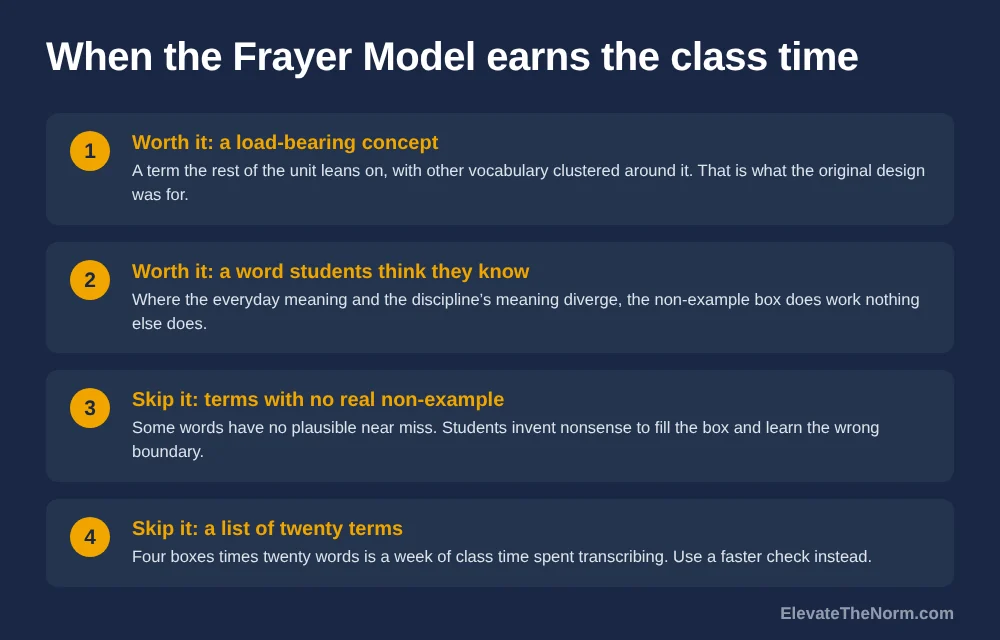
The second case on that list is the one teachers underuse. Words where the everyday meaning and the discipline’s meaning pull apart — theory, significant, argument, power — are where students carry a confident wrong answer all year. A non-example box surfaces that without a one-to-one conversation.
On how many: no authoritative source gives a number, and it would be easy to invent one here. The design logic points at a small handful per unit. For scale, Harvard’s Nonie Lesaux has summarized estimates putting explicit academic vocabulary instruction at roughly 10% of academic time in middle school, much of it incidental — and she attributes those figures to estimates rather than to a measured study. Her practical advice is the usable part: focus deeply on a small set of high-utility words rather than skimming many.
How do I run a Frayer Model in a content class?
Run it across a unit rather than in one sitting, model the first one yourself, and have students argue about the examples. The failure mode is handing out a blank template and collecting it at the bell, which produces four boxes of copied text and no thinking.
One practical note before the steps, because it stops people adopting this. There is no special template to hunt down. A Frayer Model is a page divided into four boxes with the term in the middle — students can fold a sheet into quarters or you can draw it on the board in ten seconds. That matters beyond convenience: the strategy costs nothing, needs no device and no subscription, and works the same in a room with a class set of laptops and a room without one.
- Fill one in yourself first. This is the step everyone skips and it is the one that saves the period. If you cannot write a plausible non-example for the term, the term is wrong for this task and you have found that out before thirty students did.
- Tell students what the organizer is for. Thirty seconds of “this is about where the concept stops being true, not about the definition” changes what they write. Without it, students reasonably assume the goal is a neat page.
- Model the first term with a think-aloud. Say out loud why a borderline case does or does not qualify. The reasoning is the thing being taught; the boxes are just where it gets stored.
- Give the definition and characteristics early, then stop. Students have enough to work with and nothing yet to argue about.
- Come back to it during the reading. Characteristics get added as evidence turns up. This is what makes the organizer a running account rather than a worksheet.
- Add examples and non-examples once there is content to draw on. Require a reason beside each one. An example without a reason is a guess that looks like an answer.
- Have students sort cases you supply before they generate their own. Sorting is easier than generating and it surfaces disagreements you can teach into. It is also the move for a student who is stuck: a student who cannot invent a non-example can almost always judge one, and judging is the same thinking in an easier form.
- Have them defend one non-example to a partner, then take volunteers. Asking a student to defend a borderline case cold, in front of the room, when they are not sure yet is a good way to teach them to write only the safe answer. Let the reasoning get rehearsed at the desk first. You will still hear what you need while circulating, and you will hear more of it.
Where the finished organizers live matters more than it sounds. A Frayer Model built over a week and then lost in a backpack has wasted the week. Pairing it with a notebook system that gives the work a permanent home is the difference between a reference students actually return to and a page they hand in once.
How should I score a Frayer Model?
Score the reasoning, not the handwriting. Three levels per box — absent, present but copied, present and reasoned — is enough to tell you what you need, and it keeps the grading load survivable across five sections.
The definition box tells you whether a student can restate a concept without the glossary. The characteristics box tells you whether they were reading. The examples box is the easiest to fake, because a student can lift examples straight from the text. The non-example box with its reason attached is the one that separates understanding from copying, and if you are short on time it is the box to read first.
Two cautions worth stating. A Frayer Model is diagnostic work, and grading diagnostic work heavily teaches students to play it safe on exactly the box where risk is the point. Weighting it like a quiz produces four tidy boxes and no honest attempts at the hard edge. It also lands hardest on the students it should help most — English learners and students who find written output slow will lose marks for the writing rather than the thinking, on a task whose whole purpose was to show you the thinking. And a student who writes a wrong non-example and explains their reasoning has given you something more useful than a student who wrote nothing. The score should say so.
It is worth being able to explain this to a family, too, because four boxes on a page look a lot like busywork from the kitchen table. The short version: the organizer is not asking a student to copy a definition, it is asking them to work out where a concept stops applying and to say why. That is a harder question than the definition, and it is the one that shows up again on the test.
When is the Frayer Model a waste of a class period?
The Frayer Model wastes a period when it is used on a vocabulary list rather than a concept, when a term has no real near miss, or when it is set as silent seatwork with no discussion. In each case students fill four boxes and learn close to nothing.
There is a fourth failure that is harder to see coming. The Middle School Matters account of a school-wide rollout reports that early enthusiasm faded, teachers drifted back to their own methods, and the inconsistency confused students — a real cost of adopting the model as a building-wide expectation rather than a tool teachers reach for. The same account names the snag teachers hit first: not every term has a non-example.
If what you actually need is for students to interact with the text as they read, the organizer is the wrong instrument and how students mark up the text itself is the better place to start. If you need them to capture a long stretch of content, note-taking formats built for longer stretches of content will serve better than four boxes ever will.
What to do next
Pick one concept from the unit you are teaching next — the one the rest of the content leans on — and fill in a Frayer Model for it yourself before you plan anything. If you can write a non-example that a reasonable student would get wrong, you have found a good candidate. If you cannot, you have saved yourself a period and learned something about the term.
Then use it on that one concept and nothing else in the unit. The Frayer Model is not a vocabulary system and it does not scale to a word list. It is a way of making one idea’s boundaries visible, and used that way it earns its time. Used on twenty terms it is a photocopying habit with a research-sounding name, and the research, honestly read, does not back it that far.
Sources
- Kamil, M. L., Borman, G. D., Dole, J., Kral, C. C., Salinger, T., & Torgesen, J. Improving Adolescent Literacy: Effective Classroom and Intervention Practices. National Center for Education Evaluation and Regional Assistance, Institute of Education Sciences, U.S. Department of Education (NCEE 2008-4027).
- Dexter, D. D., & Hughes, C. A. “Graphic Organizers and Students with Learning Disabilities: A Meta-Analysis.” Learning Disability Quarterly, 34(1), 51–72.
- Hulderman, K., Wageman, J. J., Duffield, S., & Nyachwaya, J. “The Effect of the Frayer Model on Secondary English Learner Vocabulary Acquisition.” TESL-EJ, 29(1). ERIC EJ1477809.
- Iowa Reading Research Center, University of Iowa. “Research Brief: Discussing a Vocabulary Graphic Organizer with an Online Partner May Help Students Learn Science Content.” A summary of Reed, D. K., Jemison, E., Folsom, J. S., & Weber, A., Journal of Experimental Education, 87, 552–574. Cited here as a research brief; the primary paper was not read directly.
- Griffin, C., with Reed, D., & Parhms, P. “Delivering Explicit Vocabulary Instruction: Using the Frayer Model.” Middle School Matters Institute, George W. Bush Institute with the Meadows Center for Preventing Educational Risk, University of Texas at Austin. Carries the Frayer, Frederick & Klausmeier (1969) citation and the Graves six-step adaptation.
- Lesaux, N. K. “Focus Deeply: Best Practices in Academic Vocabulary Instruction.” Harvard Graduate School of Education. The instructional-time percentages in it are described as estimates rather than measured figures.
- Frayer, D. A., Frederick, W. C., & Klausmeier, H. J. A Schema for Testing the Level of Concept Mastery, Technical Report No. 16. University of Wisconsin Research and Development Center for Cognitive Learning, Madison. Origin citation, carried by the two sources above; the technical report itself was not reachable and is not quoted here.
Frequently Asked Questions
What are the four parts of the Frayer Model?
The four parts of the Frayer Model are a definition, characteristics, examples, and non-examples, arranged around a central term. The definition should be in the student’s own words. Characteristics are the attributes that hold every time. Examples and non-examples each need a stated reason, because the reason is where the thinking shows up rather than the item itself.
Is the Frayer Model backed by research?
Not directly, and that distinction matters. Explicit vocabulary instruction in content classes carries a strong evidence rating from the federal What Works Clearinghouse panel, but that rating covers the category, not the four-box format. No controlled trial has isolated the Frayer Model against a comparison condition in grades 6 through 12. Treat it as a sound structure, not a proven intervention.
How many Frayer Models should students do in a unit?
No authoritative source sets a number, which is worth saying plainly rather than inventing one. The design logic points to a small handful per unit: terms the rest of the content leans on, with other vocabulary clustered around them. Four boxes across twenty words turns a thinking task into a transcription task and costs days of class time.
How long does a Frayer Model take in class?
Expect a meaningful slice of a period rather than a warm-up. One randomized fourth-grade study logged roughly 101 minutes of added partner discussion across 15 organizers, about seven minutes each on collaboration alone. Building the boxes well, with reading in between, generally runs longer than that in a secondary content class.
When should I not use a Frayer Model?
Skip it when a term has no plausible near miss, because students will invent nonsense to fill the non-example box and learn a false boundary. Skip it for long vocabulary lists, for words students only need to recognize once, and for anything a two-minute check would settle. The organizer is built for concepts, not for terms.
What is the difference between the Frayer Model and a word wall?
A Frayer Model is a deep treatment of one concept that a student builds and keeps; a word wall is a shallow, persistent reference for many terms that lives on the classroom wall. They answer different questions. A word wall helps a student recall that a term exists and roughly what it means. A Frayer Model is how a student works out where the concept’s boundaries sit.
Does the Frayer Model work for English learners?
The only peer-reviewed secondary study on the Frayer Model ran with five English learners aged 15 to 17 and reported gains, but it had no control group, no p-values and no effect sizes. That is promising rather than conclusive. The structure’s emphasis on examples, non-examples and student wording is well matched to language learning, but five students cannot settle the question.
How do you grade a Frayer Model?
Score the reasoning, not the neatness. The definition box checks whether a student can restate the concept without the glossary. The non-example box, with its reason, is the one that actually separates students who understand the boundary from students who copied. A simple three-level scale per box is enough; a detailed rubric costs more time than the task is worth.
About Clay Shumate
Clay Shumate is a certified secondary Social Studies teacher in the public schools of West Alabama, with seven years of classroom experience, a B.A. in History, and an M.Ed. in Secondary Education. He writes about project-based learning, student responsibility, respect, and practical ways to hold young people to a higher standard while giving them room to learn from mistakes. This site’s editorial standards and corrections policy are published in full. More about Clay.

