
By Clay Shumate
The note taking strategies with the best evidence for high school students are the ones that change what a student does with the page: partially completed guided notes during the lesson, and self-quizzing from those notes over several short sessions afterward. Handwriting versus typing matters far less than most advice claims.
Key Takeaways
- Guided notes — a partially completed handout students fill in — have the strongest numbers here. A meta-analysis of 12 studies and 1,529 students found an overall effect of d = 0.546 against student-generated notes, though every study was post-secondary.
- The famous pen-beats-laptop study was run on 65 Princeton and 151 UCLA subject-pool students, and a 2019 direct replication did not reproduce it. Two experiments found no consistent difference, and the effect shrank further once students studied their notes.
- Note-taking’s own benefit is real but modest. Across 57 comparisons of note-taking against no note-taking, the effect was described as positive but modest — and higher grade levels did not increase it.
- What a student does afterward is where the big, well-replicated effects live. Practice testing and spacing study across sessions were both rated high utility in a major review; summarization, highlighting and rereading were all rated low.
- Teach one format, teach it explicitly, and then spend your time on the review step. There is no credible secondary-school trial showing one template beats another.
Almost every article on this subject answers a different question than the one students are asking. Teenagers want to know what to put on the page; the research is mostly about what happens to the page afterward. That gap explains why so much note-taking advice feels true and changes nothing.
Below is what holds up: five strategies ordered by what they cost a teacher, the honest version of the handwriting-versus-laptop fight, the one intervention with real numbers behind it, and the review step that does most of the actual work.
What are the best note taking strategies for high school students?
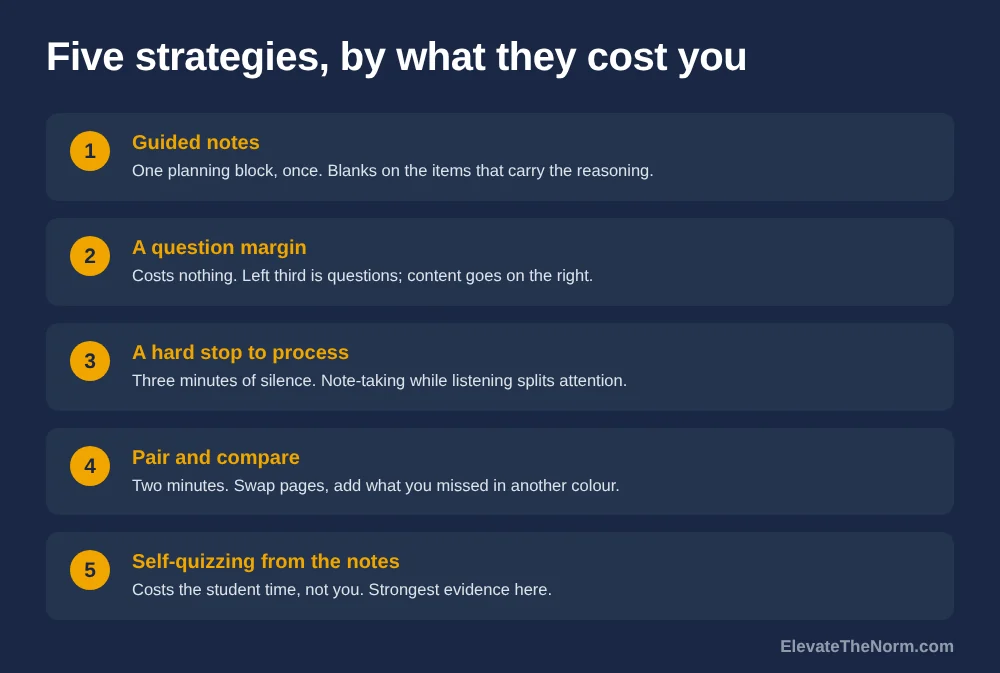
Five, in order of what they cost you to run: guided notes, a two-column page with a question margin, a hard stop for processing, pair-and-compare, and self-quizzing from the notes later in the week. The last one carries the most evidence.
- Guided notes — costs one planning block, once. Hand out the lesson’s structure with the key terms, figures and transitions left blank. Put the blanks on the items that carry the reasoning, not on incidental detail — a page of fill-in-the-blank trivia is a worksheet wearing a strategy’s name. Students write less and think more, and nobody loses the thread because they were still copying the previous slide.
- A question margin — costs nothing. Students rule off the left third of the page and write questions there, not content. The content goes on the right. The margin turns the page into a quiz by Friday instead of a transcript, which is the whole point of the two-column formats.
- A hard stop to process — costs three minutes. Stop talking twice a lesson and have students finish a sentence, fill a gap, or write the one thing they are not sure about. Taking notes while listening is a split-attention task; a pause is how you stop charging students for your pacing.
- Pair and compare — costs two minutes. Students swap pages and add what they missed in a different colour. It surfaces gaps immediately, it is the cheapest formative check in the room, and it runs on the same mechanics as any other structured student talk.
- Self-quizzing from the notes — costs the student time, not you. Cover the right column, answer the questions in the margin, check. Three short sessions across the week, not one long one the night before. This is the step with the strongest research in the entire article and the one students skip.
Notice that four of the five change the page and the fifth changes the week. If you only have the appetite for one, take the fifth. And be realistic about the first: one guided-notes page for the hardest lesson in a unit is achievable and reusable next year; one for every lesson is not, and a plan that assumes it will collapse by October.
Is handwriting notes better than typing on a laptop?
Probably a little, in some conditions, on a question nobody has properly tested on high schoolers. The original finding was real; the direct replication did not reproduce it, and both studies ran on university students.
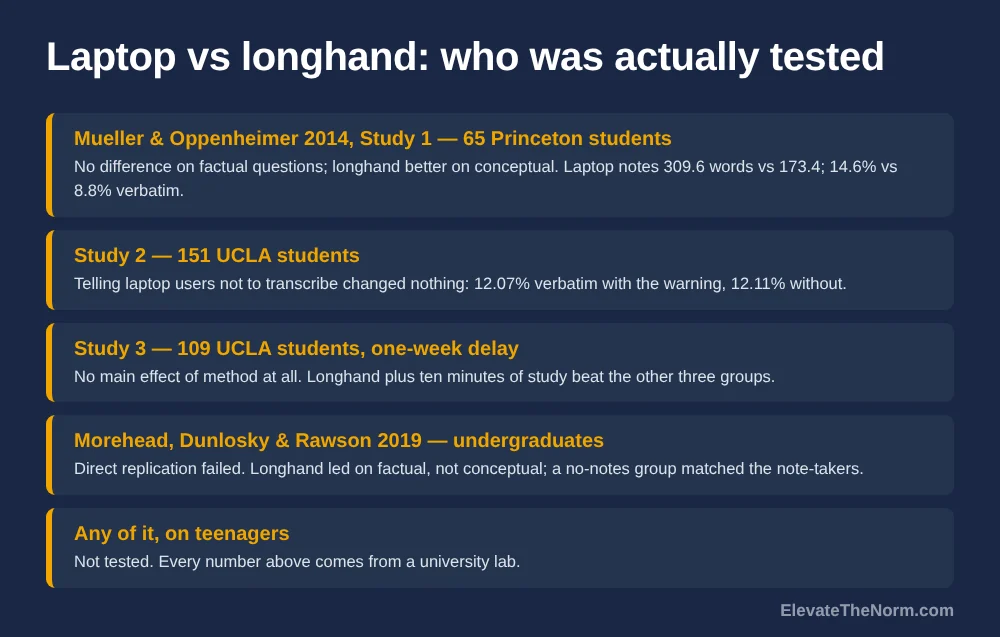
Pam Mueller and Daniel Oppenheimer’s 2014 study in Psychological Science is the source of every “the pen is mightier” headline. In Study 1, 65 students from the Princeton subject pool took notes on five TED Talks. On factual questions there was no difference at all. On conceptual questions the longhand group did better. Laptop notes averaged 309.6 words against 173.4 longhand, with 14.6 percent verbatim overlap with the talk against 8.8 percent — which is the mechanism the authors proposed: typing fast enough to transcribe means you can skip the thinking.
Study 2, with 151 UCLA subject-pool students, added a group told explicitly not to transcribe. The instruction did nothing — verbatim overlap was 12.07 percent with the warning and 12.11 percent without it. Study 3 tested a week’s delay and found no main effect of method at all; the only significant result was an interaction, where longhand students who got ten minutes to study their notes outperformed the other three groups.
Then in 2019, Kayla Morehead, John Dunlosky and Katherine Rawson published a direct replication and extension in Educational Psychology Review. In their first experiment longhand students did better on factual questions and showed no advantage on conceptual ones — the opposite pattern to the original. Their second experiment found no significant difference at all on an immediate test, and a group that took no notes did not perform worse than the note-takers. Across two delayed tests, method had no effect. Their meta-analysis of the direct replications found small, non-significant effects favouring longhand, and they concluded that naming a superior method “seems premature.”
| Study | Who it was run on | What it found | What it means for a 10th grader |
|---|---|---|---|
| Mueller & Oppenheimer (2014), Study 1 | 65 Princeton subject-pool students | No difference on factual questions; longhand better on conceptual. Laptop notes 309.6 words vs 173.4, 14.6% vs 8.8% verbatim | The mechanism is transcription, not the pen. A typist who paraphrases is not the person in this study |
| Mueller & Oppenheimer (2014), Study 2 | 151 UCLA subject-pool students | Telling laptop users not to transcribe changed nothing — 12.07% vs 12.11% verbatim | Do not expect a reminder to fix it. Change the task instead |
| Mueller & Oppenheimer (2014), Study 3 | 109 UCLA subject-pool students, one-week delay | No main effect of method. Longhand plus ten minutes of study beat everything else | The study step is doing the work in the one result that survived a delay |
| Morehead, Dunlosky & Rawson (2019) | Undergraduates, two experiments plus a replication meta-analysis | Longhand advantage on factual, not conceptual; no consistent difference overall; a no-notes group matched the note-takers | Nobody should be telling your students the question is settled |
| Any of them, on teenagers | — | Not tested | Every number above comes from a university lab. Treat the transfer as an assumption |
The defensible position for a high school teacher: if a student is transcribing instead of thinking, that is a problem whatever they are typing on, and the fix is a page that cannot be transcribed — which is what guided notes and a question margin are for. The same requirement, applied to the text itself rather than a separate page, is what separates annotation that works from highlighting. Banning laptops on the strength of a Princeton lab study is more certainty than the evidence supports. None of which overrides a device policy your school has already set; if yours restricts laptops, that is a conversation to have with an administrator rather than a rule to quietly ignore.
Does taking notes actually help, or just feel productive?
It helps, modestly. Across 57 studies comparing note-taking with no note-taking, the benefit of the act of writing was positive but small, and it did not get larger in higher grades.
Keiichi Kobayashi’s meta-analytic examination of the encoding effect in Contemporary Educational Psychology looked at exactly this. Three of its findings are worth a teacher’s time. Interventions designed to improve note-taking did not reliably increase the benefit, and neither did a higher schooling level. Visual presentation of the material interfered with note-taking. And recall tests picked up the effect more readily than recognition or higher-order tests did — so the gain is clearest on the kind of question that asks students to produce something, and least clear on the kind we say we care about most.
That middle finding deserves a sentence on its own. If you are projecting a dense slide and talking over it while students write, you are running the condition that interfered. The three minutes of silence in strategy 3 above is not a courtesy; it is the correction, and it is the same reason the first five minutes of a lesson are worth protecting.
Do guided notes work better than letting students take their own?
Yes, by a clear margin against blank-page notes, and by much less against a full set of teacher-provided notes. That second comparison is the one that tells you what to hand out.
Karen and David Larwin’s meta-analysis of guided notes pooled 12 studies, 27 effect sizes and 1,529 students. The overall effect was d = 0.546 (95% CI 0.342 to 0.749), which the authors describe as the average guided-notes student outperforming about 72 percent of students without them. Twenty-one of the 27 effects were positive.
The moderator analysis is the practical part. Against students generating their own notes from scratch, guided notes returned d = 0.781. Against a full set of professor-provided lecture notes, d = 0.265 — small, though still significant. In other words most of the value is in giving students structure, and you lose a lot of it by filling the structure in for them. The blanks are the intervention.
Two honest wrinkles. Every included study was post-secondary — the authors found no graduate studies and, relevant here, no secondary ones. And the discipline breakdown was not uniform: education d = 0.749, physics d = 0.614, psychology d = 0.603, but mathematics came out at d = −0.355 and dentistry at −0.142, neither significant. A procedural subject where the working is the content may not behave like a content-heavy one, and a maths teacher should treat this as untested rather than as support. Scaffolding the task without lowering the standard is the same principle that governs any other differentiation decision.
What should students do with their notes after class?
Quiz themselves from the notes, in short sessions spread across several days. Those two moves have the best-replicated evidence in the whole study-skills literature, and they are the two students almost never make.
Dunlosky and colleagues’ review of ten learning techniques in Psychological Science in the Public Interest rated practice testing and distributed practice high utility — the authors note these benefited students across many ages and ability levels. Rated low utility: summarization, highlighting and underlining, rereading, keyword mnemonics and imagery for text. On highlighting, the review found most studies show no benefit beyond simply reading the text.
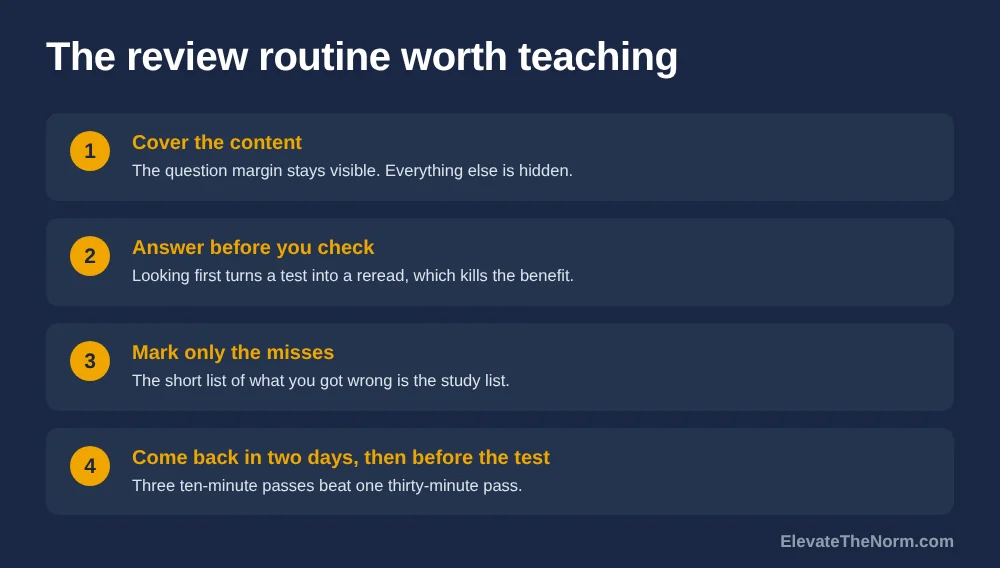
Read that list next to what students actually do with notes, and the problem is obvious. Rereading the page and highlighting it are the two default behaviours, and they are both in the low column. So the review routine worth teaching is four steps:
- Cover the content. The question margin stays visible; everything else is hidden.
- Answer out loud or in writing. Produce the answer before checking. Looking first converts a test into a reread, which is exactly the swap that kills the benefit.
- Check and mark the misses. Only the misses. A short list of what you got wrong is the study list.
- Come back in two days, then before the test. Three ten-minute passes beat one thirty-minute pass, and the spacing is doing the work, not the total. It is also less total time than cramming, which is worth saying to a student carrying six other subjects.
For families asking what to buy: nothing. No pen, app or subscription in this literature outperforms a covered page and a question. If a parent wants to help, the useful job is asking their teenager to answer three questions from the margin out loud on Wednesday — not checking whether the notes look neat, which is the thing that is easy to see and does not matter.
If you want this to happen rather than to be recommended, put the first pass in class. Two minutes of covered-column quizzing as a starter costs almost nothing and is the same trade as retrieval on old material for early finishers. Students who have done it once with you are considerably more likely to do it alone.


Should I teach Cornell notes or another format?
Teach one format explicitly, then stop optimising the format. There is no credible secondary-school trial showing that a particular template beats another, and the research weight sits on use rather than layout.
Cornell’s structure — a cue column, a notes column, a summary strip — is sensible and the cue column is doing the job the question margin above does. What it does not have is a body of randomized evidence in grades 6–12 saying it outperforms a well-run two-column page. Treat it as a reasonable default rather than an evidence-based one, and be honest with students that you are choosing it for consistency.
What does matter, and what teachers routinely skip, is teaching the format like content: model a page under a document camera, show a bad example next to a good one, and look at students’ actual pages more than once in the first fortnight. A format assigned and never inspected is a format that quietly becomes a transcript again.
Three things to look for when you do inspect one, because “are these good notes?” is not a question you can answer by glancing: are any of the words the student’s own rather than yours, is there at least one question on the page, and is anything marked as not understood. A page with none of those is a transcript, whatever template it is on.
And leave a door open. A student who already has a system that works — and some do, including ones that look like nothing you would recommend — should be allowed to keep it once they can show you it passes those three tests. Forcing a template onto a method that is already working is the kind of compliance exercise this site exists to argue against.
Where does the evidence run out?
Almost immediately, once you ask about teenagers specifically. Every quantitative claim in this article comes from a population that is not a high school class.
- The laptop-versus-longhand literature is university students — Princeton and UCLA subject pools in the original, undergraduates in the replication. There is no equivalent trial on 15-year-olds, and the replication failed on the adults it was run on.
- The guided-notes meta-analysis contains no secondary studies at all. Its authors say they found none at graduate level and the included work is undergraduate. The d = 0.546 is a real number about a different population.
- Kobayashi’s review reports the gain most clearly on recall tests and least clearly on higher-order ones. If what you care about is analysis rather than retrieval, the encoding effect is on weaker ground.
- Nothing above is broken out for students with disabilities, or for English learners, or for students who cannot write at speed. Guided notes are widely recommended as an access measure and that recommendation is older than the evidence base quoted here; check the accommodations on file rather than inferring from a meta-analysis.
- No study here tested a format. Cornell, outline, mapping, charting — the comparative question is effectively unanswered in secondary classrooms.
Clay’s take: I have taught this at three levels of device access
The laptop question looks different to me than to most people arguing about it, because I have taught at all three levels of device access.
My second year, devices meant one cart shared between two classrooms. By my final year before my current school it was one device per student, and it is 1:1 again now.
What that taught me is that the device is rarely the variable. On the shared-cart years students wrote everything by hand and most of it was still a transcript. The pages that were worth anything were the ones where the task made transcription impossible — blanks to fill, a question to write, a partner’s page to compare against. That is a design choice, not a stationery choice.
I also take the research’s own hint seriously: I am circulating for most of the period, which means I can see what is actually on the page while there is still time to do something about it. A page that is three slides behind tells me something a quiz on Friday cannot, and it is the same reason pulling a few students to a table beats reteaching the whole room.
And I would rather be honest with students than tidy. When a teenager asks whether handwriting makes them remember more, the true answer is that the study everyone quotes was run on college students and did not replicate, and that what they do on Wednesday with Monday’s notes matters more than which hand they used. Treating them as people who can hear that is most of what this site is about.
What to do next week
Five moves, and none of them needs a purchase or a new system. Build one guided-notes page, add two silent stops, teach the question margin once, run the first review pass in class, and then look at four pages to see whether any of it landed.
- Pick your busiest content lesson and build one guided-notes page for it. Leave the key terms, the figures and the transitions blank, and nothing else.
- Add two three-minute stops to that lesson where you are not talking.
- Teach the question margin once, explicitly, with a bad example beside a good one.
- Put a two-minute covered-column quiz at the start of the next lesson so students have done the review step with you before you ask them to do it alone.
- Walk the room and look at four pages. If they are transcripts, the task needs changing before the format does.
If you want the next step after notes, the same retrieval logic is what makes test corrections teach instead of hand back points, and the quickest checks for whether any of it landed are the five-minute formative ones. Everything on this site is free and nothing asks for your email address.
Frequently Asked Questions
What is the best note taking strategy for high school students?
Guided notes during the lesson plus self-quizzing from them afterward. The guided handout gives students structure without letting them transcribe, and the quizzing is where the best-replicated evidence sits: practice testing and spacing study across several short sessions were both rated high utility in a major review of learning techniques, while rereading and highlighting were rated low.
Is it better to write notes by hand or type them?
The honest answer is that nobody has shown this clearly for high schoolers. The well-known study favouring handwriting used Princeton and UCLA subject-pool students, and a 2019 direct replication did not reproduce it — in one experiment a no-notes group did as well as the note-takers. If a student is transcribing rather than thinking, change the task rather than the tool.
What are guided notes?
A partially completed handout that carries the lesson’s structure with key terms, figures and transitions left blank for students to fill in. A meta-analysis of 12 studies and 1,529 students found d = 0.546 against student-generated notes but only d = 0.265 against a full set of teacher-provided notes, which suggests the blanks are what matters.
Are Cornell notes evidence-based?
Cornell’s cue column is a sound idea and the format is a reasonable default, but there is no credible randomized trial in grades 6–12 showing it beats another well-run two-column page. Pick one format for consistency, teach it explicitly, and spend the rest of your effort on whether students actually review from it.
How should students review their notes?
Cover the content, answer the questions in the margin from memory, check, and mark only what was missed. Then repeat in two days and again before the test. Three ten-minute passes beat one thirty-minute session, because the spacing is doing the work rather than the total time.
Does taking notes even make a difference?
A modest one. Across 57 studies comparing note-taking with no note-taking, the benefit of the writing itself was described as positive but modest, and higher grade levels did not increase it. The same review found visual presentation of the material interfered with note-taking, which is a reason to stop talking over a dense slide.
How do I help a student who cannot write fast enough to keep up?
Start with the accommodations or plan on file rather than improvising, then give that student the guided-notes page with more filled in and the same blanks everyone else has for the key ideas. Reducing the transcription load is not reducing the standard, and a page the student can finish is a page they can revise from.
Sources
- Mueller, P. A., & Oppenheimer, D. M. (2014). The pen is mightier than the keyboard: Advantages of longhand over laptop note taking. Psychological Science, 25(6), 1159–1168. Study 1: 65 Princeton subject-pool students. Study 2: 151 UCLA subject-pool students. Study 3: 109 UCLA subject-pool students with a one-week delay. No high school sample in any study; the Study 3 main effect was null and the surviving result was an interaction with a ten-minute study period.
- Morehead, K., Dunlosky, J., & Rawson, K. A. (2019). How much mightier is the pen than the keyboard for note-taking? A replication and extension of Mueller and Oppenheimer (2014). Educational Psychology Review, 31(3), 753–780. Abstract read via ERIC; the experiment-level detail quoted here (the factual versus conceptual reversal, the no-notes group, the effect of studying notes) was read in the Learning Scientists’ summary of the paper and is attributed to that summary rather than to a reading of the full text, which sat behind a publisher paywall.
- Kobayashi, K. (2005). What limits the encoding effect of note-taking? A meta-analytic examination. Contemporary Educational Psychology, 30(2), 242–262. 57 note-taking versus no note-taking comparisons. Abstract read; it describes the overall effect as positive but modest without giving a figure in the abstract, so no number is quoted here. Schooling level did not increase the benefit; visual presentation interfered; recall tests detected the effect more than recognition or higher-order tests.
- Larwin, K. H., & Larwin, D. A. (2013). The impact of guided notes on post-secondary student achievement: A meta-analysis. International Journal of Teaching and Learning in Higher Education, 25(1), 47–58. 12 studies, 27 effect sizes, 1,529 participants, all post-secondary. Overall d = 0.546; d = 0.781 against student-generated notes and d = 0.265 against full provided notes; mathematics d = −0.355 and dentistry d = −0.142, neither significant.
- Dunlosky, J., Rawson, K. A., Marsh, E. J., Nathan, M. J., & Willingham, D. T. (2013). Improving students’ learning with effective learning techniques. Psychological Science in the Public Interest, 14(1), 4–58. Practice testing and distributed practice rated high utility; summarization, highlighting/underlining, rereading, keyword mnemonics and imagery rated low; elaborative interrogation, self-explanation and interleaved practice rated moderate.