
By Clay Shumate
Three-day weekends are awesome. Nobody argues that part. The argument I want to have is about the two days that sit on either side of one — the Friday before and the Tuesday after — because those are the two days most of us quietly write off every single year.
I don’t write them off. I use them to introduce new material. Here’s how.
The Friday tension nobody names
As soon as that final bell hits on Friday — and really the day or two before it — these kids are going to be all riled up. They are going to be ready to go as much as you are. And that creates a tension whether you believe it or not.
They’re happy. And you’re probably, let’s just be honest, a little unhappy at how happy they are. Because you’re standing there running the checklist in your head: are they actually paying attention? Are they getting their information? Are you meeting your standards for those two days that you don’t already have enough time to do?
Probably not. So what do you do?
Don’t review. Not yet.
Review is the reflex. It’s the move that feels responsible, because it looks like content and it fills a block. But a review on Friday afternoon, aimed at a room that mentally left the building on Thursday, is not going to repair anything. If they didn’t have it Wednesday, one more pass at 2:15 on Friday isn’t the fix.
Save review for a day they can actually spend it. You don’t need it yet.
Play a game — a real one, that you built
So go back to what I did on the Thursday or Friday before: play games.
And I need to be specific about that word, because it gets used badly. These games aren’t Candy Land and dice and pick-it-up-off-the-shelf. It’s a true game that you have taken the time to build, one that creates curiosity, interest, and fun. The build is the whole thing. A game you didn’t design is a babysitter. A game you designed is a lesson wearing better clothes. If you want the design rules rather than the argument, they are set out in how to build a review game that actually teaches something.
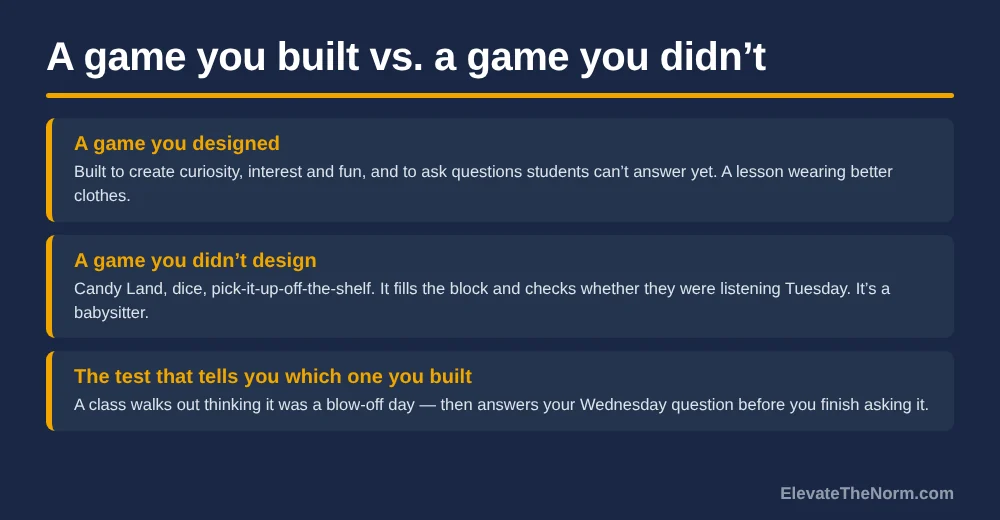
The engine underneath it is curiosity. You ask them questions they more than likely don’t know the answer to — not questions that check whether they were listening Tuesday. Not knowing is the point. Not knowing is what makes a fourteen-year-old pick up a laptop on a Friday.
Make it a webquest, not a worksheet
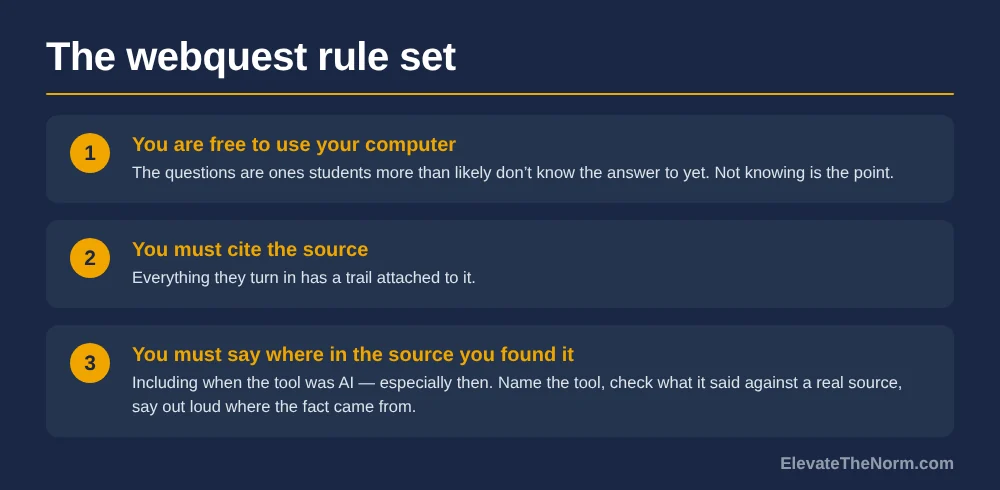
Here’s the turn that makes it a lesson instead of a time-filler. Instead of this webquest being on a piece of paper that they turn in at the end of the day, you create a webquest for them to do. Then you ask them the questions and you tell them: you are free to use your computer. You must cite the source. And you must say in the source where you found the info.
That’s it. That’s the whole rule set. Everything they turn in has a trail attached to it.
Yes, they can use AI. Make them show the receipts.
Including if they choose to use AI. Especially then.
Please remember, everyone’s using AI. Instead of being afraid of it or trying to fight it, start teaching them how to successfully use it on a daily basis.
I don’t think that’s a controversial position anymore, but plenty of buildings are still acting like it is. The kids are using it whether it’s on your syllabus or not. The only variable you control is whether they learn to use it well — naming the tool, checking what it told them against a real source, and being able to say out loud where a fact came from.
A webquest on a Friday before a long weekend is about the lowest-stakes place in the calendar to teach that skill. Nobody’s grade is riding on it. The topic is brand new. And you get to watch, in real time, which students can tell a source from a sentence that just sounds confident.
Now it’s Tuesday. Everybody’s energized, right?
No.
Most of the time the teachers are energized and the students are tired, peeved, wondering why they didn’t do this or that this weekend, and catching up with their friends. That’s the room you’re walking into. Planning a Tuesday like it’s a Wednesday is how good lessons get burned.
So what do you do on that day? It’s a rinse and repeat, folks. Find a new game. Same structure, new topic, new questions they don’t know the answer to yet.
Notes get taken Wednesday
Then, as we settle back down on Wednesday and they wake up a little bit more, we begin maybe fifteen minutes of direct instruction.
Their notes are not taken on a Tuesday after a long weekend. And if we’ve got a more in-depth activity on deck, that activity is going to be given a lot more attention and love by those students when they’re not exhausted and unable to wake up no matter what time of day it is.
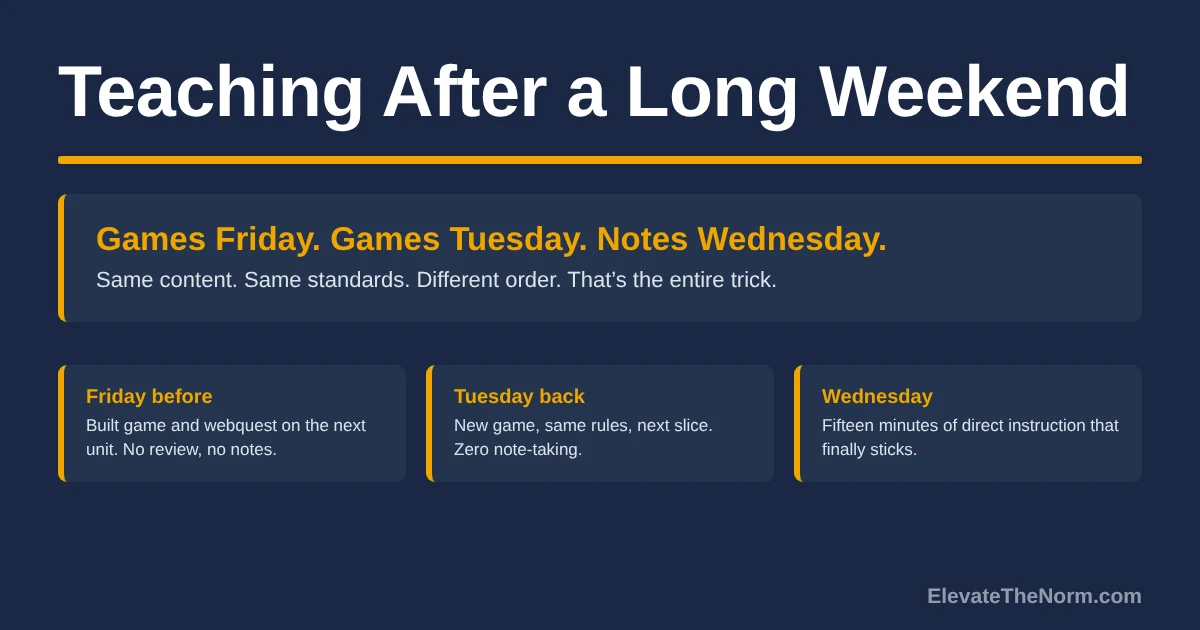
Same content. Same standards. Different order. That’s the entire trick.
Long weekends are not the only stretch that drains a room. The weeks with no days off drain the teacher, too, and it helps to have a few habits for getting through them without burning out before you need them.
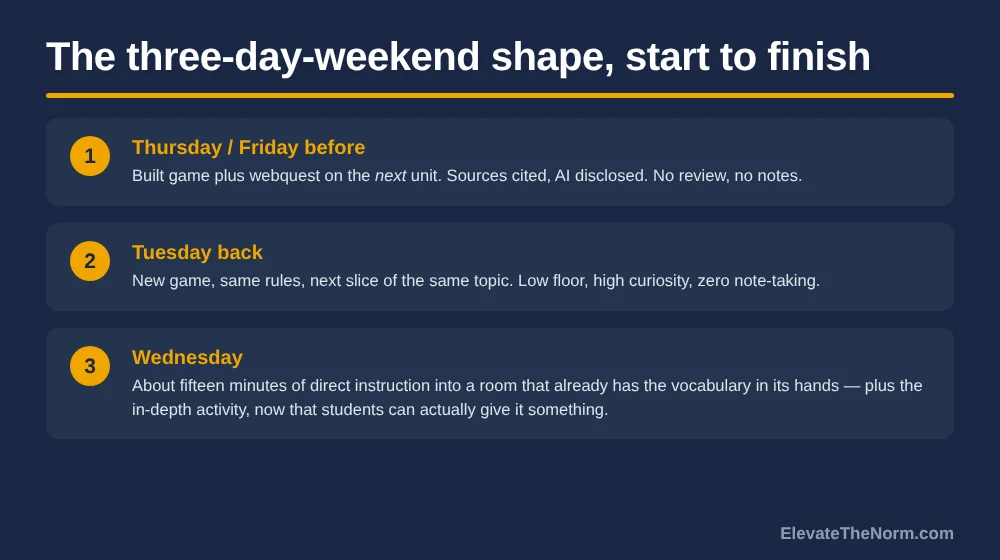
The three-day-weekend shape, start to finish
- Thursday/Friday before: built game plus webquest on the next unit. Sources cited, AI disclosed. No review, no notes.
- Tuesday back: new game, same rules, next slice of the same topic. Low floor, high curiosity, zero note-taking.
- Wednesday: about fifteen minutes of direct instruction into a room that already has the vocabulary in its hands — plus the in-depth activity, now that they can actually give it something.
If you’re a new teacher, classroom management on those two bookend days is most of the battle, and this is a management plan as much as it’s a lesson plan. A room chasing an answer is not a room you have to manage. That’s not a trick — it’s just where their attention already wanted to go.
This is not anti-direct-instruction
I talk about project based learning constantly, and I live and die by it, so it seems like this is that. It’s not, or at least not only that.
I am somebody who believes in direct instruction. I just believe in less direct instruction. I don’t believe in wasting days.
That’s the honest version of my position, and it’s the same one I’d give you about PBL versus traditional instruction. Direct instruction works. Fifteen focused minutes into a prepared room beats fifty minutes into a room that’s still asleep, every time. This is my way of not wasting days, introducing new topics, and buying myself a Wednesday where the notes actually stick.
Fun and learning are not opposites
So embrace the fun. Embrace the fact that fun can be learning. Embrace the fact that you can have an entire class walk out thinking they hadn’t learned anything — and then come back the next day and not have to take half their notes, because they already know it.
That gap between what they think happened and what happened is the best feedback you’ll get all year. When a kid tells you Friday was a blow-off day and then answers your Wednesday question before you finish asking it, you built the right game. And if you want more ideas to build from, that’s the standard I’d hold them to.
Kids figure things out. That’s what people do.
Kids learn in a myriad of ways. Remember that we are a people who have evolved over millions of years, and through that time you see evolution create people who know how to get out of problems. Those become us. We were the first to figure out small problems, and instead of ignoring them or working around them, we figured out a solution.
It’s the same thing now. Just because we have evolved does not mean we don’t have basic instincts. Hand a teenager a question they can’t answer and a way to go find it, and something old kicks in. They will figure that stuff out.
Which leaves the part that’s on us. It comes down to two questions, and neither one is about the kids:
- Are you giving them enough time?
- Are you presenting the opportunity on the correct day for them to have the information they need in order to execute?
Get those two right and a three-day weekend stops costing you two days. It starts buying you one.
Frequently asked questions
Why introduce new material before a long weekend instead of reviewing?
Review on a Friday afternoon into a room that has mentally left the building rarely sticks. New material paired with a curiosity-driven game works because it meets students where their energy already is — not bored by something they’ve heard twice, but genuinely stumped by something they haven’t seen yet. The review gets its proper day later, when they can actually spend the attention.
What makes a teacher-built game different from a commercial classroom game?
A commercial game is built for generic engagement. A teacher-built game is built around the specific vocabulary and questions of the next unit. The questions students can’t answer are the point — that gap is what generates real curiosity instead of hollow competition. The build takes time upfront, but it doubles as next-unit pre-exposure, not filler.
How should students properly cite an AI tool in a webquest?
Students should name the specific tool (e.g., “ChatGPT, September 2026”), record the question or prompt they used, and then cite a primary or secondary source they consulted to verify the AI’s answer. Both the AI disclosure and the verification citation are required. The goal isn’t just transparency — it’s teaching students that AI output is a starting place, not a source.
Does this approach work across different subjects and grade levels?
Yes, with adaptation. The structure — curiosity-first game, webquest with sourcing requirements, notes deferred to Wednesday — applies from middle through high school across most content areas. A science teacher builds a game around phenomena students haven’t studied yet; an English teacher builds one around an author or text coming up next. The rules are the same. The content is yours.
How long does it take to build one of these games?
Forty-five minutes to a couple of hours, depending on how elaborate the question set needs to be and how well you already know the content. The webquest sourcing rules add a few minutes of setup once you have a bank of reliable sites. The investment is front-loaded: once you’ve built the game for a unit, the next year you refine it rather than starting from scratch.
What if district pacing guides expect direct instruction on those days?
The approach doesn’t drop content — it reorders it. Students meet the same standards on the same week; they just encounter the vocabulary through a game on Friday and Tuesday and take formal notes on Wednesday. If a pacing guide is day-specific, document Friday and Tuesday as “unit introduction and pre-exposure” and Wednesday as “note-taking and structured input.” Most pacing guides care about when students have the content, not which day the notes were written.
What if students don’t take the Friday game seriously?
That’s a management signal, not a content problem. A room that won’t engage with a curiosity-driven question on a Friday afternoon is telling you something about established expectations, not about the game design. The fix is building throughout the year — starting in September — that every class has a task with a standard attached. Students who believe you mean it in the fall behave differently by spring.