By Clay Shumate
Good ideas for project based learning start with a real question somebody outside your classroom actually wants answered, and end with a product that person actually sees. Everything else—the subject, the length, the technology—is negotiable. The 50 ideas below are organized by subject and grade band, each one built around a genuine audience, so you can find one that fits Monday.
I want to be straight with you about what this list is. It is not 50 activities. Activities are easy to find and mostly interchangeable. These are project premises—each one has a question worth arguing about, a decision that has not been made yet, and somebody on the other end who will look at the result. That last part is what makes the difference, and it is the part most “PBL idea” lists skip.
Key Takeaways
- A project idea is only a project if it has an open question, real research, revision, and an audience beyond the gradebook. Otherwise it is an activity with a poster attached.
- The strongest secondary projects solve a problem the school or the town actually has. Those beat invented scenarios every time, and they cost nothing.
- Start with one project, not a semester of them. Pick something two to three weeks long with a low materials cost and a real audience you can secure with one email.
- Evidence for PBL at the secondary level is genuinely good—an 8 to 10 percentage-point advantage on AP exams, gains in middle school science that carried into math and ELA—but it depends on implementation, not on the idea being clever.
- Every idea here can be run without one-to-one devices. The low-tech swaps are in their own section, because most PBL writing quietly assumes technology that plenty of schools do not have.
What Makes an Idea for Project Based Learning Worth Running
Before the list, a filter. PBLWorks names seven essential project design elements: a challenging problem or question, sustained inquiry, authenticity, student voice and choice, reflection, critique and revision, and a public product. The Framework for High Quality Project Based Learning lists six overlapping criteria, adding project management as its own skill students have to be taught rather than assumed to have. For social studies teachers, my Social Studies Teacher Toolkit Bundle on TPT gives you a head start on the materials.
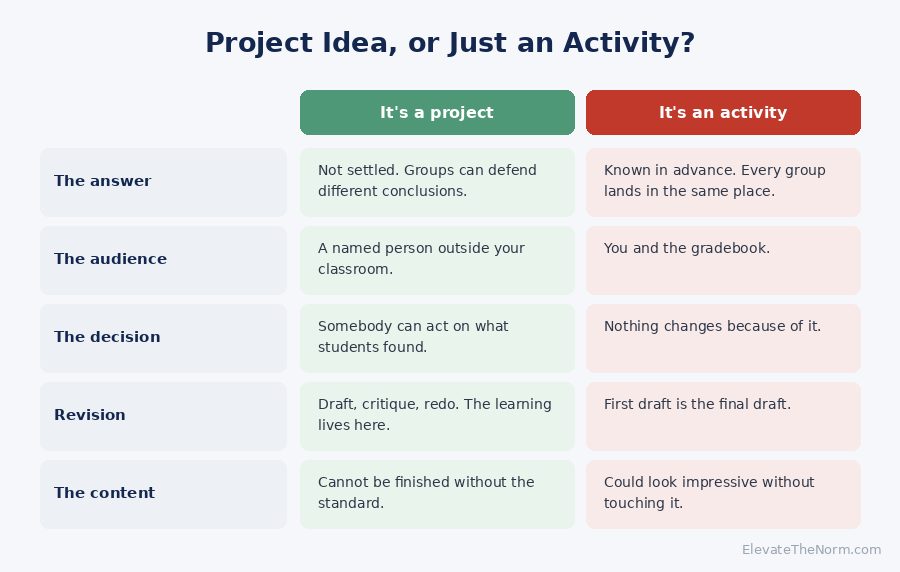
You do not need to memorize either list. In practice, five questions will tell you whether an idea is a project or a costume. If you teach a single subject and want the narrower version of this list, these ten history project ideas for grades 7–12 are built the same way:
- Do I already know the answer? If you do, and every group will arrive at the same place, it is an assignment. Real projects have room for defensible disagreement.
- Who sees this besides me? Name the person. Not “the community”—a name, a role, an inbox.
- What decision does it inform? Somebody should be able to do something differently because of the work.
- Where does the revision happen? If the first draft is the final product, you have skipped the part where the learning lives.
- What is the academic content students cannot avoid? If a group could produce something impressive without touching the standard, the project is decorative.
If an idea below does not survive those five questions in your building, adapt it until it does. I would rather you run a modified version that fits your reality than a faithful version that collapses in week two. For the full breakdown of what does and does not count, see the definition of project based learning, and for projects explained in depth rather than listed, see these examples of project based learning.
50 Ideas for Project Based Learning, Grades 6–12
Each table gives the project premise, the grade band it fits best, a realistic time estimate with how much lift it takes on you, and the audience that makes it public. “Low lift” means you can run it without new materials, outside partners, or a schedule change. “High lift” means you will be making phone calls. Several of these touch permissions, privacy, or school policy—read the three conversations below before you commit to one.
Social Studies and History
| Project | Grades | Time & lift | Who sees it |
|---|---|---|---|
| 1. Marker audit. Which local historical markers tell the whole story, and which leave something out? Research and write corrected text. | 8–12 | 3 weeks · medium | County historical society |
| 2. Oral history archive. Interview long-time residents about one decade, transcribe, and index the collection. | 9–12 | 6 weeks · high | Public library collection |
| 3. Attendance-zone proposal. Use real census and enrollment data to propose a fairer school zone map. | 10–12 | 4 weeks · high | School board member |
| 4. Plain-language ballot guide. Translate the next local ballot into language a first-time voter can actually use. | 9–12 | 3 weeks · medium | Community center, church bulletins |
| 5. Name that street. A blank or badly named street needs a name. Build the historical case for one. | 6–9 | 2 weeks · low | City council |
| 6. Disputed event investigation. Take a contested local event and reconstruct it from primary sources only. | 9–12 | 4 weeks · medium | School news site |
| 7. Century story map. Map where families in this county came from across a hundred years, with sourcing. | 7–10 | 5 weeks · medium | Library display |
| 8. Museum in a hallway. Build a docent-led exhibit on a world history unit and tour younger students through it. | 6–10 | 3 weeks · medium | Sixth-grade classes |
English Language Arts
| Project | Grades | Time & lift | Who sees it |
|---|---|---|---|
| 9. Podcast series. Four episodes on a question students genuinely argue about, scripted, sourced, and edited. | 8–12 | 5 weeks · high | Public feed or school site |
| 10. Handbook rewrite. Rewrite the student handbook in language students can read, keeping every rule intact. | 7–12 | 3 weeks · medium | Administration |
| 11. Hard-concept picture book. Explain something difficult to a second grader in a bound, illustrated book, then read it to them. | 6–10 | 4 weeks · medium | Partner elementary class |
| 12. Literary walking tour. Sign a downtown route with writing tied to each stop, QR-coded to student audio. | 9–12 | 5 weeks · high | Downtown businesses |
| 13. Edited anthology. Solicit, select, edit, design, and print a collection of student writing. | 7–12 | 6 weeks · medium | Families at a reading night |
| 14. Change one rule. Build an evidence-based case to change a single school rule and present it. | 6–12 | 3 weeks · low | Principal and student government |
| 15. Reviews on spec. Write book or film reviews to a real publication’s submission guidelines and pitch them. | 9–12 | 2 weeks · low | Local paper editor |
Science
| Project | Grades | Time & lift | Who sees it |
|---|---|---|---|
| 16. Creek watch. Test a local waterway weekly for two months and report the trend, not the snapshot. | 8–12 | 8 weeks · high | County environmental office |
| 17. Energy audit. Audit the building’s energy use and recommend one change with a payback period attached. | 9–12 | 4 weeks · medium | Facilities director |
| 18. Room-by-room air quality. Map CO2 and comfort across the building and correlate it with when students fade. | 8–12 | 3 weeks · medium | Principal |
| 19. Pollinator plan. Design a native pollinator planting for school grounds with species list and budget. | 6–10 | 5 weeks · medium | Grounds crew and PTA |
| 20. Cafeteria waste study. Measure food waste, run one intervention, then measure again and report honestly. | 6–12 | 4 weeks · medium | Child nutrition director |
| 21. Weather station. Build and calibrate a station, then publish a weekly hyper-local forecast with accuracy tracking. | 8–12 | 6 weeks · high | School website |
| 22. Does the expensive one work? Test a consumer product claim under controlled conditions and publish the results. | 7–11 | 3 weeks · low | Public consumer guide |
| 23. Invasive species survey. Survey school grounds, identify invasives, and write a phased removal plan. | 7–12 | 4 weeks · medium | County extension office |
Mathematics
| Project | Grades | Time & lift | Who sees it |
|---|---|---|---|
| 24. Cut the lunch line. Time the cafeteria line, model the bottleneck, and propose a layout that shortens it. | 7–11 | 3 weeks · medium | Cafeteria manager |
| 25. Cost per use. Analyze a real purchase the school is weighing and recommend for or against with the math shown. | 8–12 | 2 weeks · low | Bookkeeper or principal |
| 26. Price the tickets. Build a pricing model for a school event that hits a stated revenue target without pricing families out. | 9–12 | 3 weeks · medium | Athletic director, boosters |
| 27. Bus route math. Analyze one route’s time and mileage and propose a defensible alternative. | 10–12 | 4 weeks · high | Transportation director |
| 28. Courtyard to scale. Produce scaled drawings and a materials budget for an unused outdoor space. | 7–11 | 4 weeks · medium | PTA |
| 29. Fair split. Design and defend a fair-cost-sharing rule for a class trip or shared supplies, then adopt it. | 6–9 | 2 weeks · low | The class itself |
| 30. Audit the claim. Take a statistic from an ad or news story and verify or refute it with the underlying data. | 8–12 | 2 weeks · low | Published explainer |
Arts and Music
| Project | Grades | Time & lift | Who sees it |
|---|---|---|---|
| 31. Mural pitch. Propose a mural for a blank wall with sketches, budget, and a written rationale. | 7–12 | 5 weeks · medium | Administration or city |
| 32. Score the silence. Compose and perform an original score for a public-domain silent film clip. | 8–12 | 5 weeks · high | School assembly |
| 33. The people nobody photographs. Portrait series of custodians, bus drivers, and cafeteria staff, with their own words. | 6–12 | 4 weeks · low | Hallway exhibition |
| 34. Rebrand a nonprofit. Redesign a small local nonprofit’s logo and basic brand kit to their actual brief. | 9–12 | 4 weeks · medium | The nonprofit’s board |
| 35. One business, one film. Document the history of a single local business in a five-minute film. | 9–12 | 5 weeks · high | The business’s customers |
Career Tech, Business, and Technology
| Project | Grades | Time & lift | Who sees it |
|---|---|---|---|
| 36. Run the store. Write the business plan for a school store, then actually operate it for a month and report the P&L. | 9–12 | 6 weeks · high | Real customers |
| 37. Accessibility audit. Audit the school website against WCAG basics and file a prioritized fix list. | 9–12 | 3 weeks · medium | District tech director |
| 38. Repair café. Fix donated items, document each repair, and hold a community drop-off day. | 7–12 | 4 weeks · medium | Community attendees |
| 39. Prototype and test. Build a working prototype that solves one school problem and user-test it with real students. | 9–12 | 6 weeks · high | Student body |
| 40. Career guide for eighth graders. Interview working adults and turn it into a guide for students choosing a pathway. | 9–12 | 4 weeks · low | Counselor’s office |
| 41. Family cybersecurity night. Research the scams that actually hit your community and teach families to spot them. | 8–12 | 3 weeks · medium | Parents at an evening event |
| 42. Maker corner proposal. Cost out a maker space corner and submit a real budget request. | 7–12 | 4 weeks · medium | Principal and PTA |
Health and Physical Education
| Project | Grades | Time & lift | Who sees it |
|---|---|---|---|
| 43. PE for people who hate PE. Design and run a two-week unit aimed at the students who dread the gym. | 7–12 | 4 weeks · medium | Other PE sections |
| 44. Sleep and the schedule. Study your grade level’s actual sleep and report what the schedule costs. | 8–12 | 3 weeks · medium | School leadership |
| 45. Menu inside the rules. Redesign a week of cafeteria menus inside real federal nutrition rules and the real budget. | 9–12 | 4 weeks · high | Nutrition director |
| 46. Concussion explainer. Produce a short video explaining the school’s concussion protocol to athletes and parents. | 8–12 | 3 weeks · low | Athletic department |
World Languages
| Project | Grades | Time & lift | Who sees it |
|---|---|---|---|
| 47. Bilingual welcome. Produce bilingual signage and a welcome packet for the front office, reviewed by a fluent adult. | 8–12 | 4 weeks · medium | Front office and new families |
| 48. Community resource guide. Translate a guide to local services, verified for accuracy before it goes out. | 10–12 | 5 weeks · high | Public library |
Cross-Curricular
| Project | Grades | Time & lift | Who sees it |
|---|---|---|---|
| 49. Readiness research memo. Research national best practices in school emergency preparedness and deliver a private findings memo to the people responsible. Never published, never posted. | 9–12 | 5 weeks · high | Safety committee, privately |
| 50. Time capsule with a defense. Curate artifacts and write the argument for why each one deserves to represent this year. | 6–10 | 3 weeks · low | Sealing ceremony now, opening later |
Before You Run Any of These: Three Conversations
Real audiences are what make these projects work, and they are also what makes them capable of causing you a problem. Three conversations, none of them long, prevent almost all of it.
- With your administrator, about scope. Any project that contacts someone outside the building, examines a school decision, or asks for a policy change needs a heads-up first. That is not permission-seeking for its own sake—a principal who has agreed in advance to genuinely consider a student proposal turns the project real. A principal ambushed by one turns it into a lesson about how adults do not listen, which is the opposite of the point.
- With families and interviewees, about consent. Anyone interviewed, recorded, or photographed for a public product gives written consent first, including staff. Follow your district’s policy on student names and images in public work; default to first names. Any project that gathers information about other students stays anonymous and aggregated, and never gets framed as health or psychological data.
- With yourself, about supervision. Water sampling, tool use, repair work, and off-campus contact all need an adult plan, not just a student plan. If a project cannot be supervised properly with the staffing you actually have, run a different one. There are forty-nine others.
Two of the ideas above deserve a specific flag. The attendance-zone proposal touches genuinely contested local politics—run it only where a board member has agreed to receive it in that spirit. The readiness memo stays private by design; students research public best practices and deliver findings to the people responsible, and none of it gets posted anywhere.
None of this is a reason to shrink the work. Clear expectations and honest guardrails are what let you hand students something real in the first place—the same argument as in classroom expectations.
Does Project Based Learning Actually Work in Grades 6–12?
Yes, with a caveat worth stating up front: the evidence supports well-implemented PBL, not the idea of PBL. A clever premise badly run is worse than a good lecture. If you are weighing whether to hand part of your course over to projects at all, start with the research comparing PBL with traditional teaching and decide from the numbers rather than the enthusiasm.
At the high school level, researchers at the University of Southern California studied a project-based curriculum called Knowledge in Action in AP U.S. Government and AP Environmental Science across five predominantly urban districts. Students in the project-based courses passed their AP exams at rates 8 percentage points higher than students in traditional sections, rising to an estimated 10 points when teachers were in their second year with the curriculum (Saavedra et al., Lucas Education Research, 2021). Edutopia’s coverage puts the sample at more than 3,600 students across 114 schools, with over half from low-income households—and the gains held for those students at the same rate as for their wealthier peers.
At the middle school level, the Learning Through Performance science curriculum developed at Stanford produced an 11 percentage-point gain in science achievement, and the effect did not stay in science: students also outperformed peers on state assessments in mathematics and English language arts (Deutscher et al., Lucas Education Research, 2021).
That is a real result and I do not want to undersell it. I also do not want to oversell it, which is the next section.
How to Run Any of These Without One-to-One Devices
Every project above can run on paper. I have taught with no devices, with one cart shared between two classrooms, and with one-to-one, and the shared-cart year taught me more about project design than the one-to-one years did—because scarcity forces you to decide what the technology was actually for.
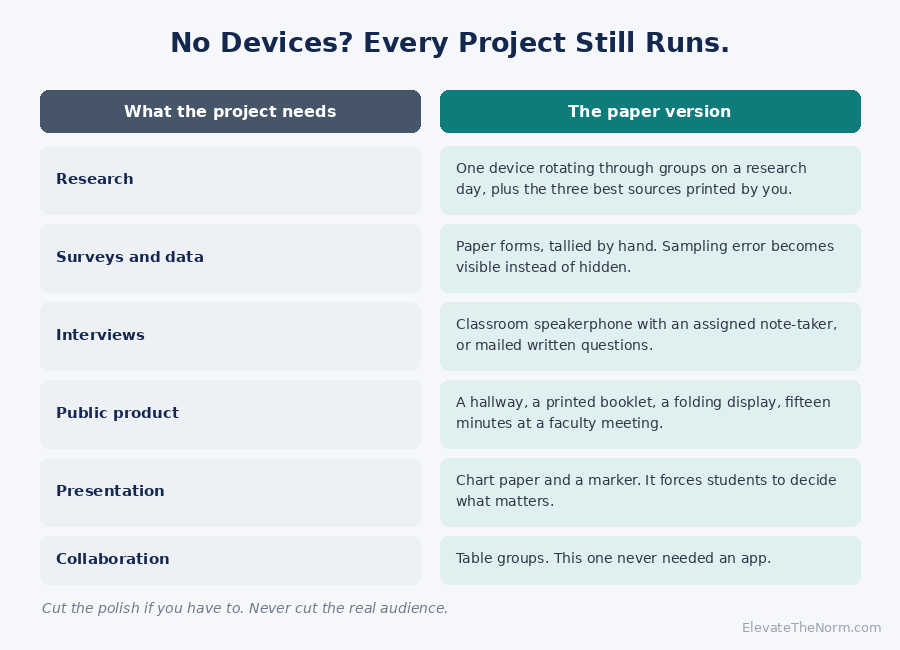
- Research: One device rotating through groups on a research day beats thirty devices open all week. Print the three or four best sources yourself and let the argument be about the evidence rather than the searching.
- Surveys and data: Paper surveys, tallied by hand, teach the sampling problem better than a form that auto-charts the answer.
- Interviews: A speakerphone in the classroom and a designated note-taker works. So does a written question set mailed to somebody who answers in writing.
- Public product: A hallway, a printed booklet, a folding display, or fifteen minutes at a faculty meeting are all public. Public means seen by someone who is not you—not published online.
- Presentation: Chart paper and a marker force students to decide what matters. A slide deck lets them avoid deciding.
The one thing worth protecting is contact with the real audience. If you have to cut something, cut the polish, not the person on the other end.
Grading Individuals Inside a Group Project
This is the objection I hear most from teachers, and it is a fair one. A single group grade rewards the student who did nothing and punishes the one who carried it. It also lets weak content knowledge hide behind a strong product. Assigning job titles does not fix it either; the accountability underneath the card is what carries the weight, which is why most standard group roles fail the deliverable test.
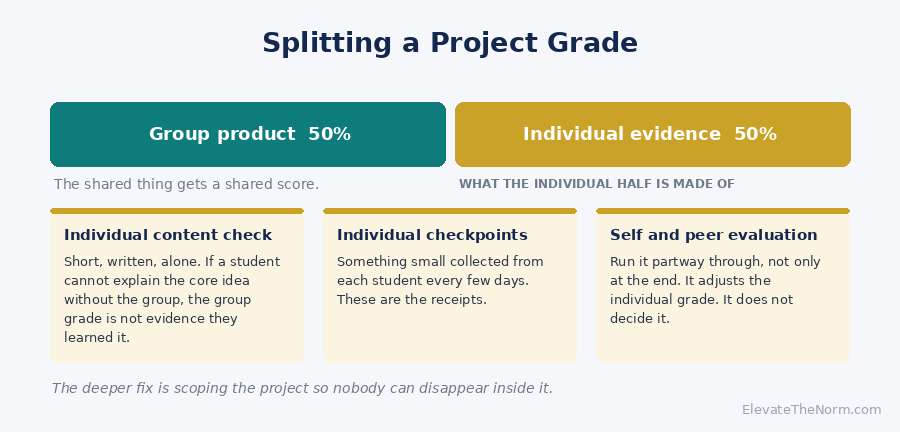
Carnegie Mellon’s Eberly Center recommends carrying both a group component and an individual component in the project grade—commonly split 50/50 or 80/20—and assessing the process as well as the product, using individual assessments, self-evaluation, and peer evaluation that adjusts individual grades (Eberly Center, Carnegie Mellon University). Their other point is the one teachers skip: run the evaluations partway through, not only at the end, so the information can still change something.
What I do, in plain terms:
- The product gets a group grade. It is a shared thing; it gets a shared score.
- Every student takes an individual assessment on the content. Short, written, no group. If a student cannot explain the project’s core idea alone, the group grade is not evidence they learned it.
- Checkpoints are individual. I am collecting something small from each student every few days anyway. Those are the receipts.
- Self and peer evaluation adjusts, it does not decide. Students are honest more often than teachers expect, but a peer rating is one input, not a verdict.
The deeper fix is not a grading scheme. It is scoping the project so nobody can disappear inside it, which is really a planning problem. More on that idea in student responsibility.
For free planning templates, critique protocols, and assessment tools that support PBL implementation, see project based learning resources for middle and high school teachers.
The Failure I Catch Most Often, and How
Projects rarely fail loudly. They fail quietly, in week one, when a driving question shrinks into something a search bar can answer, and nobody notices because the group looks busy.
I catch it by moving. I am on a stool most of the period, going table to table, and I listen more than I talk. A few days into a project I will hear a group planning around a question that has quietly stopped being a question—they have already settled the answer and are now decorating it. So I sit down with them and ask them to walk me through their reasoning from the beginning, out loud. Not to correct it. To make them hear it. Nine times out of ten somebody at the table catches the collapse before I have to name it, and the fix is theirs instead of mine.
That is the whole argument for circulating instead of monitoring. You cannot hear a premise go soft from the front of the room.
Where Project Based Learning Genuinely Struggles
The most honest summary of the research is still MDRC’s literature review, which calls the evidence for PBL “promising but not proven,” notes that the field lacks agreement on what the core elements even are, and points out that evaluation has been hampered by a shortage of valid, usable measures for the deeper learning PBL claims to produce. It also names the real implementation problem: teachers have to shift from directing to facilitating, and manage a great deal of ambiguity while they do it (Condliffe et al., MDRC, 2017).
Three practical cautions from my own room:
- Coverage is real. A four-week project has to carry four weeks of standards, not one week of standards and three weeks of production. Map it backward: list every standard the project will assess, then name the specific checkpoint or artifact where you will see each one. Any standard without an artifact next to it is a standard you are hoping happens.
- Access is not equal. A project that depends on a parent’s connections, a car, or an evening free is a project that sorts students by circumstance. Build it so it can be completed inside the school day.
- The first run will be rough. The AP result got better in year two for a reason. Plan to run the same project twice before you judge it.
Pick One and Start
Do not redesign your course. Choose two or three ideas from the list marked low lift, two or three weeks, with an audience you can secure in a single email—the plain-language ballot guide, the cost-per-use analysis, the portrait series, the concussion explainer—and then let the class pick between them. Student voice is one of the design elements, and the cheapest place to honor it is the choice of project itself. Run it once. Keep notes on what broke. Run it again in the spring with the breakage fixed. If you want one written up all the way through — the weekly formats, the family note, what it cost — this mock election is that account.
The point of any of these ideas for project based learning is not the project. It is that students spend three weeks being treated as people whose work is worth showing to somebody. That treatment is the intervention. The project is just the excuse to deliver it. If that framing is new, start with what project based learning actually is, then look at how the same principle shows up in real world learning.
How many projects should I run in a school year?
Two done well beats six done thinly. Most teachers new to project based learning should run one project in the fall and one in the spring, ideally the same project twice so the second run benefits from what the first one taught you. The AP research found the effect grew from 8 to 10 percentage points when teachers were in their second year with the curriculum, which is a good argument for repeating rather than constantly starting over.
What if my school does not have devices for every student?
Every idea on this list can run on paper. Rotate one or two devices through groups on designated research days, print the strongest sources yourself, use paper surveys tallied by hand, and conduct interviews on a classroom speakerphone with an assigned note-taker. A hallway exhibit, a printed booklet, or fifteen minutes at a faculty meeting are all genuinely public products. Protect contact with the real audience and cut the polish instead.
How do I grade individual students in a group project?
Carry both a group score and an individual score. The shared product gets a shared grade; each student also completes an individual content assessment, individual checkpoints throughout the project, and a self and peer evaluation that adjusts but does not decide the individual grade. Carnegie Mellon’s Eberly Center recommends splits around 50/50 or 80/20 and stresses running the evaluations partway through, while the information can still change something.
Will a project cover enough standards to justify the time?
Only if you map the standards before you commit to the product. A four-week project must carry four weeks of curriculum, not one week of content plus three weeks of building. Write down every standard the project will assess, then check whether a group could produce the final product without touching them. If they could, the project is decorative and needs redesigning.
What makes a project audience genuinely public?
A public audience is any person outside your classroom who will actually look at the work and could plausibly act on it. A facilities director reading an energy audit, a librarian accepting an oral history collection, a second-grade class hearing a book read aloud, or a school board member receiving a proposal all qualify. Your gradebook, a classroom presentation to peers, and a folder that goes home do not.
How do I keep one student from carrying the whole group?
Scope the project so there is no place to hide. Assign individual checkpoints every few days, require each student to be able to explain the core idea alone, and define roles that produce visible artifacts rather than vague responsibilities. If a student can still disappear inside the project, that is usually a planning problem on the teacher’s end rather than a character problem on the student’s.
Are these ideas appropriate for struggling readers or English learners?
Yes, and the research supports it. The elementary science study found gains that held across all reading ability levels, and the middle school study found English learners gained 8 percentage points in language proficiency in year one and 28 points with second-year teachers. Projects give students more ways to demonstrate understanding than a text-only assessment does, provided you scaffold the reading and do not treat the written product as the only evidence.
What permissions do I need before students interview people or photograph them?
Get written consent from any adult who is interviewed, recorded, or photographed for a public product, and clear the project with your administrator before students contact anyone outside the building. Follow your district policy on student names and images appearing publicly, and default to first names only. Any project that collects information about other students should be anonymous, aggregated, and never framed as health or psychological data.
Sources
- PBLWorks. Gold Standard PBL: Essential Project Design Elements. Buck Institute for Education.
- HQPBL. Framework for High Quality Project Based Learning.
- Saavedra, A. R., Liu, Y., Haderlein, S. K., Rapaport, A., Garland, M., Hoepfner, D., Morgan, K. L., & Hu, A. (2021). Project-Based Learning Boosts Student Achievement in AP Courses. Lucas Education Research, University of Southern California.
- Deutscher, R. R., Holthuis, N. C., Maldonado, S. I., Pecheone, R. L., Schultz, S. E., & Wei, R. C. (2021). Project-Based Learning Leads to Gains in Science and Other Subjects in Middle School and Benefits All Learners. Lucas Education Research.
- Terada, Y. New Research Makes a Powerful Case for PBL. Edutopia, George Lucas Educational Foundation.
- Eberly Center for Teaching Excellence. How Can I Assess Group Work? Carnegie Mellon University.
- Condliffe, B., Quint, J., Visher, M. G., Bangser, M. R., Drohojowska, S., Saco, L., & Nelson, E. (2017). Project-Based Learning: A Literature Review. MDRC.
About Clay Shumate
Clay Shumate is a certified secondary Social Studies teacher in the public schools of West Alabama, with seven years of classroom experience, a B.A. in History, and an M.Ed. in Secondary Education. He writes about project-based learning, student responsibility, respect, and practical ways to hold young people to a higher standard while giving them room to learn from mistakes. He is a member of the Society of Professional Journalists and writes to its Code of Ethics; this site’s editorial standards and corrections policy are published in full. More about Clay.