By Clay Shumate
Classroom review games work because they force retrieval, not because they make content fun. The ones that hold up give every student a real job instead of four, keep questions short and frequent, and end with kids asking when you are playing again. The ones that fail almost always fail the same way: twenty-four students watching four.
What follows is the mechanism the research actually supports, two formats broken down far enough to run on Monday, and the design failures that turn a review game into a spectator sport.
Key Takeaways
- Retrieval is the mechanism. Pulling an answer out of memory builds retention; re-reading it does not. The game is the packaging.
- A format without a sideline job is not a whole-class review game. It is four students reviewing and the rest of the room waiting.
- Two formats are broken down in full below: a four-square court built around eight assigned roles, and a five-minute trash-can format that needs nothing but a ball.
- The evidence is good and it is not unlimited. Games reliably move content knowledge. The strongest school-based meta-analysis found no significant effect on metacognitive outcomes at all.
- Short and repeated beats long and once. Fifteen minutes on three days does more than a full period the day before the test.
Free Download · PDF
Formative Assessment Quick-Use Pack
A strategy decision matrix, an evidence tracker, four exit-ticket formats, and a next-day response planner — for turning what a review game surfaces into the next day’s lesson.
Free. No email address required. Designed for grades 6–12. Browse every printable in Your Free Library.
Why Do Classroom Review Games Work?
Because retrieving an answer from memory strengthens it more than reading it again does. That effect has a name — the testing effect, or retrieval practice — and it is one of the better-replicated findings in learning science.
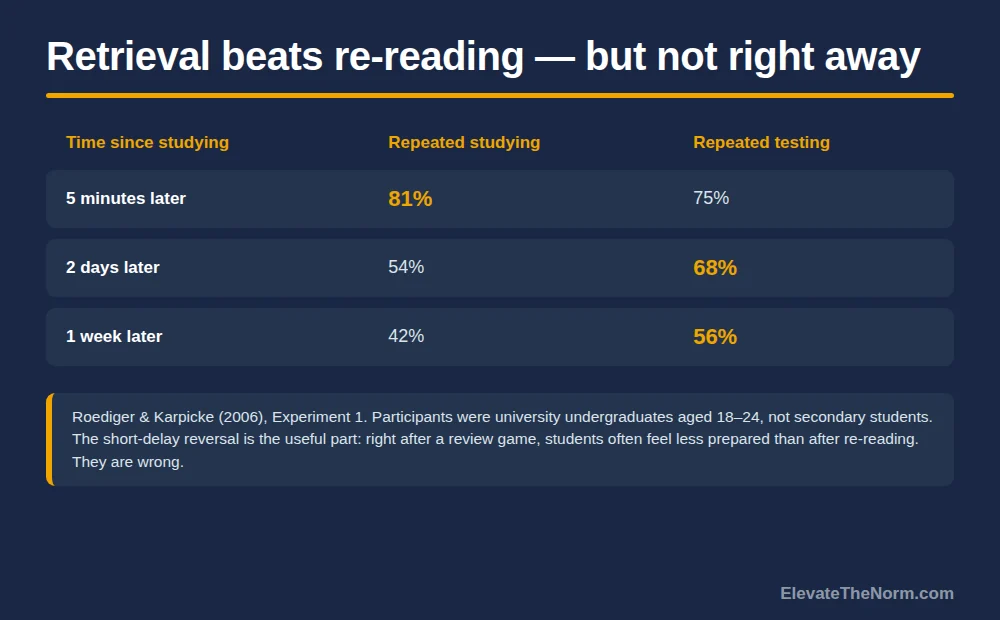
The landmark demonstration is worth knowing precisely, including the part that gets left out. Roediger and Karpicke had readers either study a passage repeatedly or study it once and then take repeated recall tests. Five minutes later, the repeated studiers were ahead — 81% recall against 75%. A week later the result had flipped hard: 56% for the testers, 42% for the studiers. In their second experiment the gap was wider still, 61% against 40%.
Two honest caveats belong with that study. The participants were university undergraduates, ages 18 to 24, not teenagers. And the short-delay reversal is the most useful part of the finding for a teacher: immediately after a review game, students will often feel less prepared than they would after twenty minutes of re-reading their notes. They will be wrong, and they will tell you so. Knowing that in advance is what keeps you from abandoning a format that is working.
The classroom evidence runs in the same direction. A five-year applied research project across more than 1,400 middle school students found that retrieval practice built into normal classroom quizzing improved long-term learning, that delayed quizzes were more potent than immediate ones, and that quizzes with feedback beat quizzes without. A 2021 systematic review screened nearly 2,000 abstracts and coded 50 classroom experiments covering 5,374 students: 57% of effect sizes showed medium or large benefits. The authors flag their own limit plainly — only 6% of the experiments were run outside WEIRD countries.
A review game is a low-stakes retrieval quiz wearing a costume. The costume is not decoration; it is what gets a room of teenagers to willingly retrieve the same content twelve times without it feeling like a test. It belongs in the same toolbox as any other strategy built around real thinking rather than visible compliance.
What Does the Research Not Say?
It does not say that making something a game teaches students how to learn. This is where most review-game advice quietly oversells.
The strongest recent synthesis of game-based learning in schools — Barz and colleagues, in Review of Educational Research — pooled studies of digital game-based learning and found a medium overall effect (g = .54), a solid cognitive effect (g = .67), a small affective-motivational effect (g = .32), and no significant effect on metacognitive outcomes. The authors found no evidence of publication bias, which makes the null finding harder to wave away.
Two things follow. First, that meta-analysis covers digital games, and the formats below are a taped floor and a trash can — the content-knowledge finding transfers by mechanism, the effect size does not transfer automatically. Second, and more practically: a review game will help students remember what you taught. It will not teach them to study, to plan, or to notice what they do not know. If you want that, the reflective work has to be built in on purpose — which is what a separate student self-assessment routine is for.
Why Do Most Classroom Review Games Fail?
Because the format only has room for four players and no plan for everyone else.
Almost every teacher has lived this period. Four students play a game-show format at the front. Twenty-four watch. The four are genuinely engaged and learning. The twenty-four are half-watching, half on their phones, and the review reached a sixth of the room. That is not a review game. It is a spectator sport with a curriculum connection.
The failure is not the game and it is not the students. It is a design gap, and it is fixable before the first round: if a format has room for a handful of active participants, it needs a real job for everybody else. “Pay attention” is not a job.
How Do You Design a Review Game That Actually Works?
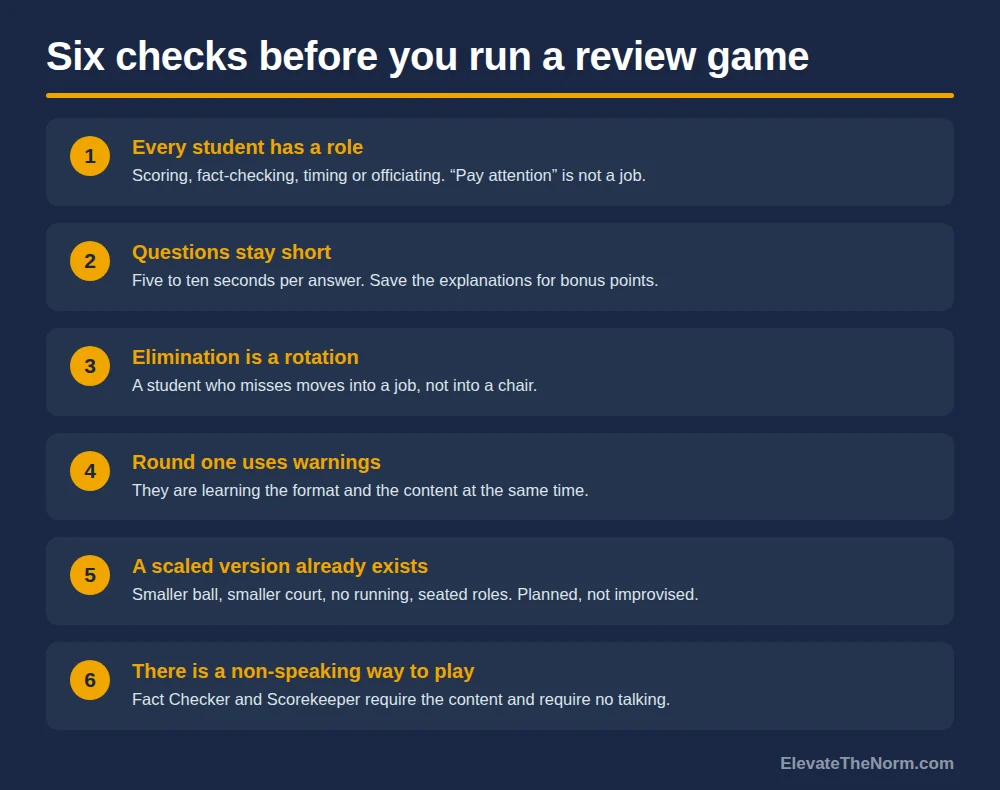
Run it against six checks before you build it or borrow it.
- Every student has a role. The students not currently answering should be scoring, checking answers, timing or officiating — not spectating.
- Questions stay short. Five to ten seconds per answer keeps the pace up. Save the multi-sentence explanations for bonus points, not the base question.
- Elimination does not mean disappearing. A student who misses rotates into another job. A student who is “out” with nothing to do will find something to do, and it will not be what you wanted.
- The first round uses warnings, not eliminations. Students are learning the format and the content at the same time; do not punish them for the first. This is the same logic behind teaching a routine explicitly before holding anyone to it.
- A scaled version exists before you need it. Smaller ball, smaller court, no running, seated variant. Planned, not improvised.
- There is a non-speaking way to play. Scorekeeper, fact checker and timekeeper all require knowing the content and none requires answering out loud. Build that in from the start rather than after a student has to ask for it.
Those six are the difference between a format that runs itself after the first week and one you referee forever. Most of them are the same principle underneath any student-centered activity: the structure works when students genuinely own a piece of it, not when they have permission to join in.
What Does a Full Format Look Like? The 4 Square Review Game
A four-square court, four players, and eight assigned jobs for everyone else. It is built specifically to solve the spectator problem, and the roles do not change by subject — only the question cards do.
Setup. Tape a 16′ × 16′ court split into four 8′ × 8′ squares, labeled A through D. Square A is the top position; D is the entry point. Split the class into four teams, one player from each team on the court, the next four in a marked Sub Zone.
The round. Before a player serves or returns, the Question Master asks a content question. The player has about five seconds. A correct answer makes the ball live and standard four-square rules apply — one bounce before the return. A wrong answer eliminates the player unless a challenge changes the ruling, and they rotate to the end of their team’s line. The next player enters at D and everyone on the court steps up one square.
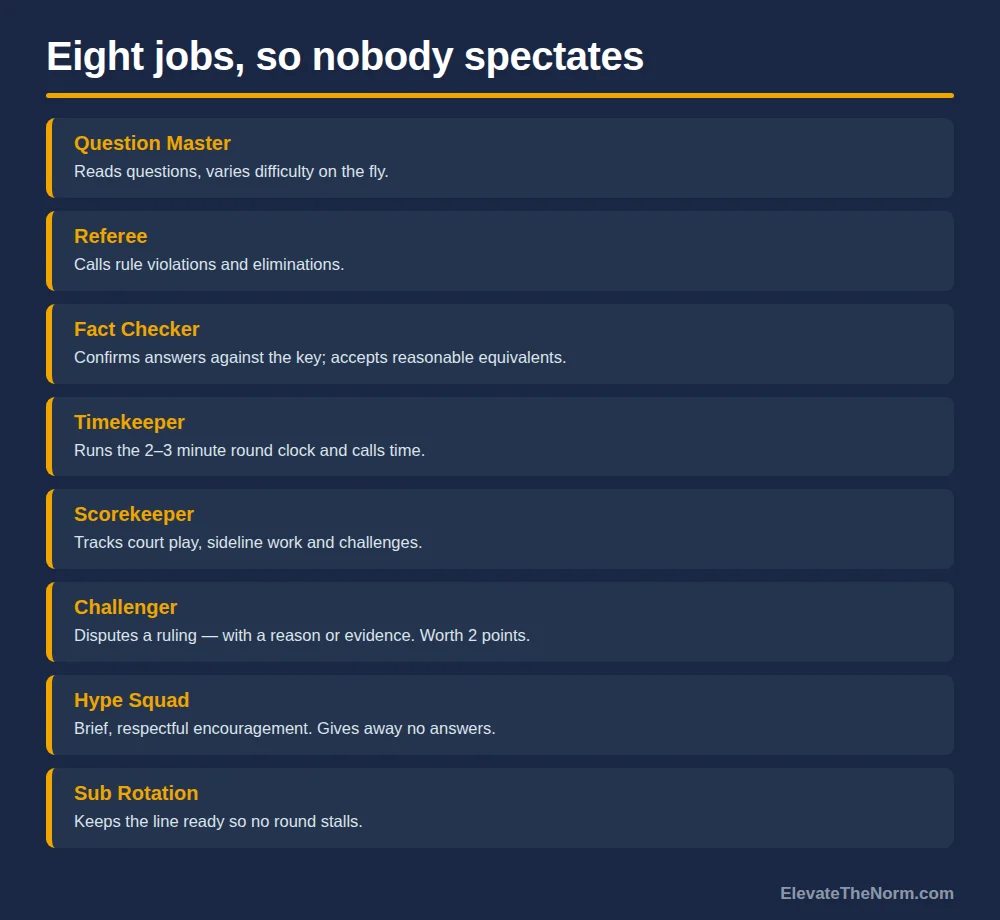
The eight jobs. This is the part that makes it a whole-class format:
- Question Master reads the questions and varies the difficulty.
- Referee calls rule violations and eliminations.
- Fact Checker confirms answers against the key and accepts reasonable equivalents.
- Timekeeper runs a two-to-three-minute round clock and calls time.
- Scorekeeper tracks points for court play, sideline jobs and challenges.
- Challenger can dispute a ruling — but only with a reason or a piece of evidence, which turns disagreement into an academic move instead of an argument with you.
- Hype Squad keeps energy up with brief, respectful encouragement and gives away no answers.
- Sub Rotation manages the line so the next players are always ready.
Roles rotate every round, so the student who spent one round scoring is playing the next. Scoring stays simple: a point for a correct answer, a point for a successful serve or return, a point for reaching Square A, a point for a clean sideline call, two points for a successful challenge. Small bonuses for a team lifeline, strong supporting evidence, or a team that covers every assigned role keep the sideline jobs from reading as busywork.
Adapting 4 Square to Any Subject
The court and the roles never change. The question bank does. A social studies class can run cause-and-effect recall one round and source-analysis the next. A math class swaps in problem-solving questions with a slightly longer answer window. An English class runs vocabulary in context. Build more questions than you think you need, sorted by difficulty, so the Question Master can adjust live when a round runs hot or cold. Running out of questions kills the pace faster than anything else on this page.

What If You Only Have Five Minutes to Set Up? Trashketball
A question, a correct answer, then a shot at the trash can from a distance the student picks. Trashketball is a long-standing, widely used classroom format, and it earns its place here for one reason: it delivers the same retrieval mechanism with no court to tape and no roles to assign.
I did not invent it and I want to be clear about that, because how I got it is the more useful part of the story. In my first year I did not have many review formats that were actually enjoyable, and another teacher on my hall noticed. I asked. They walked me through Trashketball, and I have been running some version of it ever since.
Keeping your ears open and your mouth shut pays off some of the time. Asking a direct question pays off faster. If you are in your first years and your review days are flat, the fix is probably already being run two doors down by somebody who would be glad you asked. That is not a soft lesson about collegiality — it is the cheapest professional development available and it costs one conversation.
The basic loop is a question to a team, a short answer window, and a shot worth more points from further out. The self-chosen distance is the good part — it gives a student who is sure of the content a way to press the advantage and a student who is not a way to stay in without being exposed.
Two upgrades are worth building in. First, give the non-shooting teams a job: one team fact-checks the answer, one keeps score, and both rotate. Second, have each question lead into a one-or-two-sentence note rather than a full explanation, so movement and note-taking land in the same fifteen minutes instead of competing for them.
The lesson from both formats is the same. A physically engaged class and a content-reviewing class are not in competition. They can be the same fifteen minutes.
What Do You Watch For While It Runs?
The answers you overhear, not the score.
My room runs as a workshop — tables grouped rather than in rows, me on a wheeled stool moving between them instead of standing at the front. That habit is worth more during a review game than during almost anything else I do. Circulating while a round plays, you hear a group land on a confident wrong answer before it reaches anybody’s notes, and you can fix it in the next question instead of on the test. The scoreboard tells you who is winning. The sideline conversation tells you what you still have to teach.
That is also the honest answer to whether a review game is “real” instruction. It is, if you are listening. It is not, if you are refereeing.
What Are the Most Common Mistakes?
- No job for the sideline. The single most common failure, and the one that turns a review game into a spectator sport.
- Elimination with nowhere to go. Rotate eliminated students into a job instead of into a chair.
- No warning period. Hard eliminations from question one punish students for not knowing a format they have never played.
- Speed rewarded over accuracy. A five-second window is fine. A game that rewards the fastest guess over the most defensible answer teaches the wrong thing.
- The same students in the low-status seat every time. If the fast recallers always play and the same kids always keep score, you have built a ranking system, not a review game. Rotate on a schedule, not on volunteering.
- No safety plan. Any physical format needs its scaled version ready before somebody asks for it.
- Treating it as a time-filler. If the game does not require retrieving real content, it is recess with a curriculum label.
What Should You Do Next?
Pick one format — 4 Square if your class needs structure and assigned roles, Trashketball if you need something running in five minutes — and build a question bank of about thirty questions sorted into three difficulty tiers. Run it for fifteen minutes on three separate days before your next unit test rather than for a full period the day before it. The spacing is doing as much work as the game.
Then watch two things. Whether the sideline stays engaged, which tells you if the roles are real. And whether students ask when you are playing again, which tells you whether you have a repeatable Friday or a one-time novelty. A review game also fits an awkward period well — the kind covered in teaching after a long weekend, when a straight lecture is fighting uphill no matter how good it is.
Before you go: grab the free Formative Assessment Quick-Use Pack (PDF) — ElevateTheNorm.com branded, printable, no email required.
Frequently Asked Questions
Do classroom review games actually work, or do they just feel productive?
They work when they force retrieval — students pulling an answer out of memory rather than recognizing it on a page in front of them. That mechanism has been tested directly. Roediger and Karpicke found repeated testing beat repeated studying by 14 points of recall a week later. The game format is the delivery system, not the mechanism. A game where students look up every answer is a worksheet with a ball in it.
How do I keep 28 students engaged when only four can play at a time?
Assign every non-playing student a real job and rotate the jobs every round — scorekeeper, fact checker, timekeeper, referee, challenger. “Pay attention” is not a job, it is a hope. If a format has no work for the twenty-four students who are not currently answering, it is not a whole-class review game and you should expect it to behave like one.
Won’t the competition discourage my students who are already behind?
It can, and the design has to answer for it. Three things keep it from landing on the same students every time: rotate the jobs so nobody sits in the low-status seat all period, score sideline work as heavily as court play, and score teams rather than individuals so a wrong answer is absorbed. If a specific student is visibly shrinking during a game, give them the Fact Checker role — it is high-status, it requires knowing the content, and it never requires answering in front of the room.
What if my class is not ready for something physical?
Scale it before ruling it out. A softer or larger ball, a smaller court, a no-running rule, or a fully seated version of every role keeps the structure intact. The roles and scoring do not depend on anyone moving. Plan the scaled version before the first round rather than improvising it after someone gets hurt or someone gets left out.
How long should a review game run?
Rounds of two to three minutes with a role rotation between them, for a total of fifteen to twenty minutes. That is long enough to cycle the whole class through several retrievals and short enough that it does not eat the period. A game that runs forty minutes has stopped being retrieval practice and started being an activity.
Do these formats work outside social studies?
Yes, because nothing in the court, the roles or the scoring references a subject. Only the question bank changes. A math class can lengthen the answer window for a multi-step problem; an English class can run vocabulary-in-context questions; a science class can run prediction questions. The one thing that does not travel is a question bank written the morning of.
A student is arguing with my ruling. How do I handle it without losing the room?
Build the argument into the format. A Challenger role that requires a brief reason or a piece of evidence turns a dispute into an academic move and takes you out of the middle of it. Award points for a successful challenge. Students who would never volunteer an answer will absolutely argue a call, and a challenge is a retrieval too.
Is a review game a good use of a class period before a test?
It is a good use of fifteen to twenty minutes of one, run more than once. The retrieval research is consistent that spaced, repeated retrieval beats one long session, so a short game on three different days will do more than a single period-long game the day before the exam. It is also worth being honest about what games do not do: the best meta-analysis of game-based learning in schools found solid gains in content knowledge and no significant effect on metacognitive outcomes. A game will help students remember. It will not, on its own, teach them how to study.
Sources
- Roediger, Henry L., III, and Jeffrey D. Karpicke. “Test-Enhanced Learning: Taking Memory Tests Improves Long-Term Retention.” Psychological Science, vol. 17, no. 3, 2006, pp. 249–255. Participants were university undergraduates aged 18–24. https://journals.sagepub.com/doi/10.1111/j.1467-9280.2006.01693.x
- Agarwal, Pooja K., Ludmila D. Nunes, and Janell R. Blunt. “Retrieval Practice Consistently Benefits Student Learning: A Systematic Review of Applied Research in Schools and Classrooms.” Educational Psychology Review, vol. 33, no. 4, 2021, pp. 1409–1453. 50 coded experiments, 5,374 participants; 57% of effect sizes medium or large; only 6% of experiments conducted outside WEIRD countries. https://link.springer.com/article/10.1007/s10648-021-09595-9
- Agarwal, Pooja K., Patrice M. Bain, and Roger W. Chamberlain. “The Value of Applied Research: Retrieval Practice Improves Classroom Learning and Recommendations from a Teacher, a Principal, and a Scientist.” Educational Psychology Review, vol. 24, no. 3, 2012, pp. 437–448. Five-year project with more than 1,400 middle school students. https://eric.ed.gov/?id=EJ977134
- Barz, Nathalie, Manuela Benick, Laura Dörrenbächer-Ulrich, and Franziska Perels. “The Effect of Digital Game-Based Learning Interventions on Cognitive, Metacognitive, and Affective-Motivational Learning Outcomes in School: A Meta-Analysis.” Review of Educational Research, 2024. Overall g = .54; cognitive g = .67; affective-motivational g = .32; no significant effect on metacognitive outcomes; no evidence of publication bias. https://journals.sagepub.com/doi/10.3102/00346543231167795