Real World Learning: How Schools Can Connect Work to Life
By Clay Shumate
Part of the project-based learning guide — real audiences are one half of PBL; the hub covers the rest.
Real world learning is not a field trip. It is not career day. It is not a worksheet about a fictional bakery that asks students to calculate profit margins for a business that does not exist. Real world learning happens when the work students do in a classroom connects to something genuine — a real problem, a real audience, a real product someone could actually use. And the reason most schools struggle with it has nothing to do with curriculum. It has to do with the difference between work that matters and work that pretends to.
Key Takeaways
- Real world learning means the work connects to something genuine — a community problem, a professional practice, or a product someone outside the classroom could actually use.
- Most “real-world” assignments are simulations. Students know the difference, and it shows in their effort.
- Access to real world learning cannot depend on family connections, transportation, or the teacher’s personal network. Schools need to build it into the system, not leave it to chance.
- You do not need a community partner or a bus to create authentic work. Some of the strongest real world learning happens inside the school building.
- Research consistently shows that applied, authentic learning improves academic outcomes — and the benefits are strongest for students from low-income backgrounds.
The Problem with Most “Real-World” Assignments
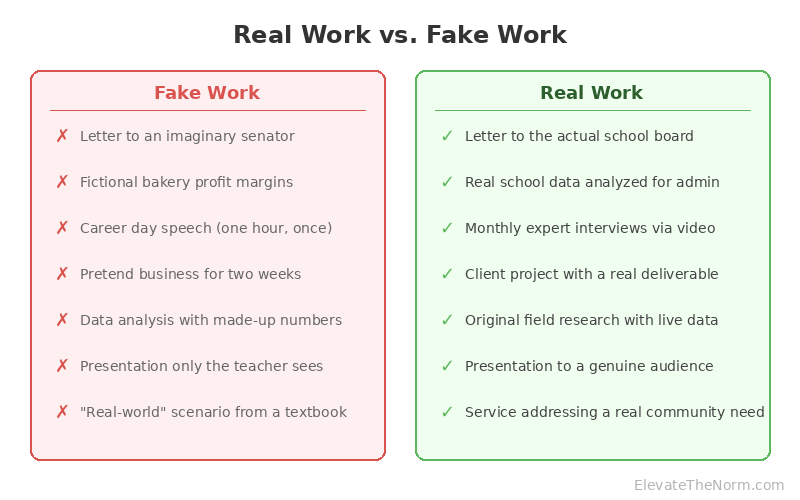
Teachers know they should connect work to the real world. The problem is how that usually looks. A science class calculates carbon footprints using made-up numbers for a city that does not exist. An English class writes persuasive letters to an imaginary senator. A math class runs a pretend business for two weeks and then never mentions it again. Sound familiar? It should — these are the same problems behind ineffective classroom expectations: telling students the work matters while designing it so it does not.
Students can tell. They can tell when the audience is fake, when the data is invented, and when the outcome does not matter to anyone except the gradebook. And when they can tell, they give it exactly the effort that fake work deserves — enough to get the grade, not enough to learn anything.
This is not a laziness problem. It is a design problem. A research brief from EdResearch for Action identifies authenticity as the first of four core design principles for applied learning: the work must connect to real-world problems, expert practices, and student aspirations. When the connection is manufactured, the learning stays surface level no matter how well the lesson is planned.
What Makes Work Real
Real world learning is not a category of assignment. It is a quality of the work itself. Here is the test: could someone outside the school see this, use this, or benefit from this? If the answer is no — if the work only exists to be graded — it is school work, not real work. Both have their place. But only one teaches students what it feels like to do something that matters.
Real work comes in different forms, and not all of them require leaving the building:
- Community problems. Students identify a real issue in their school or town — a broken process, a missing resource, an unanswered question — and produce something useful in response. A data report, a proposal, a working solution.
- Professional practices. Students use the same tools and methods that adults in a field actually use. Historians analyze primary sources. Scientists follow real protocols. Writers publish for readers who chose to read, not readers who were assigned to.
- Public audiences. The work goes somewhere beyond the teacher’s inbox. A presentation to the school board, a gallery for families, a report delivered to a local organization. The audience does not have to be large. It has to be real.
- Career exposure. Not a career day presentation — actual contact with how work is done. Job shadows, expert interviews, mentorship hours, apprenticeship tasks. The Kansas City Real World Learning Initiative calls these “market value assets” and tracks them as credentials students carry beyond graduation.
- Service. Work that meets a genuine need — not community service hours logged for a transcript, but a sustained project where students provide something a community actually needs and can verify.
- Field research. Students collect original data in real settings. Water quality at a local creek, traffic patterns near the school, oral histories from community members. The data is real. The analysis is real. The conclusions might actually be wrong — and that is the point.
- Useful products. A handbook, a tutorial video, a design prototype, a functioning tool. Something that works and that someone would choose to use even if no grade were attached.
Not every lesson needs to be real work. Sometimes you need direct instruction, practice problems, and structured skill-building, and it is worth being honest about where direct instruction still outperforms projects. But if a student can get through an entire semester without producing something that matters to anyone besides the teacher, the course has a relevance problem that no amount of engagement tricks will fix.
Real World Learning Inside the School Building
The biggest misconception about real world learning is that it requires a field trip, a community partner, or a bus. It does not. Some of the most authentic work students can do happens inside the building they are already in — if the teacher designs it that way.
Consider what is available in every school, regardless of location or budget:
- The school has real data — attendance patterns, lunch participation, energy usage, event turnout — and students can analyze it for actual decision-makers.
- The school has real audiences — younger students, parents, other teachers, administrators — who can receive and respond to student work.
- The school has real problems — signage that does not work, processes that confuse new students, information that families never receive — and students can research, propose, and sometimes solve them.
- The school has real history — alumni, community changes, institutional decisions — that students can document before it disappears.
In my room, partner work is the default condition, not something we pull out for special projects. Students are already sitting in groups, already working alongside somebody, already talking about the work every period. That means when a real task comes in — a presentation for the front office, a proposal for the administration, an analysis that someone outside the room will actually read — the transition is small. The respect and trust are already there. We are not suddenly learning to collaborate because the project requires it. We have been collaborating since September.
That structural advantage is worth mentioning because it changes what is possible. A teacher who runs a silent, independent classroom has to teach collaboration before launching real-world work. A room where students work alongside each other every day can move straight to the task. It is the same reason teaching responsibility works better when ownership is the default, not a special assignment. The collaboration is not the special event. The collaboration is the air in the room.
What the Research Says About Real World Learning
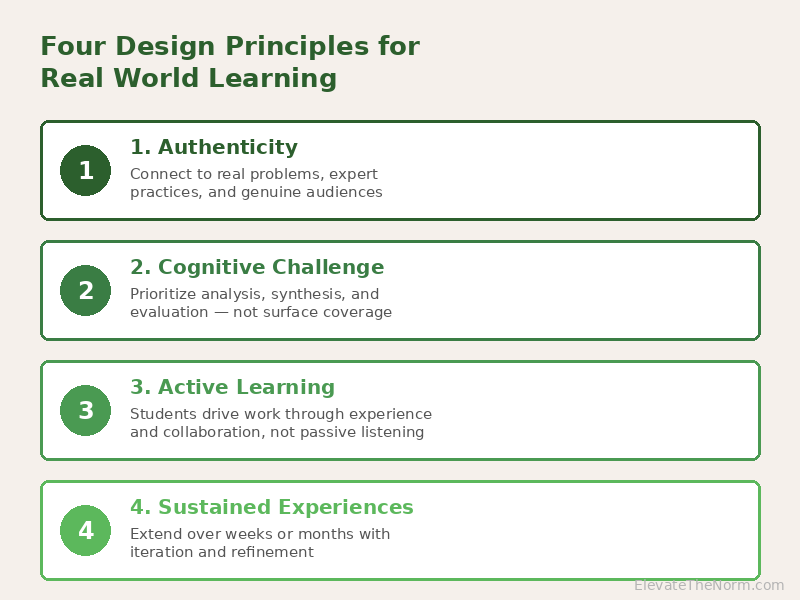
The evidence base for applied, authentic learning is strong — and getting stronger. EdResearch for Action’s comprehensive brief reviews the evidence across multiple randomized controlled trials and identifies four core design principles that predict effectiveness:
- Authenticity. The work connects to real-world problems, expert practices, or student aspirations through essential questions and genuine audiences.
- Cognitive challenge. The work prioritizes deep mastery and complex thinking — analysis, synthesis, evaluation — not surface-level coverage.
- Active learning. Students drive the work through experience, collaboration, and reflection, with direct instruction used strategically rather than as the default mode.
- Sustained experiences. The work extends over weeks or months, allowing iteration and refinement — not a one-day activity squeezed between test-prep sessions.
When those principles are present, the results are consistent. Randomized controlled trials show that project-based learning improved high school science and social studies achievement, with similar gains across income levels. Career and technical education increased on-time graduation rates, particularly for low-income students. Inquiry-based instruction improved middle school math scores. And linked learning — programs that combine academic and career-technical coursework — improved eleventh-grade English scores and college readiness. Those constraints — credits, bells, a transcript — are why running this in a high school is a different problem from running it in a middle school.
The benefits are not limited to test scores. A Carnegie Foundation report on Kansas City’s Real World Learning Initiative found that 52 percent of recent high school graduates earned at least one market value asset before graduation — an internship, a client-connected project, an industry credential, or significant college credit. Students with these assets showed stronger transitions to employment and further education. The initiative now covers 34 school districts and approximately 100,000 high school students across urban, suburban, and rural areas.
Service learning adds its own layer of evidence. Students in service-learning programs score higher in social studies, writing, and English language arts, and students in semester-long service-learning courses are almost three times more likely to believe they can have a significant impact on their community. These outcomes correlate with higher GPAs and improved graduation rates.
Access and Equity: Real World Learning Cannot Depend on ZIP Code
Here is the equity problem with real world learning, and it is not small: the best opportunities usually go to students who already have connections. The student whose parent works at the hospital gets the shadowing opportunity. The school with corporate neighbors gets the mentorship program. The district with transportation funding gets the field research trips.
If real world learning depends on what families and communities can provide on their own, it reproduces the same inequities the rest of schooling already has. The Next Generation Learning Challenges project identified social capital as the critical gap: significant disparities exist between socioeconomic groups in accessing mentors, professional networks, and community connections. Students from low-income families are less likely to have adults in their life who can open professional doors — not because those students are less capable, but because those doors were never in their hallway.
The answer is not to give up on real world learning for schools without resources. The answer is to design it so that access does not depend on any individual teacher’s personal network or any family’s existing connections. That means:
- District-level coordination. Partnerships with local organizations, businesses, and agencies should be built at the system level and shared across schools — not left to individual teachers to hustle on their own time.
- In-building alternatives. The school-based real world learning described above requires no bus, no budget, and no external partner. It is available to every teacher in every building starting tomorrow.
- Virtual connections. Video conferencing puts expert interviews, professional mentorship, and virtual field trips within reach of any school with an internet connection. A rural school in Alabama can connect with a museum in Washington or an engineer in Houston without a travel budget.
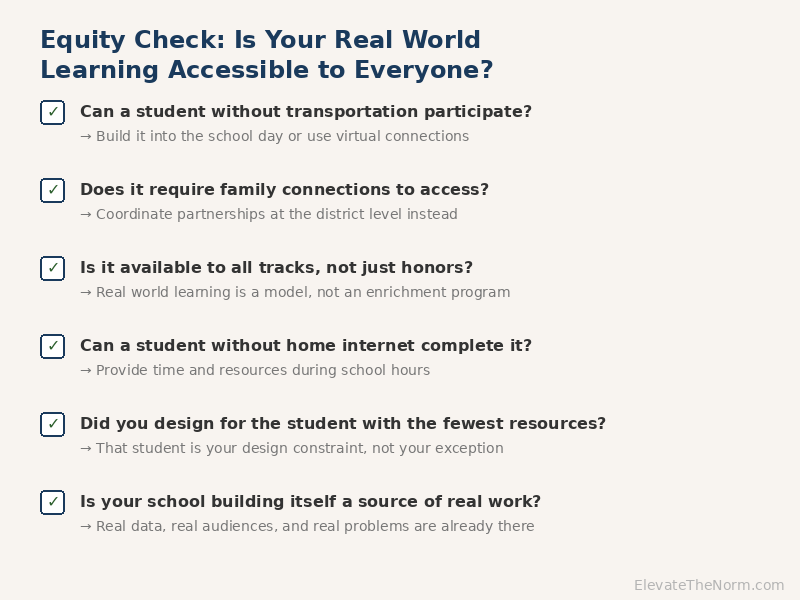
- Designing for the student without connections. When planning real world learning, ask: can the student whose family works nights and cannot drive them anywhere still access this? If not, redesign it.
Kansas City’s initiative is worth studying here because it started by addressing this exact problem. The Carnegie Foundation reports that the program explicitly focused on equity for historically marginalized students from low-income backgrounds, using district-level coordination rather than school-by-school improvisation.
Common Mistakes That Make Real World Learning Fall Apart
Even teachers who believe in authentic work make predictable mistakes when implementing it. These are the ones I see most often:
Calling it real when it is not. The fastest way to lose a teenager’s trust is to promise them their work matters and then let it disappear into a grade. If you tell students they are writing a proposal for the principal, the principal needs to read it. If you tell them they are presenting to a real audience, the audience needs to actually care about the topic. Otherwise you have taught them that “real world” is just another school phrase that means nothing.
Assuming real work means less structure. Authentic tasks need more structure, not less — clearer criteria, tighter checkpoints, more explicit scaffolding. The EdResearch brief directly addresses the misconception that applied learning eliminates direct instruction. It does not. It changes when and how you use it.
Waiting until students have “the basics.” The belief that students need to master foundational skills before they can do real work is one of the most persistent barriers to real world learning — and the evidence does not support it. Applied learning and structured instruction are complementary. Students can learn content through authentic tasks, not only after them.
Making access unequal. The honors students get the client project. The general-track students get the worksheet. If your real world learning is only available to students who already perform well, you have created an enrichment program, not a learning model.
Where to Start Tomorrow
You do not need to overhaul your curriculum to bring real world learning into your classroom. You need to change who sees the work and what happens to it after it is finished.
- Find one unit this semester where the final product could go to a real audience. Not the whole course. One unit. A report that goes to the school counselor. A presentation for another class. A proposal delivered to someone who could actually act on it.
- Replace one fake scenario with real data. Instead of the fictional bakery, use real school data. Instead of the imaginary senator, write to the actual school board member who represents your district. The skill being practiced is the same. The motivation is not.
- Invite one outside person into your classroom this month. Not for a career day speech — for a working session. Someone who can listen to student work, ask questions, and respond. A video call is enough.
- Look at your building with fresh eyes. What problem exists in this school right now that students could investigate, document, or address? That is your next authentic unit.
- Set up the collaboration first. Students who already work alongside each other every day — who know how to divide labor, give feedback, and hold each other accountable — can take on real work with real stakes faster than students who only collaborate during special projects.
Real World Learning Is Not an Add-On
The phrase “connect work to life” makes it sound like classroom learning and real life are separate things that need a bridge. They are not — or at least they should not be. The goal of real world learning is not to add a real-world component to an otherwise academic course. It is to stop pretending that academic work is not supposed to mean anything beyond the transcript.
Students in grades 6–12 are old enough to do work that matters. They are old enough to analyze real data, address real audiences, investigate real problems, and produce things that real people actually use. When we understand what actually motivates students, we see that this kind of work is not extra — it is the condition under which engagement survives. The question is not whether they are capable. The question is whether we are building classrooms that give them the chance.
That chance does not require a corporate partner, a grant, or a bus. It requires a teacher who is willing to ask: who will see this work besides me? If the answer is nobody — and it has been nobody all year — that is the place to start.
Frequently Asked Questions
How is real world learning different from project-based learning?
Real world learning is broader than project-based learning. PBL is one method for delivering real world learning — a sustained project driven by an authentic question and ending in a public product. But real world learning also includes service, career exposure, field research, expert collaboration, and any work that connects to something genuine outside the classroom. A teacher can create real world learning without running a full PBL unit — and a PBL unit can fail at real world learning if the project is a simulation instead of the real thing.
What if my school does not have community partners or business connections?
Start inside the building. Every school has real data, real audiences, and real problems students can work on — attendance patterns, communication gaps, school history, proposals for administration. You do not need an external partner to make work authentic. You need a real audience and a product that someone will actually use. Video conferencing also makes expert interviews and virtual mentorship available to any school with an internet connection, regardless of location.
Does real world learning work for students who are below grade level?
Yes — and the research is direct on this point. Randomized controlled trials show that project-based and applied learning improve outcomes across income levels and prior achievement levels. Career and technical education increased on-time graduation particularly for low-income students. The belief that students need to master basics before engaging in authentic work is not supported by evidence. Students can learn foundational skills through real tasks, not only before them.
How do I assess real world learning when the product is not a test?
Use performance-based assessment tied to clear, public criteria. Before students start the work, show them what quality looks like — a rubric, an exemplar, or a set of success criteria. Then assess the product, the process, and the reflection. The EdResearch for Action brief recommends aligned performance assessments that measure complex skills like problem-solving, transfer, and collaboration alongside content knowledge. Real world learning does not mean you stop assessing. It means you assess what students can do with what they know.
Is real world learning realistic with a packed curriculum and standardized tests?
It is — but it requires planning. Applied learning is not an addition to curriculum. It is a different way of delivering the same standards. Students in high-quality applied-learning programs perform as well or better on standardized assessments, including AP exams. The key is choosing tasks that align with the standards you are already required to teach and using direct instruction strategically within the authentic context, not abandoning it.
How do I make sure real world learning is equitable across different student groups?
Design for the student with the fewest resources. If an opportunity requires transportation, family connections, or technology that not every student has, it is not equitable. Build real world learning into the regular school day, use in-building options for schools without community partnerships, and coordinate partnerships at the district level rather than leaving individual teachers to build their own networks. When planning any real-world task, ask: can the student whose family works nights and cannot provide a ride still fully participate?
What is the role of the teacher during real world learning?
The teacher is not a bystander. Real world learning requires more teacher involvement, not less — setting clear criteria, building scaffolding, facilitating checkpoints, providing direct instruction when students need specific skills, and ensuring quality before the work reaches its audience. The teacher is the quality-control mechanism. Without that involvement, real world learning becomes real world chaos. The structure is what makes the authenticity possible.
Sources
- EdResearch for Action. “Making Learning Real: Design Principles and Evidence for Applied Learning in Schools.” https://edresearchforaction.org/research-briefs/making-learning-real-design-principles-and-evidence-for-applied-learning-in-schools/
- Carnegie Foundation for the Advancement of Teaching. “Scaling Real-World Learning: How Kansas City is Preparing Students for the Future.” https://www.carnegiefoundation.org/scaling-real-world-learning-how-kansas-city-is-preparing-students-for-the-future/
- Next Generation Learning Challenges (NGLC). “The Importance of Real-World Experience for Student Learning.” https://www.nextgenlearning.org/articles/learning-for-success-in-the-real-world
- Rustic Pathways. “Service Learning Statistics 2026: Education, Growth & Community Impact.” https://rusticpathways.com/statistics/service-learning-statistics
- Learner-Centered Collaborative. “Bring the Real World into the Classroom.” https://learnercentered.org/strategies/bring-the-real-world-into-the-classroom/
- Education Advanced. “Authentic Learning: Bringing Real-World Relevance to the Classroom.” https://www.educationadvanced.com/blog/authentic-learning-bringing-real-world-relevance-to-the-classroom
For the project-shaped version of this idea, the list of ideas for project based learning collects fifty real-world premises by subject, including several that solve a problem inside the school building when community access is limited.
About Clay Shumate
Clay Shumate is a certified secondary Social Studies teacher in the public schools of West Alabama, with seven years of classroom experience, a B.A. in History, and an M.Ed. in Secondary Education. He writes about project-based learning, student responsibility, respect, and practical ways to hold young people to a higher standard while giving them room to learn from mistakes. He is a member of the Society of Professional Journalists and writes to its Code of Ethics; this site’s editorial standards and corrections policy are published in full. More about Clay. For a structured framework that turns experiences into lasting learning, see experiential learning high schools can actually use.