By Clay Shumate
Most students will tell you, if you ask them directly, that they don’t always understand why they’re doing what they’re doing in school. Not because they’re disengaged, but because no one has made the connection between the task and anything that matters outside the classroom. Authentic learning is the attempt to close that gap — a local-history evidence lesson is one of the cheapest versions of it to run — and the evidence behind it is more specific, and more compelling, than the phrase usually suggests.
What Authentic Learning Actually Means
The phrase gets used loosely. Teachers call hands-on projects authentic. Administrators call anything real-world authentic. Some people use it to mean simply “not worksheets.”
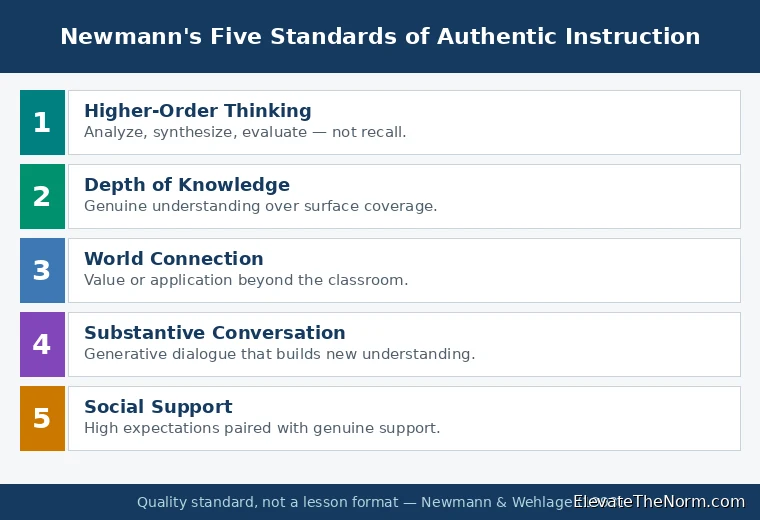
Fred Newmann, a University of Wisconsin researcher who spent decades studying what makes student work worth doing, defined it more precisely. In a 1993 paper with Gary Wehlage, Newmann proposed five standards of authentic instruction — not as a lesson format, but as a quality standard for asking whether the intellectual work students do in school resembles the intellectual work that matters outside of it.
Those five standards are:
Higher-order thinking. Students analyze, synthesize, and evaluate rather than recall and reproduce. They construct interpretations rather than retrieve stored answers.
Depth of knowledge. Students develop genuine understanding of a topic rather than covering as much material as possible as quickly as possible. Breadth is sacrificed for meaning.
Connectedness to the world beyond the classroom. The work has value or application outside school. Students produce something, solve something, or engage with something that exists beyond the classroom walls — not just as a simulation, but as a real contribution or genuine inquiry.
Substantive conversation. Students and teachers engage in real dialogue about ideas, not just question-and-answer recitation. Talk is generative — it produces new understanding rather than merely correcting mistakes.
Social support for student achievement. The environment communicates that every student is capable of high-quality intellectual work. High expectations are paired with genuine support — not as a slogan, but as a visible daily practice.
These five standards are not a lesson format or a curriculum design. They are a quality standard. You can teach a lecture that hits all five. You can run a week-long project that hits none. The question is whether the work asks students to think in ways that are worth thinking.
What the Research Actually Shows
The phrase “research-based” appears on so many practices and products that it has largely lost meaning. So let me be specific about what the research on authentic learning actually demonstrates.
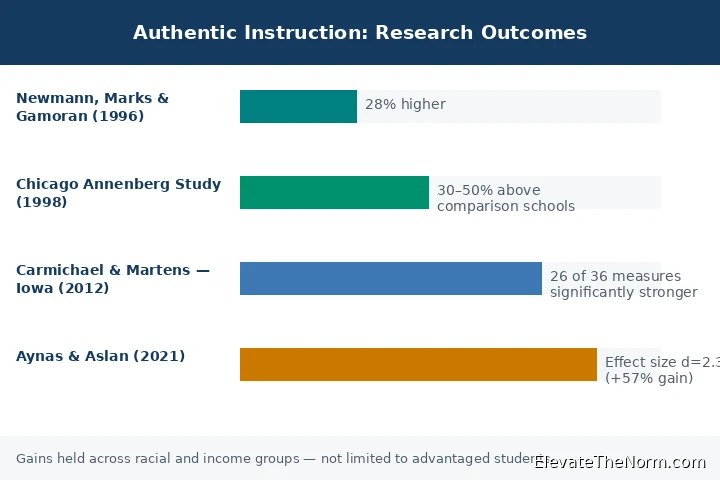
In 1996, Newmann, Marks, and Gamoran studied 2,128 students in grades 3, 6, and 8 across 24 restructured schools — schools given autonomy to try new instructional approaches. Students in classrooms that scored high on the authentic instruction standards outperformed students in low-scoring classrooms by roughly 28 percent on assessments measuring genuine understanding. That gap held across racial and income groups, which matters: the gain was not confined to already-advantaged students.
A separate Chicago Annenberg Challenge study by Newmann, Lopez, and Bryk (1998) found that schools implementing authentic intellectual work produced student achievement margins of 30 to 50 percent above comparison schools across reading and mathematics.
A 2012 study by Carmichael and Martens followed students in 27 Iowa schools implementing Authentic Intellectual Work frameworks. In 26 of 36 measured comparisons, students showed significantly stronger performance on state assessments than matched comparison groups.
More recently, a 2021 study by Aynas and Aslan worked with 92 sixth-grade students comparing authentic problem-based tasks against traditional instruction. Students in the authentic learning group improved problem-solving scores from 30.06 to 47.41 — a 57 percent gain — with an effect size of Cohen’s d = 2.37. That effect size is extraordinarily large by social science standards.
These are not studies of elite schools or specially selected students. They are studies of ordinary classrooms where teachers changed the quality of the intellectual work expected, not the subject, not the schedule, and not the student population.
The Gap Between Authentic and Traditional
Here is the practical difference in concrete terms.
In a traditional classroom, a student studying a local water-quality issue might read an article about pollution, answer comprehension questions, and write a paragraph summarizing the article’s main points. In an authentic classroom, that same student might analyze actual water-quality data from a local river, identify a trend, and present findings — with recommendations — to someone who could act on them: a city council member, a county health board, a local environmental organization.
The content knowledge is identical in both cases. The intellectual demand is not. The authentic version requires the student to ask what the data means, not just what the article says. It requires judgment about the strength of evidence, not just recall of facts. And it produces something that exists in the world — a report, a presentation, a recommendation — rather than a paper graded and returned.
This distinction matters because students are not fooled. They understand when work is made up. They understand when nobody outside the classroom will ever read it, use it, or care about it. And they calibrate their effort accordingly — not because they are lazy, but because they are rational. They are treating manufactured tasks with the seriousness manufactured tasks deserve.
What connects all of this to real-world learning at its best is the shift from performing school to producing understanding. The goal is not an assignment. It is thinking that goes somewhere.
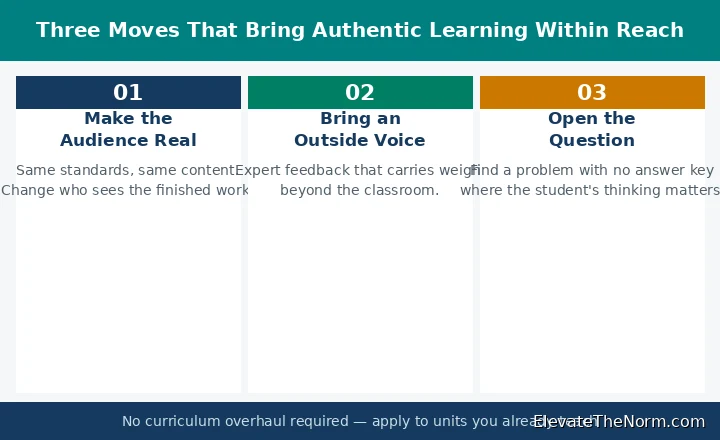
Three Moves That Bring Authentic Learning Within Reach
None of these require a complete curriculum overhaul. Each can be applied to a unit you already teach.
Make the audience real. The simplest shift is changing who sees the work. A persuasive essay written for the teacher is different from a persuasive essay written for the school board, the principal, or the local newspaper. Same standards, same skills. The audience changes the stakes, and the stakes change the thinking. Students who know their work will be read by someone other than their teacher tend to revise it more carefully and argue more precisely.
Bring in an outside voice. Experiential learning research consistently finds that outside expert feedback is one of the most powerful levers available to classroom teachers. The expert does not need to be famous or formally credentialed — they need to be someone whose opinion carries weight beyond the classroom. A local engineer reviewing a student’s bridge design. A small-business owner reading a marketing proposal. A retired teacher critiquing an educational policy argument. The outside voice introduces a standard that is not just the teacher’s standard, and that shift changes what students produce.
Connect to a question that does not have an answer yet. This works in every subject. History teachers can ask what a historical decision should have been, given the evidence available at the time. Science teachers can ask what a data set actually suggests, before revealing what researchers concluded. English teachers can ask what a character’s choice means for how we should read the rest of the novel. The key is finding a question where the student’s thinking actually matters — where there is no answer key and where the argument has to hold up under scrutiny.


A Project Check-In
Midway through most projects, I run a check-in where I ask each group — or each student individually — to defend their decisions to me.
Not present their work. Not summarize what they have done. Defend their specific choices: why did they organize the information this way, why did they select this source over another one, what does their argument actually claim, and what would someone with the opposing view say in response?
The conversation takes three to five minutes. It sounds like this: “Walk me through why you went in this direction.” Then silence. Then: “What is the strongest argument against that position?” Then silence again.
Students who are doing genuine intellectual work — who have actually wrestled with the material — can answer those questions. Students who have been arranging surface information rather than thinking with it usually cannot, not because they are unwilling, but because the work they have been doing has not required that kind of thinking. The check-in reveals which kind of work the project is producing, and it reveals it early enough to do something about it.
This kind of mid-process accountability is one of the most direct expressions of student autonomy in its genuine form — students who are making decisions they can account for, not students who are completing tasks according to directions. The check-in is how I know whether those two things are happening at the same time.
It is also how I find out whether the project structure itself is supporting the right kind of thinking. When multiple students cannot defend their choices in the same way, the problem is usually with the task design, not with the students. That feedback is worth more than any rubric.
What Authentic Learning Is Not
Three distinctions worth making explicit, because the term is misused often enough that they are not obvious:
Authentic learning is not permissiveness or reduced rigor. High-quality intellectual work is more demanding than recall, not less. Students who engage with ambiguous real-world questions must manage genuine uncertainty, revise their thinking when evidence cuts against them, and produce something that can withstand scrutiny from a real audience. That is harder than filling in a blank or summarizing a chapter. Teachers who worry that authentic learning “lowers the bar” have it backward.
Authentic learning is not project-based learning by another name. Project-based learning is a specific instructional approach with its own design elements — a sustained inquiry, a driving question, a public product, and formal critique and revision cycles. Authentic learning is a quality standard that can apply to many different instructional formats, including short lessons, discussions, and even well-designed lectures. A lecture can satisfy all five of Newmann’s standards. A poorly designed three-week project may satisfy none of them. The format is not the point.
Authentic learning is not simply making class engaging or enjoyable. Engagement without intellectual demand is not authentic instruction. A fun simulation that produces only surface-level recall has failed the depth-of-knowledge standard and the higher-order-thinking standard simultaneously. The goal is not enthusiasm — it is thinking that holds up under scrutiny and produces understanding that transfers beyond the classroom.
Starting Without Overhauling Everything
A student-centered classroom does not require redesigning every unit at once, and neither does authentic learning. The research Newmann and his colleagues conducted was not research on schools that had replaced their entire curriculum. It was research on classrooms where individual teachers made a persistent, specific effort to raise the intellectual quality of the work they assigned.
One starting point: take one unit you already teach and add a real audience to the final product. Keep the standards you are covering. Keep the content. Change only who sees the finished work and why. That single shift — from “turn it in to the teacher” to “present it to people who might actually respond to it” — tends to change the quality of the thinking that leads up to it.
Another starting point: find one question in your current curriculum that genuinely has not been settled. Not a trick question. A real question where reasonable people who have examined the evidence still disagree. Give students the evidence, the frameworks, and the time to form a defensible position. Require them to engage with the counterargument. That is authentic intellectual work by Newmann’s standard, and it costs no additional planning time beyond what you are already doing. If you want activities that work with any article, my Current Events and Media Literacy Bundle on TPT has 21 of them for grades 6–12.
The experiential learning activities that stay with students years after the course are almost always the ones that produced something real — a genuine discovery, a real audience, a question that did not have an answer in the back of the book. The difference is not the format. It is whether the work produced understanding that goes somewhere.
Sources
- Newmann, F. M., & Wehlage, G. G. (1993). Five standards of authentic instruction. Educational Leadership, 50(7), 8–12. Available at the ASCD archive.
- Newmann, F. M., Marks, H. M., & Gamoran, A. (1996). Authentic pedagogy and student performance. American Journal of Education, 104(4), 280–312. https://doi.org/10.1086/444136
- Newmann, F. M., Lopez, G., & Bryk, A. S. (1998). The quality of intellectual work in Chicago schools: A baseline report. Consortium on Chicago School Research. Consortium on Chicago School Research
- Carmichael, D. L., & Martens, K. (2012). Authentic intellectual work: Improving teaching for rigorous learning. Corwin Press.
- Aynas, N., & Aslan, S. (2021). The effect of authentic learning on problem-solving skills of secondary school students. Malaysian Online Journal of Educational Sciences, 9(4), 1–16.
- Newmann, F. M. (Ed.). (1996). Authentic achievement: Restructuring schools for intellectual quality. Jossey-Bass.
Frequently Asked Questions
What is authentic learning in simple terms?
Authentic learning means schoolwork that asks students to think in ways that matter outside the classroom — work that connects to real questions, real audiences, or real problems rather than to manufactured tasks designed only to be graded. The term comes from Fred Newmann’s research framework, which defines authentic instruction by five standards: higher-order thinking, depth of knowledge, connectedness to the world beyond the classroom, substantive conversation, and social support for student achievement.
What does authentic learning look like in a 50-minute class period?
It does not have to span multiple class periods or require a full project. A single class period can include authentic elements: a discussion that generates new thinking rather than reciting correct answers, a short writing task with a real audience (even if that audience is only a schoolmate or a department head), or an analysis of real data rather than textbook examples. The format matters less than whether the intellectual demand is genuine.
Does authentic learning prepare students for standardized tests and college?
The research suggests it does. Newmann, Marks, and Gamoran (1996) found that students in classrooms with high authentic instruction scores outperformed comparison students not just on open-ended assessments but also on standardized measures. This is consistent with what cognitive science suggests: students who develop deep understanding of material — rather than surface familiarity — tend to perform better on varied assessment formats, including multiple-choice and short-answer tests.
How do I grade authentic learning fairly?
Grading authentic work requires making the criteria explicit before students begin — what makes an argument defensible, what distinguishes strong evidence from weak evidence, what a well-reasoned recommendation includes. Rubrics that describe quality thinking (rather than just format compliance) work better for authentic tasks than rubrics that reward procedure. It also helps to involve students in understanding the criteria before the work begins, which is itself an authentic intellectual task.
Can I use authentic learning when I have a prescribed textbook curriculum?
Yes. Authentic learning is a quality standard applied to the intellectual work students do — it is not a curriculum. You can add a real audience to a textbook writing assignment, find a genuine open question within a textbook chapter, or bring in outside expert feedback on work students produce from textbook content. None of that requires replacing the curriculum. It requires adjusting the intellectual demand placed on students while using the same material.
Does authentic learning work for all students, including those who struggle academically?
The research by Newmann and colleagues found that the achievement gains from authentic instruction held across racial and income groups — not just for already-advantaged students. Carmichael and Martens’ Iowa study showed consistent results across diverse student populations. This matters: one concern about raising intellectual demand is that it benefits strong students while leaving struggling students further behind. The available evidence does not support that concern. Genuine intellectual demand, paired with genuine support, appears to improve outcomes across the range.
What is the difference between authentic learning and just making class more fun or engaging?
Engagement without intellectual demand is not authentic learning. A fun simulation that produces only surface recall has failed Newmann’s higher-order-thinking and depth-of-knowledge standards, regardless of how much students enjoyed it. The goal of authentic learning is not enthusiasm — it is understanding that transfers. Students should leave a well-designed authentic task able to think with what they learned, not just remember that they had a good time. Both things can happen at once, but enjoyment is not the measure.
About Clay Shumate
Clay Shumate is a certified secondary Social Studies teacher in the public schools of West Alabama, with seven years of classroom experience, a B.A. in History, and an M.Ed. in Secondary Education. He writes about project-based learning, student responsibility, respect, and practical ways to hold young people to a higher standard while giving them room to learn from mistakes. He is a member of the Society of Professional Journalists and writes to its Code of Ethics; this site’s editorial standards and corrections policy are published in full. More about Clay.