Experiential Learning High Schools Can Actually Use
By Clay Shumate
Experiential learning in high schools is learning that comes from doing something real, reflecting on what happened, and applying what you figured out to the next challenge. It is not a field trip. It is not a hands-on activity tacked onto the end of a lecture unit. It is a structured cycle of experience, reflection, and transfer — and high schools can use it inside ordinary schedules and budgets without rebuilding anything.
Key Takeaways
- Experiential learning is a structured cycle — experience, reflection, conceptualization, application — not just any activity where students use their hands.
- High schools can implement experiential learning within existing courses, bell schedules, and budgets. The barrier is design, not money.
- Reflection and transfer are what separate experiential learning from mere activity. Without them, students have an experience but do not learn from it.
- Types range from simulations and case studies that never leave the classroom to internships, service learning, and community partnerships that extend beyond it.
- The teacher’s role shifts from delivering information to designing experiences, supporting learners through difficulty, and facilitating reflection — not disappearing.
What Experiential Learning Actually Is
The term goes back to John Dewey, who argued in the 1930s that education must be grounded in real experience — not experience for its own sake, but experience organized to produce growth. David Kolb formalized the idea into a four-stage cycle in 1984: concrete experience, reflective observation, abstract conceptualization, and active experimentation. That cycle remains the dominant framework (Morris, 2020).
The Association for Experiential Education defines it as “a teaching philosophy that informs many methodologies in which educators purposefully engage with learners in direct experience and focused reflection in order to increase knowledge, develop skills, clarify values, and develop people’s capacity to contribute to their communities” (AEE).
The key word in that definition is purposefully. A student who dissects a frog has had an experience. A student who dissects a frog, records what they observe, connects it to the circulatory system they studied, and applies that understanding to a comparative anatomy problem has had experiential learning. The difference is not the activity. The difference is the reflection and the transfer.
The Kolb Cycle in a High School Classroom
Kolb’s four stages look abstract on paper. In a classroom, they look like this:
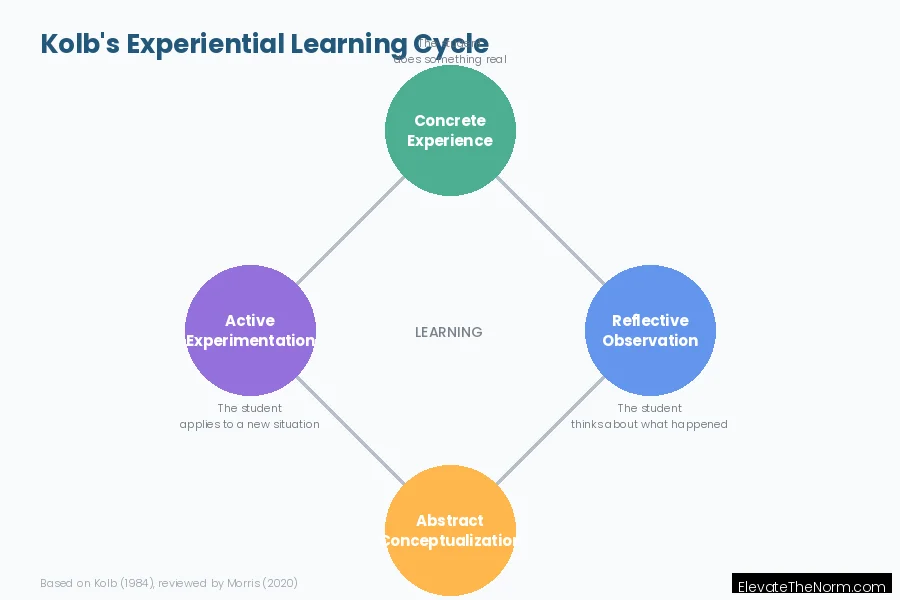
Stage 1 — Concrete Experience. The student does something. They run a simulation of a historical negotiation. They conduct an interview with a local business owner. They attempt to solve a problem with incomplete data. The experience is real enough that it produces genuine confusion, interest, or difficulty — not a rehearsal of something the teacher already explained.
Stage 2 — Reflective Observation. The student steps back and thinks about what happened. What worked? What did not? What surprised them? This stage is where most high school implementations fail — the activity ends, the bell rings, and nobody processes anything. Without reflection, the experience is a memory, not learning.
Stage 3 — Abstract Conceptualization. The student connects the experience to bigger ideas, theories, or principles. This is where content instruction lives. The difference is that the student encounters the concept after the experience, not before — so the concept explains something they have already encountered rather than something they have only been told about.
Stage 4 — Active Experimentation. The student applies what they have learned to a new situation. This is the transfer. A student who ran a Treaty of Versailles simulation, reflected on why negotiations collapsed, and connected it to concepts of national self-interest now applies that understanding to analyzing a current diplomatic dispute. The cycle starts again.
I have a whiteboard table in my classroom — a table I built, surrounded by better chairs and a low lamp, in the corner of the room where students actually ask to sit. That table is where the reflection stage happens for most of my small-group work. When I pull a group there after a simulation or a document analysis, the shift in setting signals that we are moving from doing to thinking. The conversation changes. Students are not performing for the room anymore. They are processing what just happened, and the physical space — quieter, closer, more intentional — makes that processing better.
Types of Experiential Learning That Work in High Schools
Not every form of experiential learning requires a bus, a budget, or a community partner. Many of the most effective types happen inside the building, during regular class periods, with materials already available. A set of worked project examples across subjects shows what this looks like in school-based, community-connected, and cross-curricular formats. My Social Studies Teacher Toolkit Bundle on TPT covers world history and civics if you want finished materials for the content side.
Inside the Classroom
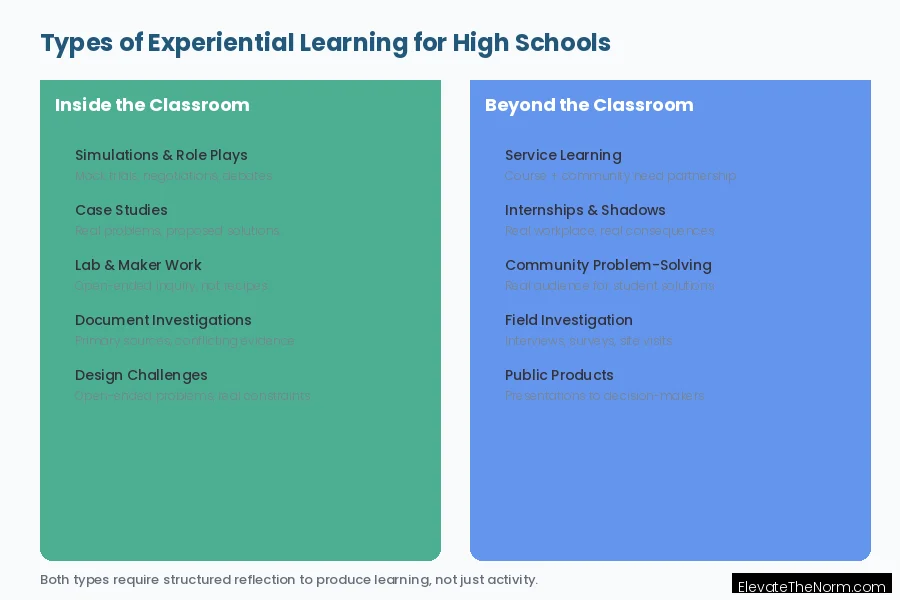
Simulations and role plays. A mock trial. A constitutional convention with competing delegates. A town-hall debate on a local zoning decision. Simulations compress real-world complexity into a classroom-sized experience and force students to make decisions under constraints. The learning lives in the debrief — the conversation afterward about why they made the choices they made and what those choices reveal about the subject.
Case studies. Give students a real problem — a business decision, a public health crisis, an engineering failure, a historical dilemma — and ask them to analyze it, propose a solution, and defend their reasoning. Case-based learning is experiential because the student is doing the intellectual work of a practitioner, not memorizing someone else’s conclusions.
Laboratory and maker work. Science labs are the oldest form of experiential learning in secondary schools. The challenge is ensuring that labs are genuine inquiry — where the student does not know the answer before they start — rather than confirmation exercises where they follow a recipe to arrive at a predetermined result. The same principle applies to maker spaces, fabrication labs, and design challenges: the value is in the open-ended problem, not the equipment.
Document-based investigations. In a social studies class, this means handing students primary sources, conflicting accounts, or incomplete evidence and asking them to construct an interpretation. The experience is the intellectual struggle of the discipline itself — weighing evidence, identifying bias, tolerating ambiguity, building an argument.
Beyond the Classroom
Service learning. Service learning is not community service with a reflection worksheet. It is a structured partnership between a course and a community need, where the service advances the academic learning and the academic learning improves the service. A biology class monitoring water quality for a local watershed organization is service learning. A class picking up trash for a day is community service — valuable, but not the same thing.
Internships and job shadows. Extended placements in professional settings give students access to the real pace, decisions, and consequences of adult work. Several states have begun requiring or incentivizing these: Mississippi now provides career coaches in every public high school, Indiana requires all graduates to complete a work-based learning experience, and Delaware has built a statewide career pathway system that connects classroom learning to industry credentials.
Community problem-solving and public products. Students identify a real problem in their community, research it, propose a solution, and present that solution to a genuine audience — a city council, a school board, a local business, a nonprofit. The audience is what makes it experiential rather than hypothetical. A student who presents to someone who might actually implement their idea is having a fundamentally different experience from a student who presents to their teacher for a grade. This is also the heart of strong project-based learning.
Field investigation. Site visits, interviews, environmental surveys, oral history projects, archaeological-style artifact analysis. The fieldwork does not need to be exotic. Interviewing a grandparent about their experience during a historical period is field investigation. Photographing and documenting the architectural history of a single block downtown is field investigation. What matters is that the student encounters primary evidence in its natural context rather than in a textbook.
Why Reflection Makes or Breaks the Whole Thing
An experience without reflection is just something that happened. Reflection is the mechanism that converts an event into understanding. Kolb’s model, Dewey’s philosophy, and the AEE’s principles all agree on this point: the learning does not live in the experience. It lives in what the learner makes of the experience afterward.
In practice, reflection requires three things from the teacher:
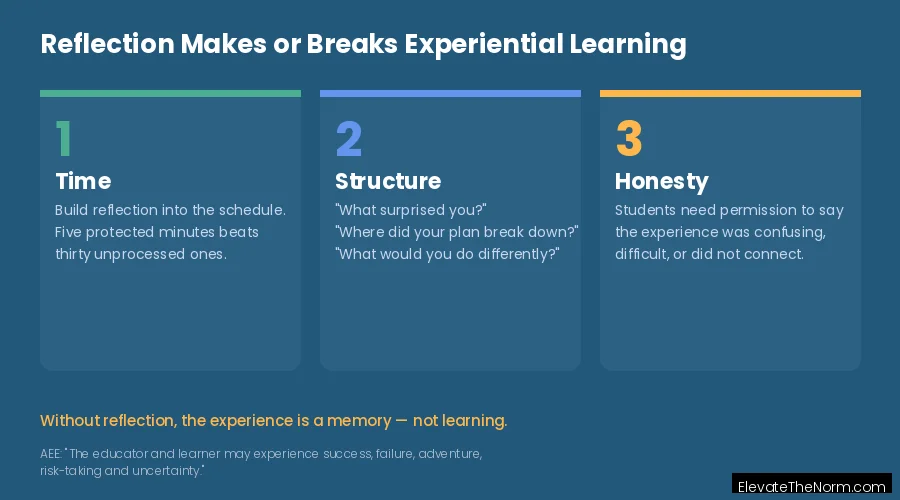
Time. This is the hardest resource to protect. When the simulation runs long or the lab takes the full period, reflection gets cut. Plan for it. Build it into the schedule, not the leftover minutes. Even five protected minutes of structured reflection are worth more than thirty minutes of unprocessed activity.
Structure. “What did you think?” is not reflection. It is an invitation to say “It was cool” and move on. Effective reflection questions are specific: What surprised you? Where did your plan break down? What would you do differently if you ran the simulation again? What does this experience suggest about how [concept] works in practice?
Honesty. Students need permission to say the experience did not work, was confusing, or did not connect. The AEE’s principles explicitly state that “the educator and learner may experience success, failure, adventure, risk-taking and uncertainty.” If every reflection ends with a tidy success narrative, the reflection is performative, and students will learn to produce the expected answer rather than the honest one.
Making It Work Inside an Ordinary Schedule
The most common objection to experiential learning in high schools is time. Block schedules help, but plenty of schools run 45-minute periods. Experiential learning is still possible. It just requires different design.
Break the cycle across days. Kolb’s cycle does not need to happen in one period. Run the experience on Monday, the reflection on Tuesday, connect to the content on Wednesday, and apply to a new situation on Thursday. This is no different from what good teachers already do — it just makes the structure explicit.
Use the classroom for what the classroom can do. Simulations, case studies, document analyses, design challenges, and problem-solving protocols are all experiential and all fit inside a regular class period. A bank of ready-to-run activities across those categories shows how each one fits a single period. Not every experiential activity requires leaving the building. Some of the strongest experiences are intellectual, not physical — the struggle of interpreting conflicting evidence, the difficulty of building a persuasive argument, the challenge of solving a problem with incomplete information.
Start with one unit. You do not need to redesign an entire course. Take one unit you already teach, identify where students currently receive information passively, and replace that section with an experience that forces them to encounter the concept before you explain it. Then add structured reflection. That is the whole conversion. You can scale from there.
Budget is not the barrier — design is. A simulation costs nothing. A case study costs nothing. A structured interview protocol costs nothing. An oral history project costs nothing. The expensive forms of experiential learning — internship programs, community partnerships, off-campus placements — are valuable, but they are not the only forms, and waiting for the budget to build them should not prevent you from using the forms you can start tomorrow.
What the Research Says
Ranken’s 2025 rapid evidence assessment, published in The Curriculum Journal, examined studies on the effect of experiential learning on academic achievement for students aged 4–14. The assessment found positive effects overall but noted wide variation by implementation quality, with the strongest outcomes in programs that included structured reflection and explicit connection to curriculum content (Ranken, 2025).
Morris (2020), in a systematic review and revision of Kolb’s model published in Interactive Learning Environments, confirmed the experiential learning cycle’s continued relevance while noting that Kolb’s original four-stage model benefits from greater emphasis on the social context of learning — the idea that experiences are more powerful when learners process them with others, not just internally (Morris, 2020).
Data from CapSource and other employer surveys consistently find a gap between what high school and college graduates can do and what employers need them to do. CapSource reported that 72 percent of graduates felt unprepared for workplace challenges and 84 percent of hiring managers identified readiness gaps. Experiential learning directly addresses this by giving students practice with the skills — problem-solving, communication, adaptation, professional judgment — that traditional instruction often describes but rarely lets students perform.
The evidence does not suggest that experiential learning is a universal replacement for direct instruction. Some content is efficiently taught through explanation, practice, and feedback. The evidence suggests that experiential learning fills a gap that direct instruction cannot: the gap between knowing about something and knowing how to do it, between receiving information and constructing understanding. Strong project-based learning uses the same principle at a larger scale.
Common Mistakes to Avoid
Activity without purpose. An experience that is fun but unconnected to learning goals is not experiential learning. It is a field trip. Every activity needs to produce a struggle, a question, or a problem that the curriculum can then help resolve.
Skipping the reflection. This is the most common failure, and it reduces experiential learning to busy hands. If the bell rings before students process what happened, the learning did not happen. Protect the reflection time the way you protect the test — it is not optional.
Assuming experiences must leave the building. Internships and community partnerships are excellent, but they are not the definition. Simulations, case analyses, structured debates, and design challenges are experiential, and they work inside a regular classroom during a regular period.
Removing the teacher. Experiential learning shifts the teacher’s role — it does not eliminate it. The AEE’s principles describe the educator’s role as setting suitable experiences, posing problems, supporting learners, ensuring physical and emotional safety, and facilitating the learning process. A teacher who launches an activity and then retreats to a desk has not implemented experiential learning. They have implemented unsupervised activity.
Confusing experiential learning with entertainment. Difficulty is not a design flaw. It is the point. An experience that challenges, confuses, or frustrates the student is exactly where learning happens — provided the teacher supports the student through it and the reflection helps them make sense of it. Ease and fun are not the goal. Growth is.
Conclusion
Experiential learning in high schools does not require a new building, a grant, or a revolution. It requires a teacher who is willing to let students encounter a problem before the answer, sit with difficulty long enough to learn from it, and reflect honestly on what happened. That cycle — experience, reflection, understanding, application — is how people actually learn outside of school. There is no reason school should be different.
Start with one simulation, one case study, one structured interview, one investigation. Build in the reflection. Connect it to the content. Let the student apply what they figured out to something new. That is experiential learning. It works in a 45-minute period, in a regular classroom, on a regular budget. And it produces students who can actually use what they learned the moment they walk out the door.
Frequently Asked Questions
What is the difference between experiential learning and hands-on learning?
Hands-on learning means the student physically manipulates materials or does an activity. Experiential learning adds three critical layers: the experience must produce a genuine question or challenge, the student must reflect on what happened, and the student must apply the insight to a new situation. A student building a volcano model is doing hands-on learning. A student designing a structure to withstand a simulated earthquake, reflecting on why it failed, and revising the design based on engineering principles is doing experiential learning. The difference is the reflection and the transfer, not the materials.
Can experiential learning work in a 45-minute class period?
Yes. Kolb’s learning cycle does not need to happen in a single period. Run the experience on one day and the reflection on the next. Alternatively, use shorter experiential activities that fit inside a standard period: a 15-minute simulation followed by 10 minutes of structured reflection and 15 minutes of content connection. Many classroom-based forms — case studies, document analyses, structured debates, design challenges — are designed for exactly these time constraints.
What is the teacher’s role in experiential learning?
The teacher designs the experience, sets up the problem, supports students through difficulty, ensures physical and emotional safety, and facilitates reflection. The teacher does not disappear. The Association for Experiential Education explicitly names educator presence and intentional facilitation as foundational principles. The role shifts from delivering information to creating the conditions for students to encounter, struggle with, and make sense of that information through experience.
What are examples of experiential learning that stay inside the classroom?
Simulations and role plays, such as a mock trial or a historical negotiation. Case studies where students analyze a real problem and propose solutions. Document-based investigations using primary sources, conflicting accounts, or incomplete evidence. Design challenges and maker projects with open-ended problems. Laboratory investigations structured as genuine inquiry rather than recipe-following. Structured debates where students must argue positions they did not choose. All of these produce authentic intellectual struggle, which is what makes them experiential.
How is experiential learning different from project-based learning?
Experiential learning is the broader philosophy — learning through direct experience, reflection, and application. Project-based learning is one methodology that uses experiential principles at an extended scale, typically involving a driving question, sustained inquiry, and a public product. All strong PBL is experiential, but not all experiential learning is PBL. A 20-minute simulation is experiential but is not a project. A two-week investigation culminating in a community presentation is both.
Does experiential learning work for all subjects?
Yes, though it looks different across disciplines. In science, it may involve laboratory inquiry or field investigation. In social studies, it may involve simulations, primary-source analysis, or oral history. In English, it may involve real-world writing for an actual audience. In math, it may involve data collection and analysis on a genuine question. In career and technical education, it may involve internships, job shadows, or client projects. The principle is universal: students learn more deeply when they encounter problems before solutions and reflect on what they discover.
How do I assess experiential learning?
Assess both the process and the product. Reflection journals, debriefing discussions, self-evaluations, and peer feedback capture what the student learned from the experience. Rubrics, portfolios, and final products measure the quality of work produced. The key is aligning assessment with the learning goals, not the activity itself. A student who had a strong experience but a weak reflection has not completed the cycle. A student who produced a polished product without engaging genuinely in the experience has performed, not learned.
Sources
- What Is Experiential Education?, Association for Experiential Education.
- Experiential Learning — A Systematic Review and Revision of Kolb’s Model, Morris, T. H., Interactive Learning Environments, 2020.
- The Effect of Experiential Learning on Academic Achievement of Children Aged 4–14: A Rapid Evidence Assessment, Ranken, The Curriculum Journal, 2025.
- Applying Kolb’s Experiential Learning Cycle for Deep Learning: A Systematic Literature Review, 2025.
- CapSource — Experiential Learning Data and Employer Readiness Surveys.
About Clay Shumate
Clay Shumate is a certified secondary Social Studies teacher in the public schools of West Alabama, with seven years of classroom experience, a B.A. in History, and an M.Ed. in Secondary Education. He writes about project-based learning, student responsibility, respect, and practical ways to hold young people to a higher standard while giving them room to learn from mistakes. He is a member of the Society of Professional Journalists and writes to its Code of Ethics; this site’s editorial standards and corrections policy are published in full. More about Clay.