Tag: classroom-norms

  • Why Are Classroom Expectations Important? Because Students Deserve Clarity

    Why Are Classroom Expectations Important? Because Students Deserve Clarity

    By Clay Shumate

    Why are classroom expectations important? Because a room without them runs on guesswork, and guesswork is unfair to the student who can’t read your mood on a given day. Clear, taught expectations tell a class exactly what the room requires and what it promises back — protected instructional time, predictable fairness, and a real path toward independence.

    Key Takeaways

    • Clear expectations reduce discipline problems and protect instructional time — Marzano’s research found teachers with strong management practices and high-quality relationships had 31 percent fewer discipline issues over a full year.
    • Expectations are not rules posted on a wall. They are behaviors you teach, model, practice, and revisit — the same way you teach content.
    • Adolescents respond better to expectations they understand the reasoning behind. Stating a standard without explaining why it exists invites testing.
    • Consistency matters more than severity. A predictable room where small things are addressed early is calmer than a room where nothing happens until someone explodes.
    • Expectations must go both ways. If students are expected to be prepared, on time, and respectful, the adult in the room owes them the same.

    What Classroom Expectations Actually Are

    Classroom expectations are the specific, observable behaviors that define how a learning environment operates. They cover how students enter the room, how they participate, how they treat each other, how they handle materials, what happens when they finish early, and what happens when they need help.

    That is different from rules. Rules tell students what not to do. Expectations tell them what to do instead — and the research consistently favors the second approach. Positively stated expectations (“Be prepared with your materials before the bell”) give students a target to hit rather than a minefield to avoid. If you are building a complete set of classroom expectations for the first time, starting with positively stated behaviors is the most important decision you will make.
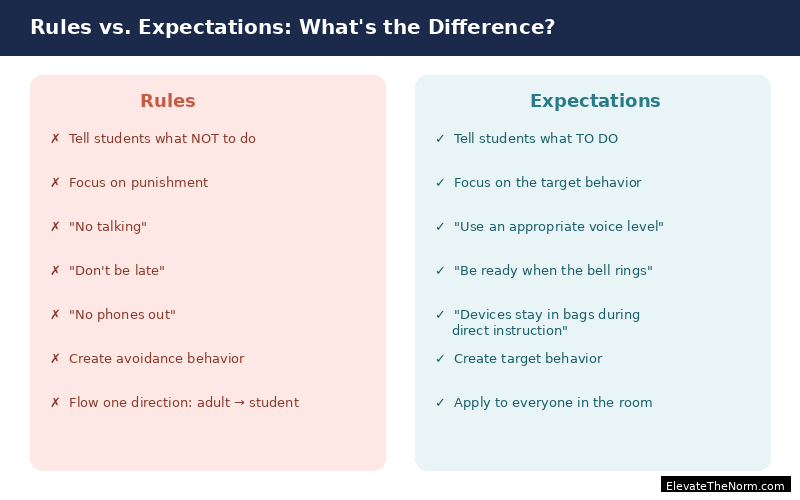
    Side-by-side comparison showing the difference between classroom rules and classroom expectations, with rules focused on what not to do and expectations focused on what to do
    Rules tell students what not to do. Expectations tell them what to do instead.

    The distinction matters more than it sounds. “No talking” is a rule. “Use a voice level appropriate to the activity” is an expectation. The first one creates a room where students are trying not to get caught. The second creates a room where students are making judgments about what the moment requires — and that judgment is a skill worth developing.

    Why Expectations Change Everything in a Secondary Classroom

    They Protect Instructional Time

    Research from the IRIS Center at Vanderbilt University is direct about this: teachers who establish and maintain clear norms for behavior spend more time teaching because less time goes to discipline (Brophy, 2000). Every minute spent restating a procedure that was never taught properly is a minute taken from the content students came to learn.

    In a secondary classroom with 50-minute periods — or in some cases, 90-minute blocks — lost minutes compound fast. If a teacher loses five minutes every period to transitions that were never practiced, that is 25 minutes a day across five classes. Over a semester, that is roughly 2,250 minutes — more than 37 hours of instruction gone.

    They Reduce Anxiety and Guesswork

    This is the part most teachers underestimate. Adolescents are performing a complicated identity negotiation every period of every day. They are testing who they are, what their peers think of them, how much authority to accept, and how much risk to take. A room with clear expectations removes one variable from that equation: they do not have to guess what the teacher wants.

    The Australian Education Research Organisation reviewed the evidence and found that when behavioral standards are transparent, “students feel more secure because they know where they stand” (DeNobile, 2021). Security does not mean softness. It means the room is predictable — and predictable rooms are calmer rooms.

    They Make Fairness Visible

    One of the fastest ways to lose a teenager’s trust is to enforce something they did not know existed. When expectations are public, taught, and consistent, a correction becomes a reference to a shared agreement rather than a personal attack. “We said prepared means materials out before the bell — grab your notebook” is a different conversation than “Why aren’t you ready?”

    The first version holds the standard. The second version questions the student. Adolescents can feel the difference, and they respond accordingly. This same principle applies to how teachers handle respect in the classroom — fairness is not about treating every moment identically, but about making every standard visible and every correction consistent.

    They Build Independence Over Time

    Here is what gets overlooked: clear expectations are not about control. They are a scaffold. When students know the procedures, they stop relying on the teacher to direct every transition, every material distribution, and every shift between activities. They run the routines themselves — and that frees the teacher to do the work that actually requires a human being: circulating, checking understanding, pulling small groups, and responding to what students need in real time.

    I spend most of my class period moving between groups, sitting down with students at the whiteboard table I built in the corner of my room. That table is the best seat in the house — low lamp, a rug, better chairs. Students ask to come there. But the only reason I can spend my time that way is because the rest of the room is running on expectations we practiced until they became automatic. If I had to stand at the front managing every transition, that table would just be furniture.

    How to Teach Expectations (Not Just State Them)

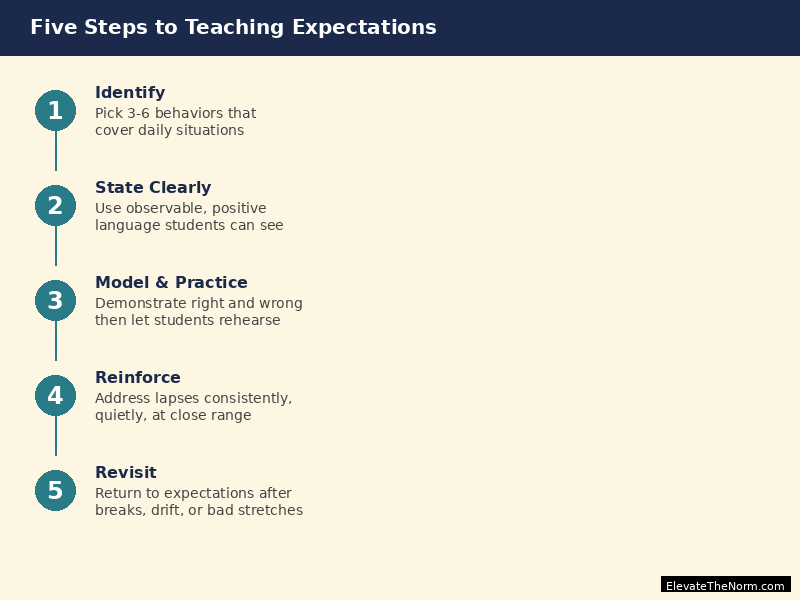
    Posting expectations on a wall is step one of a five-step process. Stopping there is the most common mistake secondary teachers make — and it is the reason so many give up on expectations by October. If you have already created a classroom expectations poster, that visual is useful — but it is the beginning of the work, not the end of it.

    Infographic showing the five steps to teaching classroom expectations: identify key behaviors, state them in observable language, model and practice, reinforce consistently, and revisit and adjust
    Teaching expectations requires five deliberate steps — not just posting them on a wall.

    Step 1: Identify the Behaviors That Matter Most

    You cannot have 30 expectations. You can have five or six — the ones that cover the situations your students encounter every day. Start with the moments that consistently cause problems: entering the room, transitions between activities, asking for help, working with a partner, and what to do when you finish early.

    Step 2: State Them in Observable Language

    An expectation is only useful if you can see whether someone is meeting it. “Be respectful” is not observable. “Listen without interrupting when someone is speaking to the class” is. “Be responsible” is not observable. “Turn in your work by the deadline or communicate with me before it passes” is.

    The IRIS Center recommends keeping rules few, universal, and positively stated — then linking specific procedures to each one (IRIS Center, 2003). A general expectation like “Be prepared” needs concrete procedures attached: what “prepared” looks like in this room, by this bell, for this type of activity.

    Step 3: Model and Practice

    This is where secondary teachers get uncomfortable. Modeling expectations feels elementary — and most of us skipped it. But the research is clear: students perform better when expectations are explicitly taught through demonstration, not merely announced (Archer & Hughes, 2011).

    Model what a good transition looks like. Model what asking for help looks like. Model the wrong way, too, if you can do it with humor and not sarcasm — so students see the contrast. Then let them practice. The first three days of the year are not lost instruction. They are the most important instruction you will give all year. This is especially critical if you are in your first years and still working out classroom management as a new teacher.

    Step 4: Reinforce Consistently, Not Loudly

    Marzano’s meta-analysis found that the quality of teacher-student relationships was the most important variable in effective classroom management — teachers with strong relationships and clear expectations had 31 percent fewer discipline problems across the year (Marzano et al., 2003). That finding matters because it means enforcement does not require volume. It requires consistency and connection.

    When a student does not meet an expectation, address it immediately, briefly, and at close range. A quiet redirect while you are already circulating — “Materials out, please” — costs less social capital than a public correction from across the room. And it preserves the relationship that makes the expectation stick. Strong relationships with students are not a separate initiative from classroom management — they are the mechanism that makes management work.

    Step 5: Revisit and Adjust

    Expectations are not a September activity. They need to be revisited after breaks, after schedule changes, after a stretch of bad days, and after you realize one of your expectations was unreasonable in the first place. Acknowledging that an expectation needs adjusting is not weakness. It is modeling exactly the kind of honest self-assessment you want from students.

    What Happens When Expectations Are Missing

    The consequences of vague or absent expectations are not dramatic. They are gradual — and that is what makes them dangerous.
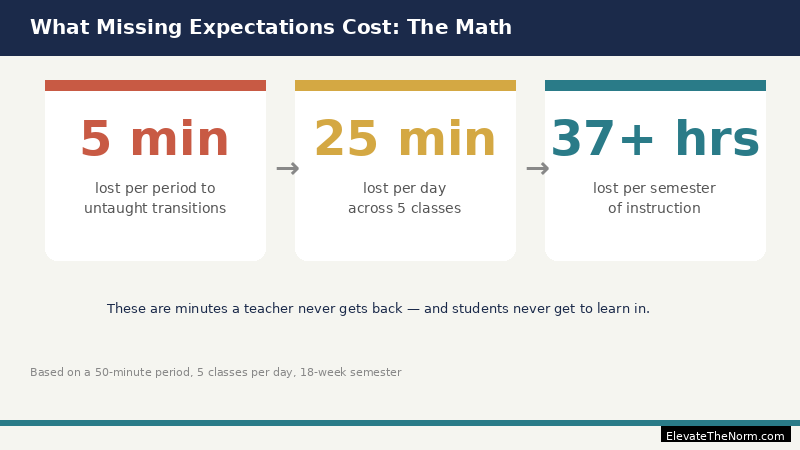
    Visual showing the costs of missing classroom expectations: lost instructional time, reactive discipline cycles, eroded trust, and disproportionate impact on marginalized students
    Without clear expectations, teachers spend more time managing confusion than teaching content.

    Without clear expectations, teachers tend to rely on reactive discipline: waiting for something to go wrong and then responding. That pattern creates an exhausting cycle. The teacher feels like they are constantly putting out fires. The students feel like the rules change depending on the teacher’s mood. Both sides get frustrated, and the relationship erodes.

    Research on teacher expectations confirms this pattern. A 2024 narrative review published in the Journal of the Royal Society of New Zealand found that teachers’ expectations significantly influence student outcomes, and that inconsistent or unclear expectations disproportionately affect students from marginalized backgrounds (Rubie-Davies et al., 2024). Students who already face barriers outside of school should not have to decode a second set of hidden expectations inside it.

    For a practical look at what those belief-driven expectations actually require—the specific moves, language, and mindset that separate genuine high expectations from surface-level optimism—see holding students to high expectations in secondary classrooms.

    Expectations Go Both Ways

    This is the part that separates a set of classroom expectations from a set of classroom rules. Rules flow in one direction — from the teacher to the student. Expectations, done well, apply to everyone in the room.

    If students are expected to arrive on time, the teacher starts on time. If students are expected to be prepared, the teacher has the plan posted and the materials ready. If students are expected to listen without interrupting, the teacher does the same when a student is speaking.

    That does not mean teachers and students hold identical authority. They do not. But mutual respect for each other’s time, effort, and presence is what turns expectations from a behavior-management tool into a culture.

    Three Things Your Expectations Cannot Decide for You

    No classroom expectations list exists in isolation. Before you finalize yours, account for these:

    Your school’s behavior framework comes first. If your building uses PBIS, a schoolwide behavior matrix, or a restorative practices model, your classroom expectations must align with it — not contradict it. A classroom expectation that conflicts with the schoolwide framework confuses students who are trying to follow both, and it puts you in an awkward position with administrators when a situation escalates beyond your room.

    IEPs and 504 plans take legal precedence. A student’s documented behavior intervention plan overrides your classroom expectations for that student. This is not optional, and it is not a weakening of your standards. It is the law. Consult with the special education team before the year starts and whenever a new student with a plan enters your class.

    Families should know what you expect in week one. Send your expectations home — in writing, not just verbally through students. A parent who understands what the room requires can support it. A parent who discovers your expectations only when their child gets a consequence feels blindsided, and that damages a relationship you may need later.

    A Practical Starting Point

    If you are starting from scratch — or starting over — here is what works:

    Pick three to five expectations that cover the broadest range of daily situations. State each one in observable, positive language. On the first day, explain each one, model it, let students practice it, and explain why it exists. Then hold it — every day, every period, for every student — without exceptions that are not also explained publicly.

    It is not complicated. But it is relentless, and the relentlessness is the point. Students do not learn expectations from a poster. They learn them from a teacher who means what they say and says it every single day until the room runs on its own. The same principle applies to teaching student responsibility — it is a daily practice, not a one-time conversation.


    How many expectations should a secondary classroom have?

    Three to six. More than that and students cannot remember them, teachers cannot enforce them consistently, and the list starts contradicting itself. Each expectation should be broad enough to cover multiple situations but specific enough to be observable. If you need more than six, you probably need better procedures underneath fewer expectations.

    Are classroom expectations the same as classroom rules?

    Not exactly. Rules typically tell students what they cannot do and carry stated consequences. Expectations tell students what the room requires and are stated positively — what to do, not what to avoid. In practice, many teachers use a small set of expectations supported by procedures, with consequences understood but not the headline. The research favors positively stated expectations because they give students a behavior to perform, not just a behavior to suppress.

    When should expectations be introduced — the first day or after content starts?

    The first day. Marzano’s research and the IRIS Center’s synthesis both agree: explicitly teaching expectations during the first days of school produces better outcomes than announcing rules and moving to content. Time spent modeling, practicing, and discussing expectations in week one saves far more time than it costs over the remaining weeks of the semester.

    Do expectations work with students who have behavioral challenges?

    Clear expectations help every student, but they are especially important for students with behavioral challenges, including those with IEPs or 504 plans. Predictability reduces anxiety, and publicly stated expectations prevent the perception that consequences are personal or arbitrary. That said, individual behavior plans required by an IEP or 504 take legal precedence over classroom expectations — always follow the documented plan and consult with the special education team.

    How do you handle a student who refuses to follow expectations?

    Start with a private, calm conversation — not a public confrontation. Ask what happened. Restate the expectation. Give the student a clear path to meet it. If the behavior continues, follow your escalation process and document. Never abandon the expectation itself because one student resists it. The other 25 students are watching to see whether the standard is real.

    Should students help create classroom expectations?

    Research supports involving students in the process when it is genuine — not performative. A class discussion about why an expectation exists and what it should look like increases buy-in, especially with adolescents who need to understand the reasoning behind a standard. What does not work is asking students to create the expectations entirely and then overriding them when you do not like the result. If you ask for input, use it.

    Do expectations need to be revisited after the first week?

    Yes — after every long break, after a schedule change, after a substitute teacher, and after any stretch where the room has drifted. Expectations are not a contract signed and filed. They are a practice maintained through repetition and honest conversation about what is working and what is not.


    Sources


    About Clay Shumate

    Clay Shumate is a Class A certified Social Studies and History teacher for grades 6–12, now in his seventh year in the classroom, with an M.Ed. in Secondary Education and a B.A. in History. He teaches 9th grade World History and writes about project-based learning, student responsibility, and classroom culture. He is a member of the Society of Professional Journalists and writes to its Code of Ethics; this site’s editorial standards and corrections policy are published in full. More about Clay.
  • Example of Classroom Expectations for Middle and High School Students

    Example of Classroom Expectations for Middle and High School Students

    By Clay Shumate

    A good example of classroom expectations for middle and high school says exactly what a student is supposed to do, not how they are supposed to be. “Be in your seat and working when the bell rings” is an expectation. “Be respectful” is a mood. This page gives you observable examples for several different kinds of secondary classrooms, the reasoning behind each one, and the words to teach them with.

    I am going to skip the part where I tell you expectations matter. You know that. What most teachers actually need is not the argument, it is the wording—a set of examples specific enough to steal from, and honest about the edge case each one is designed to survive.

    Key Takeaways

    • An expectation is only usable if two people watching the same student would agree on whether it happened. If they would not, you have written a judgment call, not an expectation.
    • Five is the ceiling. The IRIS Center’s guidance for secondary classrooms is no more than five, stated positively, in observable terms.
    • Vague expectations are not just ineffective—they are where discipline disparities concentrate. Subjectively defined infractions like “willful defiance” show the largest racial gaps in referral research.
    • The examples below are written for different rooms: a middle school classroom, a high school seminar, a lab or shop, a performance class, and a one-to-one device room. Take the wording, not the whole list.
    • An expectation you will not enforce on your worst day is not an expectation. It is a wish, and students identify it within two weeks.

    Two notes before the examples. If you want the underlying framework—why expectations work, how they differ from rules, how to build a set from scratch—that lives in classroom expectations: a practical framework for grades 6–12. If you want print-ready wall copy, that is the classroom expectations poster. This page is the examples themselves, sorted by the kind of room you actually teach in.

    What Separates a Good Example of Classroom Expectations From a Bad One

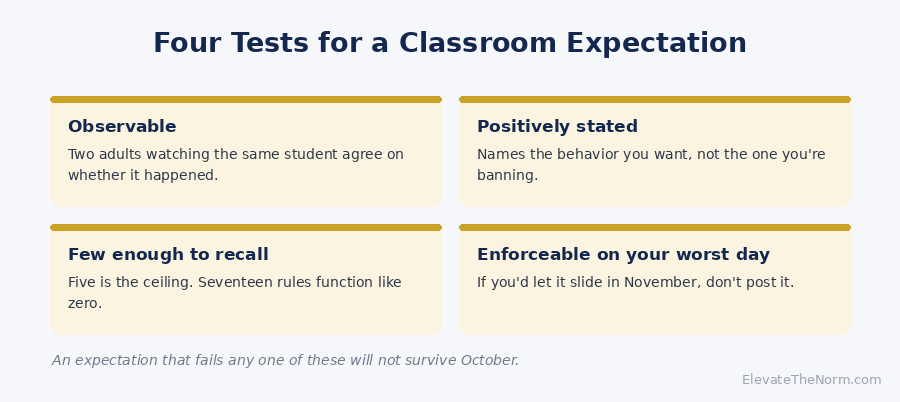
    Four tests. An expectation has to pass all four to be worth posting.

    Four tests for a classroom expectation: observable, positively stated, few enough to recall, and enforceable on your worst day
    Four tests. An expectation that fails any one of them will not survive October.
    1. Observable. Two adults watching the same student agree on whether it happened. The IRIS Center puts it as “observable and measurable,” and offers the useful contrast: “Follow directions” beats “Be respectful,” because one of those can be seen (IRIS Center, Vanderbilt University).
    2. Positively stated. Name the behavior you want, not the one you are banning. “Phones stay in the caddy until the work needs one” tells a student what to do. “No phones” only tells them what you will be annoyed about.
    3. Few enough to recall. No more than five. Seventeen rules function like zero, because nobody—including you—is holding seventeen standards consistently.
    4. Enforceable on your worst day. This is the test nobody writes down and everybody fails. If you would let it slide on a Friday in November when you are tired and behind, do not post it. Students learn which expectations are real by watching what you do when you are worn out.

    Rewriting Vague Expectations Into Usable Examples

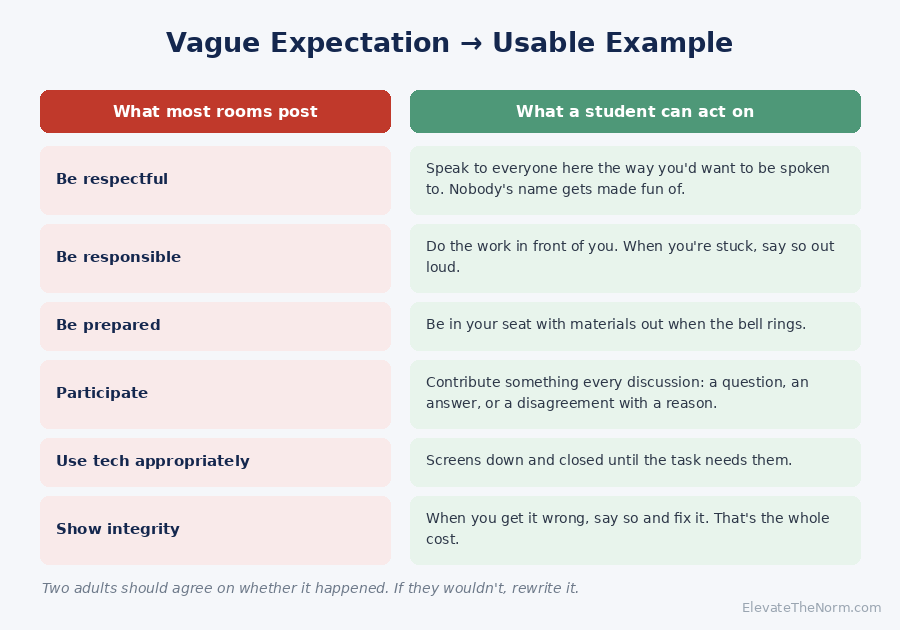
    Most expectation sets are not wrong, they are just unfinished. The words on the wall are the category; the usable version is the behavior underneath it. Here is the same standard written both ways.

    The category most rooms postThe observable example a student can act on
    Be respectfulSpeak to everyone in this room the way you would want to be spoken to. Nobody’s name gets made fun of.
    Be responsibleDo the work in front of you. When you are stuck, say so out loud—to me or to your table.
    Be preparedBe in your seat with your materials out when the bell rings.
    ParticipateContribute something to every discussion: a question, an answer, or a disagreement with a reason attached.
    Use technology appropriatelyScreens are down and closed until the task needs them. When it does, I will say so.
    Show integrityWhen you get something wrong, say so and fix it. That is the whole cost.
    Be on taskBetween the bell and the last five minutes, you are working on this class’s work.
    CooperateYour group can name what you contributed by the end of the period.
    Chart converting vague classroom expectations such as be respectful and be responsible into specific observable behaviors students can act on
    The wall version is the category. The usable version is the behavior underneath it.

    This is not only a clarity problem. It is a fairness problem with data behind it. Research summarized by Brookings found that Black students in North Carolina were less likely to face exclusionary discipline when taught by Black teachers than by white teachers within the same school, and that the gap was strongest for office referrals categorized as “willful defiance”—the most subjectively defined infraction available (Brookings, summarizing Lindsay & Hart, 2017).

    Read that as a design instruction. Every vague expectation you post is a place where a judgment call gets made, and judgment calls are where the disparities live. Writing “be in your seat when the bell rings” instead of “be respectful of class time” is not pedantry. It shrinks the space where bias operates.

    Examples of Classroom Expectations by Type of Room

    A set that works in a discussion-heavy history room will not work in a shop with power tools. Below are five worked examples, each capped at five expectations, each with the specific problem it is built to survive. Take the wording. Do not take the whole list—an expectation set only works if the person enforcing it believes it.

    Middle school, grades 6–8

    Sixth graders are still learning what school even is at this level. The wording has to be concrete without sounding like elementary school, because nothing loses a twelve-year-old faster than being talked to like a child.

    ExpectationWhat it is built to survive
    Be in your seat with materials out when the bell rings.The four-minute settling period that eats a week of instruction per semester.
    One person talks at a time, and it is whoever has the floor.Enthusiastic interrupting, which at this age is usually not defiance.
    Nobody’s name gets made fun of. Ever.The specific cruelty that middle schoolers are best at and adults most often miss.
    When you are stuck, say so out loud before the period ends.Students who have learned that silence hides not knowing.
    When you get it wrong, say so and fix it.The instinct to lie about small things because the cost feels enormous.

    High school, grades 9–12, discussion-heavy course

    Older students will meet a higher bar if the bar is explained. This set assumes disagreement is the point of the class, not a disruption of it.

    ExpectationWhat it is built to survive
    Be working within a minute of the bell.The senior-year drift where arrival becomes negotiable.
    Disagree with the idea, by name, with a reason. Never with the person.Debate collapsing into personal shots—or into nobody saying anything.
    Contribute something every discussion: a question, an answer, or a disagreement.Four students carrying every conversation while twenty coast.
    Screens down and closed until the task needs them.The device that is technically for notes.
    Meet the deadline, or renegotiate it before it passes.The after-the-fact excuse, replaced with a before-the-fact conversation.

    Lab, shop, or any room with equipment

    Safety expectations are the one category where “positively stated” bends. A hard prohibition tied to a real hazard should be stated as a prohibition, and it should be the shortest sentence on the wall.

    ExpectationWhat it is built to survive
    Eye protection on before you touch anything, off when you leave the bench.The five-second task nobody thought needed goggles.
    Hands stay off equipment until you have been checked out on it.Confidence outrunning training.
    Report every spill, break, or injury immediately. Nothing bad happens to you for reporting.The student who hides a small problem until it becomes a large one.
    Clean and return everything before the last five minutes.The bell as an exit from responsibility.
    If you are unsure, stop and ask. Stopping is never the wrong call.Guessing under time pressure.

    Performance class: PE, band, theater, athletics

    These rooms run on effort in front of an audience, which makes them the easiest place for a student to protect themselves by not trying. The expectations have to make trying safe.

    ExpectationWhat it is built to survive
    Dressed, present, and in your spot on time.The slow leak of five minutes per class.
    Attempt everything. You are graded on the attempt, not the outcome.Opting out to avoid being seen failing.
    Nobody laughs at somebody else’s attempt. That is the one that ends a class.The single behavior that makes a performance room unsafe.
    Take the correction, run it again.Feedback treated as an insult.
    If something hurts, say so immediately.Playing through an injury to look tough.

    One-to-one device classroom

    I have taught with no devices, with one cart shared between two classrooms, and with one-to-one. The one-to-one year needed the most explicit expectations, not the fewest, because the distraction is inside the tool students are required to use.

    ExpectationWhat it is built to survive
    Lids at forty-five degrees when I am talking, open when you are working.The ambiguity of “pay attention” in a room full of screens.
    One tab for the task. If a second one is open, be able to say why.Tab-switching as a reflex rather than a decision.
    Charged and ready is part of being prepared.The dead battery as a daily out.
    If you use an AI tool, say where and what you changed. (Check your district’s policy first—yours may already answer this.)Pretending the question does not exist.
    Nothing about a person in this room gets typed, shared, or posted.The fight that starts in a document and finishes in the hallway.

    Notice what is missing from all five sets: threats. Students deserve to know what happens after a miss, and that conversation is real—but it happens calmly, separately, and it always includes the way back. That is covered in classroom consequences that teach instead of humiliate. A list of expectations that reads like a list of warnings tells students you are expecting the worst from them, and teenagers are accommodating people.

    How to Teach an Expectation Instead of Announcing It

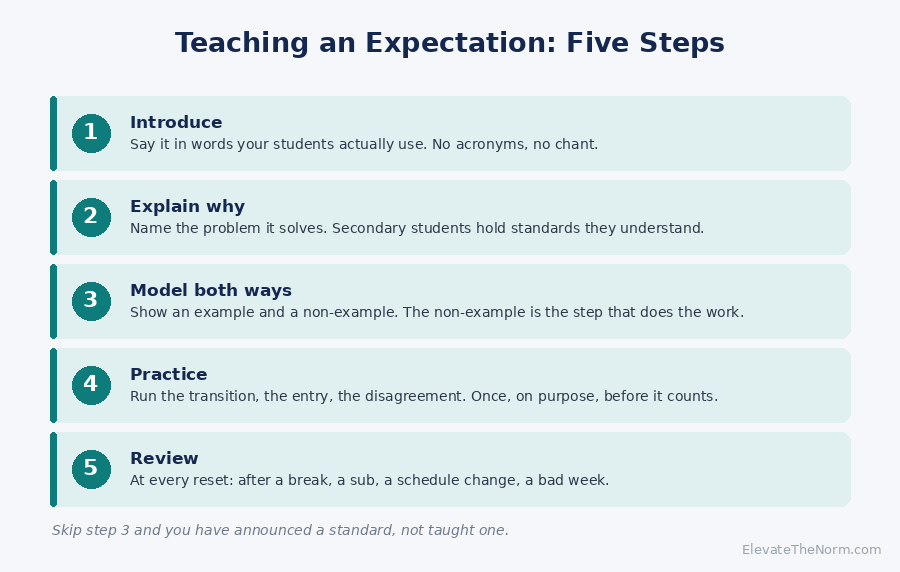
    A posted expectation is a claim. A taught expectation is a skill. The IRIS Center’s sequence for secondary classrooms has five steps: introduce it in student-friendly language, discuss why it exists, model it with examples and non-examples, practice it, and review it—especially at transitions and whenever it starts slipping (IRIS Center, Vanderbilt University).

    Five-step sequence for teaching a classroom expectation: introduce, explain why, model with examples and non-examples, practice, and review
    A posted expectation is a claim. A taught one is a skill.

    The step teachers skip is the non-example, and it is the one that does the work. Secondary students do not need “what respect looks like.” They need the eight-inch difference between a joke that lands and a joke that costs somebody something. Show both. Let them argue about where the line is. They will hold a line they helped draw.

    The Australian Education Research Organisation makes the companion point: high expectations only function when the belief comes packaged with instruction. “I believe you can do it” has to be followed by “here is how” (AERO). An expectation announced without a method is a standard you have set and then declined to teach toward.

    The Launch-Day Script

    Here is roughly what I say on day one. It takes about six minutes and I do not read it off a slide.

    “When you walk through that doorframe, you have 100% of my respect. You don’t earn it in here. You already have it. What you do with it is up to you, and it’s yours to lose—but it starts full.”

    “Here’s what I need from you. Five things. That’s the whole list, and I’m not adding to it in October.”

    [Read the five. One sentence each on why it exists.]

    “Two of these I will hold on my worst day, and you should know which. You will not make fun of anybody’s name in here—not how it’s spelled, not how it sounds, not where it came from. And when you get something wrong, you’ll say so and fix it, and that’s the end of it. No speech from me, no bringing it back up in April.”

    “Everything else on that list, I’ll remind you about. Those two I’ll hold.”

    Then I stop talking. That pause is doing more than the speech was. The room decides in that silence whether I meant it, and filling the gap is how you tell them you did not.

    Two things about that script are worth stealing regardless of your wording. First, respect starts at full rather than being earned—which changes what a correction means later, because you are restoring something rather than withholding it. More on that in respect in the classroom. Second, name which expectations are absolute and which are coachable. Pretending all five carry equal weight is a lie students catch by week three, and once one expectation turns out to be soft, they will test all of them.

    What Follow-Through Actually Looks Like

    The expectations are the easy part. Three practices decide whether they survive past September.

    • Precorrect before the moment, not after it. Prompt the expectation right before the transition where it usually breaks—”Materials out, we’re moving to the lab in ninety seconds”—rather than correcting the eleven students who got it wrong. The OSEP classroom PBIS guide lists prompts before difficult routines as a core practice (Simonsen et al., 2015).
    • Acknowledge the expectation being met, roughly five times for every correction. That same guide puts the target at about five praise statements per corrective one. In a secondary room this is not gold stars—it is naming the behavior quietly and moving on. “Whole table was working before the bell finished. Thanks.”
    • Correct at close range, at conversation volume. A redirect delivered across the room is a performance, and the audience changes what the student has to do to save face. Walking over costs you four seconds and removes the audience entirely.

    Consistency here is not a management preference. It is fairness. The expectation that flexes with your energy teaches students to read your mood instead of the standard, and the students who already trust school least pay the highest price for that unpredictability.

    Three Things These Examples Cannot Decide for You

    Any set you borrow has to survive contact with three things that are specific to your building.

    • The schoolwide behavior matrix. If your building runs a schoolwide system with its own three or four expectations, yours have to sit underneath those, not compete with them. A student who hears one standard in the hallway and a different one in your room learns that standards are a matter of whose room they are in. Map each of your five to the schoolwide expectation it makes concrete—that alignment is the point, and it is usually a ten-minute exercise.
    • Students with an IEP, a 504, or an individual behavior plan. A written plan takes precedence over a classroom list, and it is not an exception you are granting—it is a legal document you are following. Read the plans before you finalize the wording, because sometimes a small rewrite makes an expectation workable for a student instead of setting up a conflict every day. “Be in your seat when the bell rings” and “be in the room and settled within two minutes” hold the same standard; only one of them is reachable for some students.
    • How families find out. Send the five home in the first week, in plain language, without a signature line. Families who know the standard can back it; families who first hear about it when something has gone wrong will reasonably assume it was invented on the spot. It costs one email and it removes most of the arguments you would otherwise have in October.

    Where These Examples Go Wrong

    • Copied wholesale. An expectation set in someone else’s words is one you will not enforce, because you do not believe it in your body. Rewrite every line until it sounds like you saying it out loud.
    • Posted and never revisited. Laminated is not learned. Reteach at every natural reset: after a long break, after a bad week, after a schedule change.
    • Written for the student you dread. A set designed around your hardest class reads as suspicion to the other four sections. Write for the room you want and handle the outlier individually.
    • No route back. If missing an expectation only costs and never leads anywhere, students stop trying to recover once they have missed one. The way back has to be built in, not improvised. See learning from mistakes.
    • Enforced for compliance instead of for the room. If a student cannot tell you who the expectation protects, it is a rule about your convenience. Some of those are legitimate. Just be honest about which ones they are.

    Take the Wording, Not the List

    Pick the set closest to your room. Cut it to five. Rewrite every line in your own words until you could say it to a class without looking at the page, and cross out anything you would let slide in November. What is left is your actual expectations set, and it will be shorter and more honest than what you started with.

    Then teach it—introduce, explain, model both ways, practice, review—and hold it at close range and low volume for the first three weeks. That is the entire job. The example of classroom expectations you land on matters far less than whether the students watching you decide the standard is real. For what happens after a student misses one, keep reading in student responsibility.

    How many classroom expectations should I have?

    No more than five. The IRIS Center’s guidance for secondary classrooms is to limit the list to five or fewer, stated positively and in observable terms, so students can actually recall them. Seventeen rules function like zero, because neither you nor your students are holding seventeen standards consistently. If your list is longer, most of the items are procedures rather than expectations and belong in a routine you teach, not on the wall.

    What is the difference between classroom rules and classroom expectations?

    Expectations are broad goals for behavior; rules are explicit statements defining what those goals look like in a specific context. “Take care of this room and the people in it” is an expectation. “Return tools to the board before the last five minutes” is a rule that shows what it means in a shop. Most secondary classrooms need a small number of expectations and a slightly larger number of taught procedures.

    Should students help write the classroom expectations?

    Student input works best on wording and on the non-examples, not on whether a standard exists. Bring the five you need, then let the class argue about where each line actually falls and rewrite the phrasing together. Students hold a line they helped draw. What does not work is a blank-slate vote, which either produces the list you were going to write anyway or produces one you cannot enforce.

    Why is “be respectful” considered a weak classroom expectation?

    Because two adults watching the same student will not agree on whether it happened. That ambiguity is not only a clarity problem: research summarized by Brookings found racial disparities in office referrals were strongest for subjectively defined infractions like willful defiance. Every vague expectation is a place where a judgment call gets made, and judgment calls are where disparities concentrate. Replacing it with an observable behavior shrinks that space.

    How do I teach expectations without sounding like an elementary teacher?

    Explain the reasoning and use real non-examples. Secondary students do not need a chant or an acronym; they need to know what problem the expectation solves and where exactly the line falls. Show a case that clearly crosses it, a case that clearly does not, and one genuinely ambiguous case, then let them argue. Treating the line as debatable is what makes it land with teenagers.

    When should I reteach classroom expectations during the year?

    At every natural reset: after a long break, after a schedule change, after a substitute, after a bad week, and any time a specific expectation starts slipping. Reteaching is not punishment and should not be delivered as a lecture about disappointment. Two minutes naming the expectation, why it exists, and what it looks like today is enough.

    What if a student refuses to follow an expectation?

    Handle it at close range and at conversation volume rather than across the room, which removes the audience the student would otherwise have to perform for. Address the behavior, name the expectation, and give a path back in the same breath. Follow your school’s policy for anything involving safety or repeated refusal, and keep the what-happens-next conversation separate, calm, and always inclusive of the route to repair.

    Sources


    About Clay Shumate
    Clay Shumate is a Class A certified Social Studies and History teacher for grades 6–12, now in his seventh year in the classroom, with an M.Ed. in Secondary Education and a B.A. in History. He teaches 9th grade World History and writes about project-based learning, student responsibility, and classroom culture. He is a member of the Society of Professional Journalists and writes to its Code of Ethics; this site’s editorial standards and corrections policy are published in full. More about Clay.
  • Classroom Expectations Poster for Middle and High School Students

    Classroom Expectations Poster for Middle and High School Students

    By Clay Shumate

    A classroom expectations poster for middle and high school students should do one thing: give teenagers a clear, honest statement of what this room stands for and what you expect from them. It should not look like a kindergarten behavior chart. It should not list everything a student might ever do wrong. And it should not hang untouched on the wall for nine months while everyone quietly ignores it. A good secondary poster is short, specific, adult in tone, and introduced in a way that gives it weight.


    Key Takeaways

    • A poster designed for teenagers should use adult language, not elementary slogans like “Be Safe, Be Kind, Be Responsible.”
    • Secondary expectations should address preparation, effort, respect, collaboration, and accountability — not just behavior compliance.
    • Posting it without teaching it means students will treat it as decoration. The introduction matters as much as the content.
    • Five to six concrete expectations are enough. More than that, and nothing gets remembered.
    • The poster works best as a reference point, not a threat — something you return to when expectations need reinforcing.

    Why Most Classroom Expectations Posters Miss the Mark in Secondary School

    Walk into most middle or high school classrooms and you will find one of two things: a bare wall with no expectations posted at all, or a poster designed for a seven-year-old. “Be Respectful. Be Responsible. Be Ready.” Those three-word phrases were written for elementary cafeterias. They communicate nothing useful to a fourteen-year-old who already knows what respect means — or thinks she does.

    The problem is not the concept. Research consistently shows that students in grades 6–12 benefit from explicit, clearly taught behavioral expectations. The IRIS Center at Vanderbilt University, citing a base of positive behavioral interventions and supports research, notes that effective classroom expectations are “positively stated, specific, and taught — not just posted.” The issue is that most secondary teachers either skip the poster entirely or borrow materials built for a different developmental stage.

    Adolescents are not small children who need to be told not to run in the halls. They are developing young adults who respond to being treated as such. When the expectations on the wall look like they belong in a first-grade classroom, students notice — and the message the poster sends is not the one you intended.

    A well-designed secondary expectations poster does the opposite. It names real behavior in real language. It acknowledges that this room has standards and that the students in it are capable of meeting them. And it signals from day one that the teacher takes the social contract of this classroom seriously.


    What Belongs on a Classroom Expectations Poster for Grades 6–12

    A side-by-side comparison showing classroom rules on the left (prohibitions) and classroom expectations on the right (positive behaviors) for secondary students
    Rules tell students what not to do. Expectations describe the positive behaviors a secondary classroom runs on.

    Secondary expectations should cover the behaviors that actually determine how well a classroom runs: preparation, contribution, respect, accountability, and communication. That covers nearly every situation you will face without turning into a rulebook.

    Here is what each expectation needs to do in order to work:

    State a behavior, not a value. “Be responsible” is a value. “Come to class with your materials, ready to work when the period starts” is a behavior. Students can observe, perform, and be held to behaviors. Values are harder to enforce fairly.

    Use complete sentences, not slogans. Single-word or three-word expectations (“Respect. Responsibility. Readiness.”) sound professional from a distance and mean nothing up close. Write out what you mean.

    Stay positive. List what students should do, not what they should not do. “Come prepared” is easier to remember and easier to reinforce than “don’t come without your materials.”

    Match the developmental stage. A fourteen-year-old reading “Keep your hands to yourself” will feel condescended to. The same idea written as “Respect the space and the people in it” lands differently — same principle, adult register.

    Keep it to five or six items. Research on working memory and behavioral learning consistently points toward manageable, memorable sets of expectations. The PBIS framework — supported by the Institute of Education Sciences — recommends three to five positively stated expectations at the schoolwide level. In a classroom, where you have more specific context, five to six gives you enough room to cover the full range of what matters without overwhelming students or yourself.


    The Complete Classroom Expectations Poster — Ready to Adapt

    Below is a complete, print-ready set of classroom expectations for grades 6–12. These are not sacred text — adapt the language to fit your course, your students, and your own voice. What matters is that the expectations are honest, specific, and ones you can actually enforce.

    Classroom Expectations — Room [Your Number]

    1. Come prepared. Bring your materials. Do the work. If you are behind, tell me — do not disappear.
    2. Respect the room and the people in it. That means your peers, your workspace, and yes — the furniture.
    3. Do your part. In group work and on your own. Your effort is visible, and it matters.
    4. Own your mistakes. Everyone makes them here. What counts is what you do next.
    5. Speak up. Ask questions. Push back respectfully. Let me know when something is not working. I cannot help if I do not know.
    6. Finish what you start. Follow through on commitments to the group, to yourself, and to the work.

    — [Teacher Name], [Course Name]

    A ready-to-adapt classroom expectations poster template listing six numbered expectations for middle and high school students: come prepared, respect the room, do your part, own your mistakes, speak up, and finish what you start
    Adapt this template with your course name and voice. Print at 11×17 or 18×24 for visibility from the back row.

    A few notes on the design. Each expectation above addresses a real, recurring classroom situation. “Come prepared” covers materials and readiness. “Respect the room and the people in it” covers interpersonal behavior and property without listing every possible offense. “Do your part” covers collaboration accountability. “Own your mistakes” connects to repair rather than hiding. “Speak up” actively invites communication — which middle and high school students often do not do because they do not know they are allowed to. “Finish what you start” addresses follow-through, which is where a lot of secondary students struggle in project and group work.

    You will notice there is nothing on this poster about phones, about hall passes, or about bathroom policy. Those are procedures, not expectations. Procedures go in a different place — a syllabus, a classroom handbook, a first-day walkthrough. Mixing procedures and expectations on one poster dilutes both.


    Download it: A print-ready PDF of the poster below is available in 11×17, letter, and PNG, with blanks for your room number, name, and course. It is free on the teacher resources page — no email required.

    How to Design the Poster Itself

    The visual design of a classroom expectations poster matters more than teachers usually think — not because teenagers are visually illiterate, but because a poorly designed poster communicates “I printed this from a clip-art site in three minutes” before anyone reads a word.

    Readable from across the room. The primary text should be legible from the back row. Use a clean sans-serif font at a size that actually works at distance. Test it by standing at the back of the room before you hang it.

    No cartoon characters, no elementary-school imagery. Animals, mascots, and illustrated smiley faces read as condescending at the secondary level. A clean, professional design — similar to what a workplace or studio might use — signals that you take the room seriously.

    Your school’s color palette, or a neutral one. The poster should look like it belongs in your building. If your school has a color scheme, work within it. Black text on white or ivory with one or two accent colors is clean and always works.

    Your name or course name at the bottom. Ownership matters. A nameless poster could belong to any room. Your name on it says: I wrote these, I mean them, and I am the person who holds them.

    The recommended final size is 11×17 for desk-level reading or 18×24 for wall mounting with full visibility across a standard classroom. Print it at a copy shop if the school printer cannot handle the size or quality you want.


    How to Introduce the Poster So It Actually Means Something

    Hanging the poster before students arrive is the easy part. Introducing it well is what determines whether students treat it as information or wallpaper.

    The First-Day Launch

    A four-step sequence for introducing a classroom expectations poster: hand out on paper first, discuss predictions, reveal the poster, and explain consequences clearly
    The introduction matters as much as the content. Reflection before the reveal turns the poster from a pronouncement into a shared agreement.

    Do not start class by pointing at the poster and reading it aloud while students zone out. Instead, give students the list on paper — on day one, before the poster even comes up. Ask them to mark the one expectation they predict will be hardest for them personally, and the one they think the class will struggle with most.

    Share those responses without calling out individuals. You will learn more about your students in that ten minutes than in a week of name-tags and icebreakers. Then reveal the poster as the room’s standing version of what they just discussed. It goes from a pronouncement to a shared reference.

    That sequence — reflection first, poster second — is consistent with what self-determination theory research identifies as autonomy-supportive classroom practice. Niemiec and Ryan’s 2009 work in Theory and Research in Education found that students who understand the rationale behind classroom requirements show stronger internalization of those expectations and better self-regulatory behavior over time. You are not just posting rules. You are giving students a reason to buy in.

    When Expectations Slip Mid-Year

    Every classroom hits a stretch in October or February when the room’s standards start to drift. Work quality drops, group dynamics get irritable, or participation dries up. The poster gives you a way to address it without singling out individuals or delivering a lecture.

    You can simply pause at the start of a class period, walk to the poster, and say: “I want to check in on these. Which one are we doing well? Which one do we need to recover?” Running it as a quick conversation — two or three minutes — resets the room without creating a confrontation or making any one student the problem.

    This is one of the things a visual reference does well. It depersonalizes the conversation. The poster is the standard; you are enforcing the standard; no one is being singled out.


    What This Looks Like in a Workshop Room

    In my room, the expectations poster hangs near the front, visible from the whiteboard table where I pull small groups. Students know it is there. Most of them could probably recite it by November without looking at it — not because I made them memorize it, but because I return to it consistently.

    I had a group last year deep into a project on regional economic history. They had been working together for a few weeks, and the collaboration had started fraying. One student in the group was doing most of the research and getting increasingly frustrated; the other two were contributing ideas but not documentation. When I pulled the three of them over to the whiteboard table for a check-in, I did not start by describing the problem. I asked each of them: looking at expectation five — “Do your part” — how would you rate where the group is right now?

    That question changed the whole conversation. Instead of me telling them something was wrong, they were each reading the expectation and deciding for themselves whether they were meeting it. The student carrying most of the load said “five out of ten.” One of the others said “seven.” That gap opened up a productive conversation about what “doing your part” actually looked like in this project — not as a lecture from me, but as something they worked out together at the table.

    The poster was the frame. The check-in was the conversation. The expectation gave us shared language that made the harder feedback possible without it becoming personal.


    Connecting the Poster to Consequences

    An expectations poster without consequences attached is just decoration. Students need to know — early, clearly, and honestly — what happens when an expectation is not met. This is not about threat. It is about transparency.

    You do not need to list consequences on the poster itself. But in the first-day launch, after you have introduced the expectations, it is worth being direct: “These are what I expect. When one of them is not happening, here is how I will handle it — first, a conversation at the table or in the hall; second, I contact home; third, I loop in the office. I will always start with a conversation. I will never embarrass you in front of the room.”

    That sequence — conversation first, escalation as needed, dignity protected throughout — is consistent with what the research on logical consequences supports. Consequences that are predictable, proportionate, and connected to the behavior produce better outcomes than unpredictable or humiliating responses. More importantly, it matches what most teenagers actually want: to know what the rules are and to be treated fairly when they break them.

    The poster anchors all of this. It is the reference point for every consequence conversation: “You committed to coming prepared. What happened today?” That framing puts the student’s own stated agreement in the conversation rather than making it feel arbitrary. For a closer look at why classroom expectations are important beyond the poster itself — including how they protect instructional time and reduce student anxiety — that article walks through the research.


    Frequently Asked Questions

    Is a classroom expectations poster actually necessary for high school?

    Yes — and arguably more necessary than in elementary school, because secondary teachers often assume students already know the expectations without ever stating them explicitly. Research from the IRIS Center at Vanderbilt confirms that explicitly taught expectations reduce problem behavior and improve learning time at all grade levels, including high school. The form of the poster matters: it needs to match the developmental stage. A well-designed secondary poster is a standing reference, not a behavior-chart throwback.

    How many expectations should be on the poster?

    Five to six is the right range for secondary classrooms. Three is probably too few to cover the behaviors that actually matter in a grades 6–12 setting. More than six, and no one will remember them, including you. The PBIS framework recommends three to five at the schoolwide level; classrooms can add one or two subject- or course-specific expectations on top of that if needed.

    Should students help create the classroom expectations?

    Student input on expectations is worth using, but it is not required — and the research on co-creation is more nuanced than the “always co-create” advice you often hear. What matters most is that students understand the rationale behind the expectations, not necessarily that they wrote them. A teacher who explains clearly why each expectation exists will see stronger compliance than one who holds a half-hearted committee meeting. If you use student input, use it genuinely — incorporate specific language they suggested, or address expectations they raised that you did not include.

    What is the difference between classroom rules and classroom expectations?

    Rules are typically prohibitions: “No phones during direct instruction.” Expectations describe positive, proactive behavior: “Use technology for the task at hand.” The more useful distinction for secondary teachers is between expectations (the standing standards for how the room operates) and procedures (the specific steps for specific situations — how to enter, what to do when absent, how to turn in work). Procedures go on a separate document. Expectations go on the poster.

    How do I enforce expectations without embarrassing students?

    Keep the first response private and close. A quiet conversation at the student’s table, a quick pull into the hall, or a check-in at the whiteboard table is almost always more effective than a public correction — and research on adolescent dignity consistently shows that public shaming increases resistance rather than compliance. State the expectation, describe what you observed, give the student a chance to respond, and agree on what happens next. Save escalation for situations where a private response has already been tried and failed, or where safety is at stake.

    Should the poster be printed professionally or is a regular printer fine?

    A regular printer handles 8.5×11 adequately, but that is often too small to read from across a classroom. For visibility from the back row, 11×17 or 18×24 is more effective — both of which usually require a copy shop. The investment is minor; a professionally printed poster also signals that you take the standards seriously, which affects how students read the room on day one.

    How do I reintroduce expectations mid-year without it feeling like a lecture?

    Return to the poster as a conversation, not a correction. At the start of a class period, ask students to identify which expectation the class is meeting well and which one needs work. Keep it two to three minutes, collective, and impersonal — the poster is the standard, not the teacher’s opinion. This works much better than a speech delivered in frustration, and it signals that expectations are a living agreement the room owns, not a one-time announcement.


    Conclusion

    A classroom expectations poster is not a decoration and it is not a behavior chart. At the secondary level, it is a public commitment — yours to the room and the room’s to itself. The five or six expectations on that poster say: this is what we are doing here, this is what I expect from you, and this is what you can expect from me.

    That is worth putting on the wall. More importantly, it is worth introducing with enough care that students actually read it, think about it, and can refer back to it when the room needs a reset. If you want to start somewhere, adapt the poster template above to your course and voice. Print it large enough to read from the back row. Introduce it on day one as a conversation, not a reading assignment. And make it one of the things you return to throughout the year — not as a threat, but as the standing answer to the question every student is quietly asking: what do you actually expect here?

    For more on setting standards that treat teenagers as young adults, see Classroom Expectations: A Practical Framework for Grades 6–12, Respect in the Classroom: Why It Must Go Both Ways, and Classroom Consequences That Teach Instead of Humiliate.


    Sources

    1. IRIS Center, Vanderbilt University. “Page 4: Rules.” Behavior Management: Strategies for Secondary Students. Peabody College. https://iris.peabody.vanderbilt.edu/module/beh2_sec/cresource/q2/p04/
    2. Niemiec, C. P., & Ryan, R. M. (2009). “Autonomy, competence, and relatedness in the classroom: Applying self-determination theory to educational practice.” Theory and Research in Education, 7(2), 133–144. https://journals.sagepub.com/doi/10.1177/1477878509104318
    3. Institute of Education Sciences, REL Northwest. “Positive Behavioral Interventions and Supports.” U.S. Department of Education, January 2025. https://ies.ed.gov/rel-northwest/2025/01/positive-behavioral-interventions-and-supports
    4. IRIS Center, Vanderbilt University. “Understanding Behavior Expectations and Rules.” Early Childhood Behavior Management. Peabody College. https://iris.peabody.vanderbilt.edu/module/ecbm/cresource/q1/p02/
    5. Midwest Teachers Institute. “From Classroom Rules to Expectations: The Shift.” https://www.midwestteachersinstitute.org/from-classroom-rules-to-expectations-the-shift/
    6. Guay, F. (2022). “Applying Self-Determination Theory to Education: Regulation Types, Psychological Needs, and Autonomy Supporting Behaviors.” Canadian Journal of School Psychology, 37(1), 75–92. https://journals.sagepub.com/doi/10.1177/08295735211055355
    7. Panorama Education. “15 Classroom Rules and Expectations.” Panorama Ed Blog. https://www.panoramaed.com/blog/classroom-rules-and-expectations
    8. Visible Learning. “Hattie Effect Size List — 256 Influences Related to Achievement.” https://visible-learning.org/hattie-ranking-influences-effect-sizes-learning-achievement/

    Before you print anything, it is worth reading the wording against several other rooms. These examples of classroom expectations show how the same standard gets written differently for a lab, a seminar, a gym, and a one-to-one device classroom—and how to rewrite a vague expectation into one two adults would agree on.


    About Clay Shumate
    Clay Shumate is a Class A certified Social Studies and History teacher for grades 6–12, now in his seventh year in the classroom, with an M.Ed. in Secondary Education and a B.A. in History. He teaches 9th grade World History and writes about project-based learning, student responsibility, and classroom culture. He is a member of the Society of Professional Journalists and writes to its Code of Ethics; this site’s editorial standards and corrections policy are published in full. More about Clay.