Classroom Consequences That Teach Instead of Humiliate
By Clay Shumate
Classroom consequences are the responses a teacher uses when a student’s behavior or choices fall below the standard. Good consequences are predictable, proportionate, connected to the behavior, and respectful enough that the student can still learn from the experience. Bad consequences punish the person instead of addressing the problem. Here is how to design consequences that teach—and how to avoid the ones that just make teenagers resentful.
Key Takeaways
- Consequences and punishment are not the same thing. Consequences aim to teach; punishment aims to hurt enough to stop the behavior.
- Effective classroom consequences are related, respectful, and realistic—often called the three R’s.
- Natural consequences happen without teacher intervention. Logical consequences require teacher design.
- Humiliation, public shaming, and disproportionate responses damage the teacher-student relationship and make future behavior worse.
- Repair after a consequence is where real learning happens. The conversation matters more than the penalty.
Free Printable: Classroom Consequence Planning Sheet
A one-page teacher reference with the 3 R’s checklist, a behavior-response planner you fill in for your own class, and the three-question repair conversation framework. Print it and keep it at your desk.
Download Free Planning Sheet (PDF)The Difference Between Consequences and Punishment
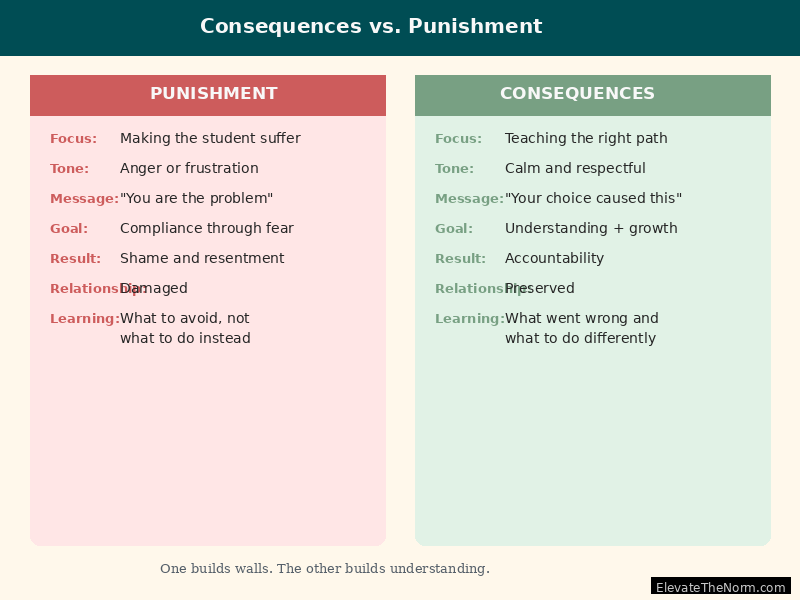
This is where most classroom discipline goes wrong. Teachers use the word “consequences” but deliver punishment. The difference is not semantic. It changes what the student learns.
Punishment is designed to cause enough discomfort that the student stops the behavior. It focuses on the adult’s power and the student’s suffering. A student who talks during instruction gets assigned a 500-word essay on respect. A student who is late gets locked out of the classroom. A student who forgets materials sits with nothing to do for the entire period. The message is: you made a mistake, and now you pay. A consequence that teaches needs something written down and owed back, which is what a repair-and-return sheet is for.
Consequences are designed to help the student understand the impact of their behavior and take responsibility for repairing it. A student who talks during instruction has a brief private conversation about what they missed and what the expectation is. A student who is late makes up the missed work on their own time. A student who forgets materials uses a loaner set and brings their own the next day. The message is: you made a mistake, and here is what you do about it. If you want the exact words for that follow-up talk, my Restorative Conversation Scripts on TPT give you a script for each step.
The Responsive Classroom framework describes effective logical consequences as fundamentally different from punishment in purpose: punishment enforces compliance through external controls, while consequences develop “internal understanding, self-control, and a desire to follow the rules”—the foundation of genuine student responsibility (Responsive Classroom, 2023).
That distinction matters because of what the research shows about punishment. A 2026 meta-analysis in Frontiers in Psychology, synthesizing 18 studies and over six million students, found a statistically significant negative association between teacher punishment and student academic achievement (r = −0.183, p < 0.001). Punitive approaches did not improve outcomes. They made them measurably worse (Wang et al., 2026).
Types of Classroom Consequences
Not all consequences work the same way. Understanding the categories helps teachers choose the right response instead of defaulting to the most convenient one.
Natural consequences
These happen without any teacher intervention. A student who does not study performs poorly on the assessment. A student who does not participate in the group project has nothing to present. A student who does not bring supplies to class falls behind on the day’s work.
Natural consequences are powerful because they come from reality, not from an adult’s decision. The student cannot argue with them, resent the teacher for imposing them, or claim the system is unfair. The work simply did not get done, and the result is what the result is.
For a deeper look at how natural consequences work—and when they do not—see natural consequences in the classroom.
But natural consequences have limits. They only work when the natural outcome is safe, timely, and genuinely experienced by the student. A student who runs in the hallway might fall—but you do not wait for that to happen. A student who cheats might not get caught until the consequences are permanent. And some natural consequences fall hardest on students who already have the fewest resources, which is not teaching—it is neglect.
Logical consequences
These are teacher-designed responses that connect directly to the behavior. They are the backbone of effective classroom discipline in grades 6–12.
The Responsive Classroom approach identifies three types of logical consequences:
- Loss of privilege. The student temporarily loses access to something related to the misuse. A student who misuses a laptop loses laptop access for the rest of the period. A student who abuses the freedom to choose a seat returns to an assigned seat.
- Break it, fix it. The student repairs the damage they caused. A student who makes a mess cleans it up. A student who damages a relationship makes a direct apology. A student who disrupts a lesson contributes positively to the next one.
- Space and time. The student takes a brief break from the activity to reset. This is not punishment—it is a cooling-off period, and the student returns to the group when they are ready to re-engage.
The test for whether a logical consequence is actually logical: can you explain the connection between the behavior and the response in one sentence? If the student talked during instruction and the consequence is copying dictionary definitions, you cannot explain that connection—because there is none.
Restorative consequences
These go beyond fixing the immediate problem to repairing the relationship. They ask the student to consider who was affected, what the impact was, and what they owe.
Research from Chicago Public Schools found that schools implementing restorative practices saw an 18% decline in suspension days and a 19% decrease in student arrests over four years. The effects were strongest for Black students, who had faced the starkest disciplinary disparities before implementation. Importantly, the changes did not negatively impact academic outcomes for other students in the classroom (Brookings, 2022).
Restorative consequences are not a replacement for accountability. They add a step: after the consequence, you have a conversation. What happened? Who was affected? What can you do about it? When will you do it? Schools that formalize this into a program are practising something with a real research base and real limits; the guide to accountability without empty punishment lays out what the randomized evidence does and does not support.
The Three R’s: Related, Respectful, Realistic
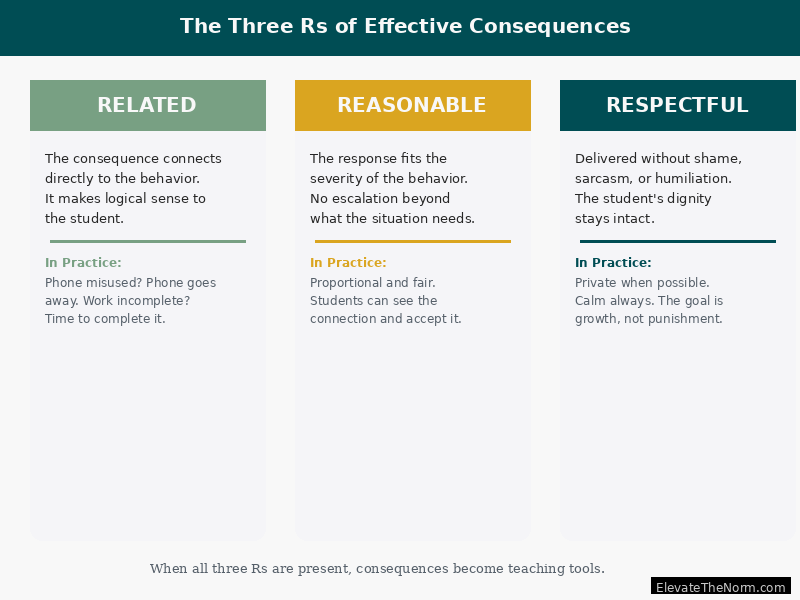
This framework, drawn from the work of Rudolf Dreikurs and adapted by the Responsive Classroom and Positive Discipline traditions, gives teachers a quick test for any consequence they are considering.
Related. The consequence connects logically to the behavior. A student who wastes class time makes up the time. A student who is disrespectful to a peer makes a direct apology. A student who turns in poor work revises the work.
Respectful. The consequence addresses the behavior without attacking the student’s character. (For a deeper look at why this matters, see Respect in the Classroom.). “You need to redo this section because it doesn’t meet the standard” is respectful. “I guess you didn’t think this was worth your time” is not.
Realistic. The consequence is something the teacher can actually enforce and the student can actually complete. Assigning a lunch detention every day for a week sounds firm. It also means the teacher has to show up every day for a week, and the student misses the only unstructured time they have. If a consequence is unsustainable, it will collapse—and when it does, the student learns that the teacher’s word does not hold.
If a consequence fails any one of the three R’s, it is probably punishment dressed up as a consequence.
A Practical Response Ladder for Common Problems
This is not a rigid escalation chart. It is a guide for proportionate responses. Skip steps when the situation requires it. Start lower than you think you need to.
Before you reach for any of it, check whether the behavior is a broken rule or an untaught procedure. A class that packs up early or crowds the door is usually failing a routine that was announced but never actually taught, and a consequence will not fix that. Most of this work sits upstream of the ladder entirely, which is why prevention comes first on any honest list of what works.
| Behavior | First Response | If It Continues | If It Escalates |
|---|---|---|---|
| Off-task (phone, talking, zoning out) | Proximity + quiet redirect | Brief private conversation; remove the distraction | Loss of privilege for the period; contact home if pattern develops |
| Disrespect toward a peer | Immediate, private correction | Restorative conversation between the students with teacher present | Separate the students; parent contact; administrative referral if repeated |
| Refusal to work | Check in privately: “What do you need to get started?” | Offer modified entry point; document the pattern | Parent contact; team conference; check for underlying issues |
| Late to class | Note it; do not interrupt instruction to address it | Brief private conversation about the pattern | Make up missed time; parent contact if chronic |
| Incomplete or missing work | State the deadline and ask for a plan | Require revision or completion before new privileges | Parent contact; academic intervention plan |
| Cheating or plagiarism | Private conversation; require honest resubmission | Parent contact; academic consequence per school policy | Administrative referral per school policy |
| Physical aggression or safety threat | Immediate administrative referral | Follow school safety protocol | Follow school safety protocol |
Notice what is not on this list: writing lines, public humiliation, removing the student’s chair, making students stand in the hallway, or assigning unrelated busywork. Those are punishments. They do not teach anything except that the teacher has more power than the student, which the student already knew.
The Repair Conversation: Where Real Learning Happens
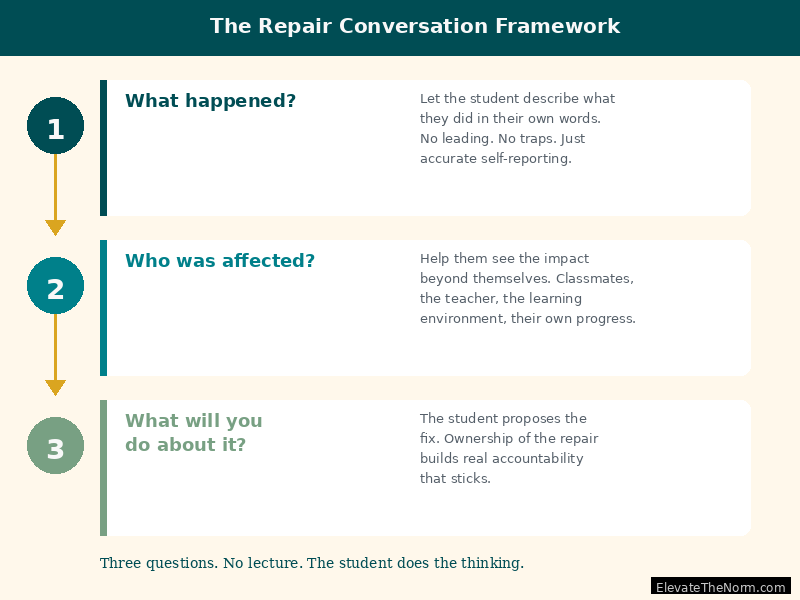
The consequence is not the end. It is the setup. The real teaching happens in the conversation that follows.
In my classroom, when a student and I have gotten through whatever happened—the disruption, the missed deadline, the moment that went sideways—we have a conversation. Not a lecture. A conversation. I pull the student aside, usually at the whiteboard table where the lighting is low and the chairs are better, and we talk through three questions:
- What happened? Not “what did you do wrong.” What happened. Let them describe it. Often their version is different from yours, and the difference is where the real issue lives.
- Who was affected, and how? This is the question that turns a behavior correction into a moral education moment. When a student can name who was affected—their group partner lost ten minutes of work time, the class lost focus, the teacher had to stop instruction—they are learning something consequences alone cannot teach.
- What are you going to do about it, and by when? This is where accountability lives. Not “what will you never do again,” which is a promise teenagers cannot keep. What will you do about this specific situation? Apologize to the partner. Turn in the revised work by Thursday. Show up on time for the next three days. Something concrete, something measurable, something the student commits to with a date attached.
That conversation takes four minutes. It does more than any detention I could assign.


Consequences Teachers Should Stop Using
Some consequences survive in secondary classrooms not because they work but because they are easy, familiar, or satisfying in the moment. Here are the ones that consistently backfire.
Public call-outs
Naming a student’s misbehavior in front of the class. (This is a close cousin of yelling at students—both use volume and audience as weapons.) This forces the student to choose between backing down (humiliating) and pushing back (escalating). There is no good outcome for either party.
Writing lines or copying text
Writing “I will not talk in class” fifty times teaches the student exactly one thing: that their time means nothing to the teacher. It has no connection to the behavior and no instructional value.
Group punishment
Punishing the entire class because one or two students misbehaved. This destroys trust, breeds resentment among the students who did nothing wrong, and teaches the class that individual accountability does not exist in this room.
The one genuine edge case is an environmental change that takes nothing away from anybody and reverses within a day or two — turning the overhead lights back on in a lamp-lit room is the version I use. It still affects students who did nothing, so it still has to be rare, never aimed at one student, and named out loud rather than left to be guessed at.
Removal as a first resort
Sending a student out of the room should be a last step, not a first one. A meta-analysis of 40 studies and 274 effect sizes found that exclusionary discipline—suspensions, expulsions, and removals—is “an important and meaningful predictor of increased delinquency.” Students who are removed do not improve. They disengage further (Novak, 2021). Understanding what actually motivates students makes it clear why removal does the opposite.
Delayed or disproportionate consequences
A consequence that arrives days after the behavior loses its connection to the event. A consequence that is wildly out of proportion to the offense—three weeks of detention for one late assignment—teaches the student that the system is arbitrary, not fair.
Consequences disguised as questions
“Do you think that was a good choice?” is not a real question. It is a humiliation ritual. The student knows the answer. The teacher knows the answer. The only purpose is to make the student say it out loud for the teacher’s satisfaction.
When School Policy Requires a Specific Response
Teachers do not operate in a vacuum. School policies, district codes, and state laws dictate certain responses for certain behaviors. Fights may require an automatic suspension. Drugs or weapons may require an automatic referral. Bullying may trigger a mandated investigation.
In those situations, the teacher’s role is clear: follow the policy. Do not try to handle a legally mandated situation with a classroom consequence. The liability is too high, the situation is too serious, and the student may need supports the teacher cannot provide.
But following the policy does not mean abandoning the student. After the formal process runs its course, the teacher can still have a repair conversation. The teacher can still welcome the student back without a grudge. Building relationships with students means staying in their corner even after the hard moments. The teacher can still be the adult who says: “We need to talk about what happened, and I still expect good things from you.”
The American Psychological Association’s 2008 Zero Tolerance Task Force review is still relevant here. The task force concluded that zero-tolerance policies have “not been shown to improve school climate or school safety” and that schools with higher suspension rates actually reported lower overall climate ratings (APA, 2008). Mandatory does not mean effective. And a teacher who adds humanity to a rigid process is not undermining the policy—they are making the policy survivable for the student on the other end of it.
How to Make Consequences Consistent Without Being Rigid
Consistency does not mean identical. It means predictable. Students need to know that certain behaviors will always produce a response—but the specific response can and should account for context.
A student who is late for the first time gets a different response than a student who is late every day. A student who snaps at a classmate during a terrible week gets a different response than a student who routinely bullies peers. A student with an IEP or a 504 plan may have specific behavioral supports that modify the standard consequence.
None of this is favoritism. It is professional judgment. Doctors do not give every patient the same prescription. Teachers should not give every student the same consequence. What stays consistent is the standard—not the response.
Document when you flex. If a parent or administrator asks why Student A received a different consequence than Student B, you need to be able to explain the reasoning. Flexibility without documentation becomes inconsistency, and inconsistency erodes trust.
Building a Consequence System That Lasts
A consequence system that collapses by October was never a system. It was a list of threats. Here is what makes a system durable:
- Keep it simple. Three to five clear expectations with predictable responses. Consequences only read as fair when students already know the standard, which is why naming expectations out loud does so much of the work. If you need a flowchart to explain your consequence system, it is too complicated for you to enforce and too complicated for students to follow.
- Teach it explicitly. Do not assume students know what will happen when they miss a deadline or disrupt a class. Tell them on day one. Revisit it in week three. Refer to it every time you use it.
- Use it early. A teacher who lets small violations slide for two weeks and then suddenly cracks down is not being patient—they are building a credibility problem. Address small things early, calmly, and consistently. This is one of the most important habits for new teachers building classroom management skills.
- Follow through. If you say the consequence is losing laptop access for the period, take the laptop. If you say you will call home, call home — which is easier when you have already decided in advance who you contact, through which channel, and at what point. Every time you do not follow through, you teach students that your words are suggestions.
- Pair consequences with repair. The consequence addresses the immediate behavior. The repair conversation addresses the relationship and the learning. You need both.
Conclusion
Classroom consequences are not about making students suffer for their mistakes. They are about helping students understand what went wrong, take responsibility for the impact, and do something concrete to make it right. When consequences are related, respectful, and realistic—and when they are followed by a genuine conversation—they teach more than any lecture on behavior ever could. I hand students a page from my Behavior Reflection Sheets on TPT so the reflection is written down before we talk.
The alternative is punishment: public, disproportionate, disconnected from the behavior, and designed to make the student feel bad enough to stop. Decades of research confirm what experienced teachers already know—punishment does not fix behavior. It suppresses it temporarily and damages the relationship permanently.
Hold the standard. Address the behavior. Have the conversation. That is how consequences teach.
Free Printable: Classroom Consequence Planning Sheet
A one-page teacher reference with the 3 R’s checklist, a behavior-response planner you fill in for your own class, and the three-question repair conversation framework. Print it and keep it at your desk.
Download Free Planning Sheet (PDF)Frequently Asked Questions
When consequences are connected to the behavior and followed by a genuine second chance, students can learn from mistakes rather than just survive the punishment. A complementary framework is positive discipline for teens, which builds on the same idea that consequences should teach rather than humiliate.
What is the difference between natural and logical consequences?
Natural consequences happen without any teacher action—a student who does not study performs poorly on the test. Logical consequences are designed by the teacher to connect directly to the behavior—a student who misuses a tool loses access to the tool for the period. Both teach, but logical consequences give the teacher control over timing, safety, and proportionality.
How do I keep consequences from feeling like punishment to students?
Three things help. First, explain the connection between the behavior and the consequence so the student understands why this response and not something else. Second, deliver it calmly and privately, not in anger and not in front of an audience. Third, follow it with a brief conversation about what happened and what comes next. When students understand the reasoning, consequences feel like structure rather than retribution.
What should I do when a student refuses to accept a consequence?
Do not escalate in the moment. State the consequence clearly and move on. “The laptop is done for today. We can talk about it after class.” If the student continues to refuse, involve administration—that is what they are there for. A power struggle in front of the class has no winner.
Are there consequences that work better for middle school than high school?
The principles are the same, but the delivery shifts. Middle school students often need more explicit teaching of what consequences mean and why they exist. High school students respond better to brief, private, adult-to-adult conversations. The three R’s framework—related, respectful, realistic—works across both levels.
Should consequences be the same for every student?
The standard should be the same. The response can and should account for context. A student having a crisis week may need a different consequence than a student engaging in a repeated pattern. This is not favoritism—it is professional judgment. Document your reasoning so you can explain it if asked.
How do I handle consequences when a student has an IEP or 504 plan?
Follow the plan. Students with IEPs or 504 plans may have specific behavioral interventions, modified consequences, or positive behavior supports written into their documentation. Those provisions are legal requirements, not suggestions. Consult with the special education team before applying consequences that may conflict with the student’s plan.
What role should parents play in classroom consequences?
Parents should know your system, understand the expectations, and be informed when patterns develop. Do not call home after a single minor incident—that erodes trust and creates the impression that you cannot manage your own classroom. Do call home when a pattern emerges, when the behavior is serious, or when the student needs support you cannot provide alone. Frame the call as a partnership, not a complaint.
Sources
- Responsive Classroom. (2023). How Logical Consequences Are Different from Punishment. Responsive Classroom.
- Wang, X., et al. (2026). The Relationship Between Teacher Punishment and Student Academic Achievement: A Meta-Analysis. Frontiers in Psychology.
- Augustine, C. H., et al. (2022). A Restorative Approach to Student Discipline Shows Promise in Reducing Suspensions and Arrests. Brookings Institution / RAND Corporation.
- Novak, A. (2021). Exclusionary School Discipline and Delinquent Outcomes: A Meta-Analysis. Journal of Youth and Adolescence, 50, 1493–1509.
- American Psychological Association Zero Tolerance Task Force. (2008). Are Zero Tolerance Policies Effective in the Schools? An Evidentiary Review and Recommendations. American Psychologist, 63(9), 852–862.
- U.S. Department of Education. (2022). School Discipline Literature Review. ERIC.
- Responsive Classroom. (2023). Five Discipline Strategies That Preserve Dignity. Responsive Classroom.
- Critical Social Epidemiology Research Collaborative. (2023). Restorative Practices in Schools: Research Summary.
About Clay Shumate
Clay Shumate is a certified secondary Social Studies teacher in the public schools of West Alabama, with seven years of classroom experience, a B.A. in History, and an M.Ed. in Secondary Education. He writes about project-based learning, student responsibility, respect, and practical ways to hold young people to a higher standard while giving them room to learn from mistakes. He is a member of the Society of Professional Journalists and writes to its Code of Ethics; this site’s editorial standards and corrections policy are published in full. More about Clay.
Consequences work best as one section of something larger. Setting the whole thing down in writing is what keeps the response consistent on the days you are least inclined to be.