By Clay Shumate
High expectations for students means holding a standard you genuinely believe a teenager can reach, and then building the path that lets them reach it. Belief without a path is not a high expectation. It is pressure. The research is clear that expectations move outcomes — and just as clear that they move them only when support moves with them.
Key Takeaways
- Teacher expectations really do change outcomes. A national study of 10th graders found that a teacher expecting a student to finish college, rather than not, was associated with roughly a 15-percentage-point increase in the odds that the student actually did.
- But the effect is smaller than the Pygmalion legend. The most careful review of the field concluded that self-fulfilling prophecies in classrooms are real, typically small, and more likely to fade than to compound.
- Expectations are mostly accurate, which is its own problem. When a teacher’s read on a student is wrong, it is usually wrong in a patterned way — and the pattern tracks race, income, and prior grades.
- Press without support does almost nothing. Chicago middle-grades students with high academic press and low support gained about half as much math as students who had both.
- One sentence changes how criticism lands. Seventh graders who were told the comments came from high expectations and a belief they could meet them revised at more than twice the rate of students who got the same comments without the sentence.
- The bar stays. The runway changes. Every honest version of high expectations keeps the task and adds the scaffolding, the conference, and the second attempt.
What high expectations for students actually means
Most schools say they have high expectations. Very few can tell you what that sentence commits them to on a Tuesday.
Here is a working definition. A high expectation has three parts: a standard the student can actually see, a stated belief that this particular student can reach it, and a route from where they are now to there. Drop the third part and you have a slogan. Drop the second and you have a syllabus.
This is different from classroom expectations in the behavior sense — how we treat each other, how we start class, what happens when work is late. Those matter, and teaching them explicitly — including with a well-designed classroom expectations poster that students can reference all year — is most of the job in September. This article is about the other kind: what you believe a student is academically capable of, and what that belief does to them.
The two get confused constantly. A teacher can run a tightly managed room with airtight procedures and still quietly expect very little of half the students in it.
The evidence: real, causal, and smaller than the legend
Short answer: expectations move outcomes, but not by magic, and not by much on their own.
Everyone in education has heard some version of the 1968 Pygmalion study — tell teachers a random group of kids are late bloomers, and the kids bloom. It is one of the most repeated findings in the field and one of the least accurately repeated.
The most thorough review of what came after it is blunt. Lee Jussim and Kent Harber concluded that self-fulfilling prophecies in classrooms do occur, but that the effects are “typically small,” do not accumulate much across teachers or years, and “may be more likely to dissipate than accumulate” (Jussim & Harber, 2005). They also found something more uncomfortable: teacher expectations predict student outcomes largely because those expectations are accurate, not because they are self-fulfilling. Teachers are generally reading students correctly.
That is worth sitting with before you assume belief alone will carry a kid. It usually will not.
What Jussim and Harber also found is where this gets useful: the powerful self-fulfilling effects show up selectively, among students from stigmatized groups. The students most affected by what a teacher believes are the students the system already treats worst.
The strongest causal estimate available comes from Nicholas Papageorge, Seth Gershenson, and Kyung Min Kang, who used a national sample of 10th graders in which two different teachers each predicted the same student’s educational future. Comparing the two predictions strips out the student’s own characteristics and isolates the teacher. When a teacher expected a student to complete a four-year degree rather than not, that student’s likelihood of actually earning one rose by about 15 percentage points (Papageorge, Gershenson & Kang, 2018/2020).
Read that carefully. It is a large effect attached to a large swing — from a teacher writing a student off to a teacher expecting a degree. It is not a promise that raising your general enthusiasm raises test scores.
Where the expectation goes wrong before the student ever sees it
If expectations are mostly accurate, the interesting question is what happens when they are not.
Using the same national data, Gershenson and colleagues compared the two teachers each student had. Non-Black teachers of Black students were about 9 percentage points less likely than Black teachers to expect that student to finish a four-year degree — about 11 points for Black boys. That single mismatch accounted for more than half of the overall Black–white gap in teacher expectations, and it was larger among math teachers than reading teachers (Gershenson, Holt & Papageorge, 2016).
Two teachers. Same student. Same transcript in front of both of them. Different forecast.
The related finding in the Papageorge paper is stranger and worth naming honestly: white teachers were more optimistic overall, and their optimism about white students was the least accurate of the lot. The problem is not simply that some teachers are pessimistic. It is that optimism gets handed out unevenly, and the students who receive less of it are the ones for whom it matters most.
You are not going to fix this by deciding you are unbiased. Nobody has ever found their own expectation gap by introspection. You find it by looking at what you handed back.
Why expectations without support turn into pressure
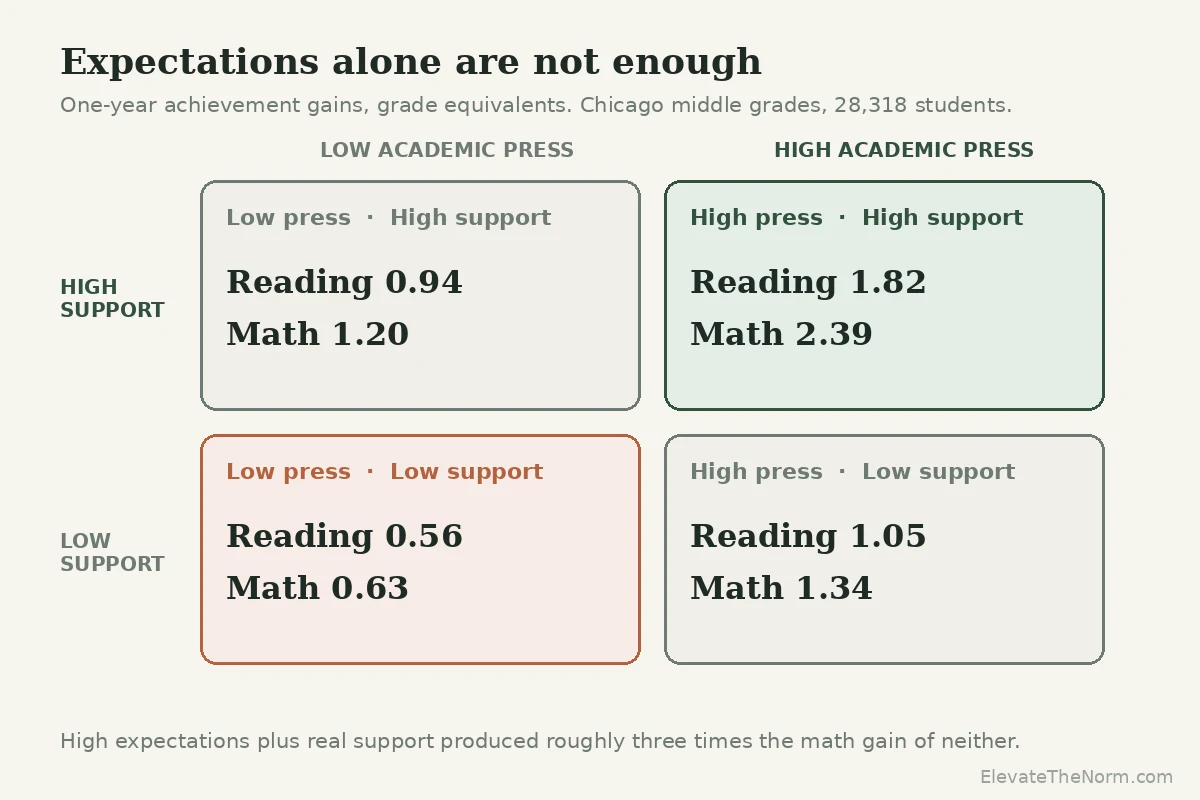
Researchers have a term for the demand side of this: academic press. It just means how strongly a school signals that academic achievement is expected and non-negotiable. The other side is social support — the adults and peers a student can actually go to for help.
Valerie Lee, Julia Smith, Tamara Perry, and Mark Smylie put 28,318 sixth and eighth graders across 304 Chicago schools into that two-by-two and measured a year of achievement growth in grade equivalents (Lee, Smith, Perry & Smylie, 1999).
| Condition | Reading gain | Math gain |
|---|---|---|
| High press + high support | 1.82 | 2.39 |
| High press + low support | 1.05 | 1.34 |
| Low press + high support | 0.94 | 1.20 |
| Low press + low support | 0.56 | 0.63 |
Look at the middle two rows. High expectations without support and warm support without expectations land in almost the same place. Neither one is worth much alone. Together they roughly triple the math growth of a school that has neither.
One honest caveat: this is sixth and eighth grade in one large urban district in the 1990s, and it is correlational. It does not prove that adding support to a demanding classroom causes the jump. It does show that the two travel together in the data, at scale, and that the version of “high expectations” that arrives as pressure alone is the version with the weakest results attached to it.
That is the whole argument of this article in one table. If you take nothing else, take the fact that the demand and the help are not in tension. They are the same intervention.
What high-expectation teachers do differently
Christine Rubie-Davies and colleagues ran something rare in this field: an actual randomized intervention that trained teachers in the practices of high-expectation teachers rather than just measuring their beliefs. Eighty-four teachers across twelve schools; students in the intervention classrooms gained roughly 28% more in mathematics over the year than the control group, an effect size of about 0.24 (Rubie-Davies, Peterson, Sibley & Rosenthal, 2014).
The caveat that matters for this site: that study was run in New Zealand with students aged roughly 6 to 13. It is not a secondary-school result and I am not going to pretend it is. What transfers is the list of practices, which are recognizably about older students too. The number does not automatically transfer with them.
The practices the intervention taught, summarized by the Society for Personality and Social Psychology:
- Flexible grouping instead of fixed ability grouping. High-expectation teachers move students between groups based on the task in front of them, not on a permanent read of who is smart.
- Goal setting with the student, not for them. Which is also how student autonomy gets built without losing the room.
- A warm class climate. Not soft. Warm. Those are different words.
- Different feedback. More specific, more forward-looking, and delivered to everyone rather than saved for the students most likely to use it.
- Attention to non-verbal signals. Who you stand near, who you wait longer for, whose answer you finish for them.
Notice that none of these are about announcing higher standards. They are about the ordinary mechanics of a class period.
The one sentence that makes criticism land
If you only change one thing this week, change this.
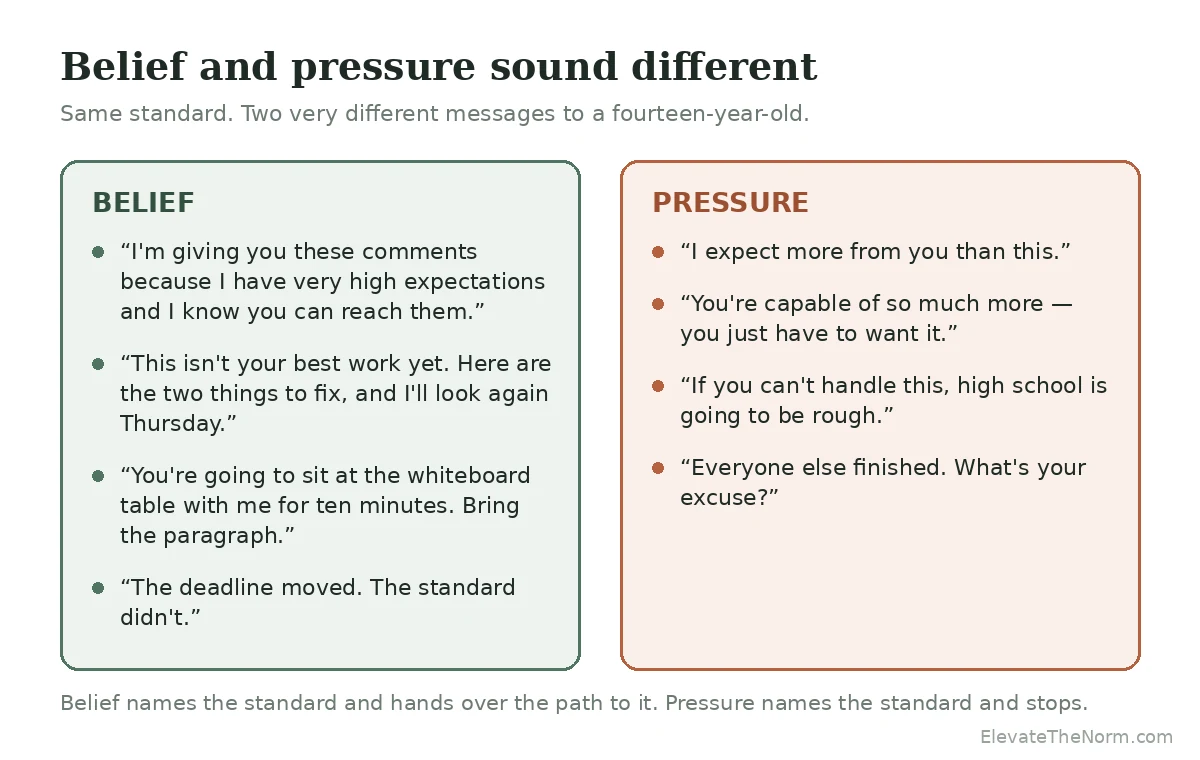
In a study of seventh graders earning Bs and Cs, researchers had teachers return marked-up essays with one of two notes attached. The control note read: “I’m giving you these comments so that you’ll have feedback on your paper.” The other read: “I’m giving you these comments because I have very high expectations and I know that you can reach them.”
The comments themselves were identical. Among African-American students, 64% of those who got the second note revised their essay, against 27% of those who got the first. When revision was required, 88% of students who had received the high-expectations note improved from first draft to second, compared with 34% in the control condition (Stanford SPARQ summary of Yeager et al., 2014).
The mechanism is not flattery. Critical feedback across a trust gap is ambiguous — a student who has good reason to wonder whether an adult has written them off cannot tell from the red pen alone whether the comments mean I think you can do better or I already knew you couldn’t. The sentence removes the ambiguity. That is all it does, and it is enough to more than double a revision rate.
Write it on the paper. Say it out loud when you hand the work back. Do not save it for the students you think need encouragement, because deciding who needs it is exactly the judgment the research says you should not trust.


What this looks like at the whiteboard table
I built a whiteboard table for small-group work. It sits in a corner under a lower lamp, on a rug, with the better chairs. Students ask to go there.
That was deliberate, and it is the most useful thing I have done about expectations. The standard pull-aside table has a problem everyone in a school can name: it becomes the table where the kids who are behind get sent. Students read that instantly. Being called over becomes a public statement about what the adult thinks of you, which means the support itself starts carrying a message that undercuts the expectation.
I did not solve that with a policy about not calling it the remediation table. I solved it by making that corner the best seat in the room. When it is the place people want to be, sitting down there stops being a verdict and starts being a normal thing that happens to everybody — the student who is lost, the student who is three steps ahead and bored, the group that needs a decision made.
The general version: if your support is visibly reserved for the students you have low expectations of, the support and the expectation cancel each other out. Whatever your version of the table is, everybody has to end up there.
What high expectations cannot fix
This is the part that usually gets left out of the assembly speech.
- They cannot substitute for course access. If a student is not enrolled in the class that leads to the next class, no amount of belief in that student’s potential changes the transcript. Master-schedule decisions outrank classroom optimism.
- They cannot replace an IEP or 504 team. Goals for a student with a disability are set by a team through a legal process. “I have high expectations” is not a reason to disregard an accommodation, and a teacher does not get to raise a documented goal unilaterally. Bring the observation to the team.
- They cannot compensate for missing instruction. A student who never learned to cite evidence needs to be taught to cite evidence. Believing harder is not a curriculum.
- They cannot fix a schedule with no time for revision in it. If the pacing guide leaves no room for a second attempt, the school has decided the standard is a filter. That is an administrative choice, not a teacher’s failure of will.
- They are not a district initiative. A campaign that tells staff to expect more, with no change to grouping, feedback, planning time, or course access, costs nothing and does about as much. The Rubie-Davies work changed practices, not slogans.
Being honest about the limits is what keeps the rest credible. A teacher who claims expectations can overcome anything will be disbelieved on the parts that are true.
A four-week way to check yourself
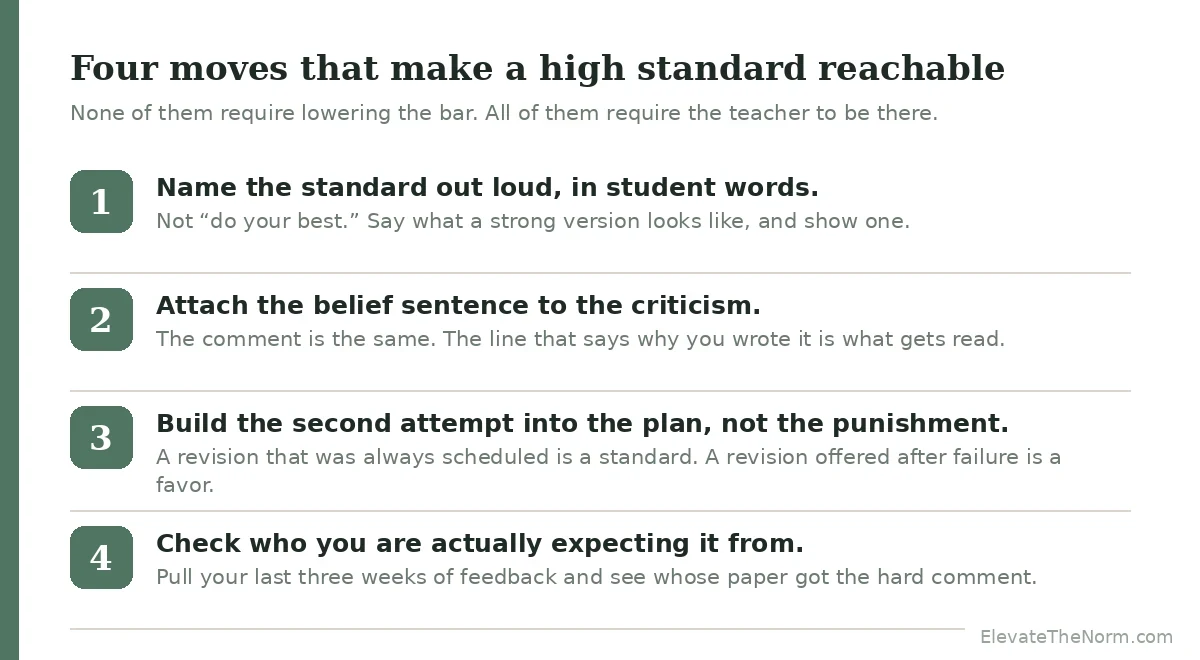
None of this requires a program. It requires four weeks and a willingness to look at your own paperwork.
- Week one — the feedback audit. Pull every piece of work you handed back in the last three weeks. Sort it into “got a demanding comment” and “got a pleasant one.” Then look at the names. You are not looking for villainy. You are looking for a pattern you did not choose.
- Week two — the sentence. Attach the high-expectations line to every marked-up paper. Every student, no exceptions, no editing the list.
- Week three — the call list. Track who you call on for the question that requires reasoning rather than recall. Most teachers find they have a small rotation of four or five students they trust with the hard question, and that the rotation formed itself.
- Week four — the second attempt. Put one revision cycle into the calendar in advance, before anyone has failed anything. Announce it when you assign the work, not after the grades come back.
Four weeks of this will tell you more about your expectations than any survey will. It also pairs naturally with what already works for students who look like they have stopped caring — disengagement is frequently a reasonable response to being quietly written off.
Holding the standard when a student misses it
The test of a high expectation is not what happens when a student meets it. It is what happens the first time they do not.
Two failure modes, and both are common. The first is quietly dropping the bar for that student from then on — usually dressed up as being realistic. The second is holding the bar and treating the miss as a character finding, which teaches the student that the standard was really a test of who they are.
The honest third option is that the standard holds, the miss gets named plainly, and the student does the work of getting there. That is the same logic behind accountability paired with another chance, and, when the miss involved harming somebody else, behind structured repair rather than empty punishment. In every case the standard is the constant. What flexes is the route back to it.
Students can tell the difference between a teacher who lowered the bar for them and a teacher who kept it and stayed. They tend to remember the second one.
Conclusion: what to do Monday
High expectations for students are not a posture. They are a set of decisions about who gets the hard question, whose paper gets the demanding comment, who gets pulled to the table, and whether anybody gets a second attempt.
The evidence says expectations matter, that they are unevenly distributed along lines nobody would defend out loud, and that they do very little on their own. It also says the fix is not more enthusiasm. It is attaching one sentence to your feedback, scheduling the revision before the failure, making your support desirable rather than remedial, and auditing what you actually handed back.
Start with the feedback audit. It costs an hour and it is the only one of these that will tell you something you do not already believe about yourself.
Frequently Asked Questions
What does “high expectations for students” actually mean in a classroom?
It means naming a standard you believe a specific student can reach, saying out loud what reaching it looks like, and then building the instruction, feedback, and second attempts that make it reachable. Belief is half of it. The path is the other half. An expectation with no path attached is not a high expectation — it is a demand.
Can high expectations be harmful?
Yes, when they arrive without support. In the Chicago middle-grades data, students in schools with high academic press but low social support gained about 1.34 grade equivalents in math in a year, compared with 2.39 for students who had both. The standard was the same in both groups. What differed was whether anyone helped. Pressure by itself mostly teaches students that the adult’s opinion of them is already fixed.
How do I hold a high standard for a student who is several grade levels behind?
Keep the standard and change the runway. The grade-level task stays; you add the vocabulary front-loading, the worked example, the sentence frames, the extra conference, and the built-in revision. What you do not do is hand that student an easier assignment and call it differentiation. Scaffolding is temporary and comes off. A lowered task is permanent and the student knows it.
Isn’t this just growth mindset again?
No, and the distinction matters. Growth mindset research is about what students believe about their own ability, and the intervention literature there is contested. This is about what teachers believe about students and what they do as a result — a different body of evidence with different findings. You can hold accurate, high expectations for a student without ever saying the word “mindset.”
How would I know if I have lower expectations for some students without realizing it?
Audit the artifacts instead of your intentions. Pull three weeks of graded work and look at whose paper got a demanding comment and whose got “nice job.” Look at who you called on for the hard question, who you pulled for a conference, and who you told about the honors option. Bias in expectations rarely shows up as a thought you would recognize. It shows up as a pattern in what you actually handed back.
What should I tell a parent who says my class is too demanding?
Show them the standard and the support in the same conversation. Say what the assignment asks, what a strong version looks like, what help is available and when, and how many attempts their child gets. Most families are not objecting to rigor. They are objecting to rigor that arrived without a plan, which is a fair objection.
Do high expectations mean no second chances?
The opposite. A standard you only get one shot at is a sorting device, not a standard. Building the revision into the calendar from the start — rather than offering it as mercy after a failure — is what makes the bar credible. The student who has to redo the work has been held to more, not less.
Sources
- Jussim, L., & Harber, K. D. (2005). Teacher Expectations and Self-Fulfilling Prophecies: Knowns and Unknowns, Resolved and Unresolved Controversies. Personality and Social Psychology Review, 9(2), 131–155.
- Papageorge, N. W., Gershenson, S., & Kang, K. M. (2018). Teacher Expectations Matter. NBER Working Paper No. 25255. Published in The Review of Economics and Statistics (2020), 102(2), 234–251.
- Gershenson, S., Holt, S. B., & Papageorge, N. W. (2016). Who Believes in Me? The Effect of Student–Teacher Demographic Match on Teacher Expectations. Upjohn Institute Working Paper 15-231; published in Economics of Education Review, 52, 209–224.
- Lee, V. E., Smith, J. B., Perry, T. E., & Smylie, M. A. (1999, October). Social Support, Academic Press, and Student Achievement: A View from the Middle Grades in Chicago. Consortium on Chicago School Research.
- Rubie-Davies, C. M., Peterson, E. R., Sibley, C. G., & Rosenthal, R. (2014). A teacher expectation intervention: Modelling the practices of high expectation teachers. Contemporary Educational Psychology, 40. Practices summarized by the Society for Personality and Social Psychology.
- Stanford SPARQ. Wise Critiques Help Students Succeed — summarizing Yeager, D. S., Purdie-Vaughns, V., Garcia, J., Apfel, N., Brzustoski, P., Master, A., Hessert, W., Williams, M., & Cohen, G. L. (2014). Breaking the Cycle of Mistrust: Wise Interventions to Provide Critical Feedback Across the Racial Divide. Journal of Experimental Psychology: General, 143(2), 804–824.
About Clay Shumate
Clay Shumate is a certified secondary Social Studies teacher in the public schools of West Alabama, with seven years of classroom experience, a B.A. in History, and an M.Ed. in Secondary Education. He writes about project-based learning, student responsibility, respect, and practical ways to hold young people to a higher standard while giving them room to learn from mistakes. He is a member of the Society of Professional Journalists and writes to its Code of Ethics; this site’s editorial standards and corrections policy are published in full. More about Clay.