By Clay Shumate
Student responsibility is what happens when a young person owns their preparation, effort, deadlines, collaboration, and mistakes — not because an adult is standing over them, but because the standard is clear and the student believes it applies to them. Raising that standard in grades 6–12 requires both firmness and a genuine path back when students fall short. Neither half works alone.
Key Takeaways
- Responsibility is practiced, not preached — students learn it by doing it, not by hearing about it.
- What students, teachers, families, and schools each control is different, and mixing those up creates most of the conflict.
- High standards without support create failure. Support without standards creates dependence.
- Responsibility has four dimensions: academic, behavioral, interpersonal, and community. Most schools only measure the first two.
- Grace and accountability are not opposites. They are the same system working correctly.
What Student Responsibility Actually Means
Student responsibility means a student can answer three questions honestly: What is expected of me? Am I doing it? If not, what am I going to do about it? Those three questions are unpacked at length in the plain-language definition.
There is a format built almost entirely around making a student answer those three questions out loud. Student-led conferences put the student in front of their own work and their own family, which is a far harder audience than a teacher and a much better test of whether the responsibility is real.
That sounds simple. It is not simple at all for a fourteen-year-old who has spent years in systems that either removed their choices or removed the consequences of their choices. Responsibility requires practice the same way reading requires practice — and like motivation, it develops when conditions support it — you do not get better at it by listening to someone talk about it.
Self-determination theory, developed by Edward Deci and Richard Ryan, identifies three psychological needs that drive motivation and responsible behavior: autonomy (some genuine control over choices), competence (belief that effort leads to improvement), and relatedness (connection to people who matter). When those three conditions are present, students are far more likely to internalize the standards around them rather than comply because they’ve been forced to (Ryan & Deci, 2000; Guay, 2022).
This is not a soft finding. It is one of the most replicated results in motivational psychology. And it means that the first job in building student responsibility is structural: does your classroom give students real choices, achievable challenges, and relationships worth protecting?
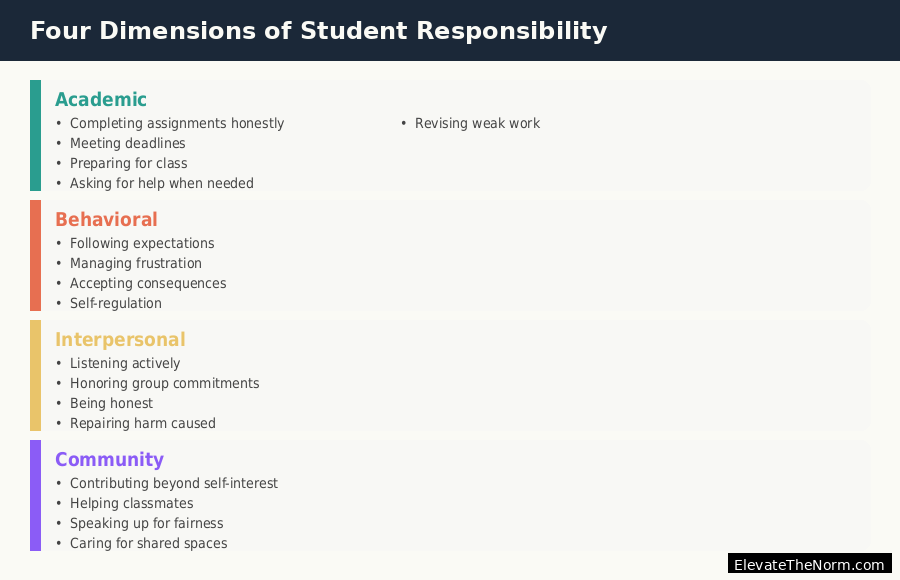
The Four Dimensions of Student Responsibility
Most schools define responsibility narrowly — turn in your work, follow the rules. That covers two dimensions and misses two others that matter just as much.
Academic Responsibility
This is the one schools measure most: completing assignments, meeting deadlines, preparing for class, doing honest work, and asking for help when needed. Academic responsibility means the student treats their own learning as their job.
What this looks like in practice: a student who doesn’t understand the assignment asks for clarification instead of guessing. A student whose first draft is weak revises it. A student who misses a deadline explains why and finishes the work.
What this does not look like: a student who turns in someone else’s work. A student who consistently arrives unprepared and shrugs. A student who does the minimum to avoid a zero.
Behavioral Responsibility
Following classroom expectations, treating shared spaces with care, managing frustration without harming others, and accepting consequences when behavior falls short. Behavioral responsibility is the hardest dimension for adolescents because it requires impulse control that is still developing neurologically.
This is where the pause matters. When a student pushes back — argues a deadline, refuses a task, challenges a grade — my first move is not to respond. I pause. It runs roughly a fifteen count, on average, but that number changes with the student, the day, and what just happened. The pause is not a technique from a book. It is a habit I built because the first thing I want to say is almost never the most useful thing I can say.
That pause does two things. It gives me time to think. And it shows the student that their behavior did not control my response. Both of those outcomes are lessons in responsibility — mine and theirs.
Interpersonal Responsibility
How a student treats the people around them: listening, following through on commitments to a group, being honest, handling disagreement without personal attacks, and repairing harm when they cause it. This dimension is where responsibility becomes relational — it is no longer about the student and the standard. It is about the student and other people.
Schools that treat interpersonal responsibility as a bonus rather than a requirement produce students who can pass tests and follow rules but cannot collaborate, resolve conflict, or maintain trust. Those skills do not develop on their own. They develop when teachers name them, model them, and hold students to them.
Community Responsibility
The broadest dimension: contributing to the classroom, the school, and eventually the community beyond school. Picking up something that isn’t yours. Helping a classmate who is lost. Speaking up when something unfair is happening. Community responsibility is the hardest to teach because it requires students to act on behalf of someone other than themselves.
This is also where responsibility intersects with leadership. A student who takes community responsibility seriously is already leading — they just may not have the title. Closing that gap between doing the work and holding the role is the whole point of giving teenagers genuine authority in the building.
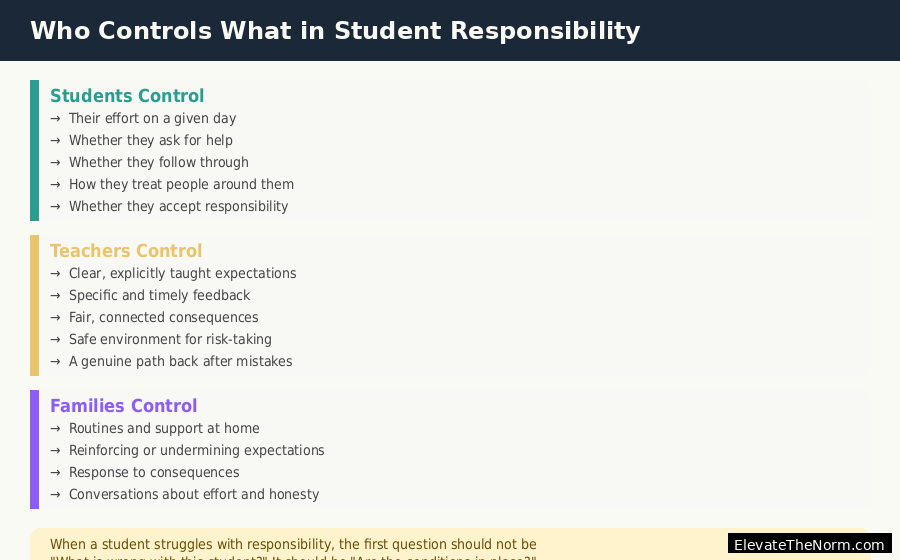
What Students Control, What Teachers Control, What Families Control
Most conflict around student responsibility comes from blurring these lines.
Students Control
- Their effort on a given day
- Whether they ask for help
- Whether they follow through on commitments
- How they treat the people around them
- Whether they accept responsibility when they fall short
Teachers Control
- Whether expectations are clear and explicitly taught
- Whether feedback is specific and timely
- Whether consequences are fair and connected to the behavior
- Whether the classroom feels safe enough to take risks
- Whether there is a genuine path back after a mistake
- Whether the standard stays consistent or quietly shifts based on the student
Families Control
- The routines and support available at home
- Whether they reinforce or undermine the school’s expectations
- How they respond when their child faces consequences
- The conversations they have about effort, honesty, and responsibility
Schools Control
- Whether policies support responsibility or undermine it (a grading system that averages a zero with later scores teaches learned helplessness, not responsibility)
- Whether teachers have the time, training, and backing to follow through
- Whether the culture treats mistakes as learning opportunities or permanent marks
When a student is struggling with responsibility, the first question should not be “What is wrong with this student?” It should be “Are the conditions for responsibility actually in place?” If the expectations are unclear, the feedback is absent, the consequences are disconnected, or the path back doesn’t exist, then the system is failing — not the student.
What High Standards Actually Look Like
High standards are not the same as high pressure. A teacher with high standards believes every student can meet the expectation and builds the structure to make that possible. A teacher with high pressure demands performance without building the structure.
The difference shows up in how you handle the student who falls short.
High standards: “This isn’t at the level we discussed. Here’s specifically what needs to change. You have until Thursday to revise it. I’m available Tuesday during advisory if you need help.”
High pressure: “This is unacceptable. You should know better by now. I’m very disappointed.”
The first response holds the standard and provides a path. The second response holds the standard and provides shame. Both sound firm. Only one teaches responsibility.
Research on teacher expectations consistently shows that what teachers believe about students’ capabilities shapes student outcomes. Rosenthal and Jacobson’s classic 1968 study on teacher expectancy effects — where students whose teachers were told they were “intellectual bloomers” showed greater IQ gains — has been replicated and refined across decades. The finding holds: high expectations, communicated through specific support rather than general pressure, produce better results (Rosenthal & Jacobson, 1968; Jussim & Harber, 2005).
How to Teach Responsibility — Not Just Demand It
Responsibility is a set of behaviors, and behaviors can be taught. Here is a practical sequence for building responsibility in grades 6–12.
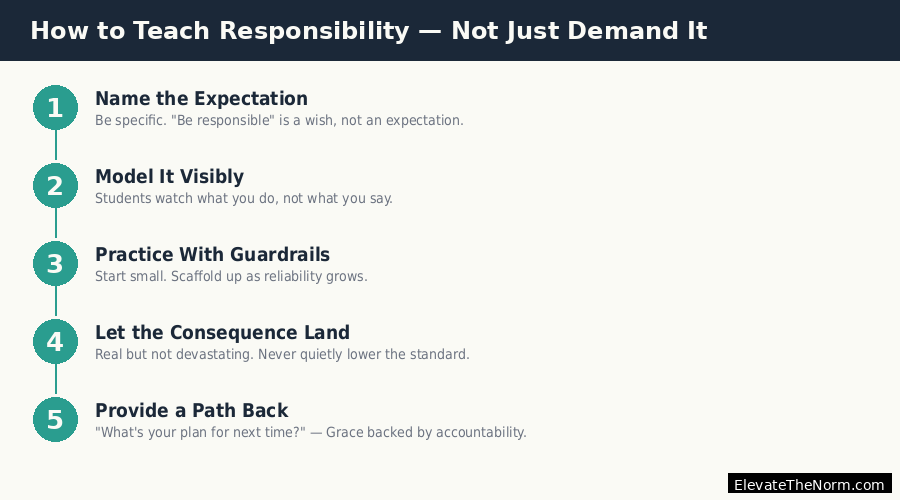
1. Name the Expectation Specifically
“Be responsible” is not an expectation. It is a wish. Clear classroom expectations sound different. An expectation sounds like: “When you arrive, your materials are out and you’re looking at the board for the first task within two minutes.” Specificity removes guesswork and gives students a clear target to hit.
2. Model It Visibly
Students watch what you do, not what you say. This is one reason classroom management starts with the teacher, not the student. If you expect them to meet deadlines, meet yours. If you expect them to admit mistakes, admit yours publicly. If you expect them to prepare, show them what your preparation looks like. Responsibility is taught as much by example as by instruction.
3. Practice It With Guardrails
Give students real responsibility in small doses with scaffolding. A student who has never managed a deadline doesn’t need a month-long project on day one. They need a three-day task, a check-in at the midpoint, and a clear consequence for missing the end date. As they demonstrate reliability, extend the timeline and reduce the check-ins. My Makeup Work System on TPT puts the tracking on the student, which is where the responsibility belongs.
This is not coddling. This is what teaching actually looks like. You do not hand a student a novel and say “read it” if they have never finished a chapter book. You scaffold. Responsibility deserves the same approach.
4. Let the Consequence Land
When a student doesn’t meet the expectation, the consequence has to be real. Not devastating. Not humiliating. But real. A student who doesn’t prepare for a group presentation should feel that — through honest feedback from peers, through a required individual follow-up, through the visible gap between what they delivered and what was expected.
The worst thing you can do is quietly lower the standard. The student learns nothing. The other students learn that the standard is fake.
5. Provide a Path Back
After the consequence, the conversation should end with a question: “What’s your plan for next time?” Not a lecture. Not a threat. A question that places the responsibility back where it belongs — with the student.
The path back is where grace lives. It is also where learning from mistakes actually happens — not in the consequence itself, but in the moment after, when the student decides what to do next. It does not erase the consequence. It says: the standard is still here, I still believe you can meet it, and here is your chance to prove it.
Common Mistakes Teachers Make With Student Responsibility
Confusing Responsibility With Obedience
Obedience is doing what you’re told because someone told you. Responsibility is doing what needs to be done because you understand why it matters. A classroom full of obedient students looks orderly. A classroom full of responsible students looks orderly and keeps running when the teacher steps out.
If your system requires your constant presence and enforcement to function, you have built obedience. If your system runs because students have internalized the standard, you have built responsibility. The difference matters because obedience does not transfer. Responsibility does.
Rescuing Students From Consequences
When a student fails to meet a deadline and the teacher extends it without conversation, the teacher has just taught the student that deadlines are negotiable. When a parent calls to argue a grade and the teacher changes it, the student learns that consequences can be outsourced. When an administrator overrides a classroom consequence to avoid a complaint, the student learns that persistence beats integrity.
Each of these moments, individually, seems small. Together, they build a system where responsibility is optional.
Punishing Without Teaching
A detention for missing homework teaches a student to sit in a room. It does not teach them to manage their time, prioritize their work, or ask for help before the deadline passes. If the consequence doesn’t include a conversation about what went wrong and what the student will do differently, it is punishment, not accountability.
Applying Standards Unevenly
Students have a ruthless eye for inconsistency. If one student gets a pass and another doesn’t, every student in the room notices. Responsibility flourishes in systems that are predictable, fair, and built on mutual respect. It collapses in systems where the rules depend on who you are or how the teacher is feeling that day.
A Responsibility Framework for the Classroom
| Dimension | What It Looks Like | What the Teacher Does | What It Doesn’t Look Like |
|---|---|---|---|
| Academic | Prepared, on time, honest work, asks for help | Clear expectations, specific feedback, revision opportunities | Plagiarism, chronic unpreparedness, helplessness |
| Behavioral | Follows expectations, manages frustration, accepts consequences | Consistent follow-through, private correction, a path back | Disruption without accountability, forced compliance without understanding |
| Interpersonal | Listens, follows through on group commitments, repairs harm | Models respect, names expectations, holds students to them | Personal attacks, broken commitments with no consequence |
| Community | Contributes beyond self-interest, helps others, speaks up | Creates opportunities, recognizes contribution, makes it visible | Treating shared spaces or people as someone else’s problem |
If you want specific classroom activities that put this framework into practice, activities for teaching responsibility walks through ten structured approaches — from deadline choice contracts to repair letters — designed for grades 6–12. And because none of these activities work without a predictable room, understanding why classroom expectations are important is the foundation everything else sits on. When a student has stopped engaging with responsibility altogether, motivating students who don’t care addresses that harder starting point directly. And when the pattern traces back to missed class time rather than a change in effort, chronic absenteeism is the first thing worth ruling out.
What is the difference between student responsibility and student accountability?
Responsibility is internal — it is the student’s sense of ownership over their preparation, effort, and behavior. Accountability is external — it is the system of expectations, feedback, and consequences that supports responsibility. A student needs both. Accountability without internal motivation produces compliance. Responsibility without external accountability can drift into good intentions with no follow-through.
How do you teach responsibility to a student who has never been held to a standard?
Start small, be explicit, and be patient. Name one expectation clearly. Practice it. Follow through when the student misses it — with a consequence that teaches, not one that punishes. Then add the next expectation. A student who has spent years in systems without standards needs time to adjust. That is not a reason to lower the standard. It is a reason to scaffold the path to it.
What do you do when a student says they do not care?
Take it seriously but do not take it literally. A student who says they do not care usually means one of three things: they care but are protecting themselves from failure, they do not see the relevance, or they are overwhelmed and shutting down. The response is not a motivational speech — it is a specific question: “What part of this is getting in the way?” That question respects their intelligence and opens a conversation instead of closing one.
How do you handle responsibility in group projects?
Structure the group so individual responsibility is visible. Each student should have a defined role, a personal deliverable, and a moment where they present or defend their own contribution. When a group member does not follow through, the consequence falls on that individual — not the group. Group grades that allow one student to carry others teach the wrong lesson about both effort and fairness.
Should families be involved in building student responsibility?
Yes, but with clear boundaries. Families can reinforce expectations, support routines, and have honest conversations about effort. They should not do the student’s work, argue consequences down, or remove the productive struggle that builds responsibility. The most useful family partnership is one where the school’s expectations and the family’s expectations align — and where both adults agree that the student is the one who needs to do the work.
What if the school’s grading system undermines responsibility?
Many do. A system that averages a zero with later scores can make it mathematically impossible for a student to recover from one missing assignment. A system that gives points for compliance — bringing a pencil, sitting quietly — measures obedience, not learning. If your grading system punishes honest effort and rewards strategic gaming, the system needs to change before student responsibility can improve. Advocate for grading policies that reflect actual mastery and allow recovery.
For a detailed breakdown of what each domain looks like in practice—preparation, participation, deadlines, collaboration, mistakes, help-seeking, and repair—see student responsibility in the classroom.
Sources
- Ryan, R. M., & Deci, E. L. (2000). Self-determination theory and the facilitation of intrinsic motivation, social development, and well-being. American Psychologist, 55(1), 68–78. https://selfdeterminationtheory.org/SDT/documents/2000_RyanDeci_SDT.pdf
- Guay, F. (2022). Applying self-determination theory to education: Regulations types, psychological needs, and autonomy supporting behaviors. Canadian Journal of School Psychology, 37(1), 75–92. https://journals.sagepub.com/doi/10.1177/08295735211055355
- Responsive Classroom. (2025). Secondary practices (Grades 6–12). https://www.responsiveclassroom.org/secondary-practices/
- Rosenthal, R., & Jacobson, L. (1968). Pygmalion in the Classroom: Teacher Expectation and Pupils’ Intellectual Development. Holt, Rinehart and Winston. https://psycnet.apa.org/record/1968-08876-000
- Jussim, L., & Harber, K. D. (2005). Teacher expectations and self-fulfilling prophecies: Knowns and unknowns, resolved and unresolved controversies. Personality and Social Psychology Review, 9(2), 131–155. https://journals.sagepub.com/doi/10.1207/s15327957pspr0902_3
- González-Villora, S., et al. (2017). Program to promote personal and social responsibility in the secondary classroom. Frontiers in Psychology, 8, 809. https://www.frontiersin.org/journals/psychology/articles/10.3389/fpsyg.2017.00809/full
- Niemiec, C. P., & Ryan, R. M. (2009). Autonomy, competence, and relatedness in the classroom: Applying self-determination theory to educational practice. Theory and Research in Education, 7(2), 133–144. https://selfdeterminationtheory.org/SDT/documents/2009_NiemiecRyan_TRE.pdf
- Edutopia. (2023). Perceptions of mistakes in the classroom. https://www.edutopia.org/article/perceptions-mistakes-classroom/
About Clay Shumate
Clay Shumate is a certified secondary Social Studies teacher in the public schools of West Alabama, with seven years of classroom experience, a B.A. in History, and an M.Ed. in Secondary Education. He writes about project-based learning, student responsibility, respect, and practical ways to hold young people to a higher standard while giving them room to learn from mistakes. He is a member of the Society of Professional Journalists and writes to its Code of Ethics; this site’s editorial standards and corrections policy are published in full. More about Clay.