
By Clay Shumate
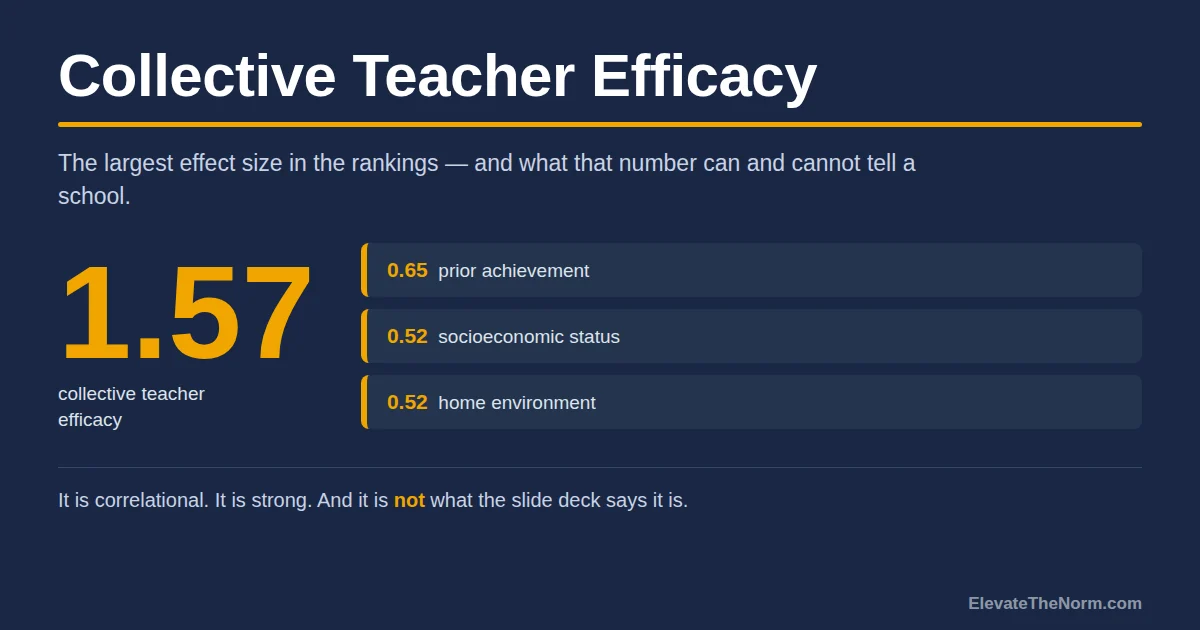
Collective teacher efficacy is the shared belief among a staff that, working together, they can move student learning — and it carries the largest effect size in John Hattie’s rankings, 1.57. That number is real, it is correlational, and it is almost certainly too large to mean what your next professional development day will tell you it means.
Both halves of that sentence matter. Below is where 1.57 came from, why the researcher who published it alongside Hattie thinks numbers like it get misread, and what a secondary department can actually do with the idea once the slide deck is over.
Key Takeaways
- Collective teacher efficacy is a belief about the group, not about you. Not “I can teach this kid” — “we can teach these kids.” That distinction is the whole construct.
- The 1.57 figure is correlational. It describes schools where staff belief and student achievement travel together. It does not establish which one moved first, and the honest answer is that success probably builds belief at least as much as belief builds success.
- The same journal published the rebuttal. Matthew Kraft, writing with Hattie in Educational Leadership, calls effect size “a misleading term” and reports that only 13 percent of nearly 2,000 effect sizes from randomized trials reached 0.40 at all.
- A big effect size is not a plan. Nothing about 1.57 tells you what to do Monday, which is why it shows up on so many slides and changes so few schools.
- What the research does name is conditions — evidence that the work is landing, structures where teachers actually talk, and enough safety that a teacher can say “that lesson did not work” out loud.
- The cheapest version of this is one conversation. Ask a colleague how they teach the thing you teach badly. That is the whole mechanism, and it does not require a framework.
Free Download · PDF
The Effect Size Sanity Check
Five questions to run any effect size through before it reaches a slide or a board packet — plus Hattie’s hinge point set beside Kraft’s causal benchmarks, the 1.57 figure worked all the way through, and a blank sheet for the next number somebody hands you.
Free. No email address required. Designed for grades 6–12. Browse every printable in Your Free Library.
What Is Collective Teacher Efficacy?
It is the shared belief among the teachers in a building that their combined effort can move student learning, including for the students who are hardest to move. The unit is the group. That is what separates it from ordinary teacher confidence.
The difference sounds academic until you hear it in a hallway. “I can get through to that kid” is individual efficacy. “The kids who come to us behind, leave us less behind” is collective. The second one is a claim about what a staff can do together, and it is the kind of sentence you either hear in a building or you do not.
You can hear the absence of it just as clearly. A department where the honest summary is “there is only so much we can do with these kids” has low collective efficacy, and everybody in it knows, and nobody says it in those words.
Two things are worth naming before the numbers. Collective efficacy is measured by asking teachers what they believe, usually on a survey. And the outcome it is correlated with is student achievement, usually on a test. Both of those are real measurements and both have the obvious limits of a survey and a test.
Where Does the 1.57 Effect Size Come From?
From Donohoo, Hattie and Eells, writing in ASCD’s Educational Leadership in March 2018. They place collective teacher efficacy at an effect size of 1.57, and they compare it directly against three things schools usually treat as fixed.
Here is the comparison as they present it:
- Collective teacher efficacy — 1.57
- Prior achievement — 0.65
- Socioeconomic status — 0.52
- Home environment — 0.52
Their framing is that collective efficacy is “greater than three times more powerful and predictive of student achievement than socioeconomic status,” and more than double the effect of prior achievement. You can see why it travels. It is a research finding that says the thing schools control matters more than the things they do not, and every educator in the room wants that to be true. I want it to be true.
One caution about that comparison before anyone puts it in a board packet. “Beats socioeconomic status three times over” is one short step from “poverty is not the problem, attitude is,” and that step gets taken in rooms where budgets are decided. The study does not support it. Comparing a belief measured by survey against a demographic measured by household income tells you those two numbers relate differently to test scores — not that one can be swapped for the other. A staff with tremendous collective efficacy and no counselor is still a staff with no counselor.
That is exactly why the number deserves a harder look than it usually gets.
Why the 1.57 Is Almost Certainly Too Big
Because effect sizes drawn from correlational research are inflated relative to effect sizes drawn from experiments, and 1.57 is the correlational kind. The clearest statement of this problem was published by ASCD too, three years later, with Hattie himself on the byline.
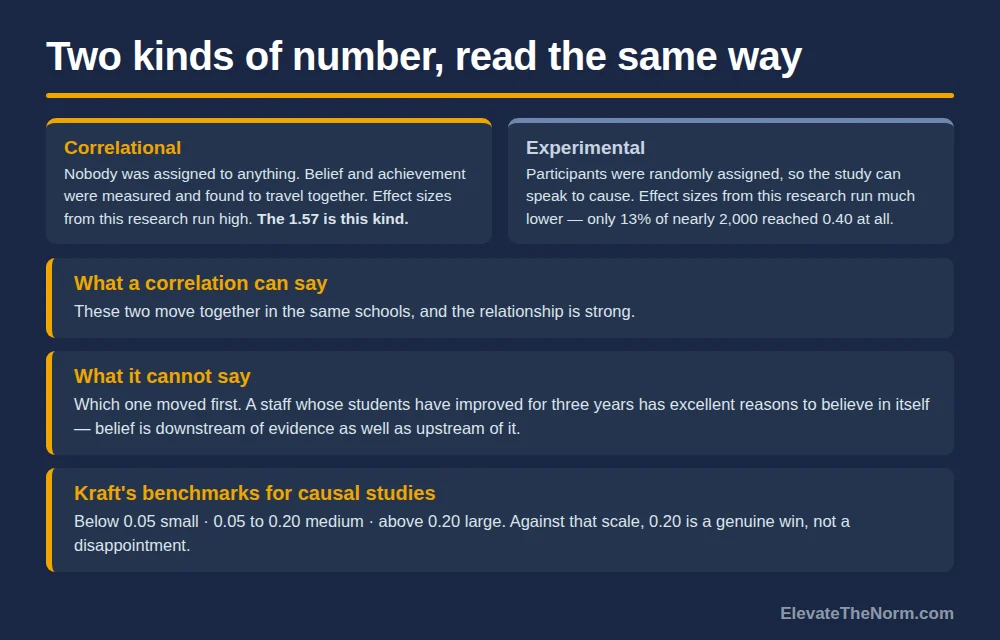
In that 2021 piece, Brown University economist Matthew Kraft argues that “effect size is such a misleading term,” because an effect size “tells us nothing about whether the underlying relationship represents cause and effect or a simple correlation.” It is a translation of a relationship onto a common scale. It is not a measure of whether one thing caused the other.
Kraft goes further, and this is the part that should change how you read every effect size you are shown. Looking at nearly 2,000 effect sizes from randomized controlled trials — studies built to establish cause — he found that only 13 percent reached 0.40 or larger. Hattie’s widely quoted 0.40 “hinge point,” the line above which an intervention is supposedly worth having, sits near the top of what carefully controlled education research actually produces.
So Kraft proposes different benchmarks for causal studies: below 0.05 is small, 0.05 to 0.20 is medium, and above 0.20 is large. Against that scale, an effect size of 0.20 is not a disappointment. It is a genuine win.
Hattie’s reply in the same article is fair and worth stating: 0.40 was always an average across all the studies in his database, offered as a starting point for a conversation rather than a universal pass mark. That is a reasonable defense of what he wrote. It is not much of a defense of how the number gets used in a faculty meeting.
The specific problem with 1.57 is direction. Schools where teachers believe they can collectively succeed also tend to post higher achievement. Nothing in a correlation tells you which came first — and the common-sense reading runs at least partly backwards. A staff whose students have been improving for three years has excellent reasons to believe in itself. Belief is downstream of evidence, not only upstream of it.
The honest version of the claim is smaller and still worth having: collective efficacy and achievement travel together, the relationship is strong, and the arrow probably runs both directions. That is defensible. “Believe harder as a staff and test scores follow” is not.
This is not a new standard for this site. We ran the same check on formative assessment’s headline numbers, where a widely repeated 0.4 to 0.7 range comes from a 1998 review and a later meta-analysis landed nearer 0.20.
Does That Mean Collective Efficacy Doesn’t Matter?
No. It means it is a condition, not an intervention. Those are different things and schools keep buying the second when the research describes the first.
An intervention is something you do to a class on Tuesday. A condition is the state of the building that determines whether Tuesday’s thing has a chance. Collective efficacy is the second kind. You cannot run it in fourth period. You also cannot run much of anything well without it.
Which is why “we are going to build collective teacher efficacy this year” is a sentence that means nothing on its own. It is like announcing that the department will have good morale. The belief is the readout, not the lever.
That has a direct purchasing consequence, and it is the one a district leader should take from this. You cannot buy a readout. A program promising to raise collective teacher efficacy is selling you the dial rather than the engine — the same substitution that turns teacher appreciation week into a catered lunch instead of the conditions staff actually asked for — and the survey score will move whether or not anything underneath it did. The spend that actually maps to the research is duller and harder to put in a press release: protected common time, and the data work required to show a staff whether last year’s push moved anything.
What Actually Builds Collective Efficacy?
Evidence that the work is landing, structures where teachers genuinely talk, and enough safety to say “that did not work” out loud. Donohoo, Hattie and Eells name a set of enabling conditions, and none of them is a belief you can adopt by deciding to.
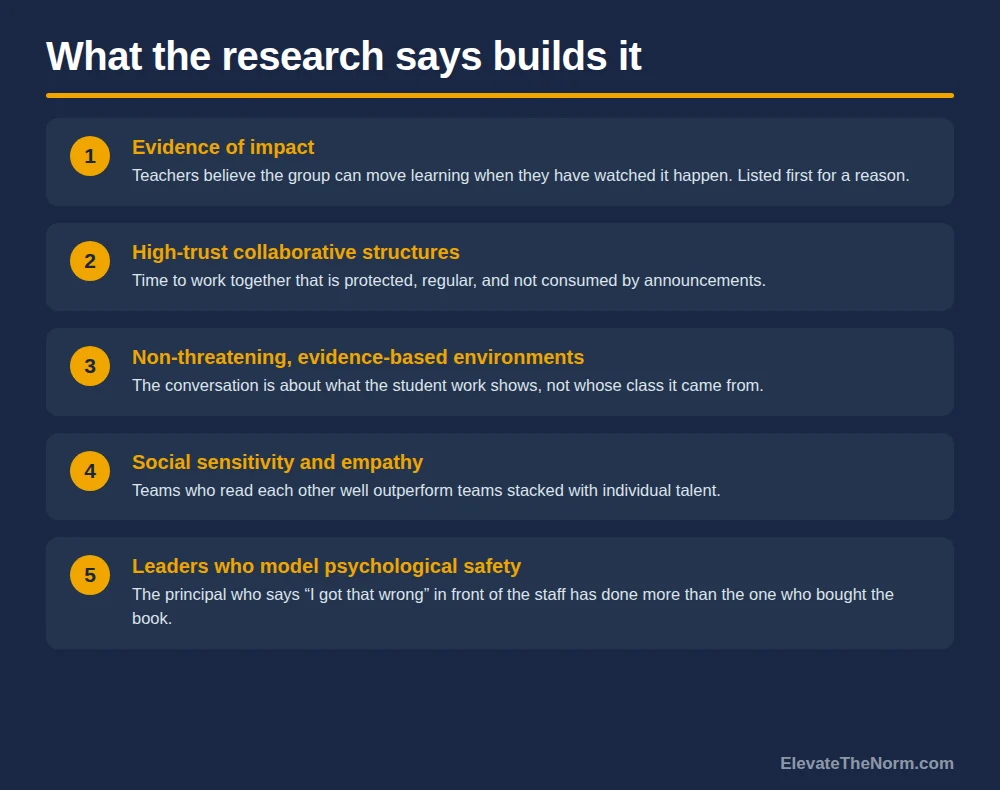
The conditions they list:
- Evidence of impact on student outcomes. Teachers believe the group can move learning when they have watched the group move learning. This is first for a reason, and it is the one that explains the direction problem above.
- High-trust collaborative structures. Time to work together that is protected, regular, and not consumed by announcements.
- Non-threatening, evidence-based environments. The conversation is about what the student work shows, not about whose class it came from.
- Social sensitivity and empathy among team members. Teams where people read each other well outperform teams stacked with individual talent.
- Leaders who model psychological safety. The principal who says “I got that wrong” in front of the staff has done more for this than the principal who buys the book.
Read that list again and notice what is not on it. No slogan. No banner. No survey. Four of the five are structural and belong to whoever controls the schedule and the tone, which in most buildings is not the classroom teacher.
None of those four is free, and a protected common period is the most expensive thing on the list — it is a master-schedule decision that costs staffing, and pretending otherwise is how this advice gets dismissed by the person who builds the schedule.
That is not a reason for a teacher to disengage. It is a reason to be precise about the ask. If your department wants this, the request is not “more collaboration.” It is a protected common period, an agenda that is about student work, and an administrator who does not treat a failed lesson as a performance problem. Those are three specific things an administrator can say yes or no to — which is the same reason a specific, answerable ask beats a general one every time.
The Effect Size Sanity Check
Five questions to run any effect size through before you repeat it. None of them requires statistics training, and together they catch most of what goes wrong between a study and a slide. It is the same scepticism worth bringing to any claim made for a professional development program.
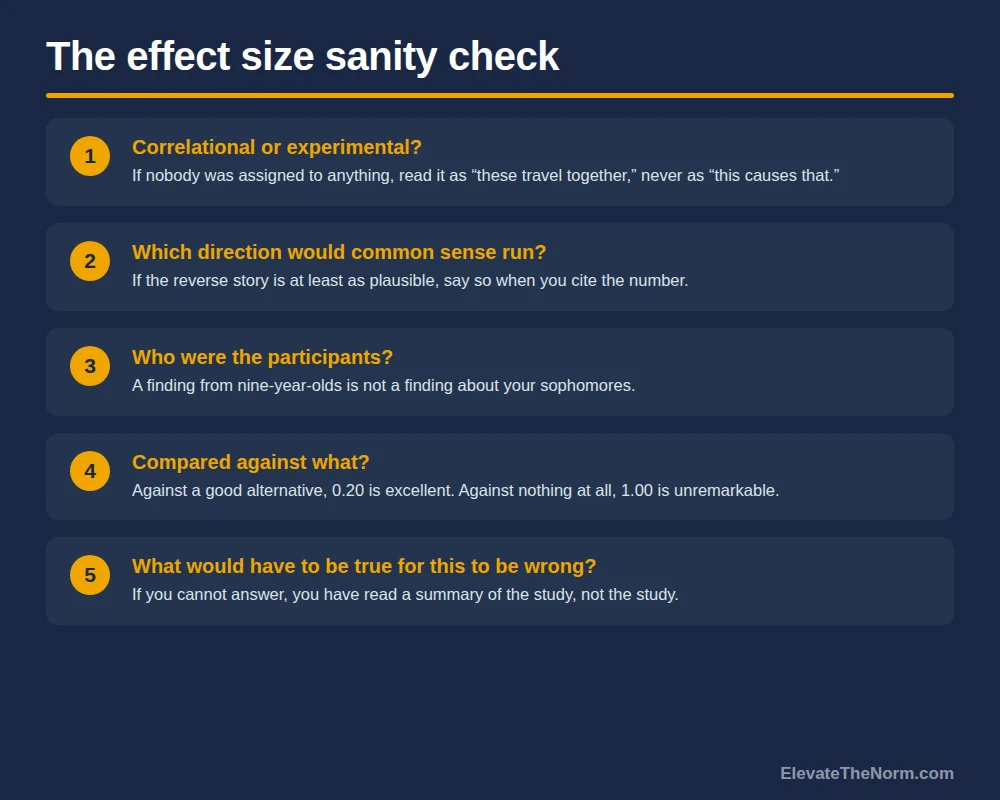
- Correlational or experimental? If nobody was assigned to anything, the number describes a relationship, not a result. Read it as “these travel together,” never as “this causes that.”
- Which direction would common sense run? Ask it out loud. If the reverse story is at least as plausible — success building belief rather than belief building success — say so when you cite the number.
- Who were the participants? A finding from nine-year-olds is not a finding about your sophomores. This one disqualifies more education research than any other question on the list.
- Compared against what? An effect size is always a comparison. Against a good alternative, 0.20 is excellent. Against nothing at all, 1.00 is unremarkable.
- What would have to be true for this to be wrong? If you cannot answer, you have not finished reading the study — you have finished reading a summary of it.
Run the 1.57 through those five. It fails the first, wobbles on the second, passes the third, and the fourth and fifth are rarely asked at all. That does not make it worthless. It makes it a strong correlation reported honestly, which is a perfectly respectable thing for a number to be.
What Kills Collective Efficacy Faster Than Anything Else
Being asked to collaborate while being evaluated on the result. Every other failure mode on this list is a version of that one.
- Data meetings that are really accountability meetings. The moment a common assessment becomes evidence about the teacher rather than evidence about the learning, honest conversation ends and everyone brings their best class.
- Collaboration time that gets eaten. A protected period consumed by announcements three weeks running teaches the staff exactly what the period is worth.
- Mandated agendas. A team handed its problem of practice is a team doing compliance. The problem has to be one the teachers actually have.
- Treating a failed lesson as a performance issue. One instance of this and nobody in the building admits to a failed lesson again. This is the single most expensive thing an administrator can do here.
- Celebrating belief instead of evidence. Posters about believing in kids, in a building where nobody can show whether last year’s reading push worked, produce cynicism rather than efficacy.
What This Looks Like in a Grades 6–12 Department
Small, specific, and about a unit you are both teaching. The research operates at the level of a building. The version a teacher can start does not.
The cheapest possible version is one conversation. Pick the thing you teach worst — everyone has one, and if you cannot name yours you have not thought about it hard enough — and ask a colleague who teaches it better how they run it. That is it. That is the mechanism the whole construct is describing, stripped of the vocabulary.
I would not have written that sentence in my first year. I learned a review format from another teacher on my hall, and the only reason I learned it is that he noticed I was short on ways to review and offered. Keeping your ears open and your mouth closed sometimes pays off. Keeping your ears open and asking questions pays off more, and it is faster.
The next version up is a shared artifact. Two teachers, one common assessment or one set of student work, one question: what did students do here that we did not expect? Not “how did your class do.” What did the work show. The best department-level version of this I have been part of started with an instructional coach, not an administrator, which is worth saying plainly — a coach is a partner in this, not an evaluator.
Three things make a two-person version work where a mandated team often does not:
- You picked the problem. Not the school improvement plan.
- The evidence is student work, not scores. Work can be looked at together without anyone being graded — and it rarely needs a name on it. Take the name off when the name is not the point.
- It repeats. Once is a chat. Every two weeks for a semester is a practice, and the same frequency argument runs under every structure worth building — the first run is about the structure, and only the fourth or fifth is about the content. A signal that took six weeks of holding the line before it worked is the same lesson one classroom down.
None of this needs permission, a budget, or a framework. It needs one colleague and a recurring thirty minutes, which is also roughly what an honest reflection practice costs.
What Do Students Experience When a Staff Has This?
Consistency — and they notice its absence long before any adult names it. This is the part of the research that never makes the slide, and it is the part that matters most on a site about treating teenagers as developing young adults.
A student moving through six classrooms in a day is running an experiment on whether the adults in that building talk to each other. When late work means three different things in three rooms, when one teacher’s “prepared” is another’s bare minimum, when nobody can tell them why the rule changed at the door — that is what low collective efficacy feels like from a desk. Students do not have the vocabulary for it. They describe it as the school not making sense, and they are describing it accurately.
The reverse is just as visible. In a building where teachers genuinely work together, a student gets the same answer twice, and the second teacher already knows what the first one tried. Teenagers read that instantly, and they read it as being taken seriously. It is the difference between a set of adults and a staff.
Worth saying plainly: none of that requires students to be told about collective efficacy, and no fourteen-year-old should sit through a presentation about it. They will judge the staff by whether the answers match.
What to Do Next
If you are a teacher: name the unit you teach worst, find the person who teaches it better, and ask them this week. One conversation. You do not need to call it anything — and if you are early enough in the job that asking feels like admitting something, that is exactly backwards.
If you lead a department or a building: stop asking for belief and start supplying the two things it grows from — evidence that the work is landing, and a room where a teacher can say a lesson failed without it costing them. Protect the common period, put student work on the table instead of a spreadsheet, and go first when something does not work.
And if somebody puts 1.57 on a slide in front of your staff, the useful question is not whether the number is right. It is the one that follows: what would we have to see in our own students’ work to believe it about us? That question has an answer, and chasing it is the actual work.
Before you go: grab the free The Effect Size Sanity Check (PDF) — ElevateTheNorm.com branded, printable, no email required.
Frequently Asked Questions
What is collective teacher efficacy?
It is the shared belief among the teachers in a school that, working together, they can move student learning — including for the students who are hardest to reach. The unit is the group, which is what separates it from individual teacher confidence. “I can get through to that student” is individual efficacy; “students who arrive behind leave us less behind” is collective.
What is the effect size of collective teacher efficacy?
Donohoo, Hattie and Eells put it at 1.57 in ASCD’s Educational Leadership in March 2018, compared against 0.65 for prior achievement and 0.52 for both socioeconomic status and home environment. That figure is correlational, which matters a great deal for how it should be read — it describes belief and achievement travelling together, not belief causing achievement.
Is the 1.57 effect size reliable?
It is a real figure from real studies, and it is almost certainly larger than any causal effect would be. Effect sizes from correlational research run higher than those from randomized trials. Writing in the same journal in 2021, Matthew Kraft found that only 13 percent of nearly 2,000 effect sizes from randomized controlled trials reached 0.40 at all. A correlational 1.57 and an experimental 0.20 are not the same kind of number and should not be compared as though they were.
Does collective teacher efficacy cause higher achievement, or the other way around?
Nobody can answer that from a correlation, and the reverse story is at least as plausible. A staff whose students have improved for three running years has excellent evidence for believing in itself. That is probably why “evidence of impact on student outcomes” is the first enabling condition the researchers list — belief appears to be downstream of results as much as upstream of them. The defensible claim is that the two reinforce each other.
What actually builds collective teacher efficacy?
Five conditions, per Donohoo, Hattie and Eells: evidence that the work is moving student outcomes, high-trust collaborative structures, non-threatening evidence-based environments, social sensitivity among team members, and leaders who model psychological safety. Four of the five are structural, which means they belong to whoever controls the schedule and the tone rather than to an individual teacher.
Can one teacher do anything about this, or is it an administrator’s job?
Most of the conditions are structural, but the smallest working version needs no permission: pick the unit you teach worst, find a colleague who teaches it better, and ask them how they run it. Add a shared piece of student work and a recurring thirty minutes and you have a two-person version of the whole thing. What a teacher should not do is carry the structural part alone — that is a specific, answerable request to make of an administrator.
Why does collective efficacy work fail in so many schools?
Usually because staff are asked to collaborate openly while being evaluated on what the collaboration reveals. Once a common assessment becomes evidence about the teacher rather than about the learning, everyone brings their best class and the honest conversation stops. Collaboration time that gets eaten by announcements, mandated problems of practice nobody actually has, and treating a failed lesson as a performance issue all do the same damage.
What is Hattie’s 0.40 hinge point and should I use it?
It is the line in Hattie’s rankings above which an influence is said to be worth having, and it was calculated as an average across his whole database. Use it carefully. Kraft’s analysis suggests 0.40 sits near the top of what well-controlled education research produces, and he proposes separate benchmarks for causal studies: below 0.05 small, 0.05 to 0.20 medium, above 0.20 large. Hattie’s own reply is that 0.40 was meant as a starting point for discussion rather than a pass mark, which is a fair description of what he wrote and a poor description of how it usually gets used.
Sources
- Donohoo, J., Hattie, J., & Eells, R. (2018). “The Power of Collective Efficacy.” Educational Leadership, 75(6). Source of the 1.57 effect size and the comparison figures for prior achievement (0.65), socioeconomic status (0.52) and home environment (0.52), and of the five enabling conditions. https://www.ascd.org/el/articles/the-power-of-collective-efficacy
- Kraft, M. A., & Hattie, J. (2021). “Interpreting Education Research and Effect Sizes.” Educational Leadership. Kraft: effect size is “such a misleading term” and “tells us nothing about whether the underlying relationship represents cause and effect or a simple correlation”; only 13 percent of nearly 2,000 effect sizes from randomized controlled trials reached 0.40; proposed causal benchmarks of <0.05 small, 0.05–0.20 medium, >0.20 large. Hattie’s reply that 0.40 is an average and a starting point appears in the same article. https://www.ascd.org/el/articles/interpreting-education-research-and-effect-sizes
A note on what is not cited here. Learning Forward’s 2015 article on collaborative expertise is frequently recommended alongside this topic; it sits behind a membership wall and could not be read, so it is not cited. The 1.57 figure is reported as its authors report it, and the limits described in this article are the limits its own co-author published three years later — not an outside attack on it.

