By Clay Shumate
Professional development courses for teachers are usually judged by what they hand out: a certificate, a transcript line, a count of clock hours. Judge them instead by what they change. A course worth your time is focused on the subject you actually teach, long enough to let you practice, built around something you can carry into class, and recognized by whoever renews your license.
Teachers get plenty of advice about which course to take and almost none about how to judge one. That gap matters, because the research on teacher learning is far less flattering than the brochures. Well-funded, well-attended, well-reviewed programs have repeatedly produced no measurable change in what teachers know or what students learn. What follows is the criteria, not the catalogue.
Key Takeaways
- The features that predict good PD are known, but the evidence behind them is softer than it is usually presented. Content focus, active learning, modeling, coaching, feedback and sustained duration show up across reviews — and the most careful critiques say those reviews were built on weak inference.
- Hours are a floor, not a guarantee. Short one-off sessions almost never move student outcomes, but a rigorous federal trial delivered 77 hours of middle school math PD and measured no impact on teacher knowledge or student achievement.
- Ask what happens after the last session. Follow-up coaching has the strongest causal evidence of any PD format, and its effects shrink sharply when programs scale.
- Apply the Monday test. If you cannot name the artifact you will walk out with — a task, a rubric, a sequence, a set of questions — the course is selling a feeling.
- Check credit before you pay, not after. Renewal rules are set by your state, and a course can be excellent and still count for nothing.
- The honest trade-off: the best-evidenced PD is expensive in the one resource teachers have least of. Depth costs hours, and nobody is giving you those hours back.
What makes professional development courses for teachers actually work?
The most cited answer is a list of seven features: content focus, active learning, collaboration, models and modeling, coaching and expert support, feedback and reflection, and sustained duration. That list comes from a 2017 review by Linda Darling-Hammond, Maria Hyler and Madelyn Gardner at the Learning Policy Institute, which examined 35 studies of PD programs with positive, statistically significant effects on student achievement (report, p. 2).
Read that sentence again, because the method is the catch. The review deliberately selected programs that had already worked, then described what they had in common. The authors are upfront that they “do not seek to draw conclusions about the efficacy of individual program components,” since real programs bundle several at once, and they note that six well-designed studies in their scan found no impact on student learning at all. So the seven features are a reasonable description of what effective programs look like. They are not proof that adding a feature will make your course effective.
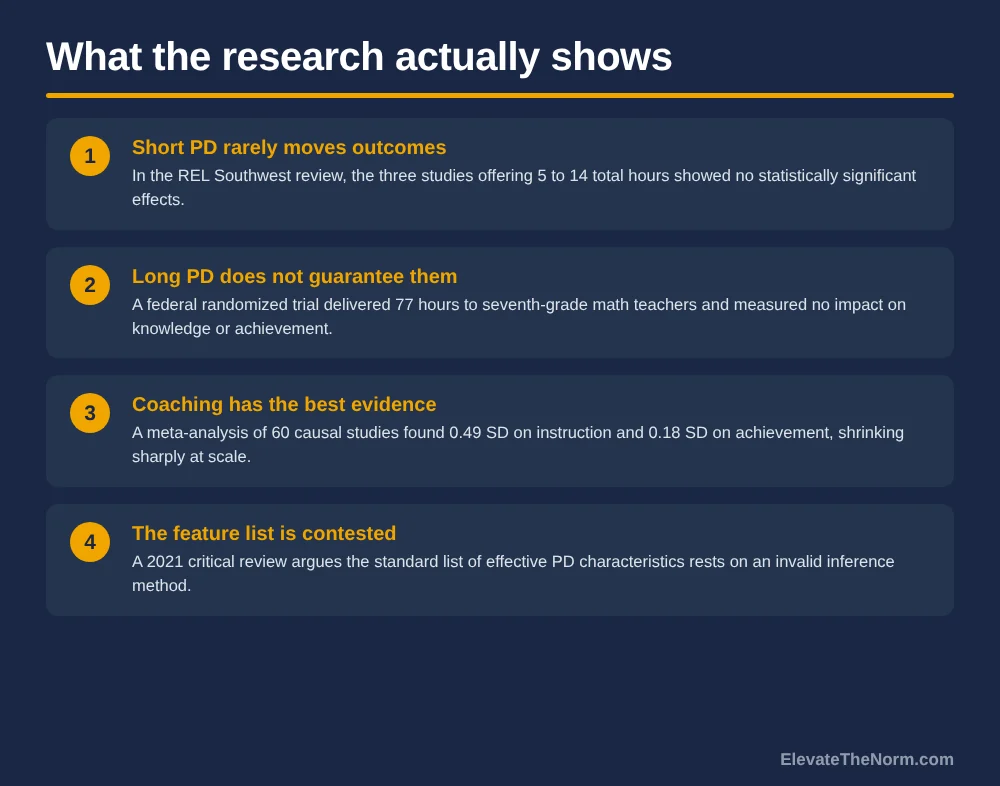
That distinction is not academic nitpicking. In 2021, Sam Sims and Harry Fletcher-Wood published a critical review in School Effectiveness and School Improvement arguing that the whole international consensus on PD characteristics — sustained, collaborative, subject-specific, expert-supported, practice-based — rests on reviews with “inappropriate inclusion criteria” that “depend on an invalid inference method,” and is therefore “likely to be inaccurate” (critical review, open access). Their point is not that collaboration is bad. It is that nobody has established these features are the active ingredients.
So use the features as a screen, not a scorecard. A course that has all seven can still be a waste. A course that has three of them, aimed hard at a problem you actually have, can be the best thing you do this year.
Why does so much teacher PD fail anyway?
Because districts buy formats instead of outcomes, and almost nobody checks afterward. TNTP’s 2015 study The Mirage surveyed more than 10,000 teachers and 500 school leaders across three large districts and one mid-size charter network. It found those systems spent an average of nearly $18,000 per teacher per year on development, that teachers reported roughly 19 school days a year on it — about a tenth of the school year — and that nearly seven in ten teachers’ evaluation ratings stayed flat or declined over two to three years (executive summary).
That report got hit hard, and the criticism is worth knowing. Heather Hill, an education researcher who studies teacher learning, reviewed it for the National Education Policy Center in September 2015 and argued the cost figure was inflated by rolling in salary bumps for advanced degrees, that teacher evaluation ratings are an unreliable outcome measure, and that the study examined PD formats rather than content or quality. She concluded the descriptive findings deserve attention but the analytic conclusions were “overly broad and not supported by the study’s methods” (NEPC review).
Fair. But the more uncomfortable evidence comes from a randomized trial, not a survey. The Institute of Education Sciences funded a two-year study of a professional development program for seventh-grade math teachers focused on rational numbers. Treatment teachers received an average of 77 hours. After two years, the measured impact on total teacher knowledge was an effect size of 0.05 (p = 0.79), and the impact on student achievement in rational numbers was -0.01 (p = 0.94) (Garet et al., NCEE 2011-4024). Seventy-seven hours. Content-focused. Expert-delivered. Nothing.
I take that study seriously because it is middle school, it is the subject, and it is the design that can actually tell you something. It does not prove PD cannot work. It proves that hitting the recommended features is not enough, and that anyone promising you results from a course should be asked how they know.
Does course length matter?
Length is a floor you have to clear and nothing more. The most quoted number in this field comes from a 2007 review by Kwang Suk Yoon and colleagues for the Regional Educational Laboratory Southwest. They screened more than 1,300 studies; nine met What Works Clearinghouse evidence standards. Teachers in those nine received an average of 49 contact hours, ranging from 5 to 100. The three studies with the least PD — 5 to 14 hours total — showed no statistically significant effects (Yoon et al., 2007).
Two caveats that rarely travel with that statistic. First, 12 of the 20 measured effects across those nine studies were not statistically significant, and the authors call their own findings “only a preliminary marker.” Second, and this matters a great deal on a grades 6-12 site: all nine studies were conducted with elementary school teachers. The 14-hour threshold you see quoted in secondary school PD catalogs was never measured on secondary teachers.
Practically, treat it this way. A 90-minute webinar can legitimately teach you a technique. It will not change how you teach a unit. If a course is promising transformation in two hours, it is promising something no study in this literature has delivered.
Is the course about your subject or about teaching in general?
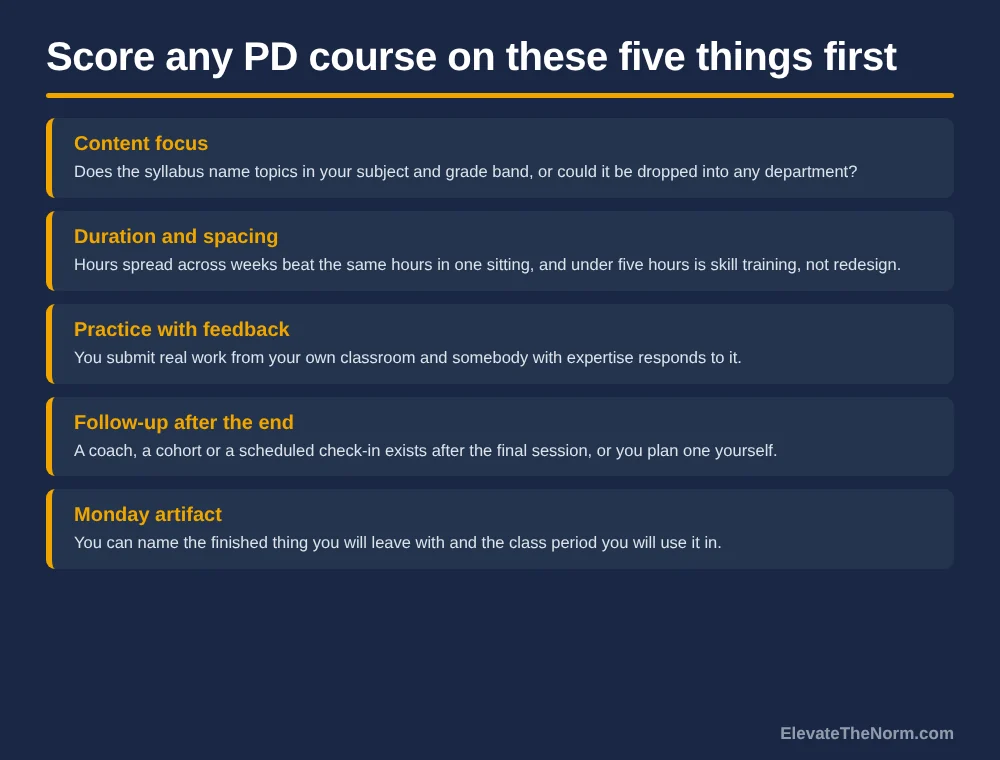
Content focus is the feature with the most consistent support, and it is the easiest one to check from the course description. A course on “student engagement” can be filled with anything. A course on how students misread primary sources, or where they get lost in proportional reasoning, or how to sequence a lab so the inquiry is real, has to commit to something.
Here is a fast test. Open the syllabus and count how many of the session titles could be swapped into any subject without editing. If most of them could, you are buying generic pedagogy. Generic pedagogy is not worthless — a new teacher drowning in behavior needs it, and that is a different problem than needing better questions about the Dust Bowl. Just know which one you are buying. If you need the behavior side, our walkthrough of building a classroom management plan from scratch is free and will cost you an afternoon instead of a semester.
Will you practice, or just listen?
Active learning in a PD course means you produce something and get a response to it, not that the facilitator asked you to turn and talk. The distinction is whether your work is the object of instruction.
Signals that the course involves real practice:
- You bring your own unit, roster or assessment data into the sessions and leave with it changed.
- Somebody with expertise reads your work and tells you what is wrong with it.
- You watch a model — video, live, annotated transcript — of the practice being done well, not just described.
- You rehearse the hard part before you do it with students.
- There is an assignment between sessions that requires you to try it and report back.
Signals that it is a lecture wearing a lanyard: breakout rooms with no product, a shared slide deck as the main artifact, a facilitator who has never seen your classroom and does not ask about it, and a final “reflection” that nobody reads.
What happens after the course ends?
Follow-up is where the strongest causal evidence lives. Matthew Kraft, David Blazar and Dylan Hogan’s 2018 meta-analysis of 60 studies with causal designs found teacher coaching produced a pooled effect of 0.49 standard deviations on instruction and 0.18 on student achievement (Kraft, Blazar & Hogan, 2018).
Those are good numbers by education research standards. But the authors also report that average effects from effectiveness trials of larger programs are only a fraction of those found in efficacy trials of small ones. Coaching works best when it is small, close and well-run, which is exactly the version a mass-market online course cannot sell you.
So ask the blunt question: after the final session, does anything happen? Is there a cohort that still meets? A coach who will watch a lesson? A facilitator who will read a student work sample in November? If the honest answer is no, you are buying input only, and you will have to build the follow-up yourself. That is doable — a colleague who agrees to watch you teach one period and talk afterward is the cheapest coaching there is — but it only happens if you plan it before the course ends. A structured reflection habit is the minimum version.
Can you use it on Monday?
The Monday test: name the artifact you will walk out with and the class period you will use it in. If you cannot do both in one sentence, the course has not been designed for implementation.
An artifact is concrete. A driving question you will actually launch. A rubric with your standards in it. A set of ten exit-ticket prompts for the unit you teach in February. A revised lab sequence. A conference protocol. An artifact survives the drive home. Inspiration does not.
This is also the part of PD that most often fails on grounds of plain workload. A course that hands you a beautiful framework requiring twelve hours of redesign per unit has handed you a second job. When you evaluate a course, estimate the implementation cost, not just the seat time, and decide whether you are willing to pay it. If the answer is no, do not enroll and then feel guilty in July. Pick the smaller thing you will finish. Our writeup on formative assessment strategies that fit a normal class period exists because that is usually where the smaller thing lives.
Does it count for anything your state recognizes?
Check the credit question before you pay, because an excellent course can count for nothing. Nearly every state requires periodic license renewal tied to some form of continuing education, but the rules, the accepted providers, the hour-to-credit conversions and the documentation differ state by state. A 2018 New America report on relicensure found that most state systems are built around credit accumulation rather than demonstrated growth, so that “whether a teacher grows considerably while fulfilling her state’s renewal requirements or does not improve at all is of no consequence” as long as the credits clear (Rethinking Relicensure).
That cuts both ways, and you should be honest with yourself about which way you are using it. Sometimes you need hours and you need them cheap, and there is no shame in that. Sometimes you need to actually get better at something, and the hours are incidental. Trouble starts when you tell yourself you are doing the second thing while shopping for the first.
Three things to verify in writing, from your own state’s certification office rather than from the provider: whether the provider is on an approved list, how the course’s hours or graduate credits convert for renewal, and what documentation you must keep. Do not accept “most states accept this” as an answer.
A scoring checklist for any PD course
Run this before you register. Score each row 0, 1 or 2. It takes about ten minutes with the course description and one email to the provider.
| Criterion | 0 points | 1 point | 2 points |
|---|---|---|---|
| Content focus | Generic pedagogy, any subject | Subject-adjacent, examples from elsewhere | Your subject and grade band, specific topics named |
| Duration and spacing | Under 5 hours, single sitting | Roughly 15-30 hours, or spaced over weeks | 40+ hours spread across a term or more |
| Active practice | Watch and discuss only | One assignment, no feedback | You submit work and an expert responds |
| Modeling | Practice described in slides | One demonstration video | Multiple annotated models, including ones that go wrong |
| Follow-up | Ends at the last session | Optional forum or office hours | Scheduled coaching, observation or cohort check-ins |
| Monday artifact | Nothing nameable | Templates you still have to fill | A finished, usable product built on your own materials |
| Implementation cost | Unclear or enormous | Heavy but defined | Stated honestly and sized to one unit |
| Evidence offered | Testimonials only | Internal satisfaction data | External evaluation or a named study, with limits acknowledged |
| Recognized credit | Provider is vague | Hours offered, conversion unverified | Confirmed by your state licensing office |
| Who is teaching it | No classroom background stated | Former teacher, different grade band | Practitioner or researcher in your grade band and subject |
How to read the total. Sixteen to twenty: strong, enroll. Ten to fifteen: probably worth it if the gaps are ones you can fill yourself, which usually means follow-up. Below ten: you are buying hours. That can be a legitimate purchase. Just name it.
Questions to ask the provider before you pay
Email these. How a provider answers tells you more than the syllabus does, and a good one will not mind.
- “How many contact hours, and across how many weeks?”
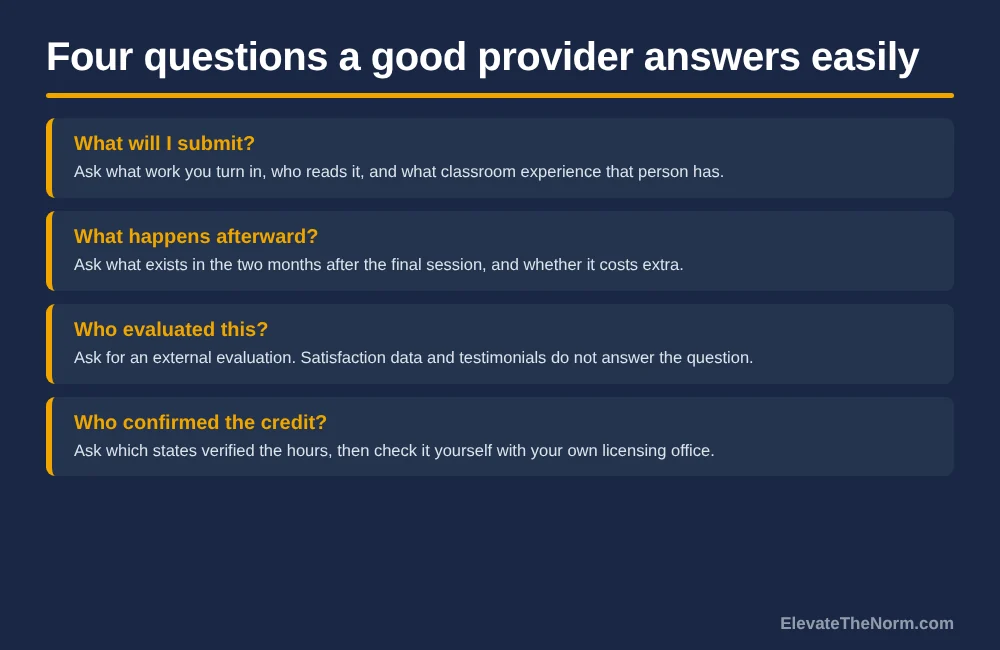
- “What will I submit for feedback, who reads it, and what is their classroom background?”
- “What finished materials will I leave with that use my own curriculum?”
- “What happens in the two months after the course ends?”
- “Has this course ever been evaluated by anyone outside your organization? May I see it?”
- “What is the typical completion rate, and what counts as completion?”
- “Which states have confirmed these hours for renewal, and who do I contact to verify?”
- “What is the refund policy if the first two sessions are not what was described?”
Vague answers on questions four, five and six are the ones I would treat as disqualifying. Those are the three a provider with real results can answer in a paragraph.
The honest trade-off nobody puts in the brochure
The features with the best evidence behind them are all expensive in time, and time is the resource teachers have least of. There is no way around this and I am not going to pretend there is.
Look at the numbers together. The reviews point toward dozens of hours, spaced, with coaching attached. Teachers in the TNTP districts were already giving up around 19 school days a year to development they largely did not rate as a good use of time — two-thirds reported being satisfied with it, but only 40 percent called it a good use of time. The hours exist. They are mostly already spent, and spent badly, and you do not control that calendar.
Which leads to a position I will own as opinion rather than finding. If your district already consumes nineteen days of your year, your personal PD budget should go toward depth in one thing, not breadth across five. One course in your subject, long enough to matter, with a colleague doing it alongside you so somebody asks whether you tried it. Everything else should be free, short and immediately usable. On that point, what the research says about collective teacher efficacy is the most encouraging reading in this area: the belief that your faculty can move outcomes together is itself associated with results, and it is not something you buy.
If the budget is the binding constraint rather than the calendar, start with the genuinely free options and what free actually costs. If the constraint is geography or scheduling, the specific strengths and weaknesses of online delivery are worth reading before you commit to a platform.
How to choose professional development courses for teachers this year
Pick one problem you can name, then find the longest, most subject-specific course that addresses it and has something happening after the last session. Score it with the checklist above. Verify the credit question with your state before paying. Recruit one colleague so there is somebody to answer to in six weeks.
And set the bar where it belongs. Professional development courses for teachers are worth judging by one question in April: what do you do differently now, and can you point at it in a student’s work? If you cannot, the course was entertainment with paperwork. That is not a disaster. It is just information, and it should change what you buy next year. After seven years of classroom experience, the thing I am most confident about is that the sessions I remember are the ones that gave me something to carry out the door.
Sources
- Darling-Hammond, L., Hyler, M. E., & Gardner, M., Effective Teacher Professional Development, Learning Policy Institute, June 2017. Source of the seven features of effective PD. Caveat: the review deliberately selected 35 studies that already showed positive effects and states it does not draw conclusions about individual components. https://learningpolicyinstitute.org/sites/default/files/product-files/Effective_Teacher_Professional_Development_REPORT.pdf
- Yoon, K. S., Duncan, T., Lee, S. W.-Y., Scarloss, B., & Shapley, K. L., Reviewing the Evidence on How Teacher Professional Development Affects Student Achievement, REL Southwest / Institute of Education Sciences, October 2007. Source of the 49-hour average, the 21-percentile-point figure and the finding that 5-14 hours produced no significant effects. Caveat: only nine of more than 1,300 studies met the evidence standards, 12 of 20 effects were not statistically significant, and all nine studies were conducted with elementary teachers. https://files.eric.ed.gov/fulltext/ED498548.pdf
- Sims, S., & Fletcher-Wood, H., “Identifying the characteristics of effective teacher professional development: a critical review,” School Effectiveness and School Improvement, 32(1), 2021, pp. 47-63. Supports the argument that the consensus list of PD characteristics rests on weak inference. https://discovery.ucl.ac.uk/id/eprint/10101575/
- Garet, M. S., et al., Middle School Mathematics Professional Development Impact Study: Findings After the Second Year of Implementation, NCEE 2011-4024, May 2011. Source of the 77 hours delivered and the null effects on teacher knowledge (0.05, p = 0.79) and student achievement (-0.01, p = 0.94). Caveat: one program, one content area, six districts in year two. https://air.org/sites/default/files/downloads/report/IES_PD_Math_Exec_20114025_0.pdf
- Kraft, M. A., Blazar, D., & Hogan, D., “The Effect of Teacher Coaching on Instruction and Achievement: A Meta-Analysis of the Causal Evidence,” Review of Educational Research, 2018. Source of the 60-study count and the 0.49 and 0.18 standard deviation effects. Caveat: the authors report that effects from larger-scale programs are only a fraction of those from small efficacy trials. https://annenberg.brown.edu/publications/effect-teacher-coaching-instruction-and-achievement-meta-analysis-causal-evidence
- TNTP, The Mirage: Confronting the Hard Truth About Our Quest for Teacher Development (executive summary), August 2015. Source of the $18,000 per teacher figure, the 19 school days, and the finding that nearly seven in ten teachers’ ratings were flat or declining. Caveat: three districts and one charter network, with an outcome measure (evaluation ratings) that Heather Hill’s NEPC review argues is unreliable for this purpose. https://tntp.org/wp-content/uploads/2023/02/TNTP_Mirage_Executive_Summary_2015.pdf
- Hill, H. C., Review of The Mirage, National Education Policy Center, September 15, 2015. The critique of TNTP’s cost calculation, outcome measures and generalizability. https://www.nepc.colorado.edu/sites/default/files/ttr_hill_tntp_mirage.pdf
Frequently Asked Questions
How many hours of professional development actually make a difference?
There is no reliable threshold, only a floor. The REL Southwest review found that studies offering 5 to 14 total hours showed no statistically significant effects, while the nine studies that met evidence standards averaged 49 contact hours. But all nine of those studies were conducted with elementary teachers, and a federal randomized trial delivered 77 hours of middle school math PD with no measurable impact. Treat anything under about 15 hours as skill-level training, and do not assume that clearing 40 hours guarantees anything.
Is a cheap course automatically worse than an expensive one?
No, and price carries almost no information here. Some of the most content-rich PD available is federally funded or museum-run and costs nothing, while some expensive courses are a slide deck and a certificate. What price does predict is whether anyone is paid to follow up with you, since coaching and feedback are labor and labor costs money. Score the course on the criteria, then ask whether the price is buying follow-up or just access to a recording.
My district chooses my PD. Does any of this help me?
Yes, in two ways. First, you can use the criteria to decide where to invest your own attention inside required sessions, which is a real choice even when attendance is not. Second, the questions in this article are the ones to bring to whoever schedules PD at your school. Asking what teachers will walk out with, and what happens in the two months after, is a reasonable question from a staff member and tends to improve the answer over time.
Does a course that counts for license renewal have to be good?
No. Most state renewal systems are built around accumulating approved credits rather than demonstrating growth, which means a course can clear your renewal requirement without changing your teaching. That is not an argument for ignoring credit. Hours are a real obligation with a real deadline. It is an argument for being clear with yourself about which purchase you are making, and for verifying the credit question with your own state licensing office rather than trusting a provider’s marketing.
What if I only have a few hours this semester?
Then buy depth in something small rather than breadth across a topic. A short, specific course on one technique you will use in a unit you already teach is a defensible use of three hours. A broad survey course is not, because surveys need the implementation time that short courses do not include. The other high-value option for a few hours is arranging to watch a colleague teach and talk afterward, which costs nothing and has better follow-up built into it than most paid courses.
How do I know whether a provider’s evidence claims are real?
Ask who evaluated the course and whether anyone outside the organization did it. Satisfaction surveys are not evidence of learning, and testimonials are not evidence of anything. A provider with real results can name an external evaluation, describe its design and tell you its limits without getting defensive. If the only evidence offered is enthusiasm from past participants, treat the course as unevaluated and price it accordingly.
Should students or families care which PD their teacher takes?
They will see the consequences rather than the course. Good PD tends to show up as clearer assignments, better feedback and assessments that match what was taught, which are the things students notice. The fairness question families sometimes raise is whether PD time pulls teachers out of the room. That is a scheduling decision made above the classroom, but it is a legitimate thing to ask a principal about, and depth in one area usually means fewer disruptions than scattered one-day sessions.
Is there any PD worth taking that is not about my subject?
Yes, in specific cases. Early-career teachers usually need classroom systems before they need subject-specific depth, because nothing content-focused survives a room that is not functioning. Teachers moving into a new role, grade band or program also need the general version first. The caution is that generic PD is the easiest kind to repeat forever, since it never gets hard enough to expose what you do not know. Once systems are stable, move toward content.