
To help teacher burnout, change the working conditions that produce it — workload, control, recognition, community, fairness and values — rather than the coping skills of the people inside them. Burnout is an occupational condition. The research points at the job, and the measured cost to students lands on the classroom experience before it lands on any test score. Most of the levers that matter are held by an administrator, not a teacher.
This page is for the person holding those levers: a principal, an assistant principal, a department chair with a schedule to build, a central-office administrator with a budget. Everything else in this series is written for the teacher — the definition the rest of this series is built on, how the three symptoms present in a 6–12 classroom, and what recovery asks of someone already past prevention. This one is about what you can do from your chair, and the honest size of the effect to expect. Some of that evidence is less flattering to the standard advice than you would guess, and it is here too.
Key Takeaways
- Burnout is a condition of the job, not a defect in the person. Christina Maslach, whose framework the WHO definition is built on, puts it plainly: “Organizational intervention can be more productive than individual intervention.”
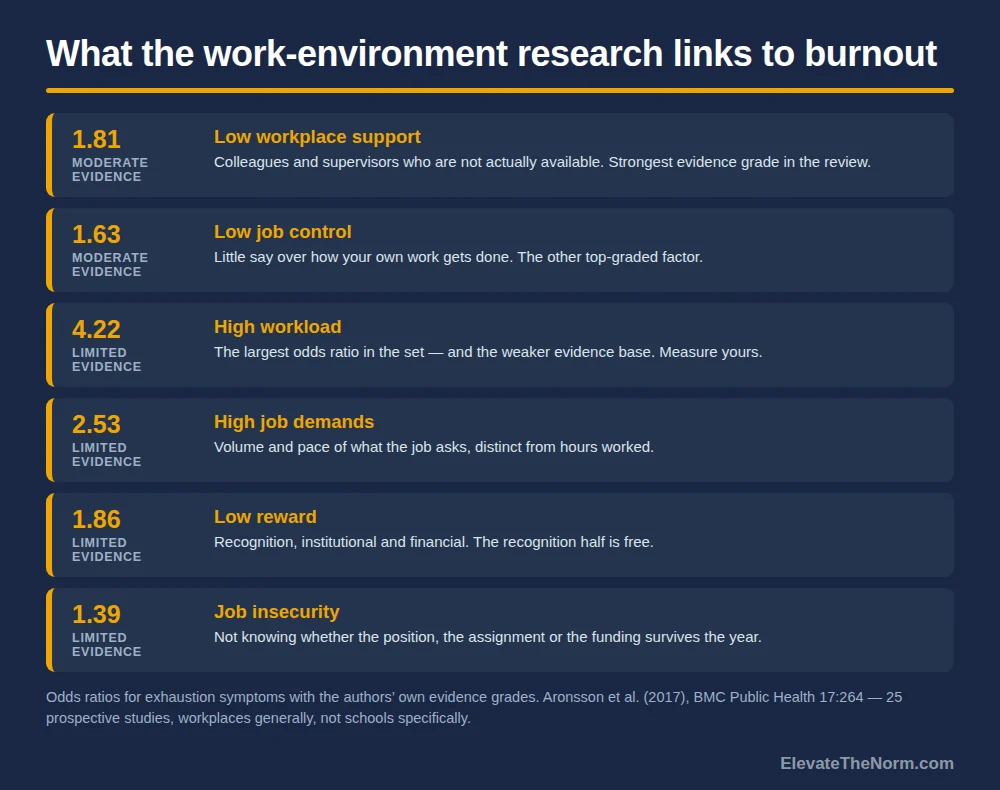
- Job control and workplace support have the best evidence behind them. A systematic review of 25 prospective studies graded both as moderate — low job control at an odds ratio of 1.63 for exhaustion symptoms, low workplace support at 1.81. High workload carries the biggest number, 4.22, on the weaker limited grade: the loudest signal, and the one most worth measuring locally rather than assuming.
- Expect a small effect, honestly reported. Across 23 controlled teacher-burnout trials the overall effect was d = 0.18, and almost nothing on cynicism (0.03). Organizational interventions move exhaustion about −0.30, on evidence the authors call very low quality. Real workload reductions ran −0.44; schedule tweaks showed no significant effect at all.
- There is real contrary evidence. A 35-year meta-analysis in a related helping profession found person-directed interventions beat organization-directed ones on exhaustion (g = .38 vs .13). “Fix the job, not the person” is better supported by the cause research than by the intervention research.
- Fewer than half of teachers think you are trying. In RAND’s 2025 national survey, fewer than one-half said their school or district was making efforts to help them balance work and life. Forty-six percent said the job left them too tired for their own lives.
- None of this makes you a clinician. Conditions are your job. A particular person’s health is not, and a wellness newsletter is not a substitute for either.
Free Download · 2-page PDF
The Administrator’s Six Conditions Walkthrough
Page one: the six areas of worklife, the question to ask in each, the levers that answer it, and space to write the lever you hold, who owns it and by when. Page two: the three-question count, the scheduling-problem versus staffing-finding test, what to say when a teacher tells you, and what not to do. It returns no score and it is not a screening instrument.
Free. No email address required. Designed for grades 6–12.
What actually helps teacher burnout?
Changing the conditions that caused it. Specifically: cutting real workload rather than redistributing it, giving teachers genuine decision-making authority over their own work, making recognition and fairness visible, and protecting the time that makes the rest of a life possible. Everything else is downstream of whether those four are true.
That ordering comes out of the definition. The World Health Organization classifies burn-out as an occupational phenomenon resulting from chronic workplace stress “that has not been successfully managed.” The stress is the input. If the input does not change, an intervention can only help someone tolerate it longer — worth doing, and not the same as helping.
Maslach’s 2017 paper in Consulting Psychology Journal makes the administrative case in one sentence: “If improvements can be made in job conditions that affect a lot of employees, then those interventions can have a much larger impact.” That is a scale argument, and it is aimed squarely at your job. A counselor helps one teacher at a time. A schedule helps everybody on it, every day, whether or not they opted in.
Which working conditions actually predict burnout?
Low job control and low workplace support have the strongest evidence. A systematic review including meta-analysis of the work environment and burnout symptoms — 25 studies that survived quality screening, drawn from prospective research across Europe, North America and Australasia — graded both at the highest level of confidence the review awarded anything.
The odds ratios for exhaustion symptoms, with the authors’ own evidence grades attached, are in the chart. The short version: low workplace support 1.81 and low job control 1.63, both graded moderate; high workload 4.22, job demands 2.53, low reward 1.86 and job insecurity 1.39, all graded limited.
Read honestly, that is slightly awkward. The condition with the largest apparent effect — workload — sits on the weaker evidence base, while the two firmest findings are the quieter ones about autonomy and support, both of which the review found actively protective rather than merely neutral. So do not skip control and support because workload is what everybody is shouting about. And because this evidence covers workplaces generally rather than schools specifically, treat the workload number as a reason to measure yours rather than a finding to quote at a board meeting.
How big an effect should an administrator expect?
Small. Real, repeatedly measured, and small. Anyone promising you a transformation is selling something. The honest range is a modest shift in exhaustion, very little movement on cynicism, and nothing at all if the change is cosmetic.

A meta-analysis of 23 controlled trials aimed specifically at reducing teacher burnout found an overall effect of d = 0.18 — statistically significant, practically small — and an effect on depersonalization of 0.03, which is nothing. Interventions lasting under a month had the smallest effects of all, so a one-day training in August is close to a rounding error.
A separate 2023 meta-analysis looked only at organizational interventions and exhaustion, across 13 studies with a median of 119 workers each. Pooled effect: −0.30, which the authors themselves call a small reduction on very low quality evidence. The pattern inside it is the useful part. Workload reductions ran −0.44. Participatory changes — where staff had a hand in designing them — ran −0.34. Work-schedule interventions produced no significant effect at all. And combined interventions, which change the job and support the person, ran −0.54, the largest figure in the set. That last one is what I would build a plan around: not because it is large, but because it is the only one that beats doing a single thing well.
Does fixing the teacher instead of the job ever work?
Sometimes better than fixing the job, and the research saying so is good research. Leaving this out is how you end up with a plan that cannot survive a skeptical question.
A meta-analysis of 35 years of burnout-intervention research in a closely related helping profession — mental health providers, 27 samples, 1,894 workers — compared the two approaches directly. Person-directed interventions outperformed organization-directed ones on emotional exhaustion, Hedges’ g of .38 against .13, and the gap was statistically significant. On overall burnout the two were indistinguishable.
Two caveats, neither of which erases it. The organizational studies were a relatively small subset, which limits what the comparison carries. And those workers are not teachers. But the honest summary stands: “change the job, not the person” is much better supported by research on what causes burnout than by research on what fixes it.
Which is an argument for doing both, and for being suspicious of any plan — including yours — that only does the cheap half. A resilience workshop with no workload change is the cheap half. So is a structural announcement with nothing for the people already depleted while it takes effect.
What is a practical framework for a principal to use?
Walk the six areas of worklife and, for each one, name a lever you personally control and a date. Maslach’s model describes six places where a person and a job can mismatch. It was not written for schools, but it maps onto a building without much translation, and it has the advantage of being the framework the definition itself rests on.

Here is the walkthrough. The test for every row is the same: can you name a specific thing, a specific person, and a specific date? If not, you have written a value, not a change.
- Workload. What is the heaviest recurring demand here that is not instruction? Duty rotations, meeting count and length, separate preps assigned to one person, data entry done three times instead of once, grading systems that take longer than the feedback is worth, coverage absorbed by whoever is nearest. If the answer is “we need more staff,” that may be true and it is still not this week’s lever.
- Control. What decisions about their own work do teachers not get to make? Pacing, assessment format, room arrangement, how a department spends its own PD time, who is consulted before a schedule publishes rather than after. A 2020 systematic review of 31 studies on administrator support found an outright gap here: no study it located had tested a principal intervention that increased teachers’ decision-making. A gap in the literature, not permission to skip it.
- Reward. Is good work noticed specifically, or generically? Named recognition in front of peers; protected time rather than pizza; pay, where you have any say. Recognition is the half you can act on today.
- Community. Do teachers here have colleagues, or just neighbors? Common planning that is actually common, deliberate veteran and early-career mixing, and dealing with the one adult everybody works around — a documented personnel process with its own timeline, and starting it in September is the only version that finishes.
- Fairness. Can a teacher predict how a decision will be made before it is made? Written criteria for coverage, duties, rooms and course assignments; consistent follow-through on referrals; explaining the reasoning when a decision goes against someone. Nearly free. And note the direction: when behavior shows up as a burnout driver it is almost always the process that failed, not the students.
- Values. Does what we say we care about survive contact with the calendar? Stop asking for a thing you have decided not to fund. Stop running an initiative you will abandon in March. When a mandate arrives that you think is wrong, say so rather than selling it.
Run it as a walkthrough, not a survey — one afternoon, with three or four teachers in the room rather than alone, because participatory changes were the second-best performing category in the meta-analysis and because you will get the workload answer wrong by yourself. Pick the room deliberately: at least one person who will disagree with you out loud, at least one early-career teacher, not only department chairs.
How do you tell a scheduling problem from a staffing problem?
Count how many people describe the same condition. One teacher describing one duty is a scheduling problem. Nine teachers describing the same three conditions is a staffing finding, and it belongs in a budget conversation rather than a coaching conversation. Special education is where this distinction bites hardest, because the vacancy rate does the redistributing for you — what the same question looks like for special education staffing.
The two failures are opposite. Treating a building-wide condition as an individual problem produces a teacher coached on time management while carrying an impossible load, which reads — correctly — as blame. Treating one person’s situation as a crisis produces an initiative that annoys forty people to help one. Neither is an argument against coaching a skill someone wants; what reads as blame is coaching offered as the answer to a structural load.
The count is easy to get and most administrators do not have it. Ask the same three questions in every exit interview, every post-observation conference and every department meeting for a semester, write the answers down, and read them together in May. Look for repetition, not intensity — the loudest complaint in a building is frequently not the most common one. Then disaggregate: RAND’s national data has repeatedly found stress and burnout reported at different rates across groups of teachers, and a building average can look tolerable while a subset of your staff carries most of it.
What do administrators try that does not work?
Anything that adds an obligation in the name of relief. That is the clean test, and it catches most of the failures on its own.
- An after-school wellness session, or appreciation week. Not harmful; not interventions. The session costs an hour of the exact resource that is missing — run it inside contract time and cancel something to make room, or do not run it. And recognition is about whether good work is noticed specifically and routinely, not whether there were donuts in April.
- A survey with no published response. Asking teachers to describe conditions you then neither act on nor explain is a fairness problem you created on purpose.
- Schedule tinkering presented as the fix. Work-schedule interventions were the one category showing no significant effect on exhaustion. Moving the same load around the same week is not a reduction, and teachers do that arithmetic faster than you can present it.
- A one-off August training. Interventions shorter than a month had the smallest effects measured. Whatever you do has to outlive the first grading period.
One more, and it is the one I would most want an administrator to hear. Do not frame endurance as a virtue. Praising the teacher who never takes a day, telling a depleted staff that this is what the work asks, treating a request for help as a character question — that is not motivation. It is an instruction to hide the problem until it is much more expensive, and it works. You will stop hearing about burnout in your building long before it stops happening.
What can a district change that a principal cannot?
Time, coverage, and the number of separate things a teacher is accountable for. Those are budget and policy decisions; a building leader can only ration them. RAND’s 2025 national survey put numbers on the gap: three times as many teachers as similar working adults said it was hard to change their work schedule, 46% said the job made them too tired for their private life, and fewer than one-half said their school or district was making efforts to help them balance the two. That last one is a perception measure, so it moves on two things — what you do, and whether anyone knows you did it.
The report’s own recommendations are concrete and unglamorous: make paid leave genuinely usable by guaranteeing coverage, offer flexible arrangements such as team teaching or job-sharing, provide benefits that address household responsibilities, and change the messaging so taking time is not treated as a lapse. Coverage is the hinge. A leave policy that produces a scramble every time it is used is not a leave policy — so coverage that does not create a second problem is worth sorting out before you tell anybody to take a day.
Two more levers that quietly add hours. The number of distinct initiatives a teacher is accountable for in a year — each with its own training, data entry and fidelity check — is a workload decision even when every piece is defensible. And family contact is real work that mostly happens after hours; a contact routine that does not eat every evening gives back several hours a month.


A teacher just told you they are burned out. What do you actually say?
Treat it as information about conditions, ask which demand is heaviest, and do not diagnose anybody. The shortest useful version: thank you for telling me — which part of the load is heaviest right now, and what would it take to move it? Three things to get right after that.
- It is not a performance conversation and should not feel like one. Someone describing burnout is describing the fit between a person and a set of working conditions. If they leave your office having been evaluated, nobody else will tell you anything this year. It is also not a favour you are doing them: mental distance is one of the three defining symptoms, and it reaches students as less patience long before it reaches a resignation letter.
- Do not decide what is wrong with them. Burnout is occupational and it overlaps with things that are not. You cannot tell the difference and neither can a checklist — the instruments researchers use lack a clinically validated cutoff. Name what you can act on, make sure they know how to reach a counselor, the employee assistance program or their own doctor, and let them decide. Do not ask for a diagnosis, do not record a guess about one, and keep health conjecture out of email and out of an evaluation file.
- Come back with something specific — and say how it was decided. One removed duty, one deadline moved, one meeting cancelled, with a date. But an unexplained exception is a fairness problem for everybody else. Either the criterion is public and anybody who meets it gets the same relief, or you have traded one teacher’s load for the building’s trust.
Keep that record off the school network, and encourage them to do the same with anything they write for themselves. A district device is not a private place to write “I am not coping.”
And know the limits of the role. If what you are hearing sounds like more than the job — and sometimes it will — the honest answer is not a framework. It is a person: a counselor, a doctor, the employee assistance line. Conditions are your department. Health is theirs to take to someone qualified.
Where to start this month
Pick one row of the walkthrough and finish it. Not six. The evidence supports small, real, durable changes over large announcements, and the one category that produced nothing measurable was the kind that moved work around without reducing it.
A defensible first month: run the walkthrough with three or four teachers in the room, written down. End one recurring non-instructional demand outright, with a date. Publish what you decided and what you could not do. Then start the count. And pair it with the teacher-facing half, because combined approaches were the only ones that beat doing a single thing well — the prevention side, written for the teacher is what people can use while a structural change works through a budget cycle.
None of this is dramatic and the effect sizes are small. They are also the largest ones anybody has measured, they compound across everyone on the schedule, and a teacher can tell within a month whether a building is actually trying. Fewer than half of them currently think so. That number is yours to move. And if what you want is what a facilitated hour actually has to include to be the thing that was tested, that is a separate page.
Before you go: grab the free Administrator’s Six Conditions Walkthrough (PDF) — ElevateTheNorm.com branded, printable, no email required, and not a screener.
Frequently Asked Questions
What can a principal do about teacher burnout with no budget?
Three of the six areas of worklife cost nothing. Fairness: publish written criteria for how coverage, duties, room assignments and course assignments get decided, and explain the reasoning when a decision goes against someone. Control: consult teachers before a schedule is published rather than after, and hand back a decision they currently do not get to make — pacing, assessment format, how a department spends its own PD time. Reward: notice good work specifically and by name, in front of peers, routinely rather than annually. In the systematic review of work environment and burnout symptoms, low job control and low workplace support carried the strongest evidence grade of any factor examined — stronger than workload, which is the one that costs money. Start there while the budget conversation takes its year.
Does reducing a teacher’s workload mean students get less?
Not if you cut the right thing. The workload levers that matter most in a 6–12 building are duty rotations, meeting count, redundant data entry, the number of separate preps assigned to one person, and feedback systems that make grading take three times longer than the feedback is worth — none of which is instruction. Cutting a third data-entry pass does not cost a student anything. It is also worth saying the reverse plainly: a depleted teacher is already giving students less. Mental distance from the work is one of the three defining symptoms of burnout, and it shows up as less patience, less individual attention, and a room that is a worse place to be. Protecting a teacher’s capacity is a student-facing decision, not a perk.
Is student behavior the cause of teacher burnout?
It is one demand among several, and the research does not single it out. The work-environment evidence points at job control, workplace support, workload, reward and fairness — conditions set by adults, not by teenagers. Behavior becomes a burnout driver mainly through a fairness failure: when a teacher follows the process, sends the referral, and nothing predictable happens. That is an administrative problem wearing a student’s face. Treating students as the cause leads to policy that punishes kids for a scheduling decision, and it is both unfair and ineffective. Students are the people who lose most when a building runs its teachers down; they are not the reason it happens.
How do I tell burnout from a teacher having one hard semester?
You largely cannot, from the outside, and it is not your call to make. The useful version of the question for an administrator is different: what is the pattern, and what is the load? A hard semester has a cause with an end date — a new prep, a difficult section, something happening at home. Burnout is the condition that does not lift when the immediate pressure does. The three symptoms and where the word stops fitting are set out in detail for teachers elsewhere on this site. What you can act on is the same in both cases: find out which demand is heaviest and whether any part of it can be moved, reassigned or ended with a date attached.
Should we run a wellness program, or is that a waste of money?
Run one, but never instead of a conditions change. The evidence here is genuinely mixed and worth knowing: a 35-year meta-analysis of burnout interventions in mental health providers found person-directed approaches outperformed organization-directed ones on emotional exhaustion (g = .38 versus .13), while the causal research consistently points at the job. The strongest single number in the organizational meta-analysis was for combined interventions — changing the job and supporting the person — at −0.54, larger than either alone. What fails is the wellness session that adds an obligation in the name of relief. If you run one, run it inside contract time and cancel something to make room for it.
How long before a change shows up in how teachers feel?
Longer than a month, and you should plan for a semester before you read anything into the result. The teacher-burnout meta-analysis found that interventions lasting under one month had the smallest effects of any duration category — a one-day August training is close to a rounding error. Expect the effect itself to be small when it arrives: the overall figure across 23 controlled trials was d = 0.18, and the effect on cynicism was essentially zero. The thing that changes faster than the burnout measure is the credibility measure. Teachers can tell within a few weeks whether a stated change actually happened, and that judgment determines whether anyone tells you anything next time.
What if a teacher seems to be dealing with more than the job?
Then the honest answer is a person, not a framework. Burnout is an occupational condition and it overlaps with things that are not occupational; the instruments researchers use to measure it lack a clinically validated cutoff, which is exactly why no checklist and no administrator can sort one from the other. Do not attempt a diagnosis, do not ask for one, and do not put a health conjecture in writing. Make sure the person knows how to reach a counselor, the employee assistance program, or their own doctor, say clearly that using any of those is not a mark against them, and then act on the part you actually control — the load. Conditions are your department. Health is theirs to take to someone qualified.
How do we measure this without another survey nobody answers?
Count instead of survey. Ask the same three questions in every exit interview, every post-observation conference and every department meeting for a semester, write the answers down, and read them together at the end. You are looking for repetition, not intensity — the loudest complaint in a building is frequently not the most common one. One teacher describing one duty is a scheduling problem; nine teachers describing the same three conditions is a staffing finding that belongs in a budget conversation. Disaggregate before you conclude: RAND’s national data has consistently found stress and burnout reported at different rates across groups of teachers, so a building average can look acceptable while a subset of your staff is carrying most of it. And if you do run a survey, publish what you decided and what you could not do. An unanswered survey is a fairness problem you created on purpose.
One more reason to move on the conditions rather than the newsletter: the teachers who do leave are not mostly leaving education. In the federal follow-up survey, about three in ten former teachers took another K–12 job with a school or district for every one who left the field. They are not disappearing. They are moving to a job with a better workload, often in somebody else’s district.
Sources
- Maslach, C. (2017). “Finding solutions to the problem of burnout.” Consulting Psychology Journal: Practice and Research, 69(2), 143–152 — the six areas of worklife — workload, control, reward, community, fairness and values — and the statements that “organizational intervention can be more productive than individual intervention” and that “if improvements can be made in job conditions that affect a lot of employees, then those interventions can have a much larger impact.” This is a theoretical and practice paper, not a trial.
- Aronsson, G., Theorell, T., Grape, T., Hammarström, A., Hogstedt, C., Marteinsdottir, I., Skoog, I., Träskman-Bendz, L., & Hall, C. (2017). “A systematic review including meta-analysis of work environment and burnout symptoms.” BMC Public Health, 17, 264 — 25 articles meeting quality criteria, from prospective studies across Europe, North America and Australasia. Every odds ratio quoted in this article comes from here, with the authors’ own evidence grades attached: moderate for low job control (1.63) and low workplace support (1.81); limited for high workload (4.22), job demands (2.53), low reward (1.86) and job insecurity (1.39). These are workplaces generally, not schools specifically.
- Iancu, A. E., Rusu, A., Măroiu, C., Păcurar, R., & Maricuţoiu, L. P. (2018). “The Effectiveness of Interventions Aimed at Reducing Teacher Burnout: a Meta-Analysis.” Educational Psychology Review, 30(2), 373–396 — 23 controlled trials. Overall effect d = 0.18; depersonalization d = 0.03 and not statistically significant; interventions lasting under one month had the smallest effects. The authors also report below-average effects for studies of primary and middle school teachers, which is a limit on how far the average travels.
- Bes, I., Shoman, Y., Al-Gobari, M., Rousson, V., & Guseva Canu, I. (2023). “Organizational interventions and occupational burnout: a meta-analysis with focus on exhaustion.” International Archives of Occupational and Environmental Health, 96(9), 1211–1223 — 13 studies from 11 articles, at most 1,173 participants, median 119 per study. Pooled effect on exhaustion −0.30, which the authors describe as a small reduction on very low quality evidence. Workload-focused −0.44 (2 studies), participatory −0.34 (9 studies), work-schedule interventions no significant effect, combined interventions −0.54. The authors name high heterogeneity, bias potential and the small number of eligible studies as limits.
- Dreison, K. C., Luther, L., Bonfils, K. A., Sliter, M. T., McGrew, J. H., & Salyers, M. P. (2018). “Job burnout in mental health providers: A meta-analysis of 35 years of intervention research.” Journal of Occupational Health Psychology, 23(1), 18–30 — 27 samples, 1,894 mental health workers. The contrary evidence in this article. Person-directed interventions outperformed organization-directed ones on emotional exhaustion, Hedges’ g of .38 against .13 (Qbetween = 6.70, p = .010); on overall burnout the difference was not significant. The authors note the organizational studies were a relatively small subset. These are not teachers.
- Steiner, E. D., Levine, P. R., & Doan, S. (2026). Teacher Well-Being, Pay, and Intentions to Leave in 2026: Selected Findings from the 2026 State of the American Teacher Survey. RAND, RR-A4404-2 — 829 K–12 public school teachers and 498 similar working adults, fielded late January to late February 2026 from RAND’s American Teacher Panel and weighted to represent U.S. public school teachers. Correction (24 September 2026): this entry previously gave about 28% of teachers against about 17% of similar working adults as the 2026 burnout figures. Those numbers were read off the wrong series in the report’s Figure 1 and belong to a different well-being indicator. RAND’s 2026 report does not print a burnout percentage in its text at all — it states only that the 2026 share was within four percentage points of 2023, 2024 and 2025. The most recent published figure is 53% of teachers, from RAND’s 2025 survey. The measure is agreement with at least two of four statements about enthusiasm and satisfaction — a survey measure, not a clinical instrument. Where each burnout statistic actually comes from sets out the provenance in full.
- Steiner, E. D., Woo, A., & Doan, S. (2025). To Make Teaching Sustainable, Help Teachers Balance Work and Personal Demands: Findings from the 2025 State of the American Teacher Survey. RAND, RR-A1108-20 — The work–life findings quoted here: three times as many teachers as similar working adults said it was difficult to change their work schedule; 46% said their job made them too tired for activities in private life; fewer than one-half said their school or district was making efforts to help teachers balance work and life. The leader recommendations quoted — usable leave with guaranteed coverage, flexible arrangements, household-facing benefits, and changed messaging — are the report’s own.
- Martinez, J., & McAbee, S. (2020). “School Administrator Support of Teachers: A Systematic Review (2000–2019).” ICPEL Education Leadership Review, 21(1), 230–254 — 31 peer-reviewed empirical studies. The supports the review associates with satisfaction and retention — induction, mentoring, staffing support, course-assignment changes, resources and professional development, increased autonomy and agency, meaningful evaluation, workload abatement, discipline enforcement and support with challenging parents. The review also reports an outright gap: no study it found tested a principal intervention that increased teachers’ decision-making. Most of the underlying studies are correlational, so read these as associations rather than proven causes.
Every link above was opened and checked on September 24, 2026. Where a figure could not be read verbatim in the source document, it is not quoted here. This article describes burnout as an occupational condition. It is not medical advice, it is not a diagnosis, and neither this page nor the linked walkthrough is a screening instrument.
For the same ground from the other side of the desk, see the demand side at classroom resolution, written for the teacher carrying it — including the four-column log a teacher can bring you, which is a far more workable agenda than a general complaint.