By Clay Shumate
A good example of classroom expectations for middle and high school says exactly what a student is supposed to do, not how they are supposed to be. “Be in your seat and working when the bell rings” is an expectation. “Be respectful” is a mood. This page gives you observable examples for several different kinds of secondary classrooms, the reasoning behind each one, and the words to teach them with.
I am going to skip the part where I tell you expectations matter. You know that. What most teachers actually need is not the argument, it is the wording—a set of examples specific enough to steal from, and honest about the edge case each one is designed to survive.
Key Takeaways
- An expectation is only usable if two people watching the same student would agree on whether it happened. If they would not, you have written a judgment call, not an expectation.
- Five is the ceiling. The IRIS Center’s guidance for secondary classrooms is no more than five, stated positively, in observable terms.
- Vague expectations are not just ineffective—they are where discipline disparities concentrate. Subjectively defined infractions like “willful defiance” show the largest racial gaps in referral research.
- The examples below are written for different rooms: a middle school classroom, a high school seminar, a lab or shop, a performance class, and a one-to-one device room. Take the wording, not the whole list.
- An expectation you will not enforce on your worst day is not an expectation. It is a wish, and students identify it within two weeks.
Two notes before the examples. If you want the underlying framework—why expectations work, how they differ from rules, how to build a set from scratch—that lives in classroom expectations: a practical framework for grades 6–12. If you want print-ready wall copy, that is the classroom expectations poster. This page is the examples themselves, sorted by the kind of room you actually teach in.
What Separates a Good Example of Classroom Expectations From a Bad One
Four tests. An expectation has to pass all four to be worth posting.
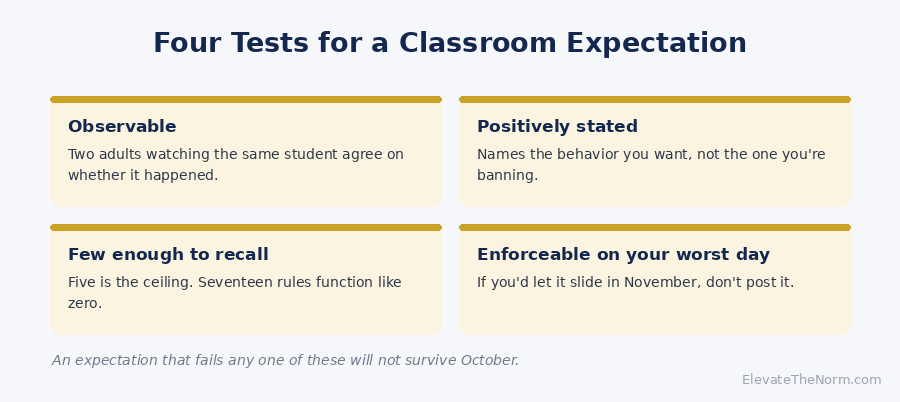
- Observable. Two adults watching the same student agree on whether it happened. The IRIS Center puts it as “observable and measurable,” and offers the useful contrast: “Follow directions” beats “Be respectful,” because one of those can be seen (IRIS Center, Vanderbilt University).
- Positively stated. Name the behavior you want, not the one you are banning. “Phones stay in the caddy until the work needs one” tells a student what to do. “No phones” only tells them what you will be annoyed about.
- Few enough to recall. No more than five. Seventeen rules function like zero, because nobody—including you—is holding seventeen standards consistently.
- Enforceable on your worst day. This is the test nobody writes down and everybody fails. If you would let it slide on a Friday in November when you are tired and behind, do not post it. Students learn which expectations are real by watching what you do when you are worn out.
Rewriting Vague Expectations Into Usable Examples
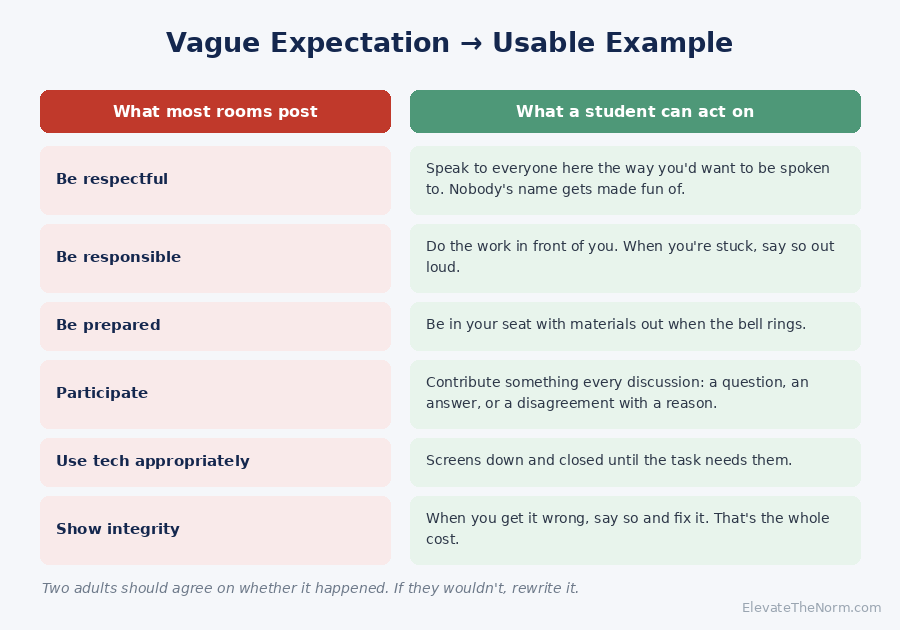
Most expectation sets are not wrong, they are just unfinished. The words on the wall are the category; the usable version is the behavior underneath it. Here is the same standard written both ways.
| The category most rooms post | The observable example a student can act on |
|---|---|
| Be respectful | Speak to everyone in this room the way you would want to be spoken to. Nobody’s name gets made fun of. |
| Be responsible | Do the work in front of you. When you are stuck, say so out loud—to me or to your table. |
| Be prepared | Be in your seat with your materials out when the bell rings. |
| Participate | Contribute something to every discussion: a question, an answer, or a disagreement with a reason attached. |
| Use technology appropriately | Screens are down and closed until the task needs them. When it does, I will say so. |
| Show integrity | When you get something wrong, say so and fix it. That is the whole cost. |
| Be on task | Between the bell and the last five minutes, you are working on this class’s work. |
| Cooperate | Your group can name what you contributed by the end of the period. |
This is not only a clarity problem. It is a fairness problem with data behind it. Research summarized by Brookings found that Black students in North Carolina were less likely to face exclusionary discipline when taught by Black teachers than by white teachers within the same school, and that the gap was strongest for office referrals categorized as “willful defiance”—the most subjectively defined infraction available (Brookings, summarizing Lindsay & Hart, 2017).
Read that as a design instruction. Every vague expectation you post is a place where a judgment call gets made, and judgment calls are where the disparities live. Writing “be in your seat when the bell rings” instead of “be respectful of class time” is not pedantry. It shrinks the space where bias operates.
Examples of Classroom Expectations by Type of Room
A set that works in a discussion-heavy history room will not work in a shop with power tools. Below are five worked examples, each capped at five expectations, each with the specific problem it is built to survive. Take the wording. Do not take the whole list—an expectation set only works if the person enforcing it believes it.
Middle school, grades 6–8
Sixth graders are still learning what school even is at this level. The wording has to be concrete without sounding like elementary school, because nothing loses a twelve-year-old faster than being talked to like a child.
| Expectation | What it is built to survive |
|---|---|
| Be in your seat with materials out when the bell rings. | The four-minute settling period that eats a week of instruction per semester. |
| One person talks at a time, and it is whoever has the floor. | Enthusiastic interrupting, which at this age is usually not defiance. |
| Nobody’s name gets made fun of. Ever. | The specific cruelty that middle schoolers are best at and adults most often miss. |
| When you are stuck, say so out loud before the period ends. | Students who have learned that silence hides not knowing. |
| When you get it wrong, say so and fix it. | The instinct to lie about small things because the cost feels enormous. |
High school, grades 9–12, discussion-heavy course
Older students will meet a higher bar if the bar is explained. This set assumes disagreement is the point of the class, not a disruption of it.
| Expectation | What it is built to survive |
|---|---|
| Be working within a minute of the bell. | The senior-year drift where arrival becomes negotiable. |
| Disagree with the idea, by name, with a reason. Never with the person. | Debate collapsing into personal shots—or into nobody saying anything. |
| Contribute something every discussion: a question, an answer, or a disagreement. | Four students carrying every conversation while twenty coast. |
| Screens down and closed until the task needs them. | The device that is technically for notes. |
| Meet the deadline, or renegotiate it before it passes. | The after-the-fact excuse, replaced with a before-the-fact conversation. |
Lab, shop, or any room with equipment
Safety expectations are the one category where “positively stated” bends. A hard prohibition tied to a real hazard should be stated as a prohibition, and it should be the shortest sentence on the wall.
| Expectation | What it is built to survive |
|---|---|
| Eye protection on before you touch anything, off when you leave the bench. | The five-second task nobody thought needed goggles. |
| Hands stay off equipment until you have been checked out on it. | Confidence outrunning training. |
| Report every spill, break, or injury immediately. Nothing bad happens to you for reporting. | The student who hides a small problem until it becomes a large one. |
| Clean and return everything before the last five minutes. | The bell as an exit from responsibility. |
| If you are unsure, stop and ask. Stopping is never the wrong call. | Guessing under time pressure. |
Performance class: PE, band, theater, athletics
These rooms run on effort in front of an audience, which makes them the easiest place for a student to protect themselves by not trying. The expectations have to make trying safe.
| Expectation | What it is built to survive |
|---|---|
| Dressed, present, and in your spot on time. | The slow leak of five minutes per class. |
| Attempt everything. You are graded on the attempt, not the outcome. | Opting out to avoid being seen failing. |
| Nobody laughs at somebody else’s attempt. That is the one that ends a class. | The single behavior that makes a performance room unsafe. |
| Take the correction, run it again. | Feedback treated as an insult. |
| If something hurts, say so immediately. | Playing through an injury to look tough. |
One-to-one device classroom
I have taught with no devices, with one cart shared between two classrooms, and with one-to-one. The one-to-one year needed the most explicit expectations, not the fewest, because the distraction is inside the tool students are required to use.
| Expectation | What it is built to survive |
|---|---|
| Lids at forty-five degrees when I am talking, open when you are working. | The ambiguity of “pay attention” in a room full of screens. |
| One tab for the task. If a second one is open, be able to say why. | Tab-switching as a reflex rather than a decision. |
| Charged and ready is part of being prepared. | The dead battery as a daily out. |
| If you use an AI tool, say where and what you changed. (Check your district’s policy first—yours may already answer this.) | Pretending the question does not exist. |
| Nothing about a person in this room gets typed, shared, or posted. | The fight that starts in a document and finishes in the hallway. |
Notice what is missing from all five sets: threats. Students deserve to know what happens after a miss, and that conversation is real—but it happens calmly, separately, and it always includes the way back. That is covered in classroom consequences that teach instead of humiliate. A list of expectations that reads like a list of warnings tells students you are expecting the worst from them, and teenagers are accommodating people.
How to Teach an Expectation Instead of Announcing It
A posted expectation is a claim. A taught expectation is a skill. The IRIS Center’s sequence for secondary classrooms has five steps: introduce it in student-friendly language, discuss why it exists, model it with examples and non-examples, practice it, and review it—especially at transitions and whenever it starts slipping (IRIS Center, Vanderbilt University).
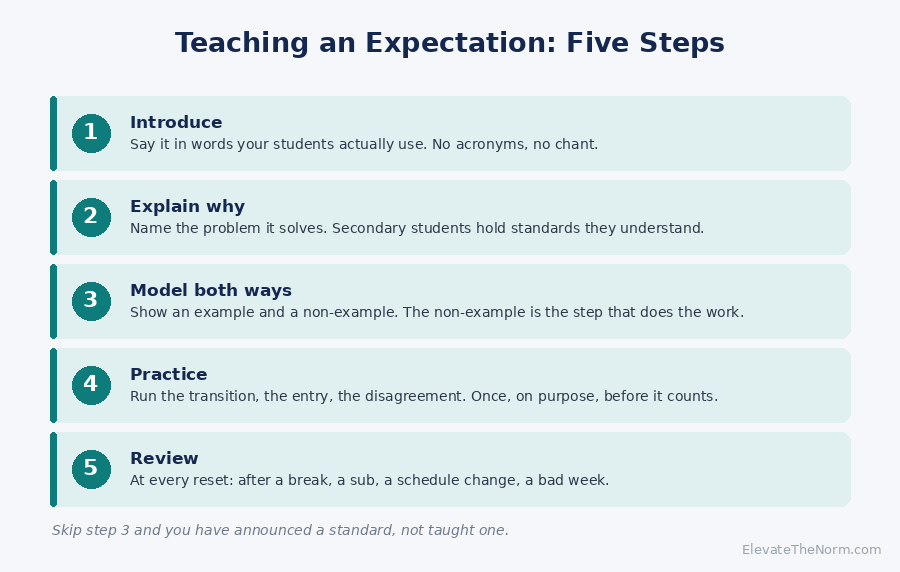
The step teachers skip is the non-example, and it is the one that does the work. Secondary students do not need “what respect looks like.” They need the eight-inch difference between a joke that lands and a joke that costs somebody something. Show both. Let them argue about where the line is. They will hold a line they helped draw.
The Australian Education Research Organisation makes the companion point: high expectations only function when the belief comes packaged with instruction. “I believe you can do it” has to be followed by “here is how” (AERO). An expectation announced without a method is a standard you have set and then declined to teach toward.
The Launch-Day Script
Here is roughly what I say on day one. It takes about six minutes and I do not read it off a slide.
“When you walk through that doorframe, you have 100% of my respect. You don’t earn it in here. You already have it. What you do with it is up to you, and it’s yours to lose—but it starts full.”
“Here’s what I need from you. Five things. That’s the whole list, and I’m not adding to it in October.”
[Read the five. One sentence each on why it exists.]
“Two of these I will hold on my worst day, and you should know which. You will not make fun of anybody’s name in here—not how it’s spelled, not how it sounds, not where it came from. And when you get something wrong, you’ll say so and fix it, and that’s the end of it. No speech from me, no bringing it back up in April.”
“Everything else on that list, I’ll remind you about. Those two I’ll hold.”
Then I stop talking. That pause is doing more than the speech was. The room decides in that silence whether I meant it, and filling the gap is how you tell them you did not.
Two things about that script are worth stealing regardless of your wording. First, respect starts at full rather than being earned—which changes what a correction means later, because you are restoring something rather than withholding it. More on that in respect in the classroom. Second, name which expectations are absolute and which are coachable. Pretending all five carry equal weight is a lie students catch by week three, and once one expectation turns out to be soft, they will test all of them. If you want posters written for teenagers instead of little kids, my free Classroom Norms Poster Set on TPT is ready to print.
What Follow-Through Actually Looks Like
The expectations are the easy part. Three practices decide whether they survive past September.
- Precorrect before the moment, not after it. Prompt the expectation right before the transition where it usually breaks—”Materials out, we’re moving to the lab in ninety seconds”—rather than correcting the eleven students who got it wrong. The OSEP classroom PBIS guide lists prompts before difficult routines as a core practice (Simonsen et al., 2015).
- Acknowledge the expectation being met, roughly five times for every correction. That same guide puts the target at about five praise statements per corrective one. In a secondary room this is not gold stars—it is naming the behavior quietly and moving on. “Whole table was working before the bell finished. Thanks.”
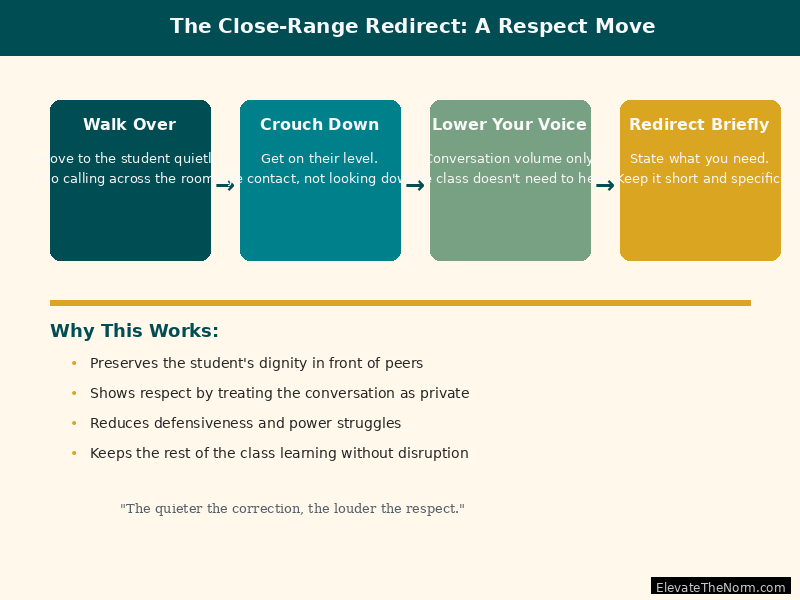
- Correct at close range, at conversation volume. A redirect delivered across the room is a performance, and the audience changes what the student has to do to save face. Walking over costs you four seconds and removes the audience entirely.
Consistency here is not a management preference. It is fairness. The expectation that flexes with your energy teaches students to read your mood instead of the standard, and the students who already trust school least pay the highest price for that unpredictability.
Three Things These Examples Cannot Decide for You
Any set you borrow has to survive contact with three things that are specific to your building.
- The schoolwide behavior matrix. If your building runs a schoolwide system with its own three or four expectations, yours have to sit underneath those, not compete with them. A student who hears one standard in the hallway and a different one in your room learns that standards are a matter of whose room they are in. Map each of your five to the schoolwide expectation it makes concrete—that alignment is the point, and it is usually a ten-minute exercise.
- Students with an IEP, a 504, or an individual behavior plan. A written plan takes precedence over a classroom list, and it is not an exception you are granting—it is a legal document you are following. Read the plans before you finalize the wording, because sometimes a small rewrite makes an expectation workable for a student instead of setting up a conflict every day. “Be in your seat when the bell rings” and “be in the room and settled within two minutes” hold the same standard; only one of them is reachable for some students.
- How families find out. Send the five home in the first week, in plain language, without a signature line. Families who know the standard can back it; families who first hear about it when something has gone wrong will reasonably assume it was invented on the spot. It costs one email and it removes most of the arguments you would otherwise have in October.
Where These Examples Go Wrong
- Copied wholesale. An expectation set in someone else’s words is one you will not enforce, because you do not believe it in your body. Rewrite every line until it sounds like you saying it out loud.
- Posted and never revisited. Laminated is not learned. Reteach at every natural reset: after a long break, after a bad week, after a schedule change.
- Written for the student you dread. A set designed around your hardest class reads as suspicion to the other four sections. Write for the room you want and handle the outlier individually.
- No route back. If missing an expectation only costs and never leads anywhere, students stop trying to recover once they have missed one. The way back has to be built in, not improvised. See learning from mistakes.
- Enforced for compliance instead of for the room. If a student cannot tell you who the expectation protects, it is a rule about your convenience. Some of those are legitimate. Just be honest about which ones they are.
Take the Wording, Not the List
Pick the set closest to your room. Cut it to five. Rewrite every line in your own words until you could say it to a class without looking at the page, and cross out anything you would let slide in November. What is left is your actual expectations set, and it will be shorter and more honest than what you started with.
Then teach it—introduce, explain, model both ways, practice, review—and hold it at close range and low volume for the first three weeks. That is the entire job. The example of classroom expectations you land on matters far less than whether the students watching you decide the standard is real. For what happens after a student misses one, keep reading in student responsibility.
How many classroom expectations should I have?
No more than five. The IRIS Center’s guidance for secondary classrooms is to limit the list to five or fewer, stated positively and in observable terms, so students can actually recall them. Seventeen rules function like zero, because neither you nor your students are holding seventeen standards consistently. If your list is longer, most of the items are procedures rather than expectations and belong in a routine you teach, not on the wall.
What is the difference between classroom rules and classroom expectations?
Expectations are broad goals for behavior; rules are explicit statements defining what those goals look like in a specific context. “Take care of this room and the people in it” is an expectation. “Return tools to the board before the last five minutes” is a rule that shows what it means in a shop. Most secondary classrooms need a small number of expectations and a slightly larger number of taught procedures.
Should students help write the classroom expectations?
Student input works best on wording and on the non-examples, not on whether a standard exists. Bring the five you need, then let the class argue about where each line actually falls and rewrite the phrasing together. Students hold a line they helped draw. What does not work is a blank-slate vote, which either produces the list you were going to write anyway or produces one you cannot enforce.
Why is “be respectful” considered a weak classroom expectation?
Because two adults watching the same student will not agree on whether it happened. That ambiguity is not only a clarity problem: research summarized by Brookings found racial disparities in office referrals were strongest for subjectively defined infractions like willful defiance. Every vague expectation is a place where a judgment call gets made, and judgment calls are where disparities concentrate. Replacing it with an observable behavior shrinks that space.
How do I teach expectations without sounding like an elementary teacher?
Explain the reasoning and use real non-examples. Secondary students do not need a chant or an acronym; they need to know what problem the expectation solves and where exactly the line falls. Show a case that clearly crosses it, a case that clearly does not, and one genuinely ambiguous case, then let them argue. Treating the line as debatable is what makes it land with teenagers.
When should I reteach classroom expectations during the year?
At every natural reset: after a long break, after a schedule change, after a substitute, after a bad week, and any time a specific expectation starts slipping. Reteaching is not punishment and should not be delivered as a lecture about disappointment. Two minutes naming the expectation, why it exists, and what it looks like today is enough.
What if a student refuses to follow an expectation?
Handle it at close range and at conversation volume rather than across the room, which removes the audience the student would otherwise have to perform for. Address the behavior, name the expectation, and give a path back in the same breath. Follow your school’s policy for anything involving safety or repeated refusal, and keep the what-happens-next conversation separate, calm, and always inclusive of the route to repair.
Sources
- IRIS Center. Classroom Behavior Management (Part 2, Secondary): Rules. Peabody College, Vanderbilt University.
- Simonsen, B., Freeman, J., Goodman, S., Mitchell, B., Swain-Bradway, J., Flannery, B., Sugai, G., George, H., & Putnam, B. (2015). Supporting and Responding to Behavior: Evidence-Based Classroom Strategies for Teachers. Office of Special Education Programs, U.S. Department of Education.
- Australian Education Research Organisation. High Expectations for Student Behaviour: Their Role in Classroom Management.
- Brookings Institution. Disproportionality in Student Discipline: Connecting Policy to Research, summarizing Lindsay, C. A., & Hart, C. M. D. (2017).
- IRIS Center. Establishing Classroom Norms and Expectations. Peabody College, Vanderbilt University.
About Clay Shumate
Clay Shumate is a certified secondary Social Studies teacher in the public schools of West Alabama, with seven years of classroom experience, a B.A. in History, and an M.Ed. in Secondary Education. He writes about project-based learning, student responsibility, respect, and practical ways to hold young people to a higher standard while giving them room to learn from mistakes. He is a member of the Society of Professional Journalists and writes to its Code of Ethics; this site’s editorial standards and corrections policy are published in full. More about Clay.