Positive Discipline for Teens: Firm Standards Without Shame or Power Struggles
By Clay Shumate
Positive discipline for teens is an approach to behavior guidance that holds firm, clear standards while treating the student as a developing person rather than a problem to control. It replaces shame, yelling, and power struggles with consistency, dignity, and real accountability — without sliding into permissiveness. The goal is not obedience. The goal is a young person who understands what is expected, why it matters, and what to do when they fall short.
Key Takeaways
- Positive discipline is not soft discipline. It holds high standards and enforces real consequences — it just does so without humiliation.
- The approach is rooted in Adlerian psychology and built around belonging, significance, and the connection between how students feel and how they behave.
- Firm and kind are not opposites. The most effective classroom management research supports doing both at the same time, every time.
- Public correction escalates conflict with adolescents. Private, close-range redirection keeps the standard intact without handing the student an audience.
- Positive discipline teaches long-term skills — problem-solving, self-regulation, repair — rather than training short-term compliance.
What Positive Discipline Actually Means
The phrase “positive discipline” gets used loosely enough that it needs defining before it can be useful. In its most specific form, it refers to a program developed by educator and psychologist Jane Nelsen in the 1980s, built on the earlier psychological work of Alfred Adler and Rudolf Dreikurs. Adler’s core idea was that human behavior is driven by the need to belong and to feel significant. Dreikurs extended that into parenting and schools, arguing that misbehavior is a discouraged child’s mistaken attempt to find belonging. Nelsen turned those ideas into a practical framework with books, training, and classroom tools (Positive Discipline Association).
More broadly, “positive discipline” describes any approach to behavior that holds clear limits while respecting the student’s dignity. That is the version this article is about — not one branded program, but the principle underneath all of them: you can be firm and kind at the same time, every time, without either one canceling the other out.
That distinction matters because some teachers hear “positive discipline” and assume it means letting things slide, going easy, or replacing consequences with conversations. It does not. The firmness is not optional. What changes is the method — not the standard.
Why Adolescents Respond Differently Than Younger Students
Positive discipline was originally developed for families with young children. Translating it into a high school hallway requires understanding what makes teenagers different — not harder, but different.
Adolescents are wired to care about status, autonomy, and peer perception. Yeager, Dahl, and Dweck’s synthesis of adolescent motivational development found that teenagers are strongly driven by concerns about status and respect, and that interventions built on compliance or on distant future consequences tend to fail with them precisely because those approaches ignore what actually motivates adolescent behavior. A correction delivered across a room is not received as information about a behavior. It is received as a public statement about position — and a fifteen-year-old will often defend that position at the cost of everything else.
This is not defiance for its own sake. It is predictable developmental behavior, and the adult who understands it can work with it instead of against it.
Darling and Steinberg’s research on parenting styles — which has been replicated extensively in school settings — consistently shows that the authoritative style (high warmth, high expectations) produces the strongest outcomes across behavior, academic achievement, and social competence. Authoritarian approaches (high control, low warmth) produce compliance in the short term but undermine the student’s capacity to self-regulate. Permissive approaches produce neither (Darling & Steinberg, 1993).
Positive discipline for teens, done right, lives in the authoritative quadrant: clear expectations, consistent follow-through, genuine relationship, and the student’s dignity intact at every step.
The Five Principles in a Secondary Classroom
Nelsen’s Positive Discipline framework identifies five criteria for effective discipline. Here is what each one looks like when applied to teenagers in a school building rather than children at a kitchen table.
1. Build a Sense of Belonging and Significance
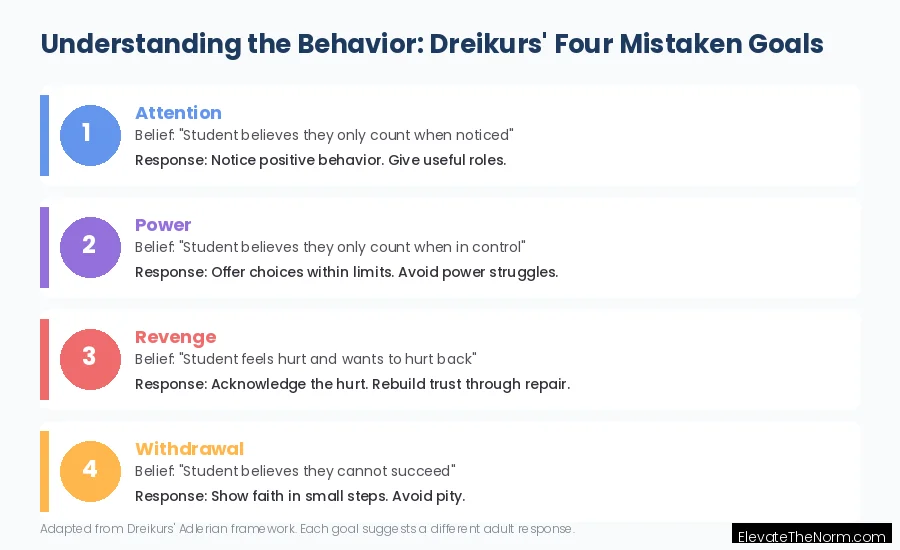
Adolescents need to feel that they matter — not abstractly, but concretely, in this room, with this group, under this adult. When that sense of belonging is missing, the behavior you see is the student’s attempt to find it another way. Dreikurs called those attempts “mistaken goals”: attention, power, revenge, or withdrawal. Each one is a discouraged student trying to answer the question Do I count here?
In a classroom, belonging is built through small, consistent actions: using names, acknowledging presence, assigning real roles, following through on what you said you would do. It is not built through inspirational posters or one-time activities.
2. Be Kind and Firm at the Same Time
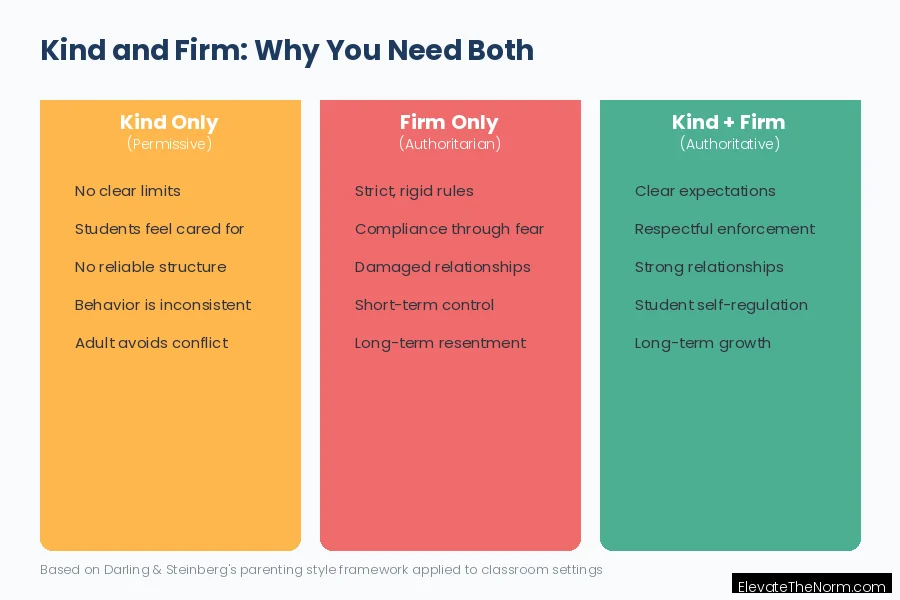
This is where most teachers get stuck. Kindness without firmness is permissiveness — the student feels cared for but has no structure. Firmness without kindness is authoritarianism — the structure exists but the student feels controlled, not guided.
In practice, kind and firm looks like walking over to a student who is off task, crouching or sitting to eye level, and saying quietly, “I need you back on this. What do you need to get started?” The expectation is restated. The student’s agency is included. The audience is removed. Nothing about the standard changed — only the delivery.
I spend most of my class periods on a wheeled stool, circulating between table groups. When I need to redirect someone, I am already close. The correction happens at conversation volume, between the two of us, not from across the room where it becomes a performance. The student hears the expectation. The rest of the class keeps working. Nobody has to choose between compliance and saving face.
3. Focus on Long-Term Skills, Not Immediate Obedience
Traditional discipline asks: How do I make this stop? Positive discipline asks: What do I want this student to be able to do next time?
The difference changes everything about how you respond. If the goal is stopping the behavior, the fastest tool is force — raise your voice, threaten a consequence, remove the student. If the goal is teaching the student to manage themselves the next time, you need a different set of moves: a conversation about what happened and why, a problem-solving process, a plan the student helps build, and a follow-up to see whether it worked.
This is slower. It is also the only approach that actually produces a student who can function without you standing over them — which is, after all, the point of school.
4. Look for What the Behavior Is Telling You
Dreikurs’ contribution to education was the insight that a student’s misbehavior is a message, not a character flaw. A student who constantly seeks attention may believe she only counts when she is noticed. A student who challenges every direction may believe he only matters when he is in control. A student who has shut down entirely may believe she cannot succeed and has stopped trying.
None of these beliefs justify the behavior. All of them change how you respond effectively. Punishing the attention-seeking student with isolation confirms her belief that she does not belong. Engaging in a power struggle with the defiant student confirms his belief that control is the only currency that matters. Ignoring the withdrawn student confirms her belief that nobody notices.
This is not therapy. You are not diagnosing anyone. You are asking a practical question — what would have to change for this student to stop needing this behavior? — and then adjusting the environment, the relationship, or the task accordingly.
5. Use Encouragement Over Praise
Praise rewards a result. Encouragement notices effort, progress, and process. The difference sounds minor until you watch what happens over time. A student who is praised only for outcomes learns to perform for approval and to hide struggle. A student who is encouraged through the process learns that effort is valued and that difficulty is not a sign of failure.
“Great job” after a test tells a student almost nothing. “You stuck with that Reconstruction analysis even when the sources contradicted each other — that is exactly what historians do” tells a student what they did well, why it mattered, and what the skill looks like.
With teenagers, this distinction is especially important. Adolescents are acutely sensitive to insincerity. Vague, inflated praise — “You’re so smart!” — is often read as empty, and research suggests it can actually backfire with students who are struggling, making them less willing to take risks (Mueller & Dweck, 1998). That study involved fifth graders, not teenagers, and direct non-replications exist, including Glerum et al. (2020) in an adolescent sample. The principle — that process-focused feedback tends to serve students better than person-focused praise — holds across a broader evidence base, but the specific claim should be held lightly.
What Positive Discipline for Teens Is Not
Clarity about what this approach excludes is as important as clarity about what it includes.
It is not the absence of consequences. Positive discipline uses consequences — natural consequences when safe, logical consequences when not. A student who does not complete the lab report does not earn the lab credit. A student who damages shared equipment contributes to the repair or replacement. What positive discipline does not use is punishment designed to hurt, humiliate, or coerce rather than teach.
It is not negotiating with students about whether rules apply to them. The expectations are not up for debate. What positive discipline does allow is involving students in defining how expectations look in practice, and it allows conversation about why a rule exists — because a student who understands the reason is more likely to follow it when no one is watching.
It is not ignoring serious behavior. Safety violations, bullying, threats, and repeated defiance still require immediate action, which may include removal from the room. Positive discipline governs how you handle the conversation before, during, and after that action — not whether the action is taken. A student who threatens another student leaves the room. What happens in the conversation that follows is where positive discipline lives.
It is not a replacement for school discipline policies. Teachers work within systems. Positive discipline informs how you use your professional judgment within those systems — it does not override required reporting, mandated procedures, or administrative decisions.
Positive Discipline Strategies That Work With Teenagers
The following strategies translate the principles above into daily classroom practice. None of them requires a program, a purchase, or an overhaul. They require consistency.
Close-Range, Private Redirection
Move to the student. Lower your volume. Restate the expectation. Ask what they need. Move on. This is the single most effective change a secondary teacher can make, because it removes the audience that makes compliance feel like surrender. Simonsen and colleagues’ review of evidence-based classroom management practices emphasizes responding to inappropriate behavior along a planned, consistent continuum — and proximity is the lowest-cost, lowest-disruption step on that continuum (Simonsen et al., 2008).
Curiosity-Based Questions Instead of Lectures
Nelsen’s framework replaces telling with asking. Instead of “You need to stop talking,” try “What are you working on right now?” Instead of “You know better than that,” try “What happened, and what’s your plan to fix it?”
The questions are genuine, not rhetorical. Rhetorical questions — “Do you think that’s appropriate?” — are sarcasm with a question mark, and teenagers see through them instantly. A genuine question invites the student to think, which is what you actually want them to do.
Natural and Logical Consequences
Natural consequences happen on their own: a student who does not study earns the grade that reflects their preparation. Logical consequences are designed by the adult but connected directly to the behavior: a student who misuses a shared resource loses access to that resource until they demonstrate readiness to use it appropriately.
What separates a logical consequence from a punishment is the connection. Detention for talking is a punishment — the consequence has nothing to do with the behavior. Losing independent work time and moving to a supervised station for the rest of the period is a logical consequence — it is connected, respectful, and teaches something about the expectation that was not met. For a deeper treatment, see Natural Consequences in the Classroom.
Repair Conversations After Conflict
Positive discipline treats mistakes — the adult’s included — as opportunities to rebuild rather than reasons to punish. After a conflict, a repair conversation asks three questions: What happened? What needs to be made right? What will you do differently?
The repair is not about making the student feel guilty. It is about restoring the relationship and the classroom agreement. When the adult was part of the problem — and sometimes the adult was — the adult repairs too, openly. That modeling is one of the most powerful things positive discipline offers, because it shows students that accountability is a human practice, not something adults impose on children from above. The opening move in that conversation is usually naming the impact in a single sentence, which is cheap enough to use on an ordinary Tuesday.
Class Meetings and Problem-Solving Circles
Nelsen’s framework includes regular class meetings where students and the teacher collaboratively discuss problems, generate solutions, and make group agreements. In a secondary classroom, this can look like a five-minute check-in at the start of a week: “What’s working? What’s not? What should we try?” The teacher retains authority over non-negotiable expectations, but the students have genuine input on how the room runs — and genuine investment in the result.
This works especially well with teenagers because it treats them as people with opinions worth hearing. That is the entire point.


The Evidence for This Approach
The evidence base for positive discipline as a specific branded program in secondary settings is still developing. A 2024 meta-analysis published in Early Child Development and Care examined the overall effectiveness of Positive Discipline programs and found meaningful positive effects, though the analysis noted that moderating variables — including age, setting, and implementation quality — matter significantly (Gonzalez et al., 2024).
The broader evidence for the underlying principles is stronger and longer-established. Simonsen et al.’s review of evidence-based classroom management practices — published in the Journal of Positive Behavior Interventions — found that the most effective approaches share common features: clear expectations, active supervision, consistent responses along a planned continuum, and positive reinforcement of prosocial behavior. These overlap almost entirely with positive discipline’s core principles.
RAND Corporation’s evaluation of the Pittsburgh Public Schools’ Positive Discipline program — a districtwide implementation across 44 schools — found a 36 percent reduction in suspensions during the implementation period. The study noted that reductions were strongest in schools with the highest implementation fidelity, which is consistent with what every classroom teacher already knows: the approach only works if you actually do it, every day, with every student (RAND Corporation).
An ERIC literature review on school discipline documented the costs of the alternative: students who are suspended are up to ten times more likely to drop out of high school, and over eleven million days of instruction were lost to out-of-school suspensions in 2017–18 alone (ERIC, 2022). The question is not whether exclusionary discipline causes harm. The question is whether the alternative works — and the evidence says it does, when implemented with fidelity.
Common Objections — and What the Evidence Actually Says
“This won’t work with my students.”
This objection usually means one of two things: either the school context is genuinely difficult, or the speaker assumes that certain students need control rather than relationship. The first concern is legitimate and worth addressing. The second is a bias that the evidence does not support.
Bloem et al. (2024), published in Social Psychology of Education, found that teachers reported giving lower-socioeconomic-status students less autonomy support and more controlling behavior — and that teachers with more biased attitudes toward low-SES backgrounds differentiated the most. The students who most needed respectful, structured guidance were the ones least likely to receive it. Positive discipline is not more necessary in high-poverty schools. It is necessary everywhere. But the gap between what students need and what they get tends to widen as resources narrow.
“Students need real consequences, not conversations.”
They need both. Positive discipline does not replace consequences. It changes how consequences are delivered and what they are designed to accomplish. A consequence without a conversation teaches a student that something is not allowed. A consequence with a conversation teaches a student why it matters, what they could do instead, and how to repair what went wrong. The second student is more likely to change their behavior because they understand it, not because they fear the adult.
“I don’t have time for this.”
You do not have time for the alternative. A single escalated power struggle can consume fifteen minutes of class time and two days of relational damage. A thirty-second private redirect at the table takes less time and produces a better outcome. Positive discipline is not an add-on. It is what effective classroom management has always looked like — it just has a name now.
Getting Started Without an Overhaul
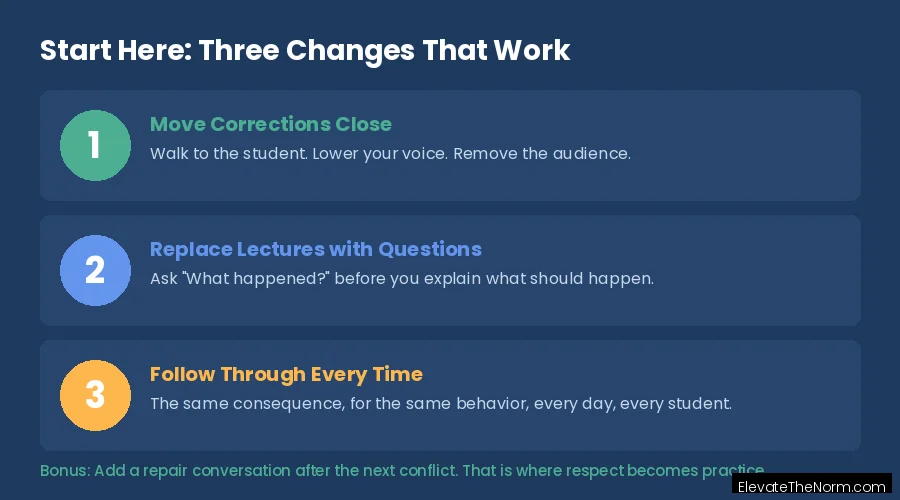
You do not need to adopt a program, attend a training, or announce to your students that you are doing something new. Start with three changes and build from there.
First, move your corrections to close range. Stop calling students out from across the room. Walk over. Sit down or crouch. Say what you need at a volume meant for one person, not thirty. This single change will reduce escalation more than any other technique in this article.
Second, replace one lecture with one question. The next time you catch yourself about to deliver a monologue about a student’s choices, stop and ask instead: “What happened?” Then listen. The student may give you information that changes your response entirely — and even if they do not, the act of asking communicates that you see them as a person with a perspective, not a problem to be managed.
Third, follow through every time. Consistency is the non-negotiable. A consequence that happens on Tuesday but not on Friday teaches students that the rule depends on the adult’s mood, not on the expectation itself. Decide what you will actually do — not what sounds strong in August — and then do it, every time, for every student. The consequence does not need to be dramatic. It needs to be certain.
If those three changes work — and they will — add a fourth: a repair conversation after the next conflict you have with a student. Not instead of the consequence. After it. “Here’s what happened. Here’s what needs to be different. What do you need from me?” That conversation is where respect in the classroom stops being a slogan and starts being a practice.
Conclusion
Positive discipline for teens is not a softening of standards. It is a refusal to confuse control with teaching. You hold the expectation. You enforce the consequence. You do both without humiliating anyone — because humiliation does not teach. It damages, and a damaged relationship is the one tool you cannot afford to lose with a teenager.
Start small. Move your body closer before you raise your voice. Ask a question before you deliver a verdict. Follow through with the same consequence for the same behavior, every time, for every student. And when you get it wrong — because you will — say so, repair it, and move on. That is positive discipline. It is also just teaching responsibility by living it.
Printables for this
Two of mine on TPT, both built for this. 5 De-escalation Scripts You Can Use Today is free and gives you the exact close-range wording for the moment a redirect could turn into a power struggle. Behavior Reflection Sheets are the written version of the repair conversation — what happened, who it affected, what happens next — at two levels so the sheet matches the incident.
Frequently Asked Questions
What is the difference between positive discipline and permissive parenting or teaching?
Positive discipline holds firm expectations and enforces real consequences. Permissiveness avoids conflict by removing expectations. The difference is visible: a positive-discipline classroom has clear rules, consistent follow-through, and students who know exactly what is expected. A permissive classroom has vague hopes and no reliable structure. Positive discipline is firm and kind simultaneously — it does not sacrifice one for the other.
Does positive discipline for teens work in schools with serious behavior challenges?
The evidence says yes, when implemented consistently. RAND’s evaluation of Pittsburgh’s Positive Discipline program across 44 schools — including schools with significant behavioral challenges — found a 36 percent reduction in suspensions. The critical variable was implementation fidelity: schools that applied the approach consistently saw the strongest results. The approach does not eliminate every problem, but it reduces escalation and keeps more students in class.
How is positive discipline different from restorative practices?
Positive discipline and restorative practices overlap significantly but are not identical. Positive discipline is a broader behavioral framework emphasizing belonging, kind-and-firm responses, and long-term skill development. Restorative practices are a specific set of tools — circles, conferences, repair agreements — focused on repairing harm after it occurs. Many educators use both. The repair conversation in positive discipline serves a similar function to restorative conferencing, but positive discipline also governs prevention, classroom structure, and daily teacher-student interaction.
What are natural and logical consequences in positive discipline?
Natural consequences happen without adult intervention: a student who does not prepare for the presentation gives a weaker presentation. Logical consequences are designed by the teacher but connected directly to the behavior: a student who misuses a device loses device access until demonstrating readiness. Both differ from punishments, which are disconnected from the behavior and designed to cause discomfort. Detention for talking is a punishment. Supervised work time after misusing independent time is a logical consequence. The connection to the behavior is what makes it a teaching tool rather than a penalty.
Can I use positive discipline without my school adopting it as a program?
Yes. Positive discipline is a set of principles, not a schoolwide initiative. An individual teacher can apply every principle in this article within their own classroom without administrative approval, additional budget, or program adoption. Close-range redirection, curiosity-based questions, natural and logical consequences, encouragement over inflated praise, and repair conversations are all within any teacher’s professional discretion.
Is positive discipline evidence-based?
The specific branded Positive Discipline program has a growing evidence base, including a 2024 meta-analysis examining its effectiveness across settings. The broader principles — authoritative style, consistent expectations, positive reinforcement, close-range correction, and belonging — are supported by decades of research in classroom management, developmental psychology, and school discipline outcomes. Simonsen et al.’s review of evidence-based classroom management practices identifies features that align directly with positive discipline’s core framework.
How do I handle defiance with positive discipline?
First, avoid escalating in front of an audience. Move close, speak quietly, and restate the expectation once. If the student refuses, give them a brief window: “I’ll come back in two minutes.” Step away. Most defiance dissolves when the audience disappears. If it does not, follow your planned consequence calmly and without negotiation. After the situation is resolved, hold a repair conversation privately. Defiance is usually a signal about status or discouragement, not about the rule itself — and the repair conversation is where you learn which one.
Sources
- About Positive Discipline, Positive Discipline Association (Jane Nelsen).
- Evidence-Based Practices in Classroom Management: Considerations for Research to Practice, Simonsen et al., Education and Treatment of Children, 2008.
- A Comprehensive Three-Level Meta-Analysis of the Positive Discipline Programme, Gonzalez et al., Early Child Development and Care, 2024.
- Evaluation of the Pittsburgh Public Schools’ Positive Discipline Initiative, RAND Corporation.
- Parenting Style as Context: An Integrative Model, Darling & Steinberg, Psychological Bulletin, 1993.
- School Discipline Literature Review, ERIC, 2022.
- Praise for Intelligence Can Undermine Children’s Motivation and Performance, Mueller & Dweck, Journal of Personality and Social Psychology, 1998. Note: Study participants were fifth graders; direct non-replications exist in adolescent samples.
About Clay Shumate
Clay Shumate is a certified secondary Social Studies teacher in the public schools of West Alabama, with seven years of classroom experience, a B.A. in History, and an M.Ed. in Secondary Education. He writes about project-based learning, student responsibility, respect, and practical ways to hold young people to a higher standard while giving them room to learn from mistakes. He is a member of the Society of Professional Journalists and writes to its Code of Ethics; this site’s editorial standards and corrections policy are published in full. More about Clay.