By Clay Shumate
Every teacher has had the moment. A paragraph comes in that’s a little too polished, a little too confident, and a little too empty. You know where it came from.
Banning AI won’t fix that. It just moves the use out of sight. A better approach is to teach students to use AI the way we teach them to use any source: with a healthy dose of suspicion.
Treat AI Like a Source, Not an Answer Key
AI is fast and sounds sure of itself, and it is wrong more often than students expect. It can mix up two historical figures or invent a source that doesn’t exist, all in the same calm tone. That’s useful for teaching. The first time a student catches the AI in a mistake, they stop treating it like an oracle and start treating it like a classmate who sometimes bluffs.
A Simple Five-Step Routine
This works in any subject:
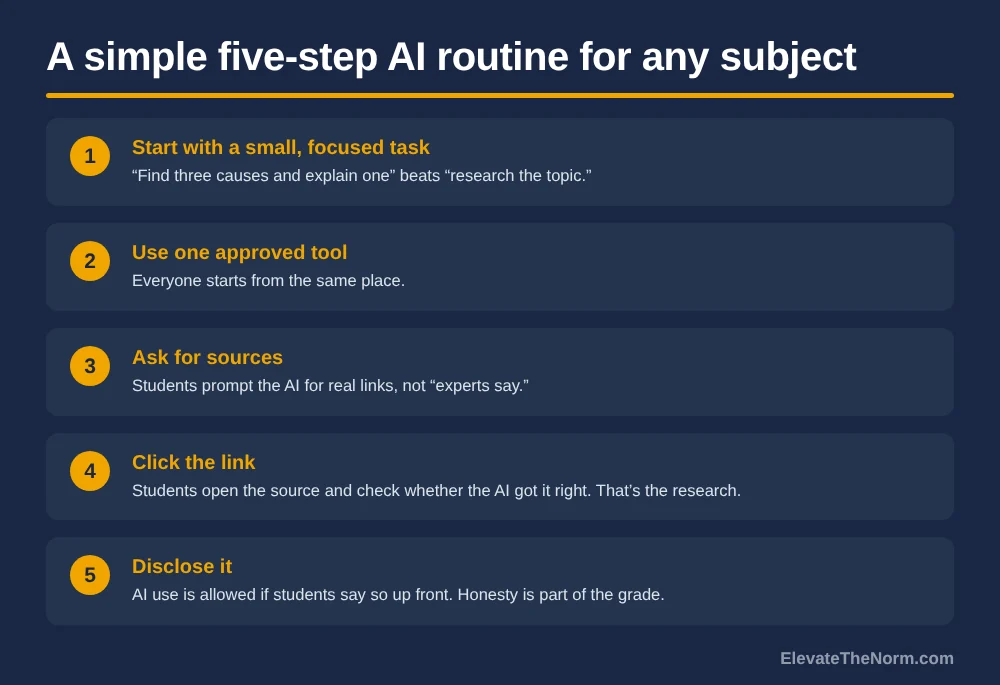
- Start with a small, focused task. “Find three causes and explain one” beats “research the topic.”
- Use one approved tool. Everyone starts from the same place.
- Ask for sources. Students prompt the AI for real links, not “experts say.”
- Click the link. Students open the source and check whether the AI got it right. That’s the research.
- Disclose it. AI use is allowed if students say so up front. Honesty is part of the grade.
Once the use is out in the open and verification is required, there’s not much left to cheat with.
Three Questions That Build Thinking Skills
Teach students to ask the AI these:
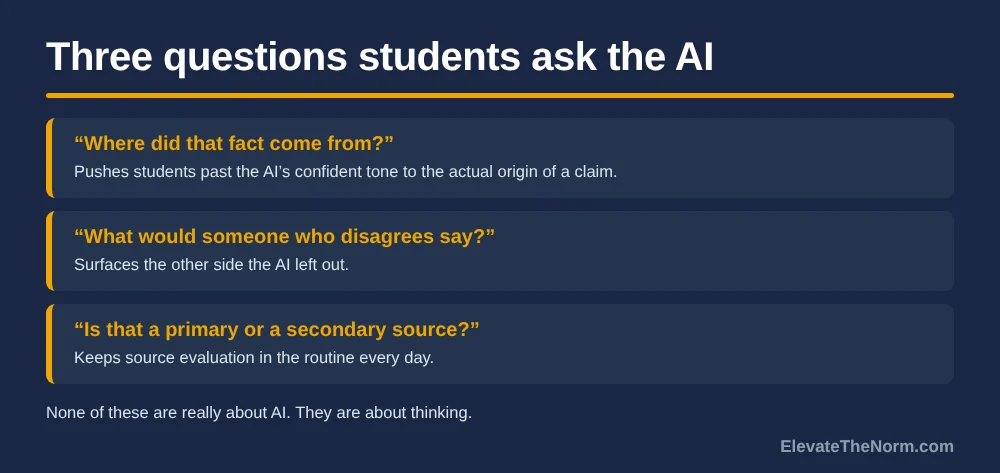
- “Where did that fact come from?”
- “What would someone who disagrees say?”
- “Is that a primary or a secondary source?”
None of these are really about AI. They’re about thinking, and AI gives you a reason to practice them daily.
Use AI for Format, Not Facts
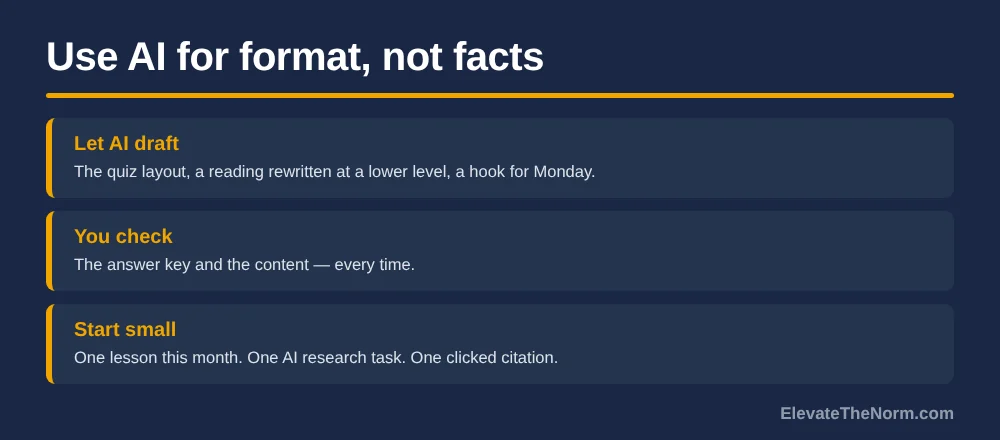
Teachers are stretched thin, and AI can give some time back if you’re careful. Let it draft the quiz layout, rewrite a reading at a lower level, or brainstorm a hook for Monday. You check the answer key and the content.
And before you prompt your way through another worksheet at 10 p.m., check whether the work is already done. Bell ringers, rubrics, exit tickets, and project packets are waiting in our free teacher resources.
Start Small
Pick one lesson this month. Add one AI research task. Require one clicked citation. See what your students find. Students who learn to question, verify, and cite will be fine however the tools change.
Treating AI output as a source to check rather than an answer to copy is a source-evaluation skill, and it can be taught directly. High school students who got six lessons in checking who published something doubled their score on the task. What the research says about teaching students to judge what they read online includes that trial, the ceiling it ran into, and how to measure it without relying on what students say about themselves.

