By Clay Shumate
A Socratic seminar rubric should score four things: preparation, use of the text, how a student treats other people’s ideas, and what they wrote afterward. It should not score how many times somebody spoke. The full rubric is below, free, on this page, with no email to give — and a printable version at the bottom if you want one.
It comes with an argument, because a rubric that counts talking turns is worse than no rubric at all — and because the research on rubrics is more qualified than the phrase “research-based rubric” suggests.
Key Takeaways
- Four criteria, four levels, and none of them is participation frequency. Counting comments rewards volume and punishes the students who most need the practice.
- Most of the score comes from writing, not talking. Preparation before and reflection after are visible, gradeable, and fair to a student who spoke twice.
- Analytic beats holistic on reliability. A review of 75 studies found scoring agreement improves with analytic, topic-specific rubrics plus exemplars or rater training.
- Rubrics are not automatically valid. The same review is explicit that a rubric improves agreement between scorers without guaranteeing you are measuring the right thing.
- You cannot facilitate and score thirty students at once. Anyone who says otherwise is describing a checklist, not an assessment.
Free Download · PDF
Socratic Seminar Rubric (Four Criteria)
The same four-criterion rubric printed above, laid out to print and cut, plus the scoring rotation for thirty students and a student self-score half-sheet.
Free. No email address required. Designed for grades 6–12. Browse every printable in Your Free Library.
What Should a Socratic Seminar Rubric Measure?
The things a student controls, that leave evidence, and that you would still care about if the student were quiet. That test eliminates most of what standard seminar rubrics score.
Four criteria survive it.
- Preparation. Did they read it, mark it, and bring a written question? This is visible before anyone speaks and it is the single best predictor of whether the seminar works.
- Use of the text. When they did speak or write, did they point at a specific place in the text, or at a general impression?
- Treatment of other people’s ideas. Did they build on, question, or directly respond to a classmate — or deliver a prepared statement into the middle of the circle and stop?
- Reflection afterward. Can they name what changed in their thinking and whose comment did it? This one is only answerable by a student who was listening, which is why it is the hardest to fake.
If your gradebook is standards-based, those four map cleanly onto speaking-and-listening standards without inventing a category: preparation and use of the text are evidence standards, treatment of others’ ideas is a collaborative-discussion standard, and the reflection is usually assessable under both. You do not need a “participation” line item, and if the gradebook has one, these are what should feed it.
One caution on the third criterion, and it is the one I would want a department to talk through before adopting any seminar rubric. Norms about interrupting, turn length, directness and how openly you disagree are not universal — they vary by family, by community, and by what a student has been taught is respectful. A rubric that scores “treatment of others’ ideas” can quietly encode one conversational style as the correct one. Keep the descriptors pointed at what the student did with the idea — responded to it, questioned it, built on it — and away from manner, volume and poise. If a descriptor could be satisfied by a confident student who said nothing of substance, it is scoring style.
Three of those four produce writing. That is deliberate. A rubric whose evidence is mostly written is a rubric you can actually apply after the period ends, and it is a rubric a student who said very little can still score well on.
The Socratic Seminar Rubric
Four criteria, four levels, no participation count. Copy it, cut it, change the language to match your school’s scale. It is free, it is printed in full right here, and there is a printable version at the bottom of this page.
One framing worth saying to students before you hand it over: the level-one column describes something that happened on one day, not a kind of person. A student who arrived without the text marked is a student who arrived without the text marked. If a descriptor reads to a fourteen-year-old like a verdict on their character, rewrite it — that costs nothing and it changes whether they look at the rubric again.
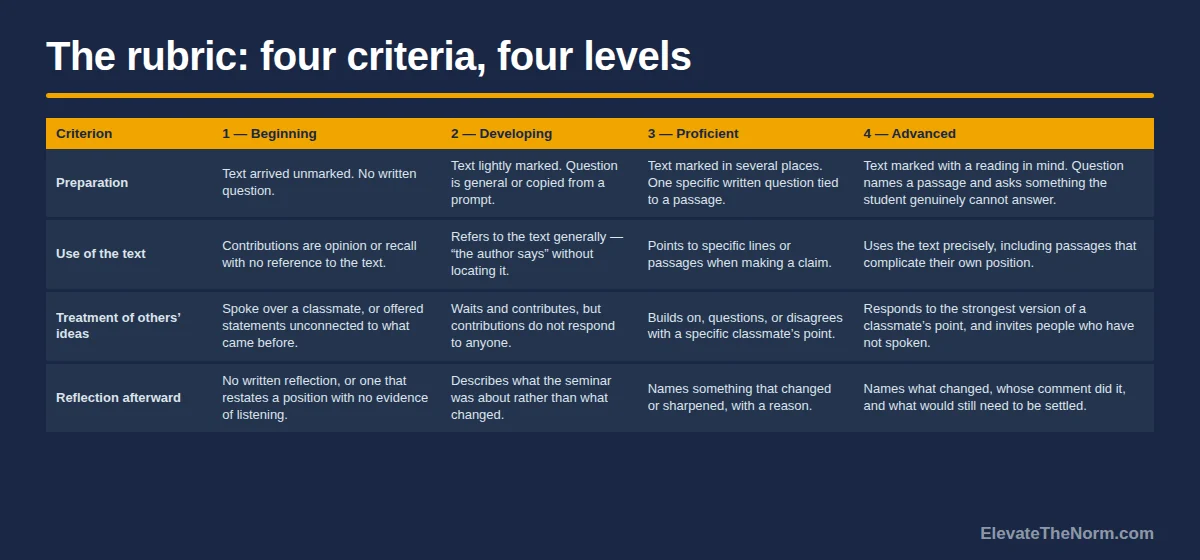
| Criterion | 1 — Beginning | 2 — Developing | 3 — Proficient | 4 — Advanced |
|---|---|---|---|---|
| Preparation | Text arrived unmarked. No written question. | Text lightly marked. Question is general or copied from a prompt. | Text marked in several places. One specific written question tied to a passage. | Text marked with a reading in mind. Question names a passage and asks something the student genuinely cannot answer. |
| Use of the text | Contributions are opinion or recall with no reference to the text. | Refers to the text generally — “the author says” without locating it. | Points to specific lines or passages when making a claim. | Uses the text precisely, including passages that complicate their own position. |
| Treatment of others’ ideas | Spoke over a classmate, or offered statements unconnected to what came before. | Waits and contributes, but contributions do not respond to anyone. | Builds on, questions, or disagrees with a specific classmate’s point. | Responds to the strongest version of a classmate’s point, and invites people who have not spoken. |
| Reflection afterward | No written reflection, or one that restates a position with no evidence of listening. | Describes what the seminar was about rather than what changed. | Names something that changed or sharpened, with a reason. | Names what changed, whose comment did it, and what would still need to be settled. |
Why This Rubric Does Not Count How Often You Spoke
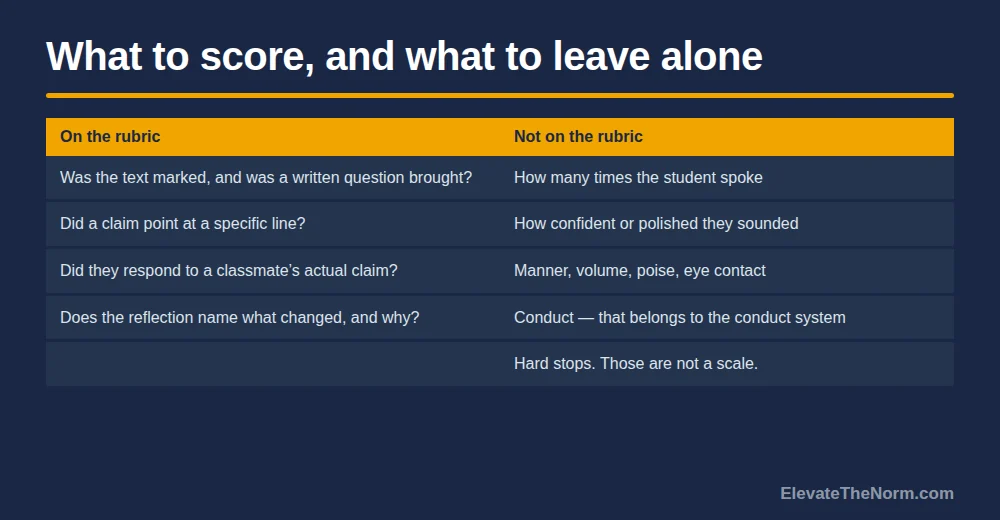
Because a participation count measures confidence and rewards it, and confidence is not the skill you are teaching. The moment students know comments are scored, you get performances of the right length at the right frequency, and the conversation stops being about the text.
There is a second reason, and it is about who pays. A qualitative study of quiet students — ten undergraduates, so treat it as a description rather than a finding about your seventh period — found that nine of the ten struggled with instructor expectations for verbal participation, and six reported physical reactions when speaking aloud: trembling, blushing, stuttering. One described planning out what they wanted to say before speaking. A frequency count charges those students a fee the loud ones never pay, for a behavior that is not the learning objective.
Related, and worth checking against your district’s grading policy: criterion three has to stay academic. “Responded to a classmate’s specific claim” is an academic behavior. “Was respectful” is conduct, and in a lot of districts conduct is not permitted inside an academic grade — for good reason. If a student’s behavior in a seminar is a problem, that is the conduct system’s job, handled the way you would handle it on any other day, and not something you fold into a score for a speaking standard.
This also gives you a clean answer when a parent asks. A quiet student can earn full marks here, because three of the four criteria are about preparation, precision and listening, and none of them requires their child to perform in front of the class. Say that in the same sentence you send the rubric home, before anyone has to ask.
If your school requires a participation grade, pull it from criteria one and four — both of which are written, both of which are about preparation and listening, and neither of which requires a student to perform. Then say out loud to the class that talking is not scored. The first seminar after they believe you is a different conversation.
One thing that belongs nowhere on a rubric: the behaviors that are not a continuum. In my room, making fun of how unusual somebody’s name is is a hard stop — not a criterion where a student can earn a 2. A rubric is for things that improve by degrees. Hard stops are a different category, and putting them on a scoring scale quietly suggests there is an acceptable amount.
Do Rubrics Actually Help?
They reliably help scoring agreement. Their effect on learning is real, mixed, and badly confounded — and the honest version is more useful than the sales version.
Jonsson and Svingby reviewed 75 empirical studies on rubrics. Their finding on reliability is clear: scoring “can be enhanced by the use of rubrics, especially if they are analytic, topic-specific, and complemented with exemplars and/or rater training.” Their finding on validity is the one people skip — rubrics do not by themselves make an assessment judgement valid. Two teachers agreeing on a score is not the same as the score measuring the thing you care about.
Panadero and Jonsson then reviewed 21 studies on using rubrics formatively. Some reported large effects on performance — effect sizes from 0.99 to 1.6 — and others reported little or nothing. The authors are direct about why that range is not as impressive as it looks: “most studies reporting on such improvements have combined the use of rubrics with other instructional interventions.” The rubric usually arrived alongside self-assessment, peer assessment or extended instruction, so the rubric’s own contribution is hard to isolate. They also note that positive effects were more likely in higher education, in interventions lasting several weeks or longer, and when rubrics were paired with metacognitive work.
What they identify as the mechanism is worth keeping, because it tells you how to use the thing: rubrics work by making expectations transparent, which reduces anxiety, supports feedback, and lets students plan. Students in those studies described using a rubric “much like a recipe or a map.”
The practical conclusion: hand the rubric out before the seminar, not after. A rubric used as a scoring instrument is a grading tool. A rubric used as a description of what good looks like, given to students in advance, is the version with evidence behind it.
Analytic or Holistic?
Analytic, if you want two teachers to agree. That is the clearest single recommendation in the rubric literature, and the rubric above follows it — four separate criteria scored separately rather than one overall impression.
Jonsson and Svingby list four things that improve scoring agreement, and it is worth reading them as a to-do list rather than a finding: analytic design, topic-specific criteria, exemplars, and rater training. The first two are free and you did them by choosing this rubric. The third costs one seminar — keep two reflections, one strong and one thin, and show students both. Anonymised means actually anonymised — names and identifying details stripped, and the student asked first. A class can usually recognise its own handwriting and its own arguments, and “this is the weak one” is not a thing to do to a student by accident. The fourth matters only if more than one adult is scoring.
“Topic-specific” is the one worth acting on. A rubric that says “uses evidence effectively” is generic and every scorer fills in their own meaning. Rewriting that row to name what evidence looks like in this text — a line number, a date, a specific claim — takes two minutes and does more for consistency than any amount of descriptor polishing. The same principle runs through the site’s approach to rubrics generally: specific beats elegant.
How Do You Score Thirty Students in One Period?
You do not, and the sooner you stop trying the better your seminars get. Facilitating and scoring are two jobs. Doing both means doing the first one badly, and the first one is the one that makes the seminar work.
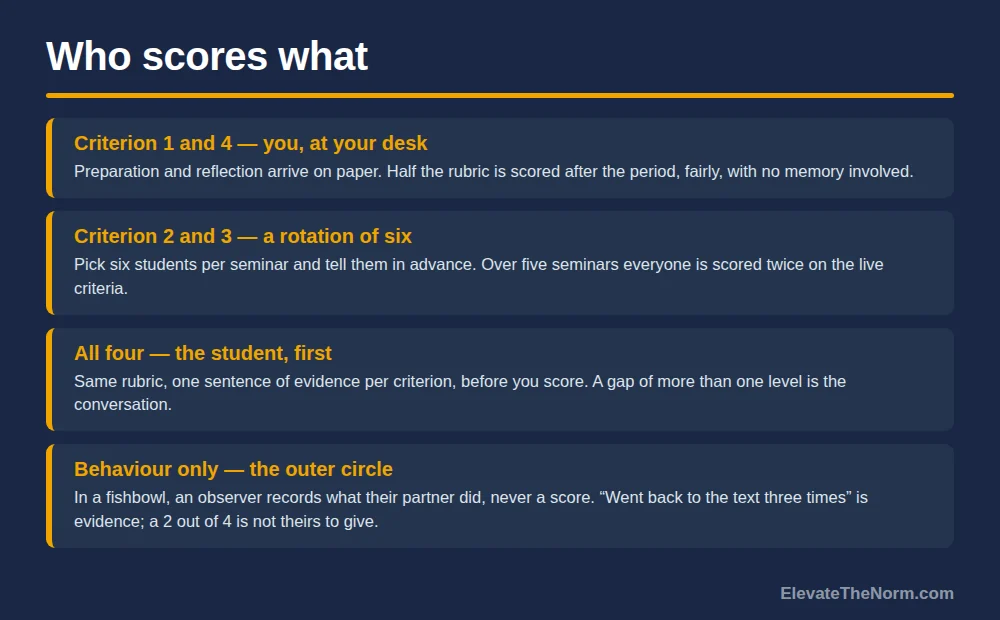
Three ways out, in order of how much I trust them.
- Score the writing, not the room. Criteria one and four are collected on paper. That is half the rubric done at your desk, after school, fairly, with no memory involved.
- Score a rotation. Pick six students per seminar for criteria two and three and tell them in advance. Over five seminars everyone gets scored twice on the live criteria. Telling them beforehand is not cheating — it is the transparency the research says is doing the work.
- Use the fishbowl. If half the class is in an outer circle already, give each observer one partner and one behavioral thing to record. Their notes are not the grade, but they are evidence you did not have to generate while running the conversation.
Check one thing before you adopt any of this: if a student has an IEP or 504 plan that addresses oral participation, the live criteria may need to be replaced rather than adapted for that student. Ask the case manager rather than improvising a workaround, and note that this rubric already makes that easy — half the score is written, so substituting the other half costs you less than it would on most discussion rubrics.
On time, honestly: four criteria for twenty-eight students is about twenty minutes if you are scoring the written half from paper and six students on the live half. It is not nothing. It is roughly the cost of grading a set of exit tickets, and it is the reason the rotation exists.
What I would not do is score from memory at the end of the period. Twenty minutes after a good seminar, what you remember is who was interesting, and “interesting” correlates with confident far more than it correlates with prepared.
Who Should Do the Scoring?
Students first, on the same rubric, before you score anything. This is the change that makes the rubric an instructional tool rather than a grading one, and it costs four minutes.
Hand out the rubric before the seminar. Afterward, have each student score themselves on all four criteria and write one sentence of evidence for each. Then score them yourself. Where you disagree by more than one level, that is your conversation — and it is a better conversation than any comment you would have written unprompted.
Two guards on this. The student’s self-score is not the grade; it is information, and the moment it becomes the grade you have taught them to inflate it. And peer scoring should stay behavioral: what a classmate did, not how well they did it. A fifteen-year-old can honestly record “went back to the text three times.” A fifteen-year-old should not be handing another fifteen-year-old a 2 out of 4 on how they treat people’s ideas. This is the same line the site draws around having students judge their own work: the judgement is real, and it does not become the record.
What to Do With the Score
Use it to decide what to teach next, and put as little of it in the gradebook as your school allows. A seminar rubric’s best use is diagnostic.
Look down the columns rather than across the rows. If twenty of twenty-eight students scored low on use of the text, that is not twenty-eight individual grades — that is one lesson about citing a line, and you should teach it before the next seminar instead of recording twenty low scores. If preparation is the weak column, the problem is upstream of the seminar entirely and no amount of facilitation will fix it.
If the scores do go in the gradebook, weight them low and tell students the weight. A seminar is a practice format. Grading practice heavily is how you get students who will not risk a wrong reading out loud, which is the one behavior the whole format exists to produce.
What to Do Next
Take the rubric above, rewrite the use of the text row so it names what evidence looks like in the specific text you are teaching, and hand it to students the day before — not the day after. Score criteria one and four from the paper they turn in. Pick six students for the live criteria and tell them who they are.
Then run it twice before you judge either the rubric or your class. If you need the rest of the format, it is in the guide to running a Socratic seminar, and the questions that make one worth scoring are in the seminar question bank.
Before you go: grab the free Socratic Seminar Rubric (Four Criteria) (PDF) — ElevateTheNorm.com branded, printable, no email required.
Frequently Asked Questions
What should a Socratic seminar rubric include?
Four criteria: preparation, use of the text, treatment of other people’s ideas, and written reflection afterward. Three of the four produce writing, which means you can score them after the period rather than while facilitating, and a student who spoke twice can still score well. What it should not include is a count of how many times a student spoke.
Should you grade a Socratic seminar at all?
Grade the preparation and the reflection, and weight the whole thing lightly. A seminar is a practice format, and grading practice heavily produces students who will not risk a wrong reading out loud — which is the behavior the format exists to create. If a participation grade is required, take it from the written criteria and say plainly that speaking is not scored.
Why shouldn’t a rubric count how many times a student speaks?
Because it measures confidence and charges a fee to students who find speaking aloud genuinely hard. A study of quiet students found most struggled with verbal participation expectations and several reported physical symptoms — trembling, blushing, stuttering — when speaking in class. Frequency is also easy to game: three short comments at the right moments will beat one student who prepared thoroughly and spoke once.
Is an analytic or holistic rubric better for a seminar?
Analytic, if you want consistency. A review of 75 rubric studies found scoring reliability improves when rubrics are analytic and topic-specific and are paired with exemplars or rater training. Holistic rubrics are faster and less consistent, and with something as fuzzy as discussion quality, consistency is exactly what you are short of.
Do rubrics actually improve student learning?
The evidence is genuinely mixed. A review of 21 studies of formative rubric use found effects ranging from very large to nothing, and noted that most studies combined rubrics with other interventions, so the rubric’s own contribution is hard to isolate. What the authors identify as the mechanism is transparency — which means handing the rubric out before the seminar rather than attaching it to the grade afterward.
How do you score thirty students during one seminar?
You do not. Facilitating and scoring are two jobs, and doing both means doing the facilitation badly. Score the two written criteria from paper afterward, and score the two live criteria for a rotating group of about six students per seminar, told in advance. Over five seminars everyone gets scored twice on the live criteria.
Should students score themselves on the seminar rubric?
Yes, before you score them, using the same rubric with one sentence of evidence per criterion. Where your score and theirs differ by more than one level, that gap is the conversation worth having. Keep the self-score as information rather than as the grade — the moment it becomes the grade, students learn to inflate it.
Is this Socratic seminar rubric free to use?
Yes. It is printed in full on this page and there is a free printable version too, with no email address to hand over, and you are welcome to copy it, cut criteria, or rewrite the language to match your school’s scale. Rewriting the use-of-the-text row so it names what evidence looks like in your specific text is the single change that will do the most for consistency.
Sources
- Jonsson, Anders, and Gunilla Svingby. “The Use of Scoring Rubrics: Reliability, Validity and Educational Consequences.” Educational Research Review, vol. 2, no. 2, 2007, pp. 130–144. Review of 75 empirical studies; reliable scoring “can be enhanced by the use of rubrics, especially if they are analytic, topic-specific, and complemented with exemplars and/or rater training”; rubrics do not by themselves guarantee valid judgements. https://eric.ed.gov/?id=EJ796733
- Panadero, Ernesto, and Anders Jonsson. “The Use of Scoring Rubrics for Formative Assessment Purposes Revisited: A Review.” Educational Research Review, vol. 9, 2013, pp. 129–144. 21 studies; effects on performance ranged from large (0.99–1.6) to negligible, and “most studies reporting on such improvements have combined the use of rubrics with other instructional interventions.” Positive effects more likely in higher education, over longer interventions, and when paired with metacognitive activity. https://platform.europeanmoocs.eu/users/4567/Les3/Panadero-Jonsson-rubrics-3.pdf
- Murphy, P. Karen, et al. “Examining the Effects of Classroom Discussion on Students’ Comprehension of Text: A Meta-Analysis.” Journal of Educational Psychology, vol. 101, no. 3, 2009, pp. 740–764. Discussion produced strong increases in student talk and substantial gains in text comprehension, but “few approaches to discussion were effective at increasing students’ literal or inferential comprehension and critical thinking and reasoning.” https://eric.ed.gov/?id=EJ861185
- Applebee, Arthur N., Judith A. Langer, Martin Nystrand, and Adam Gamoran. “Discussion-Based Approaches to Developing Understanding: Classroom Instruction and Student Performance in Middle and High School English.” American Educational Research Journal, vol. 40, no. 3, 2003, pp. 685–730. 64 middle and high school English classrooms, grades 7, 8, 10, 11 and 12. https://eric.ed.gov/?id=EJ782328
- Medaille, Ann, and Janet Usinger. “Quiet Students’ Experiences with the Physical, Pedagogical, and Psychosocial Aspects of the Classroom Environment.” Educational Research: Theory and Practice, vol. 31, no. 2, 2020, pp. 41–55. Ten upper-division undergraduates — not secondary students; nine of ten struggled with verbal participation expectations and six reported physical symptoms when speaking aloud. https://files.eric.ed.gov/fulltext/EJ1274336.pdf