By Clay Shumate
Cooperative learning is the instructional use of small groups so students work to raise their own learning and each other’s at the same time. It only counts as cooperative learning when five things are present: positive interdependence, individual accountability, promotive interaction, taught social skills, and group processing. Four kids at a table sharing one worksheet is none of those.
That gap is the whole problem. Cooperative learning is one of the most-researched ideas in education, and most of what happens under its name in a secondary building is just furniture. Below: the definition, the real numbers, and the two findings almost nobody repeats — one about teenagers, one about what happens when researchers randomise properly.
Key Takeaways
- Five elements make it cooperative learning. Positive interdependence, individual accountability, promotive interaction, social skills, group processing. Miss one and you have group work.
- The evidence is real but softer than the headlines. Johnson and Johnson report d = 0.67 from more than 1,200 studies. Kyndt and colleagues report g = 0.54 from 51 classroom studies. The EEF says +5 months and rates its own evidence security as low.
- 🔴 Secondary students showed the smallest effect in the strongest classroom meta-analysis. Kyndt found age was a significant moderator and the 12–18 band came in below both primary and university.
- 🔴 Randomised designs show less. A 2026 second-order meta-analysis found quasi-experimental studies produced 1.11 and fully experimental studies produced no significant effect.
- The subject matters a lot. Science +10 months, maths +5, literacy +3 on the EEF’s numbers. Kyndt found the same split from different studies.
- Individual accountability is the lever. Effort drops in groups mainly when individual contributions can’t be evaluated. Make them visible and the drop shrinks.
What Is Cooperative Learning?
Cooperative learning is small-group instruction built so that students can only succeed together, and are still held to account individually. The phrase most often used is from Johnson, Johnson and Smith: the instructional use of small groups so that students work together to maximise their own and each other’s learning.
David and Roger Johnson have been working on this since the 1960s. In their 2009 review in Educational Researcher they describe three shapes it takes. Formal cooperative learning runs from one period to several weeks on a shared goal. Informal is a temporary pairing lasting a few minutes. Base groups are long-term, heterogeneous and stable, and exist to support members and hold them accountable across a semester.
All three show up in secondary buildings. Only the first one usually gets planned.
What Are the Five Elements of Cooperative Learning?
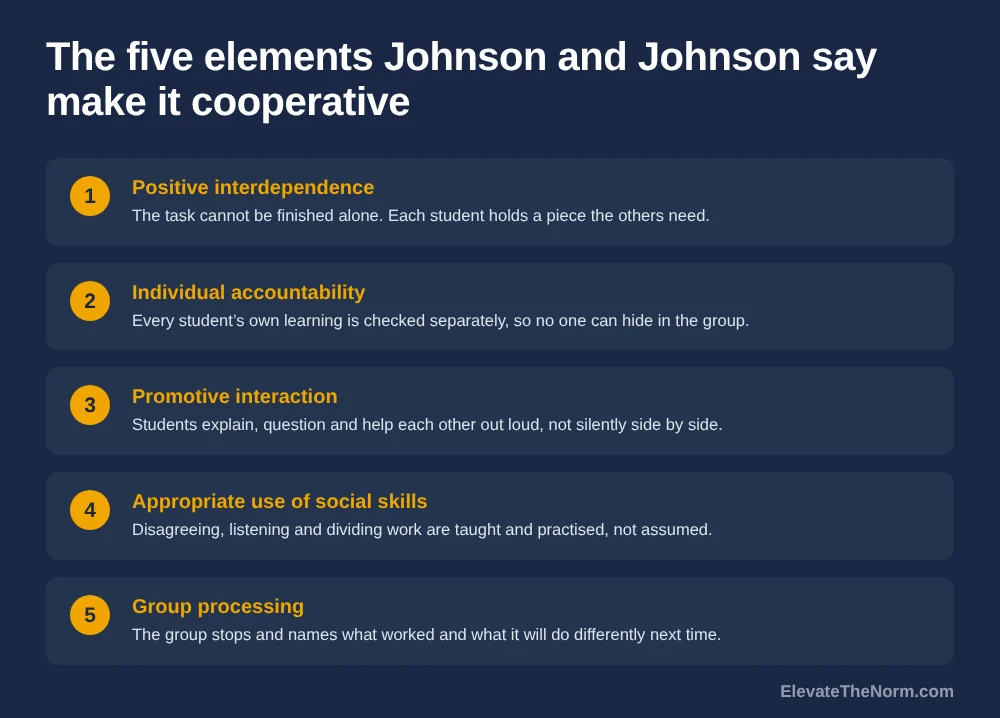
Johnson and Johnson name five variables that mediate whether cooperation works: positive interdependence, individual accountability, promotive interaction, the appropriate use of social skills, and group processing. Here is what each one means on a Tuesday.
Positive interdependence. The task genuinely cannot be finished alone. Each student holds a piece the others need. If your strongest student could do the whole thing at home in forty minutes, you haven’t built interdependence — you’ve built a group project they’re going to resent.
Individual accountability. Every student’s own learning gets checked separately. This is the one secondary teachers skip most and it is the one the research cares about most. More on it below.
Promotive interaction. Students explain things to each other, ask each other questions, and help each other out loud. Four students working silently side by side on four parts of a poster are not interacting promotively. They’re doing parallel homework in the same room. If you want the talk itself to be the lever, that is a separate skill and a separate structure — see what it takes to get students talking to each other instead of taking turns answering you.
Appropriate use of social skills. Disagreeing without it getting personal, listening, splitting work fairly, asking for help. Johnson and Johnson are explicit that these get taught. Adults assume fourteen-year-olds have them because they can hold a conversation at lunch. Holding a conversation and negotiating a disagreement over a primary source are not the same skill.
Group processing. The group stops, out loud, and names what worked and what it will do differently. Two minutes at the end. It is the first thing cut when the bell is coming and it is the element that turns a one-off activity into something students get better at. There is a workable format for the group-processing step here.
How Is Cooperative Learning Different From Group Work?
Group work is a seating arrangement. Cooperative learning is a structure. The fastest test is two questions. Could one capable student finish this alone? And will every student be checked separately on what they learned? If the first answer is yes, or the second is no, you have group work.
The Education Endowment Foundation says this plainly in its own Toolkit: simply seating pupils together or asking them to work in groups, without structure, is not enough, and some pupils may struggle to take part or end up working alone. It adds a harder warning — if high attainers solve the problems without input from peers, existing attainment gaps are likely to widen. That is the thing worth sitting with. Badly built group work doesn’t just fail to help. It can make the spread in your room worse.
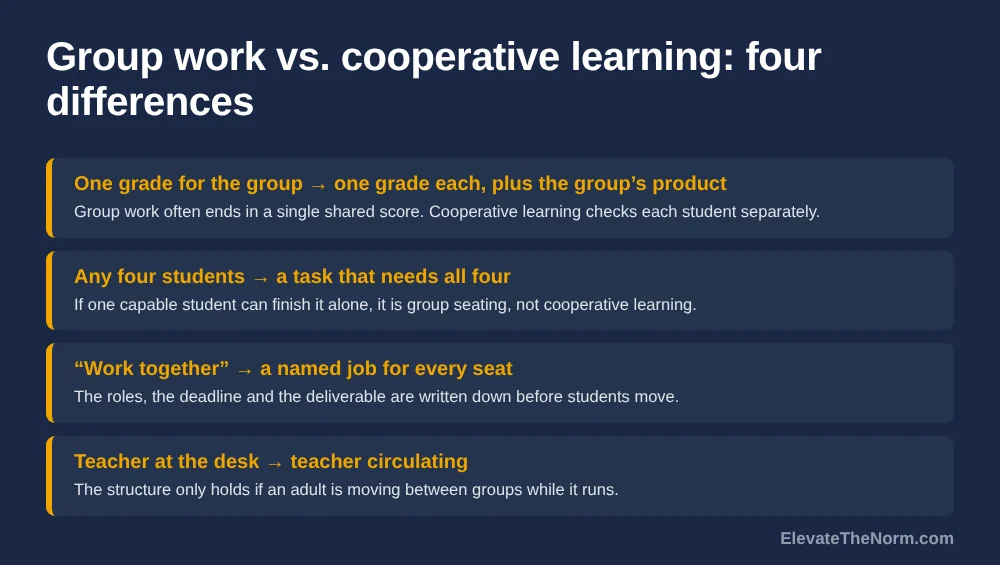
The fix is not complicated, it is just work you have to do before the lesson rather than during it. A named job for every seat. A deliverable each student signs. A task whose pieces actually need each other. And an adult moving between the groups while it runs, which is the part no structure survives without.
One thing that belongs in that pre-work and usually isn’t: you assign the groups. Letting students pick looks generous and costs the same two or three students every single time — they end up last, in public, repeatedly. That is not a minor social cost and it is avoidable. Assign them, change them often enough that no grouping reads as a verdict, and if a student tells you privately that a particular pairing is not survivable, believe them and move it.
Does Cooperative Learning Actually Work?
Yes, on average, across a very large evidence base — and the honest version of that sentence has three caveats attached. Here are the four numbers worth knowing and what sits behind each one.
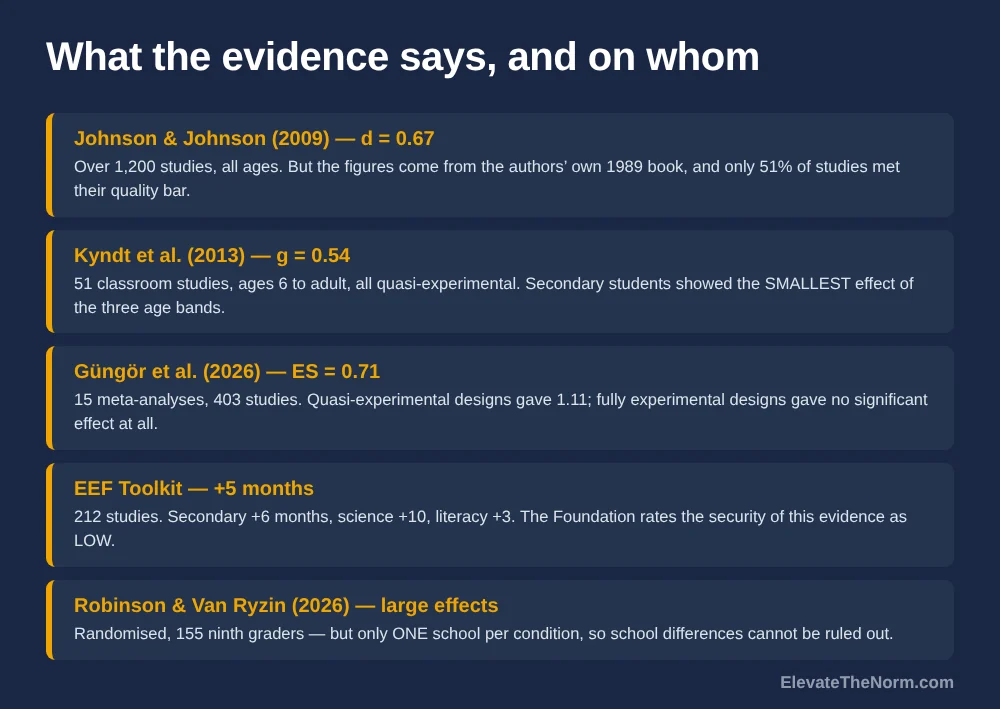
Johnson and Johnson (2009) report d = 0.67 for cooperation against competitive structures and 0.64 against individualistic ones, from a base of more than 1,200 studies, rising to 0.88 among studies they judged high quality. Caveat: those figures come from the authors’ own 1989 book rather than a fresh analysis, only 51 percent of studies met their quality criteria, and the authors are the method’s principal advocates. That doesn’t make it wrong. It means it isn’t independent.
Kyndt and colleagues (2013) report g = 0.54 for achievement from 51 classroom studies, published in Educational Research Review. Attitudes came in at 0.15 from 13 studies — below the usual threshold for a small effect. The authors warn in their own discussion that publication bias means their analysis “might present a too optimistic image.” Every one of those 51 studies was quasi-experimental.
The EEF Toolkit says +5 months from 212 studies — and rates the security of that evidence as low, losing three of its five padlocks because few studies are recent, many weren’t independently evaluated, and results vary a lot in ways nobody has explained. The Foundation notes that evaluations run by the people selling an approach tend to show larger impacts.
Güngör and colleagues (2026) report 0.71 in Current Psychology, pooling 15 earlier meta-analyses covering 403 studies. That is the newest and broadest number available, and it is also where the most uncomfortable finding lives.
What Happens When Researchers Randomise Properly?
In the 2026 second-order meta-analysis, research design was a significant moderator: quasi-experimental studies produced an effect of 1.11, and fully experimental studies produced no significant effect at all. Mixed designs landed at 0.69.
That is worth saying slowly, because it is not what the headline figure suggests. When researchers compared classes that happened to be doing cooperative learning against classes that weren’t, the effect was enormous. When they randomly assigned who got it, it wasn’t there.
There are innocent explanations. Fully experimental studies were fewer, so the estimate is noisier, and randomised classroom trials tend to be shorter than the multi-week implementations teachers actually run. The authors also flag that their sample is dominated by Indonesian and Turkish studies and is English-language only. And the EEF, working from a different and largely UK evidence base, still lands on +5 months.
But the pattern lines up with the EEF’s own low security rating and with Kyndt’s publication-bias warning, and it points the same direction all three times. The defensible claim is that cooperative learning is a good bet with a real evidence base, not a settled multiplier. Anyone selling you a specific percentage gain is rounding somebody else’s estimate.
Why Is the Evidence Weakest for Secondary Students?
Nobody knows, and the two best sources disagree about whether it even is. That question matters more here than anywhere else on this site, so here is the whole picture.
Kyndt’s meta-analysis found educational level was a significant moderator, and the secondary band — ages 12 to 18, 12 studies — produced the smallest average effect of the three. Primary (11 studies) and tertiary (22 studies) were both higher and did not differ from each other. The authors are careful to note the samples in each category are relatively small.
The EEF Toolkit says the opposite: secondary +6 months, primary +5.
So you have two credible sources pointing in opposite directions on the one question a secondary teacher most wants answered, and no published work resolving it. The useful response isn’t to pick the flattering one. It is to assume cooperative learning works for teenagers somewhere in the ordinary range of good teaching practices, build it carefully, and judge it on your own students’ work rather than on either average.
There is one recent trial specifically on teenagers. Robinson and Van Ryzin, writing in School Mental Health in 2026, randomly assigned two rural high schools to a structured cooperative learning platform or a packaged social-emotional learning curriculum and followed 155 ninth graders for four months. The cooperative learning school came out ahead on peer support, loneliness, victimisation, depression, social stress, anxiety and bullying. The limitation is severe and the authors say so: one school per condition. With two clusters, any difference between those buildings is tangled up with the intervention, and every measure was self-report. Promising, not conclusive.
How Do You Stop One Student Doing All the Work?
Make individual output visible. That is the single most consistent finding in the research on why effort drops in groups. Karau and Williams’ 1993 meta-analysis of 78 studies — which we read here through a published summary rather than the paper itself, because the original is paywalled — found social loafing is moderate and general, and that it gets bigger when contributions can’t be evaluated, and shrinks or disappears when they can. Group size makes it worse. Cohesive groups and tasks students find worth doing make it better.
Which is the same thing Johnson and Johnson called individual accountability forty years ago, arrived at from a different literature. When two research traditions that aren’t talking to each other land on the same mechanism, that is about as close to a safe bet as education research offers.
Four things that do it, none of which require a new program:
- Every student submits something with their own name on it — a paragraph, a solved problem, a labelled diagram — alongside the group product.
- Any student can be asked to explain any part of the group’s work. Say this before they start, then actually do it while circulating. It changes the division of labour inside the group immediately.
- Keep groups small. The EEF reports that groups of three to five with a shared outcome appear most successful. Six is where a student can go quiet without anyone noticing.
- Give every seat a named job before students move. A short set of roles that survive contact with real teenagers is more useful here than a long one.
What this also means: the group grade should never be the only grade. A shared score with no individual component is the exact condition the loafing research says produces loafing. It is also the single most common complaint students and parents have about group work, and they are right.
The honest cost of that: an individual deliverable on every group task is more papers to look at. There is no version of this where the accountability is free. What keeps it survivable is keeping the individual piece small — one paragraph, one worked problem, one labelled diagram — and checking a lot of it while you are circulating rather than carrying it home in a stack. If the individual deliverable is as big as the group product, you have built two assignments and you will stop doing it by October.


What Does This Look Like in a Real Classroom?
In my room, working alongside somebody is the default condition, not a reward for finishing something else. The tables are trapezoids and rectangles pushed together in pairs and fours. There is no row of desks facing front to move out of. Students don’t get put into groups on project days, because they are already in them.
That changes what the five elements cost to run. When collaboration is the resting state of the room, you are not spending eight minutes reorganising furniture every time you want students to work together — which is usually why teachers save it for special occasions and then wonder why students are bad at it. The social skills Johnson and Johnson say have to be taught get practised constantly, at low stakes, because there is no other way the room operates.
It also changes what I am doing. I am not at a desk. I am on a wheeled stool moving between tables, or pulling two or three students to a whiteboard table in the corner. That circulation is not supervision. It is how I find out which group has quietly agreed on something wrong, and catching a misconception while it is still contained to one table is most of the value of teaching this way at all.
I am not claiming this is the only workable setup. It is the one I run, and it is why this article is about structure rather than enthusiasm.
How Do You Grade It Without Punishing the Group?
Grade the learning individually and the collaboration separately, and never let one student’s choices determine another student’s transcript.
A defensible split: the individual deliverable carries the academic grade. The group product gets feedback and, if it gets a score at all, a small one. Collaboration itself gets named and assessed, but not as part of the content grade — a student who understands the material and struggled to work with three peers has one problem, not two, and the gradebook shouldn’t pretend otherwise.
And say the split out loud before the task starts — in writing, where students can go back and check it. Most of the resentment teenagers carry about group work comes from watching a grade they earned get averaged with one they didn’t. Tell them which parts are theirs alone and the complaint mostly disappears. Students are entitled to know how they are being assessed before they do the work, and a student who asks you to explain the split is doing what you would want an adult to do.
What Should a Coach or Administrator Look For?
Six things, none of which require watching a whole lesson.
- Is there an individual deliverable? Ask to see what each student turns in. If the answer is the group product, the structure isn’t there.
- Could one student have done it alone? Read the task, not the objective.
- Are the groups three to five?
- Is the teacher moving? The EEF is explicit that these approaches need professional development to manage, and the management happens while the activity runs.
- Were the social skills taught, or assumed? Ask the teacher when they last taught students how to disagree.
- Is there a processing step? Two minutes at the end where groups name what they’d change.
On equity specifically, the Foundation is careful: evidence on the effect for disadvantaged pupils is limited, and the suggested benefit for lower-attaining pupils is conditional on activities being well designed and those pupils actively involved. Read with the widening-gaps warning above, that is one finding rather than two: structure decides which direction this moves your gap.
And one for district-level decisions: the cost here is very low — the EEF puts it at training and resources plus a little planning time — but the evidence security is also low, and the effect varies by subject by a factor of three. Rolling it out department by department rather than building-wide lets you find out which of your subjects it actually moves before you commit everyone’s PD days to it.
What to Do Next
Pick one lesson you already teach this month and run it against the two-question test: could one student finish this alone, and will every student be checked separately? Fix whichever one fails. That is the whole intervention.
Then add the individual deliverable. It is the cheapest change here and the research behind it is the strongest: one thing per student, with their name on it, turned in alongside whatever the group makes.
Leave the processing step for third. It is the easiest to add once the first two are holding, and a structure where groups see each other’s work before they reflect on their own gives students something concrete to process against rather than asking them to rate their own teamwork out of five. And don’t buy a program first — the five elements are public, and nothing in the evidence says a branded version beats a teacher who builds the structure properly.
Frequently Asked Questions
What is cooperative learning?
Cooperative learning is the instructional use of small groups so that students work together to maximise their own and each other’s learning. Johnson and Johnson, who have spent five decades on it, say five elements have to be present for it to count: positive interdependence, individual accountability, promotive interaction, the appropriate use of social skills, and group processing. Four students at a table with one worksheet meets none of those conditions, which is why most of what gets called cooperative learning in a secondary building is really just group seating.
What is the difference between cooperative learning and group work?
Group work is a seating arrangement. Cooperative learning is a structure. The practical test is two questions: could one capable student finish this alone, and will every student be checked separately on what they learned? If the answer is yes to the first or no to the second, it is group work. The EEF is blunt about this — it says simply seating pupils together or asking them to work in groups, without structure, is not enough, and that some pupils may struggle to take part or end up working alone.
Does cooperative learning actually work for high school students?
Probably, but the evidence for teenagers is weaker than for any other age group, and you should know that before you build a semester around it. Kyndt and colleagues’ 2013 meta-analysis of 51 classroom studies found an overall achievement effect of g = 0.54 — but age was a significant moderator and secondary students showed the smallest average effect of the three bands, below both primary and university. The EEF Toolkit disagrees, putting secondary at +6 months against primary’s +5. Two credible sources, opposite answers, and nobody has resolved it.
Why do the effect sizes for cooperative learning vary so much?
Mostly because of study design. A 2026 second-order meta-analysis by Güngör and colleagues pooled 15 earlier meta-analyses covering 403 studies and found an overall effect of 0.71 — but when it split the studies by design, quasi-experimental studies produced 1.11 and fully experimental studies produced no significant effect at all. Kyndt’s 51 studies were all quasi-experimental. The EEF independently rates the security of its collaborative-learning evidence as low. The honest summary is that the method looks strong when researchers choose the classes and weaker when they randomise them.
How do you stop one student doing all the work?
Make individual output visible. That is the single most reliable finding in the social-loafing literature: effort drops in groups mainly when individual contributions cannot be evaluated, and the drop shrinks or disappears when they can. In practice that means every student submits something with their own name on it, every student can be asked to explain any part of the group’s work, and the group product is never the only grade. It is also the second of Johnson and Johnson’s five elements, which is not a coincidence.
Does cooperative learning work in every subject?
No, and the gaps are large. Kyndt found significantly stronger effects in mathematics and the sciences than in social sciences and languages, a difference of 0.32. The EEF Toolkit shows the same shape from a different evidence base: science +10 months, maths +5, literacy +3. Nobody has a settled explanation. If you teach English or history, plan for a smaller return than the headline numbers promise and judge it on your own students’ work rather than on someone else’s average.
Is cooperative learning fair to students who would rather work alone?
It has to be made fair, and that is a real design job rather than a disclaimer. A student who thinks better in silence is not being difficult. Build in genuine individual thinking time before any group turn, let students write before they talk, keep groups small — the EEF reports that three to five pupils with a shared goal works best — and never make the social performance itself the graded outcome. What gets assessed should be the learning, not how comfortably a student does it in front of four peers.
Sources
- Johnson, D. W., & Johnson, R. T. (2009). An Educational Psychology Success Story: Social Interdependence Theory and Cooperative Learning. Educational Researcher, 38(5), 365–379. Source of the five elements, the three forms of cooperative learning, the “more than 1,200 research studies” figure and the d = 0.67 / 0.64 achievement effects. Read in full. Note the authors’ own caveats: the effect sizes are drawn from their 1989 book rather than a new analysis, only 51% of studies met their quality criteria, and no systematic search procedure is described. full text
- Kyndt, E., Raes, E., Lismont, B., Timmers, F., Cascallar, E., & Dochy, F. (2013). A meta-analysis of the effects of face-to-face cooperative learning. Do recent studies falsify or verify earlier findings? Educational Research Review, 10, 133–149. Source of g = 0.54 for achievement (51 studies), 0.15 for attitudes (13 studies), the significant age moderator placing secondary lowest, and the 0.32 subject-domain gap. The authors state that publication bias means the analysis “might present a too optimistic image,” and that moderator samples are relatively small. full text · independent methodological appraisal
- Güngör, F., Altunbaşak, İ., Aydın, A. T., Kaya, M., et al. (2026). A second-order meta-analysis on the effects of cooperative learning on students’ academic achievement, higher-order thinking, and affective behaviors. Current Psychology, 45(6), 552. Source of the 0.71 overall effect (15 meta-analyses, 403 studies) and the research-design moderator: quasi-experimental 1.11, fully experimental no significant effect, mixed 0.69. Authors flag geographic and language bias — the sample is dominated by Indonesian and Turkish studies and is English-language only — and that only published articles were included. springer.com
- Education Endowment Foundation, Teaching and Learning Toolkit: Collaborative learning approaches (last updated July 2021). Source of +5 months overall, secondary +6, primary +5, science +10, maths +5, literacy +3, the 212-study base, the three-to-five group-size finding, and the warning that unstructured group work can widen attainment gaps. The Foundation rates the security of this evidence as low. educationendowmentfoundation.org.uk
- Robinson, L. E., & Van Ryzin, M. J. (2026). Promoting Positive Social and Mental Health Outcomes: Technology-Supported Cooperative Learning vs. Curriculum-Based SEL. School Mental Health, 18, 137–148. Cluster-randomised, 155 ninth graders, two rural Pacific Northwest high schools, four months. Reported here with its stated limitations: one school per condition, all measures student self-report, a homogeneous rural sample, and low reliability on the bullying measure at follow-up (α = .62). springer.com
- Karau, S. J., & Williams, K. D. (1993). Social loafing: A meta-analytic review and theoretical integration. Journal of Personality and Social Psychology, 65(4). The paper itself is paywalled and was not read for this article. The findings cited here — 78 studies, a moderate and generalisable effect, and the moderating roles of evaluation potential, task valence, group size and cohesion — are taken from a published summary, which is named as a summary rather than cited as the primary source. summary