By Clay Shumate
Digital citizenship is instruction in how students manage their identity, privacy, conduct and sources online. The ISTE standard breaks it into four jobs: digital identity, how you treat people, well-being, and privacy. Any school taking federal E-rate money already has to teach part of it. The strongest classroom evidence is for source evaluation.
Key Takeaways
- Students are worse at this than adults assume. A Stanford assessment of 3,446 high school students, working with a live internet connection, found 96 percent never discovered that a climate website was tied to the fossil fuel industry and two-thirds could not tell news stories from ads.
- Six lessons measurably changed what students could do. In a randomized study across one district’s six high schools, students who got the curriculum did twice as well at spotting dubious websites — and still earned only half the available points.
- It is already required, in part, almost everywhere. Taking E-rate discounts obliges a school to teach students about appropriate online behavior and cyberbullying. Most districts satisfy that with a slideshow nobody remembers.
- Cyberbullying programs work, but less well than you would hope. A review of 24 evaluations found reductions of roughly 10 to 15 percent in perpetration and about 14 percent in victimization, below what face-to-face bullying programs achieve.
- Do not measure this with a survey. In the one study that measured both, students’ self-reported source-checking barely moved while their actual behavior changed enormously. They overestimate themselves.
What is digital citizenship?
Digital citizenship is teaching students to act responsibly in the online spaces they already live in — managing their identity and footprint, treating people decently, protecting their privacy and data, and judging what they read. It is a conduct-and-judgment subject, not a technology-skills subject.
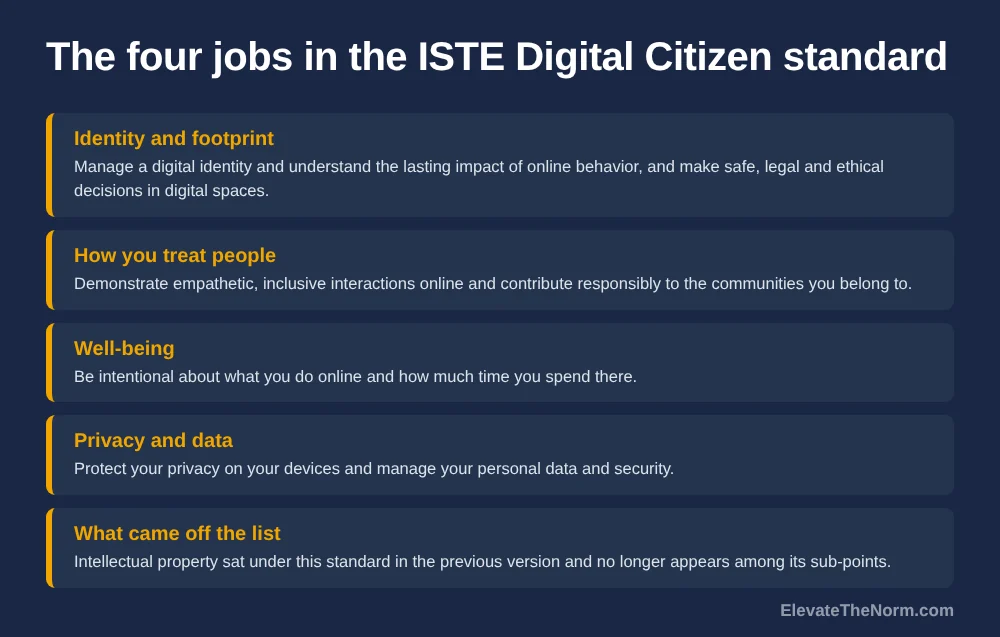
The reference definition most districts point at is the ISTE Standards for Students. Standard 1.2, Digital Citizen, reads: “Students recognize the responsibilities and opportunities for contributing to their digital communities.” Its four sub-points cover managing digital identity and the lasting impact of online behavior, demonstrating empathetic and inclusive interactions, safeguarding well-being by being intentional about time spent online, and protecting privacy and personal data.
One thing worth knowing if your district’s slide deck is a few years old: intellectual property used to sit under this standard and no longer appears among its sub-points, while digital well-being and time online were added. Plenty of curriculum maps still quote the retired version.
Two things this is not. It is not the “nine elements of digital citizenship” you will find all over search results — that is a framework from a book ISTE published, not from the standards. And it is not the set of media literacy activities covered separately on this site, which is one component of the job rather than the whole of it.
Is digital citizenship required to be taught?
Partly, and the requirement is older and broader than most teachers realize. It arrives through federal E-rate funding rather than through a curriculum mandate, which is why nobody announced it.
| Where it comes from | Who it binds | What it actually requires |
|---|---|---|
| Protecting Children in the 21st Century Act, through the E-rate program | Any school or district taking E-rate discounts | Educate minors about appropriate online behavior, including interacting on social networking sites and in chat rooms, plus cyberbullying awareness and response |
| State media literacy and information literacy statutes | Varies by state; some high-school only, some K–12 | Varies widely — from a required unit of instruction to a resolution encouraging one |
| ISTE Standards for Students | Nobody, legally | A reference framework districts adopt voluntarily |
The federal piece is specific. Guidance published by state education agencies summarizing the E-rate rules states that districts “must educate minors about appropriate online behavior,” including interactions on social networking sites and in chat rooms, “as well as cyberbullying awareness and response.” That has been a condition of the funding since the 2012 funding year.
The state picture is messier than the headline. Media Literacy Now reports that 25 states have media literacy laws on their books. Read the entries and that number covers everything from binding statutes to resolutions that merely encourage instruction, so the count of states that actually require it is considerably smaller. Illinois is one of the real ones: every public high school must deliver a unit of instruction covering accessing information, analyzing and evaluating media messages, creating media, reflecting on media consumption, and social responsibility and civics.
The tracker that counts those laws also declines to evaluate whether states implemented them, and notes that passing a bill is where the work starts rather than ends. That is the implementation risk for anyone at district level: the mandate usually arrives without the training or the curriculum money, and lands on whichever teacher has a spare period.
How good are students at this already?
Worse than nearly every adult expects. The largest assessment of American high school students’ online reasoning gave 3,446 of them a live internet connection and six open-response tasks, and the results were bad across every one.
Ninety-six percent, shown a climate website, never discovered the organization’s ties to the fossil fuel industry. Two-thirds could not distinguish news stories from ads on a popular site’s front page. More than half believed an anonymously posted video, shot in Russia, was strong evidence of voter fraud in the United States. The sample reflected the demographic profile of American high school students, so this is not a story about one struggling school.
It is worth pairing that with how much of their lives this covers. Pew Research Center’s survey of 1,458 teens found 97 percent use the internet daily, 40 percent describe themselves as online almost constantly, and 64 percent have used an AI chatbot, with about three in ten using one every day. Whatever a school teaches about online judgment is competing with a great deal of practice.
And do not let anyone in a meeting tell you the kids have this handled because they grew up with it. The review that put the phrase under a microscope concluded there is no such thing as a digital native, and that people are not capable of multitasking when real thinking is involved.
Does teaching digital citizenship actually work?
For source evaluation, yes, with a measurable change from a small number of lessons. For everything else, the evidence is thinner than the curriculum catalogs suggest, and most of it measures what students say rather than what they do.
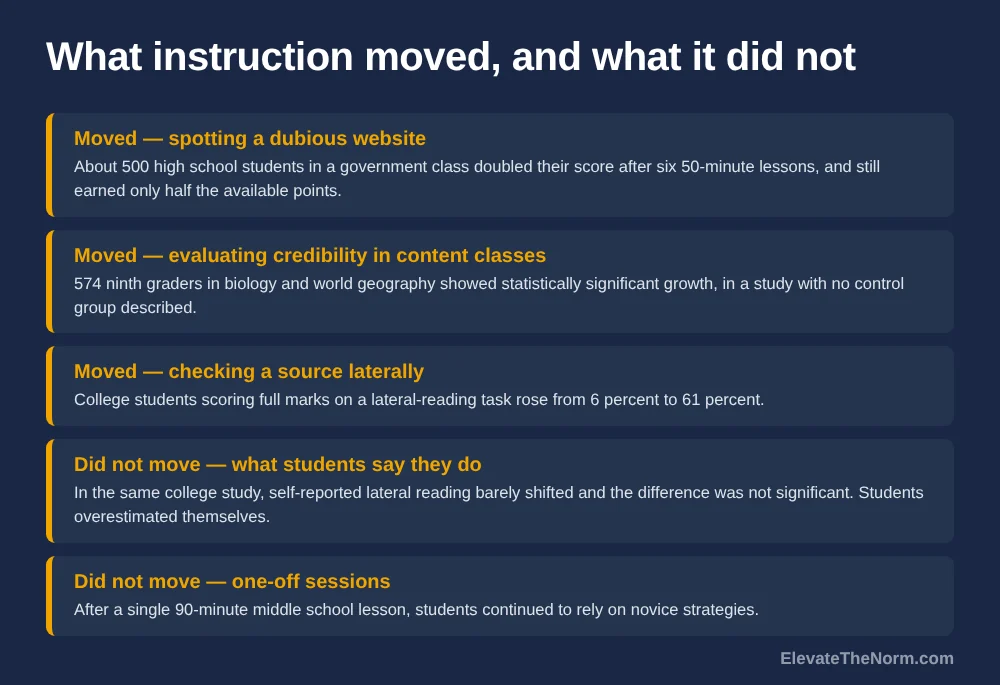
The strongest school result comes from a study of about 500 high school students in an urban Midwestern district, in a required government class at each of the district’s six high schools. After six 50-minute lessons, the curriculum group did twice as well as before at spotting dubious websites. The researchers were straight about the ceiling: those students still earned only half the total available points. The study was funded by Google.org, which is worth saying out loud given that Google also publishes a competing free curriculum.
A follow-up put the same lessons inside biology and world geography classes with 574 ninth graders, taught by content teachers rather than a specialist, and reported statistically significant growth in evaluating credibility. No control group is described, and no effect size is published on the accessible version, so read it as encouraging rather than conclusive.
The sharpest finding for anyone planning to evaluate a program is from a college study of 230 students. The share earning full marks on a source-checking task went from about 6 percent to 61 percent — while their self-reported source-checking barely moved and the difference was not statistically significant. If you survey students about their habits, you will measure their confidence.
Do cyberbullying lessons reduce cyberbullying?
Somewhat. A review of 24 evaluations of school-based programs found reductions of roughly 10 to 15 percent in cyberbullying perpetration and about 14 percent in victimization. Real, worth having, and smaller than the same team’s figures for face-to-face bullying programs.
Those face-to-face programs, across more than 100 evaluations, reduced bullying perpetration by about 19 to 20 percent and victimization by roughly 15 to 16 percent. The researchers themselves describe the effects as modest, and note that almost all of the outcomes rest on students reporting on themselves.
The scale of the problem is not in doubt. Pew found that 46 percent of teens have experienced at least one of six online abusive behaviors, with offensive name-calling at 32 percent and false rumors at 22 percent. In the same survey, roughly four in ten teens said teachers are doing a good or excellent job addressing online harassment — which means six in ten said otherwise, and they are the ones who would know.
That is the number I would put in front of a faculty before adopting anything. A ten to fifteen percent reduction is worth the time. Telling students the problem is handled, when most of them can see it is not, costs credibility that a lesson cannot buy back. This is the same reason repair after harm has to be followed through rather than announced.
Which free digital citizenship curriculum should I use?
Pick by what you are trying to change. For source evaluation, the Stanford-derived civic online reasoning lessons have the strongest evidence. For broad coverage across a whole school, Common Sense has the most material. All of the options below are free; two of them want an account.
| Source | What you get | Grades | Account needed? | Best for |
|---|---|---|---|---|
| Civic Online Reasoning (Digital Inquiry Group) | 30 free lessons plus assessments; the middle school module is 5 lessons over about 5 days | Middle school to college | Not stated on the page | The one with the classroom evidence behind it |
| Common Sense Education | Six lessons per grade by the page’s own listing, 45–60 minutes each in the 9–12 collection | K–12 | Not stated; sign-in offered | Breadth across every grade in a building |
| Be Internet Awesome (Google) | Five topics with lesson plans and a game | Not stated for the core curriculum | No — the page says no personal information or login | A no-friction starting point |
| NetSmartz (NCMEC) | One presentation for middle school, one for high school | K–12 | Yes for downloads — log in or register | A single assembly-style session |
One caution on the largest of them. Common Sense has announced that its long-running digital citizenship curriculum is being archived and is steering teachers to a replacement called Digital Literacy & Well-Being. If your building’s scope and sequence names specific lessons from the old set, check the links before you plan a semester around them.
Common Sense is also the publisher of the screen-time figures most often quoted to justify buying a digital citizenship program, and its own page carrying those figures states no sample size or methodology. Good material, and worth knowing who is counting.
Who should teach it, and how long does it take?
Content teachers, inside real subjects, in blocks of about five lessons. Both studies that moved the needle ran that way: six 50-minute lessons in a government class, and the same lessons taught by biology and world geography teachers.
What has not been shown to work is the format most schools choose. A single 90-minute middle school session improved two narrow behaviors and left students relying on novice strategies for everything else. The advisory-period version is worse still: in a student newspaper editorial from a California high school, the editor’s verdict on her district’s mandated 20-minute lessons was that they are not making an impact and are wasting students’ and teachers’ time. She is describing exactly the delivery model a compliance requirement produces.
There is a more uncomfortable reason to put this inside content classes. A government teacher asking students to check a source is doing history; an advisory teacher asking the same question in a twenty-minute block is doing a module. Students can tell the difference and they grade us on it. The practical version is to attach the lessons to assignments that already exist — the research paper, the current-events discussion, the document analysis you already run — so that checking a source is part of doing the work rather than a separate unit about being a good person.
What should you skip?
Gamified misinformation apps, anything built on the digital natives idea, and self-report as your measure of success. Each is popular, and each has evidence against it rather than merely an absence of evidence for it.
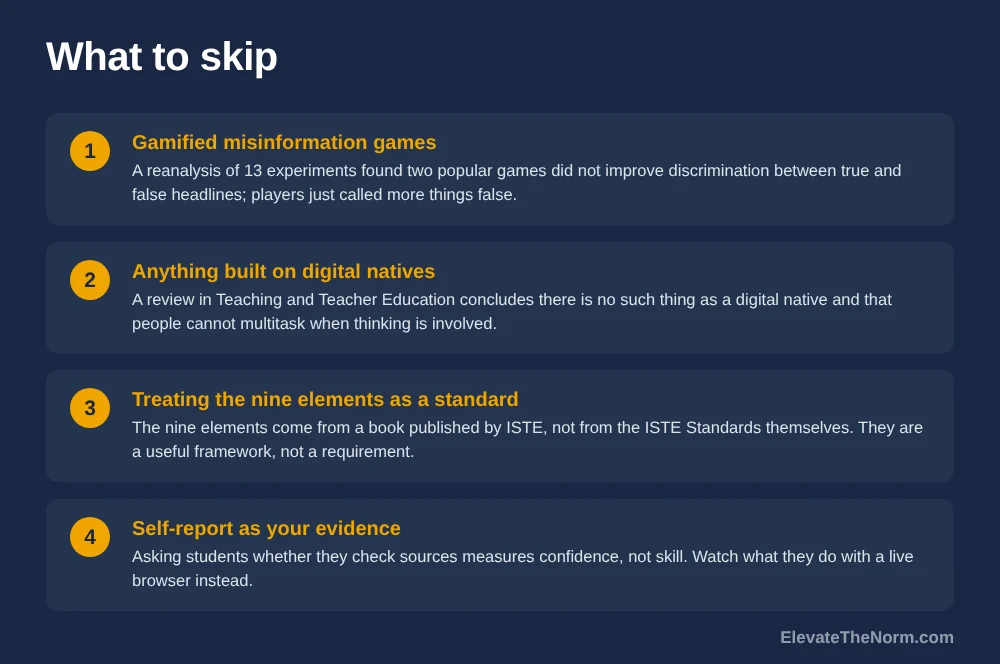
The inoculation games are the clearest case. A reanalysis of 13 experiments covering two widely promoted games found they did not improve students’ ability to tell true news from false — players simply began calling more things false, including the true ones. The authors warn the games may be counterproductive. A class that leaves believing nothing is not more informed than one that leaves believing everything.
It is also worth knowing how thin the foundation under internet safety education is. A systematic review had to examine 31 meta-analyses from other prevention fields, because the internet safety programs themselves had not been evaluated rigorously enough to review — and the authors noted there had not even been efforts to define what behavior the programs were trying to change.
Define the behavior first, then pick the lessons. “Students will be responsible online” is not a measurable outcome. “Students will open a second tab and search the name of an unfamiliar site before quoting it” is. The civic online reasoning materials ship with their own assessment tasks, including baseline and matched post versions, which is more than most free curricula give you.
One warning from the student side of the desk, because it is the fastest way to lose a class. Do not grade the ritual. If the points are for opening a second tab, students will open a second tab, and the one who already knew the source was solid gets marked down for not performing a check they did not need. Score the sources that end up in the work and ask how they know. And do not open the unit with the statistic that 96 percent of students failed — teenagers hear that as an adult telling them they are gullible, from a generation that forwards things on Facebook. Hand them the climate website first and let them find it themselves.


Clay’s take: teach the part you can actually check
Most digital citizenship curricula are a values unit with a technology coat of paint, and students read them that way. The part with real evidence behind it is narrower: can a student find out who is behind a website before believing it?
That one is less inspiring than the brochure, and it is teachable in about five lessons and testable with a laptop, which the rest of the brochure is not.
Keep it procedural and it survives a school board meeting. The tasks in the research use climate and election material, and a unit that teaches students which conclusions are correct will draw a complaint it deserves. A unit that teaches who published this, what the publisher wants, and what other sources say is a method, and a method applies to every side of every argument. That distinction is worth putting in writing before a parent asks.
It is also not an incident-response plan, and compliance paperwork tends to blur the two. Teaching students about cyberbullying in September does not tell an administrator what to do about a group chat in February, and a district that has checked the instruction box has not answered the harder question.
I would spend the instructional time there and handle the rest the way we handle other conduct — in the moment, with the actual incident, in the room where it happened. A kindness lesson in October does not compete with what a kid sees in a group chat in February. A teacher who responds to the group chat does.
The honest limit on everything above: even the best study here left students at half marks, the cyberbullying effects are in the ten to fifteen percent range, and the whole field runs on students reporting on themselves. Anyone selling certainty about this is selling something. The same applies to the parts of this that live elsewhere on the site — what the evidence says about phones in a classroom, how to make student AI use count for something, and what happens after an integrity case — are separate problems with separate evidence, and digital citizenship is not a substitute for any of them.
Where to start, concretely: take one assignment this semester that requires outside sources, add two lessons on checking who published a site, and then grade the next assignment on the quality of the sources that show up in it. That is four lessons fewer than the research used, and it puts the points on the outcome rather than on the ritual. Add the rest when you have proof the first part stuck.
Frequently Asked Questions
What are the main elements of digital citizenship?
The ISTE Digital Citizen standard groups them into four: managing your digital identity and the lasting impact of what you post, treating people online with empathy and inclusion, safeguarding your own well-being and time spent online, and protecting your privacy and personal data. Source evaluation sits alongside these and has the strongest classroom evidence of any of them.
Is digital citizenship required to be taught in schools?
Partly. Any school taking federal E-rate discounts must educate minors about appropriate online behavior, including social networking and chat rooms, plus cyberbullying awareness and response. Beyond that it varies by state: 25 states have media literacy laws on the books, but those entries range from binding statutes requiring a unit of instruction down to resolutions that merely encourage one.
Does teaching digital citizenship actually work?
For source evaluation, yes. High school students who received six 50-minute lessons scored twice as well afterward at identifying dubious websites, though they still earned only half the available points. Evidence for the broader conduct and well-being topics is much thinner, and most of it rests on students reporting on their own behavior rather than on anything measured.
How long does it take to teach digital citizenship?
The studies that changed what students could do used about five or six lessons of 45 to 60 minutes. A single 90-minute session improved two narrow behaviors and left students relying on novice strategies otherwise. Short advisory-period modules are the most common format in schools and have no evidence behind them at all.
Who should teach digital citizenship?
Content teachers, inside their own subjects. The strongest study ran in a required government class, and a follow-up put the same lessons in biology and world geography taught by those teachers rather than a specialist. Attaching the lessons to assignments that already need sources makes source-checking part of the work instead of a separate unit about being a good person.
What is the best free digital citizenship curriculum?
It depends on the goal. The Stanford-derived civic online reasoning lessons have the research behind them and ship with their own assessments. Common Sense Education has the broadest coverage across grades, though it is archiving its long-running digital citizenship curriculum in favor of a replacement. Google’s Be Internet Awesome requires no login at all; NetSmartz asks you to register for downloads.
Do cyberbullying prevention programs reduce cyberbullying?
By some amount. A review of 24 school-based program evaluations found reductions of roughly 10 to 15 percent in perpetration and about 14 percent in victimization, which is below what the same researchers found for face-to-face bullying programs. The authors describe the effects as modest and note that nearly all of the outcomes depend on students reporting about themselves.
How do I measure whether digital citizenship instruction worked?
Watch what students do, not what they say. In the study that measured both, the share of students checking sources properly went from about 6 percent to 61 percent while their self-reported checking barely moved at all. Give students a live browser and an unfamiliar website, and score the sources that end up in their actual work.
Sources
- ISTE. ISTE Standards for Students, 2024 edition. Full text. Source of the wording of Standard 1.2, Digital Citizen, and its four sub-points. Intellectual property appeared under this standard in the previous edition and does not appear among the 2024 sub-points, which is why older curriculum maps quote it differently.
- Breakstone, J., Smith, M., Wineburg, S., Rapaport, A., Carle, J., Garland, M., & Saavedra, A. (2021). Students’ Civic Online Reasoning: A National Portrait. Educational Researcher. Stanford Digital Repository record. Source of the 3,446-student sample, the six tasks completed with a live internet connection, and the 96 percent, two-thirds and over-half figures. The full text is paywalled; the figures above are the ones stated on the open repository record, which reports results for three of the six tasks.
- Wineburg, S., Breakstone, J., Smith, M., Ortega, T., & McGrew, S. (2022). Reported by Stanford Graduate School of Education, It Doesn’t Take Long to Learn How to Spot Misinformation Online. Article. Source of the roughly 500 students, six district high schools, six 50-minute lessons, the doubled score, the half-of-available-points ceiling, and the Google.org funding. The journal article itself is paywalled; no effect size is reported on the accessible page, so none is quoted here.
- McGrew, S., & Breakstone, J. (2023). Civic Online Reasoning Across the Curriculum. AERA Open, vol. 9. Repository record. Source of the 574-student sample, drawn from grade 9 biology and world geography classes, and the statistically significant growth. No control group is described and no effect sizes appear on the accessible record.
- Brodsky, J. E., Brooks, P. J., Scimeca, D., Todorova, R., Galati, P., Batson, M., Grosso, R., Matthews, M., Miller, V., & Caulfield, M. (2021). Improving College Students’ Fact-Checking Strategies Through Lateral Reading Instruction in a General Education Civics Course. Cognitive Research: Principles and Implications, 6, 23. Full text. Source of the 230-student sample, the rise from 5.9 to 61.0 percent on the performance measure, and the non-significant self-report result. First-year university students, not secondary students.
- University of Cambridge Violence Research Centre, summarizing Gaffney, H., Farrington, D. P., Espelage, D. L., & Ttofi, M. M. (2019), Are Cyberbullying Intervention and Prevention Programs Effective? Aggression and Violent Behavior, 45. Summary page. Source of the 24 evaluations, the 10 to 15 percent and 14 percent cyberbullying reductions, and the 19 to 20 percent and 15 to 16 percent figures for face-to-face programs from over 100 evaluations. The journal article was not reachable; these figures come from the research centre’s own summary of it. The team’s Campbell systematic review describes the effects as modest and notes that self-reported measures may over- or under-estimate them.
- Faverio, M., & Sidoti, O. Teens, Social Media and AI Chatbots 2025. Pew Research Center. Report. Source of the 97 percent daily internet use, 40 percent almost constantly online, and 64 percent AI chatbot figures. Survey of 1,458 U.S. teens ages 13 to 17 recruited through their parents; all figures are self-reported.
- Vogels, E. A. Teens and Cyberbullying 2022. Pew Research Center. Report. Source of the 46 percent figure, the 32 percent name-calling and 22 percent false-rumor breakdown, and the finding that roughly four in ten teens think teachers are doing a good or excellent job addressing online harassment. Survey of 1,316 U.S. teens ages 13 to 17.
- Delaware Department of Education. E-Rate and CIPA guidance for internet safety policies. Guidance document. Source of the quoted federal requirement to educate minors about appropriate online behavior, social networking and chat room interactions, and cyberbullying awareness and response, under the Protecting Children in the 21st Century Act. A state agency’s summary of the federal rule, not the statute itself; the requirement has applied since the 2012 E-rate funding year.
- Media Literacy Now. U.S. Media Literacy Policy & Impact Report. Report page. Source of the statement that 25 states have media literacy laws on their books, covering legislation through October 30, 2025. The report’s own entries mix binding statutes with resolutions and encouragements and it states no single total, and it does not evaluate whether states implemented or funded what they passed.
- Illinois General Assembly. Public Act 102-0055. Text. Source of the five required components of the Illinois high school media literacy unit and the requirement that it apply to every public high school.
- Modirrousta-Galian, A., & Higham, P. A. (2023). Gamified Inoculation Interventions Do Not Improve Discrimination Between True and Fake News. Journal of Experimental Psychology: General. Accepted manuscript. Source of the reanalysis of 13 experiments and the finding that the games elicited more “false” responses to all news items rather than improving discrimination. The samples are adults, not school students.
- Kirschner, P. A., & De Bruyckere, P. (2017). The Myths of the Digital Native and the Multitasker. Teaching and Teacher Education, 67. Full text. Source of the conclusion that there is no such thing as a digital native and that people cannot multitask when thinking is involved. A narrative review rather than new data; most of the studies it draws on used university students.
- Jones, L. M., Mitchell, K. J., & Walsh, W. A. (2014). A Systematic Review of Effective Youth Prevention Education: Implications for Internet Safety Education. Crimes Against Children Research Center, University of New Hampshire. Full text. Source of the finding that internet safety education lacked rigorous evaluation and of the review’s method of borrowing from 31 meta-analyses in other prevention fields. It did not itself evaluate internet safety programs.
- Curriculum pages read for the comparison table: Civic Online Reasoning (30 free lessons) and its middle school module; Common Sense Education, which states the curriculum will be archived in December 2026 and points to its Digital Literacy & Well-Being replacement; Be Internet Awesome, which states its materials require no personal information or login; and NetSmartz, whose downloads prompt users to log in or register. Lesson counts per grade for Common Sense are counted from the page listing, which states no total.
- Midlam, S. Mandatory digital citizenship lessons fail to engage. The Iliad, Poway High School student news. Editorial. Source of the student verdict on 20-minute mandated advisory lessons. One student’s opinion piece, not evidence — included because it is a primary account of how the compliance version lands with the people sitting through it.