By Clay Shumate
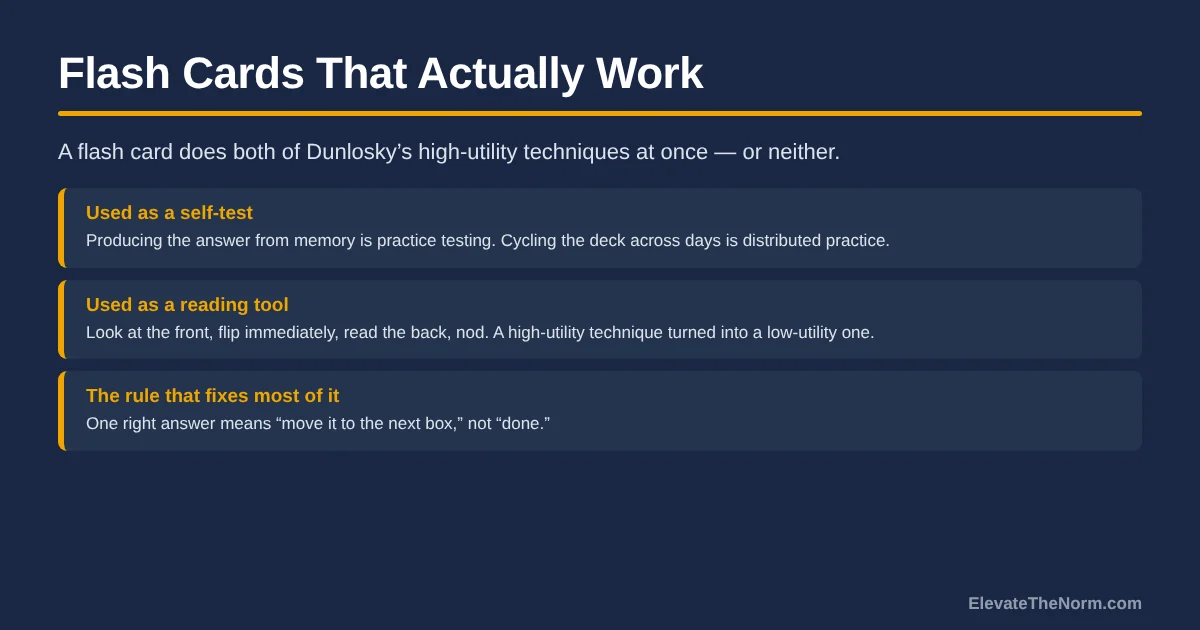
Flash cards for studying work when students use them to test themselves, not to reread. Put one question per card, say or write the answer before flipping, keep missed cards in the deck, and spread practice over several days. A 2013 review rated practice testing and spaced practice as the two highest-utility study techniques, and both are exactly what good flash card use is.
Key Takeaways
- Flash cards are a retrieval tool. The benefit comes from pulling the answer out of memory before you look, which is what researchers call practice testing.
- One big stack beats several small ones. In Kornell’s 2009 experiments, studying one stack of 20 cards beat four stacks of 5 for 90% of participants.
- Students misjudge what works. In the same study, most participants who noticed a difference believed the small stacks had worked better, even though they didn’t.
- Dropping cards too early hurts. Removing a card after one correct answer is the most common habit, and research links it to weaker learning.
- The card matters as much as the routine. One clear question per card, in the student’s own words, beats a card stuffed with a paragraph.
Do flash cards actually help students learn?
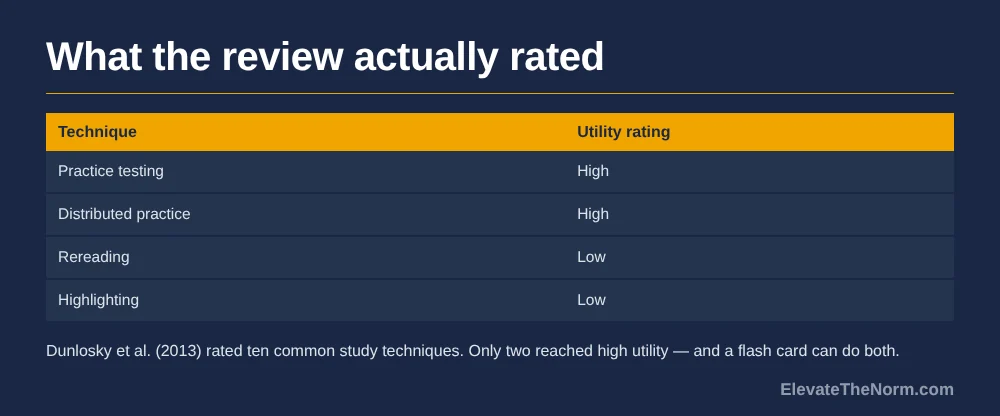
Yes, when they’re used as self-tests. In 2013, John Dunlosky and four colleagues published a long review in Psychological Science in the Public Interest that rated ten common study techniques. Only two got a “high utility” rating: practice testing and distributed practice (spreading study out over time). Rereading and highlighting, two of the most popular habits students have, were rated low utility. The authors wrote that those techniques don’t consistently boost performance and that other techniques should be used in their place.
A flash card is a cheap way to do both high-utility techniques at once. Looking at a prompt and producing the answer from memory is practice testing. Cycling through the deck across several days is distributed practice. The problem is that many students use cards as a reading tool: they look at the front, flip immediately, read the back, and nod. That turns a high-utility technique into a low-utility one.
The study skills for students guide covers the full set of techniques. This article goes deep on one tool because it’s the one most students already own and most often misuse.
What did the flash card research find about spacing and stack size?
Nate Kornell’s 2009 paper in Applied Cognitive Psychology tested something every student does without thinking: deciding how big a stack to study. College students learned GRE-style vocabulary pairs on online flash cards. Half the words were studied in one stack of 20 cards (so each card came around less often, which is spacing). The other half were studied in four stacks of 5 (each card came back quickly, which is massing). Study time and the number of words were the same.
The big stack won in all three experiments. In the experiment that ran over four days before the final test, spaced words were recalled at 54% versus 21% for massed words. Across all three experiments, 90% of participants (63 of 70) learned more with spacing. And after the first session, 72% of the participants who reported a difference thought the massed stacks had worked better. Small stacks feel like faster progress because you see each card again before you forget it. That feeling is exactly what fools students.
Keep the scope in mind: these were undergraduates learning vocabulary pairs. It’s strong evidence for the spacing principle, which shows up across many kinds of research, but a middle schooler studying the causes of World War I isn’t the same experiment.
How do I make flash cards that work?
Whether students make study cards on index cards or in an app, the rules are the same. Here’s a version you can post or hand out.
Copy-and-use: Rules for a good flash card
- One question per card. If the back has a list of five things, split it into five cards or turn it into a “name three of…” prompt.
- Write the front as a question. “What caused the Dust Bowl?” makes you retrieve. “Dust Bowl” alone invites you to recognize.
- Use your own words on the back. Copying the textbook definition word for word is easier, but rewriting it forces you to understand it.
- Keep the answer short. A phrase or one sentence. If you can’t check it at a glance, you’ll skip checking.
- Make some cards both ways. Term on the front for some, definition or example on the front for others.
- Add a “why” or “example” card for big ideas. “Give an example of checks and balances” is harder and more useful than “Define checks and balances.”
- Mark the date you made it. It helps when sorting cards into review piles later.
Students who take good notes have a head start, because the questions are already sitting in the margin. If your class uses Cornell-style notes, the left-hand cue column turns into flash card fronts almost directly; the note-taking strategies guide shows that format.
How do you study with flash cards? The Leitner box method
The Leitner system is a simple way to build spacing into paper flash cards. It was proposed by German science journalist Sebastian Leitner in his 1972 book So lernt man lernen (“How to learn to learn”). Cards move between boxes based on whether you got them right. Correct answers move a card to the next box, which you review less often. A miss sends the card back to Box 1, which you review most often.
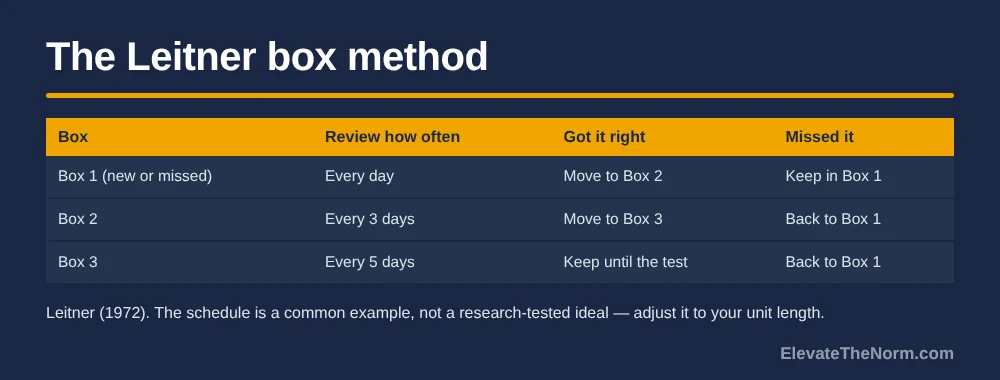
Here’s a three-box classroom version. The review schedule is a common example, not a research-tested ideal; adjust it to your unit length.
| Box | Review how often | When you get a card right | When you miss a card |
|---|---|---|---|
| Box 1 (new or missed) | Every day | Move it to Box 2 | Keep it in Box 1 |
| Box 2 | Every 3 days | Move it to Box 3 | Send it back to Box 1 |
| Box 3 | Every 5 days | Keep it in Box 3 until the test | Send it back to Box 1 |
Three envelopes or three rubber-banded piles work fine. The point is that the cards you know drift toward rare review, and the cards you don’t know keep coming back. A card shouldn’t leave the system just because it’s been right once.
What are the most common flash card mistakes?
Flipping too early. If students flip before they’ve committed to an answer, they’re recognizing, not retrieving. Require them to say the answer out loud, whisper it, or write it on scrap paper before flipping. If they can’t produce anything, that card goes in the “missed” pile, even if the answer looks familiar once they see it.
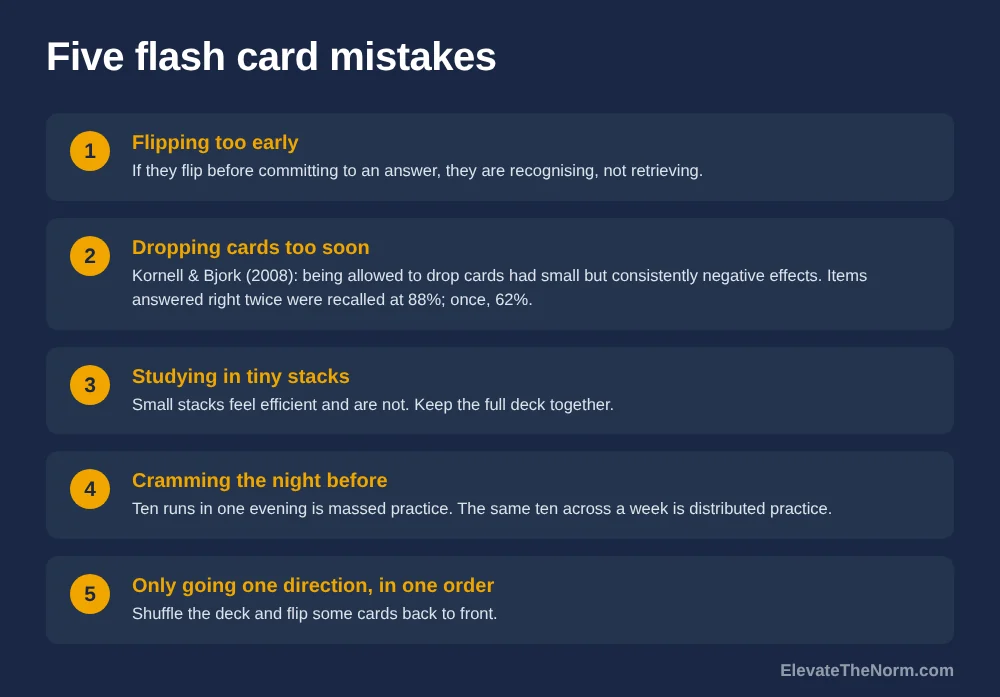
Dropping cards too soon. Nate Kornell and Robert Bjork’s 2008 paper in Memory studied the near-universal habit of setting aside cards you think you know. Across four experiments, being allowed to drop cards had small but consistently negative effects on learning. Participants usually dropped a card after a single correct answer. In one experiment, items answered correctly twice during study were recalled far better on the final test (88%) than items answered correctly once (62%). The lesson for students: one right answer means “move it to the next box,” not “done.”
Studying in tiny stacks. As the Kornell 2009 results showed, small stacks feel efficient and aren’t. Keep the full deck together, or at least use the biggest stack the student can manage.
Cramming the night before. Running the deck ten times in one evening is massed practice. The same ten runs spread across a week is distributed practice, the other high-utility technique in the Dunlosky review.
Only going one direction, in one order. Shuffle the deck and flip some cards back to front. Mixing topics in one deck is a small version of interleaving, which helps students tell similar ideas apart.
Paper or digital flash cards: which is better?
Either can work, and the research above is about how cards are used, not what they’re made of. Kornell’s experiments actually used online flash cards. What matters is whether the student retrieves before flipping, keeps missed cards in play and spreads practice out.
Paper cards have two advantages in a classroom: writing them by hand is one more pass through the material, and they don’t come with a device full of distractions. Digital cards are easier to share, carry and shuffle. Quizlet and Anki are two common options. Anki is open-source software, and its documentation says it schedules reviews with either a modified SM-2 algorithm or FSRS, which has been available since version 23.10. Both are spaced-repetition schedulers, so the app does the Leitner box sorting for you. Whatever the tool, watch for the same trap: tapping “I knew it” without producing the answer first.
How do I teach students to use flash cards in class?
Students won’t change their habits from a handout. They change from practicing the routine in class a few times. Here’s a routine you can run in about 10 minutes, two or three times a week during a unit.
- Make (first time only, 10–15 min). Students write 8–12 cards from today’s notes using the rules above. Spot-check three cards per student for “one question per card.”
- Self-test (3 min). Students go through the whole deck alone, writing or whispering each answer before flipping. Right cards go in one pile, missed cards in another.
- Partner quiz (4 min). Partners swap decks. The quizzer reads the front; the other student answers without seeing the card. Missed cards go back to their owner’s “missed” pile.
- Sort (1 min). Cards move between Leitner boxes or envelopes. Nothing gets thrown away.
- Reflect (1 min). Students write how many they got right today versus last time. This helps fight the false sense, seen in Kornell’s data, that the easier-feeling method is the better one.
Add new cards to Box 1 as the unit goes on, so the deck grows and old cards keep returning. By test day, students have run the deck many times across days without a cram night.
Clay’s take: grade the routine, not the cards
Assigning “make 20 flash cards” and collecting them for points mostly teaches students to copy definitions neatly. The cards aren’t the learning; the testing is. If you want to give credit, give it for the in-class self-test and the partner quiz, and let the deck stay with the student. Teach the “say it before you flip” rule the first week and enforce it every time you run the routine. And tell students up front that big stacks and spaced practice will feel slower. The research says they’ll think the other way is working better. Naming that ahead of time makes it easier for them to trust the method.
Who the flash card studies were actually run on
Name the population before you quote the numbers to a class. Kornell’s 2009 stack-size experiments and the Kornell and Bjork 2008 dropping experiments both used college students learning word pairs or GRE-style vocabulary. The Dunlosky review covers a wider span, but its strongest practice-testing evidence also leans heavily on undergraduates and on simple paired-associate material.
That matters in two directions. The mechanism — retrieval beats recognition, spacing beats massing — is one of the most robust findings in the field and does transfer. The specific figures do not. The 88 percent versus 62 percent gap for items answered right twice rather than once is a result from one experiment with college students and word pairs, not a prediction about your sophomores and the causes of the Civil War. Use it to justify the rule that a card does not leave the system after one correct answer. Do not use it to promise a score.
There is also a gap nobody has filled: almost none of this research compares flash cards against another good retrieval method in a secondary classroom. The honest claim is that cards are a cheap, well-understood way to get retrieval and spacing into a student’s own hands, not that they beat the alternatives.
What to do next week
Teach the flip rule and nothing else. One minute of instruction: say the answer out loud, whisper it, or write it on scrap paper before you turn the card over, and if nothing comes out, it goes in the missed pile even if the back looks familiar. That single rule converts a reading activity into a self-test, and it is the difference between the high-utility technique and the low-utility one.
Then build the boxes with them in class. Three envelopes, labelled, with the review schedule written on the front, made during the five minutes at the end of a period rather than assigned as homework nobody does. Grade the routine, not the cards: check on Friday that Box 1 has shrunk and that nothing has been thrown away. A student whose Box 3 is empty two days before the test has told you something useful, and so has a student whose Box 3 is full on day one.
Frequently Asked Questions
Are flash cards good for studying?
Yes, when students use them to test themselves. A 2013 review by Dunlosky and colleagues rated practice testing and distributed practice as the two highest-utility study techniques. Flash cards do both when students answer before flipping and spread practice over several days. Reading the front and immediately flipping is closer to rereading, which the same review rated low utility.
How do you make flash cards for studying?
Write one question per card, phrase the front as a question, and put a short answer in your own words on the back. Split long lists into separate cards. Make some cards in reverse, with the definition or an example on the front. Add why and example cards for big ideas so the deck tests understanding, not just recall of terms.
Should I study flash cards in small stacks or one big stack?
One big stack. In Kornell’s 2009 experiments, college students learned more from one stack of 20 cards than from four stacks of 5 cards, and 90% of participants did better with spacing. Small stacks feel faster because cards come back quickly, but that quick return is the massing that weakens long-term memory.
When should I take a card out of my flash card deck?
Later than you think. Kornell and Bjork (2008) found that letting learners drop cards had small but consistently negative effects, and most people dropped a card after one correct answer. Instead of removing a card, move it to a box you review less often, and only stop reviewing it after several correct answers on different days.
What is the Leitner box method?
The Leitner system, proposed by Sebastian Leitner in 1972, sorts flash cards into boxes. A correct answer moves a card to the next box, which is reviewed less often. A miss sends it back to Box 1, which is reviewed most often. It builds spaced practice into paper flash cards without any app.
Are digital flash cards better than paper ones?
Neither is clearly better. The research is about how cards are used: answering before flipping, keeping missed cards in play and spacing practice. Kornell’s 2009 experiments used online cards. Paper cards add a pass through the material when students write them and avoid device distractions; apps like Anki can schedule spaced reviews for you.
Why do my students say flash cards don’t work?
Often they flip too early, study tiny stacks, drop cards after one correct answer or cram the night before. Those habits feel productive but weaken learning. In Kornell’s 2009 study, most participants who noticed a difference thought massed study worked better even though spacing produced more learning. Teaching the routine in class helps.
Sources
- Dunlosky, J., Rawson, K. A., Marsh, E. J., Nathan, M. J., & Willingham, D. T. (2013). Improving students’ learning with effective learning techniques: Promising directions from cognitive and educational psychology. Psychological Science in the Public Interest, 14(1), 4–58. Used for the high-utility ratings of practice testing and distributed practice and the low ratings for rereading and highlighting.
- Kornell, N. (2009). Optimising learning using flashcards: Spacing is more effective than cramming. Applied Cognitive Psychology, 23, 1297–1317. Used for the stack-size design, recall percentages, the 90% figure and participants’ mistaken beliefs about massing.
- Kornell, N., & Bjork, R. A. (2008). Optimising self-regulated study: The benefits and costs of dropping flashcards. Memory. Used for the finding that dropping cards hurt learning and the one-versus-two correct answers comparison.
- Wikipedia contributors. (n.d.). Leitner system. Used for the origin of the method (Sebastian Leitner, 1972) and how cards move between boxes.
- Anki. (n.d.). What spaced repetition algorithm does Anki use? Used for the description of Anki’s two schedulers and when FSRS became available.