
A classroom seating chart is a deliberate plan for where every student sits and why — built around sightlines, access, documented needs, and the kind of work the room is doing that week. For grades 6–12 it is not a discipline tool and it is not decoration. It is the quietest piece of classroom management you own, and most of the research behind it was done on ten-year-olds.
That last part matters more than anything else in this article, so it goes near the top rather than buried in a caveat at the bottom. There is a real evidence base on classroom seating. It is genuinely useful. It is also overwhelmingly elementary, and the people quoting it at you usually do not say so.
What follows is what the research actually supports, where it stops, and how to build a chart for teenagers anyway.
Key Takeaways
- Assigned beats self-selected, and it is not close. The cleanest study on this found disruptions roughly doubled in groups and more than tripled in rows when students picked their own seats — though the sample was fifth graders.
- There is no best layout. Rows win for independent work. Semicircles get more questions asked. Groups support collaboration and hide free riders. Match the layout to the task, not to a philosophy.
- The evidence thins out badly above age 11. The main review of this literature says so outright: one study looked at teenagers, and none went past age 15.
- Documented needs are not one factor among many. If seating is written into an IEP or 504 plan, that goes on the chart before anything else does.
- Change the whole room, not one student. A chart that moves for everybody is housekeeping. A chart that moves for one kid is a public verdict on that kid.
- Some of the best seating in a room is not on the chart at all — and that is worth designing on purpose.
What a Classroom Seating Chart Is Actually For
A seating chart does four jobs. It puts every student where they can see and hear. It lets you reach anyone in the room quickly. It sets who talks to whom. And it removes a daily negotiation that costs you three minutes at the start of every period.
Notice what is not on that list: punishment. The moment a seating chart becomes the thing you rearrange when a student annoys you, it stops being a plan and becomes a consequence — an unpredictable, public one, applied at your discretion. That is the opposite of what a fair consequence looks like, and teenagers read it accurately and immediately.
It is also not a personality test. You will hear that certain students “are back-row kids.” They are not. They are students who were allowed to sit in the back row and found out nobody came to get them.
What the Research Actually Says — and Where It Stops
The standard reference here is Wannarka and Ruhl’s review in Support for Learning, which pulled together eight studies comparing rows, groups and semicircles. Their conclusion is refreshingly unglamorous: the nature of the academic task and the type of behaviour you want should dictate the seating arrangement. Rows produced more on-task behaviour for individual work and cut talking out of turn. Students asked their teacher significantly more questions in a semicircle than in rows. Grouped seating supported collaborative work.
Students who started with the lowest on-task behaviour improved most in rows. One special-school study in that review doubled on-task behaviour and cut the disruption rate by two thirds.
Then comes the part that rarely survives the journey into a blog post. The same authors state plainly that most of the studies they reviewed used participants aged seven to eleven, that only one examined teenagers, and that no study extended beyond age fifteen.
So when someone tells you “research shows rows increase on-task behaviour,” the honest completion of that sentence is “…in primary-aged children, mostly during independent seatwork, in studies largely conducted before your students were born.” That does not make it useless. It makes it a starting hypothesis for a fourteen-year-old rather than a finding about one.
The assigned-seating finding, with its actual numbers
The most-cited study on who chooses the seats is Bicard and colleagues in the Journal of Applied Behavior Analysis. Twenty-one fifth graders, a reversal design, four conditions crossing group-versus-rows with teacher-assigned-versus-student-selected. The results:
| Condition | Student-selected | Teacher-assigned |
|---|---|---|
| Group seating | 1.12 disruptions/min | 0.47 disruptions/min |
| Rows | 0.55 disruptions/min | 0.17 disruptions/min |
Roughly double in groups, more than triple in rows. The authors also say, in their own limitations, that the school was private, the group fairly homogeneous and relatively well behaved, and the tasks easy enough that academic effects may have been masked. Twenty-one ten-year-olds in one building is not a law of nature. It is one clean result pointing in an obvious direction.
Take the direction. Leave the certainty.
Four Layouts, and What Each One Is Actually For
Pick the layout that matches the work. If the work changes week to week, the layout should too — and saying that out loud to students is part of the job.
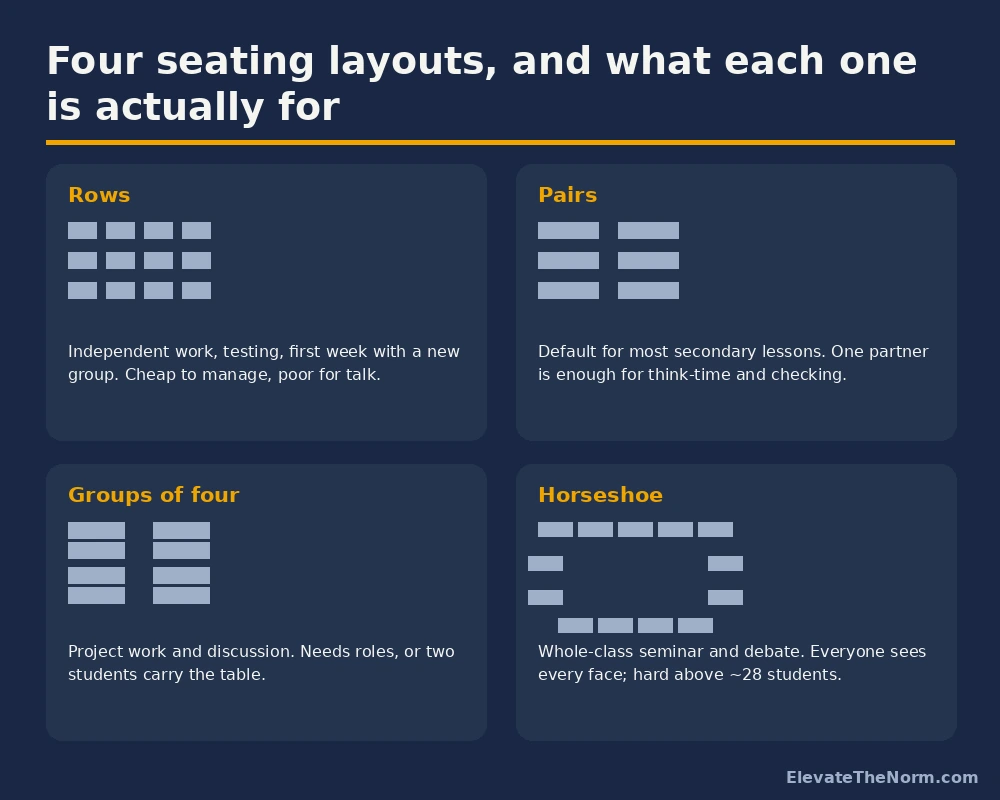
- Rows. Independent work, testing, and the first week with a group you do not know yet. Cheap to supervise, poor for talk, and the back row disappears if you let it.
- Pairs. The workhorse for most secondary lessons. One partner is enough for think-time, for checking an answer before it goes public, and for a student who will ask a neighbour what they will not ask you.
- Groups of four. Project work and sustained discussion. Requires defined roles, or two students will carry the table and the other two will learn that this is available to them.
- Horseshoe. Seminar, Socratic discussion, debate. Everybody can see every face, which changes the conversation completely. Gets difficult much above twenty-eight students and eats floor space.
Marx, Fuhrer and Hartig found German fourth graders asked more questions in a semicircle than in rows — a result summarised for teachers by Jo Earp alongside Robert Sommer’s older and still-correct point that there is no ideal layout for all activities. The same summary reports Gremmen and colleagues’ survey of fifty Dutch teachers: 48 percent used small groups, 40 percent used rows, and the researchers noted how little attention this gets in teacher training. That last observation is the one worth sitting with. Most of us were never taught this at all.
What a Secondary Seating Chart Has to Account For
Before aesthetics, before personality, before who talks to whom, six things constrain the chart. Get these right and the rest is preference.
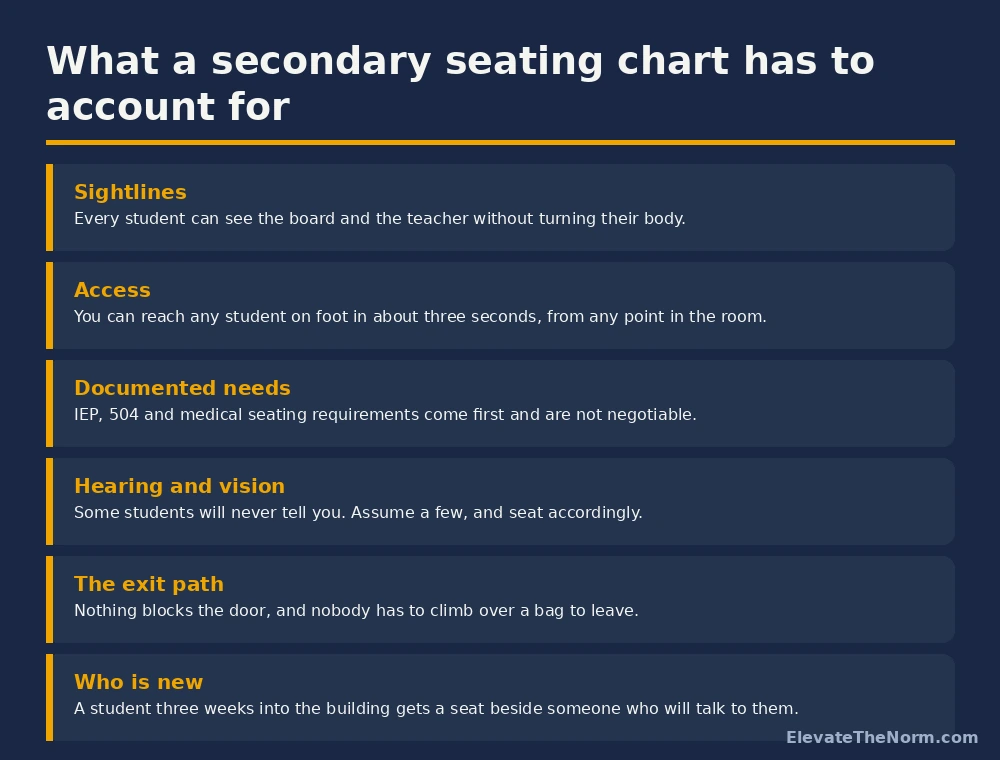
Documented needs come first. If a student has seating written into an IEP or a 504 plan, that is not one input among six — it is already decided, and you build the rest of the chart around it. Read the plans before you draw anything. This is the one item on the list where “I forgot” is not an available answer.
Sightlines. Every student should be able to see the board and the front of the room without twisting their torso. If a student has to turn their whole body to see you, they will stop turning, and you will read that as disengagement.
Access. You should be able to reach any student on foot in about three seconds from any point in the room. Draw your actual walking paths on the chart. Most teachers discover a dead zone they have not stood in since August.
Hearing and vision you do not know about. Some students will never tell you, some have not been screened, and some were screened years ago. Assume a couple in every section and seat accordingly rather than waiting to be informed.
The exit path. Nothing blocks the door and nobody climbs over a backpack to leave. This is a safety item, not a tidiness one.
Who is new. A student three weeks into the building gets a seat beside somebody who will actually talk to them. You know who those students are. Use them on purpose.
The Best Seat in My Room Is Not on the Chart
I built a whiteboard table for small-group work and put it in a corner under a lower lamp, on a rug, with better chairs than the rest of the room has. Students ask to go there.
That was the entire point. The standard worry about a pull-aside table is that it becomes the remediation table — the place everyone can see you get sent to. The fix is not a policy about who sits there and when. The fix is making it the most desirable spot in the room, so that being invited over reads as access rather than as a verdict.
Your seating chart governs the default. It should not govern every seat in the room for every minute. Build somewhere a student can be moved to that carries no sting, and a quiet redirect stops being a public event.
The rest of my room runs on tables pushed together in pairs and fours, which means working next to somebody is the resting state rather than a reward I hand out on Fridays. That is a choice about seating as much as it is a choice about instruction, and it connects directly to what a student-centered classroom looks like in practice.


How to Create a Classroom Seating Chart, Step by Step
Forty minutes once, then five minutes a month. Do it in this order, because each step constrains the next.
- Read the plans. Pull every IEP and 504 for the section and note any seating language before you draw a single box.
- Draw the room, not a grid. Door, board, windows, your desk, outlets, the cabinet everyone bumps into. The obstacles determine the layout more than the furniture does.
- Pick the layout from the unit, not the month. If the next three weeks are project work, start in fours. If they are individual writing, start in pairs or rows and say why.
- Place the constrained students first. Documented needs, then hearing and vision, then the newest students.
- Place the rest, and keep it boring. Alphabetical inside the constraints is defensible, fast, and impossible to argue with on day one.
- Walk it before you publish it. Stand at each seat. Anything you cannot see from there, they cannot see either.
- Tell them the rule. “This is the chart for the next three weeks. It changes for everybody, not for one person, and I will tell you before it does.”
Step seven is the one that does the most work and takes the least time. Naming the cycle in advance removes the interpretation that any future change is aimed at somebody. If you want the printable version of the room map and the chart grid, the free classroom seating chart template has both, with no email required.
When to Change It, and How to Change It Without Punishing Anyone
Change on a cycle you announced, not on a mood. Two to three weeks is long enough to be a fair test of an arrangement; two days is not.
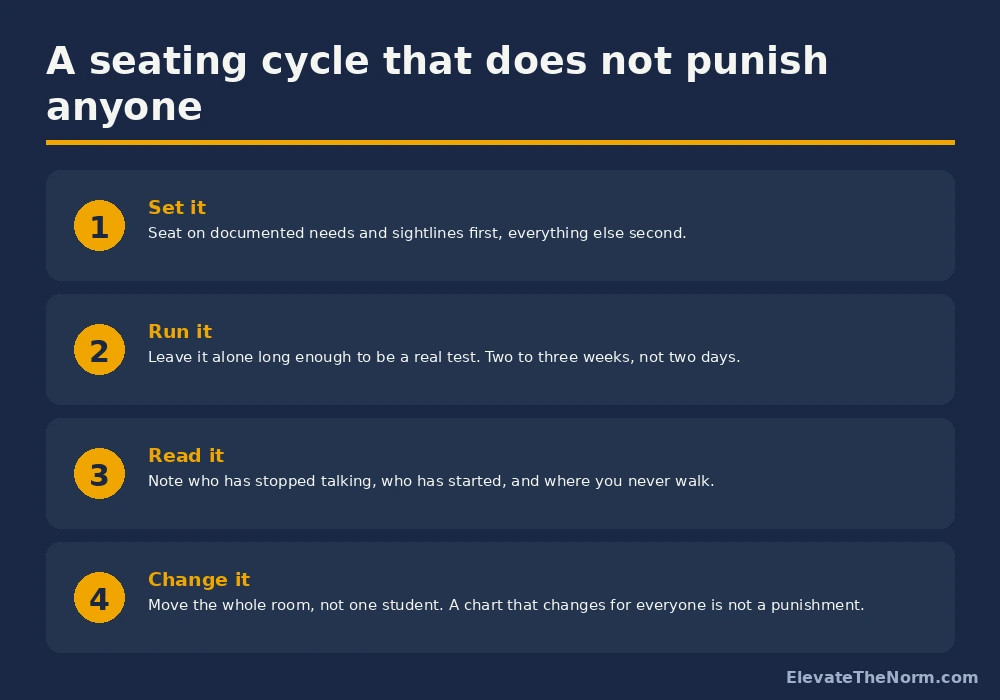
Between changes, pay attention to three signals. Who has stopped talking who used to talk. Who has started talking who never did. And which square metre of the room you have not walked into in a week — because somebody is sitting there, and you have quietly stopped teaching them.
When you do change it, move everybody. This is the single most useful rule in the article. A chart that reshuffles the whole room is administrative. Pulling one student to the front on a Tuesday is a sentence handed down in front of an audience, and every teenager in the room can read it. If a particular pairing genuinely is not working, you can still fix it — you just fix it inside a change that moves other people too, and you say nothing about why.
If a student asks to move, ask why before you decide. Sometimes the answer is “I can’t see,” which you want to know. Sometimes it is “my friend is over there,” which is a no, delivered without irritation. Either way, asking treats the request as reasonable, which is most of what respect in a classroom actually costs.
Five Ways Seating Charts Go Wrong in Secondary Classrooms
- Using it as a consequence. Covered above, and it is the most common one. It converts a planning tool into an arbitrary punishment.
- Setting it in August and never touching it. The room you planned for in August is not the room you have in November.
- Letting students pick “just this once.” Fine as a genuine, announced choice. Corrosive as a drift, because the chart then only exists on days you are annoyed.
- Seating by grades. A front row of high performers is visible to every student in the room and tells the rest exactly where they rank.
- Forgetting the plans. A chart that ignores documented seating is not a preference you defend later. Check first.
What to Do Next
Build one classroom seating chart this week for your hardest section — the one where the room feels like it is working against you. Read the plans first, draw the actual room, pick the layout from the work you have planned for the next three weeks, and tell the class the cycle out loud on the day you launch it.
Then leave it alone long enough to find out whether it worked. The most common mistake is not choosing the wrong layout. It is changing it so often, and so obviously in response to individual students, that nobody in the room — including you — ever learns what the arrangement was actually doing.
Frequently Asked Questions
How often should I change a classroom seating chart?
Every two to three weeks is a reasonable cycle for grades 6–12, and the exact number matters far less than announcing it in advance. Two weeks is long enough to find out whether an arrangement is actually working; two days is not. The one rule worth holding is that you change the whole room rather than one student, so a change never reads as a verdict on somebody.
Should students ever choose their own seats?
As a deliberate, announced choice — sure. On a Friday, for a specific activity, because you decided to. What causes problems is drift, where the chart quietly only applies on days you are frustrated. The evidence also points one direction: in Bicard and colleagues’ study of fifth graders, disruptions roughly doubled in group seating and more than tripled in rows when students picked their own seats. That was ten-year-olds in one private school, so treat it as a strong hint rather than proof about teenagers.
What do I tell a parent who asks why their child was moved?
Tell them the truth, which should be boring: the class changes seats on a cycle, everyone moved, and the arrangement is built around sightlines, access and any documented needs. If you have been following the change-everybody rule, this conversation is genuinely easy. If you moved one student in isolation because of behaviour, it will not be, which is a good reason not to do that. Never discuss another student’s needs or plan with a parent who is not theirs.
How do I handle seating when five different sections use the same room?
Keep the furniture layout stable and change only the chart. Rearranging tables five times a day is not sustainable and you will stop doing it by October. Pick a furniture arrangement that serves the majority of your teaching — for most secondary teachers that is pairs or fours — and let each section have its own seating chart on top of it. Keep the charts somewhere you can see them in three seconds, not buried in a binder.
Does a seating chart matter if my room has tables instead of individual desks?
More, not less. Tables mean students are already positioned to talk, so who sits together does more work than it does in rows. The layout questions change — you are deciding group composition rather than distance — but sightlines, access, documented needs and the exit path are identical. A room built for collaboration still needs someone deciding who collaborates with whom.
How do I know whether the seating chart is actually working?
Watch three things across a cycle. Whether students who used to contribute have gone quiet, whether students who never contributed have started, and where in the room you have physically not walked in the past week. That last one is the most useful and the least comfortable: an area you avoid is an area whose students are getting less of you. None of this requires data collection beyond paying attention on purpose.
What should I leave for a substitute?
A current chart, clearly dated, with nothing on it that reveals a student’s plan or needs — a sub does not need to know why a seat is assigned, only that it is. Add one line saying the seats are assigned and are not up for negotiation that day. Most of what goes wrong for substitutes in a secondary room starts with students relocating in the first two minutes.
Sources
- Wannarka, R., & Ruhl, K. (2008). Seating arrangements that promote positive academic and behavioural outcomes: A review of empirical research. Support for Learning, 23(2), 89–93. Full text (PDF) · ERIC record
- Bicard, D. F., Ervin, A., Bicard, S. C., & Baylot-Casey, L. (2012). Differential effects of seating arrangements on disruptive behavior of fifth grade students during independent seatwork. Journal of Applied Behavior Analysis, 45(2), 407–411. Full text (PMC)
- Earp, J. (2017, March 16). Classroom layout — what does the research say? Teacher Magazine, Australian Council for Educational Research. Read the summary — the source for the Marx, Fuhrer and Hartig (1999), Sommer (1977) and Gremmen et al. (2016) findings described above, which were read here as a summary rather than in the original papers.
- Terada, Y. (2025, August 18). Research-based tips for optimal seating arrangements. Edutopia. Read the article
- Marx, A., Fuhrer, U., & Hartig, T. (1999). Effects of classroom seating arrangements on children’s question-asking. Learning Environments Research, 2, 249–263. Journal record
Every link above was checked on September 12, 2026. Where a finding is described from a summary rather than the original paper, the Sources list says so.