By Clay Shumate
Small group instruction in middle and high school works when being called to the table reads as a privilege instead of a diagnosis. That means three things: everyone goes, including your strongest students; nobody gets announced; and the table itself is the best seat in the room. Below are two ready-to-run systems built on that rule — one for middle school and one for high school — because a sixth grader and a senior want very different things from the same ten minutes.
Small group is where a lot of the real teaching happens and also where a lot of the stress sits. Teachers are told to pull groups every day, and then they watch a fourteen-year-old slump in his chair on the walk over because everyone in the room knows what that walk means. This page is about fixing the walk.
Key Takeaways
- The problem is status, not content. Teenagers are more sensitive to status and respect than younger children, and a small group that looks like the low group gets treated like one.
- Everyone goes, every cycle. If your top students never sit at the table, every student who does sit there has been labeled.
- Middle school: The Studio. A class-named table, quiet invitation cards, and three session types — including a Sneak Peek that lets students see tomorrow’s material before anyone else.
- High school: Consults. Booked ten-minute slots that run like office hours. The schedule is public; the reason each student is there is not.
- Check your roster every two weeks. The same five names three cycles in a row means you have built a fixed low group, which is the version the evidence warns against.
Free Download · PDF
Small Group Instruction Toolkit
Two pages: eight cut-apart invitation cards for The Studio, a ten-slot consult booking sheet for high school, and a private teacher tally for catching a fixed low group early.
Free. No email address required. Designed for grades 6–12. Browse every printable in Your Free Library.
Why Does Small Group Instruction Stop Feeling Okay After Elementary School?
Because the walk to the table becomes public information about who is struggling, and adolescents are built to notice that kind of information.
In elementary school, reading groups are just how the day works. By middle school, students start doing the math on who gets pulled and why. David Yeager, Ronald Dahl and Carol Dweck put the developmental piece plainly: compared to younger children, middle adolescents “show a greater sensitivity to status and respect, resulting from pubertal maturation.” They also warn that anything that feels like talking down — repeating what students think they already know — “may come across as infantilizing and therefore disrespectful.” A small group that feels like a remedial pull-out hits both nerves at once.
The help-seeking research points the same direction. Ryan, Hicks and Midgley found that students focused on social status and on looking capable were more likely to avoid asking for help and to see it as a threat to their self-worth, and that lower-achieving students with those goals avoided help the most. That sample was fifth graders, so read it as the pattern forming, not as a secondary-school result. A later conference paper from the same Michigan research group, surveying 968 seventh graders, found that when students believed their teacher took care not to embarrass students who had difficulty, they were less likely to avoid seeking help. It is a conference paper rather than a peer-reviewed article, and it is correlational. But it names the lever precisely: not embarrassing anyone is not a nice extra. It is the condition that makes help usable.
So the design problem is not “how do I teach a small group.” Most teachers know how. It is “how do I make going to the table cost a student nothing in front of their friends.”
What Does the Research Say About Grouping in the First Place?
Grouping inside a class helps a little, and the risk is almost entirely in groups that never change.
A second-order meta-analysis by Steenbergen-Hu, Makel and Olszewski-Kubilius, pulling together a century of studies, found that students benefited from within-class grouping and from cross-grade subject grouping, while sorting students into separate classes by ability without changing the curriculum did not change achievement. A review chapter by Ed Baines summarizes the within-class finding as small positive effects “with students at all levels benefiting.”
The Education Endowment Foundation’s toolkit is more cautious, and you should hear it. It estimates within-class attainment grouping at about two months of additional progress, rates the evidence as “very limited” (22 studies), and warns that lower-attaining students can suffer from lower teacher expectations and lasting damage to their attitudes. Its fix is the one both systems below are built on: group flexibly, so students know ability is not fixed.
That is the honest summary. Small groups are not magic. Small groups that turn into a permanent low table are a real harm. Everything below is designed to stay on the right side of that line.
What Is the One Rule Under Both Systems?
The table has to be a place students want to be, and every student has to end up there.
My room runs as a workshop. Students are almost always working alongside somebody, and I pull people to a whiteboard table I made. It sits in a corner under a lower lamp, with a rug and nicer chairs than the rest of the room. You want to go there with me. Students ask.
That last part is the whole point. I did not solve the “dumb table” problem with a policy or a speech about growth. I solved it by making the table the best seat in the room. The two systems below are built out from that idea for two very different age groups. Neither one needs a budget. A lamp, a rug and a table students can write on go a long way; a lamp-lit corner does more for the mood of a small group than any sentence you can say about it.
Three rules hold for both:
- Everyone goes. Every student, every two-week cycle, including the ones who do not need help. Their visits are real — a challenge or a preview — not a decoy.
- Nobody is called across the room. No names read aloud. Notes, cards, a booked slot. The call is private; the table is visible.
- The rest of the room runs without you. If the other twenty-five students need you every ninety seconds, small group collapses. Post what everyone else is doing before the first student sits down.
How Do You Make Small Group Instruction Cool in Middle School?
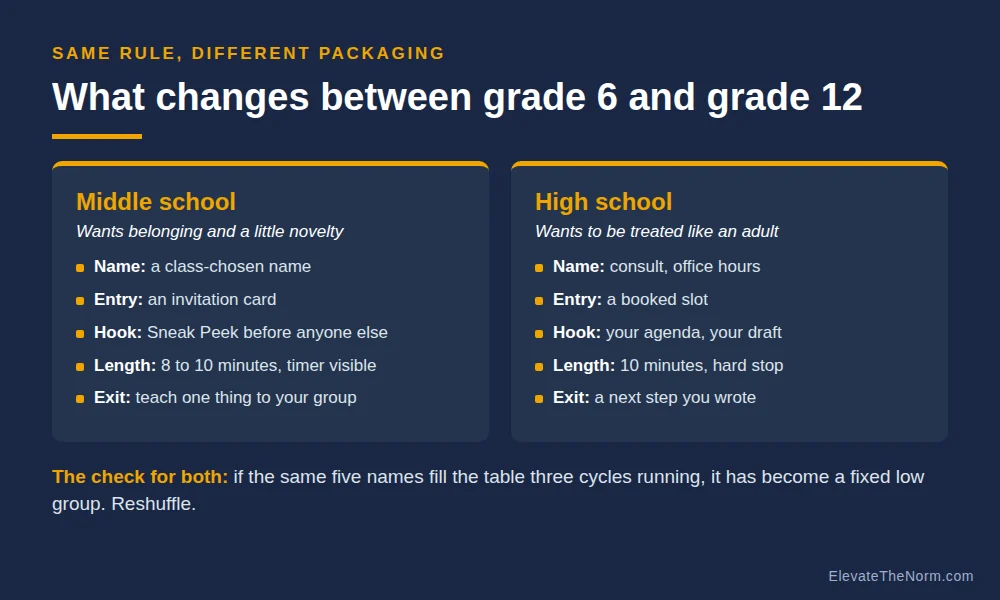
Run it as The Studio: a class-named table you get invited to, with sessions that sometimes let you in on something before anyone else.
Middle schoolers want to belong, want a little novelty, and are acutely aware of fairness. The Studio leans into all three.
1. Let the class name the table
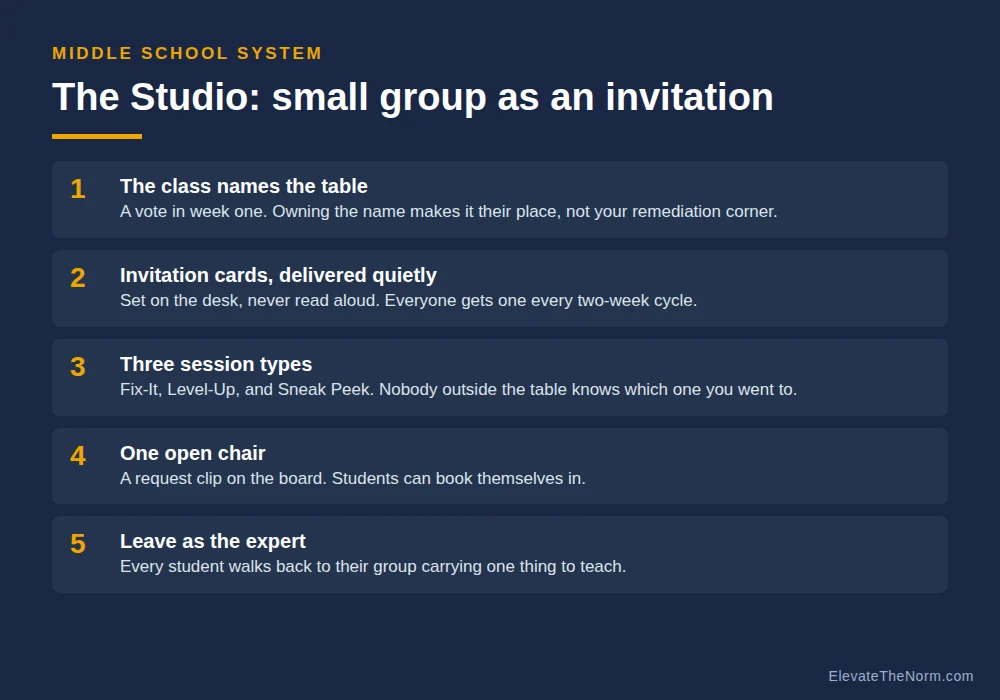
In the first couple of weeks, put three or four names on the board and let classes vote. “The Studio” is a fine default; students will come up with better ones. It sounds small. It is not. A place with a name the students chose is their place. A place the teacher calls “my reteach table” is yours, and everyone knows what it is for.
2. Invitations, not call-outs
Print a stack of small cards — “You’re invited to The Studio. Round 2, today.” — and set one on a student’s desk while you circulate. Middle schoolers like getting a card. Nobody else hears a name, and the student gets a minute of warning instead of being yanked out of whatever they were doing.
3. Three kinds of session, and nobody outside knows which
- Fix-It. The reteach. Something from an exit ticket or a confusion flag that three or four students missed.
- Level-Up. A harder version of today’s task for students who are ready. This is what makes your strongest students regulars.
- Sneak Peek. Ten minutes on tomorrow’s material before the class sees it. This is the status flip. The students who went walk into tomorrow’s lesson already knowing the vocabulary and the first example, and they get to be the ones with their hands up. Pre-teaching is also one of the kindest things you can do for a student who usually lags, and it never looks like help.
The card never says which kind it is. From the outside, all three look the same.
4. Table privileges
The Studio should be physically better than a desk. Students write directly on the whiteboard surface with markers — middle schoolers will do almost any math problem if they are allowed to write it on a table. Better chairs. The lamp. A visible timer set to eight or ten minutes so everyone, including you, knows the session ends.
5. One open chair
Keep one seat that students can request. A clip or a sticky note on the board: “Save me a seat.” When students start booking themselves in, you have won. That chair is also your honesty check — if nobody ever asks for it, the table is not yet a place anyone wants to be.
6. Leave as the expert
Every student walks back to their table group carrying one thing to explain. “Tell your group the two ways we found to check this.” They come back from The Studio as the person who knows something, not the person who was missing something. If your room is already arranged around partner work and groups of four — the site’s guide to seating charts covers layouts — this step costs nothing.
How Do You Make Small Group Instruction Work in High School?
Run it as Consults: booked ten-minute meetings that work like a professor’s office hours, where the student brings the agenda.
High schoolers do not want a cute name or a card. They want to be treated like adults, and a small group that feels like fourth-grade reading circle will be resisted with their whole body. So borrow the language and structure of how adults actually get help: office hours, a coach’s film session, a design critique, a one-on-one with a manager.
1. Booked, not pulled
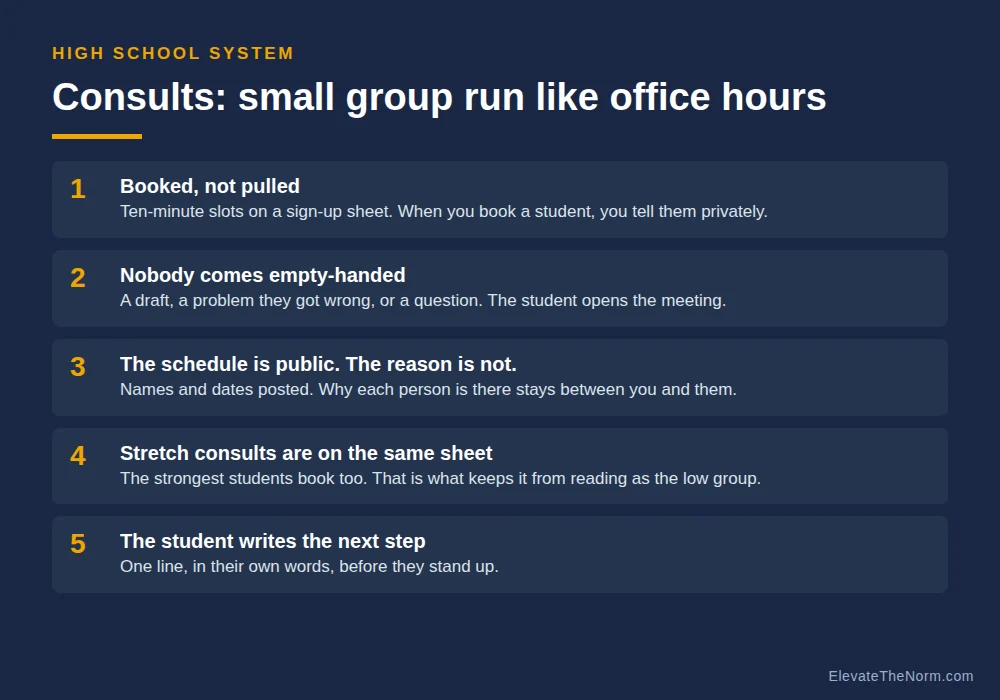
Post a sign-up sheet — paper on the wall or a simple form — with ten-minute slots for each day of the cycle. Students can book themselves. When you book a student, tell them privately: a note on their paper, a message through your learning platform, a quiet word while you circulate. “I put you down for Thursday, second slot. Bring your thesis.” That is how an adult schedules a meeting with another adult.
2. Nobody comes empty-handed
The price of a consult is bringing something: a draft, a problem you got wrong, a question you could not answer. The student talks first for the opening minute or two — what they brought and where they are stuck. This is the autonomy piece, and it matters. The Yeager, Dahl and Dweck review notes that whether adolescents felt an intervention supported their autonomy changed whether it worked. A consult where the student sets the agenda feels like their meeting. A reteach where you repeat the lesson at closer range feels like being talked down to.
3. The schedule is public; the reason is not
Post who is booked and when. Names and dates, nothing else. Everyone can see that the strongest student in the room is booked Tuesday and the quiet kid in the back is booked Wednesday and there is no visible difference between those two facts. Why each person is there stays between you and them.
4. Stretch consults on the same sheet
Your strongest students book consults too — for a harder problem, feedback on an ambitious draft, a question that goes past the unit. This is the single most important design choice in the whole system. If only struggling students ever sit down, the sheet becomes a list of who is struggling, and every protection above falls apart.
5. The student writes the next step
Before they stand up, the student writes one line in their own words: what they will do next and by when. Not your summary of what they should do — theirs. It is short, it is theirs, and it is the only record the consult needs. If you want students getting better at judging their own work, the site’s piece on self-assessment during group work pairs well with this.
6. Talk to them like colleagues
No cheerleading, no “great job, buddy.” Tell them what is working, what is not, and what you would do next if it were your draft. Respect in the classroom is mostly this: talking to a seventeen-year-old about their work the way you would want someone to talk to you about yours.
How Do You Fit This Into a Real Class Period?
One or two sessions a day, ten minutes each, on a two-week cycle.
Do the arithmetic before you promise anything. A class of 28 in groups of three or four is roughly eight sessions per cycle. Over ten school days, that is one session most days and two on a few. That fits. Three sessions a day, every day, does not fit anyone’s real schedule, and a system you drop in October helps nobody.
Use a short routine for the rest of the room: a posted task with a clear finish line, a “what to do when you are stuck” list that does not start with walking up to the table, and a rule that the table is not interrupted except for emergencies. Practice it for the first week with a two-minute session so the room learns to run without you. Clean transitions matter here more than almost anywhere else; every minute lost moving students to the table comes out of the session.
Decide who goes from evidence, not from memory. An exit ticket or a quick check sorted into piles tells you who needs a Fix-It, who is ready for a Level-Up, and who would benefit from a Sneak Peek. The site’s formative assessment strategies for reading describes a sort-don’t-mark routine that feeds straight into this.
What Are the Signs the Table Has Become the Low Group?
Same names, same kind of session, three cycles in a row. Keep a simple tally — name, date, session type — and look at it every two weeks. Four warning signs:
- The same five students fill most of the seats. That is a fixed group, and it is the version the EEF warns can depress attitudes and expectations.
- Your top students have not been in weeks. Book them. A Level-Up or a stretch consult is a real session, not a favor.
- Nobody uses the open chair or books themselves. The table is not yet desirable. Fix the table before you fix the students.
- You are reteaching the whole lesson at the table. Ten minutes is for one sticking point. If the whole lesson did not land, that is a whole-class problem, and it belongs to the whole class tomorrow.
One more boundary: The Studio and Consults are classroom instruction. They do not replace small-group services written into an IEP or a 504 plan, and a student’s visits should not be counted as those services unless the plan and your case manager say so.
Where Does the Evidence Run Out?
Nobody has run a trial on invitation cards or booking sheets. The two systems here are designs built from well-supported principles — adolescents’ sensitivity to status and respect, the link between feeling safe from embarrassment and seeking help, and the case for flexible over fixed grouping. The individual features are not tested interventions, and you should treat them as a starting point to adjust, not a protocol.
The grouping evidence itself is also thinner than it sounds. The EEF rates it very limited. The meta-analytic finding is small and positive. The help-seeking studies are correlational, one is on fifth graders, and one is a conference paper. What the evidence does support, fairly consistently, is the direction: teenagers avoid help that costs them status, and groups that never change carry real risk. Both systems are built to push against exactly those two problems.
What Should You Do Next?
Pick the system for your grade band and start small. Name the table or post the booking sheet this week. Run one session a day for two weeks with at least two of your strongest students in the rotation. At the end of the cycle, look at your tally and at the open chair. If students are asking to come, keep going. If they are not, change the table before you change anything else.
Related reading on this site: student voice and choice for how much control to hand students, and high expectations for students for why a table everyone attends is a statement about what you expect from all of them.
Before you go: grab the free Small Group Instruction Toolkit (PDF) — ElevateTheNorm.com branded, printable, no email required.
Frequently Asked Questions
What is small group instruction in middle and high school?
It is a short, focused session with three or four students while the rest of the class works independently. In grades 6 to 12 it usually runs eight to ten minutes and targets one sticking point, a challenge task, or a preview of upcoming material. The difference from elementary school is less about content and more about how students feel walking to the table.
How do I stop students from feeling singled out when I pull a small group?
Three things. Put every student in the rotation, including your strongest, so being called says nothing about ability. Call students privately with a card, a note or a booked slot instead of reading names aloud. And make the table the most comfortable seat in the room so going there reads as a privilege.
What if my high school students refuse to come to the table?
Refusal usually means the table still looks like the low group. Switch to booked consults, let students set the agenda by bringing their own draft or question, and make sure your top students are visibly on the booking sheet. If a student still declines, offer them a different slot rather than insisting in front of the class.
How often should each student get small group time?
Once every two-week cycle is a realistic floor for a class of about 28. That works out to roughly eight sessions of three or four students, or about one session a day. Students who need more can come more often, as long as the rest of the class still rotates through.
What does the rest of the class do during small group instruction?
A posted task with a clear finish line, a short list of what to do when stuck that does not start with interrupting the table, and a rule that the table is only interrupted for emergencies. Practice the routine with very short sessions during the first week so the room learns to run without you.
Is ability grouping bad for students?
Fixed ability groups carry real risk, especially for lower-attaining students, whose expectations and attitudes can suffer. Flexible groups that change based on recent evidence show small positive effects in the research, though the evidence base is limited. The practical rule is to group by what students need this week and to reshuffle constantly.
Can small group sessions count toward IEP or 504 services?
Not automatically. These sessions are general classroom instruction. If an IEP or 504 plan specifies small-group services, check with the case manager about what counts and how it is documented before treating any classroom session as meeting that requirement.
Sources
- Yeager, David S., Ronald E. Dahl, and Carol S. Dweck. “Why Interventions to Influence Adolescent Behavior Often Fail but Could Succeed.” Perspectives on Psychological Science, vol. 13, no. 1, 2018, pp. 101–122. https://pmc.ncbi.nlm.nih.gov/articles/PMC5758430/
- Ryan, Allison M., Lynley Hicks, and Carol Midgley. “Social Goals, Academic Goals, and Avoiding Seeking Help in the Classroom.” Journal of Early Adolescence, vol. 17, no. 2, 1997, pp. 152–171. Sample: 443 fifth graders. https://deepblue.lib.umich.edu/items/485258a6-d9dc-4464-b205-fd8faa0b8b70
- Friedel, Jeanne, Roxana Marachi, and Carol Midgley. “‘Stop Embarrassing Me!’ Relations Among Student Perceptions of Teachers, Classroom Goals, and Maladaptive Behaviors.” Paper presented at the American Educational Research Association annual meeting, New Orleans, 2002. Sample: 968 seventh graders. https://public.websites.umich.edu/~pals/AERA2002%20handout.pdf
- Steenbergen-Hu, Saiying, Matthew C. Makel, and Paula Olszewski-Kubilius. “What One Hundred Years of Research Says About the Effects of Ability Grouping and Acceleration on K–12 Students’ Academic Achievement.” Review of Educational Research, 2016. Summary read via Duke University: https://today.duke.edu/2016/12/new-analysis-finds-two-measures-boost-k-12-academic-achievement
- Baines, Ed. “Ability Grouping.” Review chapter, UCL Institute of Education (2nd ed.). https://discovery-pp.ucl.ac.uk/10086616/1/EdBaines-AbilityGrouping-2ndEditionFinal1.pdf
- Education Endowment Foundation. “Within-Class Attainment Grouping.” Teaching and Learning Toolkit. https://educationendowmentfoundation.org.uk/education-evidence/teaching-learning-toolkit/within-class-attainment-grouping