By Clay Shumate
Positive reinforcement in the classroom means responding to a behavior you want repeated in a way that makes it more likely to happen again — most often by naming the specific thing a student did. It is cheap, it is fast, and the formal evidence behind it is thinner and far more elementary-weighted than most training sessions admit.
Almost every classroom management book tells you to catch students being good. Far fewer tell you how much of that advice has actually been tested on teenagers, what the real numbers are, or where the research stops and the folklore starts. This page does that, and then gives the moves that survive the scrutiny.
Key Takeaways
- Positive reinforcement is research-based, not evidence-based, by the field’s own standard. A review that screened 7,016 articles found 11 methodologically sound studies of teacher praise — short of the 20 experiments the What Works Clearinghouse threshold requires, so the authors declined to call it an evidence-based practice.
- 🔴 The most-quoted praise statistic comes from elementary schools. The “20 to 30 percent more on-task” figure was measured in 19 elementary schools with students aged 5 to 12, and it describes a relationship across classrooms rather than a causal test.
- There is one real secondary study, and it is encouraging and small. Across four high school classrooms, frequent praise raised on-task behavior about 31 percent over baseline and cut disruption by nearly 20 percent — with reprimands untracked, so part of that gain may belong to the reprimands that stopped.
- Praise and reward programs are not the same intervention and they point in opposite directions. In one 128-study meta-analysis, expected tangible rewards came in at d = −0.36 on free-choice motivation while verbal praise came in at d = +0.33.
- The famous praise-to-reprimand ratios are close to folklore. Of the 11 sound studies in that evidence review, only two manipulated a ratio at all, and neither was designed to test a recommended one.
Free Download · PDF
Praise Rate & Distribution Tally Sheet
A two-page printable: count your specific-praise rate across one week of classes, then tally which students are actually receiving it. Most teachers who run the second page find the answer uncomfortable.
No email address required.
What Is Positive Reinforcement in the Classroom?
Positive reinforcement is adding something after a behavior that makes the behavior more likely next time. In a classroom that usually means specific verbal recognition — naming what a student did — rather than a sticker, a point, or a prize.
The research literature narrows it further. Behavior-specific praise, the form that has actually been studied, is defined in the largest review of it as praise that “describes what the individual has done well.” Not “nice work.” Not “thank you.” Something closer to you cited the document in your second paragraph instead of summarizing it. The specificity is the active ingredient, because it tells the student which part to do again.
That distinction matters more than it sounds. Most of what passes for positive reinforcement in a secondary building is a points economy, a reward store, or a class-wide prize. Those are a different intervention with a different research base, and as the next sections show, a different sign.
Is Positive Reinforcement Actually Evidence-Based?
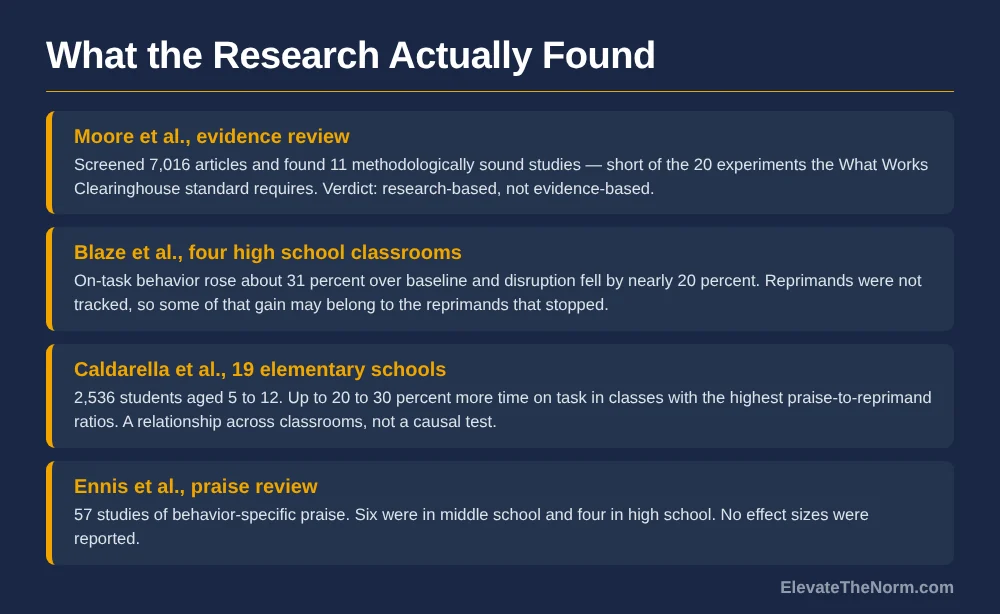
Not by the field’s own threshold. A systematic evidence review of teacher praise concluded that “there is currently insufficient evidence to identify teacher praise as an evidence-based practice,” calling it a research-based practice instead. That distinction matters before anyone builds a schoolwide initiative on it.
The arithmetic behind that verdict is blunt. The reviewers screened 7,016 articles, read 100 in full, found 30 eligible studies, and judged 11 of them methodologically sound. The What Works Clearinghouse standard they applied asks for 20 qualifying experiments. Eleven is not twenty, so praise did not clear the bar — not because it failed, but because not enough rigorous studies exist. The authors also flag publication bias directly, noting that researchers are “less likely to submit for publication results of studies with negative or neutral effects.”
The largest descriptive review tells the same story from a different angle. It covers 57 studies of behavior-specific praise published across five decades in 27 journals, with 1,947 student participants. Of those 57 studies, 56 used single-case or other quasi-experimental designs and exactly one was a randomized controlled trial. The authors report no effect sizes at all — they summarize results as positive by author report, with 48 of 50 studies showing positive adult outcomes and 31 of 36 showing positive student outcomes.
So the honest statement is this: a large, consistent, methodologically modest body of work says praising students specifically tends to help, and nobody has yet produced the volume of controlled experiments that would let you put a confident number on it.
For anyone deciding at district scale, that verdict should change what you buy rather than what you encourage. Teachers naming specific behaviors costs nothing and carries no realistic downside, so there is no reason to discourage it. A purchased praise curriculum, a paid tracking platform, or a staffing line justified by “the research on praise” is a different proposition, and this evidence base will not carry that weight. Encourage the practice; do not procure against it.
How Much Does Praise Actually Change Behavior in Grades 6–12?
In the one study run in high school classrooms, frequent praise raised academically engaged behavior roughly 31 percent above baseline and cut disruptive behavior by nearly 20 percent. That is a large change. It also comes from four classrooms in one district, so treat it as promising rather than settled.
Here is what the main studies actually measured, side by side, because the differences between them are where teachers get misled:
| Study | Who was in it | What it found | The catch |
|---|---|---|---|
| Blaze et al., high school praise comparison | 4 high school classrooms, 16–25 students each, ages 14–16, one rural district | On-task behavior up about 31% over baseline; disruption down nearly 20% | Reprimands were never tracked, so the praise and the drop in reprimands are tangled together |
| Caldarella et al., praise-to-reprimand ratios | 2,536 students, 151 classes, 19 elementary schools, ages 5–12 | Classes with the highest ratios spent 20–30% more time on task than those with the lowest | Correlational across classrooms, and the students are half the age of the ones this site writes about |
| Ennis et al., behavior-specific praise review | 57 studies, 1,947 students, early childhood through high school | 86% of student-outcome studies positive; 96% of adult-outcome studies positive | No effect sizes reported; only 6 middle school and 4 high school studies in the whole set |
| Moore et al., evidence review | K–12, general and special education, students without severe disabilities | Mixed evidence; praise rated research-based | Only 11 of 30 eligible studies were methodologically sound |
Read that table and the pattern is obvious. The biggest, most quotable number in the field — 20 to 30 percent more on-task — was measured on children aged five to twelve. The grades 6–12 evidence is four classrooms. Anyone who hands you the elementary figure as though it were a secondary one is not lying, but they have not read the population line.
Why Do Reward Programs Stop Working When Praise Does Not?
Because they are opposite interventions. In a meta-analysis of 128 studies, expected tangible rewards reduced free-choice intrinsic motivation at d = −0.36 across 92 studies, while verbal praise raised it at d = +0.33 across 21 studies. Same analysis, same outcome measure, opposite sign.
This site has already argued that rewards and motivational speeches have an expiration date, and that argument is not in tension with this one — it is the same finding stated from the other end. The thing that expires is the prize you promised in advance. Telling a student exactly what they did well is not a prize, costs nothing, and does not create the obligation that makes the prize necessary next time.
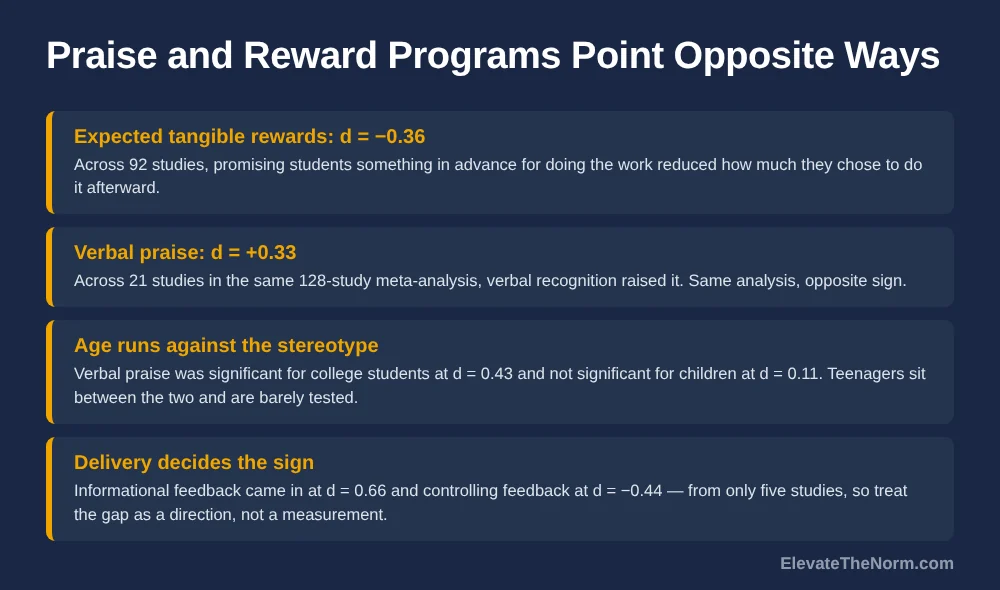
Two details inside that meta-analysis are worth more than the headline. First, the age pattern runs against the stereotype that teenagers are too old for praise: verbal rewards produced a significant effect for college students (d = 0.43, 14 studies) and a non-significant one for children (d = 0.11, 7 studies, confidence interval crossing zero). The authors state plainly that verbal rewards are less likely to help children than older individuals. Teenagers sit between those two groups and have barely been tested directly — but nothing here suggests they age out of it.
Second, how you say it appears to matter more than whether you say it. In the authors’ follow-up review, informational feedback came in at d = 0.66 while controlling feedback — praise delivered as pressure, the that’s what I like to see, keep it up register — came in at d = −0.44. That gap is dramatic and it rests on five studies, so take it as a direction worth respecting rather than a measurement to quote.
That second finding is also the reason teenagers are right to be suspicious of praise that sounds rehearsed. A class can tell the difference between a teacher describing something they noticed and a teacher running a technique on them, and the sign on the effect appears to flip when it reads as the second one. If you cannot say what the student specifically did, the honest move is to say nothing rather than to produce warmth you do not mean. Specific beats enthusiastic, and sincere beats both.
Should You Praise a Teenager in Front of the Class?
The evidence says it makes less difference than teachers fear. In the one direct comparison run in high school classrooms, public and private praise both beat no treatment and showed “no statistical or clinically significant differences” from each other. Both raised engagement; neither was clearly better.
That study is small — four teachers, one district, ages 14 to 16 — and it should not end the argument. Plenty of secondary teachers can name a student who visibly hated being singled out, and the widespread advice to praise teenagers quietly comes mostly from student preference surveys rather than from experiments measuring behavior. Preference and effect are different questions, and here they may genuinely have different answers.
The practical reading: if you have a student who you know curls up under public attention, say it quietly or on paper, and lose nothing measurable by doing so. For everyone else, use whichever is faster, because the research gives you no reason to pay a time cost for privacy.
What Praise-to-Reprimand Ratio Should You Aim For?
There is no ratio the research supports well enough to chase. The 3:1, 4:1 and 5:1 targets in circulation are recommendations, not findings. In the evidence review of 11 methodologically sound praise studies, only two manipulated a ratio at all, and neither set out to test a recommended one.
What the correlational elementary work does suggest is a direction rather than a target. In those 19 elementary schools, on-task behavior still reached 60 percent when praise merely equaled reprimands, and the researchers suggested 2:1 or higher would do better. Notably, no significant difference appeared between 3:1 and 4:1 — which is roughly what you would expect if the ratio is a proxy for something simpler.
That something simpler is probably rate. The behavior-specific praise review found that before training, most teachers delivered 0 to 2 praise statements in 30 minutes. A teacher at that baseline does not have a ratio problem that precision will fix; they have a near-total absence of the behavior. Going from one praise statement a period to ten is a change you can actually make on a Tuesday. Going from 3.2:1 to 4:1 is a spreadsheet exercise.
My read, as someone who teaches teenagers: track your rate for a week before you think about your ratio, and expect the rate to be the thing that was broken.


How Do You Run Positive Reinforcement in a Secondary Classroom?
Start by raising how often you name specific behaviors, keep it informational rather than controlling, and stop promising rewards you will not reliably deliver. The five moves below are ordered by how little they cost you.
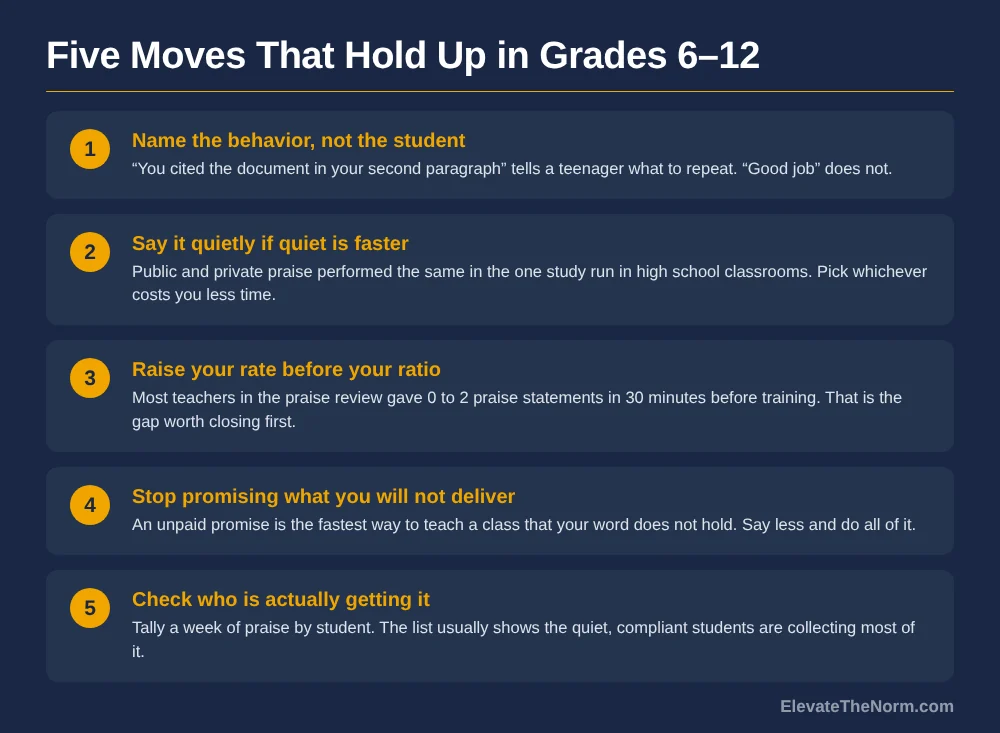
- Name the behavior, not the student. “You cited the document in your second paragraph” gives a teenager something to repeat. “Good job” gives them nothing, and by the research definition it is not behavior-specific praise at all.
- Say it quietly when quiet is faster. Public and private praise performed the same in the one secondary study available. Use that freedom to pick whichever interrupts your lesson less.
- Raise your rate before your ratio. Count your praise statements across one class period. If the number is under five, the fix is frequency, not arithmetic. You cannot reliably count your own while teaching — the high school study used a vibrating prompt on a two-minute interval, and the cheap equivalents are a silent phone timer or asking a colleague with a free period to sit in and tally.
- Stop promising what you will not deliver. An unpaid promise teaches a class that your word does not hold, which costs you more than the reward ever bought. Respecting students is mostly standing by what you said you would do, and that principle does not pause for incentives.
- Check who is actually getting it. Tally a week of praise by student name. Most teachers find it concentrated on the quiet, compliant students who needed it least.
If you are starting from near zero, do them in order and not all at once. Moves 1 and 3 need no new classroom norms and can begin tomorrow. Move 5 needs a week of data before it tells you anything. Moves 2 and 4 are decisions rather than habits — you make them once and then hold to them.
One warning for anyone thinking about this at building level: praise counts do not belong on a walkthrough form. The moment a teacher is evaluated on how many praise statements an observer logged, the praise becomes performance for the adult at the back of the room, which is precisely the controlling register that carried the negative effect size. An administrator who wants more of this should ask teachers to collect their own numbers and keep the results out of evaluation.
None of this requires a budget, a plugin, a points app, or a schoolwide rollout. That is the strongest practical argument for it: the intervention with the thin-but-consistent evidence base is also the one that costs nothing to try and nothing to abandon.
Where Does the Evidence Run Out?
It runs out almost immediately past elementary school, and it runs out entirely at academic achievement. No study found for this article tested behavior-specific praise against a control group in a grades 6–12 content classroom and measured grades or test scores as the outcome.
The specific gaps worth stating out loud:
- Secondary classrooms are 10 of 57 studies in the largest praise review — six in middle school, four in high school. The authors themselves call for replication with older students.
- Engagement is not learning. Every secondary finding above measures on-task or disruptive behavior. On-task behavior is a reasonable proxy and it is not the same thing as a student understanding more.
- The confound in the best secondary study is real. Reprimands were not tracked, and they very likely fell as praise rose. Some of that 31 percent may belong to what the teachers stopped doing.
- The lab work was run on interesting tasks. The reward meta-analysis notes that rewards do not undermine motivation for dull tasks — they simply do not help either. A worksheet nobody wants to do may not behave like a lab puzzle.
The claim I would not make from this evidence is that raising your praise rate will move a test score. The claim it does support is that a classroom where specific recognition is frequent is a calmer, more engaged room than one where it is rare — and that the cost of finding out is one week of counting.
What About Students This Does Not Reach?
Some students will not respond to praise from an adult they do not yet trust, and reinforcement is not a substitute for the relationship or for a clear response to serious behavior. Positive reinforcement is a Tier 1 practice; it does not replace consequences that teach rather than humiliate.
Three situations where this needs honest handling. A student who has learned that adult attention is unsafe may read public recognition as exposure — private and written recognition exists for exactly this. A student who is failing broadly will hear praise for a small behavior as consolation unless it is attached to something they actually did, which is another argument for specificity over warmth. And a student whose behavior is driven by something outside the room will not be reinforced out of it; that is a different problem with a different answer.
Where a pattern needs more structure than in-the-moment recognition, a written agreement the student helps draft — a student behavior contract — gives the reinforcement something concrete to attach to. And none of it substitutes for the slow work of building relationships with students, which is what makes recognition land as recognition rather than as management.
Want this as a printable? The one-week rate count, the by-student distribution tally and the five moves, on two printable pages. Download the free PDF — no email address required.
Frequently Asked Questions
What is positive reinforcement in the classroom?
Positive reinforcement in the classroom means responding to a behavior you want repeated in a way that makes it more likely to happen again. In practice that usually means behavior-specific praise, which the research defines as praise that describes what the student actually did. Naming the behavior is the active ingredient, because it tells the student which part to repeat.
Is positive reinforcement just bribing students?
No, and the research treats them as opposite interventions. In a meta-analysis of 128 studies, expected tangible rewards reduced free-choice motivation at d = minus 0.36, while verbal praise raised it at d = plus 0.33. A bribe is promised in advance and creates an obligation to pay again. Naming what a student did well costs nothing and promises nothing.
What is the best praise-to-reprimand ratio?
There is no ratio the research supports well enough to chase. The 3:1, 4:1 and 5:1 targets in circulation are recommendations rather than findings, and in one evidence review only two of eleven methodologically sound studies manipulated a ratio at all. Most teachers gave zero to two praise statements in thirty minutes before training, so rate is the real problem.
Should I praise teenagers in front of the whole class?
The one direct comparison run in high school classrooms found no statistical or clinically significant difference between public and private praise, and both beat no praise at all. Advice to always praise teenagers quietly comes mostly from student preference surveys rather than behavior studies. If you know a student hates being singled out, say it quietly and lose nothing measurable.
Does positive reinforcement improve grades or test scores?
There is no good evidence that it does. Every secondary finding available measures on-task or disruptive behavior, not achievement, and no study was found testing behavior-specific praise against a control group in a grades 6 to 12 content classroom with grades as the outcome. Engagement is a reasonable proxy for learning, and it is not the same thing.
What if praising a student feels fake?
Then do not say it. The same research that found informational feedback helping at d = 0.66 found controlling feedback at d = minus 0.44, which suggests praise delivered as pressure can do harm. Teenagers detect a rehearsed technique quickly. If you cannot name the specific thing the student did, saying nothing is the more honest and probably safer option.
Does this work for students with serious behavior problems?
It is a Tier 1 practice and not a replacement for a clear response to serious behavior. A student whose behavior is driven by something outside the room will not be reinforced out of it. Praise also lands differently for a student who has learned that adult attention is unsafe, which is one argument for private or written recognition over public recognition.
How do I know my praise is reaching the right students?
Tally one week of praise by student name, because almost nobody can judge this from memory. Most teachers who run the count find their praise concentrated on the quiet, compliant students who needed it least. You cannot reliably count while teaching, so use a silent phone timer or ask a colleague with a free period to sit in and mark it.
Sources
- Moore, T. C., Maggin, D. M., Thompson, K. M., Gordon, J. R., Daniels, S., & Lang, L. E. “Evidence review for teacher praise to improve students’ classroom behavior.” Journal of Positive Behavior Interventions, 21(1), 3–18. Source for the 7,016 articles screened, the 11 methodologically sound studies, the What Works Clearinghouse threshold of 20 experiments, the “insufficient evidence” verdict, the research-based wording, the publication-bias statement, and the finding that only two sound studies manipulated a ratio. Read in full (PDF)
- Ennis, R. P., Royer, D. J., Lane, K. L., Menzies, H. M., Oakes, W. P., & Schellman, L. E. “Behavior-Specific Praise: An Effective, Efficient, Low-Intensity Strategy to Support Student Success.” Source for the definition of behavior-specific praise, the 57 studies from 52 articles across 27 journals, the 1,947 participants, the 56-of-57 single-case designs, the absence of reported effect sizes, the 48-of-50 and 31-of-36 positive-outcome counts, the grade-level breakdown (15 early childhood, 23 elementary, 6 middle, 4 high school, 9 combined), and the 0–2 praise statements per 30 minutes baseline. Read in full (PDF)
- Deci, E. L., Koestner, R., & Ryan, R. M. “A meta-analytic review of experiments examining the effects of extrinsic rewards on intrinsic motivation.” Psychological Bulletin. Source for the 128 studies, the expected-tangible-rewards effect of d = −0.36 (CI −0.42 to −0.30, k = 92), the verbal-rewards effect of d = 0.33 (CI 0.18 to 0.43, k = 21), the children figure of d = 0.11 (CI −0.11 to 0.34, k = 7, non-significant), the college-student figure of d = 0.43 (CI 0.27 to 0.58, k = 14), and the significance of the age difference. Read in full (PDF)
- Deci, E. L., Koestner, R., & Ryan, R. M. “Extrinsic Rewards and Intrinsic Motivation in Education: Reconsidered Once Again.” Review of Educational Research. Source for the informational feedback figure of d = 0.66 against controlling feedback at d = −0.44 from five studies, and for the note that rewards neither undermine nor enhance motivation on dull tasks. Read in full (PDF)
- Blaze, J. T. “Loud Versus Quiet Praise: A Direct Behavioral Comparison in Secondary Classrooms.” Doctoral dissertation, University of Southern Mississippi; later published in the Journal of School Psychology. Source for the four high school classrooms, the 16–25 students per class, the rural district, the operational definitions of public and private praise, the two-minute praise prompt, the 97% and 96% treatment integrity, and the finding of “no statistical or clinically significant differences” between public and private praise. Dissertation record
- British Psychological Society Research Digest, summary of the Blaze et al. secondary praise study. Cited as a summary rather than as the primary paper: the journal version sits behind a publisher block, so the 31 percent on-task increase, the nearly 20 percent reduction in disruptive behavior, the ages 14–16, and the untracked-reprimands caveat are taken from this write-up. bps.org.uk
- Caldarella, P., et al. “Effects of teachers’ praise-to-reprimand ratios on elementary students’ on-task behaviour.” Educational Psychology, 40(10). Cited through the university research summary rather than the paper itself, which the publisher blocks: the 2,536 students, 151 classes, 19 elementary schools, ages 5–12, three-year observation, the 20–30 percent on-task difference, the 60 percent figure at a 1:1 ratio, and the researchers’ own framing of the result as a relationship rather than a causal effect all come from that summary. Research summary