By Clay Shumate
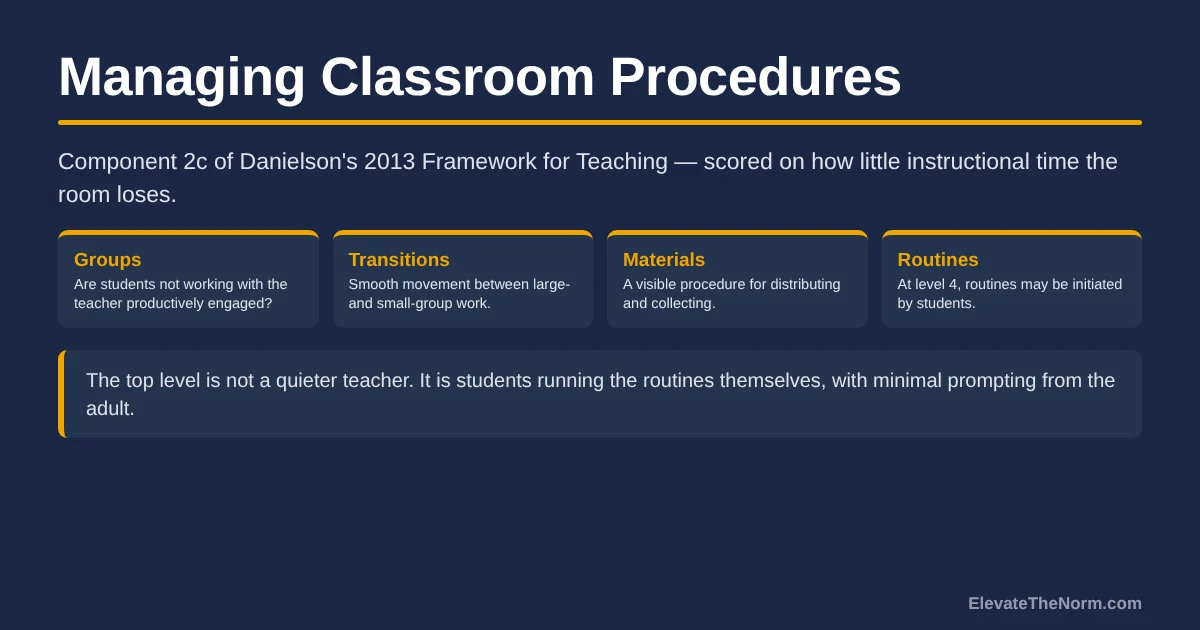
Managing classroom procedures is component 2c of Charlotte Danielson’s 2013 Framework for Teaching. It scores how little instructional time a room loses to instructional groups, transitions, materials and routines. The top level is not a quieter teacher. It is students running the routines themselves with minimal prompting from the adult.
Key Takeaways
- “Managing classroom procedures” is the name of component 2c in the 2013 edition of Danielson’s Framework for Teaching, and it is scored on four levels from “much instructional time is lost” up to “instructional time is maximized.”
- The 2022 edition of the Framework renamed 2c to “Maintaining Purposeful Environments.” Many districts are still evaluating on the 2013 wording, so a teacher can be observed under either name depending on which instrument the district bought.
- Level 4 on this component cannot be reached by a teacher who runs everything personally. The rubric requires that students take initiative in transitions, materials and instructional groups, and that routines “may be initiated by students.”
- A single observation by a single observer produced reliability between .27 and .45 in the Measures of Effective Teaching study, which used this exact instrument. One score on 2c is a weak estimate of what a room normally does.
- Seven districts and charter networks spent $597 million from 2009 to 2016 building evaluation systems around rubrics like this one. RAND’s final report concluded the initiative “did not achieve its goal of increased student achievement and graduation.”
Most teachers meet the phrase “managing classroom procedures” in one of two ways. Either a pre-observation form asks them to write about it, or a post-observation conference hands them a 2 on it and a sentence about transitions.
Neither of those tells you what the phrase means. So here is the whole thing: where it comes from, what each score level actually says, which procedures carry the most weight in a secondary room, and what the research says about how much one of these scores is worth. Some of that research is not flattering to the rubric, and it is in here anyway.
What does “managing classroom procedures” mean?
Managing classroom procedures means running the non-teaching machinery of a classroom so it costs as little learning time as possible. In the Danielson rubric it covers four things: instructional groups, transitions, materials and supplies, and everyday classroom routines.
That is a narrower idea than “classroom management,” and the distinction matters when you are being scored. Classroom management in ordinary staff-room usage covers behavior, relationships, consequences, tone, everything. Component 2c is not about behavior. Behavior lives in a different component. 2c is about logistics: whether the room knows how to start, move, get supplies, work in groups and finish without an adult narrating every step.
If you want the practice side rather than the rubric side, the companion piece on classroom routines and procedures for grades 6–12 is the one that walks through which routines to teach and how to teach them. This article is about the instrument.
Where does the phrase come from, and is it still in the rubric?
“Managing Classroom Procedures” is component 2c of Domain 2 in the 2013 edition of the Framework for Teaching. The 2022 edition of the Framework renamed that slot to “Maintaining Purposeful Environments,” which the Danielson Group publishes as its current 2c rubric.
That rename is worth knowing before a pre-conference, because the two editions are in use at the same time. A district that adopted the Framework a decade ago and never repurchased is still scoring teachers on the 2013 language. A district that updated is using the 2022 language. The phrase on your evaluation form tells you which one you are on.
| Edition | Component 2c is called | What it emphasizes | Who is likely using it |
|---|---|---|---|
| 2013 Framework for Teaching | Managing Classroom Procedures | Instructional groups, transitions, materials, routines, and minimizing lost instructional time | Districts still on the instrument they adopted during the evaluation-reform era |
| 2022 Framework for Teaching | Maintaining Purposeful Environments | The same ground, framed as a purposeful environment rather than a set of managed procedures | Districts that have repurchased or retrained since 2022 |
Both versions are asking the same practical question. The older wording is blunter about it, and because the keyword people actually search is the older wording, that is the version the rest of this article quotes.
What does an observer look for at each level?
An observer is looking for lost instructional time and who prevents it. The 2013 rubric sorts rooms by how much time the procedures cost and by how much prompting students need, and the jump from Proficient to Distinguished is entirely about students doing the work instead of the teacher.
Here is the actual ladder, in the rubric’s own terms.
| Level | Instructional time | Student prompting required | What an observer writes down |
|---|---|---|---|
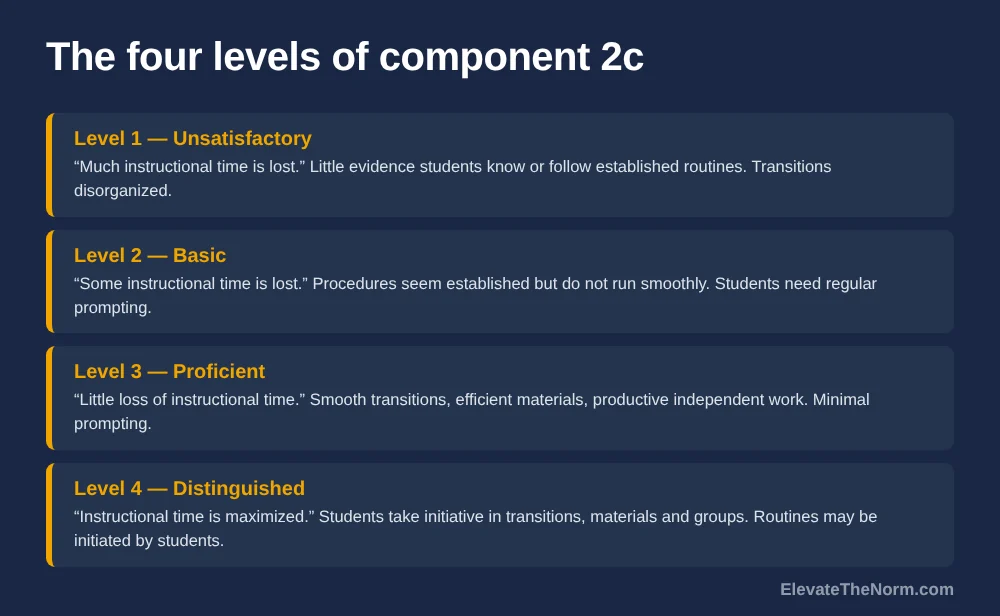
| 1 — Unsatisfactory | “Much instructional time is lost due to inefficient classroom routines and procedures” | “Little evidence that students know or follow established routines” | Disorganized transitions, no visible procedure for handing out or collecting anything, students not working with the teacher are off task |
| 2 — Basic | “Some instructional time is lost due to partially effective classroom routines and procedures” | Students follow routines “with regular guidance and prompting” | Procedures appear to exist but do not run smoothly; students are confused about carrying them out; independent work is only partially engaged |
| 3 — Proficient | “There is little loss of instructional time due to effective classroom routines and procedures” | Students follow routines “with minimal guidance and prompting” | Smooth transitions between large and small group, efficient distribution and collection of materials, productive small-group and independent work |
| 4 — Distinguished | “Instructional time is maximized due to efficient and seamless classroom routines and procedures” | Routines “are well understood and may be initiated by students” | Students take initiative in transitions, in distributing and collecting materials, and in managing instructional groups; they ensure their own time is used productively |
Read the top row again, because it is the part that gets missed. You cannot earn a 4 on this component by being an excellent manager of a room. The rubric explicitly requires that students take initiative, and that routines can start without you. A teacher who runs a beautifully tight ship personally, calling every move, is describing a 3.
Which means the move from 3 to 4 is a handoff, not an improvement. Take one of the four procedures the rubric names — materials is usually the easiest — and give it to students to start and run. Three guardrails on that, because the handoff goes wrong in predictable ways. Do not turn it into peer policing, where students enforce the routine on each other; the rubric asks students to run procedures, not to discipline classmates. Do not let the same three reliable kids absorb every job, which is how a management win becomes unpaid labor for the students who were already compliant. And check it against accommodations first, because a routine that requires every student to get up and collect their own materials is not neutral for a student whose IEP or 504 plan says otherwise.
That is a demand this site happens to agree with, for reasons that have nothing to do with evaluation scores. If a 15-year-old cannot be trusted to hand back papers or start a group task without an adult counting down, somebody decided that in advance.
Which procedures carry the most weight in grades 6–12?
The four the rubric names carry the weight, because those are the four an observer is scoring. Everything else in a secondary classroom is downstream of entry, transitions, materials and group work.
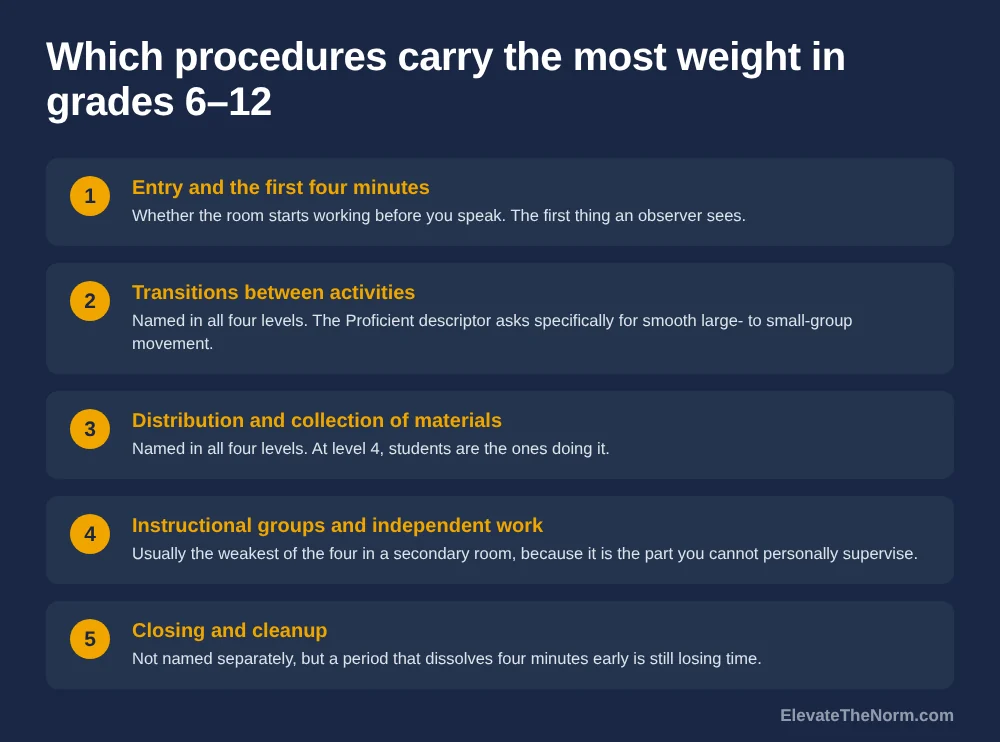
- Entry and the first four minutes. Whether the room starts working before you speak. This is the procedure an observer sees first and the one that colors the rest of the period.
- Transitions between activities. The rubric’s Proficient language is specifically “transitions between large- and small-group activities are smooth.” If you only tighten one thing before an observation, tighten this.
- Distribution and collection of materials. Named in all four levels. At level 4, students are doing it. Chromebook carts, paper, lab equipment, novels, calculators — whatever your room hands out, there is a visible procedure for it or there is not.
- Instructional groups and independent work. The rubric asks whether students not working directly with the teacher are productively engaged. In a secondary room this is usually the weakest of the four, because it is the one you cannot personally supervise.
- Closing and cleanup. Not separately named in the rubric, but it is the visible end of “instructional time is maximized.” A period that dissolves four minutes early is losing time no matter how good the middle was.
Transitions are the usual culprit, and they have their own article: how to stop losing six minutes a lesson, plus a shorter piece on cues students can actually see for rooms where verbal direction is already competing with thirty conversations.
How do you show this to an observer who is only in the room for 15 minutes?
Pick a segment that contains a transition and some independent work. A short observation that lands entirely inside a lecture gives an observer nothing to score on 2c, so they score what they can infer, which is worse for you than showing them the real thing.
Short observations are now common, and the MET study found they are not worthless: a single 15-minute observation produced about 60 percent of the reliability of a full-lesson observation while taking under a third of the time. That is a reasonable trade for an observer with forty teachers to see. It also means the 15 minutes they pick carries a lot of weight, which is an argument for making sure those minutes are representative rather than exceptional.
Plenty of districts do unannounced walkthroughs with no pre-conference at all, and in that case none of the framing above is available to you. The only defense there is that the procedures run the same whether an adult with a clipboard is standing in the door or not — which is the actual point of the component, and the reason gaming it is a waste of a week.
- Name the component in the pre-conference. Say which procedures they will see and when. An observer who knows the materials routine happens at minute six will look for it.
- Make one student-run routine visible. Level 4 language requires student initiative. If a student starts the routine, say so in the post-conference reflection, because an observer who missed the first thirty seconds cannot score what they did not see.
- Have the written procedure somewhere. Posted, in the syllabus, in the slide deck — it does not matter where. It matters that “procedures seem to have been established” (level 2) can be upgraded to “established” with something you can point at.
- Do not stage a procedure the room does not have. The rubric’s level 2 descriptor is literally the look of a staged routine: procedures that “seem to have been established, but their operation is not smooth,” with students confused about carrying them out. Observers recognize it.
- Ask which edition you are scored on. 2013 or 2022. It changes the vocabulary of the entire conference.
If your procedures are not where you want them yet, the honest move is to say so in the pre-conference and name what you are working on. A teacher who can diagnose their own level 2 is easier to coach than one who is surprised by it, and in most districts the conversation is the part that actually changes anything.


Does a good score on this component mean you are a better teacher?
Not reliably, and the research on that is clear enough that it should change how much weight anybody puts on one number. The instrument is a decent description of good practice. The scoring of it is noisy, and the systems built on top of it did not produce the results they were built to produce.
The Measures of Effective Teaching project tested exactly this instrument — ten items from Domains 2 and 3 of the Framework for Teaching, scored on the four-point scale, in Hillsborough County, Florida. Its finding on single observations is the number every teacher being evaluated should know: reliability for one observation by one observer ranged from .27 to .45.
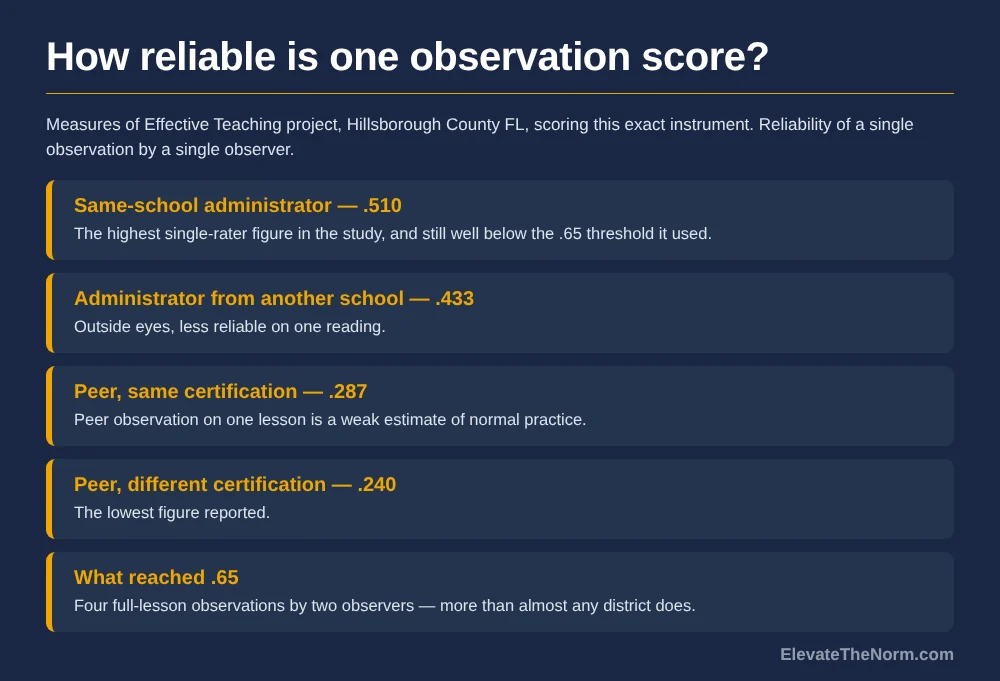
It gets more specific. Broken out by who is doing the observing, one rating by one observer produced reliability of .510 for a same-school administrator, .433 for an administrator from another school, .287 for a peer with the same certification, and .240 for a peer with a different certification. The study’s blunt conclusion was that “having more than one observer really does matter” — adding a second set of eyes bought more than twice the reliability gain of adding a second lesson with the same observer. The smallest combination the study tested that reached a .65 threshold was four full-lesson observations by two observers.
Almost no district does that. Which means most 2c scores in America are a single reading with somewhere between .27 and .51 reliability attached to it.
One honest limit on those figures: they come from a single district, Hillsborough County, Florida, with observers trained for that study. A different district with different training could do better or worse. The direction of the finding — one observer, one lesson, weak estimate — has held up well enough to be worth acting on, but the specific decimals are not a national constant.
The bigger finding is about the systems rather than the scores. RAND’s final evaluation of the Intensive Partnerships for Effective Teaching followed seven sites — three districts and four charter management organizations — from 2009 through 2016 as they built evaluation systems combining rubric-based observation with student achievement growth. The initiative cost $597 million, of which $237 million came from Gates Foundation grants.
RAND’s conclusion was that “the initiative did not achieve its goal of increased student achievement and graduation.” There were exceptions in both directions — high school English improved in the charter networks and in Pittsburgh, grades 3–8 math declined in the charter networks — but no widespread gain, no graduation improvement in most sites and grade ranges, and no improvement in low-income minority students’ access to effective teaching, which had been one of the stated goals. By the end, almost all teachers were rated effective, with only 1 to 2 percent rated ineffective at most sites.
Two caveats before anyone quotes that as a verdict. The seven sites covered elementary through high school, so the achievement results are not specific to grades 6–12. And the initiative changed far more than observation rubrics — it touched pay, tenure, staffing and professional development — so the null result belongs to the whole package, not to component 2c.
Report that honestly and it cuts both ways. It is not evidence that procedures do not matter. Lost instructional time is real and the rubric describes it accurately. It is evidence that scoring teachers on it, at the scale and frequency districts can afford, did not move student outcomes. Districts are still legally required to evaluate teachers, so the useful question is not whether to do it but what to take from it — and the specific, concrete feedback has always been the valuable half.
Clay’s take: the rubric is better than the score
The 2c language is one of the few places in a teacher evaluation instrument that says something genuinely useful about teenagers. Read level 4 without the evaluation context and it is a description of a classroom where students are trusted with the running of their own room.
That is worth chasing on its own terms. Not because a 4 looks good on a summative, but because the alternative is a room where a near-adult cannot distribute a stack of papers without supervision. The rubric is right that those are different rooms, and it is right about which one loses less time.
Where I would not spend much energy is the number itself. A measurement with .27 to .45 reliability from one observer is not a verdict on a semester of work, and a half-billion-dollar initiative built on these instruments did not raise achievement or graduation rates. Take the feedback, which is usually specific and often correct. Hold the score loosely.
And if the feedback says your transitions cost time, that is probably true regardless of what the reliability coefficient says. Transitions are the one thing on this component that nearly every teacher can see for themselves with a stopwatch.
What to do next
Find out which edition your district evaluates on, then read your own 2c language rather than a summary of it. Pick the one procedure that costs you the most time — for most secondary teachers that is transitions or materials — and build it into something a student can start.
Then put it in writing somewhere an observer can see. If you want the longer version of the underlying work, start with which routines are worth teaching in grades 6–12, keep a management plan that actually runs on one page, and if the room is still loud through every handoff, the prevention side is the better place to spend a week than the rubric is. The expectations framework covers what the procedures are supposed to be serving.
Frequently Asked Questions
What is component 2c Managing Classroom Procedures?
Component 2c is a slot in Domain 2 of the 2013 edition of Charlotte Danielson’s Framework for Teaching. It scores how much instructional time a classroom loses to instructional groups, transitions, materials and supplies, and everyday routines, and how much teacher prompting students need to follow them. It is scored on four levels, from much time lost up to instructional time maximized.
Is managing classroom procedures the same as classroom management?
No. Classroom management in everyday staff-room usage covers behavior, relationships, consequences and tone. Component 2c is narrower and deliberately excludes behavior, which is scored elsewhere in the framework. 2c is logistics: whether the room can start, move between activities, handle materials and work in groups without an adult narrating every step.
What does a Distinguished rating on 2c actually require?
Student initiative, not teacher efficiency. The 2013 rubric’s level 4 says routines are well understood and may be initiated by students, and that students take initiative in transitions, in distributing and collecting materials, and in managing instructional groups. A teacher who personally directs every smooth move is describing level 3, not level 4.
Was component 2c renamed in the 2022 Framework for Teaching?
Yes. The 2022 edition renamed 2c from Managing Classroom Procedures to Maintaining Purposeful Environments, and the Danielson Group publishes that as the current 2c rubric. Both editions are in active use, because districts adopt the instrument they purchased. Ask which edition your evaluation form uses before a pre-observation conference.
How reliable is one observation score on classroom procedures?
Not very. The Measures of Effective Teaching study, which scored this exact instrument, found reliability of .27 to .45 for a single observation by a single observer. Broken out by observer, one rating ran .510 for a same-school administrator down to .240 for a peer with different certification. More observers helped more than more lessons.
Which classroom procedures should a secondary teacher fix first?
Transitions, in most rooms. The rubric names transitions in all four levels and the Proficient descriptor specifically calls for smooth movement between large- and small-group activities. Transitions are also the easiest procedure to measure yourself with a stopwatch, which makes them the cheapest place to find real lost time before anybody observes you.
Do evaluation systems built on these rubrics improve student outcomes?
The largest test of that says no. RAND’s final evaluation of the Intensive Partnerships for Effective Teaching followed seven sites from 2009 to 2016 at a cost of $597 million and concluded the initiative did not achieve its goal of increased student achievement and graduation. The sites spanned elementary through high school, and the initiative changed pay and staffing too, so the null result belongs to the package rather than to one rubric component.
What should you do if you disagree with your score on managing classroom procedures?
Ask which level descriptor the score was based on and what specific evidence the observer recorded, because the rubric language is public and checkable. Most evaluation systems allow a written teacher response in the record. Disagreeing about a decimal is rarely worth the energy; disagreeing about an inaccurate factual observation, in writing, sometimes is.
Sources
- Danielson, C. (2013). Rubrics for the Framework for Teaching, 2013 Edition (Observable Components), Domain 2. Hosted by the Council on Teacher Education, University of Illinois. All level language and critical attributes for component 2c quoted in this article come from this document.
- Danielson Group. Component 2c Rubric. The current 2022-edition rubric, where 2c is titled “Maintaining Purposeful Environments.” The page publishes the rubric itself as an image, so the level wording for the 2022 edition is not quoted here.
- Ho, A. D., & Kane, T. J. (2013). The Reliability of Classroom Observations by School Personnel. Measures of Effective Teaching Project, Bill & Melinda Gates Foundation. Hillsborough County, Florida; ten items from Domains 2 and 3 of the Framework for Teaching; teachers scored an average of 46 times each. The .27–.45 range is for a single observation by a single observer.
- Stecher, B. M., et al. (2018). Intensive Partnerships for Effective Teaching Enhanced How Teachers Are Evaluated But Had Little Effect on Student Outcomes. RAND Corporation research brief, summarizing the final report on seven sites from 2009 through 2016. Note that the sites covered elementary through high school, so the achievement findings are not specific to grades 6–12.