The Elevate Blog banner: Real Classrooms. Practical Ideas. Higher Expectations. Three students climb a rocky ridge at sunrise, each pulling the next one up, toward a teacher reaching down to help.

Tag: Formative Assessment

  • Mastery Learning in Grades 6–12: What It Is, What the Evidence Shows, and How to Run It

    Mastery Learning in Grades 6–12: What It Is, What the Evidence Shows, and How to Run It

    By Clay Shumate

    Mastery learning is an instructional cycle: teach a short unit, give an ungraded check, re-teach the students who missed it, then re-test before moving on. Independent meta-analyses put the gain near half a standard deviation on teacher-written tests and close to zero on standardized ones. The feedback loop is the part worth keeping.

    Key Takeaways

    • Mastery learning is a teaching cycle, not a gradebook. It changes what happens after a check for understanding; standards-based grading changes how results get recorded. Schools mix the two constantly, so each gets blamed for the other’s problems.
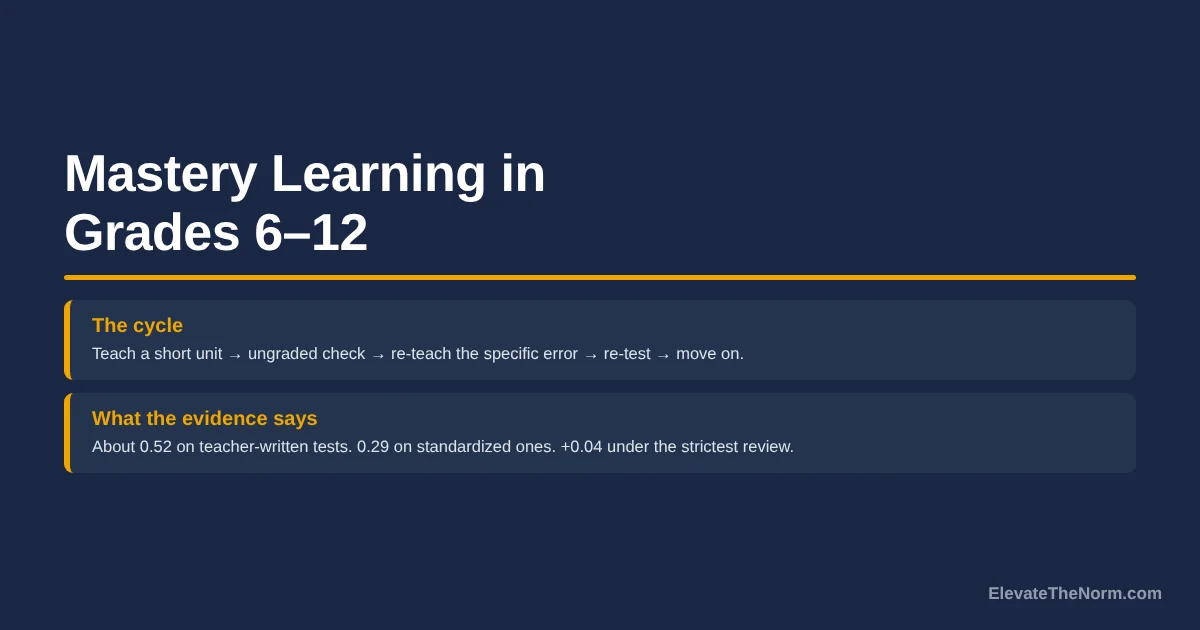
    • The effect size depends almost entirely on who wrote the test. Kulik, Kulik & Bangert-Drowns (1990) found 0.52 across 103 controlled evaluations — but 0.57 on locally developed tests and 0.29 on standardized ones.
    • The strictest review found essentially nothing. Slavin (1987) applied a four-week minimum and an equal-time rule, kept 17 studies, and reported a median effect of +0.04 on standardized measures.
    • The time cost is small; the coverage cost is not. Median instructional time rose about 4 percent. The real price is content you never reach, because corrective instruction comes out of something.

    What is mastery learning?

    Mastery learning is a teaching cycle in which students must show a defined level of understanding on a short unit before the class moves on, with re-teaching and a second assessment built in for the students who do not get there first time. The variable is time, not expectations.

    The model comes from Bloom’s original 1968 paper, and his structure is still the structure: units of a week or two, each ending in a brief diagnostic test that is not graded, used to prescribe specific corrective work, then verified. Bloom insisted “the diagnosis should be accompanied by a very specific prescription if the students are to do anything about it.” He also wrote the sentence the movement rests on — “most students (perhaps over 90 percent) can master what we have to teach them” — and argued a bell curve of results signals failure rather than rigour: “there is nothing sacred about the normal curve.”
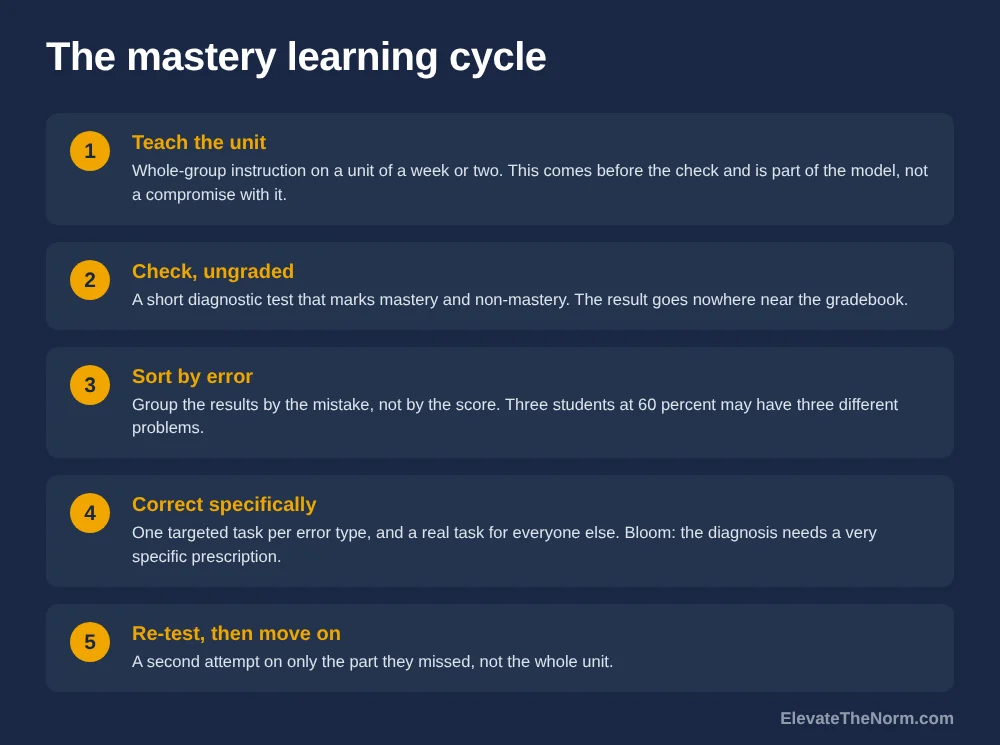
    Numbered graphic showing the five stages of the mastery learning cycle: teach the unit with whole-group instruction; give a short ungraded check that marks mastery and non-mastery; sort the results by error rather than by score; give one targeted corrective task per error type; and re-test only the part students missed before moving on.

    What the retelling drops is that Bloom named the cost in the same paper. He estimated the slowest students spend roughly six times as long on a subject as the fastest, hoped good instruction could compress that to about three to one, and admitted that bringing the slowest students to mastery in a subject like algebra “may require several years.” He called it “highly questionable” whether that was worth doing. The founder built a limit into the original argument and almost nobody quotes it.

    Is mastery learning the same thing as standards-based grading?

    No. Mastery learning is an instructional model governing what a teacher does between a check and the next unit. Standards-based grading is a reporting system governing how evidence gets recorded and turned into a grade. A classroom can run either without the other, and most schools adopt the reporting half first.

    That ordering causes most of the trouble: a school issues a new gradebook, asks for reporting by standard and reassessment, and changes nothing about instruction — so students get a second attempt with no corrective teaching between attempts, which is a retake with extra paperwork. If the reporting side is your real problem, start with what standards-based reporting actually fixes. This page is about the cycle.

     Mastery learningStandards-based gradingTeach, test, move on
    What it isAn instructional cycleA reporting and grading systemThe default calendar-driven model
    What it changesWhat happens after a check: re-teach, then re-testWhat the grade is made of and how it is displayedNothing; the unit ends when the calendar says
    Main cost to the teacherTwo versions of every assessment, plus the corrective work between themRebuilding the gradebook and re-explaining it to familiesNone up front; you pay later in gaps
    Grade fitStrongest where content is cumulativeAny grade band; harder to explain in high schoolAny
    Main drawbackCoverage. Corrective instruction comes out of something elseCan be adopted cosmetically with no change to teachingUnfixed misunderstandings compound

    Does mastery learning actually work?

    Mastery learning produces a moderate gain on tests written by the teacher or the researcher and little or no measurable gain on standardized tests. That is not one good study against one bad one — it is the shared finding of both the supportive meta-analysis and the critical one.

    ReviewWhat it pooledEffect sizePopulation
    Bloom (1984)Dissertation studies, mostly from one universityAbout 1 sigmaGrades 4, 5 and 8; three-week units
    Kulik et al. (1990)103 controlled evaluations0.52 overall; 0.57 local tests, 0.29 standardizedMostly college; 17 pre-college studies averaged 0.49
    Slavin (1987)17 studies meeting a four-week minimum and equal-time rule+0.04 standardized; +0.255 experimenter-madeGrades 1–10, many inner-city elementary

    Bloom’s “2 Sigma Problem” is where the big number comes from, and the provenance matters. Those comparisons ran over eleven instructional periods in a three-week block, in Probability and Cartography, with students in grades four, five and eight; the studies were dissertations by his own graduate students and the paper reports no sample sizes. Bloom footnoted that his percentile conversions assume normal distributions while the actual distributions were “highly skewed.”
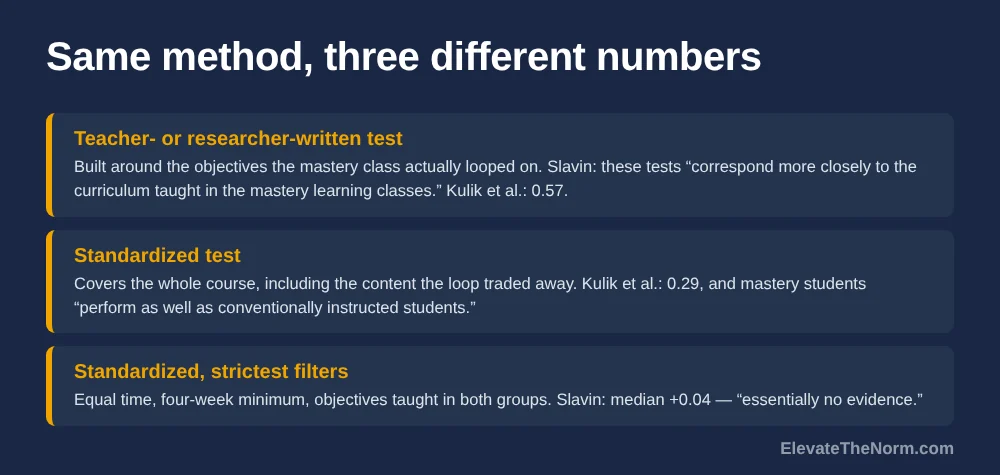
    Graphic comparing mastery learning effect sizes by the kind of test used: 0.57 on teacher- or researcher-written tests aligned to what the class looped on, 0.29 on standardized tests covering the whole course, and a median of plus 0.04 on standardized tests under Slavin's strictest equal-time filters.

    The two-sigma figure circulating online is a different thing entirely: in that paper, two standard deviations is the effect of one-to-one tutoring, which Bloom called “too costly for most societies to bear on a large scale.” The “2 sigma problem” was his challenge to find a group method that reached it, and he reported the best combinations at about 1.6 to 1.7 sigma: “we have not found any two variable combination that has exceeded the 2 sigma effect.” Anyone crediting mastery learning with two standard deviations has swapped the tutoring result in for the classroom one.

    Independent pooling came next. Kulik, Kulik & Bangert-Drowns (1990) analysed 108 controlled evaluations and found 0.52 on end-of-instruction exams, with larger attitude effects (0.63 toward the instruction, 0.40 toward the subject). One widely repeated claim from that paper needs a correction: they did find a bigger effect for lower-aptitude students, 0.61 against 0.40, but reported that the difference was not statistically significant (t = 1.23, p > .10). “It helps struggling students most” is the most-quoted line about mastery learning and the evidence for it is weaker than the quoting suggests.

    Then the sceptic. Slavin (1987) applied harder filters — regular classrooms, a formative test at least every four weeks, corrective instruction, a four-week minimum duration, and assessments covering objectives taught in both groups. Of nineteen studies Kulik and colleagues cited, four survived. His verdict on the seven equal-time standardized comparisons: “essentially no evidence to support the effectiveness of group-based mastery learning on standardized achievement measures.” Delayed retention was close to zero too.

    Why do the numbers disagree so much?

    The reviews disagree mainly because teacher-written and researcher-written tests are aligned to what the mastery classroom actually covered, while standardized tests are not. A mastery cycle spends time re-teaching a narrower set of objectives: on a test built around those objectives that looks like a large gain, and on a broad test it looks like a wash.

    This is not a hostile reading — it is in both papers. Slavin wrote that such tests “will correspond more closely to the curriculum taught in the mastery learning classes than to that taught in control classes.” Kulik and colleagues, arguing for the method, found the same split in their own data and wrote that mastery students “perform as well as conventionally instructed students on standardized tests.” Slavin named the mechanism in four words: mastery learning “trades coverage for mastery.” The honest summary is therefore narrower than the slogan and more useful than the debunking. The method reliably raises how well students know the things you chose to loop on; whether that is a good trade depends on whether those things compound.

    What does the modern evidence on competency-based learning show?

    The modern evidence is thin and mostly associational. The largest secondary-level study of competency-based education, from the American Institutes for Research, compared ten competency-based high schools against eight matched comparison schools and did not measure achievement at all — it measured mindsets and self-regulation, and reported associations rather than causal effects.

    Clear learning targets, requiring mastery of targets to pass, and extra time in mathematics were each linked to positive change in learning capacities. Other features showed no relationship, including online coursework and individualized learning plans, and the English language arts findings were largely null: “none of the CBE features we examined were related to efficacy in ELA.” The implementation result is the one to hand a district before a rollout — practices were applied so unevenly that “the amount of variation observed within schools was almost equal to the amount of variation observed among schools.” An effect range running from +0.04 to 0.52 depending on the ruler cannot carry a mandate. Make the loop available, train it, leave the choice with the teacher.

    How do you run a mastery learning cycle in one classroom?

    Run mastery learning on one short unit, with one ungraded check, one specific corrective task per error type, and one second attempt. The cycle has to fit inside about two weeks, or the re-teaching lands after students have stopped caring about the content it is fixing.

    1. Tell students what the cycle is before you run it. From a desk, a room where some students re-test while others move on looks like the teacher has decided who the smart ones are. Say out loud that the check does not count, the re-teaching is the point, and the second attempt is the plan rather than a favour.
    2. Pick a unit where the content compounds. The loop earns its cost where a missed idea breaks the next three weeks — a procedure, a vocabulary set, a type of source analysis.
    3. Write the re-test before you teach the unit. Two or three checkable statements of what a student must be able to do. If you cannot write the second assessment up front, the target is not specific enough. This is the real prep cost, and across five sections it decides whether you keep doing it.
    4. Teach normally, then give a ten-minute ungraded check. Whole-group instruction before the check is part of the model, not a compromise with it, and the result goes nowhere near the gradebook. quick checks that fit a real period covers formats that fit.
    5. Sort the results by error, not by score. This habit is most of the method. Three students who all scored 60 percent may have three different problems, and one worksheet fixes at most one. Sort from the paper, quietly — nobody needs groups announced by score in front of the room.
    6. Give a specific corrective task per error type and a real task to everyone else. One period, groups doing different things. differentiating without five lesson plans is the practical version.
    7. Re-test only the part they missed, and decide now what happens after attempt two. Re-testing the whole unit punishes students who mostly had it. Some will miss the bar twice; settle what that means for the grade with a written retake policy before you start, or the cycle decides for you in the worst possible week.

    One warning on the bar itself. Guskey and Anderman point out that “setting percentage cutoffs on any form of assessment is an arbitrary decision,” and that percentage cutoffs are “seductive, but misleading” — on the GRE a score of 50 percent can outperform most test-takers. Eighty percent is a habit, not a standard. Write the two or three items that must be right and make those the bar instead of a percentage of everything.

    What do the students who passed the first time do?

    Students who reach mastery on the first check need a task with its own purpose, not more of the same work and not a job helping classmates. This is the most common reason a mastery cycle collapses in a secondary classroom, and it is a planning problem rather than a discipline problem.
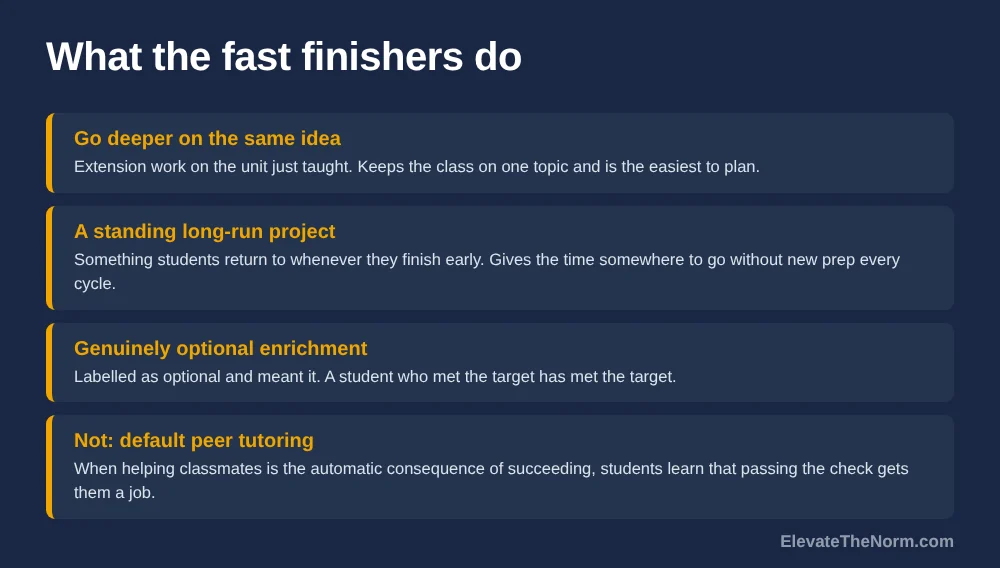
    Graphic listing three workable options for students who reach mastery on the first check - extension work going deeper on the same idea, a standing long-run project, and genuinely optional enrichment - plus one option that does not hold up, making peer tutoring the automatic consequence of succeeding.

    Three routes hold up: extension work that goes deeper into the same idea, which is easiest to plan; a standing long-run project students return to whenever they finish early, which gives the time somewhere to go without new prep every cycle; and genuinely optional enrichment, labelled as optional, which respects the fact that a student who met the target has met the target.

    The route that does not hold up is turning fast finishers into unpaid tutors by default. Peer explanation is useful and some students like it, but when it is the automatic consequence of succeeding, students work out quickly that passing the check gets them a job. That teaches compliance, which is the opposite of the point.

    What does mastery learning cost in time?

    Mastery learning costs less clock time than most teachers expect and more curriculum than they plan for. Across the eight studies reporting it, Kulik, Kulik & Bangert-Drowns (1990) found six showed more instructional time, median increase about 4 percent. The expensive part is not minutes.

    Four percent of a year is a few days — real and manageable. The cost nobody budgets is the one Slavin identified: if corrective instruction happens inside the period, the period is not teaching new content, and against a pacing guide written by someone who has never run a mastery cycle that arithmetic gets uncomfortable fast. Have that conversation with whoever sets the calendar before the semester, not in week nine. One further warning sits in the Kulik data: in the self-paced college version, course completion fell — “the most consistently negative effect of mastery programs.” A model that lets students take as long as they need lets some take longer than the term has.

    When is mastery learning the wrong move?

    • When the stakes test is broad and external. The evidence is strongest on aligned assessments and weakest on standardized ones, so the coverage trade runs against you.
    • When nothing compounds. A unit that stands alone does not punish a gap.
    • When you would add reassessment without corrective teaching. A second attempt with no instruction between attempts is a retake, and retakes make their case on different grounds.

    Clay’s take: steal the loop, skip the branding

    My read, as a teacher who works with grades 6–12 and not as someone selling a programme: the valuable thing in mastery learning is the smallest thing in it. Check, sort by error, re-teach the specific error, verify. That loop is defensible on its own terms, costs about 4 percent more time, and needs no school initiative or new gradebook. What I would not do is promise anyone two standard deviations, or one. The number shrank every time someone outside the original research group measured it — the normal life cycle of an education finding, and a good reason to distrust the version that reaches you in a slide deck.

    There is also a fairness problem the advocates skip and students spot immediately: the cycle hands more work to the students already behind. Pass the check and you get enrichment; miss it and you get a corrective task plus a second test. That is defensible — it is how you catch a gap before it compounds — but it is not self-evidently fair, and a student who says so is making an argument rather than complaining. Say the reasoning out loud.

    What should you do next?

    Pick one unit this term where a missed idea wrecks the following three weeks. Write the two things that count as mastery, write the re-test before you teach it, tell students how the cycle works, and run one loop. Sort the check by error rather than by score. Then decide from your own results whether the coverage you traded was worth what came back. If the reporting side is your real problem, go to the grading system that gets confused with it; if the question underneath this one is when a check should count at all, start there instead.

    Is mastery learning the same thing as standards-based grading?

    No. Mastery learning is an instructional cycle that governs what a teacher does between a check and the next unit: re-teach the specific error, then re-test. Standards-based grading is a reporting system that governs how evidence is recorded and converted into a grade. A classroom can run either one without the other, and most schools adopt the reporting half first.

    Does mastery learning actually work?

    It depends on the test. Kulik, Kulik and Bangert-Drowns found an average effect of 0.52 across 103 controlled evaluations, but 0.57 on locally developed tests against 0.29 on standardized ones. Slavin’s stricter review of 17 studies found a median of +0.04 on standardized measures. The method reliably improves performance on assessments aligned to what you looped on.

    Is mastery learning the same as competency-based education?

    They overlap but are not identical. Mastery learning is Bloom’s classroom cycle of teach, check, correct and re-test. Competency-based education is a broader school or system design in which progress depends on demonstrated competency rather than seat time. Competency-based education usually contains mastery learning; mastery learning can run in one classroom with nothing else changed.

    How do you decide what counts as mastery?

    Build the bar from the content rather than a round number. Guskey and Anderman call percentage cutoffs an arbitrary decision and warn they are seductive but misleading, noting that a GRE score of 50 percent can outperform most test-takers. The practical version is to name the two or three items that must be right and make those the bar.

    What happens to a student who still does not reach mastery after the second attempt?

    Decide that before you start the cycle, not during it. Most secondary teachers cap the number of attempts, record the best evidence so far, and move the class on while keeping the target open for later evidence. The failure mode is having no policy, because the decision then gets made under pressure in the worst possible week.

    Does needing a second attempt lower a student’s grade?

    It does not have to, and in Bloom’s design it should not. The first check is diagnostic and ungraded, so what enters the gradebook is the demonstrated level of understanding rather than how many attempts it took. If your gradebook penalises the second attempt, you have a reporting problem rather than an instruction problem.

    How does mastery learning fit a required pacing guide?

    Uncomfortably, and that is the honest answer. Corrective instruction inside the period means the period is not covering new content, which Slavin described as trading coverage for mastery. Clock time rose only about 4 percent in the studies that measured it, but curriculum time is the real cost. Raise it with whoever sets the calendar before the semester starts.

    Sources

    • Bloom, B. S. (1968). Learning for Mastery. Evaluation Comment, 1(2). Regional Education Laboratory for the Carolinas and Virginia. uky.edu. The original statement of the model. Source of the “perhaps over 90 percent” claim, the 95 percent figure for the grade of A, the ungraded diagnostic-progress test, the “nothing sacred about the normal curve” line, the six-to-one time ratio, and Bloom’s own admission that mastery for the slowest students “may require several years” and is “highly questionable.”
    • Bloom, B. S. (1984). The 2 Sigma Problem: The Search for Methods of Group Instruction as Effective as One-to-One Tutoring. Educational Researcher, 13(6). Full text. Source of the one-sigma mastery learning figure and the two-sigma tutoring figure, the three-week Probability and Cartography studies in grades 4, 5 and 8, the absence of reported sample sizes, and Bloom’s own footnote that the distributions were “highly skewed.”
    • Kulik, C.-L. C., Kulik, J. A., & Bangert-Drowns, R. L. (1990). Effectiveness of Mastery Learning Programs: A Meta-Analysis. Review of Educational Research, 60(2). Full text. 108 controlled evaluations. Source of the 0.52 overall effect, the 0.57 local versus 0.29 standardized split, the 0.49 pre-college average, the attitude effects, the 4 percent median instructional-time increase, the lower-aptitude comparison (0.61 vs 0.40, not significant at t = 1.23, p > .10), and the negative course-completion finding.
    • Slavin, R. E. (1987). Mastery Learning Reconsidered. Review of Educational Research, 57(2), 175–213. Full text. The best-known critique. Source of the +0.04 median on standardized measures, the +0.255 median on experimenter-made measures, the near-zero retention result, the inclusion criteria including the four-week minimum, the finding that only four of nineteen Kulik-cited studies qualified, and the “trades coverage for mastery” argument. Study populations ran from grade 1 to grade 10 and were heavily inner-city elementary, which is why this article does not present the figures as a grades 6–12 result.
    • Guskey, T. R., & Anderman, E. M. (2013/2014). In Search of a Useful Definition of Mastery. Educational Leadership, 71(4), 18–23. Full text. Source of the arbitrary-cutoff argument, the “seductive, but misleading” phrase, the GRE example, and the warning that judgment-based standard setting “can be untrustworthy and sometimes manipulated.”
    • Haynes, E., Zeiser, K., Surr, W., Hauser, A., Clymer, L., Walston, J., Bitter, C., & Yang, R. (2016). Looking Under the Hood of Competency-Based Education. American Institutes for Research. Full report. Ten competency-based high schools against eight matched comparison schools, grade 9. Source of the null ELA finding, the within-school variation result, and the authors’ own caution that the model “is still evolving.” Note that this study measured learning capacities rather than achievement and reports associations, not causal effects.
    About Clay Shumate

    Clay Shumate is a certified secondary Social Studies teacher in the public schools of West Alabama, with seven years of classroom experience, a B.A. in History, and an M.Ed. in Secondary Education. He writes about project-based learning, student responsibility, respect, and practical ways to hold young people to a higher standard while giving them room to learn from mistakes. He is a member of the Society of Professional Journalists and writes to its Code of Ethics; this site’s editorial standards and corrections policy are published in full. More about Clay.

  • Formative vs Summative Assessment: The Difference, and How to Use Both in Grades 6–12

    Formative vs Summative Assessment: The Difference, and How to Use Both in Grades 6–12

    By Clay Shumate

    Formative assessment happens during learning to find out what to do next; summative assessment happens after it to record what was learned. The real difference in formative vs summative assessment is not the test itself but what the result gets used for. The same quiz can be either, depending on whether it changes your teaching or decides a grade.

    Key Takeaways

    • The difference is the use, not the task. Dylan Wiliam’s review is explicit that formative and summative describe the function a piece of evidence actually serves. A unit test read and acted on is doing formative work. An exit ticket that goes in a pile is not.
    • A check that counts toward the grade stops telling you the truth. Students protect the score instead of showing you the confusion. That is the single most common way a school ends up with a calendar full of formative assessment and no formative information.
    • The honest effect size is about 0.20, not 0.70. Kingston and Nash screened more than 300 studies and found only 13 usable, yielding a weighted mean of 0.20 — and a 2012 commentary from five assessment researchers argued even that number should not be treated as settled.
    • At scale it gets smaller again. A pre-registered trial in 140 English secondary schools, roughly 25,000 pupils, found an effect of 0.09 on GCSE Attainment 8 — not significant at the 5 percent level — and it did not narrow the disadvantage gap.
    • There is no research-backed ratio. What there is, is a coverage test: every standard a summative assessment will judge should have been checked while there was still time to fix it.

    Ask ten teachers to explain formative vs summative assessment and you will get ten versions of the same sentence: formative is during, summative is at the end. That is close enough to be useful and wrong in the way that matters. It describes when the task happens. The distinction that actually changes anything in a classroom is about what you do with the result afterward, and most schools get that part backwards while keeping the vocabulary perfectly.

    This is a definitional article, so it starts with the definitions. But the useful part is further down: the two-axis version of the distinction, the honest numbers on how much formative assessment buys you, and the gradebook question that decides whether any of it works.

    What is the difference between formative and summative assessment?

    Formative assessment gathers evidence while there is still time to act on it, and the teacher or student uses that evidence to change what happens next. Summative assessment measures what was learned after the learning is finished, and the result is recorded rather than acted on. Purpose separates them; timing usually follows from purpose.

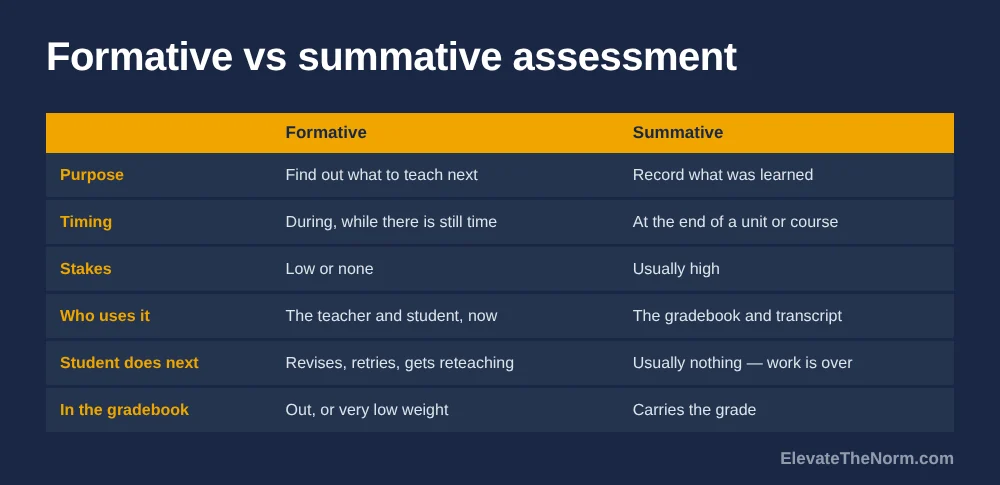
    Comparison graphic contrasting formative and summative assessment across purpose, timing, stakes, who uses the result, what the student does next, and gradebook treatment.

    Carnegie Mellon’s Eberly Center puts the purposes plainly: formative assessment exists to “monitor student learning to provide ongoing feedback” and is generally low stakes with “low or no point value,” while summative assessment exists to “evaluate student learning at the end of an instructional unit by comparing it against some standard or benchmark” and is often high stakes with a high point value. Those two sentences do more work than most professional development on the subject.

    Laid out side by side, the differences line up like this.

    Formative assessmentSummative assessment
    PurposeFind out what to teach nextRecord what was learned
    TimingDuring a unit, while there is still timeAt the end of a unit, course or year
    StakesLow or noneUsually high
    Who uses the resultThe teacher and the student, immediatelyThe gradebook, the transcript, the school, the state
    What the student does nextRevises, retries, gets reteachingUsually nothing — the work is over
    Typical grades 6–12 examplesExit ticket, mid-draft read, circulating question, project check-in, practice problem setUnit test, final essay, presented project, end-of-course exam, state test
    Gradebook treatmentOut of the grade, or very low weightCarries the grade
    What it tells youWhere the class is right nowHow far the class got
    Purpose and stakes from the Eberly Center’s definitions; the remaining rows are this guide’s practical restatement for grades 6–12, not part of any single framework.

    Keep one thing in view while reading that table: every row describes a tendency, and the first row is the only one that defines anything. The rest follow from it most of the time and can come apart from it, which is the next section.

    What is formative assessment?

    Formative assessment is any practice in which evidence of student learning is elicited, interpreted, and used to make a better-founded decision about what to teach next. The defining move is the last one. Collecting evidence you never use is not formative assessment; it is paperwork.

    The formulation most of the field works from is Black and Wiliam’s 2009 version, quoted in Wiliam’s own review of the definitions: practice is formative “to the extent that evidence about student achievement is elicited, interpreted, and used” by teachers, learners or peers “to make decisions about the next steps in instruction that are likely to be better, or better founded.” Note the hedge built into it — to the extent that. It is a matter of degree, not a label you apply to a worksheet.

    Wiliam and Thompson’s five strategies are the practical version, and they are worth having on a wall:

    1. Clarifying learning intentions and sharing criteria for success.
    2. Engineering classroom discussions, activities and tasks that elicit evidence of learning.
    3. Providing feedback that moves learners forward.
    4. Activating students as instructional resources for one another.
    5. Activating students as the owners of their own learning.

    Only the second one is what most people picture when they hear the word assessment. The other four are about what surrounds the check, and they are where the work is. If you want the technique bank rather than the theory, we keep a list of formative assessment strategies that hold up in a real class period separately.

    What is summative assessment?

    Summative assessment evaluates learning after a unit of instruction, against a standard or benchmark, and produces a result that gets recorded. Its job is to describe accurately where a student ended up. That is a legitimate and necessary job, and it is a different job from improving the learning.

    Summative assessment gets treated as the villain in a lot of assessment writing, which is silly. Students are entitled to an honest account of what they can do, families are entitled to know, and no amount of formative checking substitutes for a moment where the work is finished and judged. The problem is never that summative assessment exists. It is that in a lot of schools it is the only assessment that gets planned, and everything else is improvised around it.

    A summative assessment also does not have to be a test. In project-based work the summative assessment is usually the product and the defence of it, which has its own design problems — we cover those in assessment for project-based learning.

    When the summative assessment does need to be a test, it should be a fair one that you did not write at 11pm. Mid-Terms.org has 200 free printable midterms with answer keys for grades 6–12 in Social Studies, ELA, Math and Science — 20 courses, 10 midterms each — and a Form A and Form B for every course.

    Is the difference the assessment itself, or what you do with the result?

    It is what you do with the result. Wiliam’s review separates two distinctions that get collapsed: assessment for learning versus of learning is about the purpose a task was designed for, while formative versus summative “relates to the function it actually serves.” Design is an intention. Function is what happened.

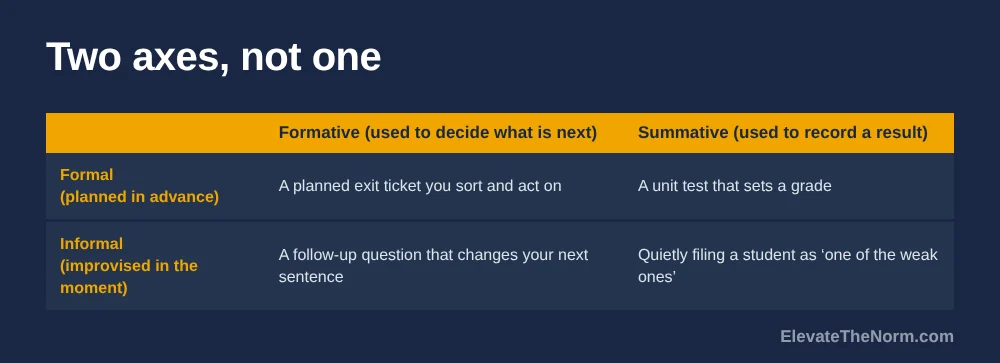
    Graphic showing formative and summative as a function axis crossed with formal and informal as a construction axis, producing four combinations with a classroom example in each.

    This is the part that turns a vocabulary lesson into something you can act on. Black and colleagues put it as a threshold: assessment “becomes ‘formative assessment’ when the evidence is actually used to adapt the teaching work to meet learning needs.” Until then it is just a task. Which produces two consequences teachers run into constantly:

    • A summative test can be used formatively. Read the unit test, find that two-thirds of the class missed the same standard, reteach it. That test just did formative work, grade and all.
    • A tool built for formative use can function summatively. Weight the exit tickets at fifteen percent of the quarter and they are now low-stakes summative assessments that students will optimise rather than answer honestly.

    There is a second axis worth keeping separate from this one, because mixing the two is the most common confusion in the whole topic. Formal and informal describe how a check is built — planned and written in advance, or improvised while circulating. Formative and summative describe what the result is for. They cross, which gives four real combinations: a planned exit ticket you sort and act on is formal and formative; a unit test that sets a grade is formal and summative; a follow-up question that changes your next sentence is informal and formative; and a teacher quietly filing a student as one of the weak ones based on an offhand answer is informal and summative, which is the box nobody names. We take that axis apart on its own in formal vs informal formative assessment; this article stays on the formative/summative one.

    Does formative assessment actually raise achievement?

    Yes, modestly, and the widely quoted numbers are too big. The best-known meta-analysis of the studies that could be used found a weighted mean effect of about 0.20. A large randomised trial in English secondary schools found about 0.09. Formative assessment is worth doing and it has been oversold.

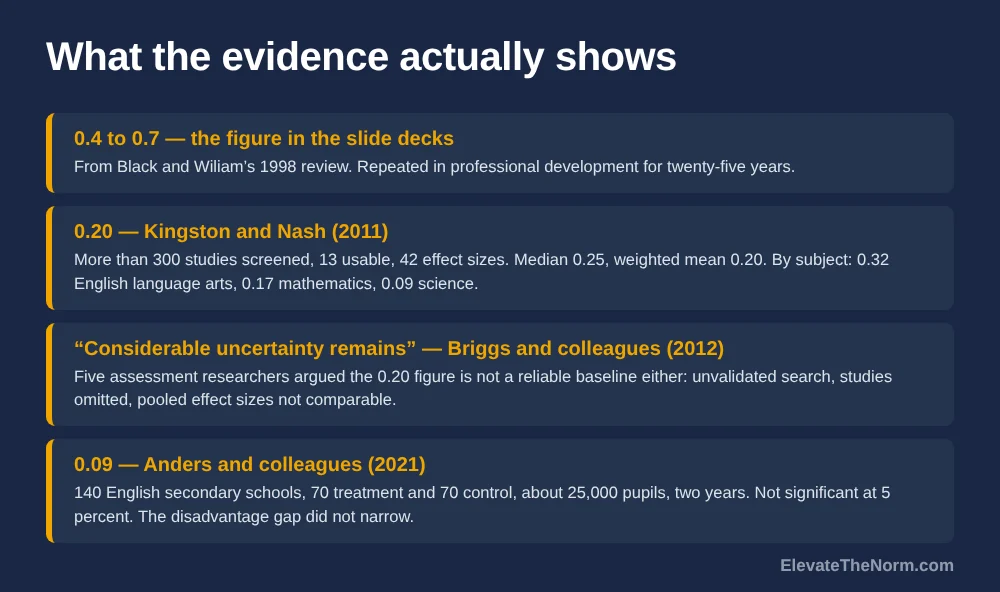
    Here is the honest history, because it matters for how you talk to a principal about it. Black and Wiliam’s 1998 review is the source of the effect-size range — roughly 0.4 to 0.7 — that has been repeated in professional development for twenty-five years. In 2011, Neal Kingston and Brooke Nash went looking for the studies behind it. They screened more than 300 and found 13 that reported enough information to compute an effect size, yielding 42 independent effect sizes. The median was 0.25; a random-effects model gave a weighted mean of 0.20. By subject: 0.32 in English language arts, 0.17 in mathematics, 0.09 in science. Their conclusion was that the commonly cited figure near 0.70 is not supported by the research base.

    Graphic comparing the commonly quoted 0.4 to 0.7 formative assessment effect-size range with Kingston and Nash's weighted mean of 0.20 and the 0.09 found in a 140-school randomised trial.

    And then the contrary evidence, which deserves saying out loud. In 2012, Derek Briggs, Maria Araceli Ruiz-Primo, Erin Furtak, Lorrie Shepard and Yue Yin published a commentary arguing that the 0.20 figure should not be treated as a baseline either. Their objections were specific: the literature search was not validated or replicable; requiring studies to use the phrase “formative assessment” excluded most work published before 2000, leaving only one such study in the review; two qualifying studies were omitted while one without a control group was included; and effect sizes computed with and without pretest data were pooled as though comparable, which in one dataset moved the mean from −0.32 to −0.14 depending on method. They concluded that “considerable uncertainty remains” and that a different set of studies could produce a meaningfully higher or lower average.

    So the defensible statement is not “formative assessment produces an effect of 0.20.” It is that the research base is too thin and too uneven to support any single number, and that the numbers it does support are far below what the slide decks claim.

    The cleanest evidence is the newest and the least flattering. In 2021 Jake Anders and colleagues reported a pre-registered, school-level cluster-randomised trial of the Embedding Formative Assessment programme: 140 English secondary schools, 70 treatment and 70 control, roughly 25,000 pupils, two years of monthly teacher learning communities and peer observation, analysed by intention to treat on administrative data. The effect on GCSE Attainment 8 was 1.66 points, d = 0.09, with a confidence interval from −0.01 to 0.18 — not significant at the conventional 5 percent level, though significant at 10 percent. English and maths effects were about 0.05 and not significant. For pupils eligible for free school meals the effect was smaller, 0.07, so the disadvantage gap did not narrow. Pupils with low prior attainment showed larger effects, but the difference between subgroups was not statistically significant.

    That is what two years of well-supported, teacher-led formative assessment work bought at scale in real schools. It is a real, positive, small effect. Anyone presenting formative assessment as the highest-leverage thing available to a secondary school is quoting 1998 and ignoring everything since.

    That trial matters more than a classroom teacher might think, because what it tested is exactly what a district buys. Embedding Formative Assessment is a packaged programme — nine monthly teacher learning community workshops a year plus monthly peer observation, delivered with light-touch external support and run mostly by teachers inside their own schools. If you are being asked to approve a districtwide formative assessment initiative, 0.09 on the primary outcome and no narrowing of the disadvantage gap is the number to hold the proposal against, not 0.70.

    How many formative checks should you run before a summative assessment?

    No study supports a particular ratio, and anyone who gives you one is giving you a preference dressed as research. Use a coverage test instead: every standard the summative assessment will judge should have been checked at least once while there was still time to do something about it.

    Ratios like 3:1 or 80/20 show up in district assessment policies and they are made up. What is defensible is the sequence, and it is easy to audit. Take the unit test you are about to give, list the standards it asks about, and for each one answer a single question: when did I last see evidence of this, and did I change anything because of it? Any standard where the answer is “the test” is a standard you are measuring rather than teaching.

    1. List the standards the summative assessment will judge. Usually four to eight for a secondary unit.
    2. For each one, name the check that already happened. An exit ticket, a mid-draft read, a circulating question, a practice set you actually looked at.
    3. For each one, name what you changed. If nothing changed, the check was data collection, not formative assessment.
    4. Fill the gaps before the test, not after it. A standard with no check gets one in the last few days of the unit, even if it is thirty seconds of circulating.
    5. Then give the summative assessment and leave the reteaching time in the calendar. A summative assessment with nothing after it cannot do double duty, and double duty is free.

    Should formative assessment go in the gradebook?

    Keep it out, or weight it near zero. A check that counts stops being a check. Students respond to stakes by protecting the score, which means they show you their best guess rather than their actual confusion — and the confusion was the entire reason you asked.

    This is the practical consequence of the function argument above, and it is where most school assessment systems quietly fail. A department decides formative assessment matters, so it gives formative work a weight to make students take it seriously. The weight converts the work into a low-stakes summative assessment. Students optimise. The teacher keeps getting clean exit tickets and keeps being surprised by the unit test. Nobody notices, because the calendar is full of things labelled formative.

    Two complications worth being honest about. First, a lot of secondary students will not do ungraded work, and that is a real constraint rather than a character flaw — they are budgeting attention across seven classes. The workable answer is usually completion credit rather than accuracy credit: the work counts for having been done, not for having been right. Second, if formative work is out of the grade, the grade rests almost entirely on summative assessment, which raises the stakes of each summative task and makes the retake question unavoidable. We go through the evidence on that in whether students should be allowed to retake tests, and the broader question of what a grade should represent in what standards-based grading actually fixes.

    There is a third consequence that falls on families rather than on teachers, and it is worth getting ahead of. If formative work leaves the gradebook, a parent checking the portal in week three may see two entries where they used to see fifteen, and the reasonable conclusion from the outside is that nothing is being assessed. The fix is a sentence, sent once at the start of a term: the grade reflects what your child can do at the end of a unit, the practice in between is not counted on purpose so that mistakes during it are free, and here is where you can see that practice. A policy that is defensible but unexplained still generates the phone call.

    Student self-assessment runs into exactly the same split, and the research there is unusually clear about it: used formatively and ungraded it supports achievement, and used summatively it mostly teaches students to inflate. That is covered separately.

    What to tell students about why it does not count

    Teenagers are not confused by this, but they are suspicious of it, and with reason — they have been told before that something does not count and then watched it count. So say the actual reasoning out loud, because the reasoning is good and they can follow it: this one is not for a grade, because I need to know what you genuinely do not understand yet, and if it were graded you would sensibly show me your best guess instead. Being wrong here costs you nothing. Being wrong on Friday costs you something. So be wrong here.

    That is a more respectful position than it sounds, and it is also just true. A student who understands that the ungraded check is the safe place to be wrong will use it that way. A student who suspects everything is secretly being recorded will protect themselves on every task, which is a rational response to a system that has not explained itself.

    Where the formative vs summative distinction goes wrong in real schools

    Four failure modes account for most of it, and none of them is a vocabulary problem. Each one is a case of the label being right and the function being wrong.

    • Labelled formative, used summatively. The most common one. The task is called formative, carries a weight, and produces optimised answers instead of information.
    • Formative data collected and never used. Exit tickets in a stack on the desk. The eliciting happened; the interpreting and using did not, which means no formative assessment occurred.
    • No time budgeted for the response. A check that reveals a problem on Thursday is worthless if Friday is the test and Monday is the next unit. The check is not the practice. The change is the practice.
    • Summative assessment treated as the finish line. The test is graded, returned, and never read by the teacher as data. A unit test is the richest formative information a secondary teacher gets all month and most of it is thrown away.

    Clay’s take: the word is doing almost no work

    I have sat in meetings where the phrase “formative assessment” meant a specific document that had to be uploaded by Friday. That is the state of the term in a lot of buildings. It has become a noun describing a thing you submit, when the research definition is a verb about something you do with information.

    My room is a workshop — tables in groups, no rows, and I am moving between them on a stool most of the period rather than standing at the front. The best formative information I get all day is not a document. It is overhearing a group work a misconception out loud before it spreads to the table next to them, and changing what I say to the whole class ninety seconds later. None of that gets recorded anywhere. By the research definition it is textbook formative assessment, because the evidence was elicited, interpreted and used. By the district definition it does not exist, because nothing got uploaded.

    That gap is worth naming, because it points at the practical takeaway. If you want more formative assessment in a secondary classroom, the lever is almost never another instrument. It is building the period so you are among the work while it is being done, and leaving enough slack in the unit that finding a problem is not an inconvenience. Everything else is documentation.

    I know what the second half of that sounds like to anyone teaching to a pacing guide. If the calendar says you are on the Industrial Revolution the week of the fourth, there is no slack to leave — that is the honest situation in a lot of buildings and pretending otherwise is useless. The version that survives a pacing guide is smaller: budget one class period per unit with nothing scheduled in it, and decide what goes in it on the day, based on what the checks turned up. One period is defensible to anyone who asks, it is recoverable if the unit runs long, and it is the difference between finding a problem and being able to do something about it. If you cannot protect one period in a three-week unit, the constraint is the pacing guide, and that is a conversation to have with the person who wrote it rather than a problem to solve with better exit tickets.

    And I would be careful with the numbers in either direction. The honest version — this helps a modest amount, the big figures are not supported, and the best trial at scale found 0.09 — is more useful to a teacher than the sales pitch, because it sets a realistic expectation for what changing your practice will feel like. A 0.09 effect across 140 schools is not nothing. It is also not going to be visible in your own gradebook by Christmas, and if you were promised it would be, you were misinformed.

    What should you do next?

    Pick the unit you are teaching now and run the coverage test above on its summative assessment. It takes about fifteen minutes and it will usually turn up one standard the test judges that nothing has checked.

    1. Run the five-step coverage audit on your current unit.
    2. Find out what weight formative work carries in your gradebook. If it is more than a token, that is the first thing to change, and completion credit is the usual compromise.
    3. Put one block of reteaching time after your next summative assessment, before the next unit starts, so the test can do formative work too.
    4. Pick two or three checks from the strategy list and run them for a fortnight rather than trying to rebuild your whole assessment system at once.

    Want the fullest version of a formative check actually changing what happens next? That is Bloom’s mastery learning cycle — the check stays ungraded, the results get sorted by error rather than by score, and a second attempt is built into the plan. The evidence for it is more contested than its reputation suggests, which is covered there.

    Frequently Asked Questions

    What is the difference between formative and summative assessment?

    Formative assessment happens during learning and the result is used to decide what to teach next. Summative assessment happens after a chunk of learning and the result is used to record how much was learned. The distinction is about what the evidence is used for, not about the format of the task. A written test can serve either purpose depending on what the teacher does with it.

    Is a quiz formative or summative?

    Either, depending on what happens next. A quiz you read, sort by error, and reteach from is formative. The same quiz entered as a grade and never revisited is summative. Nothing about the quiz itself settles the question, which is why calling a task “the formative” and a different task “the summative” gets the concept backwards.

    Should formative assessment be graded?

    It can be recorded, but if it counts heavily toward the final mark students will protect the score instead of showing you the confusion, which destroys the information you needed. Most workable secondary systems either keep formative work out of the grade or give it very low weight, and put the grade on the summative work that comes after the reteaching.

    What is the ideal ratio of formative to summative assessment?

    No study supports a specific ratio, and anyone quoting one is giving you a preference. The practical test is coverage: every standard a summative assessment will judge should have been checked informally at least once while there was still time to fix it. If a question on the unit test is the first time you have looked at that skill, the sequence is wrong.

    How effective is formative assessment really?

    More modest than the famous numbers suggest. Kingston and Nash’s 2011 meta-analysis of the usable studies found a weighted mean effect of about 0.20, not the 0.40 to 0.70 range often quoted, and a 2012 commentary argued even that single figure is unreliable. A 140-school randomised trial in England found about 0.09. Worth doing, oversold.

    Are formative and summative the same as informal and formal?

    No. Formal and informal describe how a check is built — planned and written down, or improvised in the moment. Formative and summative describe what the result is used for. They are two separate axes, so a planned written check can be formative, and an offhand judgment can function summatively.

    What are examples of formative and summative assessment in middle and high school?

    Formative: an exit ticket you sort before tomorrow, a mid-draft read of a thesis statement, a circulating question that changes your next sentence, a project check-in. Summative: a unit test, a final essay, a project presented to an outside audience, an end-of-course exam. The same artefact can switch categories if its purpose changes.

    Can a summative assessment be used formatively?

    Yes, and it is one of the cheapest upgrades available. If you read a unit test, find that two-thirds of the class missed the same standard, and reteach it before moving on, that test has done formative work even though it also produced a grade. The limiting factor is whether anything in your schedule allows the reteaching to happen.

    Sources

    About Clay Shumate

    Clay Shumate is a certified secondary Social Studies teacher in the public schools of West Alabama, with seven years of classroom experience, a B.A. in History, and an M.Ed. in Secondary Education. He writes about project-based learning, student responsibility, respect, and practical ways to hold young people to a higher standard while giving them room to learn from mistakes. He is a member of the Society of Professional Journalists and writes to its Code of Ethics; this site’s editorial standards and corrections policy are published in full. More about Clay.

Teacher Emergency Toolkit — practical resources, real classroom support. Shop on TPT.Teacher Emergency Toolkit — practical resources, real classroom support. Shop on TPT.