By Clay Shumate
Yes, students should be allowed to retake tests, as long as the policy is written down. A fair retake follows real reteaching or corrections, measures the same learning, is capped, and says which score counts. The evidence for grades 6–12 is thin, so the design matters more than the debate.
Key Takeaways
- The best K–12 evidence is one cluster randomized trial in 29 schools: a standards-based grading package with reassessment raised ninth-grade math scores about 13 percentile points (0.33 standard deviations). It tested the whole package, not retakes alone.
- Most direct evidence on retake rules comes from college courses and national admission exams, not grade 6–12 classrooms, and it points both ways: lower self-reported anxiety with second chances, lower dropout when one university cut attempts from six to three.
- Teachers are divided. In a national survey of nearly 1,000 K–12 teachers, 41 percent called unlimited retakes helpful and 37 percent called them harmful, the most accepted of five policies studied.
- Design beats the yes-or-no question: require corrections first, use a parallel version, cap attempts, set a window, and say in advance which score counts.
- Offer retakes by rule, not by request. A retake open only to students who ask favors the families who already know to ask.
Ask a department whether students should be allowed to retake tests and you will usually hear two speeches. The first says a grade should report what a student learned, and learning does not expire on test day. The second says deadlines and one honest attempt are part of learning to prepare. Both contain something true. Neither tells you what to put in the handbook.
This guide skips the speeches. It covers what the research on retakes actually studied, who was in it, the contrary evidence, and the decisions a retake policy has to make. It is written for grades 6–12. Where the evidence comes from college students or national exams, the text says so, because those students are not yours.
The position matches the rest of this site: expectations stay high, the consequence is real, and a student gets a way to repair a mistake. A retake should cost effort, not dignity, which is the logic behind the late work policy and the no-zero grading policy. The broader argument is in learning from mistakes.
Should students be allowed to retake tests?
Yes, in most secondary classrooms, with conditions. A retake belongs in the policy when its purpose is learning the material, when the student does work to earn it, and when every student gets the same rules. Unlimited, on-demand retakes with no requirement are where policies fail.
The pros and cons of retaking tests are both real. The case for is simple: a test measures one student on one day. If that student studies properly and shows the learning two weeks later, the second result is better evidence than the first. A gradebook that keeps the first number forever reports an event, not an outcome.
The case against is also real. Deadlines teach preparation, and a test that can be retaken at any time can turn the first attempt into a rehearsal. Writing, proctoring, and scoring second versions also lands on adults who already have a full day.
The two cases only collide when the policy is vague. A retake that is earned, comes once, and arrives inside a window keeps most of the benefit and most of the safeguards.
One objection deserves a direct answer: real life does not give do-overs. That is only half right. Adults retake things constantly, but usually with a wait, a cost, or a cap. A good school policy copies the wait and the effort, not the absence of a second chance, and treats students as people who can be handed a clear rule and expected to meet it.
What does the research on retaking tests actually show?
Less than the debate suggests. The strongest K–12 result is a randomized trial of a whole standards-based grading package in ninth-grade math. Nearly everything else on retakes comes from college courses, surveys, or national exams, and those results do not all point the same direction.
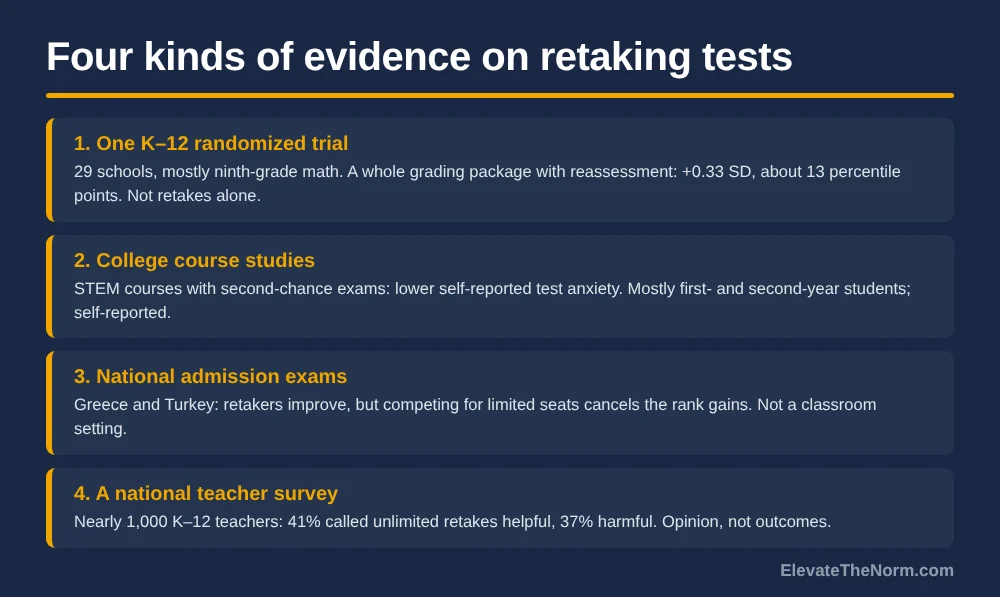
The best-controlled K–12 evidence is the PARLO trial, reviewed by the What Works Clearinghouse. Teachers organized each semester around 10 to 15 learning outcomes, gave formative feedback, and let students reassess for full credit; grades reflected demonstrated outcomes, not a points average. Of 2,736 students analyzed, those in PARLO classrooms scored 0.33 standard deviations higher on an end-of-course assessment, about 13 percentile points. The review rated it meets standards with reservations, citing high attrition of whole schools (18 intervention and 17 comparison schools were assigned; 29 are in the sample) and varied implementation.
Read that carefully. PARLO included reassessment, but also outcome-based grading, feedback, summer training, extra training days over two years, and monthly teacher meetings. It tested the package. It does not show that adding a retake to an ordinary points-based gradebook would move scores 13 percentile points. Linka and Guskey make the same point: in their review, no grading system by itself improves learning, and retaking a poorly aligned test will not either. Corrective instruction first, they argue, makes a second chance meaningful.
| Source | Who was studied | What it found | Main caution |
|---|---|---|---|
| Kramer et al. (2025) | 29 schools, mostly ninth-grade algebra and geometry; 2,736 students analyzed | +0.33 SD on an end-of-course assessment; about 13 percentile points | Whole grading package, not retakes alone; high school-level attrition |
| Emeka et al. (2023), test anxiety | Seven STEM courses at one large university; 448 of 2,102 students responded | Self-reported test anxiety fell from 22.7 to 17.7 on a 6–30 scale; 72% disagreed they studied less | 21.3% response rate; self-reported; performance not measured |
| Herman et al. (2020) | One college STEM course | A 90/10 weighted average of two attempts raised take-up more than capped replacement; authors’ data suggest more learning | One course; read at record level, no numbers reported there |
| Jenkins & Hussein (2023) | Two engineering courses | Retake options linked to higher letter grades and fewer D/F grades | Abstract level; no sample sizes or statistics |
| Fordham/RAND teacher survey | Nearly 1,000 K–12 teachers | 41% called unlimited retakes helpful; 37% harmful | Opinion, not outcomes; news report, no margin of error |
The college evidence is more detailed and less relevant. Emeka and colleagues surveyed 2,102 students in seven STEM courses with second-chance exams. Of the 448 who responded, mean self-reported test anxiety fell from 22.7 to 17.7 on a 6–30 scale, 87 percent said they prepared for the first attempt to avoid needing another, and 72 percent disagreed that they studied less when a retake was available. That counters the fear that retakes breed laziness, with limits: respondents were mostly first- and second-year college students, only about one in five answered, and everything was self-reported.
None of this is a controlled comparison, in a grade 6–12 classroom, of the same course with and without a retake option; among the sources read for this article, that comparison does not exist. Anyone who says the research proves retakes work, or proves they backfire, is stretching it.
What does the evidence against retakes say?
Three kinds of evidence cut the other way: exams where retakers compete with each other, a university that improved outcomes by cutting attempts, and educator warnings about workload. None studied an ordinary secondary classroom, but each names a failure mode a policy should plan for.
Start with national exams. In a study of Greek senior high school students, those who fell below a new minimum admission score could only gain access by retaking all exams the following year. Retakers improved by about half a standard deviation, yet did not land in clearly better courses; their rank gains disappeared against the students they actually competed with. The authors call the paper preliminary, covering one cohort.
A working paper on Turkey’s university placement exam models a similar result: because retakers raise cutoffs for everyone, limiting retaking would leave most students better off, even though gains between attempts were real (0.2 to 0.5 standard deviations). Both involve ranking for limited seats, so one student’s gain is another’s loss. A unit test has no seats; every student can earn an A. This is a mechanism to watch, not a description of your department.
The cleanest case for fewer attempts comes from a faculty at the University of Bologna, which cut the number of times a student could sit each first-year exam from six to three. Compared with related programs that did not change, first-year dropout fell about 4.2 percentage points and students earned about 11 more credits. The study covers 9,083 students at one prestigious faculty, the dropout result weakens under some statistical choices, and six attempts a year is far beyond what a secondary teacher would offer. One plausible reading, untested by the paper, is that very generous rules let students postpone the work.
Educators raise a different warning. Linka and Guskey call unlimited retakes “unrealistic” at the secondary level and warn of “burdensome workloads for teachers.” In the Fordham Institute and RAND survey of nearly 1,000 K–12 teachers, unlimited retakes were the most accepted of five equitable-grading policies, and the verdict was still split at 41 percent helpful to 37 percent harmful. That is opinion, not results; the news report gives no margin of error, and Joe Feldman, whose book the five policies come from, said the survey oversimplified his practices.
Students have their own list. In open-ended comments from students at one high school, complaints included that a worse retake score could replace a better original and that teachers applied the rules differently. The authors did not count comments by theme, so treat them as failure points, not frequencies.
The pattern is consistent. The problem is not that a second chance exists. It is a second chance that is unlimited, unstructured, or disconnected from new learning.
What should a retake policy decide in writing?
Six things: who is eligible, what the student does first, how many attempts are allowed, what the second test looks like, when it happens, and which score counts. Each unwritten decision becomes a case-by-case argument, and case-by-case arguments are where unfairness enters.
| Decision | Defensible default for grades 6–12 | What goes wrong without it |
|---|---|---|
| 1. Eligibility | Offer it by rule to anyone below proficiency; others may opt in | Only families who know to ask use it |
| 2. Entry step | Corrections with explanations, or a short study plan with practice evidence | A free second roll of the dice |
| 3. Attempts | One retake per test; a second only after a conference | Endless cycles and an unmanageable marking load |
| 4. Version | A parallel form: same standards, similar difficulty, new items | A memorized quiz, or a harder test that punishes the student |
| 5. Window | A fixed window of about ten school days after the test comes back, long enough for students with jobs or family duties | Requests pile up at the end of the quarter |
| 6. Which score counts | State one rule in advance; this guide defaults to the higher score | The “my retake was worse” surprise |
Most are judgment calls, but a few have logic behind them. Start with the entry step. The test corrections guide makes corrections the price of admission to a retake, and Linka and Guskey land in the same place. If the student never had the material, corrections amount to copying, so reteach first.
What about capping the retake score? Some college courses cap recovered credit, at 80 percent in one set of engineering sections and 90 percent in the exams Herman and colleagues compared. A cap is defensible, but it penalizes learning late. The entry step guards against gaming better because it demands new work rather than lowering the ceiling. Keep the retake rule consistent with your floor and deadline rules so students do not face contradictory systems.
The hardest decision is which score counts: the higher score, the most recent, or an average. Among 513 students in two sophomore engineering courses, preferences between a policy where grades cannot go down and one where they can were almost perfectly split. Those who liked the safety net said it eased test anxiety; those who liked the risk said it pushed them to study before the second exam. The high school comments show the other side: a retake that quietly lowered a grade was a surprise students resented.
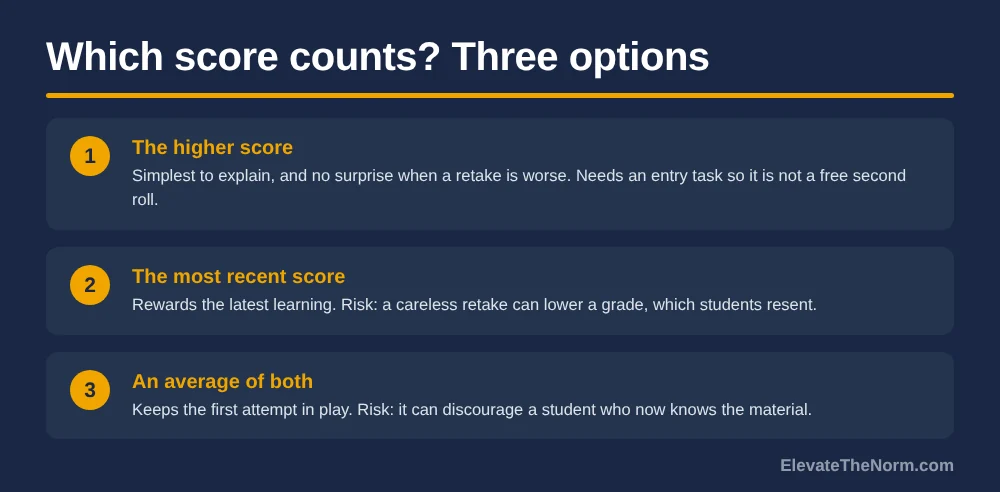
No option is neutral, so the rule that matters is the one students can recite. This guide’s default is the higher score paired with a real entry step: it is simplest to explain, it removes the lower-score surprise, and the entry step screens out the careless second attempt. A department that prefers averaging should say so before the first test, not after the first retake.
Two checks before adopting any version: read your board’s grading policy, since a conflicting department rule will not survive an appeal, and apply the same accommodations to the retake that a student receives on the original.


What does a fair retake process look like, step by step?
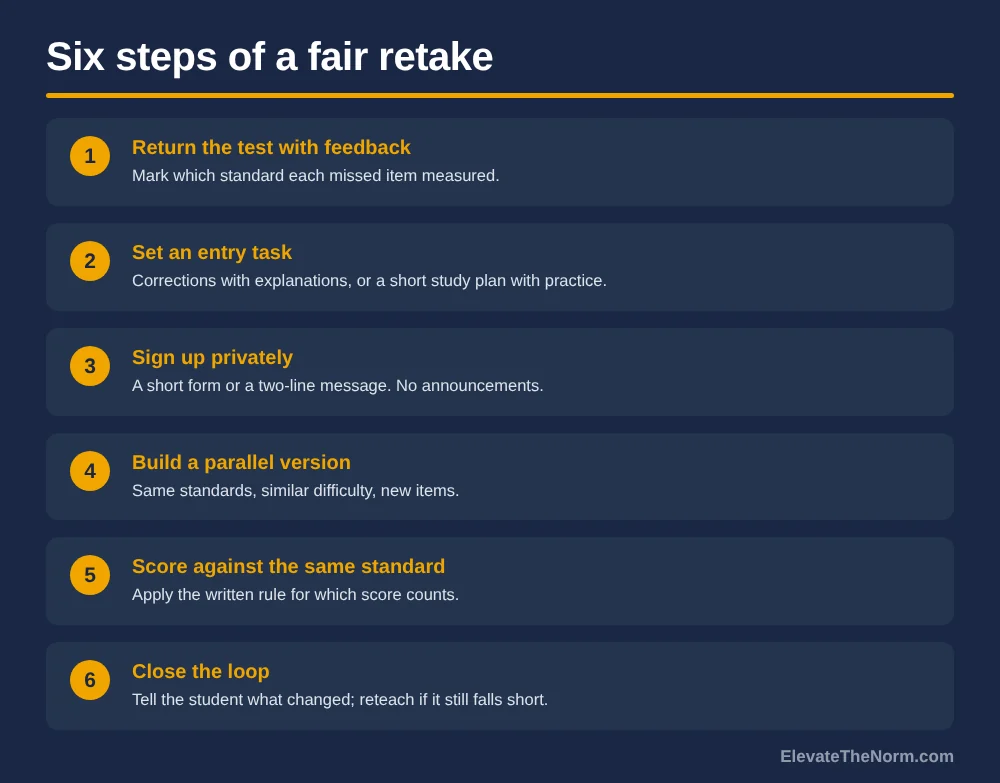
A fair retake process has six steps: return the test with feedback, require an entry task, schedule inside a fixed window, use a parallel version, score against the same standard, and talk through the result. Write it once and apply it identically to every student.
- Return the test with feedback tied to standards. Mark which skill each missed item measured. A student cannot prepare for a retake from a bare score.
- Set the entry task. Corrections with a written explanation of each error, or a short study plan with practice evidence. Keep it small enough to finish in a night or two.
- Let students sign up privately. A short form or a two-line message is enough. Do not announce who is retaking.
- Build a parallel version. Same standards, comparable difficulty, new items, written with the original. Collect every copy so questions do not circulate.
- Score against the same standard. Use the same rubric or answer-key logic, and apply the written rule for which score counts.
- Close the loop. Tell the student what changed and what it did to the grade, and note the retake in the gradebook so families see the attempt. If it also falls short, hold a short conference and reteach the specific skill.
That is a lot of structure, and the structure is what lets you say yes without retakes eating the unit. In grades 6–8, shorten the entry task and the window, and have the teacher issue the invitation rather than relying on a student to remember to sign up. Step three borrows from the objections to standards-based grading: visible reassessing announces who struggled, and a policy nobody wants to be seen using is not working. Here is the whole policy as text students can read in thirty seconds.
Retake policy: If you score below proficient on a test, you may retake it once. First, complete your corrections or study plan and show them to me. Sign up within ten school days of getting the test back. The retake uses different questions on the same skills. The higher of your two scores goes in the gradebook. If you still need help after one retake, we will talk about next steps together.
How much work do retakes add for teachers?
More than most policies admit, and the load grows with attempts rather than with students. Every extra version must be written, administered, and scored. A cap, a fixed window, and an entry task are the three cheapest ways to keep the load from collapsing by midyear.
The arithmetic is illustrative, not measured. A teacher with 130 students who sees one in five ask for a retake has 26 extra papers to administer and score after a single test, plus a second version to write; three units closing in one month make it 78. Jenkins and Hussein discuss the extra instructor workload their policies created without quantifying it. The standards-based grading gradebook guide covers why reassessment is the real labor cost of that system.
Three practices keep the number manageable: write the parallel form with the original, from the same standards blueprint; share the item bank across a course team or district; and hold retakes in a slot that already exists, such as a flex block, instead of after-school sessions only some students can attend. Align the window with grade-reporting dates too.
Will students game a retake policy, and is it fair to students who studied?
Some will test the edges, which is why a retake must be earned with an entry task. Students who studied lose nothing, because someone else’s retake does not lower their score unless grades are curved. Fairness comes from one visible path open to everyone.
The evidence on gaming is mixed and self-reported. In the Illinois survey, 87 percent said they prepared for the first attempt to avoid a retake, yet some high school students wrote that others abuse the ability to reassess. Both can be true. An entry task, an attempt cap, and a fixed window mean abuse costs the student effort instead of the class its time.
The fairness objection deserves respect, because it is usually a feeling about effort rather than points. Name it: their first score stands, another student’s retake does not change it, and they have the same path next time.
How do you keep retakes equitable?
Offer them by rule, not by request. A retake open only to students who ask favors students whose families already know the system. Publish the policy, offer the retake automatically below proficiency, and keep sign-up private so using it does not cost a student status.
The test corrections guide makes this point and it holds here: if a retake is available to anyone who asks, the students who ask are the students whose families know to ask. Automatic offers solve that. So does a written policy sent home at the start of the course, which answers the first question most parents have: is the rule predictable and the same for every child?
Consistency across teachers matters just as much. In the high school comments, students described teachers who allowed reassessment sometimes, others always, and some never, and windows that opened only near the end of the quarter. A short department-level policy removes the perception that retakes depend on whose class you are in.
Finally, treat the student as the decision maker. Explain why the rule exists, let the student choose whether to use it, and ask for their plan rather than prescribing one. That is a higher standard in a gradebook: a clear expectation, a real consequence, and a way back the student has to walk.
So, should students be allowed to retake tests?
Yes, when a retake is earned through new learning, measures the same standards, is capped, and follows one written rule for every student. Without those conditions the real question is not whether students may retake but whether the grade means anything.
The research cannot settle this for you. It marks the edges: structured reassessment inside a supported system has the best K–12 evidence, unlimited and unstructured attempts draw the most warnings, and everything in between is a decision your department has to make and write down.
If your team is stuck, start with one question: what does a student have to do between the first test and the second? Once that is written, caps, windows, versions, and scoring tend to fall into place. Then measure your own results: after a semester, count who retook, who improved, and whether the numbers differ by teacher or student group. That is better evidence for your school than any study above.
Frequently Asked Questions
Should students be allowed to retake tests?
Yes, in most secondary classrooms, as long as the retake is earned and the rules are written down. A fair policy requires corrections or a study plan first, uses a parallel version of the test, limits attempts, and states which score counts. Unlimited, on-demand retakes with no requirement are where the policy tends to fail.
Does allowing retakes make students study less?
The evidence is limited and mostly self-reported. In a survey of college STEM students whose courses offered second-chance exams, 87 percent said they prepared for the first attempt to avoid needing another, and 72 percent disagreed that they studied less. That group is older than yours, so keep an entry task and an attempt cap as protection.
Should a retake replace the original score or be averaged?
Either can work if students know the rule before the first test. Taking the higher score is simplest to explain and avoids the surprise of a worse retake lowering a grade. Averaging rewards the first attempt more but can discourage students. In one survey of engineering students, preferences between a no-risk policy and a can-go-down policy were almost evenly split.
How many times should a student be allowed to retake a test?
Once is a sound default for grades 6-12, with a second attempt only after a conference and new reteaching. Unlimited retakes are the most contested version: teachers in a national survey split 41 percent helpful to 37 percent harmful, and researchers warn of burdensome workloads. A cap keeps the policy sustainable and the first attempt meaningful.
Should the retake be the same test?
No. Use a parallel version that measures the same standards at similar difficulty with new items. Giving the identical test measures memory of the test, while a noticeably harder test punishes the student for needing a second chance. Writing the parallel form at the same time as the original keeps preparation time manageable.
How do I explain a retake policy to parents?
Put it in writing at the start of the course and send it home: who can retake, what the student must do first, how many attempts exist, the window, and which score counts. Say it applies to every student the same way, and keep individual retake results private. Parents mostly want a predictable, fair rule.
What if a student fails the retake too?
Treat it as information, not a reason for an automatic third attempt. Hold a short conference to find what is missing, reteach that specific skill, and decide on a next step together. If many students fall short, check the original instruction and how well the test matches the standards.
Do the same rules apply to students with accommodations?
Yes. A retake should follow the same accommodations a student receives on the original test, such as extended time or a read-aloud, and the entry task should be adjusted if its format creates a barrier. The retake is not a way to shorten or dilute the standard; it is a second look at the same learning.
Sources
- Kramer, S. L., Posner, M. A., Browman, A. S., Lawrence, N. R., Roem, J., & Krier, K. (2025). The impacts of a standards-based grading system emphasizing formative assessment, feedback, and re-assessment: A mixed methods, cluster randomized control trial in ninth grade mathematics classrooms. Journal of Research on Educational Effectiveness, 18(1), 56–87. Read through the What Works Clearinghouse study review, not the journal article. 29 schools, 2,736 students analyzed, effect 0.33, improvement index 13 percentile points. Caveats the review states: rated meets standards with reservations; high cluster-level attrition; teachers developed their own outcomes and routines; free/reduced-price lunch status recorded as unknown for the whole sample. The program bundled reassessment with outcome-based grading and extensive teacher training, so the result is not a test of retakes alone.
- Emeka, C. A., Zilles, C., West, M., Herman, G. L., & Bretl, T. (2023). Second-chance testing as a means of reducing students’ test anxiety and improving outcomes. ASEE Annual Conference. Seven STEM courses at a large Midwestern public university; 448 of 2,102 surveyed students responded; 23 interviews. Caveats the authors state: self-reported anxiety recalled across two hypothetical conditions, adapted six-item scale with a ceiling effect, 21.3% response rate, no pretest or posttest. Performance was not measured in this study.
- Herman, G. L., Cai, Z., Bretl, T., Zilles, C., & West, M. (2020). Comparison of grade replacement and weighted averages for second-chance exams. Proceedings of the ACM Conference on International Computing Education Research, 56–66. Read at record level: the page reports the design (90% cap with replacement versus a 90/10 weighted average) and conclusions but no effect sizes or sample sizes. One STEM course; quasi-experimental.
- Emeka, C. A., Smith, D. H., Zilles, C., West, M., Herman, G. L., & Bretl, T. (2023). Determining the best policies for second-chance tests for STEM students. ASEE Annual Conference. Read at record level: 513 survey respondents in two sophomore engineering courses; student preference between the two policies was almost perfectly split. No percentages or performance statistics appear in the record.
- Jenkins, J. M., & Hussein, F. (2023). Implementation of a retake policy: Who benefits? ASEE Annual Conference. Read at abstract level: two engineering courses at one anonymized university, retakes capped at 80 percent in the statics course, reported gains in letter grades and fewer D/F (or C/F) grades. The abstract reports no sample sizes or statistics.
- Bizopoulou, A., Megalokonomou, R., & Simion, Ş. (2022). Do second chances pay off? Evidence from a natural experiment with low-achieving students. IZA Discussion Paper 15139. Greek national admission exams, roughly 14,500 students near the threshold in the main analysis, fuzzy regression discontinuity. Caveats the authors state: discussion paper (preliminary), one cohort in one country, offers rather than enrollment, some weak subgroup results. This is a policy where retaking was the only route to admission; it is not a classroom retake.
- Krishna, K., Lychagin, S., & Frisancho, V. (2017). Retaking in high stakes exams: Is less more? IDB Working Paper 758. Turkey’s university placement exam, 31,554 science-track students; structural model with policy simulations. Caveats the authors state: one track with competitive admissions, results depend on estimated parameters, model omits longer-term learning benefits. A working paper, not a classroom study.
- Bratti, M., Granato, S., & Havari, E. (2024). Another chance: Number of exam retakes and university students’ outcomes. IZA Discussion Paper 17400. Faculty of Economics, University of Bologna; 9,083 students; difference-in-differences. Caveats the authors state: single prestigious institution, dropout counts only students leaving that university, the dropout result is not significant under some inference choices, long-term outcomes are exploratory. The paper does not test the mechanism offered in the text.
- Linka, L. J., & Guskey, T. R. (2022). Is standards-based grading effective? Theory Into Practice. A review, not an experiment. Quoted for the cautions on unlimited retakes and for the statement that no grading system by itself improves learning. The paper concludes there is little empirical evidence for the benefits some proponents claim for multiple reassessment opportunities.
- A thousand teachers were asked about equitable grading. Most didn’t like it. The 74. Read as a news report of the Thomas B. Fordham Institute and RAND survey, not the report itself. Nearly 1,000 K–12 teachers; 41% helpful and 37% harmful for unlimited retakes. Caveats: the five policies were chosen because they are controversial and are five of 14 practices examined; Joe Feldman said the survey misrepresented his practices; the article gives no margin of error.
- Peters, R., Kruse, J., Buckmiller, T., & Townsley, M. (2017). “It’s just not fair!” Making sense of secondary students’ complaints about standards-based grading American Secondary Education, 45(3). Qualitative analysis of anonymous student comments at one high school of about 478 students; themes were not quantified. Used only for the kinds of complaints students raised.
- Editorial note. The six decisions, the six steps, the sample policy text, the one-in-five workload illustration and the default of the higher score are compiled for this article. They are recommendations, not a report of any teacher’s classroom, and no study above tests them as a set.