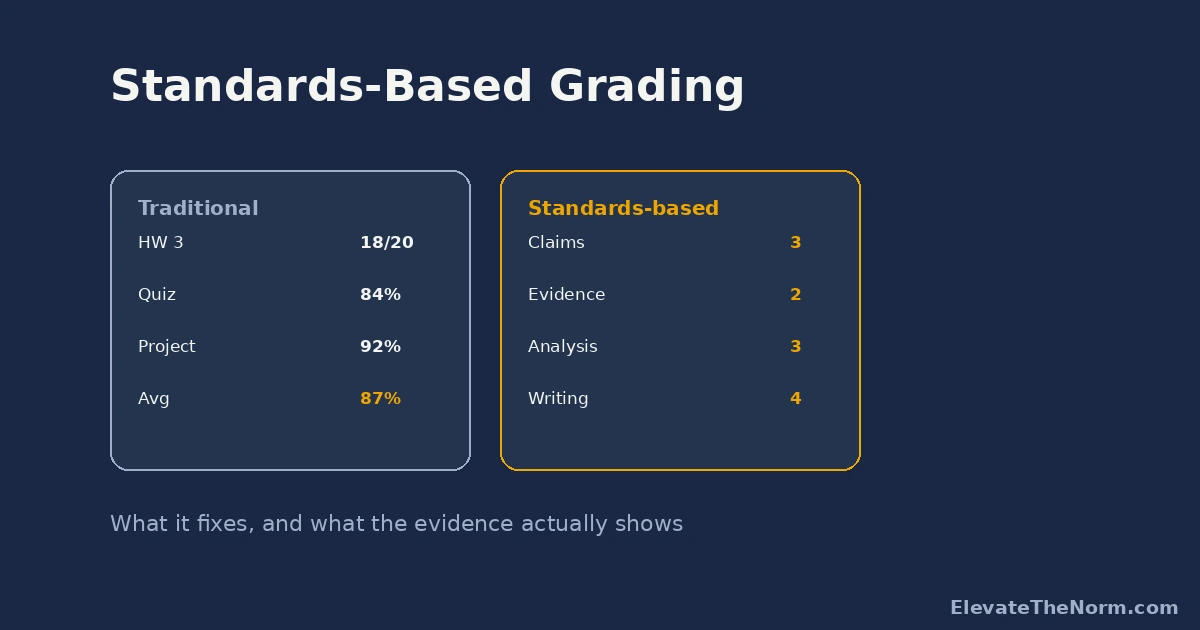
A standards-based grading system reports what a student can do against specific course standards, using a small number of proficiency levels, with academic achievement kept separate from behaviour. It is a better communication system than traditional grading. It is not, on the current evidence, a way to raise achievement — and the people who research it say so plainly.
That gap between what standards-based grading is good at and what schools are often told it will do is where most implementations fail. A staff that adopts it expecting test scores to move will conclude in year two that it did not work, and they will be measuring the wrong thing.
This is what it actually is, what the research shows and does not show, and what goes wrong.
Key Takeaways
- Three criteria define it: report on standards, use three to five levels, and separate achievement from behaviour. Everything else is a local choice.
- The clearest benefit is accuracy of meaning. A standards-based grade tells you what a student can do; an 87 percent does not.
- There is no evidence it raises achievement. That is Guskey’s own conclusion, not a critic’s.
- One comparison found the opposite on test scores. Students at a traditionally graded school scored about 2.2 points higher on the ACT — with serious limits on what that can prove.
- Retakes are the fight, and they are not part of the definition. Guskey argues against writing them in.
- Curriculum alignment comes before the report card. Schools that reverse the order generate confusion and then abandon the whole thing.
Free Download · Printable PDF
Standards-Based Grading Starter Pack
Proficiency-level rubrics, a standards list template and a split gradebook layout — the rubric work this article calls the heaviest lift, already started for you.
Free. No email address required. Designed for grades 6–12. See what is inside on the standards-based grading rubrics page.
What a Standards-Based Grading System Actually Is
Three defining criteria, from Linka and Guskey’s review in Theory Into Practice.
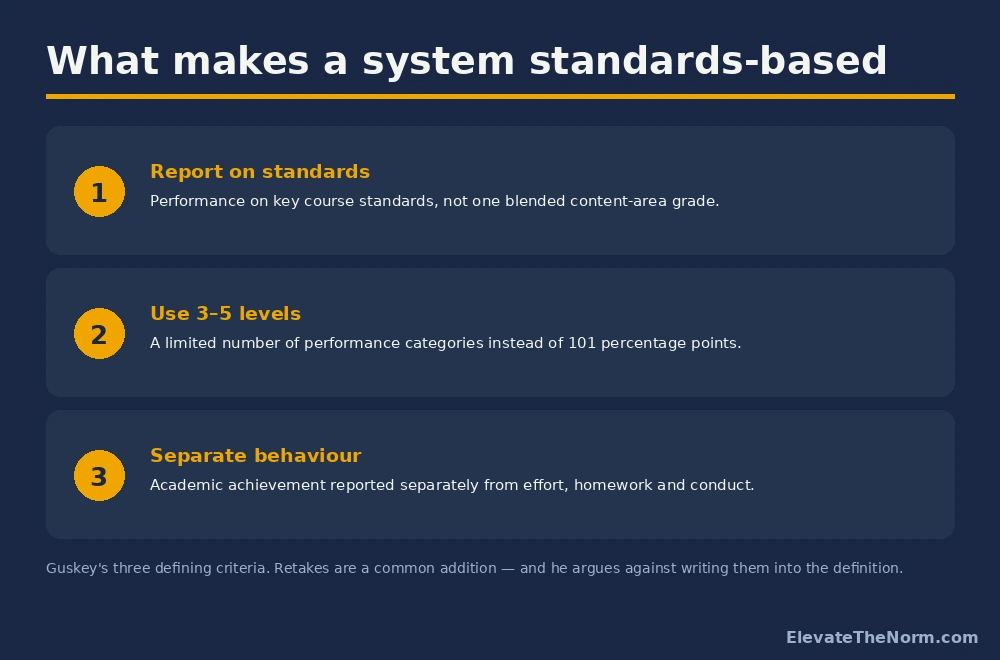
Report performance on key course standards rather than a single blended content-area grade. Use a limited number of performance categories, usually three to five. And report academic achievement separately from noncognitive factors like effort, homework completion and conduct.
That third one does most of the work. In a traditional gradebook an 87 percent might be a student who understands the material and forgets to hand things in, or a student who understands very little and hands in everything on time. Those are different students with different needs, and the single number hides which one you have.
Notice what is not in the definition: unlimited retakes. Guskey is explicit that bolting additional assessment requirements onto the definition adds confusion and can produce unreliable outcomes. Reassessment policy is a separate decision, and treating it as part of the definition is why so many staff conversations about standards-based grading immediately become arguments about retakes.
What the Evidence Actually Shows
Here is the honest summary, and it is more mixed than either side of this argument usually admits.
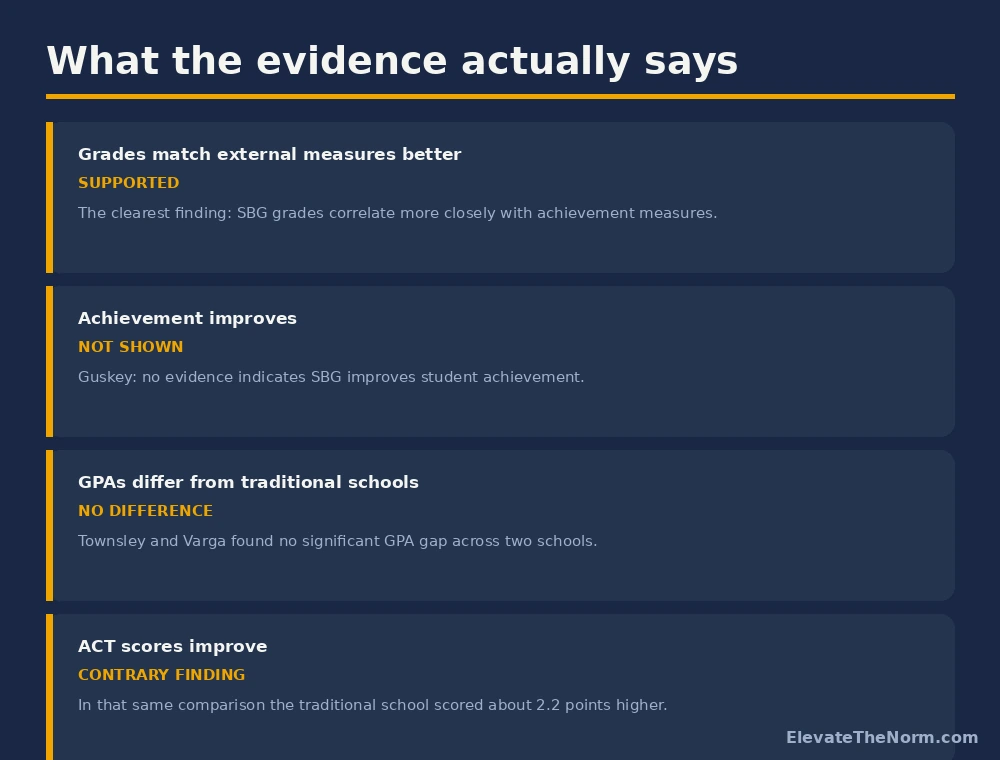
What is supported. Standards-based grades show a stronger relationship with external measures of achievement than traditional grades do. In plain terms: the grade means more, because it is measuring one thing rather than several mixed together.
What is not shown. Guskey states it directly: no grading system by itself improves student learning, and no evidence indicates that standards-based grading improves student achievement. He also notes the approach remains largely unstudied, with much of the published guidance drawn from general grading research rather than from studies of standards-based systems specifically.
And one result that points the other way. Townsley and Varga compared two demographically similar Midwestern high schools, one traditionally graded and one standards-based, across 327 students in two cohorts. They found no significant differences in GPA — but students at the traditionally graded school scored significantly higher on the ACT, by roughly 2.2 to 2.7 points depending on the subtest.
That finding deserves its caveats stated rather than buried. It is quasi-experimental, not randomised: two schools that differ in grading also differ in a hundred other ways, and nothing here establishes that the grading system caused the gap. The authors say the results are limited to the schools studied and call for replication in more diverse settings. Both schools were small, under 15 percent free or reduced lunch, and had minimal ethnic diversity.
It is one study and it cannot carry a policy. It also should not be left out, which is what usually happens to it.
So Why Do It?
Because “does it raise test scores” is not the only question worth asking about a grading system, and it may not even be the right one.
A grade is a communication. Its job is to tell a student, a family and a future teacher what this person can currently do. Traditional percentage grading does that job badly — it blends understanding, compliance, timeliness and effort into one number and then reports the number to three decimal places of implied precision.
Valerie Marsh’s research brief for the University of Rochester’s Center for Urban Education Success catalogues the reported benefits: reduced test anxiety through reassessment, clearer learning objectives, a classroom culture that talks about learning rather than points, and better communication with families. She also cites a Kentucky Algebra 2 study in which the percentage of students doing well on exams nearly doubled compared with traditionally graded peers.
Hold that Kentucky figure loosely. It is a single course in a single context, reported in a brief rather than read here in the original, and it sits alongside Guskey’s broader conclusion that achievement gains are not established. The defensible claim is about clarity, not scores.
If you want a reason that survives scrutiny: standards-based grading makes it much harder to hide a student who is quietly failing behind a wall of completed homework, and much harder to fail a student who understands the material but is disorganised. Both of those are worth having on their own terms.
Catching It Before It Sets
The most useful thing I do in a lesson has nothing to do with the gradebook. I circulate, and every so often I overhear a group working from a misconception that is about to spread to the table next to them.
Catching it there costs thirty seconds. Catching it on a unit test costs a week and a conversation with four families.
That is the honest case for standards-based grading, stated small. A system organised around specific standards makes you notice which standard a student is actually missing, rather than noticing that their average dropped. It does not make the noticing happen — walking around and listening does that. But a gradebook organised by standard means that when you do notice, there is somewhere obvious to record it and somewhere obvious to look next month to see whether it got fixed.
A percentage column cannot do that. It can only go up and down.
Where It Goes Wrong
Marsh’s brief groups the failures into four categories, and every one of them is an implementation problem rather than an evidence problem.
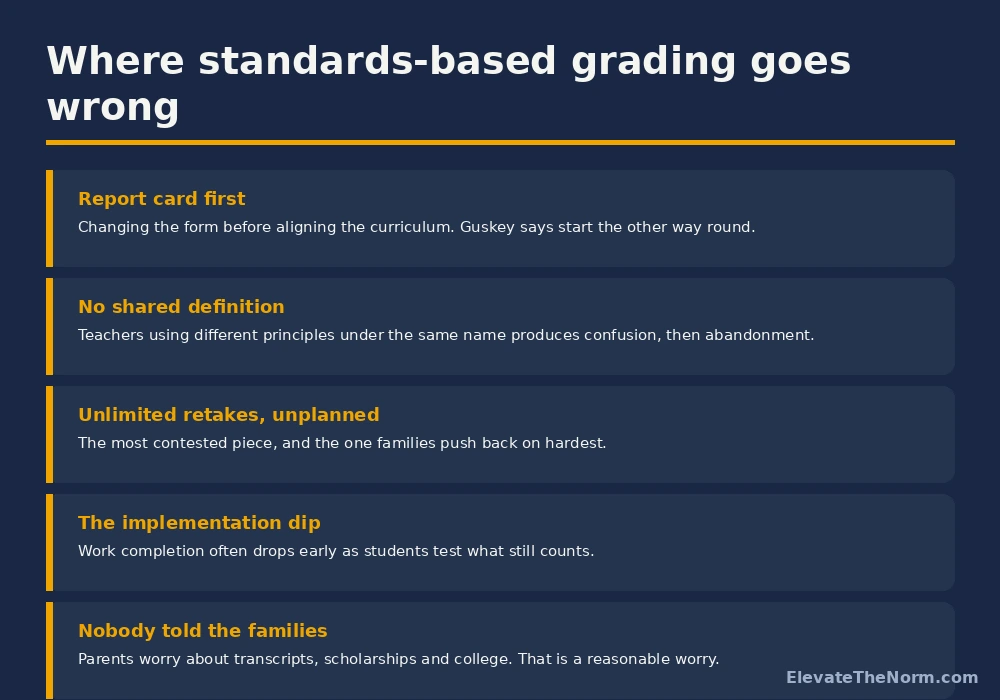
Inconsistent understanding. Teachers report awareness of the principles but struggle to identify which ones apply. A staff using different principles under the same name produces exactly the confusion you would expect, and confusion is what precedes abandonment.
The reassessment argument. Critics argue unlimited retakes do not reflect situations outside school and may demoralise students who cannot reach proficiency after several attempts. That is a serious objection, not a reactionary one, and a school that has not answered it will have the argument anyway — just later and in public.
Stakeholder resistance. Parents worry about work habits, college admission and scholarships. Teachers cite workload and grade inflation. Students worry about inconsistent implementation and college readiness. Marsh notes that most of the resistance research involved suburban, predominantly white, high-achieving populations — worth knowing before assuming those concerns will show up identically in your building.
The implementation dip. Work completion often falls early, as students feeling less accountable turn in fewer assignments and performance temporarily drops. Schools that did not expect this read it as failure in month three and reverse course.
Guskey’s structural advice cuts through most of this: start with curriculum alignment, not with the report card. Changing the form before agreeing what the standards are produces a new-looking document that nobody can fill in consistently.
The objections deserve more room than a summary. A companion article on why standards-based grading does not work takes them seriously — what nearly a thousand teachers said about no-zero policies and retakes, what secondary students identified as the core unfairness, and the five conditions under which the honest answer is not yet.


Standards-Based Grading vs Traditional Grading
The difference is not strictness. Both systems can be demanding or lax. The difference is what the number refers to.
| Traditional | Standards-based | |
|---|---|---|
| The grade measures | Points accumulated across assignments | Current proficiency on named standards |
| Late work | Usually reduces the academic grade | Reported separately as a work habit |
| Early failure | Averaged in permanently | Superseded if the student demonstrates the standard later |
| What a parent learns | A number, and a guess at what caused it | Which specific things their child can and cannot do |
| Main risk | Hides both struggling and disorganised students | Inconsistent application across a department |
The third row is the one families ask about, and it is worth answering directly rather than defensively. Yes, a student who could not do it in September and can do it in November is recorded as able to do it. That is the entire argument — a grade is supposed to describe current ability, and averaging in a September failure describes a student who no longer exists. It is the same reasoning behind giving students accountability and another chance everywhere else.
If You Are Starting This in One Classroom
- List the standards first. Six to ten for the course, in language a student can read. This is the step schools skip and it is the whole foundation.
- Pick your levels and define them. Three to five, with a written descriptor for each. Vague levels are worse than percentages.
- Split the gradebook. One section for achievement by standard, one for work habits. Do this before you change anything a family sees.
- Decide the reassessment rule in advance — and write down what a student must do to earn one. “Unlimited” is not a policy; it is the absence of one.
- Tell families in writing, early. Transcripts and scholarships are a legitimate concern. Say how your school converts this for those purposes.
- Expect the dip. Work completion may fall first. Plan for it rather than being surprised by it.
The rubric work is the heaviest lift. If you want a starting point, the free standards-based grading rubrics page has editable proficiency-level descriptors you can adapt, no email required.
What to Do Next
Be honest with yourself about what you expect from it. If you are hoping for higher test scores, the evidence does not promise them and one comparison points mildly the other way. If you want a grade that tells the truth about what a student can do, that is a real and defensible reason, and it is the one the research actually supports.
Start with the standards list for one course. Not the report card, not the software, not a department vote. Six to ten statements about what a student should be able to do by June — written where a fifteen-year-old could read them and tell you which ones they have got. Most of the value of this system shows up the moment that list exists, whatever you end up doing with the gradebook.
When you do get to the gradebook, the next thing to settle is the scale itself — and converting a 1–4 level into a report-card grade is where most implementations get stuck.
Before you go: grab the free Standards-Based Grading Starter Pack (PDF) — ElevateTheNorm.com branded, printable, no email required.
Frequently Asked Questions
Does standards-based grading improve student achievement?
On the current evidence, no — and that comes from the researchers who study it rather than from its critics. Guskey’s position is that no grading system by itself improves student learning and that no evidence indicates standards-based grading improves achievement. What it does do reliably is make grades correspond more closely to external measures of what students can actually do. That is a real benefit, and it is a different claim from raising scores.
Is there research showing it makes things worse?
There is one comparison worth knowing about. Townsley and Varga looked at two demographically similar Midwestern high schools, one traditional and one standards-based, and found no GPA difference but ACT scores roughly 2.2 to 2.7 points higher at the traditionally graded school. It is quasi-experimental rather than randomised, so it cannot show the grading caused the gap — two schools differ in countless ways — and the authors themselves limit the finding to the schools studied. It is one result, it points the other way, and it should be part of the conversation.
Do you have to allow unlimited retakes?
No, and Guskey argues that retake policy should not be written into the definition of standards-based grading at all — doing so adds confusion and can produce unreliable outcomes. Reassessment is a separate decision your school makes. What matters is that the rule is decided in advance and written down. “Unlimited” is not a policy, and the schools that have the worst time with this are the ones that never specified what a student has to do to earn another attempt.
How do standards-based grades work for college applications?
Most schools convert proficiency levels to a GPA for transcript purposes, and this is the question families will ask first, so have the answer ready before you start. Parent concern about college admission and scholarships is one of the documented sources of resistance and it is a reasonable concern rather than an obstructive one. If your school has not decided how conversion works, that decision needs making before the first report card goes out, not after.
Will students stop doing homework if it is not graded?
Some will, at first. Research describes an implementation dip where students, feeling less accountable early on, turn in fewer assignments and performance temporarily drops. The schools that handle this well expect it and plan for it; the ones that do not read it as proof the system failed and reverse in month three. Separating homework from the achievement grade does not mean homework stops mattering — it means it is reported as what it is, a work habit, rather than disguised as understanding.
Can one teacher do this if the school does not?
Partly. You can organise your own gradebook by standard, define proficiency levels, and separate achievement from work habits, and you will teach better for having done it. What you cannot do alone is change the report card or the transcript, so at some point your internal system has to convert to whatever your school reports. Be upfront with students about that conversion rather than letting them discover it in December.
Where should a school start?
With curriculum alignment, not the report card. Guskey is explicit about the order, and reversing it is one of the most common ways this fails — you end up with a new-looking form that nobody can complete consistently because the staff never agreed what the standards were. Get six to ten clear standards per course written in student-readable language first. Everything else follows from that list.
Sources
- Linka, L. J., & Guskey, T. R. (2022). Is standards-based grading effective? Theory Into Practice, 61(4). Full text (PDF) — the source for the three defining criteria, the conclusion that no evidence indicates SBG improves achievement, and the caution against writing retakes into the definition.
- Townsley, M., & Varga, M. (2017). Getting high school students ready for college: A quantitative study of standards-based grading practices. Journal of Research in Education, 28(1), 93–112. Full text (PDF) — 327 students across two Midwestern high schools; no GPA difference, higher ACT scores at the traditionally graded school. Quasi-experimental; the authors limit the finding to the schools studied.
- Marsh, V. L. (2023, November). Standards-based grading: History, practices, benefits, and challenges. Center for Urban Education Success, University of Rochester Warner School of Education. Read the brief (PDF) — the source for the benefits list, the four categories of challenge, the implementation dip, and the Kentucky Algebra 2 figure, which is reported in the brief rather than read here in the original.
Every link above was checked on September 12, 2026. Where a finding is contested or comes from a single study, the text says so in the body rather than leaving it to a footnote.