By Clay Shumate
The hardest part of grading a project is knowing what each student learned once the group hands you one polished poster or slideshow. Strong assessment for project based learning works by collecting individual evidence of content knowledge at planned checkpoints, scoring observable teamwork with a clear rubric, and giving feedback during the project so students can revise before the final grade. When those pieces line up, you can grade fairly across several class periods without drowning in paperwork.
I teach high school history, and I’ve written before about the day a student could tell me everything her teammates did and nothing about her own solution. That’s when I learned a group score hides individual learning. Assessment gets easier when you decide ahead of time what evidence you need and when you’ll collect it. Quizzes, conferences, and teacher judgment all still have a place. The full story is in my rubric for project based learning.
Key Takeaways
- Plan individual content checks before the project launches.
- Score teamwork with behaviors you can see and hear.
- Give feedback early enough that students can use it to revise.
What Should You Assess Beyond the Finished Product?
Assess three things: what each student knows about the content, how well they think with it, and how they work with others. The finished product is one piece of evidence, and it works best next to quick individual checks.
Start With Content Standards and the Driving Question
Start with the standards you’re required to teach. Then write a driving question that forces students to use those standards to answer it.
For example, “How should our town remember the people who built it?” pushes students into primary sources, cause and effect, and historical argument. Good driving question examples share this trait: the answer can’t be found without the content.
From there, list two or three things every student must know by the end. Those become your non-negotiable content criteria. Whatever the product looks like, those criteria stay the same for every team, a point Vermont’s education agency makes too: the product varies, but the learning goals and performance indicators should be consistent.
Separate Content Knowledge, Thinking, and Teamwork
When one score covers everything, nobody learns much from it. A student who argues well but forgot the timeline gets the same “B” as a student who memorized dates but can’t build an argument.
Split your evidence into three buckets:
| What you assess | What it looks like | Good evidence |
|---|---|---|
| Content knowledge | Accurate facts, terms, events | Quiz, exit ticket, short written answer |
| Critical thinking | Using sources to support a claim | Written argument, conference answers |
| Teamwork | Listening, finishing assigned work | Observation notes, contribution log |
Keeping them separate shows you exactly where to reteach. It also tells families what their kid is strong in and what needs work.
How Authentic Assessment and Traditional Assessment Work Together
Authentic assessment asks students to use learning the way people do outside school, like building an exhibit for a real audience. Traditional assessment, like a quiz, checks whether each student knows the basics.
You need both. Andrew Larson, a PBL facilitator at Columbus Signature Academy New Tech High School, writes that PBL teachers still give tests, quizzes, and homework, with questions tied to the project’s scenario. A ten-question quiz on Reconstruction tells you who’s ready to write exhibit labels and who needs a small-group session first.
Performance-based assessment shows deeper learning. The quiz makes sure nobody’s hiding behind a strong teammate.
Build Assessment Into Each Project Stage
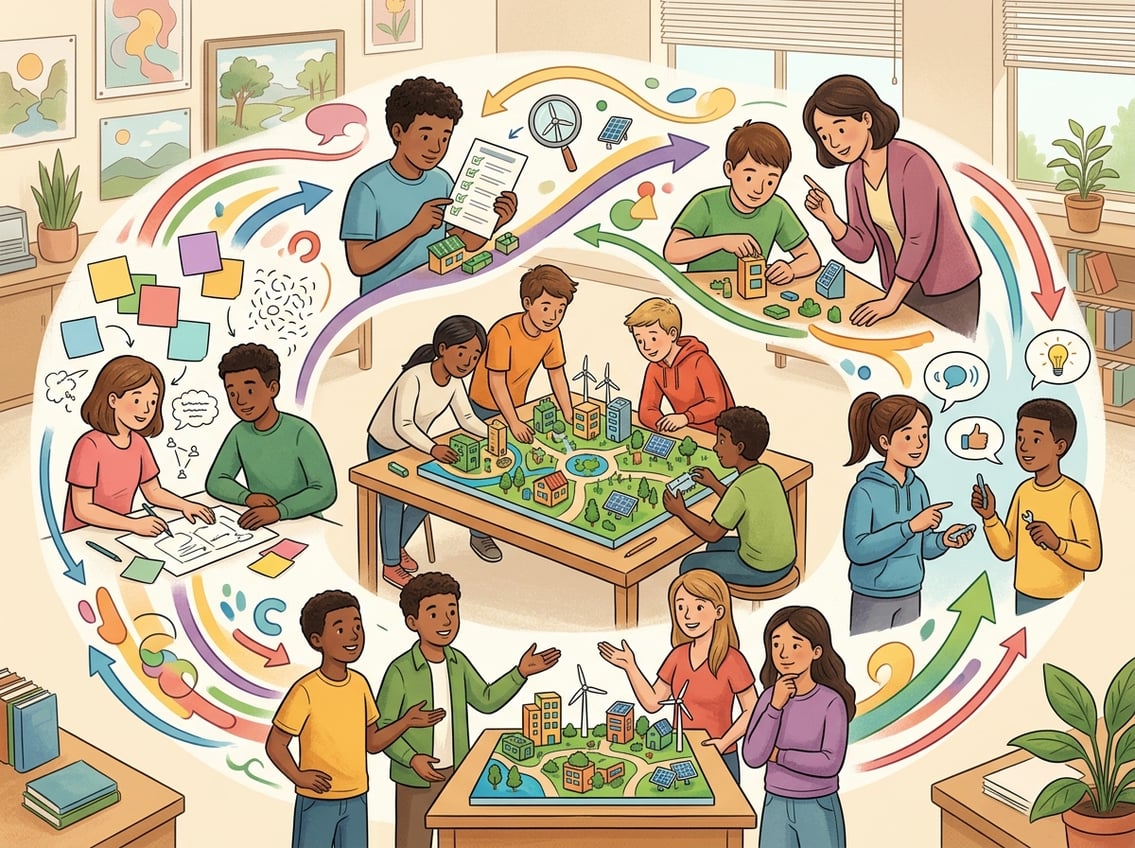
Assessment belongs at every stage of a project, from the first day to the final presentation. Early checks shape your teaching, middle checks catch problems, and the end combines a summative grade with reflection.
Edutopia frames it the same way, calling for assessments to inform teaching and learning before, during, and after a unit. Here’s how that can play out in a classroom.
Before Launch: Check Prior Knowledge With a Bell Ringer
On launch day, open with a short bell ringer (the bell ringer ideas post has plenty of formats). Three questions, five minutes:
- What do you already know about this topic?
- What’s one question you have?
- Rate your confidence from 1 to 4.
Sort the answers into three piles that night: ready, partly there, and starting from zero. That tells you who needs a mini-lesson before research starts. It also helps you build balanced teams instead of guessing.
During Inquiry: Use Exit Tickets and Individual Conferences
During research, use quick exit tickets two or three times a week. One question tied to the content, answered alone. These checks for understanding take two minutes and catch confusion before it ends up on an exhibit wall.
Add short individual conferences, about two minutes each. A good go-to prompt is: “Show me one source you used and tell me what it proves.” If a student can’t answer, you know right away, and the fix is a private, respectful next step. Nobody gets embarrassed in front of their team.
Before Presentation: Make Peer Feedback Lead to Revision
Peer feedback only helps if students have time to use it. Schedule a feedback day at least three class days before the final product is due. A gallery walk is a good format for it.
Keep the exchange simple. Each team trades drafts and writes:
- One thing that’s clear and accurate
- One question a visitor might ask
- One fix that would make it stronger
Then teams write down which suggestion they’ll act on. Check those notes. If a team ignores every suggestion, that’s a conversation, not an automatic point loss. Kids need practice taking feedback as help.
At the Finish: Combine Summative Assessment and Reflection
The final grade comes from several pieces: the shared product, an individual written piece, and a short reflection. The reflection asks what each student contributed, what they’d change, and what they learned about the content.
Read reflections next to your contribution notes. When they match, great. When they don’t, you’ve got a starting point for a fair conversation. Building student self-assessment into the end also teaches kids to judge their own work honestly.
A History Example: Assessing a Local History Exhibit
Here’s a sample plan for a high school history class. Students build a local history exhibit answering, “How should our town remember the people who built it?”
Checkpoint schedule (three weeks):
| Day | Checkpoint | Evidence collected |
|---|---|---|
| 1 | Launch bell ringer | Prior knowledge, confidence rating |
| 3 | Content quiz | Individual knowledge of the era |
| 5 | Source conference | Each student explains one source |
| 8 | Draft exhibit labels | Individual writing, teacher feedback |
| 10 | Peer feedback day | Revision plan per team |
| 13 | Final exhibit | Shared product |
| 14 | Individual reflection | Written reflection plus contribution log |
Sample rubric descriptors for “Use of Evidence”:
- Exceeds: Uses three or more primary sources, explains how each supports the claim, and notes one source’s limits.
- Meets: Uses two primary sources and explains how they support the claim.
- Approaching: Uses sources but doesn’t connect them to the claim.
- Beginning: Lists facts with no clear source.
Illustrative grading breakdown (optional, adjust to your school’s policy):
- Individual quiz and exit tickets: 30%
- Individual exhibit labels and written argument: 30%
- Shared exhibit product: 25%
- Teamwork rubric and reflection: 15%
This is my own judgment from classroom practice, not a research-backed formula. The point is that most of the grade rests on individual evidence.


How Do You Build a Rubric Students Can Actually Use?
A usable rubric names behaviors students can see in their own work, uses plain words, and has four or fewer levels. Students should be able to score themselves with it before you ever do.
Choose Observable Criteria and Clear Performance Levels
Every criterion should describe something you can point to. “Uses two primary sources” is observable. “Shows effort” isn’t.
Keep four levels: Exceeds, Meets, Approaching, Beginning. Each level should change one clear thing, like the number of sources or how well they connect to the claim. If students can’t tell the difference between two levels, neither can you on a Friday afternoon.
Hand the rubric out on launch day. Have students highlight one criterion they’re confident about and one they’re worried about. That five-minute task tells you where to focus.
Assess Collaboration and Communication Without Grading Personality
Collaboration and communication should be graded by actions, never by personality. A quiet student who listens and finishes their part is collaborating well. A loud student who talks over everyone isn’t.
In my own room I watch for the same seven traits that appear on the teamwork rubric: participation, listening, communication, responsibility, cooperation, flexibility, and respect (here’s how Elevate the Norm recognizes them). Each one gets a plain descriptor. For listening: “responds to a teammate’s idea before adding a new one.” For responsibility: “completes assigned part without repeated reminders.”
These are the same habits employers look for, like showing up prepared and solving problems with a team, and students should hear that directly. Assigning clear group work roles also makes these behaviors easier to spot and score.
Define Creativity Without Rewarding Expensive Materials
Creativity should mean original thinking, not fancy supplies. A kid with a printer and a craft store budget shouldn’t outscore a kid with notebook paper and a sharp idea.
Define creativity as a fresh angle on the question, a smart way to reach the audience, or a surprising source connection. PBLWorks offers Grades K-12 Creativity Rubrics that balance products and creative processes, which keeps the focus on thinking. You can also cap materials so everything comes from the classroom supply shelf.
Adapt Printable Rubrics From Elevate the Norm, PBLWorks, and New Tech Network
You don’t need to write a rubric from scratch. Start with the editable eight-category rubric for project-based learning and trim it for each project. It’s a free download.
Two outside groups are worth knowing, and they serve different purposes:
- PBLWorks has rubrics for teachers and students. Its Project Design Rubric aligns with the Gold Standard PBL model and helps teachers design and review projects. Its Communication and Creativity rubrics can guide student self-assessment.
- New Tech Network shares Learning Outcome Rubrics for collaboration, communication, critical thinking, and agency, designed so students can track their growth over time.
If you teach science or math, the PBL rubrics for high school STEM give you subject-specific starting points.
How Can You Grade Group Projects Fairly?
Fair group grading means most of each student’s grade comes from their own evidence, with the shared product counting for part of it. Students should know the weights before they start.
Use Individual Evidence Alongside the Shared Product
Every student needs at least one piece of work that’s theirs alone. In the exhibit project above, that’s the quiz, the exhibit labels each student writes, and the reflection.
College instructors use the same idea. Carnegie Mellon notes that some instructors combine a group project with an individual test or quiz, then count both in the project grade. It also says there is no perfect split, only that the scheme should reflect your learning goals. The same approach works just as well with ninth graders.
Explain Grade Weights Before Students Begin
Post the grading breakdown on day one and send it home. Cornell’s teaching center advises instructors to explain your grading system to students before they begin their work.
When kids see that most of the grade is individual, the “I’ll let my partner carry me” plan disappears. Families stop worrying that one teammate will sink their child’s grade.
Respond to Uneven Contributions With Documentation and Support
Every group has uneven days. Keep a simple contribution log: date, task assigned, task completed, and a factual note. “Finished two of three labels” beats “lazy.”
That log helps in three ways. It guides your private check-ins with students. It gives families specific information when you call home, including good news. And it lets you adjust a student’s teamwork score with real evidence.
My own approach is to redirect twice in a calm tone, then get curious: “What’s going on?” Often there’s a reason you didn’t know about. Students can also use a self-assessment for group work to name their own part before you do.
Honor Accommodations and Keep Behavior Separate From Academic Evidence
IEPs, 504 plans, and required accommodations come first. If a student gets extended time or a reduced writing load, the rubric bends to fit the plan.
Keep behavior out of the content grade. A student who argued with a teammate still earns full credit for accurate exhibit labels. Handle the conflict through your normal redirection steps and the teamwork rubric, where it belongs.
Keep Assessment Manageable Across Multiple Class Periods
With several sections, you can’t grade everything deeply. Pick two or three checkpoints per project to score closely and give quick feedback on the rest.
A few habits keep it manageable:
- One clipboard per period with the class list and checkpoint columns
- Exit tickets sorted into three piles, not graded with points
- Conferences spread across the week, a handful of students per period per day
- The same rubric reused across sections
The free formative assessment pack has six quick checks matched to the decision each one helps you make. If your school offers PBL professional learning, ask for time to score samples with colleagues so your ratings line up.
Plan the Evidence Before Launching the Project
Decide what evidence you’ll collect before students ever see the driving question. If you plan the product first and the assessment later, you’ll end up grading glue and font choices.
A planning order that works:
- List the standards and the two or three things every student must know.
- Write the driving question.
- Pick the individual checks (quiz, conference, written piece).
- Pick the teamwork criteria from your posted traits.
- Set checkpoint dates on the calendar.
- Choose the final product last.
PBLWorks’ Project Planner follows a similar logic with three parts: the project idea with learning goals, a project path overview, and a day-by-day calendar. It’s a solid template for teachers planning their first few projects.
Once the evidence is mapped, project design gets easier. You know which days need a quiz, which days need conferences, and where feedback has to land so students can revise. If you’re newer to this, the 7 steps of project-based learning give a clear sequence to follow from launch to presentation.
Bringing It Together
Good project assessment comes down to a few steady habits. Collect individual content evidence at planned checkpoints. Score teamwork by what students do. Schedule feedback early enough for revision, and post your grade weights on day one.
Start with one project and three checkpoints. For ready-to-use grades 6–12 classroom management, grading, and assessment materials, visit the Teacher Emergency Toolkit store on Teachers Pay Teachers. It’s my own store, and I earn from sales.
Frequently Asked Questions
What is the difference between project-based assessment and project-based learning?
Project-based learning is the teaching method, where students work over time on a real question and share a product. Project-based assessment is how you gather evidence of what they learned during and after that work. You can run PBL with quizzes, conferences, and rubrics all serving as assessment.
What are examples of project-based assessments for middle and high school?
Common examples include a local history exhibit, a science investigation with a public presentation, a community proposal, or a podcast built on primary sources. Each should pair a shared product with individual checks like exit tickets or written arguments. More ideas for project-based learning work well when you plan the evidence first.
Can quizzes and tests be part of project-based learning?
Yes, and they should be. Traditional assessment checks that each student knows the core content before they apply it. Write quiz questions that tie back to the project’s scenario so they feel connected to the work.
Should every student in a group receive the same grade?
No, at least not for the whole grade. The shared product can earn a common score, but individual work, conferences, and teamwork ratings should make up most of each student’s grade. A contribution log gives you fair evidence when contributions are uneven.
Where can I find a printable project-based learning assessment rubric?
Elevate the Norm offers a free, editable eight-category PBL rubric. PBLWorks and New Tech Network also share rubrics for communication, creativity, and collaboration. Trim any rubric to the criteria your project needs before handing it to students.