Student self assessment is the practice of having students judge their own work against criteria they can see and understand, while there is still time to improve it. Done before the grade, it is one of the more useful things a teacher can hand a class. Done after the grade, as a number that counts, it mostly teaches students to inflate.
That distinction — formative before, not summative after — is the whole argument of this article, and it is the part most schools skip.
Key Takeaways
- Self-assessment is a judgment against criteria, not a feeling about effort. “I worked hard” is not self-assessment. “My thesis states a position but my second paragraph never supports it” is.
- Formative and summative self-assessment are not the same practice. The research supports the first far more comfortably than the second.
- The honest effect sizes are modest, not miraculous. Anyone selling you a 0.70 is quoting a number with a long history of caveats.
- Accuracy is the wrong first question. The point is not whether a fifteen-year-old guesses the right score. It is whether they can find the gap in their own work.
- Four weeks of small steps beats one big rollout. Students cannot apply criteria they have never been taught.
What Is Student Self Assessment?
Student self assessment is a structured process in which a student compares their own work to a set of stated criteria, identifies where the work does and does not meet those criteria, and then does something about the gap. Three parts, and all three have to be there. A rating with no criteria is a guess. Criteria with no follow-up action is paperwork.
It is worth separating this from two things it gets confused with. It is not self-grading, where a student assigns themselves a score that lands in the gradebook. And it is not reflection in the loose sense — the end-of-unit “what did you learn about yourself” paragraph that produces a stack of pleasant, unusable sentences. Reflection has its place. This is a narrower and more mechanical thing: here is the standard, here is my work, here is the distance between them.
Paul Black and Dylan Wiliam, in the review that largely launched the modern formative assessment movement, put the case for it about as strongly as it can be put, citing Royce Sadler’s argument that self-assessment is “a sine qua non for effective learning” — a student who cannot tell good work from their own work has no way to close the gap without an adult standing over them.1 That is a theoretical claim, not an empirical one, and it is worth saying so. But it is a sound one. Every student eventually leaves a classroom where someone else is holding the rubric.
Formative or Summative? The Distinction That Decides Whether It Works
Heidi Andrade’s 2019 review in Frontiers in Education examined 76 empirical studies published between 2013 and 2018, and the cleanest finding in it is a split.2 Formative self-assessment — ungraded, criteria-referenced, attached to a chance to revise — consistently supported achievement. Summative self-assessment, where the student’s own rating counted toward the final mark, did not hold up nearly as well, and produced a predictable problem: students inflated their estimates, with males over-estimating more than females.
This should not surprise anyone who has taught teenagers. If you tell a student their number goes in the gradebook, you have not asked them to assess their work. You have asked them to negotiate. The honest answer and the advantageous answer point in opposite directions, and you have handed them the pen.
Andrade makes a second point that is easy to miss and worth sitting with: she argues the field’s long preoccupation with accuracy — how closely a student’s self-rating matches a teacher’s — may be the wrong question, and that what matters more is the cognitive and affective work happening inside the student while they do it.2 That reframes the classroom goal. You are not training students to predict your grading. You are training them to look at their own paragraph and see what is missing.
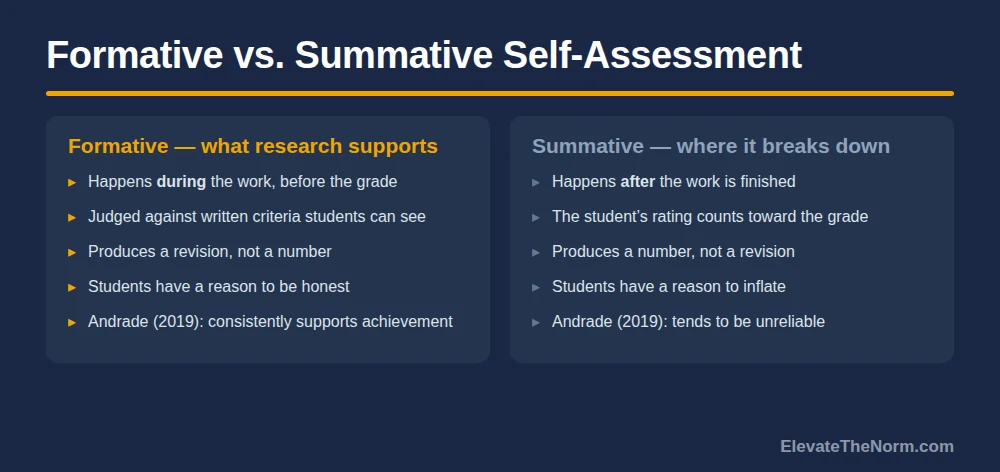
The practical rule that falls out of this is short enough to put on a sticky note: the student’s self-assessment never becomes the grade. The improved work becomes the grade. Keep that line and most of the failure modes below never start.
What the Research Actually Shows — Including the Unimpressive Parts
Here is where a lot of professional development goes wrong, so it is worth being precise.
The most rigorous quantitative work on self-assessment specifically is Ernesto Panadero, Anders Jonsson and Juan Botella’s 2017 set of four meta-analyses, covering 19 studies and 2,305 students.3 On self-efficacy — a student’s belief that they can do the work — they found a large effect, d = 0.73 across 27 comparisons. On self-regulated learning, the effect was much smaller: d = 0.23 across 12 comparisons.
Those numbers come with conditions the authors state plainly, and skipping them would be dishonest. Their publication-bias analysis suggested the self-efficacy effect is probably overestimated in magnitude, though they were satisfied the effect itself is real. The sample skewed roughly 70% female. The mean age was 17.5, ranging from 10.5 to 26 — ten of the nineteen studies were in secondary schools, which makes this more relevant to grades 6–12 than most assessment research, but eight were in higher education. And two of the four analyses rested on six and three studies respectively, which the authors themselves call too few for reliable bias testing.
Now the wider counterweight. Neal Kingston and Brooke Nash screened more than 300 studies of formative assessment in K–12 and found that most had “severely flawed research designs yielding uninterpretable results.” Thirteen survived. The weighted mean effect size across those thirteen was 0.20, with a median of 0.25 — and they published it specifically as a correction to the widely repeated 0.70 figure.4 Effects varied sharply by subject: 0.32 in English language arts, 0.17 in mathematics, 0.09 in science.
That 0.70, for the record, traces back through Black and Wiliam to a 1986 meta-analysis by Fuchs and Fuchs, and Black and Wiliam themselves attached a caveat to it that almost never travels with the number: there is, they wrote, “no guarantee that it will do so irrespective of the context and the particular approach adopted.”1
So what is a teacher supposed to do with all that? Something like this: self-assessment is a reasonable, low-cost, well-supported classroom practice with a real but moderate payoff, strongest on students’ confidence and willingness to revise. It is not a program, it does not need a budget, and it will not move a school’s scores by itself. Anyone promising otherwise is selling something.
Five Student Self Assessment Ideas That Fit in One Class Period
These are deliberately small. A self-assessment that eats thirty minutes will get cut the first week the pacing guide gets tight, which means it will never become a habit. Each of these runs in four to ten minutes.
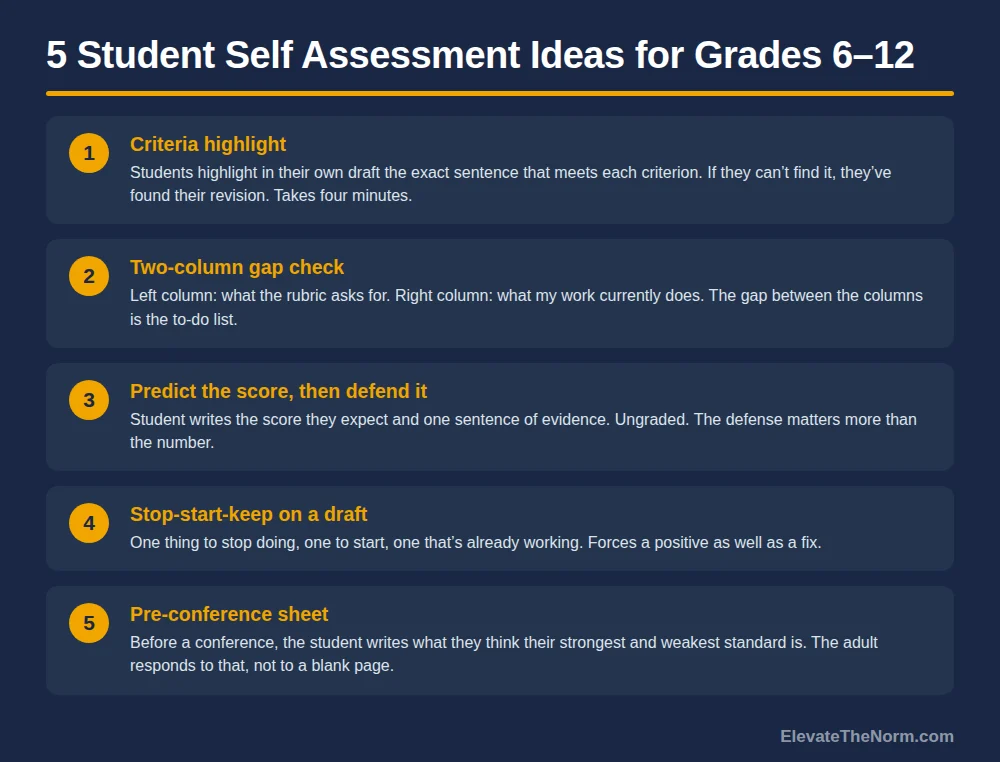
1. The criteria highlight
Students take their own draft and highlight the exact sentence that satisfies each criterion on the rubric — one color per row. The instruction is deliberately unforgiving: if you cannot find the sentence, you cannot highlight it. Students who finish with a blank criterion have just diagnosed their own revision without you saying a word. This is the single highest-yield version for writing-heavy courses.
2. The two-column gap check
Left column: what the assignment asks for, in the student’s own words. Right column: what their work currently does. The gap between the columns is the to-do list. Rewriting the criteria in their own words is half the value here — students who cannot restate the requirement usually did not understand it, and now you both know that.
3. Predict the score, then defend it
The student writes the score they expect and one sentence of evidence for it. Ungraded, always. The sentence is the assessment; the number is just the hook that makes them write it. When you hand the work back, the interesting conversations are with the students whose prediction was furthest off in either direction — and the under-predictors matter as much as the over-predictors.
4. Stop, start, keep
One thing to stop doing, one to start, one that is already working. The third one is not filler. Students who only ever hear what is broken stop believing the feedback, and a student who cannot name a single thing they do well is not going to revise with any confidence.
5. The pre-conference sheet
Before any conference, the student writes which standard they think they are strongest on and which they are weakest on. You respond to that instead of to a blank page. This is also the cleanest on-ramp into student-led conferences, where the student is expected to walk an adult through their own evidence.
If you want these as a printable rather than something you rebuild every term, the free student self-assessment forms on this site cover the same ground in a ready-to-copy format. No email required.

How to Introduce Self-Assessment Without Losing a Week
The most common failure is not resistance. It is asking students to apply criteria nobody taught them. A rubric is a technical document written in teacher language, and handing it to a fourteen-year-old with “rate yourself” produces exactly what you would expect.
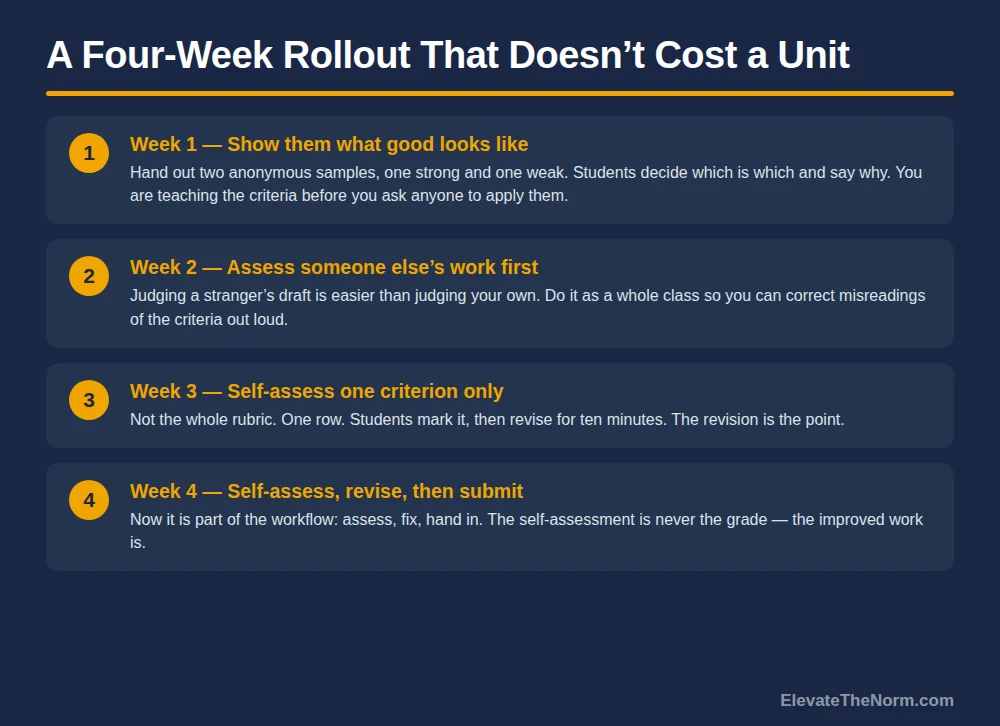
Week one: show them what good looks like. Two anonymous samples, one strong and one weak. Students decide which is which and say why. You are teaching the criteria, not assessing anything yet. Ten minutes.
Week two: assess a stranger’s work. Judging someone else’s draft is easier than judging your own, and doing it as a whole class lets you correct misreadings of the criteria out loud, in front of everyone, before those misreadings get baked in.
Week three: one criterion only. Not the whole rubric — one row. Students mark it, then revise for ten minutes. The revision is the point; the marking is just what makes the revision specific.
Week four: assess, revise, submit. Now it is part of the workflow rather than an event. And because the self-assessment never enters the gradebook, you have not created a single new grading obligation for yourself.
Four weeks, roughly forty minutes of class time total, and at the end of it students have a habit rather than a worksheet.
One adjustment that is not optional. Self-assessment depends entirely on a student being able to read and understand the criteria, which means the rubric language is an access issue before it is an instructional one. Rewrite each criterion in student-facing language — one sentence, present tense, naming a thing you could point at in the work. For students on IEPs or 504 plans, for English learners, and honestly for everyone, a checklist of three concrete criteria will produce better self-assessment than a four-column analytic rubric written for a grading conversation among adults. Reading the criteria aloud while students follow along costs ninety seconds and removes most of the barrier.
What it looks like when it is working. Do not measure this by whether students’ ratings match yours. Watch for three things instead: students start pointing at specific places in their own work rather than describing their effort; the revisions they make after self-assessing are the revisions you would have asked for; and students begin asking clarifying questions about the criteria before they start the assignment rather than after it comes back. That last one is the real signal. It means the criteria have moved from your document into their planning.
What Goes Wrong
Vague criteria. “Shows understanding” cannot be self-assessed by anyone, including the teacher who wrote it. If a criterion cannot be checked against a specific sentence, paragraph, calculation or step, it is not usable for self-assessment and it probably was not usable for grading either.
Letting the self-assessment count. Covered above, but it is the mistake that reappears every time a school tries to formalize this. The moment a self-rating carries points, Andrade’s inflation problem arrives on schedule.2
No time to act on it. A self-assessment that is not followed by a revision window is a compliance exercise. Students figure that out in about two rounds and start filling it in on the way to the door.
Treating honesty as a character test. A student who rates themselves generously is usually responding rationally to the incentives in front of them, or genuinely cannot see the gap yet. Neither is a discipline matter. Both are instructional problems — either the criteria are unclear or the stakes are wrong.
Confusing it with self-esteem work. Self-assessment is not about how students feel about themselves. Panadero and colleagues did find a real confidence effect, but it came from students getting better at the work, not from being told they were doing fine.3
Where It Fits With Grading, Feedback and Conferences
Self-assessment is one of five core formative assessment strategies identified by Siobhan Leahy, Christine Lyon, Marnie Thompson and Dylan Wiliam — alongside clarifying success criteria, engineering classroom discussion, providing actionable feedback, and using students as instructional resources for one another.5 It is not a standalone initiative. It is the piece that makes the other four stick, because a student who can assess their own work can actually use the feedback you give them.
There is a hard-edged finding from Black and Wiliam’s review that bears directly on this. Ruth Butler’s 1988 study found students who received comments only improved substantially, while students who received comments with a grade attached showed a significant decline — the grade appears to crowd out the comment.1 If you are going to invest in getting students to examine their own work honestly, stapling a number to the front of it works against you.
This is also why self-assessment sits naturally alongside a standards-based grading scale: when a grade refers to a specific standard rather than an average of everything, a student can actually locate themselves on it. And it pairs with checking for understanding during instruction — the same information, gathered from the other direction. Teachers who want the mirror image of this practice for themselves will find it in teacher reflection, which runs on the same logic: criteria, evidence, gap, action.
One last connection worth naming. Self-assessment is a form of student voice — a small, structured place where a teenager’s judgment about their own work is treated as worth hearing. That is not a soft addition to the practice. It is most of why it works.
Where to Start Tomorrow
Student self assessment is worth doing, and it is worth doing in the smallest version you can sustain. Pick one assignment you already give. Pick one criterion from its rubric. Ask students to find the sentence in their own work that meets it, give them ten minutes to fix it if they cannot, and do not put their rating in the gradebook. That is the whole practice. Everything above is detail.
The payoff is not a test-score jump, and anyone who promises you one is overstating a literature that does not support it. The payoff is a room full of students who can look at their own work and tell you what is wrong with it — which is the skill you actually wanted them to leave with.
Frequently Asked Questions
Does student self assessment mean students grade themselves?
No. In the version supported by the research, the student’s rating never enters the gradebook. They judge their work against stated criteria, find what is missing, and revise it. The teacher grades the improved work. Heidi Andrade’s 2019 review found that when a self-rating does count toward the final mark, students inflate their estimates, which defeats the purpose of asking.
What if a student rates their work far higher than it deserves?
Treat it as an instructional problem, not an honesty problem. Nine times out of ten the criteria were too vague to apply, or the student genuinely cannot see the gap yet. Sit with them and ask them to point to the exact sentence, step or calculation that meets the criterion. If they cannot find it, the conversation has already done its work. A student is never penalised for an inaccurate self-assessment.
Are self-assessments private, or do parents and administrators see them?
That is your call, and it is worth deciding before you start rather than after. Most teachers keep routine self-assessments as working documents that stay between the student and the teacher, and bring them out only at conferences, where the student presents them. Tell students the answer up front. A student who thinks their candid self-criticism is going home in a folder will write nothing useful.
How do you make this work for students with IEPs, 504 plans, or English learners?
Fix the criteria first. A four-column analytic rubric written in grading language is an access barrier for a lot more students than the ones with formal plans. Rewrite each criterion as one short present-tense sentence naming something you could point at in the work, cut the list to three criteria, and read them aloud while students follow along. Sentence stems help too: My evidence for this is on page ___ , or I still need to ___ .
How much class time does this actually take?
Each activity in this article runs in four to ten minutes, and the four-week introduction totals roughly forty minutes of instructional time. Keep it small on purpose. A self-assessment routine that takes half a period will be the first thing cut when the pacing guide gets tight, and a routine that gets cut never becomes a habit.
How do I know it is working?
Not by whether students’ ratings match yours. Watch for three signals instead: students start pointing at specific places in their own work rather than describing how hard they tried, the revisions they make on their own are the ones you would have assigned, and they begin asking about the criteria before starting an assignment instead of after it comes back. The last one means the criteria have moved into their planning.
What is the difference between self-assessment and reflection?
Reflection is open-ended thinking about an experience, usually after it is over. Self-assessment is narrower and more mechanical: here is the stated criterion, here is my work, here is the distance between them, here is what I will change. Both are useful. Only one of them reliably produces a revision, and confusing the two is how self-assessment turns into a stack of pleasant sentences nobody acts on.
Should self-assessment ever count toward a grade?
The evidence says be very careful. Formative self-assessment, done before the grade and attached to a chance to revise, consistently supports achievement. Summative self-assessment, where the rating carries points, tends to be unreliable. If a school wants to give credit, give it for completing the process and acting on it, never for the accuracy of the number the student wrote.
Sources
- Andrade, Heidi L. “A Critical Review of Research on Student Self-Assessment.” Frontiers in Education, vol. 4, art. 87, 2019. https://doi.org/10.3389/feduc.2019.00087
- Panadero, Ernesto, Anders Jonsson, and Juan Botella. “Effects of self-assessment on self-regulated learning and self-efficacy: Four meta-analyses.” Educational Research Review, vol. 22, 2017, pp. 74–98. https://doi.org/10.1016/j.edurev.2017.08.004
- Black, Paul, and Dylan Wiliam. “Assessment and Classroom Learning.” Assessment in Education: Principles, Policy & Practice, vol. 5, no. 1, 1998, pp. 7–74. (Full text copy hosted by UC Riverside.) https://assess.ucr.edu/sites/default/files/2019-02/blackwiliam_1998.pdf
- Kingston, Neal, and Brooke Nash. “Formative Assessment: A Meta-Analysis and a Call for Research.” Educational Measurement: Issues and Practice, vol. 30, no. 4, 2011, pp. 28–37. ERIC EJ951173. https://eric.ed.gov/?id=EJ951173
- Leahy, Siobhan, Christine Lyon, Marnie Thompson, and Dylan Wiliam. “Classroom Assessment: Minute by Minute, Day by Day.” Educational Leadership, vol. 63, no. 3, November 2005, pp. 18–24. ERIC EJ745452. https://eric.ed.gov/?id=EJ745452