By Clay Shumate
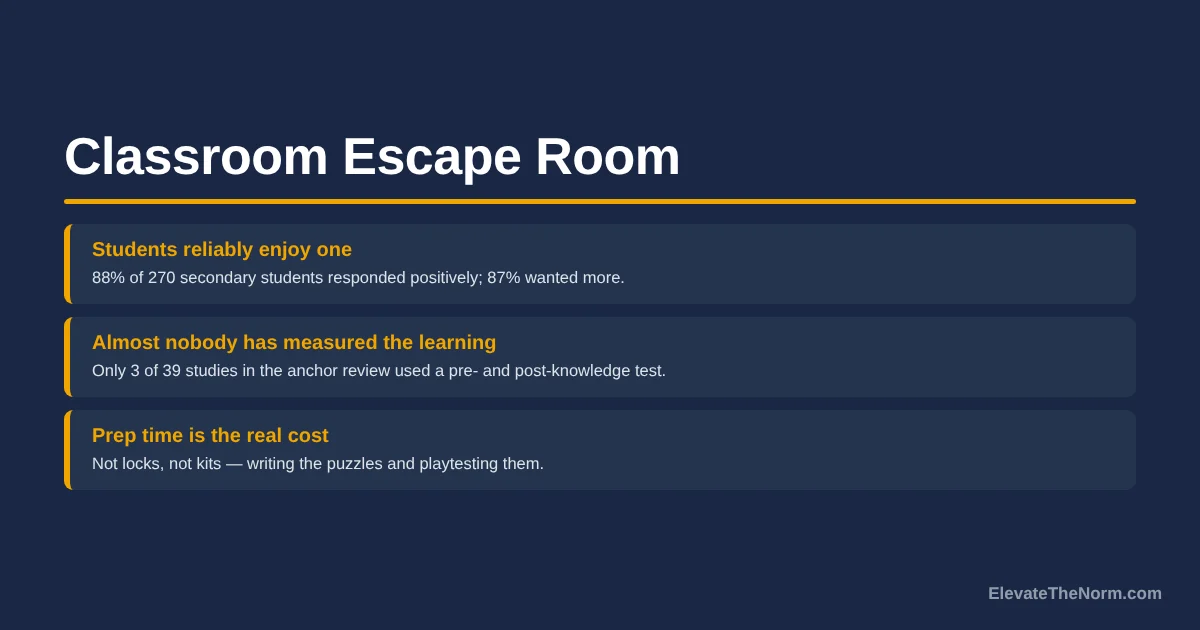
A classroom escape room is a timed activity where student teams solve content problems to open a sequence of locks, physical or digital. Students reliably enjoy one. The measured learning evidence is thin and wildly inconsistent, and the real cost is teacher prep time. Build one well, debrief it hard, and do not run it every week.
Key Takeaways
- Almost nobody has measured whether a classroom escape room teaches anything. The largest systematic review screened 39 studies and found only three that gave students a pre- and post-knowledge test. Thirty-one of the 39 were in higher education; three were in secondary schools.
- The pooled effect looks big and means less than it looks. A 2024 meta-analysis of 22 studies put knowledge gains at g = 0.86 with heterogeneity of I² = 94.69 percent. That much inconsistency means the average does not predict your room.
- Students enjoy it and often cannot tell you what they learned. Among 270 secondary students, 88 percent were positive about the experience, and most interviewed groups could not describe the content they had covered.
- Prep time is the binding constraint, not money. A full escape room runs with no locks and no kit. What you cannot avoid is writing the puzzles and playtesting them — the barrier teachers name most often — and the debrief, which is the first thing cut when the bell is close.
What Is a Classroom Escape Room?
A classroom escape room is a timed activity in which small teams solve a sequence of content-based puzzles, each yielding a code that opens the next lock, until the final lock opens. Nobody is locked in anything. The locks are the scoring mechanism.
They are also what makes the format honest: a team either has the right answer or the box stays shut. No partial credit, no bluffing.
Three things separate it from the rest of the activity drawer. It is a designed one-off rather than a routine, built once for a specific unit. The sequence is locked, so teams cannot skip a puzzle they cannot solve — a strength for rigour and a serious problem for pacing. And every student should be working the whole time, or the design has failed.
If what you want is something repeatable for the Friday before a test, you want a different tool: the two review formats broken down here are built for that job and run on a fraction of the prep. This article is about the event version.
One note first, because it is the first question an administrator asks: the name is misleading and worth correcting out loud. Nothing here confines a student. Doors stay unobstructed, nothing locks with a person inside it, and the only things that lock are boxes and envelopes. Say so before you run it, because “we did an escape room in class” sounds like something it is not.
Do Classroom Escape Rooms Actually Improve Learning?
Almost nobody has checked properly, and the studies that did check mostly found nothing. Escape rooms are one of the most enthusiastically adopted classroom formats of the past decade and one of the least rigorously evaluated.
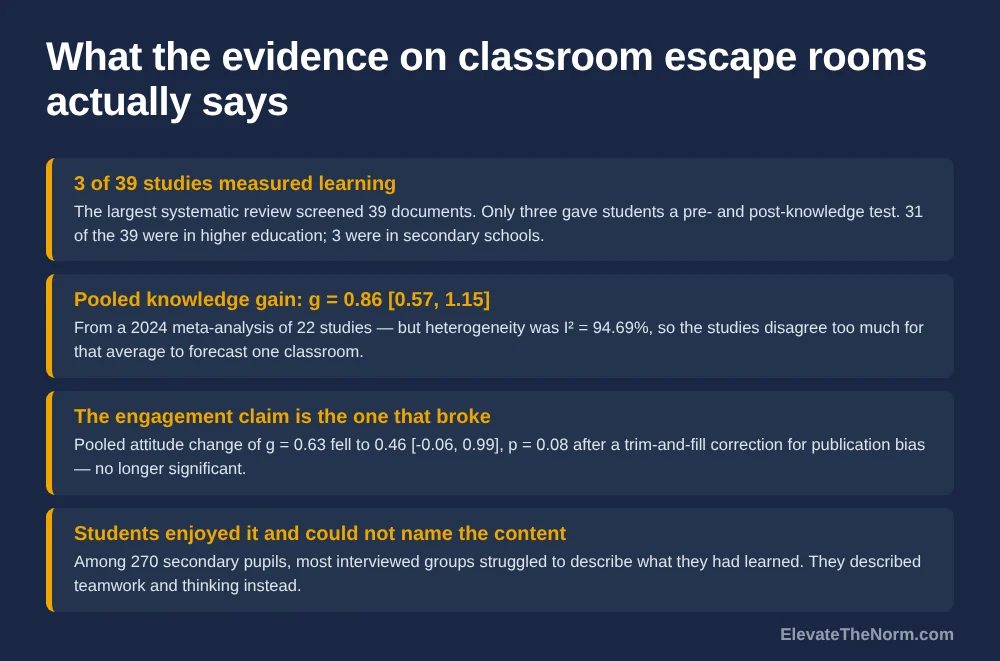
The anchor study is a systematic review by Veldkamp and colleagues in Educational Research Review, which screened 39 documents on escape rooms in education. Only three of the 39 measured achievement against the learning goals with a pre- and post-knowledge test. One compared an escape room with a regular case activity in 19 students: 18 of 19 preferred the escape room, only 11 thought they learned better from it, and it produced no measurable gain or drop. One found no significant pre/post result while 96 percent of its 51 students said the debrief improved their learning. One found scores rising from 56 to 81 percent — but a week passed between the test and the game, and those authors concluded that “the knowledge increase cannot be solely attributed to the game.”
None used a randomised design. The review’s verdict was that one study showed a disputable improvement in content knowledge while most students experienced learning. Those are different claims about different things.
A 2024 meta-analysis takes a more favourable view and is worth reading alongside it. Kim, Na, Zhang and Bai pooled 22 studies and reported knowledge gains of g = 0.86, 95% CI [0.57, 1.15]. Two numbers in the same paper complicate that:
- Heterogeneity was I² = 94.69 percent. Nearly all the variation between studies is real difference, not sampling noise. An average drawn from results that disagree that violently does not forecast your classroom.
- The attitude effect did not survive a correction for publication bias. Pooled attitude change was g = 0.63, but the funnel plot was asymmetric and a trim-and-fill correction dropped it to 0.46, 95% CI [-0.06, 0.99], p = 0.08 — no longer statistically significant.
That second point is the opposite of what most people assume: the claim everybody is confident about — students love it — is the one that weakened once the analysis corrected for missing studies. The same paper found no significant differences by escape room type, subject or educational level, but its level categories were K–12, college and adults, so secondary students sit pooled with elementary ones. That is not evidence the format works equally well with a middle school class.
Clay’s read, as a grades 6–12 teacher: enough evidence to justify building one, nowhere near enough to justify building a unit around one. Treat it as an expensive consolidation activity whose job is making students retrieve content under pressure, and judge it by what they can do the next day.
Why Do Students Love a Classroom Escape Room and Still Not Remember the Content?
Because the puzzle is memorable and the content is the thing students pass through to reach the puzzle. Students remember what they spent attention on, and in a badly structured escape room that is the padlock, not the causes of the war.
The clearest evidence comes from the one large study run with secondary students rather than undergraduates. Veldkamp and colleagues studied a national escape room challenge with 50 teachers and 270 seventh-grade biology pupils, average age 12. Eighty-eight percent responded positively and 87 percent wanted more escape rooms. And:
- Sixteen interviewed groups reported learning or strengthening knowledge, but most struggled to describe the biology content they had actually learned. Their descriptions focused on teamwork and thinking skills.
- Observers recorded frustration in 9 percent of groups when students got stuck.
- Only 3 of 14 observed teachers discussed teamwork in the debrief at all.
That is the whole problem in one study. The experience lands. The content does not attach to it by itself.
The fix is the debrief. In the systematic review, 25 of the 39 studies included one, ranging from five minutes to two hours, and the reviewers concluded that implementing a debrief “seems crucial.” A debrief is not “good job everyone, pack up” — it is a structured return to the content: which puzzle mapped to which concept, which answer your team got wrong first, what the correct reasoning was. One published workshop structure ran 20 minutes of introduction, 60 minutes of play and 40 minutes of debrief, which is more debrief than most teachers would ever plan.
Do not grade it for accuracy. The locks already give students immediate feedback, which is the useful part, and attaching a grade turns a consolidation activity into a timed high-stakes test — exactly the combination that penalises the slowest reader in the room for something other than knowing the content. Grade participation if your gradebook demands an entry. Keep the diagnostic information for yourself.
How Long Does It Take to Build a Classroom Escape Room?
Longer than you expect, and the cost sits almost entirely in writing and testing puzzles rather than in buying anything. Teacher time is the barrier teachers themselves name most often, and it is why most classroom escape rooms get built once and never again.
In the study of 270 secondary students, time was the dominant constraint teachers reported. They described development as time-consuming relative to the effective time it bought with students, and every time-related condition teachers raised beforehand reappeared afterwards as a real barrier, in 71 percent of cases. Finances, materials and finding a suitable room were named too, but well behind time.
The expensive, unavoidable step is playtesting. The systematic review called defining a realistic playtime through playtests crucial, and it is the step everybody skips. In one project where senior high school students aged 17 to 18 designed eight escape rooms themselves, teams were expected to test each room at least ten times. You are not going to playtest ten times before second period. Playtest once, on somebody who is not you, because the first run always reveals that one puzzle is impossible and another takes eleven seconds.
Two honest ways to cut the cost: build four puzzles, not eight — four well-written ones with a clean lock sequence beat eight thin ones and halve the testing load — and reuse the shell, change the content. The structure is reusable across units; the puzzles are what you rewrite, so the second escape room costs a fraction of the first.
And one thing worth saying plainly: if your real reason for building one is to check what students know before a test, there are far cheaper instruments. A page of formative checks that fit a real week will tell you more about the class for a twentieth of the preparation. Build the escape room because the event is worth something on its own, not as an expensive exit ticket.
Do You Need to Buy Locks for a Classroom Escape Room?
No. A classroom escape room needs a way to verify an answer and refuse a wrong one, and that can be a padlock, a digital form that rejects an incorrect code, or an envelope a student cannot open without saying the code to you. Physical locks buy atmosphere, not learning.
The commercial route is priced per classroom. Breakout EDU, the best-known vendor, lists its Single Classroom plan at a starting price of $99 per year for up to one educator with access starting at 60 students, and its School or District plan at a starting price of $1,499 per year. That mainly buys a library of ready-made games, which is a genuine saving on the expensive part — writing puzzles. It is not a requirement.
| Lock type | Cost | Build time | Grade fit | Best for | Main drawback |
|---|---|---|---|---|---|
| Physical locks and a box | One-off purchase of padlocks and a hasp, or from $99/year per classroom for a commercial kit and game library | Highest — build, test, and reset between every class | Works across 6–12; novelty lands hardest in middle school | A showpiece event you repeat yearly | Resetting between periods, and one broken lock stops a team dead |
| Digital locks (a form that rejects wrong codes) | Free with tools your school already has | Medium — no reset at all between classes | Strongest fit for high school | Running the same room across five periods | Everything happens on a screen, which removes most of the physical energy |
| Paper-only, no locks | Free | Lowest | Any, including classes where devices are unreliable | A first attempt, or a 50-minute period | You are the lock, so you verify every code and cannot watch the room |
A paper-only build is the right first attempt for most teachers. Teams bring you a code, you check it and hand over the next envelope. It costs nothing, it cannot break, and it tells you whether your puzzles work before you spend money on hardware.
How Do You Build a Classroom Escape Room, Step by Step?
Start from the content you want retrieved and work outwards to the puzzles, never the reverse. The common failure is designing a clever puzzle first and bolting curriculum onto it, which produces an activity students enjoy and learn nothing from.
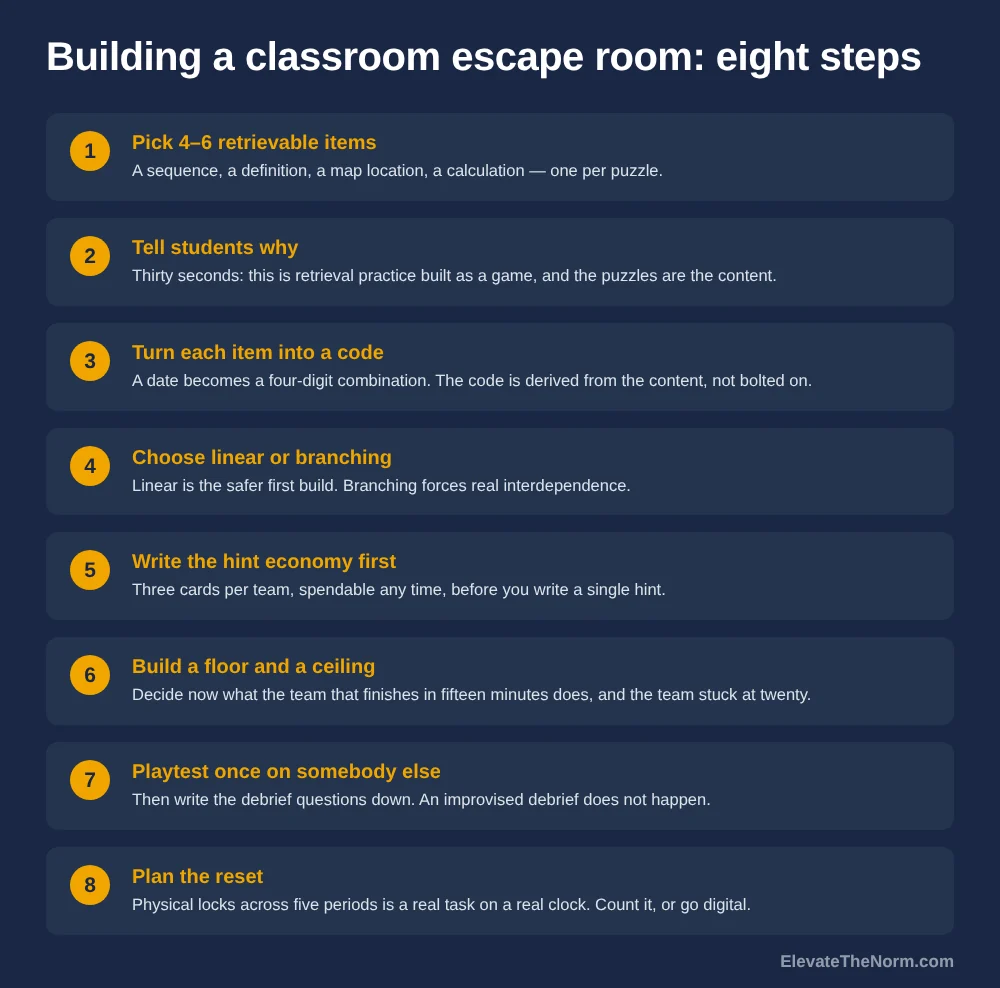
- Pick four to six things students must be able to retrieve. Not topics — specific retrievable items: a sequence, a definition, a map location, a calculation, a document’s author. These become your puzzles, one each.
- Tell students what the activity is and why you are running it. Thirty seconds at the start: this is a retrieval exercise built as a game, the puzzles are the content, and pulling an answer out of your head is what makes it stick. Students in grades 6–12 are old enough to be told the method being used on them, and a class that knows the content is the point attends to the content instead of the padlock.
- Turn each item into a code. A date becomes a four-digit combination, three events in order become a three-letter sequence, a map location becomes a direction lock. The code must be derived from the content, not attached to it arbitrarily.
- Choose your structure. A linear chain is easier to follow and needs less guidance from you. A branching structure, where several puzzles must all be solved before a final lock opens, forces real interdependence because no single student can run the whole chain. Linear is the safer first build; branching is the better activity.
- Write a hint economy before you write the hints. Decide how many hints each team gets, what they cost and how a team asks. Three cards per team, spendable any time, is a workable default. Without the rule you spend the period rescuing whoever shouts loudest.
- Build in a floor and a ceiling. Decide what a team that finishes in fifteen minutes does next, and what happens to a team stuck on puzzle two at twenty minutes. Both will happen in the same period.
- Playtest once, on somebody who is not you, then write the debrief questions down before the day. If the debrief is improvised at the bell, it will not happen.
- Plan the reset. With physical locks across multiple periods, reset is a real task on a real clock. Count it in your prep time, or go digital.
Teams of four to six is what the national challenge used and it is about right. Below four, a weak link stalls the team; above six, students disappear. If you want the groups to function rather than simply exist, the five conditions that separate cooperative learning from furniture arrangement apply here exactly as anywhere else.
How Do You Stop One Team Finishing in Four Minutes and Another Never Getting Out?
Design for the spread before the day, because it is guaranteed. Give fast teams a second-layer task that is genuinely harder rather than a reward, and give stuck teams a priced hint they can choose to spend rather than waiting to be rescued.
The failure to avoid is ending the activity when the first team wins. In the national challenge studied with 270 students, the game ended when the first team opened the vault — so every other team’s experience was terminated mid-thought, and the slowest team’s last memory of the content is failing at it in public. Let every team finish, or set a hard stop that applies to everyone equally and announce it at the start.
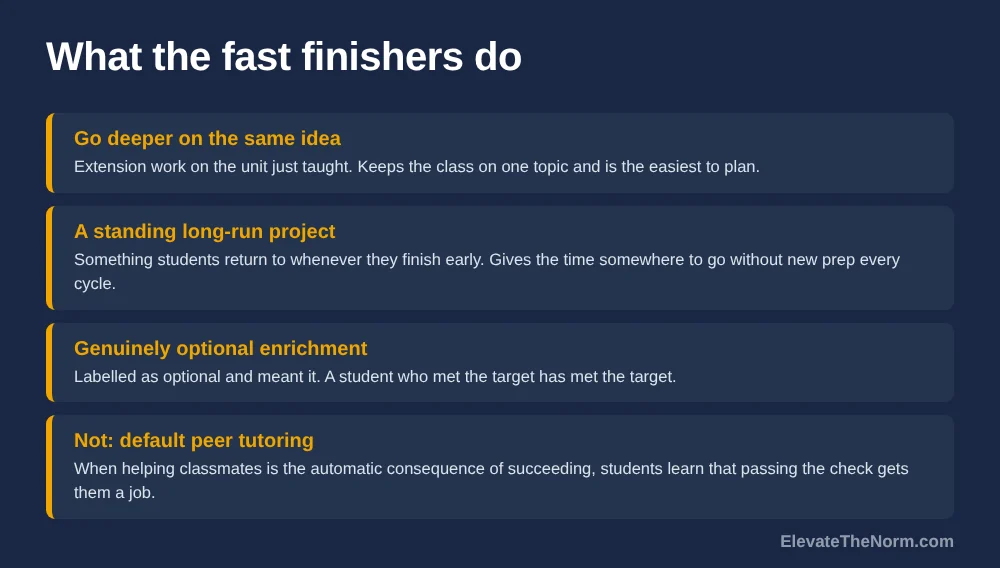
- A second-layer task for finishers. Have them write next year’s fifth puzzle, with the answer key. That is harder than solving one and it is not busywork.
- Priced hints, not pity hints. Three cards per team. Spending one is a legitimate strategic choice rather than an admission of failure, which is what makes a stuck team willing to use it.
- An escalating ladder. First hint narrows the content, second names the concept, third gives the mechanism. Never give the code.
- A floor, delivered quietly. At twenty minutes, any team still on puzzle one gets the first code outright — handed over at the table, not announced from the front, because a rescue announced to everybody is just a slower way of telling a team they lost.
One caution from the research: the systematic review found that sequential puzzle structures do not align well with genuinely collaborative goals, because a chain can be solved by one capable student while the rest watch. If you want all hands working, parallel puzzles converging on a final lock do that work — the structure carries the interdependence, not your instructions.
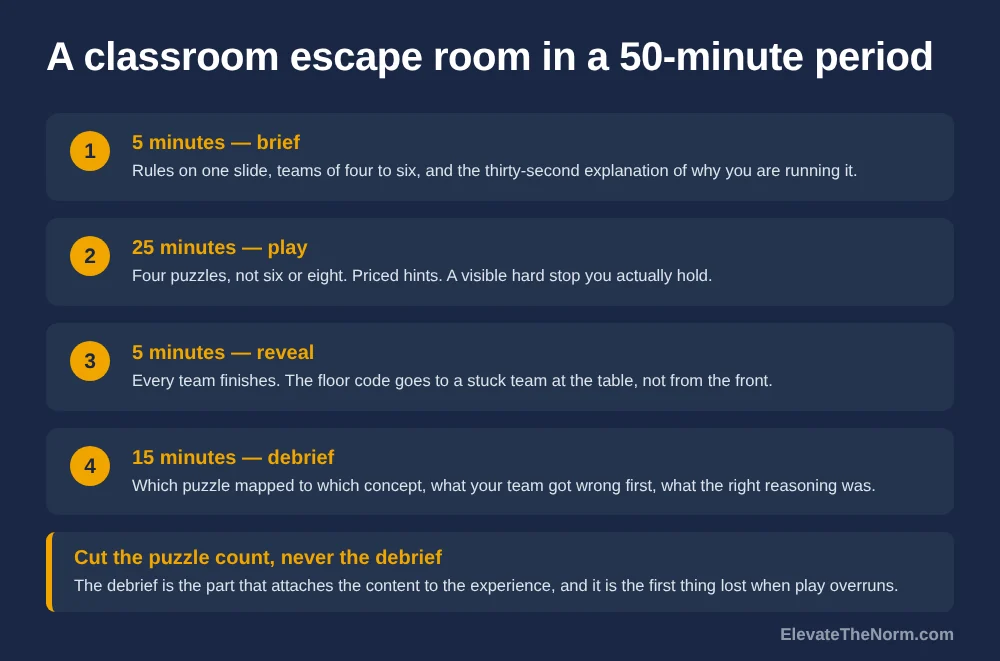
In a 50-minute period, cut the puzzle count and never the debrief. A workable split is five minutes to brief, twenty-five to play, five for the reveal and fifteen to debrief, which makes four puzzles the honest maximum. The national challenge ran six connected puzzles in 40 minutes, but that was a ready-made, heavily tested game. Two things go wrong in a short period, always the same two: the brief overruns because the rules were not written down, and the debrief gets eaten because play overran. Put the rules on one slide and hold a visible hard stop. If you want the energy without the build, a recurring format beats an event — the 25 short management games catalogued here are aimed at routines rather than content and cost almost no prep.
What About Students Who Freeze Under a Countdown?
A visible timer and a competitive puzzle in front of peers is a genuinely different activity for a student who reads slowly, processes carefully, or experiences test anxiety. Plan for that student at design time, because this format concentrates exactly the pressures that disadvantage them.
The direct evidence on time pressure is suggestive rather than settled, and it is not drawn from teenagers. A 2023 experiment with 211 adults aged 18 to 40 learning unfamiliar times tables found that participants in the timed condition reported higher state anxiety after every session and were less accurate on the immediate test than the untimed group. Those were adults doing arithmetic online, so a secondary teacher reading across to a classroom escape room is extrapolating and should say so. The directional point still holds: time pressure is not a free source of energy.
- Reduce the reading load. Long puzzle text turns a content assessment into a reading-speed assessment. Keep prompts short and put the difficulty in the thinking.
- Give the timer a floor, not a cliff. “Twenty-five minutes, and every team finishes” is a different instruction from “first team out wins.”
- Make hints visibly normal. If the strongest team spends a card early, nobody else has to be embarrassed about it.
- Give every student a job. One reader, one recorder, one code-tester, one checker. A student who cannot push to the front still has a defined contribution, and a genuine quiet role — running the hint desk, keeping time, verifying codes — is real work inside the activity for a student for whom the scrum is intolerable.
None of that lowers the standard. It removes a barrier that has nothing to do with whether the student knows the content, which is the logic behind every other differentiation move that does not require five lesson plans.
Is a Classroom Escape Room Worth It, and What Should You Do Next?
Once or twice a year, for a unit that genuinely rewards retrieval under pressure, yes. As a regular instructional strategy, no — the build cost is too high and the measured learning evidence too weak to justify the hours.
The honest case for building one anyway: students in the one substantial secondary study reported needing to think harder and reported feeling autonomy and mastery, which is worth something even with content gains unproven. A well-designed escape room also produces assessment data that is hard to get any other way — you watch which concept each team stalls on, live, which is more diagnostic than a quiz score. Against that sits the evidence base already described, and the fact that teachers consistently report the build takes more time than it returns.
For anyone deciding this at building or district level: the evidence does not support a district-wide purchase or a mandate. Fund a licence where teachers are already asking, and leave it optional. There is also a quiet equity problem in a format whose main input is unpaid prep time — it will always be easier for the teacher with one planning period than for the teacher with four sections and a duty.
So pick one unit. Write down four things students must be able to retrieve from it, turn each into a four-digit or four-letter code, and build the paper-only version with envelopes instead of locks. Write your three debrief questions before the day and playtest it once on somebody who is not you.
Then make the check specific rather than a feeling: a five-item retrieval quiz the next day, on the four things the puzzles were built from, scored against what the same class usually does on a comparable unit. That is a low bar and a real one, and it is the only way to find out whether the period bought learning or bought enthusiasm. If it worked, buy the locks for version two. If it did not, you spent a weekend and no money, and the review formats that run on five minutes of prep are still there.
Sources
- Veldkamp, A., van de Grint, L., Knippels, M.-C. P. J., & van Joolingen, W. R. (2020). “Escape education: A systematic review on escape rooms in education.” Educational Research Review, 31, 100364. Veldkamp and colleagues (2020). Source of the 39 included documents; the three studies measuring achievement by pre- and post-test and their individual results; the 31-of-39 higher-education and 3-of-39 secondary split; the debrief count of 25 of 39 and the “seems crucial” conclusion; the playtest recommendation; and the finding on sequential structures and collaborative goals. Read in full.
- Veldkamp, A., Knippels, M.-C. P. J., & van Joolingen, W. R. (2021). “Beyond the Early Adopters: Escape Rooms in Science Education.” Frontiers in Education, 6, 622860. Veldkamp, Knippels and van Joolingen (2021). Source of the 50 teachers and 270 pupils; the 88 percent positive and 87 percent wanting more figures; the finding that most interviewed groups could not describe the content learned; frustration observed in 9 percent of groups; teams of four to six with six puzzles in 40 minutes; the game ending when the first team opened the vault; 3 of 14 teachers debriefing teamwork; and time as the dominant barrier at 71 percent. Population is Dutch seventh-grade biology pupils, average age 12. Read in full.
- Kim, C., Na, H., Zhang, N., & Bai, C. (2024). “Escape rooms for education: A meta-analysis.” International Journal of Instruction, 17(4), 219–234. Kim, Na, Zhang and Bai (2024). Source of the 22 included studies; knowledge gains of g = 0.86 [0.57, 1.15] with I² = 94.69 percent; attitude change of g = 0.63 reduced to 0.46 [-0.06, 0.99] at p = 0.08 after trim-and-fill; and the non-significant moderation by escape room type, subject and educational level. Read in full.
- Jazbutis, O. R., Wiseheart, M., Radvansky, G. A., & McNeil, N. M. (2023). “Distributed practice and time pressure interact to affect learning and retention of arithmetic facts.” Journal of Numerical Cognition, 9(2), 302–326. Jazbutis and colleagues (2023). Source of the finding that timed participants reported higher state anxiety after every session and were less accurate on the immediate test. Participants were 211 adults aged 18 to 40 learning arithmetic online, not secondary students; cited as directional evidence and labelled as such in the body. Read in full.
- Rawlinson, R. E., & Whitton, N. (2024). “Escape Rooms as Tools for Learning Through Failure.” The Electronic Journal of e-Learning, 22(4), 19–29. Rawlinson and Whitton (2024). Source of the 40 senior high school students aged 17 to 18 who designed eight escape rooms, the expectation that teams test each room at least ten times, and the 20/60/40-minute workshop structure. A qualitative case study with no control group and self-reported outcomes; used for design guidance only. Read in full.
- Breakout EDU. “Pricing.” breakoutedu.com/pricing. The seller’s own pricing page and the source of the Single Classroom plan starting at $99 per year for up to one educator with access starting at 60 students, and the School or District plan starting at $1,499 per year. Prices change; check the page.
What is a classroom escape room?
A classroom escape room is a timed activity in which student teams solve content-based puzzles to open a sequence of locks, physical or digital, until a final box opens. Nothing confines a student and no door is blocked. The locks simply verify answers: a team either has the right code or the box stays shut, which removes partial credit and guessing.
Do classroom escape rooms actually improve learning?
The evidence is thin. The largest systematic review screened 39 studies and found only three that measured achievement with a pre- and post-test, and those three produced no gain, no significant result, and one gain the authors themselves discounted. A 2024 meta-analysis of 22 studies reported knowledge gains of g = 0.86, but with 94.69 percent heterogeneity, so that average cannot predict your classroom.
How long does it take to build a classroom escape room?
Longer than teachers expect, and the cost is in writing and testing puzzles rather than buying materials. Time is the barrier teachers name most often, and in one study of 270 secondary students every time-related concern teachers raised beforehand reappeared afterwards as a real obstacle in 71 percent of cases. Build four puzzles rather than eight and reuse the shell for the next unit.
Do I need to buy locks or a kit?
No. A paper-only build works: teams bring you a code, you verify it and hand over the next envelope. Digital locks using a form that rejects wrong codes are free and need no reset between class periods. Breakout EDU lists a Single Classroom plan starting at $99 per year, which mainly buys ready-made games and saves you the expensive part, writing the puzzles.
Should a classroom escape room be graded?
No, not for accuracy. The locks already give students immediate feedback, which is the useful part. Attaching a grade turns a consolidation activity into a timed high-stakes test, which penalises the slowest reader in the room for something other than knowing the content. Grade participation if your gradebook requires an entry, and keep the information about which concepts stalled teams for yourself.
How do I handle a team that gets completely stuck?
Price the hints in advance instead of rescuing teams in the moment. Three hint cards per team, spendable whenever they choose, makes asking a strategy rather than an admission of failure. Escalate the ladder: the first hint narrows the content, the second names the concept, the third gives the mechanism, and none gives the code. Set a floor too, and hand it over at the table rather than announcing it.
What about a student who panics under a timer?
Design for that student rather than managing them on the day. Keep puzzle text short so the activity measures thinking instead of reading speed, say at the start that every team finishes rather than that the first team wins, make spending a hint visibly normal, give every student a defined job in the team, and offer a genuine quiet role such as running the hint desk or verifying codes.
Can I run a classroom escape room in a 50-minute period?
Yes, with four puzzles rather than six or eight. A workable split is five minutes to brief, twenty-five to play, five for the reveal and fifteen for the debrief. Cut the puzzle count, never the debrief, because the debrief is the part that attaches the content to the experience. Write the rules on one slide so the briefing does not overrun.