Project-based learning is the most misused phrase in secondary education. Most of what gets called PBL is a regular assignment with a poster at the end. This is where everything on Elevate the Norm about doing it properly lives — written for grades 6–12 by a teacher running it on a block schedule.
The test that separates PBL from a project
Before the resources, the distinction, because getting this wrong is what wastes three weeks of a semester.
A project is something students make after they learn. You teach the unit, then they build a model, a slideshow, a trifold. The making is a demonstration. Remove it and the learning still happened.
In project-based learning, the project is how they learn. The question comes first, and students acquire the content because they cannot answer the question without it. Remove the project and there is no unit left.
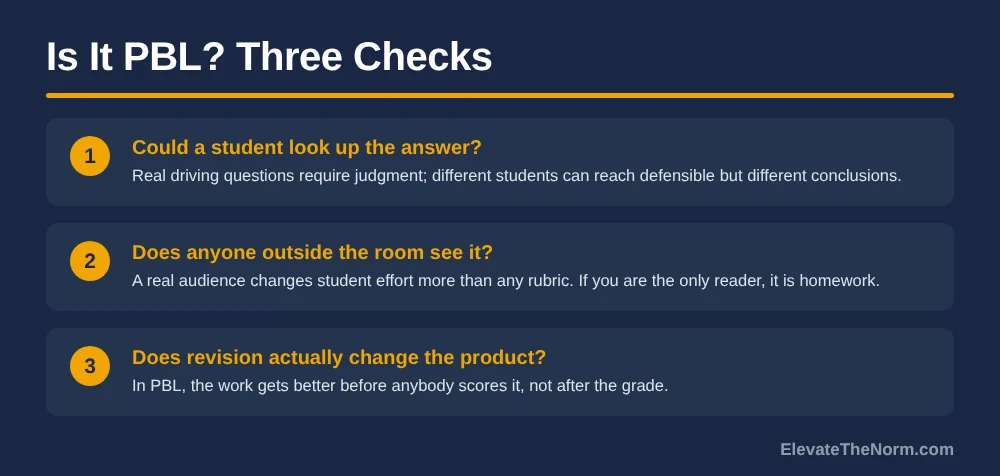
Three checks will tell you which one you have built:
- Could a student look up the answer? If the driving question has one findable answer, it is a research assignment. Real driving questions require judgment, and different students can reach defensible but different conclusions.
- Does anyone outside the room see it? A real audience changes student effort more than any rubric ever has. If you are the only reader, it is homework.
- Does revision actually change the product? If feedback arrives with the grade, at the end, it is not part of the process. In PBL, the work gets better before anybody scores it.
Fail any of the three and you may still have a good assignment. It is just not project-based learning, and calling it that will make you wonder why you are not seeing the results the research promises.
Start here
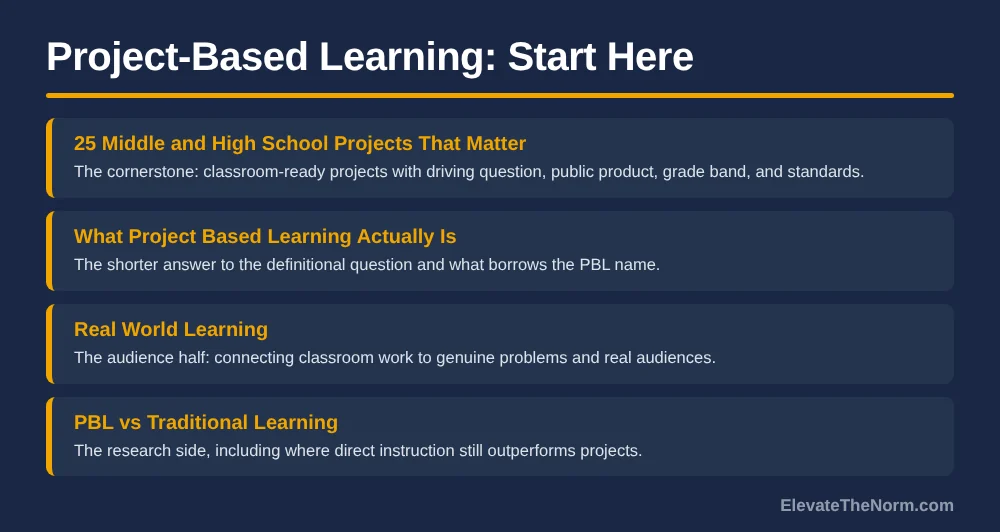
Example of Project Based Learning: 25 Middle and High School Projects That Matter
The cornerstone piece. Twenty-five classroom-ready projects across English language arts, social studies, science, mathematics, and cross-curricular electives — each with its driving question, the public product, the grade band, why it clears the bar above, and the standards it touches. If you only read one page here, read this one.
What Project Based Learning Actually Is
The shorter answer to the definitional question, and the difference between PBL and the activities that borrow its name.
Real World Learning: How Schools Can Connect Work to Life
The audience half of the equation. How to connect classroom work to genuine problems, real audiences, and products that exist after the unit ends — and why that is the part most projects skip.
Project Based Learning vs Traditional Learning: What the Evidence Actually Says
The research side. Randomized trials, meta-analyses, and an honest account of where direct instruction still outperforms projects — read it before you argue for PBL in a faculty meeting.
Plan your first project
The free packet on the teacher resources page bundles all 25 projects into a printable PDF with a one-page planning template on the back. No email required.
The planner is the part worth printing. It asks for the driving question, the final product, the real audience, the length in class periods, the skills built, your checkpoints, what you are actually grading, your modifications, and the realistic way the project could sink. Fill it in before you announce anything to students. If a box will not fill, that box is the problem to solve first — and discovering it at your desk costs a planning period instead of a unit.
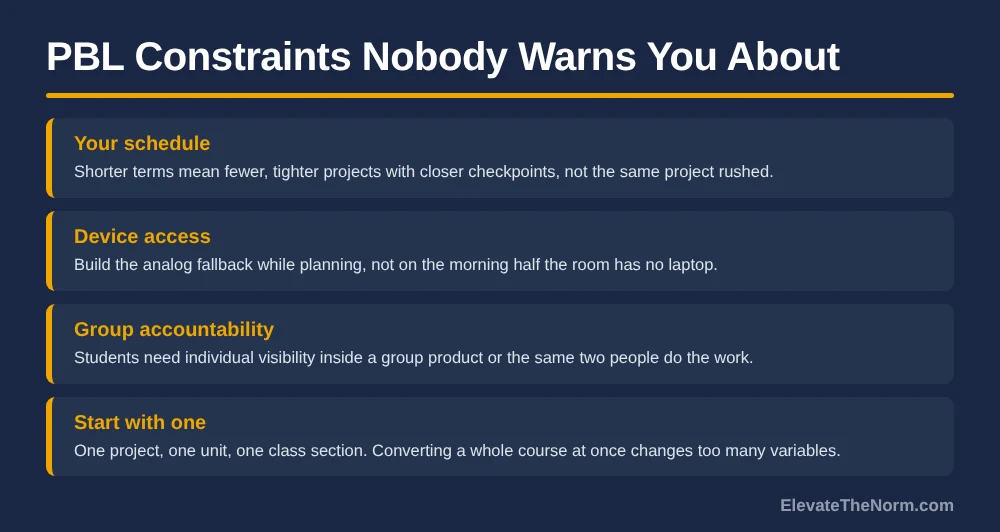
Practical constraints nobody warns you about
Your schedule shapes what is possible. A project designed for a full year does not survive an eighteen-week block. Shorter terms mean fewer, tighter projects with checkpoints closer together, not the same project rushed.
Device access is never what the plan assumed. Any project that collapses when half the room has no laptop was over-engineered. Build the analog fallback while you are planning, not on the morning it happens.
Group work is where projects usually fail — not on the content, on the accountability. Students need individual visibility inside a group product, or the same two people do the work and everyone learns the wrong lesson. That problem is a classroom-culture problem before it is a PBL problem, which is why teaching responsibility and clear classroom expectations matter more to a project’s success than the project design does.
Start with one. One project, one unit, one class section if you can. Converting a whole course at once is how teachers conclude PBL does not work, when what did not work was changing nine variables simultaneously.
If you are making the case for this to a colleague or an administrator, the numbers on student engagement, belonging, and teacher-student relationships are collected, with sources, in the classroom management and positive reinforcement statistics. The research on project-based learning itself, including the trials that found no gain, is in the project-based learning statistics.
Everything filed under project-based learning
-
Assessment for Project Based Learning: A Practical Guide for Grades 6–12
How to assess project based learning fairly: individual evidence at planned checkpoints, teamwork scored by observable behavior, and feedback early enough for students to revise.
-
PBL Rubrics for High School STEM: Best Sets and Sample Criteria
Where to get PBL rubrics for high school STEM, from free PBLWorks and NGSS tools to TeachEngineering and Defined Learning, plus a sample criteria table you can adapt.
-
Best-Value PBL Bundles for Middle School Teachers
A value analysis of PBL bundles for grades 6-8: cost per project, free vs paid, a comparison table, red flags in cheap bundles, and how to stretch one bundle across a school year.
-
PBL Rubric Bundles for Middle and High School: Free and Paid Options
Free PBL rubrics for grades 6-12 from PBLWorks and Elevate the Norm, where to buy paid bundles on TPT, and what makes a secondary project rubric actually work.
-
Common Core Aligned PBL Units: Where to Get Them (and How to Check)
Verified places to get ready-to-use Common Core aligned PBL units, from free PBLWorks and EL Education to Defined Learning and TPT, plus a 10-minute alignment check.
-
Best Project-Based Learning Kits to Buy for Your Classroom
The project-based learning kits and resources worth buying or downloading, from PBLWorks and Defined Learning to TPT bundles and LEGO Education, plus a checklist for judging any kit.
-
Project Based Learning Science: 25 Real-World Projects for Grades 6–12
Twenty-five science projects for grades 6–12 that start with a phenomenon students cannot explain and end with data someone outside the room will use — plus what the randomized trials actually found, and the four things that shut science projects down.
-
Teaching Local History With Ghost Stories: An October Lesson That Ends in Real Evidence
Use your town’s ghost stories to teach grades 6-12 students to separate folklore from documented history, with a worked Tuscaloosa example, a five-step lesson, free primary sources and a rubric.
-
Group Work Roles for Students: What the Evidence Supports, and What It Doesn’t
Group work roles for students are supposed to stop one kid doing everything. The evidence backs the accountability underneath them, not the role cards — plus five tests a role has to pass.
-
Civics Project Ideas: The Mock Election That Took Over a School
A civics project that got middle schoolers arguing about issues instead of insulting candidates, then grew into a mock election for the whole school. How it ran, what the research shows, and what keeps it safe.
-
History Project Ideas: 10 Classroom-Tested Units for Grades 7–12
Ten history project ideas built and run in a real secondary classroom, each with a driving question, a length, a public product, and an honest account of where it goes wrong.