
By Clay Shumate
These are ten history projects I have actually run with middle and high school students, written for the teacher who has to plan them. Each one includes the driving question, the grade band, how long it takes, what students produce, and the part most project lists leave out — where it goes wrong and what to do about it.
Every one of them is free to use and adapt. Nothing here requires a field trip, a budget, or a schedule change.
Key Takeaways
- A history project is worth the time when students cannot complete it without learning the content — not when it decorates content they already covered.
- Every project below starts from a real question with more than one defensible answer.
- Project-based learning does not replace direct instruction. Most of these units start with it.
- The checkpoint that saves a project is almost always the one in the middle, where students have facts but not yet an argument.
- Group size is not the problem teachers think it is. Preparation is.
What Makes a History Project Worth the Time
Most lists of history project ideas are lists of activities. Build a model. Make a poster. Do a timeline. Those can be fine, but they are usually assigned after the teaching is finished, which makes them a reward rather than a method.
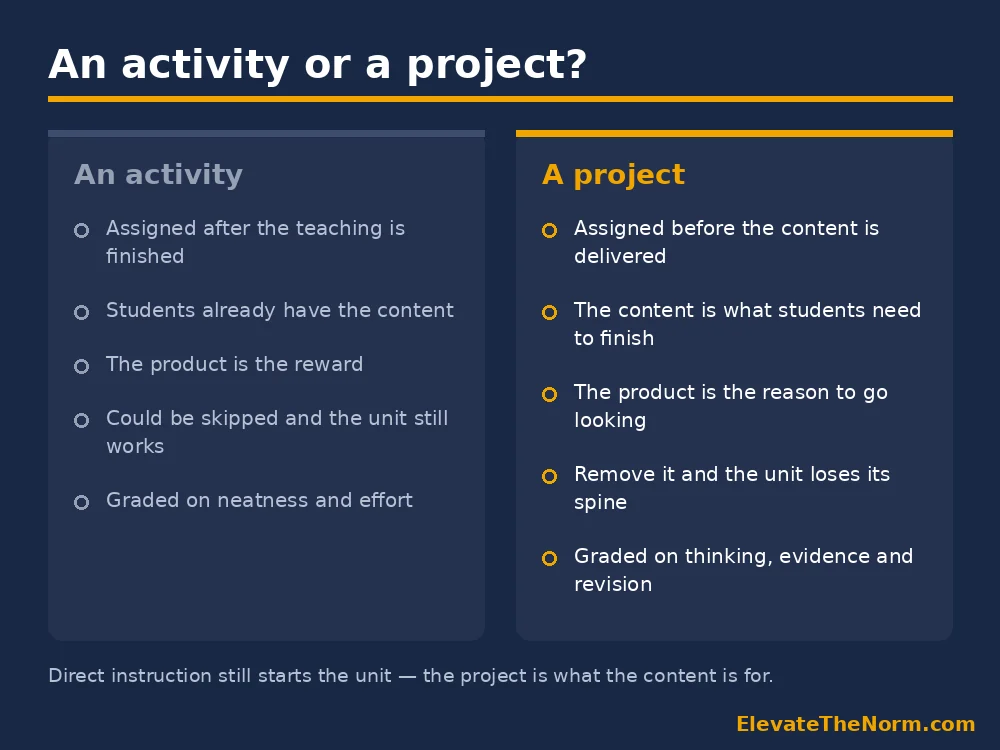
The projects below are built the other way around. The content is what students need in order to finish, which means they go looking for it. That is the difference between a project and project-based learning, and it is worth being precise about, because the two get used interchangeably and they are not the same thing. The definition of project based learning covers that distinction in more detail.
One thing I want to be clear about up front, because it is the objection I hear most: none of this means abandoning direct instruction. I start almost every unit with it, and it often comes back in the middle. Direct instruction and project work should be working together, not competing for the same minutes.
If you want the structure behind these before you pick one, the 7 steps of project based learning walks the process from driving question to public product, and there are more driving question examples if you want to write your own.
World History Project Ideas
These five world history project ideas work in a survey course and do not depend on where you are in the sequence. Two of them are period-specific; three will adapt to almost any unit.
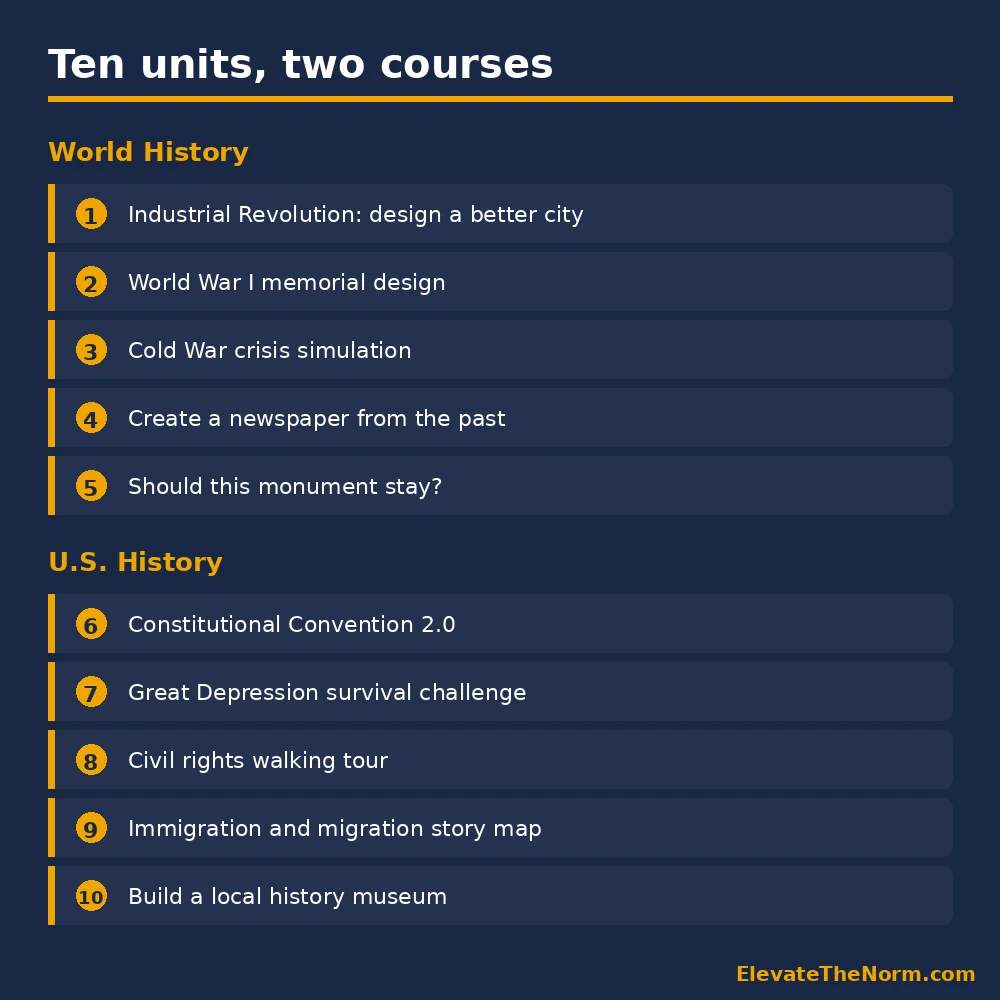
1. Industrial Revolution: Design a Better City
Driving question: How could an industrial city grow without sacrificing the lives of its workers?
Grades 8–10 · 2–3 weeks
Hand students a fictional industrial city with real problems — overcrowding, pollution, child labor, unsafe factories, disease, housing nobody should live in. They are the reformers. They build a plan covering housing, sanitation, transportation, worker protections, and factory regulation.
The design constraint is what does the teaching: students cannot propose a fix until they can explain the problem. Want a sewer system? Show why disease spread. Want a child labor law? Show what children were actually doing. The content stops being something to study for a test and becomes something they need to finish the work.
Where it goes wrong: groups jumping to solutions on day one. The fix is a hard checkpoint — problems only, with a historical cause attached to each, before any solution is allowed on paper.
2. World War I Memorial Design
Driving question: How should future generations remember a war?
Grades 7–10 · 2 weeks
Students investigate the war through soldiers, civilians, technology, casualties, and propaganda, then design a memorial and defend every major choice in writing.
A memorial forces students to decide what matters. There is room for one, and it cannot hold everything. If you have space for five ideas about this war, which five deserve to survive? One pair centers the soldiers. Another centers civilians, or what the new technology did to the human body. The products look nothing alike and they hit exactly the same standards.
Where it goes wrong: grading the art. The written defense is the assessment, and students need to hear that on day one or your strongest historians will panic about their drawing.
3. Cold War Crisis Simulation
Driving question: How do national leaders make decisions when every option carries serious consequences?
Grades 9–10 · 1–2 weeks
Students become a presidential advisory team during a fictional crisis modeled on something real. Intelligence arrives in stages. They decide whether to negotiate, blockade, use force, or gather more information — and they log why, every time.
The Cold War makes sense once students feel the uncertainty. We teach these events knowing how they ended. The people in the room did not. So the information comes in pieces, and students decide without knowing what comes next.
What I am actually measuring is not whether they pick the historically correct option. It is whether they change a decision when new evidence arrives. That is not indecisiveness. That is exactly what we want.
Where it goes wrong: releasing all the intelligence at once, which destroys the whole mechanism. Also write the third packet so it genuinely undercuts a reasonable conclusion from the first two — if nothing ever contradicts, you teach students that first instincts are always right.
4. Create a Newspaper From the Past
Driving question: What would this event have looked like to people living through it?
Grades 7–9 · 1–2 weeks
Students produce a newspaper dated to one specific day in the period you are teaching. The rule that makes it work: nothing in the paper can reference anything that had not happened yet. A student writing about the Boston Tea Party cannot mention the Constitutional Convention. It has not happened.
That single constraint teaches chronology, point of view, and sourcing at once, and it teaches them by making students enforce it on each other. Because a newspaper has different jobs — reporter, editor, cartoonist, advertisement designer — every student has a way in.
This one is a group of four to six, and that is fine. Do not be afraid of that size. If you have taken the time to understand where the project goes and where the questions will come from, you have control of the room. I call that controlled chaos, and it is the good kind.
Where it goes wrong: modern voice. Show one real front page from the period and have a student read a paragraph out loud. They hear it immediately.
5. Should This Historical Monument Stay?
Driving question: Who should we memorialize, and how should communities remember the past?
Grades 8–10 · 1–2 weeks
Teams investigate a monument and recommend what a community should do with it: keep it, remove it, relocate it, or leave it up with new signage that reinterprets it. They present to a mock city council that asks questions back.
The point is not the verdict. Students arrive with an opinion already formed and are required to investigate before they are allowed to decide. That order is the entire design. It forces them into conflicting evidence and competing perspectives, which is where the gray area lives — and history is not black and white, which is genuinely hard for students who think in straight lines.
A fictional monument works as well as a real one and lowers the temperature, which some rooms need. Invent a mill owner who founded the town, employed half of it, and broke a strike in 1913. All four recommendations become defensible.
Where it goes wrong: the teacher’s own position leaking. Do not tell students what side you are on, not once. Decide in advance how you will deflect the question and use the same move every time. The room only argues honestly if they cannot read you.
U.S. History Project Ideas
These five U.S. history project ideas map onto standard survey units. The first and last will work in a world history course too, with different content.
6. Constitutional Convention 2.0
Driving question: If we had to design a government from scratch, what powers should it have?
Grades 8–10 · 1–2 weeks
Students represent fictional states with different populations, economies, and interests, then negotiate representation, taxation, executive power, voting, rights, and the line between federal and state authority — and draft a constitution they all have to live under.
The Constitution makes sense when students live the problem that produced it. Otherwise it is a piece of paper they are told is important. Instead of memorizing the Great Compromise, they sit in a room where large states and small states actually disagree about representation, and suddenly compromise has a purpose, because they need one.
Participation climbs in this unit, and not because I asked better questions. Students are not answering the teacher. They are defending their state.
Where it goes wrong: state profiles that let one bloc win every vote. Rebalance them before you run it. And when the first session deadlocks, let it sit — that frustration is what makes the compromise land two days later.
7. Great Depression Family Survival Challenge
Driving question: How would an ordinary family survive an economic crisis?
Grades 9–10 · 1–2 weeks
Each student gets a fictional family with jobs, savings, housing costs, and a location. Then history happens to them — unemployment, a bank failure, drought, illness, a wage cut, a New Deal program. They decide, and they write down why.
Students usually learn the Depression as a list. Bank failures. Unemployment. Dust Bowl. New Deal. That is four disconnected facts. This makes them interact: lose a job and housing is at risk, lose housing and you migrate, a bank fails and the savings are simply gone. So when a New Deal program appears, students already understand the problem it was built to solve.
That is a mental model. Memorizing ten acronyms is not.
Where it goes wrong: students treating it as a game to win. Say on day one that some families do not recover, and that this is not a failing grade. Then mean it.
8. Civil Rights Community Walking Tour
Driving question: How did ordinary people and local communities contribute to the Civil Rights Movement?
Grades 8–10 · 2–3 weeks
Students research Civil Rights history in their own state or region and build a walking tour of five to eight stops, each with photographs, a map, quotations, biographies, and an explanation of why that spot earned its place.
This one destroys the idea that history happened somewhere else. Students find out that national history took place a few miles from where they live. It also widens the story past the handful of names that make the textbook — the organizers, the drivers, the people who housed marchers, the teachers who lost jobs, the students who walked out.
The tour can be entirely digital. No buses, no permission slips, no budget.
Where it goes wrong: students defaulting to the national figures they already know. Build in a checkpoint that requires three local participants by name, with what each one did.
9. Immigration and Migration Story Map
Driving question: Why do people leave one place and build a life somewhere else?
Grades 7–10 · 2 weeks
Students trace a real migration — westward expansion, the Great Migration, Ellis Island, the Dust Bowl, a modern movement — and map it, annotating push factors at the origin, pull factors at the destination, obstacles along the way, and consequences in both places.
What makes this one work is that cause and effect becomes visible. I am not handing students a definition of push and pull factors to memorize. They follow actual people across actual distance and explain why the movement happened, and the map shows the answer. Where geography and history are taught together, this is the unit that justifies it.
Where it goes wrong: routes too vague to research. “Immigration” is not a route. “Sicilian families through Ellis Island, 1900 to 1914” is. Lock the group, the origin, the destination, and the years before anyone starts.
10. Build a Local History Museum
Driving question: How can we preserve and explain the history of our community?
Grades 7–10 · 2–3 weeks
Students research a local person, building, business, school, event, or tradition and build a museum-style exhibit — artifact, photographs, captions, a map, and a written historical interpretation. The class combines them into one museum, physical or digital.
Instead of me telling students what happened in their community, they become the historians. They locate the evidence, decide what is important, and explain it to somebody else. The museum label format does a lot of the teaching on its own, because being short, accurate, and clear at the same time is harder than writing a page.
Where it goes wrong: topics that are too big, and one website used as the only source. A required source log, checked early rather than at the due date, fixes the second one. Forcing every group to one specifically named subject fixes the first.
How to Pick One
If you have never run a project like this, start with the newspaper or the memorial. Both have clear products, both forgive a rough first attempt, and neither depends on a simulation staying under control.
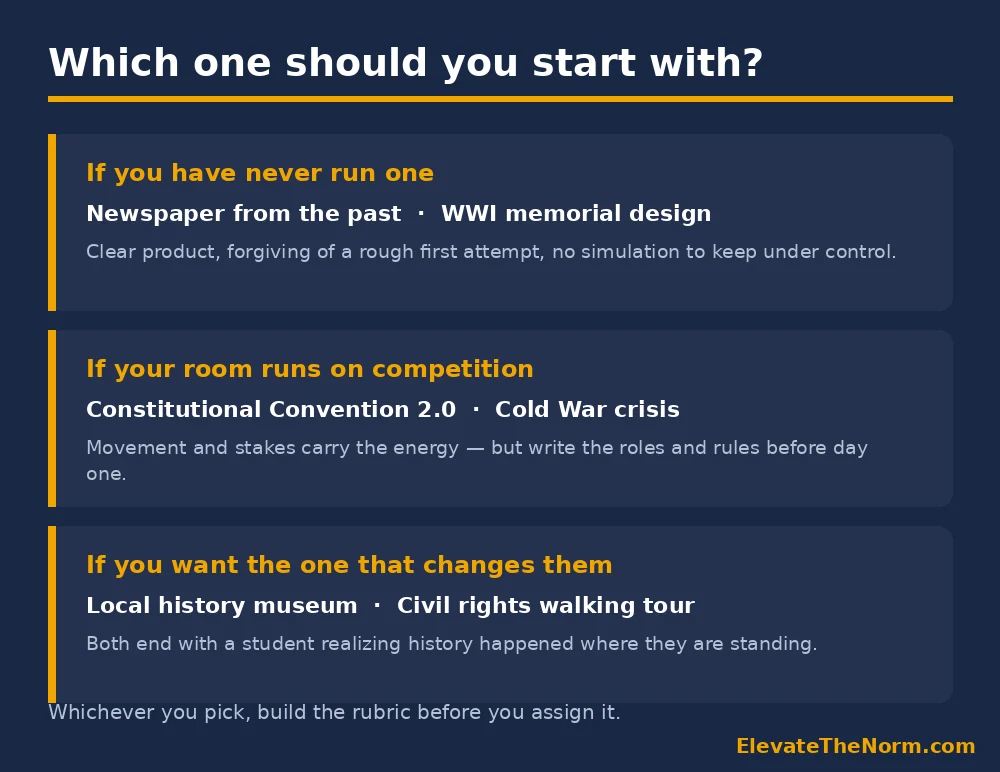
If your room responds to competition and movement, start with the Constitutional Convention or the Cold War simulation.
If you want the one that changes how students see the subject, it is the local museum or the walking tour, because both end with a student realizing history happened where they are standing.
Whichever you pick, build the rubric before you assign it — there is a free editable PBL rubric if you want a starting point, and more planning tools and templates alongside it.
The Part That Matters Most
Every one of these projects asks students to do something historians actually do. Use evidence. Defend a decision. Hold two perspectives at once. Revise an argument when the evidence changes. Those are also, not coincidentally, the things people who do well in life tend to be good at.
And for the student who struggles in a traditional history class, a project gives them a reason to read the source, learn the vocabulary, and know the content — because they need it to build the thing.
The project is not what students do after they learn the history. The project is how they learn the history.
What is a good history project for high school students?
The best history projects give students a real question with more than one defensible answer and require them to use evidence to answer it. A monument recommendation, a Cold War crisis simulation, and a memorial design all work well at the high school level because students cannot complete them without understanding the content first.
How long should a history project take?
Most of these run one to three weeks. Anything shorter than about a week does not allow for the research, feedback, and revision that make a project worth doing. A single class period activity is a good activity, but it is not project-based learning.
Do history projects replace lectures and notes?
No. Almost every project here starts with direct instruction, and several bring it back in the middle when students hit a skill they are missing. Project work and direct instruction should be working together. The project changes when and why the content is delivered, not whether it is.
How do you grade a history project fairly?
Grade the thinking, not the craftsmanship. On a memorial design, the written defense of the design choices carries the weight, not the drawing. Build the rubric before you assign the project, share it with students at the start, and keep the criteria tied to evidence use, reasoning, and historical accuracy.
What if students just divide the work and never collaborate?
Assign specific roles with specific deliverables and check individual work at a midpoint rather than group output at the end. On the newspaper project, every student has a different job. On the migration map, one student owns the source log. The checkpoint in the middle is what catches an uneven group while there is still time to fix it.
Can these history projects work in a middle school classroom?
Most of them are written for grades 7 through 10. The newspaper, the local history museum, the migration story map, and the memorial design all work well in middle school. The Cold War simulation and the Great Depression challenge are better suited to grades 9 and 10 because they depend on sustained decision-making.
How do you handle controversial topics in a history project?
Do not tell students where you stand, and require investigation before they are allowed to reach a conclusion. Using a fictional example instead of a real local one lowers the temperature without lowering the rigor. The goal is that students’ reasoning becomes more sophisticated, not that their opinions move in a particular direction.
About Clay Shumate
Clay Shumate is a certified secondary Social Studies teacher in the public schools of West Alabama, now in his seventh year in the classroom, with a B.A. in History and an M.Ed. in Secondary Education. He writes about project-based learning, student responsibility, respect, and practical ways to hold young people to a higher standard while giving them room to learn from mistakes. He is a member of the Society of Professional Journalists and writes to its Code of Ethics; this site’s editorial standards and corrections policy are published in full. More about Clay.