By Clay Shumate
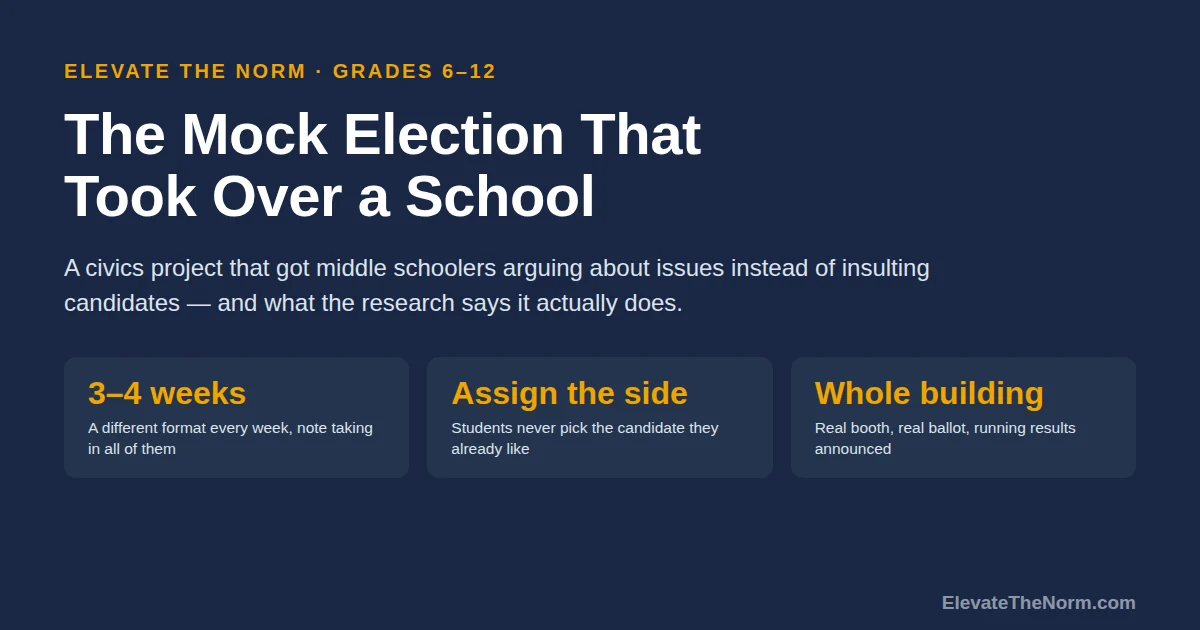
One of the most fun group projects I have ever run was a mock presidential election with seventh graders. It started in my classroom during a presidential race, and by the time it was over, the entire school was lined up to vote.
If you are looking for civics project ideas that get middle schoolers arguing about issues instead of insulting candidates, this is the one I would hand you first. Here is where it came from, how it ran, and what it honestly takes.
Key Takeaways
- Assign students a candidate’s positions, not a candidate to cheer for. Once they have to defend a platform, they argue the issues instead of the personalities.
- Change the format every week. Poster board one week, PowerPoint the next, group defenses after that, for three to four weeks.
- Keep it inside your standards. Civics carried this entire project.
- Ask for help early. An instructional coach shaped the idea, and a community partner supplied the “I Voted” stickers.
- A real booth, a real ballot, and running results turn a class project into something the whole building wants in on.
Free Download · PDF
25 Project-Based Learning Examples and Planning Template
Twenty-five driving questions with real public products and the standards they carry, plus a one-page planning template to fill in before you commit a single class period.
Free. No email address required. Designed for grades 6–12. Browse every printable in Your Free Library.
Where the Idea Came From
It was a radically difficult election, for the candidates and for the American people. I was teaching seventh grade at the time, and all of it was seeping down from home into my classroom.
Mom and dad may very well be right about what they believe. That is not the point. Our job is to put as much information in front of students as we possibly can.
This is where reaching out to others always helps. My instructional coach had taught the same course, so I went and asked a simple question: what is a good way to really embrace this election and bring middle schoolers into it? We landed on the one goal nobody could call partisan. Get them excited about voting when they turn 18.
So I suggested we hold a seventh grade presidential election, with both major-party tickets on the ballot.
How the Project Ran
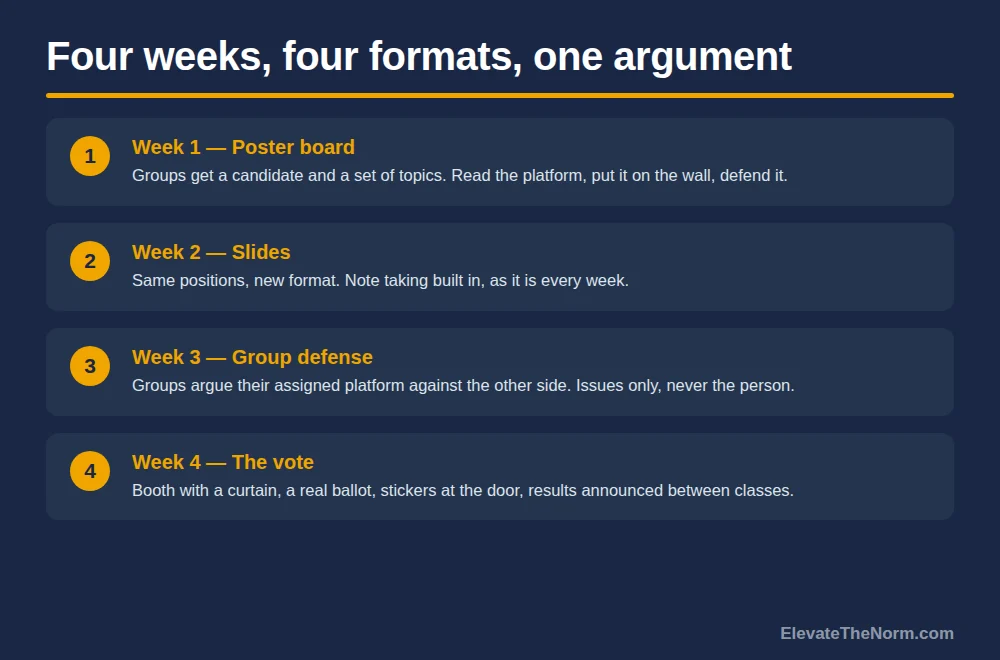
Everybody was split into groups. Each group was given topics and a side: one major-party candidate’s platform or the other’s.
By side, I mean students took that candidate’s views. They read them, applied them, and had to use them in a group setting. Then the groups defended their arguments. Without realizing it, they were practicing a lot of the same techniques you see in Advanced Placement classes.
The format changed every week for about three or four weeks. We did poster board. We did PowerPoint. You name it. By the time anyone voted, students had been through three to five group projects, with note taking built into every one of them.
There was direct instruction in there too, just not much of it. You know that salt guy? That is how I use direct instruction in a project. A little sprinkle here and there.
And it covered what I was required to teach. Civics was a seventh grade standard, taught all in one block, so the project was the standard rather than a break from it. You always have to be conscious of your standards, and this one was built around them from day one.
From Name-Calling to Actual Arguments
Before this project, the political conversation in my room sounded like “Trump sucks” and “Obama blows.” Those are two direct quotes from students, and they were the polite ones. I heard others I will not print here.
Then something shifted. Students were arguing points. Instead of fighting about the candidates, they were applying what they had learned and arguing about the issues themselves.
Along the way they figured out the thing I most wanted them to leave with: you vote for the candidate who, in your opinion, is going to meet the most of your needs. That lesson outlasts any single election.
Then the Whole School Wanted In
Word got around fast. Before long we were running the election for the entire building.
I reached out to a community partner and asked for a few hundred “I Voted” stickers. They worked some kind of miracle and got me several hundred.
Voting looked like the real thing. Students walked into a booth, pulled the curtain closed, and filled in a Scantron for one candidate or the other.
We also had our own version of Fox and CNN. I think we called it FXN. I honestly do not remember, and it does not matter. At the end of every class, I ran the Scantrons or sent a student to run them. We reworked the percentages, and our news team announced the updated results before the next group voted.
I want to be honest about one thing. A lot of the sway in those votes probably still came from home and how parents talked about the race. But by that point, my students had been fully vetted on both sides. They had argued each candidate’s positions themselves. Whatever they chose in that booth, they could tell you why.
It was incredible. They loved it. They became super involved in the rest of the unit and the rest of the year, and they got genuinely interested in what civics was and how they could learn to vote.
What Does the Research Say About Mock Elections?
The evidence is real, it is modest, and the most interesting part of it says the classroom is only half the machine.
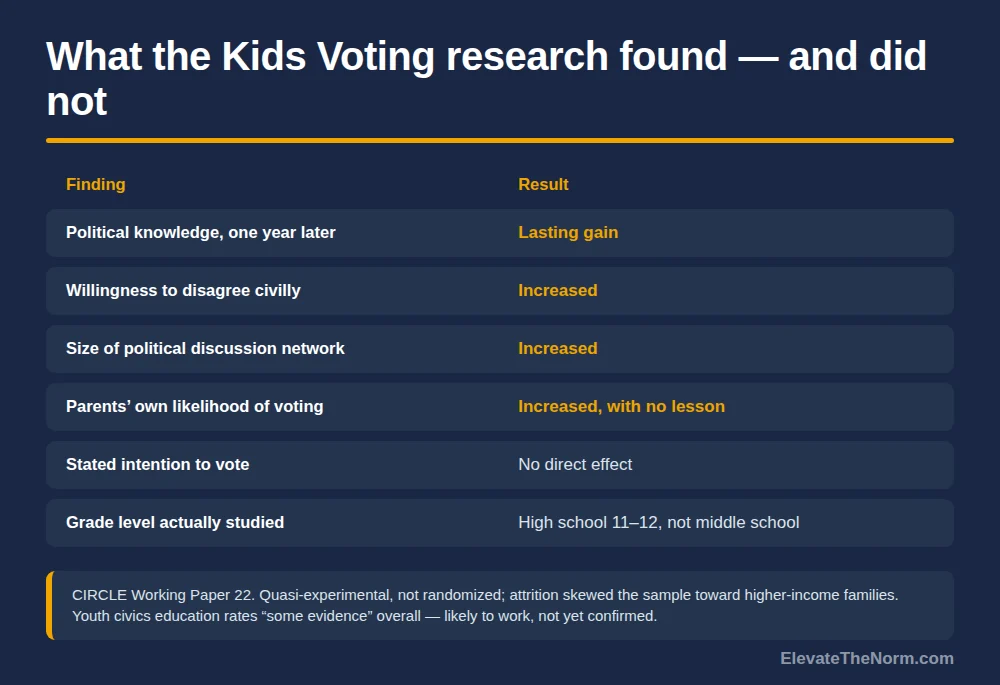
The best-studied program of this kind is Kids Voting USA, which ran mock elections in schools alongside real ones. A CIRCLE panel study followed 497 student–parent pairs across Arizona, Colorado and Florida, then checked actual voting records two years later. Students who went through it showed lasting gains in political knowledge a full year afterward, widened the set of people they talked politics with, and — the finding I care about most — got measurably better at disagreeing with someone without it turning into a fight.
Then the part that reframed my own project for me. The strongest path to students actually voting when they came of age ran through conversations at home. The curriculum got students paying attention to the news, the news got them talking at the dinner table, and that talk predicted turnout. The researchers also found parents shifted — they became more likely to vote themselves, without ever seeing a lesson, purely because their kid brought it up.
I said further up that a lot of the sway in my students’ votes probably still came from home. I had that filed as the weakness of the project. The research says it is the mechanism. You are not competing with the kitchen table. You are trying to give a twelve-year-old something worth bringing to it.
The honest limits
Four things about that evidence that a professional development slide would leave off, and you should know all of them before you quote a number to an administrator.
- The sample was high school juniors and seniors. My project was seventh grade. The practices transfer; the findings do not automatically come with them, and anyone telling you a mock election is proven for middle schoolers is going past the data.
- It was quasi-experimental, not a randomized trial, and attrition skewed the surviving sample toward higher-income families. Low-income and Spanish-speaking households were underrepresented.
- There were null results. No direct effect on students’ stated intention to vote. The authors’ own summary is that effects were “not remarkable across the board.”
- The overall strategy rates “some evidence” in the County Health Rankings review — meaning likely to work, tested more than once, trending positive, and not yet confirmed. Which is roughly where most of the good stuff in teaching sits.
None of that is a reason to skip it. It is a reason to run it because it is good teaching and students learn the content, not because you were promised a turnout statistic.
Running Your Own Mock Election
If you want to try this, here is the shape of it:
- Talk to your instructional coach or a colleague who has taught the course before you plan anything.
- Tell your administrator the design before you build it — the standard it covers and the assign-the-sides rule.
- Send a short note home explaining that students are assigned a position rather than choosing one.
- Assign sides. Do not let students pick the candidate they already like.
- Give each group specific topics, and require them to read, apply, and defend that candidate’s positions.
- Rotate the format weekly for three to four weeks, with note taking in every round and a sprinkle of direct instruction when they need it.
- Ask a community partner for “I Voted” stickers well ahead of election day.
- Build a booth with a curtain and use Scantrons as ballots.
- Start a student news team and announce running percentages before each new class votes.
There is no presidential race this November, but a midterm works the same way. Pick one race or ballot question with two clear sides and build the groups around it.
If you want more projects built on the same idea, there are ten more in history project ideas, including a Constitutional Convention that pairs well with this one, and a longer list in these examples of project based learning. Build the rubric before you assign anything.
Where This Goes Wrong, and How to Not Let It
A mock presidential election is the highest-risk project I have ever run, and every one of the risks is manageable if you handle it before week one.
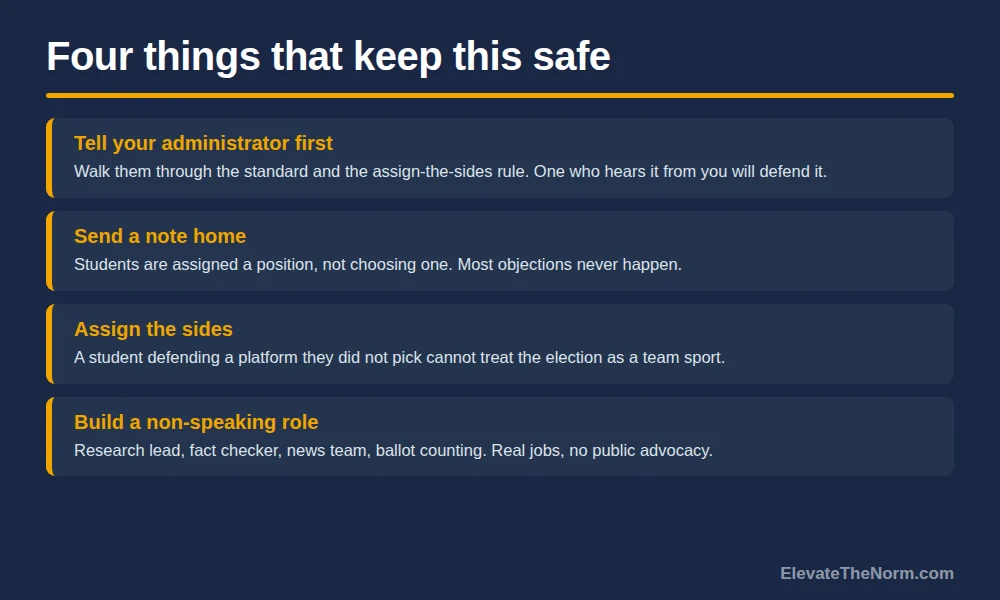
Be honest with yourself about the exposure. You are putting live partisan politics in a room full of twelve-year-olds whose families have strong feelings, in a building with a principal who will get the phone call. Four things keep it safe, and none of them is difficult.
- Tell your administrator before you plan it, not after a parent calls. Walk them through the standard it covers and the assign-the-sides rule. An administrator who heard it from you first will defend it. One who hears it from a parent first has to investigate it.
- Send something home. A short note explaining that students are assigned a position rather than choosing one, that the goal is understanding both platforms, and that nobody is being told who to support. Most objections never happen if the family already knows the design.
- Assigning sides is the neutrality mechanism, and it is also the thing families worry about. The answer to “my child had to argue for someone we cannot stand” is that arguing a position you do not hold is the oldest exercise in civic education, it is what debate has always been, and it is the single most reliable way to stop students from treating an election as a team sport. Say that plainly and say it early.
- Give a student a way out of the spotlight without leaving the project. Some students have a genuine reason not to want to stand up and argue a position — a family situation, an immigration-adjacent worry in the room, a kid who simply will not perform. Research lead, fact checker, news team, and ballot-counting are all real jobs that require the content and require no public advocacy. Build them in from the start instead of after someone has to ask.
What It Actually Takes
Project-based learning can be extremely powerful. It also takes a lot of work, and it takes asking others for help.
If you are not super outgoing, this will not be easy for you at first. You will not know the answers to everything, and you are going to have to ask. That is fine — it is how I got half of what I use. If you want to talk one through, the contact page is open.
Because the gratification from a correctly executed PBL project is nearly as good as that feeling right after you cut the lawn, when you look back on it with a cold glass of iced tea.
Before you go: grab the free 25 Project-Based Learning Examples and Planning Template (PDF) — ElevateTheNorm.com branded, printable, no email required.
Frequently Asked Questions
What is a good civics project for middle school?
A mock election works well because students cannot take part without learning the content. Assign each group a candidate’s positions rather than letting them pick a side, require them to read, apply and defend those positions, and finish with a real vote using a booth and a ballot. The project carries the standard instead of interrupting it.
How long does a mock election project take?
Mine ran about three to four weeks with a different format every week. Students completed three to five group projects, each with note taking built in, before anybody voted. You could run a smaller version in one week with a single ballot question and two groups, and it would still work.
How do you keep a mock election from getting too political?
Assign sides instead of letting students choose, and keep every argument on the issues rather than the candidates. That one rule does most of the work: a student defending a platform they did not pick cannot treat the election as a team sport. Tell your administrator the design before you start, and send a short note home explaining it.
What do I say to a parent whose child was assigned a candidate the family opposes?
Say it early rather than defending it later. Arguing a position you do not personally hold is the oldest exercise in civic education and the whole point of debate: it is how a student finds out what the other half of the country actually believes rather than what they have been told it believes. Nobody is being asked to change their mind, and no student’s own view is ever graded.
What if a student does not want to argue a position in front of the class?
Give them a real job that needs the content and needs no public advocacy. Research lead, fact checker, news team, ballot counting. Build those roles in from day one so a student can take one without it reading as an exemption, and so nobody has to ask in front of anybody.
Does research actually show mock elections work?
Partly, and it is worth knowing the shape of it. A CIRCLE panel study of Kids Voting USA found lasting gains in political knowledge, wider political discussion networks, and students who got better at disagreeing civilly — but that sample was high school juniors and seniors, not middle schoolers, the design was quasi-experimental rather than randomized, and there was no direct effect on stated intention to vote. The County Health Rankings review rates youth civics education as “some evidence.” Run it because it is good teaching, not because you were promised a statistic.
There is no presidential race this year. Does this still work?
Yes, and a smaller race is easier to run. A midterm, a statewide office, a local ballot question, or a single policy proposal with two defensible sides all produce the same argument structure. The presidential version is louder, not better — and a ballot question has the advantage that neither side comes with a personality attached.
What does this cost?
Almost nothing. Scantrons or paper ballots you already have, a refrigerator box or a rolling whiteboard for a booth, and stickers if a community partner will donate them. The expensive part is your planning time during the three to four weeks, not materials.
Sources
- McDevitt, Michael, and Spiro Kiousis. Education for Deliberative Democracy: The Long-Term Influence of Kids Voting USA. CIRCLE Working Paper 22, 2004. Panel study, 497 student–parent dyads in Arizona, Colorado and Florida; high school juniors and seniors; lasting knowledge gains, wider discussion networks, greater willingness to disagree civilly; no direct effect on intention to vote; quasi-experimental, sample skewed upper-SES. https://circle.tufts.edu/sites/default/files/2019-12/WP22_Long-termInfluenceofKidsVotingUSA_2004.pdf
- McDevitt, Michael. Experiments in Political Socialization: Kids Voting USA as a Model for Civic Education Reform. CIRCLE Working Paper 49, 2006. Three-year longitudinal design with verified voting records; political communication in the home increased the probability of voting once students reached voting age. https://eric.ed.gov/?id=ED494074
- County Health Rankings & Roadmaps, University of Wisconsin Population Health Institute. Youth Civics Education. Rated “Some Evidence” — likely to work, tested more than once, results trending positive, further research needed; effects vary by curriculum and by student population. https://www.countyhealthrankings.org/strategies-and-solutions/what-works-for-health/strategies/youth-civics-education
- Simon, Jesse, and Bruce Merrill. “Trickle Up Political Socialization: The Impact of Kids Voting USA on Voter Turnout in Kansas.” State Politics & Policy Quarterly. Cambridge Core
About Clay Shumate
Clay Shumate is a certified secondary Social Studies teacher in the public schools of West Alabama, with seven years of classroom experience, a B.A. in History, and an M.Ed. in Secondary Education. He writes about project-based learning, student responsibility, respect, and practical ways to hold young people to a higher standard while giving them room to learn from mistakes. He is a member of the Society of Professional Journalists and writes to its Code of Ethics; this site’s editorial standards and corrections policy are published in full. More about Clay.