By Clay Shumate
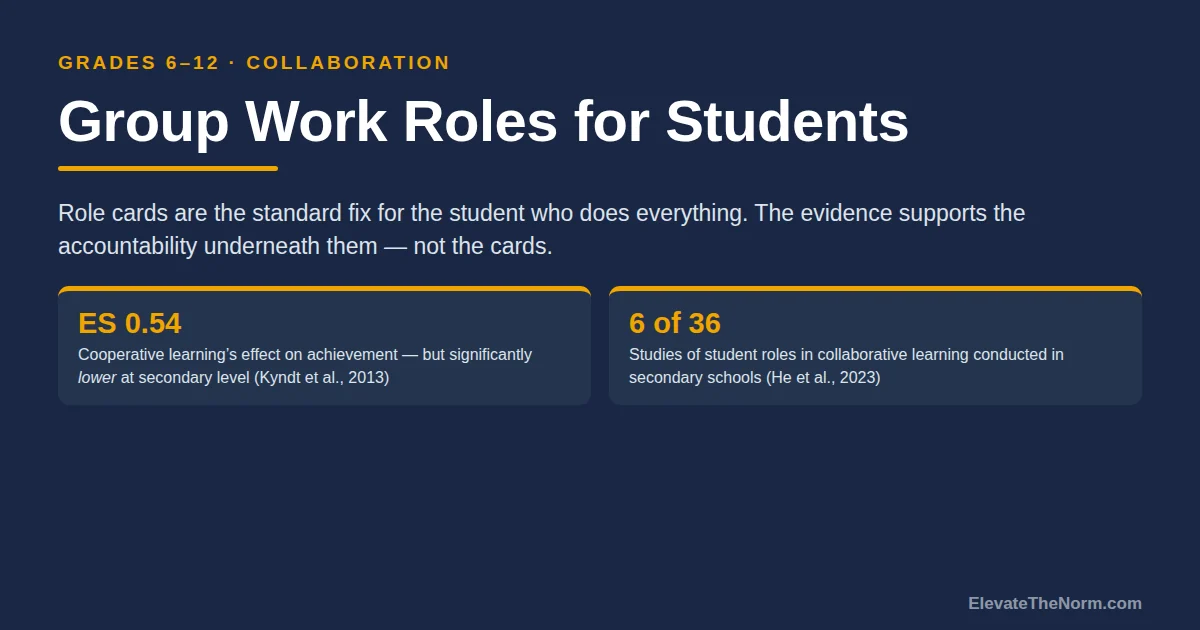
Group work roles for students are assigned jobs inside a team — a scheduler, a source keeper, a build lead — meant to stop one student doing everything. They are the standard fix, and the research supports what sits underneath them rather than the roles themselves. Individual accountability and a real shared goal are well evidenced. Role cards are not.
That distinction is not an academic quibble. It is the difference between a role that changes who works and a laminated card that changes nothing.
Key Takeaways
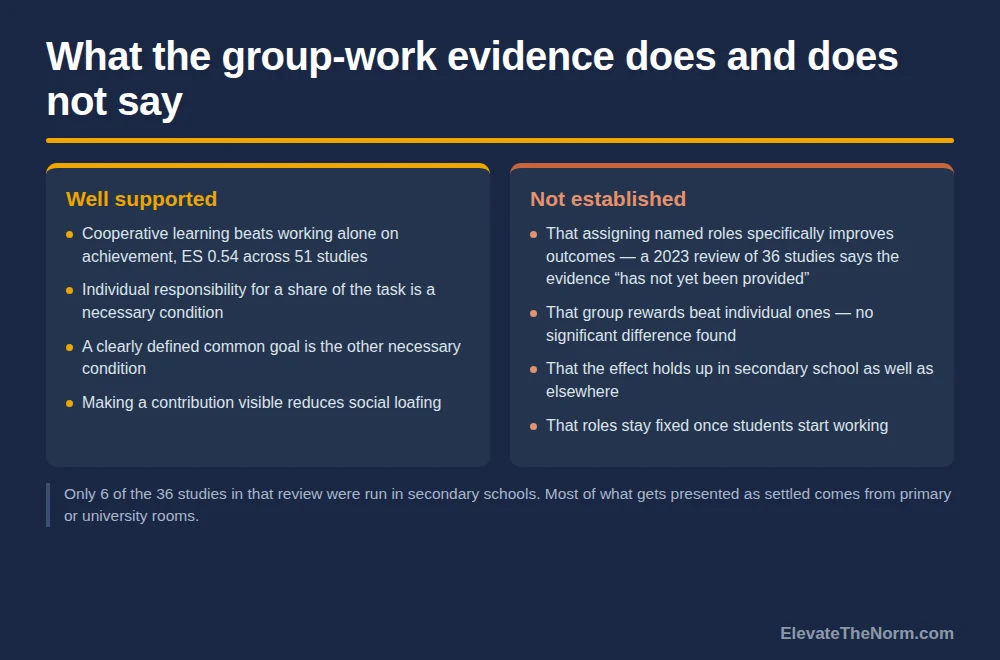
- Cooperative learning works — and works least well in secondary school. A meta-analysis of 51 studies put the achievement effect at 0.54, with the secondary level significantly lower than both primary and university.
- The evidence for assigned roles specifically is thin. A 2023 systematic review of 36 studies concluded that empirical evidence for the assumption that roles improve collaborative problem-solving “has not yet been provided.”
- What is well supported is individual responsibility plus a clear common goal. Both are necessary conditions. Neither requires a role card.
- Making effort matter beats making effort watched. In one experiment, students who believed their effort genuinely affected the outcome worked just as hard unobserved as observed students did.
- A role has to produce something. If nobody would notice the role vanishing, it is decoration, and students work that out faster than adults do.
Free Download · PDF
Group Work That Does Not Collapse (2 pages)
Page 1 is the five tests to run before you make a single role card, plus the one sentence that answers the parent email about group grades. Page 2 is the task planner and a plain table of which claims the evidence actually supports.
Free. No email address required. Designed for grades 6–12. Browse every printable in Your Free Library.
What Are Group Work Roles for Students?
A group work role is a named job inside a team, assigned rather than negotiated, with responsibilities attached to it. The familiar set is project manager, researcher, recorder, timekeeper, presenter, materials manager.
The logic is sound on its face. Left to themselves, a group of four will not divide work evenly. One student will take over because they want the grade, one will drift because taking over is exhausting, and two will do what is asked and no more. Assigning roles is supposed to pre-empt that by giving everybody a defined share before the negotiation can happen.
The problem is that most of the roles on that standard list are not shares of the work. They are labels attached to students who are then expected to do the work anyway. “Encourager” is the clearest case: it produces nothing, it cannot be done badly in any way you could point to, and if the student simply does not do it, the project finishes on time regardless.
Do Assigned Roles Actually Improve Group Work?
Nobody has shown that they do, and the researchers who looked hardest say so directly.
He, Shi, Choi and Zhai published a systematic review in Thinking Skills and Creativity in 2023, covering 36 empirical studies of student roles in collaborative learning from 2013 to 2022. Their conclusion is unusually blunt for a review: the assumption that roles drive collaborative problem-solving competency is widespread, and “empirical evidence for this assumption has not yet been provided.”
Two further findings from that review are worth carrying into a classroom:
- Roles are fluid. Whatever you assign, students renegotiate it once the work starts. The review distinguishes scripted roles, which the teacher sets, from emergent roles, which the group actually settles into — and the emergent ones are what you end up observing.
- Effects are conditional. Whatever roles do depends on the students, the context and the teacher support around them. There is no version where the card does the work.
And the sample problem again: of those 36 studies, 23 were in higher education, 7 in primary schools, and 6 in secondary. The advice circulating in secondary professional development is mostly borrowed from somewhere else.
None of this means stop assigning roles. It means stop expecting the assignment to be the intervention. What you are actually reaching for when you hand out roles is accountability, and accountability has much better evidence behind it than roles do.
What Does the Research Actually Support?
Two things, and both are conditions rather than techniques.
Kyndt and colleagues published a meta-analysis of face-to-face cooperative learning in Educational Research Review in 2013, covering 65 articles with 51 providing usable effect sizes. The headline is good news: an achievement effect of 0.54, with a confidence interval well clear of zero. Attitudes moved far less, at 0.15.
Their summary of what makes it work is short. Effectiveness depends on the individual responsibility each learner takes for completing the task and on a clearly defined common group goal. That is the whole mechanism. Everything else — the cards, the contracts, the seating — is machinery for producing those two conditions, and the machinery is replaceable.
Two findings that cut against the standard advice
Group rewards did not beat individual rewards. Kyndt’s team compared the two and found no significant difference. They flag this themselves as contradicting earlier reviews, which had consistently favoured group rewards, and they suggest the more useful distinction is between result interdependence — your grade depends on the team’s outcome — and task interdependence — you literally cannot finish without the others. The second has the more consistent evidence behind it. Build the task so students need each other, and you need the grading lever less.
And group work does measurably worse in secondary school. Kyndt’s moderator analysis found the secondary level had a significantly lower effect size than both primary and tertiary — differences of roughly 0.20 and 0.18 respectively. That finding deserves more attention than it gets on a site like this one. The age group that gets the most group work in the name of collaboration skills is the age group where the achievement payoff is smallest. It is still positive. It is just not what the slide deck claimed.
Why Does One Student End Up Doing Everything?
Because effort that nobody can see is effort most people reduce — and because in a lot of group tasks, one student’s effort genuinely does not change the outcome.
The research term is social loafing, and it has been studied since the 1970s. Karau and Williams’s 1993 meta-analysis in the Journal of Personality and Social Psychology is the standard reference for it. The classic finding is that people work less hard in groups than alone, and that making individual contributions identifiable reduces the drop.
Shepperd and Taylor ran a more interesting version in 1999. Their control condition replicated the standard effect: participants whose work would be evaluated individually produced 28.4 ideas, against 20.0 for participants who knew nobody would look. But their main finding was about something else. Participants who were not going to be evaluated but who believed their effort genuinely affected the group’s result produced 28.4 — matching the evaluated group exactly. Participants who were unevaluated and did not believe their effort mattered produced 21.1.
Read that carefully, because it reframes the whole problem. Surveillance works. But believing your effort matters works just as well, and it does not require you to watch anybody. Most role systems are built as surveillance — here is your job, I will be checking. The better design question is whether the role is one where a student can see their own effect on whether the thing succeeds.
How Do You Build Roles That Come From the Task?
Start with the work, not with a list of role names. Look at what the project actually requires, find the parts that are genuinely separable, and name those. A role invented before the task exists will never fit it.
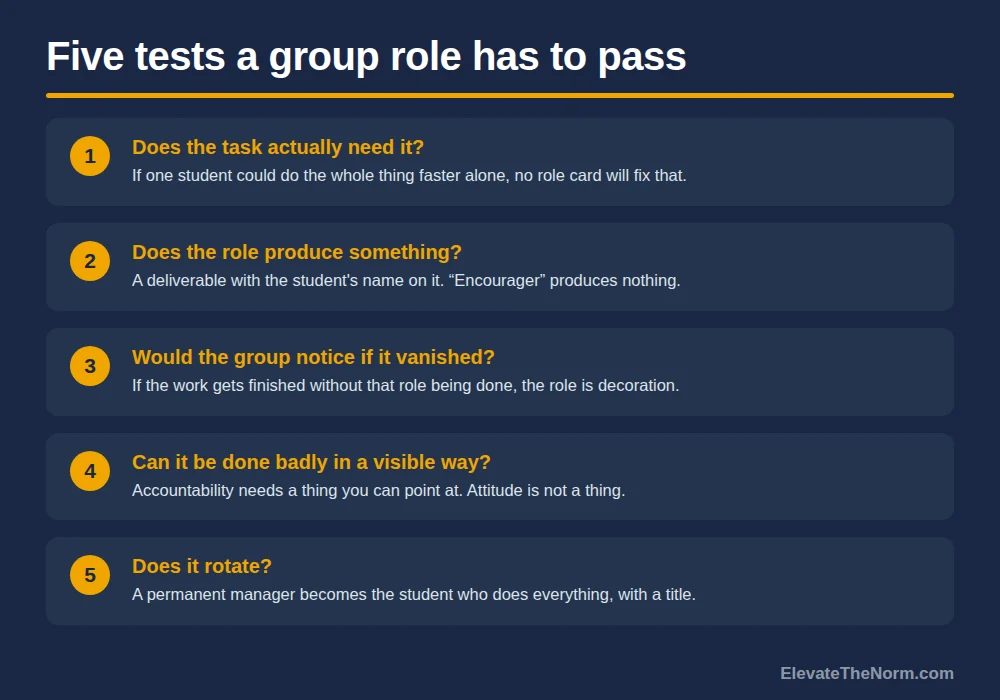
Five tests. A role that fails two of them is decoration:
1. Does the task actually need it? If one motivated student could do the whole project faster alone, you do not have a group task, you have an individual task with an audience. No role card repairs that. Fix the task.
2. Does the role produce something? A document, a build, a dataset, a written objection — something with that student’s name on it that exists at the end of the period. If the output of a role is a behaviour, it is not a role.
3. Would the group notice if it vanished? Imagine the student assigned to it did nothing at all. If the project still finishes, the role was never load-bearing.
4. Can it be done badly in a visible way? Accountability needs something you can point at. “You weren’t encouraging enough” is not a conversation anyone can have. “Your source list has three dead links and one of them is where our main claim came from” is.
5. Does it rotate? A permanent project manager is just the student who was already doing everything, now with institutional backing. Rotate on a fixed schedule and say so in advance.
One more thing to watch, and it will not show up in any of the five tests: who you hand which role to. If you assign by who seems suited to it, you will reliably end up with the same students leading and the same students recording, and the pattern tends to break along lines nobody intended. Rotation fixes most of this automatically, which is a second reason to do it. If you are letting groups pick their own roles instead, understand the trade — the systematic review found roles get renegotiated anyway, so student choice is honest about what happens regardless, but the student who always takes charge will take charge again, and you have given it your blessing.
Which Roles Do Real Work?
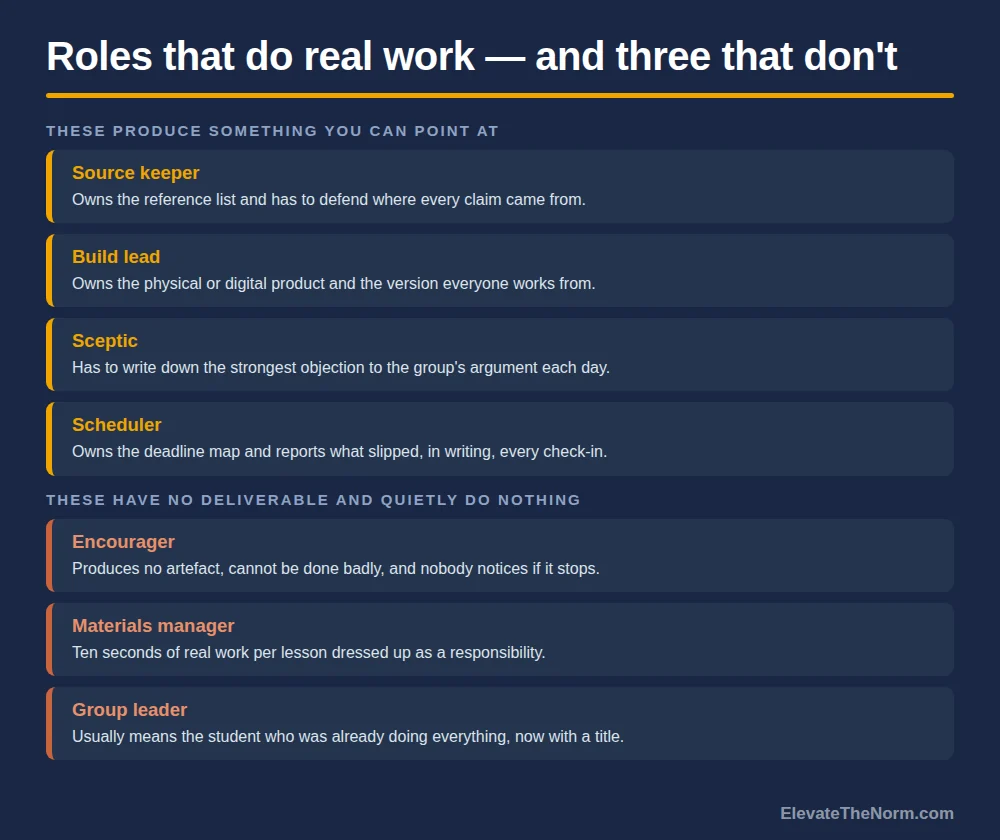
The ones with a deliverable attached. These four transfer across subjects, and the names matter less than the artefact:
- Source keeper. Owns the reference list and has to defend, out loud at a check-in, where every factual claim came from. Produces a document. Can fail visibly.
- Build lead. Owns the actual product and the version everyone else works from. Produces the thing. Cannot be faked.
- Sceptic. Writes down the strongest objection to the group’s own argument each working day and brings it to the check-in. This one is underused and it is the best of the four — it is the only role that makes disagreement a job rather than a personality trait.
- Scheduler. Owns the deadline map and reports in writing what slipped and why. Produces a record. The record is also your early-warning system.
Three that are usually decoration: encourager, which produces nothing; materials manager, which is ten seconds of real work dressed up as a responsibility; and group leader, which in practice names the student who was already carrying the group. If you want a fuller set of ready-made structures, the project-based learning toolkit has team contracts and role cards you can adapt — but run them through the five tests first rather than printing them as they come.
How Do You Grade This Without Punishing Cooperation?
Grade the individual deliverable, not the student’s share of the group’s grade. And here the evidence genuinely conflicts, so you should know that before you decide.
Every modern treatment says individual accountability is essential, and Kyndt’s meta-analysis names individual responsibility as one of two necessary conditions. But a research synthesis on instructional grouping from 1987 draws a sharper line: group-level recognition encourages cooperation, while “evaluation of each individual student’s contribution to a group score discourages cooperation.” That synthesis is old, and it covers elementary through secondary rather than secondary alone, so weight it accordingly — but the mechanism it describes is not hard to recognise. If helping a teammate improves their slice of the grade and not yours, you have built a reason not to help.
The way out is the distinction Kyndt’s team drew. Do not score “how much of the group grade did this student earn.” Score the artefact the student personally produced — the source list, the build, the written objections — and let the group’s shared product carry its own separate grade. Now the individual work is assessed, the shared work is assessed, and nothing in the system pays a student for withholding help. Grading individuals inside a group project is a longer problem than this section, and it is worth reading on its own.
Keep self-assessment separate from all of it. Asking students to rate their own contribution is useful for the conversation it starts; feeding those ratings into a grade turns them into negotiation. There is a whole method for group-work self-assessment that keeps it honest by keeping it ungraded.
This is also the answer to the complaint you will get from a parent, usually in week three: my child did all the work and everyone got the same grade. Under this structure they did not get the same grade. Their child’s own artefact was marked on its own merits, and so was everyone else’s. Being able to say that in one sentence is worth the setup.
And be honest about the cost, because the setup is not free. Four individual artefacts per group is more to look at than one project per group. The thing that makes it survivable is that most of those artefacts are short and you are checking them rather than marking them — a source list is a two-minute read, a scheduler’s slip report is thirty seconds. If you find yourself writing comments on all of them, you have turned a checking task into a marking task and you will quit by November.
Partner Work as the Default, Not the Reward
My room is set up for this and it changes what roles have to do. Trapezoid and rectangular tables pushed together in pairs and fours, no desks in rows, nobody sitting alone facing the front. I am on a wheeled stool moving between groups rather than standing at the front, and students get pulled to a whiteboard table I built for small-group work.
Students working alongside somebody is the resting state of that room, not a thing we move into on project days. That matters for roles more than it sounds like it should. When collaboration happens twice a term, every group task needs heavy scaffolding because nobody has practised. When it is the ordinary condition of the room, students have already built the habits the role cards are trying to install, and the roles can be lighter and more specific — a job for this project, not a personality assignment for the year.
It also makes the circulating part work. The scheduler’s written report of what slipped is only useful if an adult reads it the same day and does something. That is not a documentation system. It is a reason to be standing at that table on Wednesday asking a specific question of a specific student, which is also roughly how expecting every student to answer works in a whole-class discussion.
Where Group Work Roles Go Wrong
- Assigning roles to a task that does not need a group. The most common failure and the least often diagnosed. Students know when four people are doing one person’s work.
- Permanent roles. The organised student is the manager all year, learns nothing new, and resents it. Rotate.
- Roles with no deliverable. If you cannot name the artefact, you have named a mood.
- Treating the role card as the accountability. The card is a label. The accountability is somebody looking at the artefact and saying something about it.
- Grading share-of-group-work. It teaches students that helping a teammate costs them, which is the opposite of the thing you are trying to build.
- Assuming the roles survive contact. They do not — the 2023 review is explicit that roles shift once work starts. Check what students actually ended up doing rather than what you assigned.
What to Do Next
Take the next group task you have planned and run it through two questions before you print anything. First: could one student do this faster alone? If yes, the task needs redesigning and no role system will save it. Second: for each role you were going to assign, what does that student hand me at the end of the period?
Keep the roles that answer the second question. Delete the rest — you will usually find you are down to three, and three real roles beat six decorative ones. Rotate them on the next project, and tell students that is the plan so the organised kid is not quietly serving a life sentence as project manager.
Then look at what the work asks of students generally. Roles are a structure for responsibility, and structures only hold where responsibility is already something the room expects. If the task is real and the students are used to being accountable for their own share, light roles are enough. If neither is true, heavy roles will not rescue it.
Before you go: grab the free Group Work That Does Not Collapse (2 pages) (PDF) — ElevateTheNorm.com branded, printable, no email required.
Frequently Asked Questions
Do group work roles for students actually improve learning?
There is no good evidence that the roles themselves do. A 2023 systematic review of 36 studies on student roles in collaborative learning concluded that empirical evidence for the assumption that roles improve collaborative problem-solving competency "has not yet been provided." What is well evidenced is what roles are meant to produce: individual responsibility for a share of the task, and a clearly defined common goal. Both of those were named as necessary conditions in a meta-analysis of 51 cooperative learning studies. Assign roles if they help you create those conditions. Do not expect the assignment to be the intervention.
What are the best roles to assign for a group project?
The ones with a deliverable attached. A source keeper who owns the reference list and has to defend where each claim came from. A build lead who owns the product and the working version. A sceptic who writes down the strongest objection to the group’s own argument each day. A scheduler who reports in writing what slipped. Each produces an artefact with a name on it. Encourager, materials manager and group leader usually do not, which is why they get ignored by the second week.
How do I stop one student doing all the work?
Two levers, and the second is the stronger one. Make individual contributions visible — each student hands in something of their own, not just a share of the group product. And make the task one where a student can see their own effort affecting whether it succeeds. In one experiment, participants who believed their effort genuinely mattered produced exactly as much unobserved as participants who knew they were being evaluated individually. Surveillance works, but so does genuine consequence, and consequence does not need policing.
Does group work even work in middle and high school?
Yes, but less well than most professional development implies. The 2013 meta-analysis that puts cooperative learning’s achievement effect at 0.54 also found the secondary level had a significantly lower effect size than both primary and university level — differences of roughly 0.20 and 0.18. It is still a positive effect and still worth running. It is just not the strongest case for collaboration, and the age group getting the most group work is the one where the measured payoff is smallest.
Should I grade each student on their contribution to the group?
Grade the artefact the student personally produced, not their estimated share of a group score. The evidence here conflicts and it is worth knowing: individual accountability is named as a necessary condition in the modern meta-analysis, but an older research synthesis found that evaluating each student’s contribution to a group score actually discourages cooperation. Both can be true if you separate them — score the individual deliverable on its own, score the shared product on its own, and never create a situation where helping a teammate costs a student points.
Should group roles be fixed or rotated?
Rotated, on a schedule you announce in advance. A permanent project manager is normally the student who was already doing everything, now with your authority behind it — which entrenches exactly the pattern roles are supposed to break. It also means the student who most needs practice at coordinating never gets it. Fixed roles are defensible only inside a single short task where there is no time to learn a new one.
What if students ignore the roles I assigned?
Expect it, because the research does. The 2023 review found student roles are fluid and renegotiated once work begins, and distinguishes the scripted roles a teacher assigns from the emergent roles a group settles into. The useful response is to check what students actually ended up doing rather than whether they followed your chart. If the emergent division is working and everyone is contributing, that is the outcome you wanted. If one student has absorbed three roles, that is the problem to solve — and it is a task-design problem more often than a compliance problem.
How many students should be in a group?
The cooperative learning research does not settle this, and anyone quoting a magic number is going beyond their evidence. What the social loafing literature does establish is that effort drops as groups get larger, because each person’s contribution becomes less visible and less consequential. That points toward three or four for most secondary tasks — small enough that every student has a load-bearing share, large enough that the work genuinely needs dividing. If you cannot write a real deliverable for a fifth student, the group is too big.
Sources
- Kyndt, Eva, Elisabeth Raes, Bart Lismont, Fran Timmers, Eduardo Cascallar, and Filip Dochy. “A Meta-Analysis of the Effects of Face-to-Face Cooperative Learning. Do Recent Studies Falsify or Verify Earlier Findings?” Educational Research Review, vol. 10, 2013, pp. 133–149. 65 articles, 51 with usable effect sizes; achievement ES 0.54 (95% CI .47–.60, p < .001); attitudes 0.15; perceptions 0.18 (n.s.). Secondary level significantly lower than primary and tertiary (differences of −.20 and −.18, both p < .05). No significant difference between group-reward and individual-reward methods (Qm = 1.64, p = .20). Authors flag possible publication bias and small subgroup samples. https://motivatingus.wordpress.com/wp-content/uploads/2017/03/kyndt-et-al-2013-edurev-cooperative-learning.pdf
- He, Shan, Xiaoyan Shi, Tae-Hee Choi, and Junqing Zhai. “How Do Students’ Roles in Collaborative Learning Affect Collaborative Problem-Solving Competency? A Systematic Review of Research.” Thinking Skills and Creativity, vol. 50, 2023, article 101423. 36 empirical studies published 2013–2022; 23 higher education, 6 secondary, 7 primary. Roles found to be fluid and renegotiated during group work; scripted vs emergent roles distinguished; effects conditioned by student characteristics, learning context and teacher support. Authors state that empirical evidence for the assumption that roles influence collaborative problem-solving competency “has not yet been provided.” https://www.sciencedirect.com/science/article/abs/pii/S1871187123001918
- Shepperd, James A., and Kevin M. Taylor. “Social Loafing and Expectancy-Value Theory.” Personality and Social Psychology Bulletin, vol. 25, no. 9, 1999. Control condition replicated the standard social loafing effect: 28.4 uses generated under individual evaluation vs 20.0 with no evaluation (t = 1.94, p < .05). High-instrumentality participants with no evaluation generated 28.4, matching the evaluated condition; low-instrumentality no-evaluation participants generated 21.1. This paper is also the source used here for the citation of Karau and Williams’s 1993 social loafing meta-analysis, which was not read directly. https://people.clas.ufl.edu/shepperd/files/PSPB1999.pdf
- Ward, Beatrice A. Instructional Grouping in the Classroom. School Improvement Research Series, Research You Can Use, Close-Up #2, 1987. Research synthesis. Recommends heterogeneous grouping; holds individual accountability to be essential; finds that group-level rewards or recognition encourage cooperation while “evaluation of each individual student’s contribution to a group score discourages cooperation”; states the teacher must specify subtasks and assign responsibility. Covers elementary through secondary rather than secondary alone, and is now dated — cited here for the reward tension it documents. https://educationnorthwest.org/sites/default/files/InstructionalGrouping.pdf
- Farrell, Mark, Tobias Schönbeck, and the CHU Research Group. Cooperative Learning in the Classroom: New Findings Substantiate the Effectiveness of This Method. Clearinghouse Unterricht, Short Review 4, 2023. Practice-facing summary of the Kyndt meta-analysis; reports achievement ES 0.54 and attitudes 0.15, and a g = 0.32 advantage for science and mathematics over social sciences and languages. States that effectiveness “depends on the individual responsibility that each learner takes for completing the task and on a clearly defined common group goal.” Cited as a summary, not as the primary study. https://www.clearinghouse.edu.tum.de/wp-content/uploads/2023/12/CHU_KR4_ENG_Kyndt_2013.pdf