
By Clay Shumate
Part of the project-based learning guide, which collects the examples, the planning template, and the rest of the PBL writing on this site in one place.
I’ve watched project based learning get rolled out in three different buildings now, and it goes the same way almost every time.
Somebody presents a slide deck during August PD. Teachers nod. There’s a handout. And by the second nine weeks, “project” has quietly come to mean a poster board with a rubric stapled to it, turned in on a Friday, graded over the weekend, and forgotten by Monday.
That’s not PBL. That’s a craft project with a due date.
I’m not saying that to be difficult. I’m saying it because the gap between what PBL is and what it usually becomes is the single biggest reason it gets written off in schools that could benefit from it most. So let’s fix the definition first, and then I’ll tell you what to actually look for when you walk into a room.
Key Takeaways
- Project based learning is a teaching method where students investigate a complex, authentic question over an extended period and build a product for a real audience. The project is how the learning happens, not what happens after it.
- The test that separates PBL from a regular project is sequence. In a dessert project, content is taught first and the product comes last. In PBL, the challenge comes first and content is taught at the point of need.
- PBLWorks names seven Gold Standard design elements. If four of them are missing, what you are looking at is a project, not PBL.
- You can read a room in about ninety seconds by asking who is doing the thinking, where the teacher is standing, what is on the wall, and who sees the final product.
- PBL is harder in high-need classrooms, and the reasons are structural rather than a judgment about students.
What is project based learning?
Project based learning is a teaching method where students build knowledge and skills by working over an extended period — anywhere from a week to a semester — to investigate a complex, authentic question, and then create a product they present to a real audience. (For a deeper look at what makes those audiences and products genuine, see real world learning.)
The key word in there is extended. And the key idea is one sentence long:
The project isn’t what happens after the learning. The project is how the learning happens.
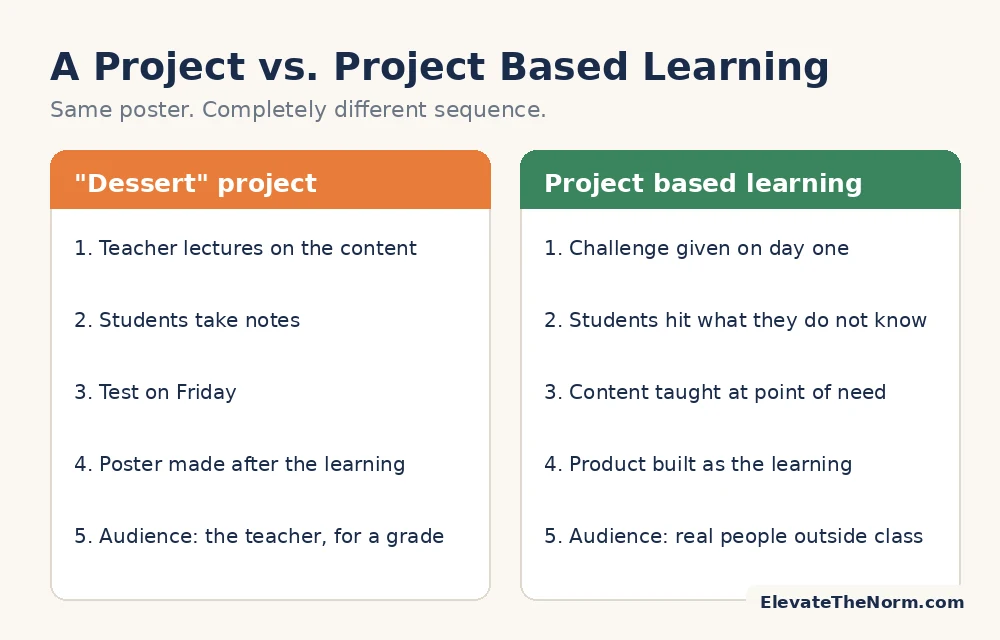
That’s the whole shift, and the difference is sequence rather than activity. In a traditional unit, I teach the content, I test the content, and then if there’s time left, students make something to show they learned it. In PBL, students are handed the challenge on day one — before they know enough to solve it — and the content gets taught along the way because they need it to finish the build.
What’s the difference between a project and project based learning?
PBLWorks, the organization that essentially wrote the modern playbook on this, has a name for the poster-board version: “dessert” projects — fun but lightweight. The project is the treat at the end of the meal. In real PBL, the project is the meal.
Here’s what that looks like in my own subject.
Dessert version: Two weeks of lecture and notes on the Columbian Exchange. Test on Friday. Then students make a poster showing crops that went east and crops that went west.
Main course version: Day one, students learn they’re a curation team building a museum exhibit that answers one question — Who gained and who lost in the Columbian Exchange, and who decides? They have three weeks. There will be an audience: another class, a parent night, a panel of adults, somebody real. Now they have to know the crops. They have to know the disease numbers. They have to know the encomienda system, because a visitor is going to ask them about it and they’ll be standing there.
Same standards. Same content. I still lecture. I still give notes, still give quizzes, still stand up front and directly teach when they need something. That’s worth saying clearly, because it’s the most common misunderstanding I run into with administrators:
PBL does not mean no direct instruction. It means direct instruction shows up when students have a reason to need it. The teacher is more present in a good PBL classroom, not less.
If you’re deciding between the two approaches, see our evidence-based comparison of project based learning vs traditional learning, including randomized trials, meta-analyses, and where direct instruction still performs better.
What are the seven elements of high-quality PBL?
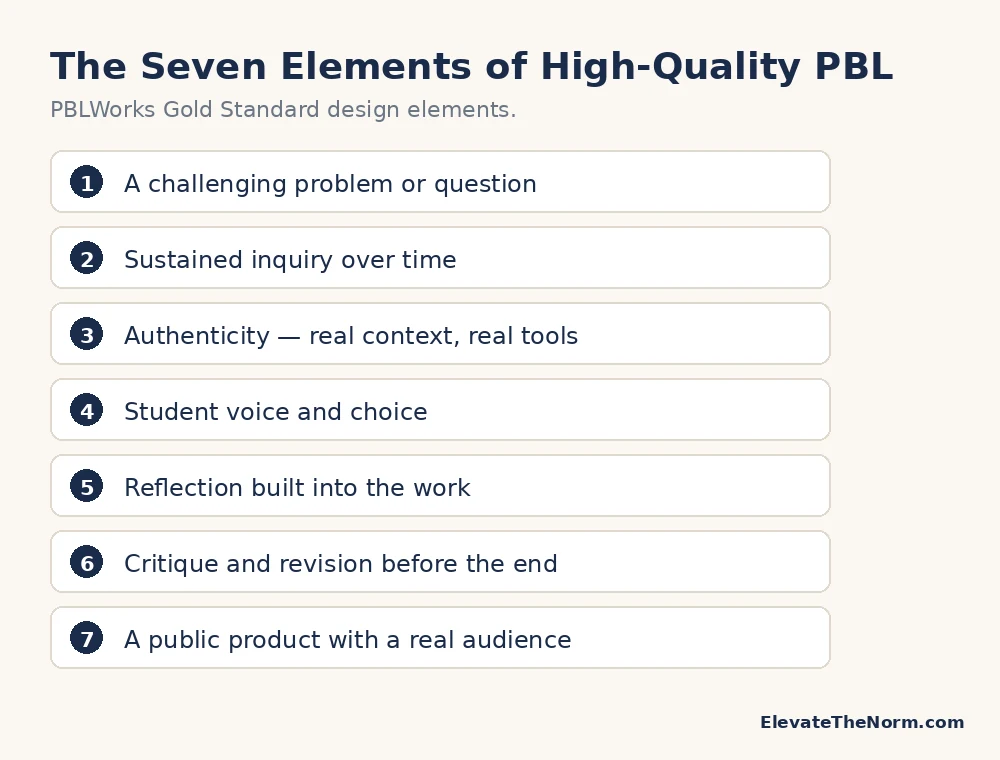
If you want a defensible standard for what counts, the Gold Standard PBL framework lists seven essential project design elements: a challenging problem or question, sustained inquiry, authenticity, student voice and choice, reflection, critique and revision, and a public product. That framework comes out of Larmer and Mergendoller’s work at the Buck Institute, and it’s the closest thing the field has to a common language. The authenticity element in that framework overlaps with but is distinct from authentic learning as a broader quality standard — one that applies to lectures, discussions, and other formats beyond project-based work.
Here’s my working translation of each one:
- Challenging problem or question — There’s a real question on the wall, and it doesn’t have a Google answer.
- Sustained inquiry — This runs for weeks, not a class period. Students go find things out.
- Authenticity — It connects to something outside the building, or to the students’ actual lives.
- Student voice and choice — They make real decisions about the product, not just which marker color.
- Reflection — Built into the process, not just a paragraph at the end.
- Critique and revision — Drafts get torn apart and rebuilt. This is the one most classrooms skip.
- Public product — Somebody other than the teacher sees it. That’s the accountability engine.
If you’re evaluating a unit and four of those seven are missing, you’re looking at a dessert project. That’s not a crime — dessert projects have their place — but don’t put it in a school improvement plan as PBL.
What should I look for during a walkthrough?
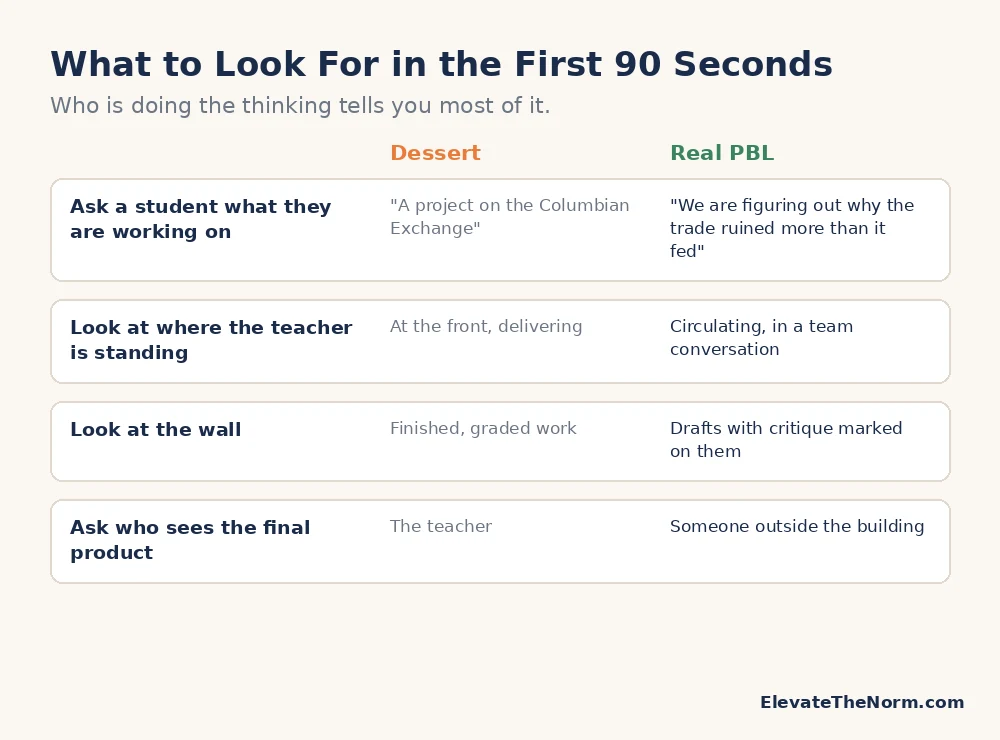
This is the practical part. A PBL classroom looks chaotic to an untrained eye, and a bad one looks exactly like a good one for the first ninety seconds. Here’s how to tell them apart:
- Ask a random student what the driving question is. Not the assignment — the question. If three kids in a row can’t tell you, the project has no spine.
- Look for a visible “need to know” list. Good PBL teachers keep a running list of what students have realized they don’t know yet. If it’s been updated recently, inquiry is actually happening.
- Ask to see a draft. Then ask to see the version before it. If there’s only one version, critique and revision isn’t real.
- Find out who’s going to see the final product. “Me” is the wrong answer.
- Watch the teacher for five minutes. Are they conferencing with small groups, redirecting, pulling a mini-lesson? Or are they at the desk while students “work on their projects”? The second one is the failure mode.
- Check that content is still being taught. Ask the teacher which standards this unit covers and where the direct instruction lives. A good PBL teacher answers that in about four seconds.
Why is PBL harder in high-need classrooms — and why is it worth doing anyway?
I’ll be honest with you: the first two weeks are brutal.
For a complete breakdown of these elements and what separates genuine PBL from regular projects, see the formal definition of project based learning.
Students who’ve spent years being handed worksheets do not know what to do with an open question. You give them autonomy and they hand it right back. It feels like running into a rock. Teachers who quit PBL almost always quit in that window, and they conclude their kids “can’t handle it.”
Their kids can handle it. They just haven’t been asked to before.
You chip away. And somewhere around week three, something turns over, and you’ve got a room of students working together instead of alone. That’s the part that doesn’t show up on a benchmark assessment and matters more than most of what does.
I spent years in retail management before I taught. At one point I was sorting through roughly 400 active applicants at a time, and I want to tell you what I was actually screening for in an interview — because it wasn’t retail experience. I’d hand a candidate a notepad and tell them to write down five things wrong with my store, then explain them to me. I was listening for how they spoke. Whether they could disagree with me without getting defensive. Whether they could work a problem out loud.
Those are the exact skills a real project builds and a worksheet cannot. I’ve had the same thing confirmed on the field — across the athletes who came through the program I built, I could count on one hand the ones who didn’t graduate with a 3.0 or better. Not because I taught them content. Because they were on the hook for something bigger than themselves and other people were counting on them.
That’s what a public product does in a classroom.
What does a teacher need from you to make this work?
Short list, and none of it costs money:
- Planning time, not another initiative. A first PBL unit runs about four or five hours to build — less than most people assume. But it needs to be four or five uninterrupted hours, not stolen twenty minutes at a time between duty and a parent call. Fragment it and you get a half-built project, and the kids can tell within a day.
- Air cover on noise. A working PBL room is loud. Make sure whoever does walkthroughs knows the difference between productive loud and unproductive loud, or your teachers will shut it down to protect their evaluation.
- Don’t mandate it building-wide in year one. Find two or three willing teachers, let them run one unit, and let the results recruit for you. Mandated PBL produces compliance projects.
- Schedule flexibility for the public product. Presentation day is the whole point. If a teacher can’t get 90 minutes or a room or a few outside adults, the seventh element quietly disappears.
For the step-by-step sequence — from driving question to public product — see 7 steps of project based learning.
Frequently Asked Questions
Does PBL work with state standards, or does it compete with them?
It works with them, but only if the standards drive the project design instead of getting reverse-engineered afterward. Build the unit from the Course of Study first, then find a driving question that requires those standards to answer.
How long should a first project be?
Two to three weeks. Do not start with a semester-long capstone. The first one is about the teacher learning to run the room, not about the product.
Does planning a project get easier?
Considerably, and faster than you’d expect. The first one takes four or five hours because you’re building the scaffolding and the rubric from nothing. After two or three, it starts to just flow out of your brain — you can visualize the whole thing before you write any of it. Good, bad, and ugly. You can see which group is going to stall in week two and where the driving question is going to get too easy, and you plan around it up front. That’s the point where PBL stops being an initiative and starts being how you teach.
How do you grade it?
Separately. Content knowledge gets assessed the way you’d normally assess it — quizzes, writing, whatever you already use. The collaboration and product get a rubric of their own. Grading them as one blended number is how you end up with a student who learned nothing riding a good group to an A.
Is PBL appropriate for struggling readers and students below grade level?
Yes, and arguably more so. The scaffolding looks different — more structured roles, shorter checkpoints, more explicit modeling — but the motivation problem PBL solves is usually bigger than the reading gap it has to work around.
What’s the single most common reason PBL fails in a building?
Nobody protected the teacher’s planning time, and the project got launched half-built. The kids can tell within a day.
If you’re considering this in your building, start with one teacher and one unit. Walk in on week two, when it looks like it’s falling apart, and don’t panic. Then walk in on week three.
Looking for concrete classroom examples? See 25 project based learning examples for middle and high school — each one built around a real driving question and a public product.
Once the definition is clear, the next question is usually what to actually run. Start with these ideas for project based learning—fifty of them, sorted by subject and grade band, each built around an audience outside the classroom.
About Clay Shumate
Clay Shumate is a certified secondary Social Studies teacher in the public schools of West Alabama, with seven years of classroom experience, a B.A. in History, and an M.Ed. in Secondary Education. He writes about project-based learning, student responsibility, respect, and practical ways to hold young people to a higher standard while giving them room to learn from mistakes. He is a member of the Society of Professional Journalists and writes to its Code of Ethics; this site’s editorial standards and corrections policy are published in full. More about Clay.