Category: Project Based Learning

Project based learning in real classrooms: what it is, how to plan it, and what to look for when you walk into the room.

  • Group Work Roles for Students: What the Evidence Supports, and What It Doesn’t

    Group Work Roles for Students: What the Evidence Supports, and What It Doesn’t

    By Clay Shumate

    Group work roles for students are assigned jobs inside a team — a scheduler, a source keeper, a build lead — meant to stop one student doing everything. They are the standard fix, and the research supports what sits underneath them rather than the roles themselves. Individual accountability and a real shared goal are well evidenced. Role cards are not.

    That distinction is not an academic quibble. It is the difference between a role that changes who works and a laminated card that changes nothing.

    Key Takeaways

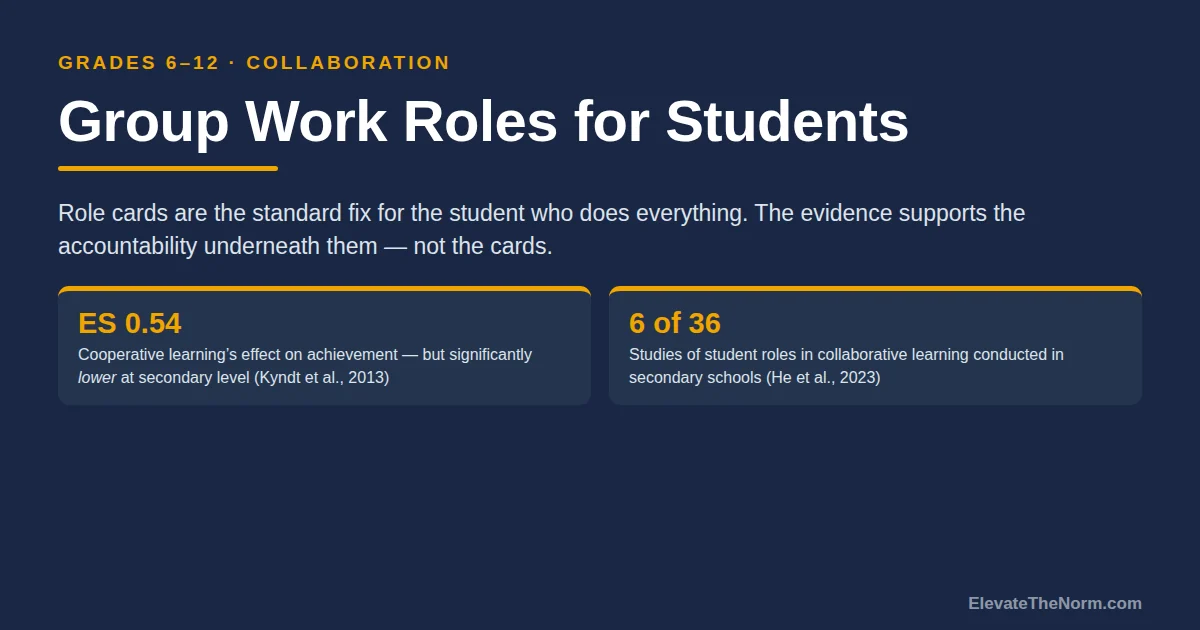
    • Cooperative learning works — and works least well in secondary school. A meta-analysis of 51 studies put the achievement effect at 0.54, with the secondary level significantly lower than both primary and university.
    • The evidence for assigned roles specifically is thin. A 2023 systematic review of 36 studies concluded that empirical evidence for the assumption that roles improve collaborative problem-solving “has not yet been provided.”
    • What is well supported is individual responsibility plus a clear common goal. Both are necessary conditions. Neither requires a role card.
    • Making effort matter beats making effort watched. In one experiment, students who believed their effort genuinely affected the outcome worked just as hard unobserved as observed students did.
    • A role has to produce something. If nobody would notice the role vanishing, it is decoration, and students work that out faster than adults do.

    Free Download · PDF

    Group Work That Does Not Collapse (2 pages)

    Page 1 is the five tests to run before you make a single role card, plus the one sentence that answers the parent email about group grades. Page 2 is the task planner and a plain table of which claims the evidence actually supports.

    Download the free PDF

    Free. No email address required. Designed for grades 6–12. Browse every printable in Your Free Library.
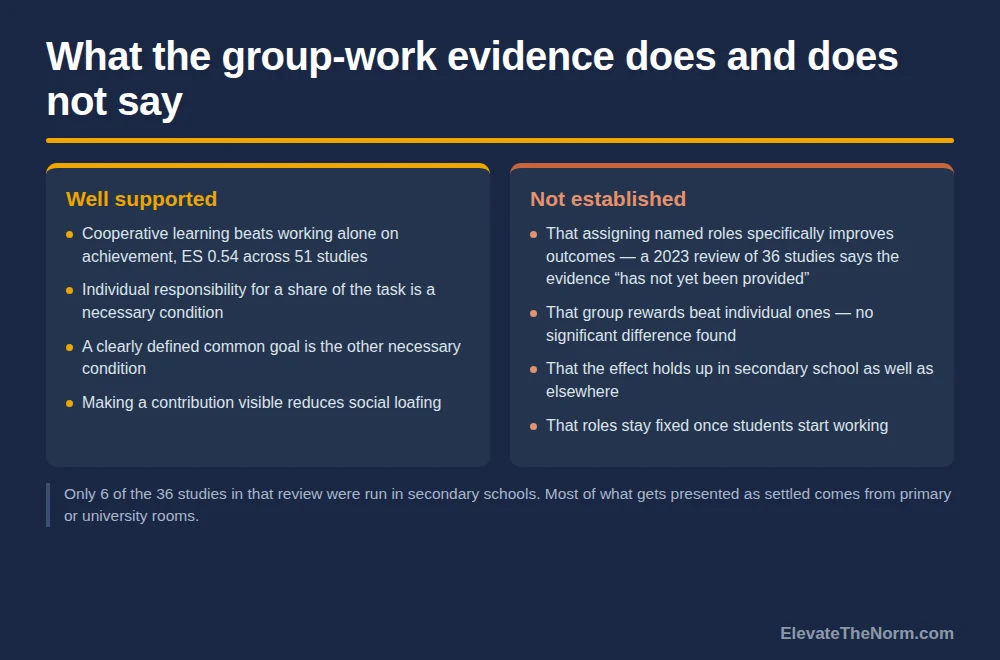
    Two-column graphic separating well-supported group work findings including the 0.54 achievement effect size from unestablished claims including that assigning named roles improves outcomes
    The left column is why you run group work. The right column is why your role cards are not working.

    What Are Group Work Roles for Students?

    A group work role is a named job inside a team, assigned rather than negotiated, with responsibilities attached to it. The familiar set is project manager, researcher, recorder, timekeeper, presenter, materials manager.

    The logic is sound on its face. Left to themselves, a group of four will not divide work evenly. One student will take over because they want the grade, one will drift because taking over is exhausting, and two will do what is asked and no more. Assigning roles is supposed to pre-empt that by giving everybody a defined share before the negotiation can happen.

    The problem is that most of the roles on that standard list are not shares of the work. They are labels attached to students who are then expected to do the work anyway. “Encourager” is the clearest case: it produces nothing, it cannot be done badly in any way you could point to, and if the student simply does not do it, the project finishes on time regardless.

    Do Assigned Roles Actually Improve Group Work?

    Nobody has shown that they do, and the researchers who looked hardest say so directly.

    He, Shi, Choi and Zhai published a systematic review in Thinking Skills and Creativity in 2023, covering 36 empirical studies of student roles in collaborative learning from 2013 to 2022. Their conclusion is unusually blunt for a review: the assumption that roles drive collaborative problem-solving competency is widespread, and “empirical evidence for this assumption has not yet been provided.”

    Two further findings from that review are worth carrying into a classroom:

    • Roles are fluid. Whatever you assign, students renegotiate it once the work starts. The review distinguishes scripted roles, which the teacher sets, from emergent roles, which the group actually settles into — and the emergent ones are what you end up observing.
    • Effects are conditional. Whatever roles do depends on the students, the context and the teacher support around them. There is no version where the card does the work.

    And the sample problem again: of those 36 studies, 23 were in higher education, 7 in primary schools, and 6 in secondary. The advice circulating in secondary professional development is mostly borrowed from somewhere else.

    None of this means stop assigning roles. It means stop expecting the assignment to be the intervention. What you are actually reaching for when you hand out roles is accountability, and accountability has much better evidence behind it than roles do.

    What Does the Research Actually Support?

    Two things, and both are conditions rather than techniques.

    Kyndt and colleagues published a meta-analysis of face-to-face cooperative learning in Educational Research Review in 2013, covering 65 articles with 51 providing usable effect sizes. The headline is good news: an achievement effect of 0.54, with a confidence interval well clear of zero. Attitudes moved far less, at 0.15.

    Their summary of what makes it work is short. Effectiveness depends on the individual responsibility each learner takes for completing the task and on a clearly defined common group goal. That is the whole mechanism. Everything else — the cards, the contracts, the seating — is machinery for producing those two conditions, and the machinery is replaceable.

    Two findings that cut against the standard advice

    Group rewards did not beat individual rewards. Kyndt’s team compared the two and found no significant difference. They flag this themselves as contradicting earlier reviews, which had consistently favoured group rewards, and they suggest the more useful distinction is between result interdependence — your grade depends on the team’s outcome — and task interdependence — you literally cannot finish without the others. The second has the more consistent evidence behind it. Build the task so students need each other, and you need the grading lever less.

    And group work does measurably worse in secondary school. Kyndt’s moderator analysis found the secondary level had a significantly lower effect size than both primary and tertiary — differences of roughly 0.20 and 0.18 respectively. That finding deserves more attention than it gets on a site like this one. The age group that gets the most group work in the name of collaboration skills is the age group where the achievement payoff is smallest. It is still positive. It is just not what the slide deck claimed.

    Why Does One Student End Up Doing Everything?

    Because effort that nobody can see is effort most people reduce — and because in a lot of group tasks, one student’s effort genuinely does not change the outcome.

    The research term is social loafing, and it has been studied since the 1970s. Karau and Williams’s 1993 meta-analysis in the Journal of Personality and Social Psychology is the standard reference for it. The classic finding is that people work less hard in groups than alone, and that making individual contributions identifiable reduces the drop.

    Shepperd and Taylor ran a more interesting version in 1999. Their control condition replicated the standard effect: participants whose work would be evaluated individually produced 28.4 ideas, against 20.0 for participants who knew nobody would look. But their main finding was about something else. Participants who were not going to be evaluated but who believed their effort genuinely affected the group’s result produced 28.4 — matching the evaluated group exactly. Participants who were unevaluated and did not believe their effort mattered produced 21.1.

    Read that carefully, because it reframes the whole problem. Surveillance works. But believing your effort matters works just as well, and it does not require you to watch anybody. Most role systems are built as surveillance — here is your job, I will be checking. The better design question is whether the role is one where a student can see their own effect on whether the thing succeeds.
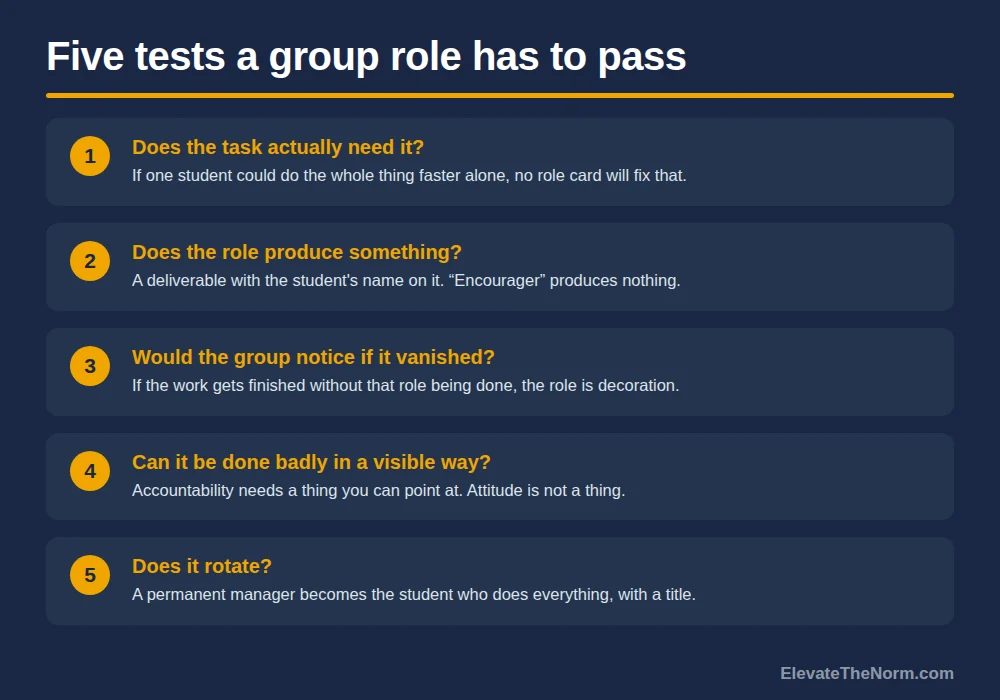
    Five numbered tests a group role must pass: does the task need it, does it produce something, would the group notice if it vanished, can it be done badly visibly, and does it rotate
    Run a role you already use through these five. Most standard roles fail at least two.

    How Do You Build Roles That Come From the Task?

    Start with the work, not with a list of role names. Look at what the project actually requires, find the parts that are genuinely separable, and name those. A role invented before the task exists will never fit it.

    Five tests. A role that fails two of them is decoration:

    1. Does the task actually need it? If one motivated student could do the whole project faster alone, you do not have a group task, you have an individual task with an audience. No role card repairs that. Fix the task. If you want the signs and recording sheets done, my Station Rotation Toolkit on TPT covers eight reusable stations.

    2. Does the role produce something? A document, a build, a dataset, a written objection — something with that student’s name on it that exists at the end of the period. If the output of a role is a behaviour, it is not a role.

    3. Would the group notice if it vanished? Imagine the student assigned to it did nothing at all. If the project still finishes, the role was never load-bearing.

    4. Can it be done badly in a visible way? Accountability needs something you can point at. “You weren’t encouraging enough” is not a conversation anyone can have. “Your source list has three dead links and one of them is where our main claim came from” is.

    5. Does it rotate? A permanent project manager is just the student who was already doing everything, now with institutional backing. Rotate on a fixed schedule and say so in advance.

    One more thing to watch, and it will not show up in any of the five tests: who you hand which role to. If you assign by who seems suited to it, you will reliably end up with the same students leading and the same students recording, and the pattern tends to break along lines nobody intended. Rotation fixes most of this automatically, which is a second reason to do it. If you are letting groups pick their own roles instead, understand the trade — the systematic review found roles get renegotiated anyway, so student choice is honest about what happens regardless, but the student who always takes charge will take charge again, and you have given it your blessing.

    Which Roles Do Real Work?

    The ones with a deliverable attached. These four transfer across subjects, and the names matter less than the artefact:

    • Source keeper. Owns the reference list and has to defend, out loud at a check-in, where every factual claim came from. Produces a document. Can fail visibly.
    • Build lead. Owns the actual product and the version everyone else works from. Produces the thing. Cannot be faked.
    • Sceptic. Writes down the strongest objection to the group’s own argument each working day and brings it to the check-in. This one is underused and it is the best of the four — it is the only role that makes disagreement a job rather than a personality trait.
    • Scheduler. Owns the deadline map and reports in writing what slipped and why. Produces a record. The record is also your early-warning system.

    Three that are usually decoration: encourager, which produces nothing; materials manager, which is ten seconds of real work dressed up as a responsibility; and group leader, which in practice names the student who was already carrying the group. If you want a fuller set of ready-made structures, the project-based learning toolkit has team contracts and role cards you can adapt — but run them through the five tests first rather than printing them as they come.
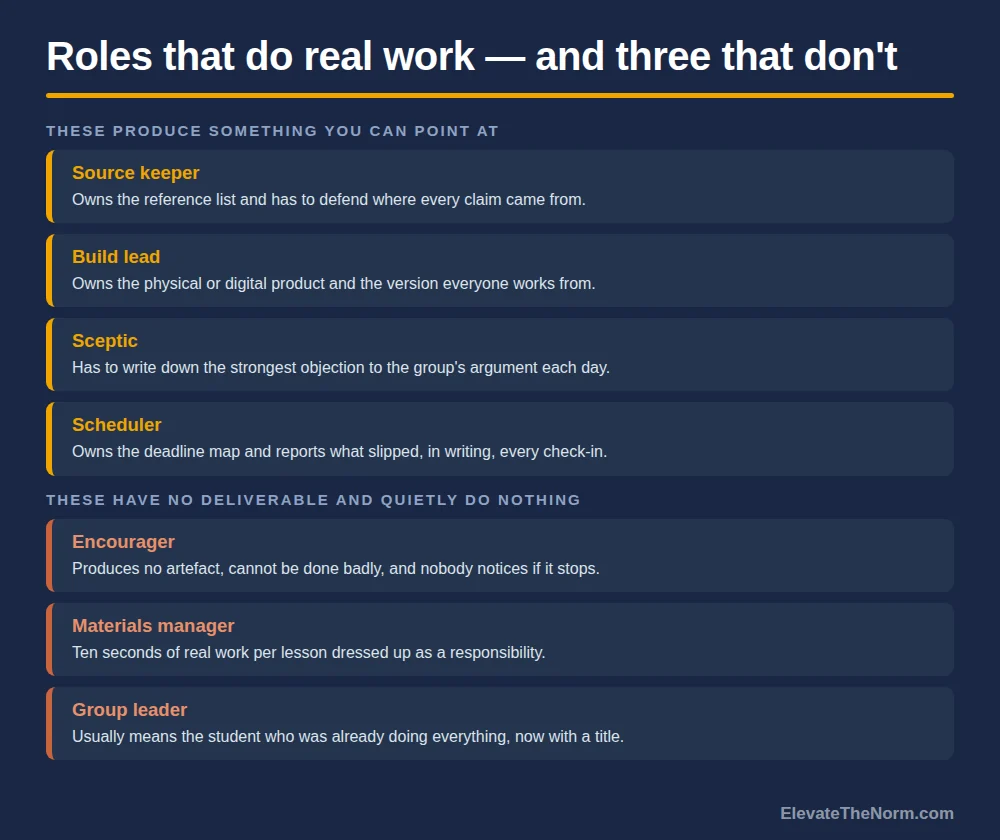
    List of four group roles with real deliverables — source keeper, build lead, sceptic and scheduler — contrasted with three roles that produce nothing: encourager, materials manager and group leader
    The test is not whether a role sounds responsible. It is whether it leaves evidence.

    How Do You Grade This Without Punishing Cooperation?

    Grade the individual deliverable, not the student’s share of the group’s grade. And here the evidence genuinely conflicts, so you should know that before you decide.

    Every modern treatment says individual accountability is essential, and Kyndt’s meta-analysis names individual responsibility as one of two necessary conditions. But a research synthesis on instructional grouping from 1987 draws a sharper line: group-level recognition encourages cooperation, while “evaluation of each individual student’s contribution to a group score discourages cooperation.” That synthesis is old, and it covers elementary through secondary rather than secondary alone, so weight it accordingly — but the mechanism it describes is not hard to recognise. If helping a teammate improves their slice of the grade and not yours, you have built a reason not to help.

    The way out is the distinction Kyndt’s team drew. Do not score “how much of the group grade did this student earn.” Score the artefact the student personally produced — the source list, the build, the written objections — and let the group’s shared product carry its own separate grade. Now the individual work is assessed, the shared work is assessed, and nothing in the system pays a student for withholding help. Grading individuals inside a group project is a longer problem than this section, and it is worth reading on its own.

    Keep self-assessment separate from all of it. Asking students to rate their own contribution is useful for the conversation it starts; feeding those ratings into a grade turns them into negotiation. There is a whole method for group-work self-assessment that keeps it honest by keeping it ungraded.

    This is also the answer to the complaint you will get from a parent, usually in week three: my child did all the work and everyone got the same grade. Under this structure they did not get the same grade. Their child’s own artefact was marked on its own merits, and so was everyone else’s. Being able to say that in one sentence is worth the setup.

    And be honest about the cost, because the setup is not free. Four individual artefacts per group is more to look at than one project per group. The thing that makes it survivable is that most of those artefacts are short and you are checking them rather than marking them — a source list is a two-minute read, a scheduler’s slip report is thirty seconds. If you find yourself writing comments on all of them, you have turned a checking task into a marking task and you will quit by November.

    Partner Work as the Default, Not the Reward

    My room is set up for this and it changes what roles have to do. Trapezoid and rectangular tables pushed together in pairs and fours, no desks in rows, nobody sitting alone facing the front. I am on a wheeled stool moving between groups rather than standing at the front, and students get pulled to a whiteboard table I built for small-group work.

    Students working alongside somebody is the resting state of that room, not a thing we move into on project days. That matters for roles more than it sounds like it should. When collaboration happens twice a term, every group task needs heavy scaffolding because nobody has practised. When it is the ordinary condition of the room, students have already built the habits the role cards are trying to install, and the roles can be lighter and more specific — a job for this project, not a personality assignment for the year.

    It also makes the circulating part work. The scheduler’s written report of what slipped is only useful if an adult reads it the same day and does something. That is not a documentation system. It is a reason to be standing at that table on Wednesday asking a specific question of a specific student, which is also roughly how expecting every student to answer works in a whole-class discussion.

    Where Group Work Roles Go Wrong

    • Assigning roles to a task that does not need a group. The most common failure and the least often diagnosed. Students know when four people are doing one person’s work.
    • Permanent roles. The organised student is the manager all year, learns nothing new, and resents it. Rotate.
    • Roles with no deliverable. If you cannot name the artefact, you have named a mood.
    • Treating the role card as the accountability. The card is a label. The accountability is somebody looking at the artefact and saying something about it.
    • Grading share-of-group-work. It teaches students that helping a teammate costs them, which is the opposite of the thing you are trying to build.
    • Assuming the roles survive contact. They do not — the 2023 review is explicit that roles shift once work starts. Check what students actually ended up doing rather than what you assigned.

    What to Do Next

    Take the next group task you have planned and run it through two questions before you print anything. First: could one student do this faster alone? If yes, the task needs redesigning and no role system will save it. Second: for each role you were going to assign, what does that student hand me at the end of the period?

    Keep the roles that answer the second question. Delete the rest — you will usually find you are down to three, and three real roles beat six decorative ones. Rotate them on the next project, and tell students that is the plan so the organised kid is not quietly serving a life sentence as project manager.

    Then look at what the work asks of students generally. Roles are a structure for responsibility, and structures only hold where responsibility is already something the room expects. If the task is real and the students are used to being accountable for their own share, light roles are enough. If neither is true, heavy roles will not rescue it.

    Before you go: grab the free Group Work That Does Not Collapse (2 pages) (PDF) — ElevateTheNorm.com branded, printable, no email required.

    Frequently Asked Questions

    Do group work roles for students actually improve learning?

    There is no good evidence that the roles themselves do. A 2023 systematic review of 36 studies on student roles in collaborative learning concluded that empirical evidence for the assumption that roles improve collaborative problem-solving competency "has not yet been provided." What is well evidenced is what roles are meant to produce: individual responsibility for a share of the task, and a clearly defined common goal. Both of those were named as necessary conditions in a meta-analysis of 51 cooperative learning studies. Assign roles if they help you create those conditions. Do not expect the assignment to be the intervention.

    What are the best roles to assign for a group project?

    The ones with a deliverable attached. A source keeper who owns the reference list and has to defend where each claim came from. A build lead who owns the product and the working version. A sceptic who writes down the strongest objection to the group’s own argument each day. A scheduler who reports in writing what slipped. Each produces an artefact with a name on it. Encourager, materials manager and group leader usually do not, which is why they get ignored by the second week.

    How do I stop one student doing all the work?

    Two levers, and the second is the stronger one. Make individual contributions visible — each student hands in something of their own, not just a share of the group product. And make the task one where a student can see their own effort affecting whether it succeeds. In one experiment, participants who believed their effort genuinely mattered produced exactly as much unobserved as participants who knew they were being evaluated individually. Surveillance works, but so does genuine consequence, and consequence does not need policing.

    Does group work even work in middle and high school?

    Yes, but less well than most professional development implies. The 2013 meta-analysis that puts cooperative learning’s achievement effect at 0.54 also found the secondary level had a significantly lower effect size than both primary and university level — differences of roughly 0.20 and 0.18. It is still a positive effect and still worth running. It is just not the strongest case for collaboration, and the age group getting the most group work is the one where the measured payoff is smallest.

    Should I grade each student on their contribution to the group?

    Grade the artefact the student personally produced, not their estimated share of a group score. The evidence here conflicts and it is worth knowing: individual accountability is named as a necessary condition in the modern meta-analysis, but an older research synthesis found that evaluating each student’s contribution to a group score actually discourages cooperation. Both can be true if you separate them — score the individual deliverable on its own, score the shared product on its own, and never create a situation where helping a teammate costs a student points.

    Should group roles be fixed or rotated?

    Rotated, on a schedule you announce in advance. A permanent project manager is normally the student who was already doing everything, now with your authority behind it — which entrenches exactly the pattern roles are supposed to break. It also means the student who most needs practice at coordinating never gets it. Fixed roles are defensible only inside a single short task where there is no time to learn a new one.

    What if students ignore the roles I assigned?

    Expect it, because the research does. The 2023 review found student roles are fluid and renegotiated once work begins, and distinguishes the scripted roles a teacher assigns from the emergent roles a group settles into. The useful response is to check what students actually ended up doing rather than whether they followed your chart. If the emergent division is working and everyone is contributing, that is the outcome you wanted. If one student has absorbed three roles, that is the problem to solve — and it is a task-design problem more often than a compliance problem.

    How many students should be in a group?

    The cooperative learning research does not settle this, and anyone quoting a magic number is going beyond their evidence. What the social loafing literature does establish is that effort drops as groups get larger, because each person’s contribution becomes less visible and less consequential. That points toward three or four for most secondary tasks — small enough that every student has a load-bearing share, large enough that the work genuinely needs dividing. If you cannot write a real deliverable for a fifth student, the group is too big.

    Sources

    1. Kyndt, Eva, Elisabeth Raes, Bart Lismont, Fran Timmers, Eduardo Cascallar, and Filip Dochy. “A Meta-Analysis of the Effects of Face-to-Face Cooperative Learning. Do Recent Studies Falsify or Verify Earlier Findings?” Educational Research Review, vol. 10, 2013, pp. 133–149. 65 articles, 51 with usable effect sizes; achievement ES 0.54 (95% CI .47–.60, p < .001); attitudes 0.15; perceptions 0.18 (n.s.). Secondary level significantly lower than primary and tertiary (differences of −.20 and −.18, both p < .05). No significant difference between group-reward and individual-reward methods (Qm = 1.64, p = .20). Authors flag possible publication bias and small subgroup samples. https://motivatingus.wordpress.com/wp-content/uploads/2017/03/kyndt-et-al-2013-edurev-cooperative-learning.pdf
    2. He, Shan, Xiaoyan Shi, Tae-Hee Choi, and Junqing Zhai. “How Do Students’ Roles in Collaborative Learning Affect Collaborative Problem-Solving Competency? A Systematic Review of Research.” Thinking Skills and Creativity, vol. 50, 2023, article 101423. 36 empirical studies published 2013–2022; 23 higher education, 6 secondary, 7 primary. Roles found to be fluid and renegotiated during group work; scripted vs emergent roles distinguished; effects conditioned by student characteristics, learning context and teacher support. Authors state that empirical evidence for the assumption that roles influence collaborative problem-solving competency “has not yet been provided.” https://www.sciencedirect.com/science/article/abs/pii/S1871187123001918
    3. Shepperd, James A., and Kevin M. Taylor. “Social Loafing and Expectancy-Value Theory.” Personality and Social Psychology Bulletin, vol. 25, no. 9, 1999. Control condition replicated the standard social loafing effect: 28.4 uses generated under individual evaluation vs 20.0 with no evaluation (t = 1.94, p < .05). High-instrumentality participants with no evaluation generated 28.4, matching the evaluated condition; low-instrumentality no-evaluation participants generated 21.1. This paper is also the source used here for the citation of Karau and Williams’s 1993 social loafing meta-analysis, which was not read directly. https://people.clas.ufl.edu/shepperd/files/PSPB1999.pdf
    4. Ward, Beatrice A. Instructional Grouping in the Classroom. School Improvement Research Series, Research You Can Use, Close-Up #2, 1987. Research synthesis. Recommends heterogeneous grouping; holds individual accountability to be essential; finds that group-level rewards or recognition encourage cooperation while “evaluation of each individual student’s contribution to a group score discourages cooperation”; states the teacher must specify subtasks and assign responsibility. Covers elementary through secondary rather than secondary alone, and is now dated — cited here for the reward tension it documents. https://educationnorthwest.org/sites/default/files/InstructionalGrouping.pdf
    5. Farrell, Mark, Tobias Schönbeck, and the CHU Research Group. Cooperative Learning in the Classroom: New Findings Substantiate the Effectiveness of This Method. Clearinghouse Unterricht, Short Review 4, 2023. Practice-facing summary of the Kyndt meta-analysis; reports achievement ES 0.54 and attitudes 0.15, and a g = 0.32 advantage for science and mathematics over social sciences and languages. States that effectiveness “depends on the individual responsibility that each learner takes for completing the task and on a clearly defined common group goal.” Cited as a summary, not as the primary study. https://www.clearinghouse.edu.tum.de/wp-content/uploads/2023/12/CHU_KR4_ENG_Kyndt_2013.pdf
    About Clay Shumate

    Clay Shumate is a certified secondary Social Studies teacher in the public schools of West Alabama, with seven years of classroom experience, a B.A. in History, and an M.Ed. in Secondary Education. He writes about project-based learning, student responsibility, respect, and practical ways to hold young people to a higher standard while giving them room to learn from mistakes. He is a member of the Society of Professional Journalists and writes to its Code of Ethics; this site’s editorial standards and corrections policy are published in full. More about Clay.

  • Civics Project Ideas: The Mock Election That Took Over a School

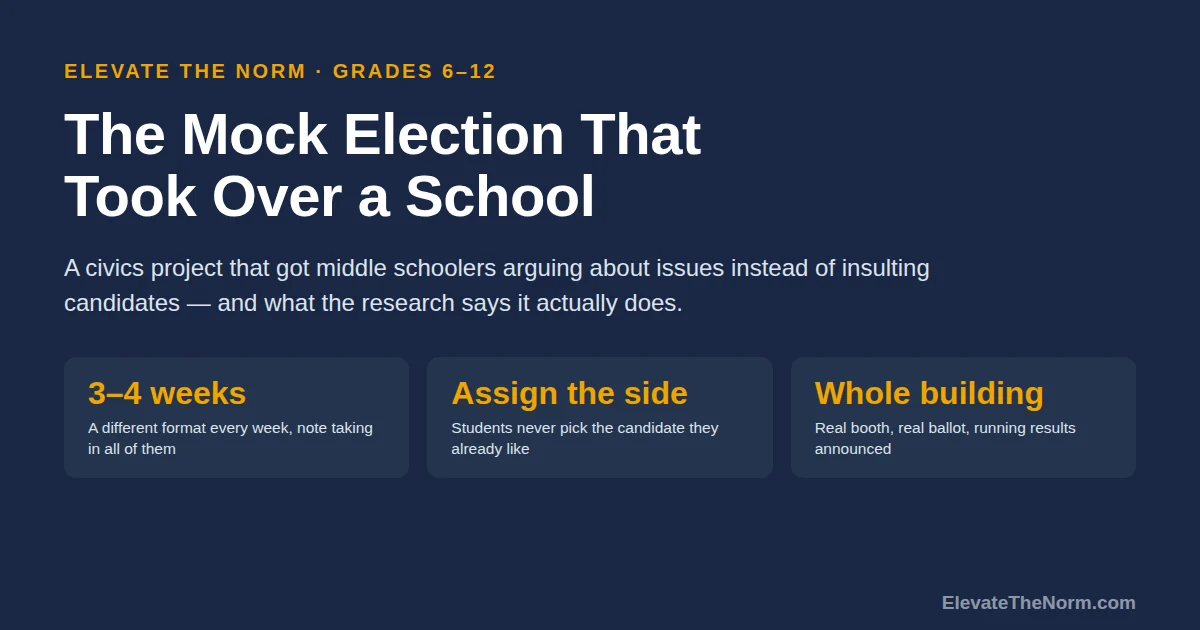
    Civics Project Ideas: The Mock Election That Took Over a School

    By Clay Shumate

    One of the most fun group projects I have ever run was a mock presidential election with seventh graders. It started in my classroom during a presidential race, and by the time it was over, the entire school was lined up to vote.

    If you are looking for civics project ideas that get middle schoolers arguing about issues instead of insulting candidates, this is the one I would hand you first. Here is where it came from, how it ran, and what it honestly takes.

    Key Takeaways

    • Assign students a candidate’s positions, not a candidate to cheer for. Once they have to defend a platform, they argue the issues instead of the personalities.
    • Change the format every week. Poster board one week, PowerPoint the next, group defenses after that, for three to four weeks.
    • Keep it inside your standards. Civics carried this entire project.
    • Ask for help early. An instructional coach shaped the idea, and a community partner supplied the “I Voted” stickers.
    • A real booth, a real ballot, and running results turn a class project into something the whole building wants in on.

    Free Download · PDF

    25 Project-Based Learning Examples and Planning Template

    Twenty-five driving questions with real public products and the standards they carry, plus a one-page planning template to fill in before you commit a single class period.

    Download the free PDF

    Free. No email address required. Designed for grades 6–12. Browse every printable in Your Free Library.

    Where the Idea Came From

    It was a radically difficult election, for the candidates and for the American people. I was teaching seventh grade at the time, and all of it was seeping down from home into my classroom.

    Mom and dad may very well be right about what they believe. That is not the point. Our job is to put as much information in front of students as we possibly can.

    This is where reaching out to others always helps. My instructional coach had taught the same course, so I went and asked a simple question: what is a good way to really embrace this election and bring middle schoolers into it? We landed on the one goal nobody could call partisan. Get them excited about voting when they turn 18.

    So I suggested we hold a seventh grade presidential election, with both major-party tickets on the ballot.

    How the Project Ran

    Everybody was split into groups. Each group was given topics and a side: one major-party candidate’s platform or the other’s.

    By side, I mean students took that candidate’s views. They read them, applied them, and had to use them in a group setting. Then the groups defended their arguments. Without realizing it, they were practicing a lot of the same techniques you see in Advanced Placement classes.

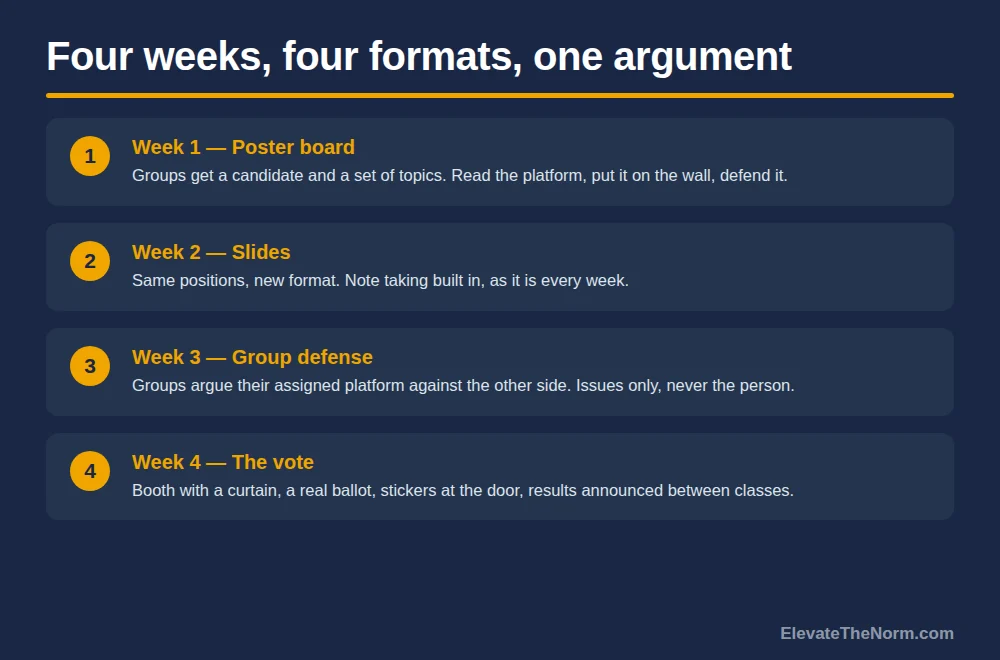
    The format changed every week for about three or four weeks. We did poster board. We did PowerPoint. You name it. By the time anyone voted, students had been through three to five group projects, with note taking built into every one of them.

    There was direct instruction in there too, just not much of it. You know that salt guy? That is how I use direct instruction in a project. A little sprinkle here and there.

    A little sprinkle of direct instructionIllustration of a hand pinching salt and sprinkling a few grains labeled direct instruction onto a large bowl labeled the project.Direct instructionTHE PROJECT
    A little sprinkle, not the whole shaker. The project is the meal; direct instruction is the seasoning.

    And it covered what I was required to teach. Civics was a seventh grade standard, taught all in one block, so the project was the standard rather than a break from it. You always have to be conscious of your standards, and this one was built around them from day one. My Social Studies Teacher Toolkit Bundle on TPT covers world history and civics if you want finished materials for the content side.

    Numbered four-week plan for a mock election civics project: week one poster board, week two slides, week three group defense of the assigned platform, and week four the vote with a booth and ballot
    Four weeks, four formats, one argument. Note taking is built into every round.

    From Name-Calling to Actual Arguments

    Before this project, the political conversation in my room sounded like “Trump sucks” and “Obama blows.” Those are two direct quotes from students, and they were the polite ones. I heard others I will not print here.

    Then something shifted. Students were arguing points. Instead of fighting about the candidates, they were applying what they had learned and arguing about the issues themselves.

    Along the way they figured out the thing I most wanted them to leave with: you vote for the candidate who, in your opinion, is going to meet the most of your needs. That lesson outlasts any single election.

    Then the Whole School Wanted In

    Word got around fast. Before long we were running the election for the entire building.

    I reached out to a community partner and asked for a few hundred “I Voted” stickers. They worked some kind of miracle and got me several hundred.

    Voting looked like the real thing. Students walked into a booth, pulled the curtain closed, and filled in a Scantron for one candidate or the other.

    We also had our own version of Fox and CNN. I think we called it FXN. I honestly do not remember, and it does not matter. At the end of every class, I ran the Scantrons or sent a student to run them. We reworked the percentages, and our news team announced the updated results before the next group voted.

    I want to be honest about one thing. A lot of the sway in those votes probably still came from home and how parents talked about the race. But by that point, my students had been fully vetted on both sides. They had argued each candidate’s positions themselves. Whatever they chose in that booth, they could tell you why.

    It was incredible. They loved it. They became super involved in the rest of the unit and the rest of the year, and they got genuinely interested in what civics was and how they could learn to vote.

    What Does the Research Say About Mock Elections?

    The evidence is real, it is modest, and the most interesting part of it says the classroom is only half the machine.

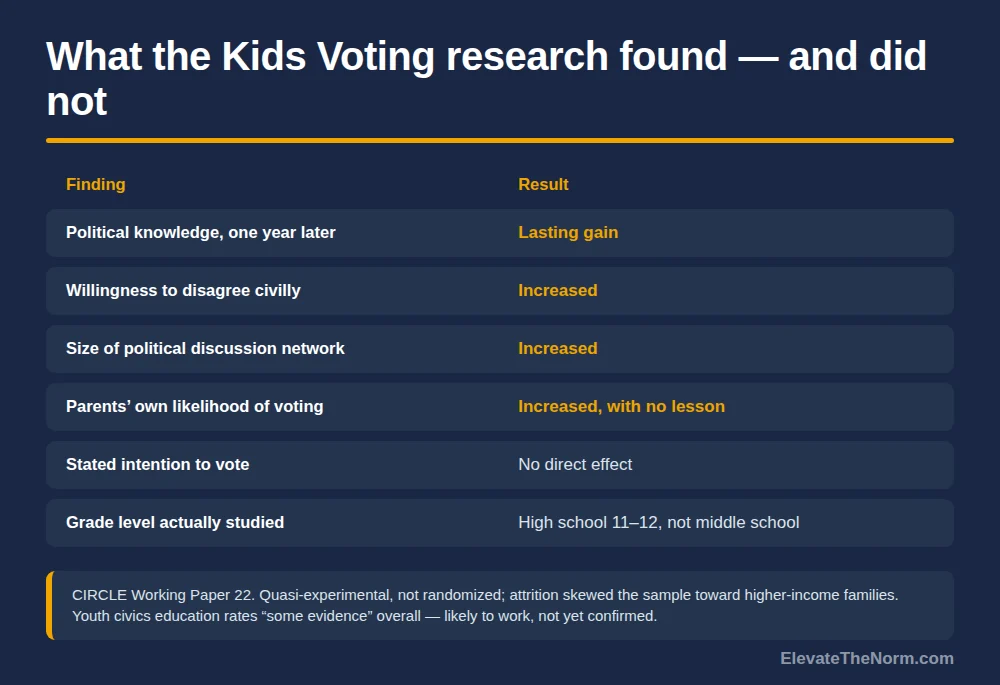
    The best-studied program of this kind is Kids Voting USA, which ran mock elections in schools alongside real ones. A CIRCLE panel study followed 497 student–parent pairs across Arizona, Colorado and Florida, then checked actual voting records two years later. Students who went through it showed lasting gains in political knowledge a full year afterward, widened the set of people they talked politics with, and — the finding I care about most — got measurably better at disagreeing with someone without it turning into a fight.

    Then the part that reframed my own project for me. The strongest path to students actually voting when they came of age ran through conversations at home. The curriculum got students paying attention to the news, the news got them talking at the dinner table, and that talk predicted turnout. The researchers also found parents shifted — they became more likely to vote themselves, without ever seeing a lesson, purely because their kid brought it up.

    I said further up that a lot of the sway in my students’ votes probably still came from home. I had that filed as the weakness of the project. The research says it is the mechanism. You are not competing with the kitchen table. You are trying to give a twelve-year-old something worth bringing to it.

    Table of findings from the Kids Voting USA research: lasting gains in political knowledge, increased willingness to disagree civilly, wider discussion networks, parents more likely to vote, no direct effect on stated intention to vote, and a sample of high school juniors and seniors rather than middle schoolers
    The numbers, including the two rows that cut against the pitch.

    The honest limits

    Four things about that evidence that a professional development slide would leave off, and you should know all of them before you quote a number to an administrator.

    • The sample was high school juniors and seniors. My project was seventh grade. The practices transfer; the findings do not automatically come with them, and anyone telling you a mock election is proven for middle schoolers is going past the data.
    • It was quasi-experimental, not a randomized trial, and attrition skewed the surviving sample toward higher-income families. Low-income and Spanish-speaking households were underrepresented.
    • There were null results. No direct effect on students’ stated intention to vote. The authors’ own summary is that effects were “not remarkable across the board.”
    • The overall strategy rates “some evidence” in the County Health Rankings review — meaning likely to work, tested more than once, trending positive, and not yet confirmed. Which is roughly where most of the good stuff in teaching sits.

    None of that is a reason to skip it. It is a reason to run it because it is good teaching and students learn the content, not because you were promised a turnout statistic.

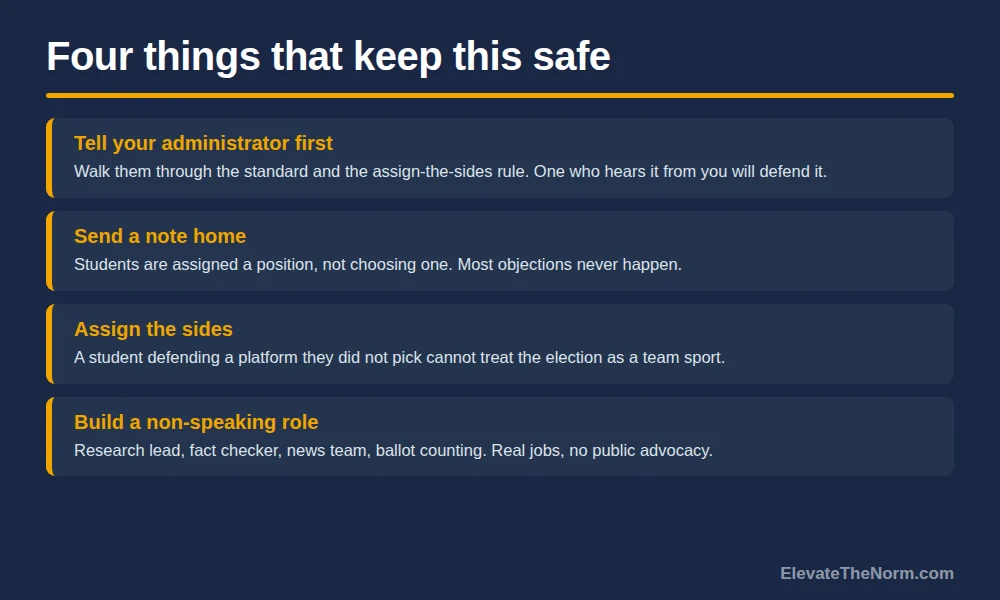
    Four safeguards for running a classroom mock election: tell your administrator first, send a note home, assign the sides rather than letting students choose, and build a non-speaking role such as fact checker or ballot counter
    Four things that keep this safe, and none of them is difficult.

    Running Your Own Mock Election

    If you want to try this, here is the shape of it:

    1. Talk to your instructional coach or a colleague who has taught the course before you plan anything.
    2. Tell your administrator the design before you build it — the standard it covers and the assign-the-sides rule.
    3. Send a short note home explaining that students are assigned a position rather than choosing one.
    4. Assign sides. Do not let students pick the candidate they already like.
    5. Give each group specific topics, and require them to read, apply, and defend that candidate’s positions.
    6. Rotate the format weekly for three to four weeks, with note taking in every round and a sprinkle of direct instruction when they need it.
    7. Ask a community partner for “I Voted” stickers well ahead of election day.
    8. Build a booth with a curtain and use Scantrons as ballots.
    9. Start a student news team and announce running percentages before each new class votes.

    There is no presidential race this November, but a midterm works the same way. Pick one race or ballot question with two clear sides and build the groups around it.

    If you want more projects built on the same idea, there are ten more in history project ideas, including a Constitutional Convention that pairs well with this one, and a longer list in these examples of project based learning. Build the rubric before you assign anything.

    Where This Goes Wrong, and How to Not Let It

    A mock presidential election is the highest-risk project I have ever run, and every one of the risks is manageable if you handle it before week one.

    Be honest with yourself about the exposure. You are putting live partisan politics in a room full of twelve-year-olds whose families have strong feelings, in a building with a principal who will get the phone call. Four things keep it safe, and none of them is difficult.

    • Tell your administrator before you plan it, not after a parent calls. Walk them through the standard it covers and the assign-the-sides rule. An administrator who heard it from you first will defend it. One who hears it from a parent first has to investigate it.
    • Send something home. A short note explaining that students are assigned a position rather than choosing one, that the goal is understanding both platforms, and that nobody is being told who to support. Most objections never happen if the family already knows the design.
    • Assigning sides is the neutrality mechanism, and it is also the thing families worry about. The answer to “my child had to argue for someone we cannot stand” is that arguing a position you do not hold is the oldest exercise in civic education, it is what debate has always been, and it is the single most reliable way to stop students from treating an election as a team sport. Say that plainly and say it early.
    • Give a student a way out of the spotlight without leaving the project. Some students have a genuine reason not to want to stand up and argue a position — a family situation, an immigration-adjacent worry in the room, a kid who simply will not perform. Research lead, fact checker, news team, and ballot-counting are all real jobs that require the content and require no public advocacy. Build them in from the start instead of after someone has to ask.

    What It Actually Takes

    Project-based learning can be extremely powerful. It also takes a lot of work, and it takes asking others for help.

    If you are not super outgoing, this will not be easy for you at first. You will not know the answers to everything, and you are going to have to ask. That is fine — it is how I got half of what I use. If you want to talk one through, the contact page is open.

    Because the gratification from a correctly executed PBL project is nearly as good as that feeling right after you cut the lawn, when you look back on it with a cold glass of iced tea.

    Before you go: grab the free 25 Project-Based Learning Examples and Planning Template (PDF) — ElevateTheNorm.com branded, printable, no email required.

    Frequently Asked Questions

    What is a good civics project for middle school?

    A mock election works well because students cannot take part without learning the content. Assign each group a candidate’s positions rather than letting them pick a side, require them to read, apply and defend those positions, and finish with a real vote using a booth and a ballot. The project carries the standard instead of interrupting it.

    How long does a mock election project take?

    Mine ran about three to four weeks with a different format every week. Students completed three to five group projects, each with note taking built in, before anybody voted. You could run a smaller version in one week with a single ballot question and two groups, and it would still work.

    How do you keep a mock election from getting too political?

    Assign sides instead of letting students choose, and keep every argument on the issues rather than the candidates. That one rule does most of the work: a student defending a platform they did not pick cannot treat the election as a team sport. Tell your administrator the design before you start, and send a short note home explaining it.

    What do I say to a parent whose child was assigned a candidate the family opposes?

    Say it early rather than defending it later. Arguing a position you do not personally hold is the oldest exercise in civic education and the whole point of debate: it is how a student finds out what the other half of the country actually believes rather than what they have been told it believes. Nobody is being asked to change their mind, and no student’s own view is ever graded.

    What if a student does not want to argue a position in front of the class?

    Give them a real job that needs the content and needs no public advocacy. Research lead, fact checker, news team, ballot counting. Build those roles in from day one so a student can take one without it reading as an exemption, and so nobody has to ask in front of anybody.

    Does research actually show mock elections work?

    Partly, and it is worth knowing the shape of it. A CIRCLE panel study of Kids Voting USA found lasting gains in political knowledge, wider political discussion networks, and students who got better at disagreeing civilly — but that sample was high school juniors and seniors, not middle schoolers, the design was quasi-experimental rather than randomized, and there was no direct effect on stated intention to vote. The County Health Rankings review rates youth civics education as “some evidence.” Run it because it is good teaching, not because you were promised a statistic.

    There is no presidential race this year. Does this still work?

    Yes, and a smaller race is easier to run. A midterm, a statewide office, a local ballot question, or a single policy proposal with two defensible sides all produce the same argument structure. The presidential version is louder, not better — and a ballot question has the advantage that neither side comes with a personality attached.

    What does this cost?

    Almost nothing. Scantrons or paper ballots you already have, a refrigerator box or a rolling whiteboard for a booth, and stickers if a community partner will donate them. The expensive part is your planning time during the three to four weeks, not materials.

    Sources

    1. McDevitt, Michael, and Spiro Kiousis. Education for Deliberative Democracy: The Long-Term Influence of Kids Voting USA. CIRCLE Working Paper 22, 2004. Panel study, 497 student–parent dyads in Arizona, Colorado and Florida; high school juniors and seniors; lasting knowledge gains, wider discussion networks, greater willingness to disagree civilly; no direct effect on intention to vote; quasi-experimental, sample skewed upper-SES. https://circle.tufts.edu/sites/default/files/2019-12/WP22_Long-termInfluenceofKidsVotingUSA_2004.pdf
    2. McDevitt, Michael. Experiments in Political Socialization: Kids Voting USA as a Model for Civic Education Reform. CIRCLE Working Paper 49, 2006. Three-year longitudinal design with verified voting records; political communication in the home increased the probability of voting once students reached voting age. https://eric.ed.gov/?id=ED494074
    3. County Health Rankings & Roadmaps, University of Wisconsin Population Health Institute. Youth Civics Education. Rated “Some Evidence” — likely to work, tested more than once, results trending positive, further research needed; effects vary by curriculum and by student population. https://www.countyhealthrankings.org/strategies-and-solutions/what-works-for-health/strategies/youth-civics-education
    4. Simon, Jesse, and Bruce Merrill. “Trickle Up Political Socialization: The Impact of Kids Voting USA on Voter Turnout in Kansas.” State Politics & Policy Quarterly. Cambridge Core

    About Clay Shumate
    Clay Shumate is a certified secondary Social Studies teacher in the public schools of West Alabama, with seven years of classroom experience, a B.A. in History, and an M.Ed. in Secondary Education. He writes about project-based learning, student responsibility, respect, and practical ways to hold young people to a higher standard while giving them room to learn from mistakes. He is a member of the Society of Professional Journalists and writes to its Code of Ethics; this site’s editorial standards and corrections policy are published in full. More about Clay.

  • History Project Ideas: 10 Classroom-Tested Units for Grades 7–12

    History Project Ideas: 10 Classroom-Tested Units for Grades 7–12

    By Clay Shumate

    These are ten history projects I have actually run with middle and high school students, written for the teacher who has to plan them. Each one includes the driving question, the grade band, how long it takes, what students produce, and the part most project lists leave out — where it goes wrong and what to do about it.

    Every one of them is free to use and adapt. Nothing here requires a field trip, a budget, or a schedule change.

    Key Takeaways

    • A history project is worth the time when students cannot complete it without learning the content — not when it decorates content they already covered.
    • Every project below starts from a real question with more than one defensible answer.
    • Project-based learning does not replace direct instruction. Most of these units start with it.
    • The checkpoint that saves a project is almost always the one in the middle, where students have facts but not yet an argument.
    • Group size is not the problem teachers think it is. Preparation is.

    What Makes a History Project Worth the Time

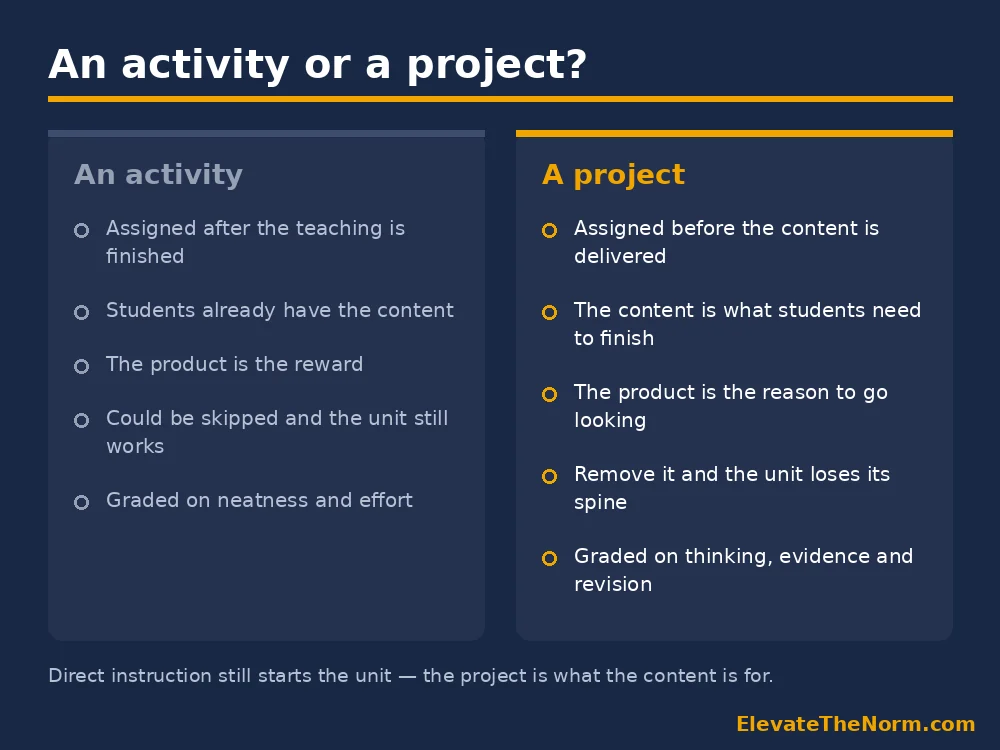
    Most lists of history project ideas are lists of activities. Build a model. Make a poster. Do a timeline. Those can be fine, but they are usually assigned after the teaching is finished, which makes them a reward rather than a method.

    Comparison of a history activity and a history project, showing an activity is assigned after the teaching while a project is assigned before the content is delivered
    The difference is not the product. It is when you assign it and what students need the content for.

    The projects below are built the other way around. The content is what students need in order to finish, which means they go looking for it. That is the difference between a project and project-based learning, and it is worth being precise about, because the two get used interchangeably and they are not the same thing. The definition of project based learning covers that distinction in more detail.

    One thing I want to be clear about up front, because it is the objection I hear most: none of this means abandoning direct instruction. I start almost every unit with it, and it often comes back in the middle. Direct instruction and project work should be working together, not competing for the same minutes.

    If you want the structure behind these before you pick one, the 7 steps of project based learning walks the process from driving question to public product, and there are more driving question examples if you want to write your own.

    World History Project Ideas

    These five world history project ideas work in a survey course and do not depend on where you are in the sequence. Two of them are period-specific; three will adapt to almost any unit.

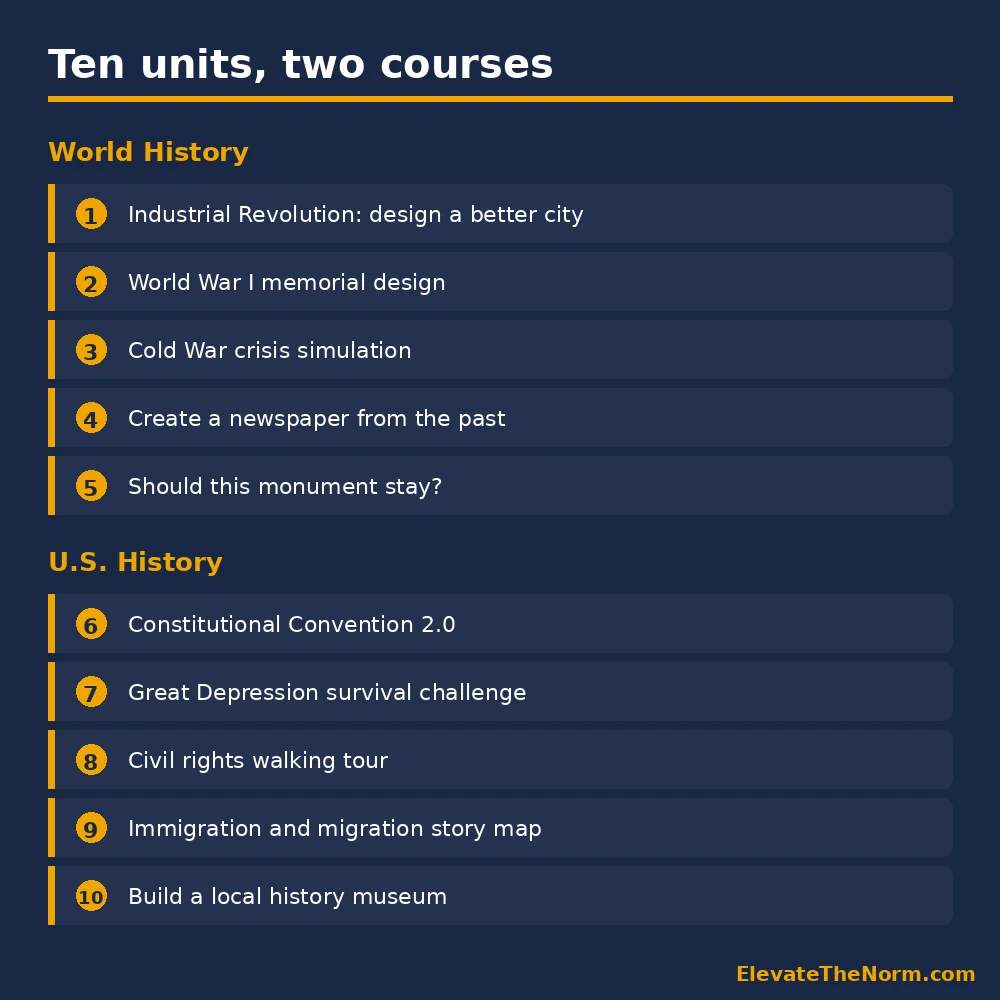
    Numbered list of ten history project ideas split into five World History units and five U.S. History units
    Five for world history, five for U.S. history. Most of them move between courses with small changes.

    1. Industrial Revolution: Design a Better City

    Driving question: How could an industrial city grow without sacrificing the lives of its workers?
    Grades 8–10 · 2–3 weeks

    Hand students a fictional industrial city with real problems — overcrowding, pollution, child labor, unsafe factories, disease, housing nobody should live in. They are the reformers. They build a plan covering housing, sanitation, transportation, worker protections, and factory regulation.

    The design constraint is what does the teaching: students cannot propose a fix until they can explain the problem. Want a sewer system? Show why disease spread. Want a child labor law? Show what children were actually doing. The content stops being something to study for a test and becomes something they need to finish the work.

    Where it goes wrong: groups jumping to solutions on day one. The fix is a hard checkpoint — problems only, with a historical cause attached to each, before any solution is allowed on paper.

    2. World War I Memorial Design

    Driving question: How should future generations remember a war?
    Grades 7–10 · 2 weeks

    Students investigate the war through soldiers, civilians, technology, casualties, and propaganda, then design a memorial and defend every major choice in writing.

    A memorial forces students to decide what matters. There is room for one, and it cannot hold everything. If you have space for five ideas about this war, which five deserve to survive? One pair centers the soldiers. Another centers civilians, or what the new technology did to the human body. The products look nothing alike and they hit exactly the same standards.

    Where it goes wrong: grading the art. The written defense is the assessment, and students need to hear that on day one or your strongest historians will panic about their drawing.

    3. Cold War Crisis Simulation

    Driving question: How do national leaders make decisions when every option carries serious consequences?
    Grades 9–10 · 1–2 weeks

    Students become a presidential advisory team during a fictional crisis modeled on something real. Intelligence arrives in stages. They decide whether to negotiate, blockade, use force, or gather more information — and they log why, every time.

    The Cold War makes sense once students feel the uncertainty. We teach these events knowing how they ended. The people in the room did not. So the information comes in pieces, and students decide without knowing what comes next.

    What I am actually measuring is not whether they pick the historically correct option. It is whether they change a decision when new evidence arrives. That is not indecisiveness. That is exactly what we want.

    Where it goes wrong: releasing all the intelligence at once, which destroys the whole mechanism. Also write the third packet so it genuinely undercuts a reasonable conclusion from the first two — if nothing ever contradicts, you teach students that first instincts are always right.

    4. Create a Newspaper From the Past

    Driving question: What would this event have looked like to people living through it?
    Grades 7–9 · 1–2 weeks

    Students produce a newspaper dated to one specific day in the period you are teaching. The rule that makes it work: nothing in the paper can reference anything that had not happened yet. A student writing about the Boston Tea Party cannot mention the Constitutional Convention. It has not happened.

    That single constraint teaches chronology, point of view, and sourcing at once, and it teaches them by making students enforce it on each other. Because a newspaper has different jobs — reporter, editor, cartoonist, advertisement designer — every student has a way in.

    This one is a group of four to six, and that is fine. Do not be afraid of that size. If you have taken the time to understand where the project goes and where the questions will come from, you have control of the room. I call that controlled chaos, and it is the good kind.

    Where it goes wrong: modern voice. Show one real front page from the period and have a student read a paragraph out loud. They hear it immediately.

    5. Should This Historical Monument Stay?

    Driving question: Who should we memorialize, and how should communities remember the past?
    Grades 8–10 · 1–2 weeks

    Teams investigate a monument and recommend what a community should do with it: keep it, remove it, relocate it, or leave it up with new signage that reinterprets it. They present to a mock city council that asks questions back.

    The point is not the verdict. Students arrive with an opinion already formed and are required to investigate before they are allowed to decide. That order is the entire design. It forces them into conflicting evidence and competing perspectives, which is where the gray area lives — and history is not black and white, which is genuinely hard for students who think in straight lines.

    A fictional monument works as well as a real one and lowers the temperature, which some rooms need. Invent a mill owner who founded the town, employed half of it, and broke a strike in 1913. All four recommendations become defensible.

    Where it goes wrong: the teacher’s own position leaking. Do not tell students what side you are on, not once. Decide in advance how you will deflect the question and use the same move every time. The room only argues honestly if they cannot read you.

    U.S. History Project Ideas

    These five U.S. history project ideas map onto standard survey units. The first and last will work in a world history course too, with different content.

    6. Constitutional Convention 2.0

    Driving question: If we had to design a government from scratch, what powers should it have?
    Grades 8–10 · 1–2 weeks

    Students represent fictional states with different populations, economies, and interests, then negotiate representation, taxation, executive power, voting, rights, and the line between federal and state authority — and draft a constitution they all have to live under.

    The Constitution makes sense when students live the problem that produced it. Otherwise it is a piece of paper they are told is important. Instead of memorizing the Great Compromise, they sit in a room where large states and small states actually disagree about representation, and suddenly compromise has a purpose, because they need one.

    Participation climbs in this unit, and not because I asked better questions. Students are not answering the teacher. They are defending their state.

    Where it goes wrong: state profiles that let one bloc win every vote. Rebalance them before you run it. And when the first session deadlocks, let it sit — that frustration is what makes the compromise land two days later.

    7. Great Depression Family Survival Challenge

    Driving question: How would an ordinary family survive an economic crisis?
    Grades 9–10 · 1–2 weeks

    Each student gets a fictional family with jobs, savings, housing costs, and a location. Then history happens to them — unemployment, a bank failure, drought, illness, a wage cut, a New Deal program. They decide, and they write down why.

    Students usually learn the Depression as a list. Bank failures. Unemployment. Dust Bowl. New Deal. That is four disconnected facts. This makes them interact: lose a job and housing is at risk, lose housing and you migrate, a bank fails and the savings are simply gone. So when a New Deal program appears, students already understand the problem it was built to solve.

    That is a mental model. Memorizing ten acronyms is not.

    Where it goes wrong: students treating it as a game to win. Say on day one that some families do not recover, and that this is not a failing grade. Then mean it.

    8. Civil Rights Community Walking Tour

    Driving question: How did ordinary people and local communities contribute to the Civil Rights Movement?
    Grades 8–10 · 2–3 weeks

    Students research Civil Rights history in their own state or region and build a walking tour of five to eight stops, each with photographs, a map, quotations, biographies, and an explanation of why that spot earned its place.

    This one destroys the idea that history happened somewhere else. Students find out that national history took place a few miles from where they live. It also widens the story past the handful of names that make the textbook — the organizers, the drivers, the people who housed marchers, the teachers who lost jobs, the students who walked out.

    The tour can be entirely digital. No buses, no permission slips, no budget.

    Where it goes wrong: students defaulting to the national figures they already know. Build in a checkpoint that requires three local participants by name, with what each one did.

    9. Immigration and Migration Story Map

    Driving question: Why do people leave one place and build a life somewhere else?
    Grades 7–10 · 2 weeks

    Students trace a real migration — westward expansion, the Great Migration, Ellis Island, the Dust Bowl, a modern movement — and map it, annotating push factors at the origin, pull factors at the destination, obstacles along the way, and consequences in both places.

    What makes this one work is that cause and effect becomes visible. I am not handing students a definition of push and pull factors to memorize. They follow actual people across actual distance and explain why the movement happened, and the map shows the answer. Where geography and history are taught together, this is the unit that justifies it.

    Where it goes wrong: routes too vague to research. “Immigration” is not a route. “Sicilian families through Ellis Island, 1900 to 1914” is. Lock the group, the origin, the destination, and the years before anyone starts.

    10. Build a Local History Museum

    Driving question: How can we preserve and explain the history of our community?
    Grades 7–10 · 2–3 weeks

    Students research a local person, building, business, school, event, or tradition and build a museum-style exhibit — artifact, photographs, captions, a map, and a written historical interpretation. The class combines them into one museum, physical or digital.

    Instead of me telling students what happened in their community, they become the historians. They locate the evidence, decide what is important, and explain it to somebody else. The museum label format does a lot of the teaching on its own, because being short, accurate, and clear at the same time is harder than writing a page.

    Where it goes wrong: topics that are too big, and one website used as the only source. A required source log, checked early rather than at the due date, fixes the second one. Forcing every group to one specifically named subject fixes the first.

    How to Pick One

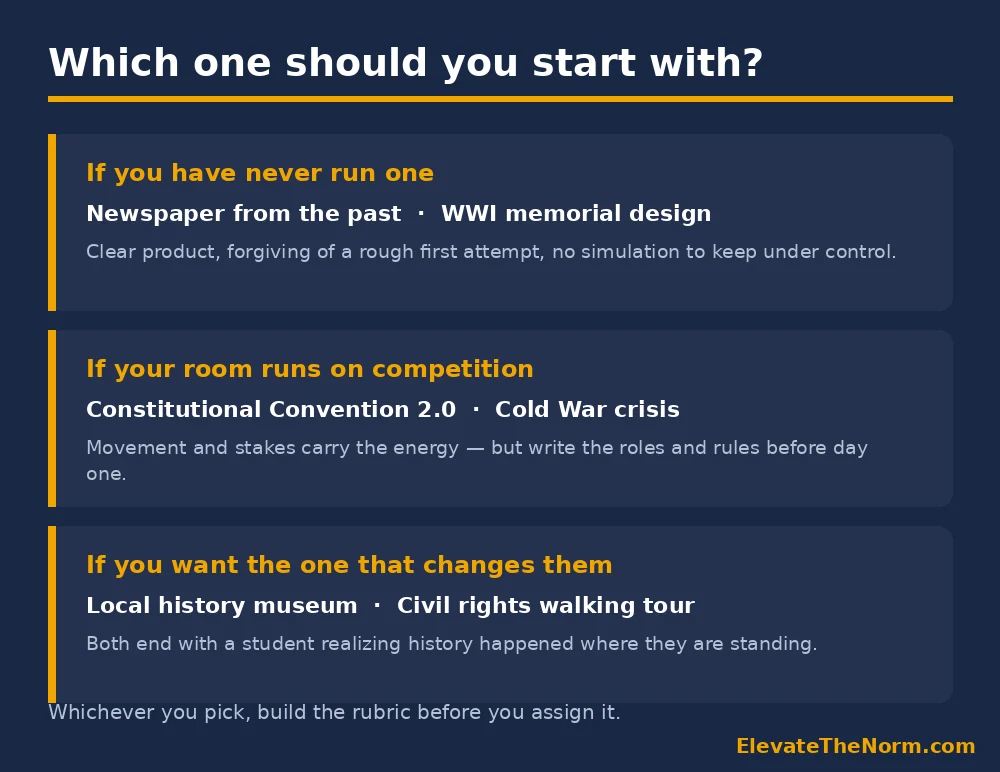
    If you have never run a project like this, start with the newspaper or the memorial. Both have clear products, both forgive a rough first attempt, and neither depends on a simulation staying under control.

    Decision guide matching three classroom situations to the history projects that suit them best
    Pick for the room you actually have, not the one you wish you had.

    If your room responds to competition and movement, start with the Constitutional Convention or the Cold War simulation — or, if an election is anywhere near, the mock election that grew into a school-wide vote, which is written up start to finish.

    If you want the one that changes how students see the subject, it is the local museum or the walking tour, because both end with a student realizing history happened where they are standing.

    Whichever you pick, build the rubric before you assign it — there is a free editable PBL rubric if you want a starting point, and more planning tools and templates alongside it.

    The Part That Matters Most

    Every one of these projects asks students to do something historians actually do. Use evidence. Defend a decision. Hold two perspectives at once. Revise an argument when the evidence changes. Those are also, not coincidentally, the things people who do well in life tend to be good at.

    And for the student who struggles in a traditional history class, a project gives them a reason to read the source, learn the vocabulary, and know the content — because they need it to build the thing.

    The project is not what students do after they learn the history. The project is how they learn the history.

    Teaching the week of Halloween? The holiday is a good small history unit in its own right: Samhain, souling and guising, turnip lanterns, and the Irish and Scottish immigrants who brought it to America. I wrote five-day Halloween Week Units for middle school and high school, each with a nonfiction article, a comparison of fall traditions around the world, and a writing project.

    What is a good history project for high school students?

    The best history projects give students a real question with more than one defensible answer and require them to use evidence to answer it. A monument recommendation, a Cold War crisis simulation, and a memorial design all work well at the high school level because students cannot complete them without understanding the content first.

    How long should a history project take?

    Most of these run one to three weeks. Anything shorter than about a week does not allow for the research, feedback, and revision that make a project worth doing. A single class period activity is a good activity, but it is not project-based learning.

    Do history projects replace lectures and notes?

    No. Almost every project here starts with direct instruction, and several bring it back in the middle when students hit a skill they are missing. Project work and direct instruction should be working together. The project changes when and why the content is delivered, not whether it is.

    How do you grade a history project fairly?

    Grade the thinking, not the craftsmanship. On a memorial design, the written defense of the design choices carries the weight, not the drawing. Build the rubric before you assign the project, share it with students at the start, and keep the criteria tied to evidence use, reasoning, and historical accuracy.

    What if students just divide the work and never collaborate?

    Assign specific roles with specific deliverables and check individual work at a midpoint rather than group output at the end. On the newspaper project, every student has a different job. On the migration map, one student owns the source log. The checkpoint in the middle is what catches an uneven group while there is still time to fix it.

    Can these history projects work in a middle school classroom?

    Most of them are written for grades 7 through 10. The newspaper, the local history museum, the migration story map, and the memorial design all work well in middle school. The Cold War simulation and the Great Depression challenge are better suited to grades 9 and 10 because they depend on sustained decision-making.

    How do you handle controversial topics in a history project?

    Do not tell students where you stand, and require investigation before they are allowed to reach a conclusion. Using a fictional example instead of a real local one lowers the temperature without lowering the rigor. The goal is that students’ reasoning becomes more sophisticated, not that their opinions move in a particular direction.


    About Clay Shumate
    Clay Shumate is a certified secondary Social Studies teacher in the public schools of West Alabama, with seven years of classroom experience, a B.A. in History, and an M.Ed. in Secondary Education. He writes about project-based learning, student responsibility, respect, and practical ways to hold young people to a higher standard while giving them room to learn from mistakes. He is a member of the Society of Professional Journalists and writes to its Code of Ethics; this site’s editorial standards and corrections policy are published in full. More about Clay.

  • Project Based Learning Tools: Free Templates for Teachers

    Project Based Learning Tools: Free Templates for Teachers

    By Clay Shumate

    Project based learning tools are the planning templates, feedback protocols, and assessment forms that give teachers and students a shared system for managing complex, multi-week work. Without them, a PBL project is ambition without infrastructure. With them, students know what they are doing each day, teachers can coach rather than rescue, and the final product reflects actual learning instead of organized chaos.

    Key Takeaways

    • Planning tools—driving question templates, project calendars, and Know/Need to Know charts—keep projects from drifting before they start
    • Group coordination tools like team contracts and role cards shift accountability from the teacher to the students where it belongs
    • Feedback and critique protocols help students improve their work before the final product, not just after it is graded
    • Free digital tools including Google Workspace, Padlet, and PBLWorks educator resources cover most of what a classroom needs without a budget
    • The best PBL programs run on five or six well-understood tools, not twenty barely-understood ones
    Driving question template for project based learning showing structure for open-ended inquiry questions
    A strong driving question is open-ended, connects to a real issue, and has no Googleable answer.

    Why PBL Needs Its Own Toolkit

    A standard assignment can run on a rubric and a due date. A project spanning three weeks—with multiple checkpoints, group coordination, research, revision, and a public product—cannot. Project based learning tools are not busy work. They solve real problems: drift, inequitable group work, surface-level feedback, and final assessments that miss what students actually learned.

    The Buck Institute for Education (now PBLWorks), which has studied project-based learning for over three decades, identifies planning, collaboration, and formative assessment as three essential supports for successful PBL implementation (Larmer, Mergendoller, & Boss, 2015). Tools are how those supports become visible inside a classroom where a teacher has twenty-eight students, five periods, and a bell that rings every fifty minutes.

    This guide covers the most useful tools in each category and points to the best free resources for getting them. For context on what strong PBL actually looks like, the definition of project based learning article explains the essential elements that separate genuine PBL from a decorated assignment.

    Planning Tools: Before the Project Starts

    The Driving Question Template

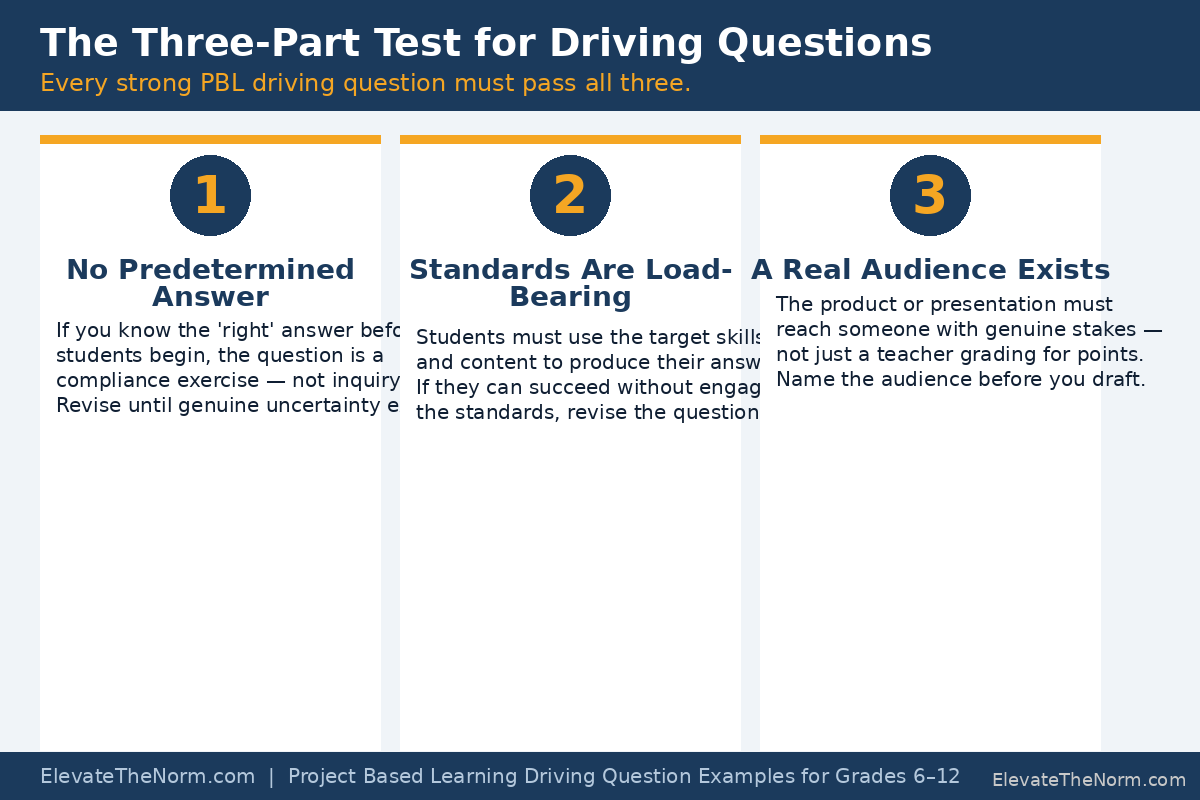
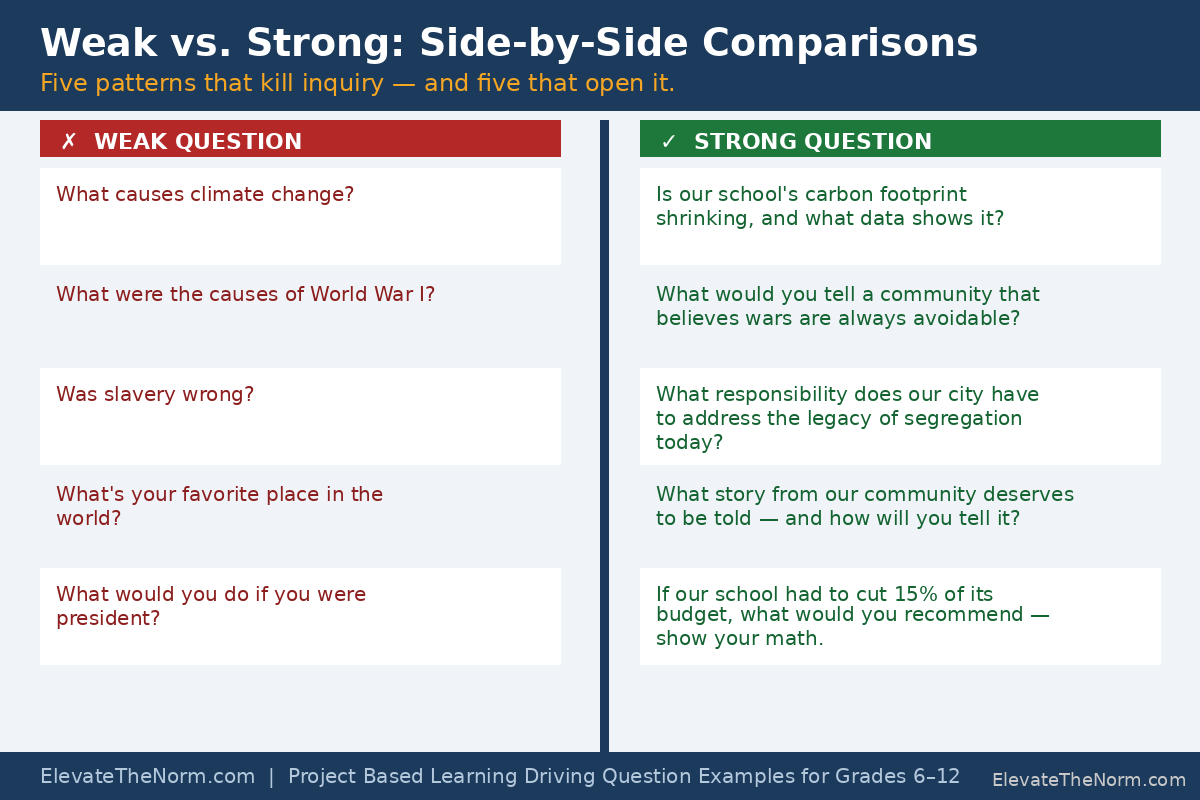
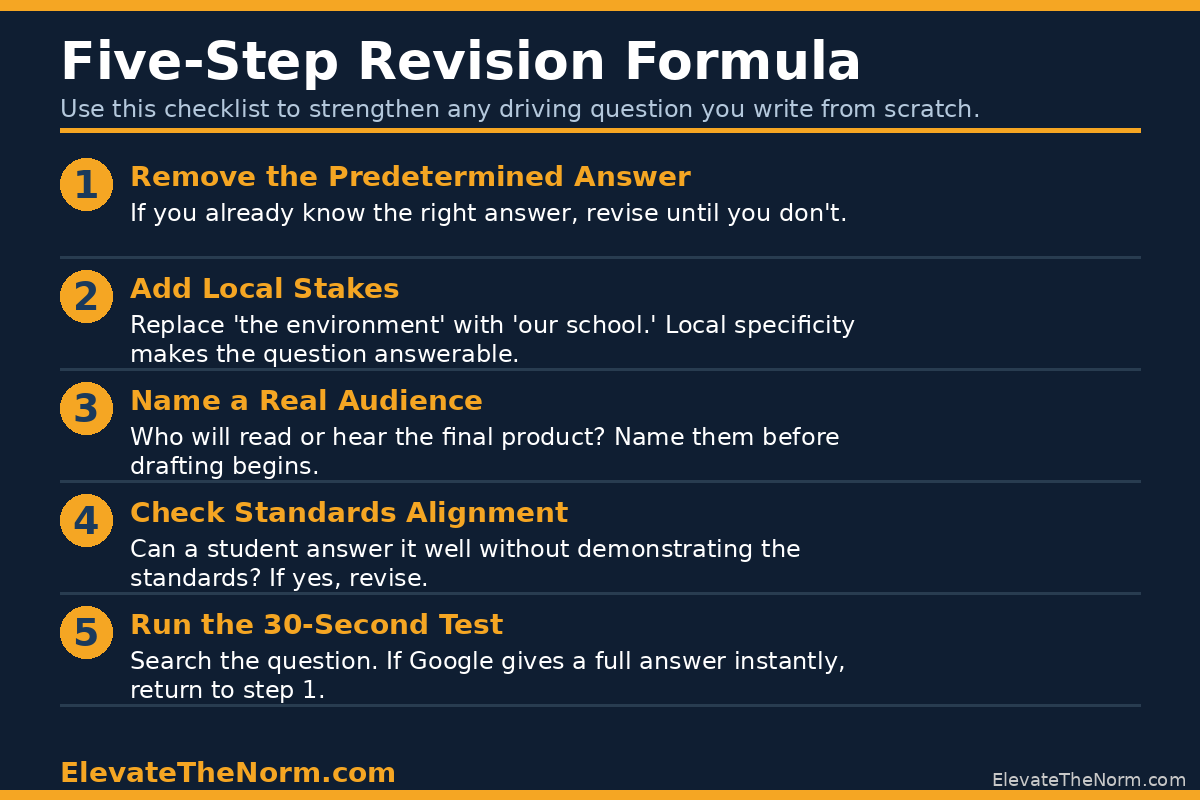
    A weak driving question makes students shrug. A strong one makes them argue and investigate. The difference is almost always structure. A strong driving question is open-ended, connects to a real issue or audience, and does not have a Googleable answer.

    Use this draft formula to build one: How should [person or group] [action] in order to [goal or value]?

    For example: How should our city council design a park renovation so that it serves both older adults and teenagers who share that space? This forces students to consider competing interests, use subject-area knowledge, and produce something—a recommendation, a proposal, a plan—rather than just a report.

    For a full breakdown of strong versus weak driving questions across multiple subjects, see project based learning driving question examples.

    Project Calendar

    A calendar does two things most teachers underestimate: it shows students how much time they actually have, and it forces the teacher to sequence direct instruction alongside inquiry. A usable PBL calendar has daily or weekly columns, labeled checkpoints, deadlines for specific deliverables (not just one big due date at the end), and built-in days for critique and revision. PBLWorks provides free downloadable planning calendars for teachers at pblworks.org/resources.

    Know/Need to Know Chart

    After launching a project—typically with an entry event that makes the problem feel real—students complete a Know/Need to Know chart. On one side: what they already know. On the other: what they need to find out. This chart does not stay static. It grows as students learn and discover new questions.

    The KNTK serves two purposes. It gives students a research direction and gives teachers a formative snapshot of background knowledge and misconceptions—without a quiz. John Hattie’s synthesis of educational research identifies formative assessment as one of the highest-impact practices in education (Hattie, 2009). The KNTK is one of the simplest formative tools that costs nothing and takes ten minutes.

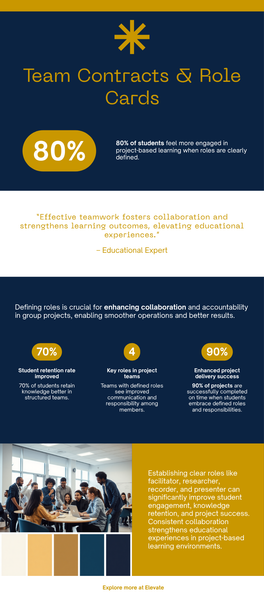
    Team contracts and rotating role cards for project based learning group coordination
    Team contracts and role cards shift accountability to students where it belongs.

    Group Coordination Tools: While the Work Is Happening

    Team Contract

    Group work fails when accountability is vague. A team contract makes it specific. A good one covers: each member’s role, what happens when someone does not complete their work, how decisions get made, and how the group will handle disagreements before they escalate to the teacher.

    It is not a behavioral management trick. It is a professional practice. Legal teams, software developers, and nonprofit boards all use agreements that define responsibility before problems start. Asking students to do the same is not asking too much—it is asking something real. See the 7 steps of project based learning for where the team contract fits in the full project sequence.

    Role Cards

    Rather than leaving students to decide who does what—which usually means one person does everything—role cards assign rotating responsibilities. Common roles include: Project Manager (keeps the group on schedule and tracks deliverables), Lead Researcher (coordinates inquiry and source evaluation), Editor/Quality Control (reviews for accuracy and coherence), and Presenter Coordinator (organizes the final product and prepares the group). Roles rotate each project so every student practices every skill. Be honest with yourself about which of those cards is doing real work, though—a 36-study review found no evidence that naming roles improves outcomes on its own, so it is worth reading what actually makes a group role earn its place before you print a set.

    Daily Stand-Up Log

    Borrowed from software development, a stand-up is a brief daily check-in with three questions: What did you accomplish? What will you do next? What is blocking your progress? Students fill this in at the start of work time. The teacher scans the logs in three minutes and knows exactly who is stuck without running to every group. Students learn to diagnose their own progress rather than waiting for the teacher to notice a problem.

    Research and Inquiry Tools

    Source Evaluation Checklist

    The standard “is it credible?” instruction is not enough. Students need specific criteria they can apply independently: Who is the author? What organization published this? When was it last updated? Does it cite evidence? Is the purpose to inform, persuade, or sell? This checklist works for websites, journal articles, primary sources, and news coverage.

    Research Notes Organizer

    A research notes organizer gives students one place to record sources, quotations, and their own interpretations. Without it, students either plagiarize because they cannot separate their notes from the source, or they lose track of where information came from. A four-column table works for most subjects: Source | Key Information | My Interpretation | Questions It Raises.

    Feedback and Critique Tools

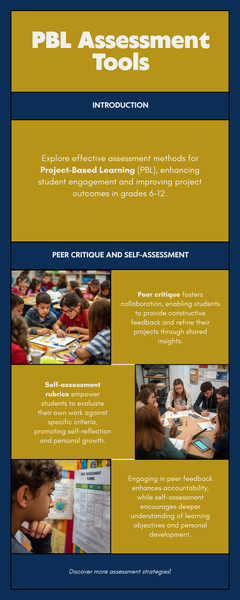
    Peer critique protocol and self-assessment rubric for project based learning student feedback
    Feedback and critique protocols help students improve their work before the final product, not just after it is graded.

    Peer Critique Protocol: Warm and Cool Feedback

    Developed and refined by educator Ron Berger and the EL Education network, warm and cool feedback is one of the most practical classroom critique tools available (Berger, Rugen, & Woodfin, 2014). Warm feedback names specifically what is working and why. Cool feedback identifies something to strengthen, phrased as a question or suggestion rather than a judgment.

    The distinction matters. “This is good” is not warm feedback. “The evidence you used in paragraph two directly supports your claim—and the contrast you drew with the counter-example is convincing” is warm feedback. “Your conclusion repeats the introduction rather than moving forward—what’s the next step you want the reader to take?” is cool feedback. This structure keeps critique from becoming personal and keeps attention on the work, not the person who made it.

    Gallery Walk with Sticky Notes

    Students post their work-in-progress on walls or tables. Classmates rotate through and leave sticky notes: one warm, one cool. This gives every student feedback from multiple peers without the teacher orchestrating every exchange. It works best mid-project—after a first draft exists but with enough time remaining to act on what they hear.

    Revision Tracker

    A simple document with three columns: Feedback Received → Change Made → Reason for the Change. Students maintain this alongside their work. It prevents revision from being cosmetic—fixing a typo and calling it done—and shows teachers whether students are actually responding to critique or going through the motions. It also gives students a record of how their thinking developed over the course of the project.

    Assessment Tools

    PBL Rubric

    Assessment in project-based learning has to measure the right things. A rubric that only scores the final product misses the inquiry, the revision, the collaboration, and the communication that make PBL valuable. A well-built PBL rubric includes separate rows for content knowledge demonstrated, quality of evidence, revision process, collaboration (assessed individually, not as a group score that hides individual gaps), and communication clarity.

    For a free editable template built specifically for grades 6–12, see the rubric for project based learning.

    Self-Assessment Form

    Before every checkpoint and after every project, students complete a brief self-assessment: What was my strongest contribution? Where did I fall short? What would I do differently? What did I learn? This is not extra busywork. It is the metacognitive habit that makes future projects better. A student who cannot answer “what did I actually learn?” has not finished the project—they have finished the assignment.

    Exhibition Checklist

    When students present to an authentic audience, an exhibition checklist covers: Does the product show evidence-based reasoning? Is the presentation clear to someone unfamiliar with the topic? Did the team handle questions directly and honestly? Does it meet the criteria the project set out to address? This checklist can be used by the presenting team for self-assessment and by the audience for structured feedback during the presentation.

    Free Digital Tools Worth Using

    Many of the most effective project based learning tools are printable and free. A few digital platforms extend them without creating new management problems.

    Google Workspace (free for schools): Google Docs for shared writing and revision history, Google Slides for presentations, Google Forms for self-assessment and checkpoint surveys, Google Drive for organizing project files. Widely available and familiar to most students before they arrive.

    Padlet (free tier available): A shared digital board for gallery walks, Know/Need to Know charts, and collaborative brainstorming. Works on any device with a browser. Students can post text, images, and links—and see what their classmates are contributing in real time.

    Canva for Education (free): Students create posters, infographics, reports, and presentations without graphic design experience. The free version for education has enough templates to cover most public-product deliverables.

    PBLWorks Educator Resources (free with registration): PBLWorks, the organization founded by the Buck Institute for Education, provides free planning templates, rubrics, and project examples at pblworks.org/resources. Their Gold Standard PBL framework is the most research-grounded planning reference currently available for classroom teachers.

    What Makes a Tool Worth Using

    A tool earns its place in a classroom when it reduces teacher-student friction, increases student clarity, and produces better work. Apply this test before adding any new form or protocol: what specific problem does this solve, and how will I know if it is working?

    The best PBL programs run on five or six tools that teachers and students both understand well. Adding more does not produce more learning—it produces more confusion. Krajcik and Shin (2014) note that effective project-based learning requires sustained student inquiry, which cannot happen when students are spending cognitive energy managing unfamiliar templates. The tools should fade into the background and let the thinking come forward.

    For broader classroom resources alongside these tools, the project based learning resources article covers free external tools, credible research references, and original ElevateTheNorm.com downloads in one place.

    What to Do Next

    Start with three: a driving question template, a team contract, and a peer critique protocol. Use them consistently for one full project. After the project ends, ask students which tools helped and which felt like extra work without a payoff. Revise based on their honest answers. The tools should be improving student work—if they are not doing that, something needs to change.

    For the sequence that holds these tools together, the 7 steps of project based learning shows where each tool fits from driving question through final reflection.

    Teachers are not the only ones researching this. Parents, administrators and students now put the same questions to an AI assistant before they ever ask a person, and the answers they get are often written from a vendor’s marketing page. The questions people are asking AI about project-based learning collects the twenty-five that come up most — platforms, cost, curriculum fit — and answers them from a classroom instead. Most of it assumes a secondary timetable; the high-school constraints specifically get their own treatment.

    Frequently Asked Questions

    What is the most important project based learning tool to start with?

    Start with the driving question template. Everything else in a PBL project depends on having a strong driving question. A weak question produces vague research, unclear products, and students who cannot explain why any of it matters. Once teachers can write strong driving questions reliably, the rest of the tools start making more sense because students understand what they are working toward.

    Do project based learning tools work without classroom technology?

    Yes. The most effective PBL tools are printable or can be run with a whiteboard and sticky notes. The team contract, peer critique protocol, Know/Need to Know chart, role cards, and self-assessment form all work without a device. Technology expands options for collaboration and presentation, but it is not a requirement for solid project management.

    How do I prevent one student from doing all the group’s work?

    Use role cards with rotating assignments and assess students individually inside a group project. If one student does all the work while others coast, the problem is usually structural—not a character issue. A team contract set up before the project starts, with agreed-upon consequences for not contributing, shifts accountability to the group before the teacher has to intervene. Individual self-assessments and revision trackers also make individual contribution visible.

    What is the difference between a PBL rubric and a regular rubric?

    A regular rubric typically scores the final product only. A PBL rubric also assesses the process: the quality of inquiry, how students responded to feedback and revised their work, how they collaborated, and how clearly they communicated their thinking. Scoring only the product rewards students who produce polished deliverables through luck or prior advantage. A PBL rubric rewards the kind of thinking and revision the project was designed to build.

    At what grade level are these tools appropriate?

    The tools in this guide are designed for grades 6–12. Middle school students generally need more structure—clear role cards, a daily stand-up log, and teacher checkpoints every two to three days. High school students can handle more open-ended planning, longer timelines, and self-directed research with less scaffolding. Adjust the level of detail and frequency of checkpoints based on your students’ experience with project work, not just their grade level.

    How does a driving question template help students?

    A driving question template gives students a structured starting point instead of a blank page. It forces them to identify who is affected by the problem, what action is needed, and why it matters—before they start researching. This clarity shapes the whole project. Students who understand why a question is worth investigating tend to stay more engaged throughout the work than those who were handed a topic without context.

    What should self-assessment include in a project based learning project?

    A useful self-assessment asks students to name their strongest contribution specifically, identify where their work fell short and why, state one thing they would do differently, and describe what they actually learned. Vague questions produce vague answers. “What did you contribute?” gets a list of tasks. “What was your most important contribution to the final product, and what evidence supports that?” gets honest reflection.

    Sources

    • PBLWorks. (n.d.). Educator resources: Free templates and rubrics. PBLWorks / Buck Institute for Education.
    • Larmer, J., Mergendoller, J. R., & Boss, S. (2015). Setting the standard for project based learning. ASCD.
    • Berger, R., Rugen, L., & Woodfin, L. (2014). Leaders of their own learning: Transforming schools through student-engaged assessment. Jossey-Bass.
    • Krajcik, J., & Shin, N. (2014). Project-based learning. In R. K. Sawyer (Ed.), The Cambridge handbook of the learning sciences (2nd ed., pp. 275–297). Cambridge University Press.
    • Hattie, J. (2009). Visible learning: A synthesis of over 800 meta-analyses relating to achievement. Routledge. (Formative assessment effect size d ≈ 0.90 as summarized.)

    About Clay Shumate

    Clay Shumate is a certified secondary Social Studies teacher in the public schools of West Alabama, with seven years of classroom experience, a B.A. in History, and an M.Ed. in Secondary Education. He writes about project-based learning, student responsibility, respect, and practical ways to hold young people to a higher standard while giving them room to learn from mistakes. He is a member of the Society of Professional Journalists and writes to its Code of Ethics; this site’s editorial standards and corrections policy are published in full. More about Clay.

  • Project Based Learning Driving Question Examples for Grades 6–12

    Project Based Learning Driving Question Examples for Grades 6–12

    By Clay Shumate

    A driving question is the engine of a PBL unit. It sets the direction, gives students a reason to care, and holds the work together across days or weeks of instruction. But a weak driving question quietly undermines everything — it either shuts down thinking before it starts or lets students coast without ever engaging the standards you need them to master.

    Below are real driving-question examples organized by subject area, an explanation of what makes each one work, a side-by-side look at weak versions of the same questions, and a five-step revision formula you can use to strengthen any driving question you write from scratch. Each of these classroom-tested history projects is built around one, if you want to see finished questions inside a full unit.

    What a Strong Driving Question Actually Does

    Before the examples, a working definition of project based learning: a driving question frames an authentic problem that has no single correct answer, requires students to use the skills and content of the unit to investigate it, and produces a product or presentation that addresses a real audience. That’s the three-part test. If a question can be answered by a quick internet search, it fails the first part. If students can answer it without demonstrating the standards, it fails the second. If the work disappears into a folder never read by anyone, it fails the third. That third test is the whole of what makes a task authentic rather than merely well-designed.

    Infographic showing the three-part test for strong project based learning driving questions: no predetermined answer, standards are load-bearing, and a real audience exists
    Before publishing a driving question, check all three conditions.

    Strong Driving Question Examples by Subject

    Science

    Strong: “How healthy is our watershed, and what should our community do about what we find?”

    Why it works: Students have to collect and analyze real water-quality data (science practices), interpret findings against state standards (content knowledge), and communicate recommendations to an audience who can actually act on them — the city water board, a local environmental group, or the school board. The question doesn’t tell students what they’ll find. It invites genuine investigation.

    Strong: “Is our school’s energy use sustainable, and what’s one change we could make that would actually matter?”

    Why it works: Local and bounded. Students aren’t solving climate change — they’re solving one building’s energy footprint. The second clause (“that would actually matter”) forces quantitative thinking: students have to calculate actual impact, not just list recycling tips. The audience is the school administration, which gives the work stakes.

    Social Studies and History

    Strong: “What should the city council do about rising housing costs in our community?”

    Why it works: It connects economics, civics, and local government in one question. Multiple defensible positions exist — zoning reform, rent stabilization, housing vouchers, market incentives — and students have to evaluate evidence for each. The audience is real: city council members, local journalists, or community advocates. Students present policy recommendations rather than five-paragraph essays. For social studies teachers, my Social Studies Teacher Toolkit Bundle on TPT gives you a head start on the materials.

    Strong: “What would you tell a younger student who thinks the civil rights movement is history and doesn’t affect them today?”

    Why it works: The audience (a younger student) is concrete. The question requires students to synthesize historical knowledge with present-day evidence — the harder cognitive move. It also demands a choice about emphasis: what do you lead with? Why? That’s persuasion, historical thinking, and communication in one question. And it treats the student as someone with something worth saying, not just someone absorbing information.

    Side-by-side comparison chart of weak versus strong project based learning driving question examples across five subject areas, showing how each weak question fails and how the strong version corrects it
    Weak questions and strong alternatives, side by side.

    Mathematics

    Strong: “Is our school’s cell phone policy working, and what does the data say?”

    Why it works: Students care deeply about this topic. They design a survey (statistics), collect and organize data (data analysis), calculate measures of center and variability (content), visualize findings (data representation), and present a recommendation to administration. Every step is grounded in mathematics content, but the reason to do the math is built in from the start.

    Strong: “If our school had to cut its budget by 15 percent, what would you recommend — and can you show your math?”

    Why it works: Proportional reasoning, budgeting, percentages, and data interpretation all appear naturally. The final clause (“can you show your math?”) builds in the accountability piece. Students have to justify their reasoning quantitatively, not just state an opinion. Presenting to a mock school board raises the stakes further.

    English Language Arts

    Strong: “What story from our community deserves to be told, and how will you tell it?”

    Why it works: Narrative writing, interview skills, audience awareness, and editing all emerge naturally from this question. Students interview community members, identify a story angle, draft and revise, and publish — to the school paper, a community website, or a class literary magazine. The question respects student judgment: they decide what deserves to be told. This connects to student voice and choice in the classroom: when students help shape the inquiry, the work carries more weight.

    Strong: “How do you write an argument that someone who disagrees with you would actually take seriously?”

    Why it works: The built-in challenge — not just “write an argument” but “write one your opposition would respect” — forces students to engage with counterargument and evidence quality from the beginning of the unit, not as an afterthought. It also develops intellectual humility, which is a real skill worth teaching.

    Weak Driving Questions — and Why They Fail

    Weak driving questions fall into five predictable patterns. Each shuts down inquiry in a different way.

    Too broad: “How does climate change affect the environment?”
    This is a research prompt, not a driving question. The answer is available in every textbook. It has no local angle, no audience, no student voice, and no product that could matter. Students fill out a graphic organizer and move on. No genuine inquiry required.

    Easily Googled: “What were the causes of World War I?”
    A student can retrieve a correct answer in under 30 seconds. There’s no reason to sustain inquiry over multiple days. This is a comprehension check question elevated to a project title.

    Leading: “Was slavery wrong?”
    There is only one acceptable answer in a school setting. Students know it before they begin. No investigation is required, no evidence is weighed, and no thinking happens. A question with only one permissible answer is a compliance exercise.

    Disconnected from standards: “What’s your favorite place in the world and why?”
    Engaging and personal — and completely untethered to any specific learning target. Without a clear standards connection, this type of question produces enjoyable work that doesn’t move students forward academically. The project feels good but doesn’t teach the things it was supposed to teach.

    Fake: “What would you do if you were president for a day?”
    The hypothetical framing removes all real stakes. Students know the audience is imaginary, the recommendations won’t be read by anyone with authority, and the “project” is really a creative-writing exercise. There’s no investigation because there’s no real problem to solve.

    Five-step revision formula infographic teachers can use to improve any project based learning driving question they write from scratch
    Run any question through these five steps before you launch the project.

    A Five-Step Revision Formula

    Take any driving question you’ve already written and run it through these five checks in order.

    Step 1 — Remove the predetermined answer. If you already know the “right” answer before students begin, revise until you don’t. The question should produce genuine uncertainty about what the best response is.

    Step 2 — Add local stakes. Replace “the environment” with “our watershed.” Replace “students” with “students at this school.” Local specificity makes the question answerable in a bounded way and gives students real data to work with.

    Step 3 — Name a real audience. Who will actually read, watch, or hear the product? The school board, a local nonprofit, a city council member, the principal, a community newspaper? A named audience changes how seriously students take their work.

    Step 4 — Check the standards connection. List the specific standards or learning targets the unit is supposed to address. Ask: “Could a student answer this driving question satisfactorily without demonstrating those standards?” If yes, revise the question until the content is load-bearing.

    Step 5 — Run the 30-second test. Type the question into a search engine. If the first result gives a complete, usable answer, the question isn’t driving anything. Return to Step 1.

    A note from the classroom: I’ve found that the weakest driving questions are usually the first ones teachers write — and the best ones come after two or three revisions. One way I’ve improved my own practice is to circulate during project work and listen to what students are actually debating with each other. When a group is genuinely arguing about which recommendation to make, I know the question is working. When they’re just dividing up a graphic organizer, something is wrong upstream — usually the driving question itself.

    Frequently Asked Questions

    What makes a driving question different from a regular essay prompt?

    A regular essay prompt has a correct answer the teacher already knows — it’s an assessment disguised as an assignment. A driving question doesn’t have a predetermined right answer. It opens genuine inquiry: multiple defensible positions, real uncertainty, and a reason to care about the outcome. Students build knowledge to answer it rather than answer it to display knowledge.

    How specific should a driving question be?

    Specific enough that students know what subject, setting, or audience they’re working with — but open enough that the answer requires real thinking. “How should our school reduce food waste in the cafeteria?” is specific (our school, our cafeteria) and open (many possible answers, each requiring investigation). “What is food waste?” is too broad. “Should we compost?” is too closed.

    Can students help create the driving question?

    Yes, and when they do, engagement goes up noticeably. One approach: give students a problem space and a standards target, then have them brainstorm questions they genuinely want to answer. The teacher narrows the list using the revision formula — removing questions that can be Googled, adding a real audience, and checking for standards alignment. The final question is often stronger when students have a hand in it.

    What if students can’t connect to the driving question?

    Usually that means the question lacks local stakes or a real audience. “How should our city handle rising housing costs?” lands differently for a class of students who have moved twice in three years than it does for a class with stable housing. Launching with a guest speaker, a local news clip, or a brief student-led discussion about their own experience before revealing the driving question dramatically improves buy-in.

    Do I need a driving question for every project?

    Not necessarily. Short, skill-building projects — a single-period lab, a one-day design challenge — can work without a formal driving question. Driving questions pay the most dividends in multi-day or multi-week projects where students need a reason to keep pushing when the work gets hard. If a project will run more than three class periods, a strong driving question is worth the 20 minutes it takes to craft one.

    Is a driving question the same as an essential question?

    They overlap but aren’t identical. Essential questions (a term from Understanding by Design) are often philosophical, transferable across units, and may never be fully answered — they’re meant to recur throughout a course. Driving questions are project-specific: they anchor one project, demand a product or presentation, and get answered by the end of the unit. Think of essential questions as the long arc and driving questions as the specific mission.

    How do I know if a driving question is connected to standards?

    Run the backward-design check: list the specific standards (or learning targets) the project must address. Then ask whether answering the driving question requires students to actually use those skills and concepts — not just mention them. If a student could produce a satisfactory answer to your driving question without ever demonstrating the standard, the question isn’t doing its job. Revise until the connection is tight.

    For a full look at how driving questions fit into the complete PBL cycle, see the seven steps of project based learning — the driving question is Step 1, but what happens in Steps 2 through 7 determines whether it does its job. For project ideas organized by subject and grade level, the project based learning ideas collection shows how driving questions look in finished form across fifty real units.

    Sources

    • Buck Institute for Education. (2019). Gold Standard PBL: Essential Project Design Elements. PBLWorks. https://www.pblworks.org/what-is-pbl/gold-standard-project-design
    • Krajcik, J. S., & Shin, N. (2014). Project-based learning. In R. K. Sawyer (Ed.), The Cambridge Handbook of the Learning Sciences (2nd ed., pp. 275–297). Cambridge University Press.
    • Larmer, J., Mergendoller, J., & Boss, S. (2015). Setting the Standard for Project Based Learning. ASCD.
    • McTighe, J., & Wiggins, G. (2013). Essential Questions: Opening Doors to Student Understanding. ASCD.
    • Mergendoller, J. R., Maxwell, N. L., & Bellisimo, Y. (2006). The effectiveness of problem-based instruction: A comparative study of instructional methods and student characteristics. Interdisciplinary Journal of Problem-Based Learning, 1(2), 49–69. https://doi.org/10.7771/1541-5015.1026

    About Clay Shumate
    Clay Shumate is a certified secondary Social Studies teacher in the public schools of West Alabama, with seven years of classroom experience, a B.A. in History, and an M.Ed. in Secondary Education. He writes about project-based learning, student responsibility, respect, and practical ways to hold young people to a higher standard while giving them room to learn from mistakes. He is a member of the Society of Professional Journalists and writes to its Code of Ethics; this site’s editorial standards and corrections policy are published in full. More about Clay.

Teacher Emergency Toolkit — practical resources, real classroom support. Shop on TPT.Teacher Emergency Toolkit — practical resources, real classroom support. Shop on TPT.