
By Clay Shumate
A choice board is a grid of options that all assess the same learning target, letting students pick how they show what they know. The format varies; the thinking does not. Built well, it is a small, well-evidenced motivational lever. Built badly, it is nine squares of unequal busywork wearing the word “choice” as a costume.
The research on student choice is better than most classroom practices can claim and smaller than most people quoting it assume. Both halves matter, so the numbers come before the grid.
Key Takeaways
- Choice has a real but modest effect. Across 41 studies, offering choice raised intrinsic motivation by d = 0.30 to 0.36. On subsequent learning the same meta-analysis found d = 0.10 with a confidence interval crossing zero.
- Two to four options, not nine. The effect was strongest with 2–4 successive choices. A full tic-tac-toe grid is usually three squares of real options and six of filler.
- Merely offering a choice is not motivating. It has to connect to something the student cares about, sit inside what they can do, and not cost them standing with their family or community.
- Do not justify a choice board with learning styles. The matching hypothesis has been tested and does not hold. You have a better reason available — use it.
- One target, one rubric. If two squares need different criteria to grade, you have two assignments, not one board.
What Is a Choice Board?
It is a set of options — usually displayed as a grid — that each assess the same standard through a different product or route. A student picks one, or sometimes picks a path of three. The teacher sets the target and the criteria. The student sets the format.
That definition is narrower than how the term usually gets used. A board where one square asks for a written argument, another a poster and a third a “creative response” is not a choice board. It is three different assignments printed on the same page, and no rubric fixes that.
Choice boards sit inside a larger family of practices. The broader question of how much control students should have, and where adults keep it, belongs to student voice and choice; the gradual-release version is student autonomy. This article is about one tool: the board itself, how to build it, and how to grade it.
What the Research on Choice Actually Shows
Choice raises motivation by a modest, real amount and does not by itself improve later learning.
The anchor study is a 2008 Psychological Bulletin meta-analysis by Erika Patall, Harris Cooper and Jorgianne Civey Robinson. Across 41 studies, 46 samples and 91 effect sizes, choice raised intrinsic motivation by d = 0.30 (fixed effects) to d = 0.36 (random effects). Accounting for publication bias, the effect stayed positive and significant but shrank by about a third.
Then the part nobody quotes. On subsequent learning, the same meta-analysis found d = 0.10, with a 95 percent confidence interval of −0.02 to 0.21. That interval contains zero. Choice made students more willing; it did not, in this body of work, make them learn more afterwards.
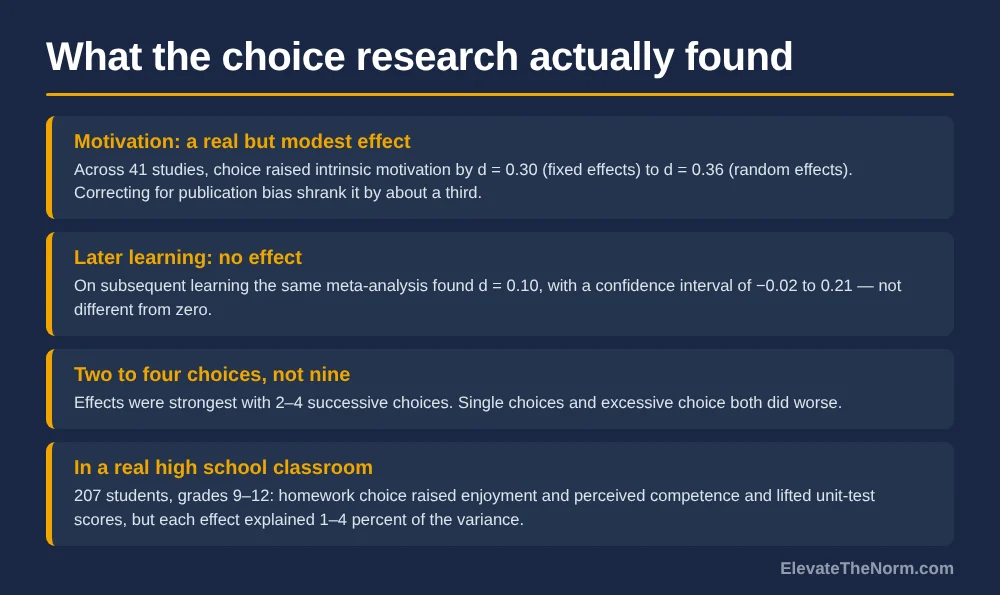
Three of their moderator findings change how you build a board. Choice worked best with two to four successive choices rather than a single choice or an overwhelming array. The benefit shrank when rewards were involved — so stapling a points bonus onto the “fun” square works against you. And the effect was stronger for children than adults, which is a caution for a grades 6–12 audience sitting between those categories rather than a license.
There is one finding here that ought to make every choice-board advocate uncomfortable, including me. The authors report that instructionally irrelevant choices — picking a game icon, choosing which pen to use — produced stronger effects than choices between task versions or activities. The motivational lift may be coming from the act of deciding rather than from the educational substance of what was decided. That does not mean choice boards are worthless. It does mean the honest claim is “this is a cheap way to raise willingness,” not “this is how students learn better.”
What Happened When Someone Tried It in a Real High School
Modest gains across the board, including on the unit test, with each effect explaining one to four percent of the variance.
Patall, Cooper and Susan Wynn ran a within-subjects experiment in the Journal of Educational Psychology in 2010: 207 students, 14 classrooms, two urban high schools, with homework choice for two units and no choice for two others, conditions reversed. The results:
- Interest and enjoyment rose in the choice condition (β = 0.22, p < .01), accounting for about 4.3 percent of the variance.
- Perceived competence rose (β = 0.19, p < .05), about 2.2 percent of variance.
- Unit test scores rose (β = 2.56, p < .05), about 1.3 percent of variance.
- Homework completion was only marginal (β = 4.80, p < .10), about 1 percent.
- No significant effect on perceived effort, task value, or pressure.
Real high school students doing real homework, which makes it unusually relevant here. It is also a study where the biggest effect explained under five percent of the variation between students. Treat choice as a worthwhile adjustment rather than a turnaround strategy and you are reading it correctly.
The Three Conditions a Choice Has to Meet
Idit Katz and Avi Assor put it plainly in their review: merely offering choice is not in itself motivating, and in some cases it can even reduce motivation. They distinguish choosing, which involves a preference, from picking, which is just selecting. A board full of options a student has no preference among produces picking.
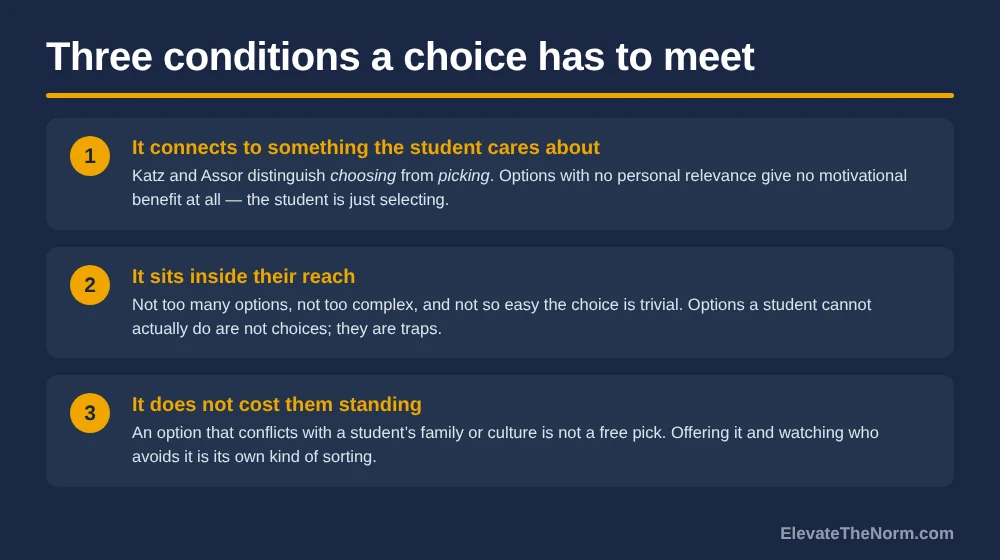
Their three conditions map directly onto board design.
- Relevance to the student’s interests and goals. If every square is a format the student is indifferent about, you have given them a menu in a language they do not read. The fix is usually fewer, better squares built from what you know about the class in front of you — not a template downloaded in August.
- Options that fit their competence. Not too numerous, not too complex, not so easy the choice is trivial. Katz and Assor cite the choice-overload work showing people are more satisfied choosing from a small array than a large one. A student who cannot realistically do four of your six squares has a two-option board that you have made them feel bad about.
- Congruence with the student’s family and culture. This one gets skipped in American classrooms and it should not be. An option that conflicts with a student’s home values is not a free pick; it is a square they must avoid in front of everyone. The fix is in the design, not in the assigning. Build squares that require no student to disclose or perform anything personal — and never pre-assign a student to a square because of what you assume about their background. That is not accommodation, it is sorting with good intentions.
Do Not Justify a Choice Board With Learning Styles
Because the matching hypothesis has been tested and it does not hold.
Rogowsky, Calhoun and Tallal tested the matching hypothesis directly in a study published in Frontiers in Psychology in 2020 and found no support for it: matching instruction to a student’s auditory or visual preference had no effect on achievement, with no sign of the crossover interaction the hypothesis requires. Their sample was 125 fifth graders in one rural Pennsylvania public school, which is below the grade band this site writes for, so read it as consistent with the wider literature rather than as the last word on teenagers. They also cite survey work finding that 93 percent of UK teachers and 96 percent of Dutch teachers agreed that individuals learn better when taught in their preferred style. Nearly everyone believes it. That is why saying it out loud in a meeting feels safe.
You have a better justification sitting right there and it costs you nothing to switch to it: offering a real choice raises willingness by a measured amount, and all the routes assess the same standard. That argument survives contact with a skeptical administrator. “Visual learners” does not, and it sorts students into categories the evidence does not support.
How to Build a Choice Board That Holds Its Shape
One target, three to six options, equal intellectual load, nothing that has to be bought, and a single shared rubric.
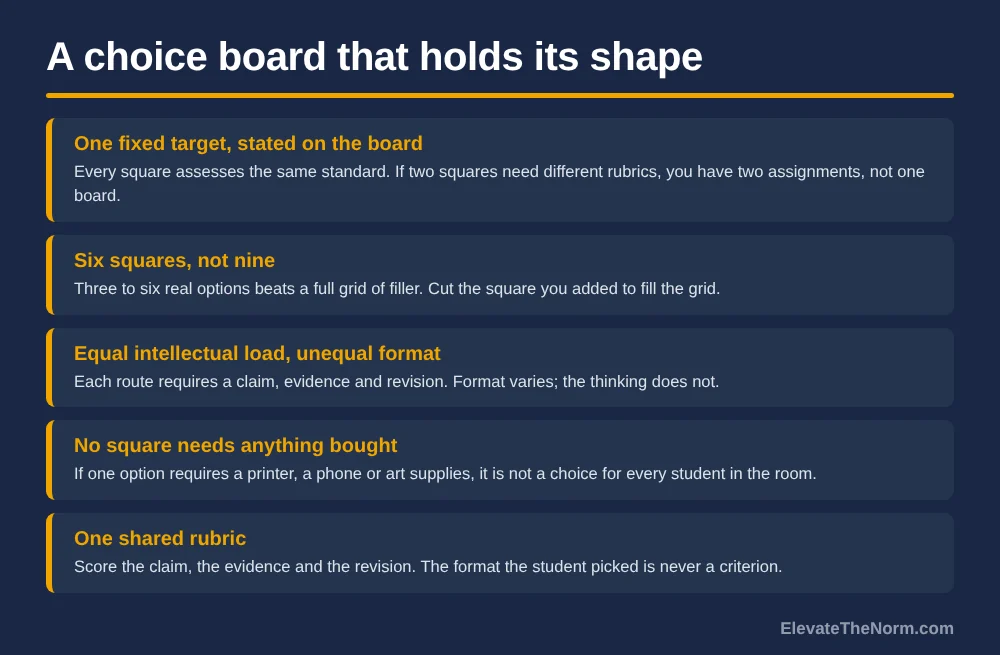
Work in this order.
- Write the target first, as a sentence, and put it on the board. “You will explain how two causes of the same event competed, using evidence from at least two sources.” Every square now has to serve that sentence.
- Write the rubric second — before the squares. If you can write one rubric that fairly scores every option you are imagining, the board is coherent. If you cannot, you have multiple assignments and you should pick one.
- Generate more squares than you need, then cut to six. The square you added to complete a 3×3 grid is almost always the weak one. Cut it. Nobody has ever complained about a board with five good options.
- A choice board does not replace an accommodation. If a student has a documented plan, that plan still governs, and “they could have picked a different square” is not compliance. Build the board, then check it against the plans you are responsible for. The same goes for multilingual learners: a choice of format is not a substitute for language support.
- Check every square for a hidden cost. Printing, poster board, a phone with a working camera, software at home, a quiet place to record. Any square carrying one of those is not a choice for every student in your room, and the students it excludes will not tell you.
- If a square involves recording, check the policy first. A video of a minor is not ordinary student work. Confirm your district’s rules, keep the file out of shared drives, and give students a non-recorded route that scores identically.
- Check that every route requires the same hard part. If the essay square demands a claim with evidence and the infographic square demands six facts in a nice layout, the board is a trap with a difficulty gradient and the students will find it before you do.
Is a Choice Board the Same Thing as Differentiation?
Not quite, and the difference is worth getting straight before a coach asks you about it.
Differentiating by readiness means deliberately varying the difficulty of the work so students are each working at the edge of what they can do. A choice board as described here does the opposite — it holds difficulty constant and varies only the route. Those are two different designs and they pull against each other. If you build a board where one square is clearly easier, you have differentiated by readiness while calling it choice, and the predictable result is that the students who most need the hard version select the easy one.
You can do both, but do them separately and say which you are doing. Vary the scaffolding — a sentence stem, a partially completed organizer, a model paragraph — while keeping the target and the criteria identical. That gets you readiness support without turning a choice into a difficulty setting. What you should not do is let a choice board quietly become the mechanism by which some students are assessed on less.
Choice Board Examples for Grades 6–12
These are structures rather than worksheets. Each row holds the target fixed and varies only the route.
| Subject | Fixed target | Options (pick one) | Shared rubric scores |
|---|---|---|---|
| Social studies | Explain how two causes of one event competed, using two sources | Written argument · recorded three-minute explanation · annotated timeline with a written claim · letter in the voice of a named historical figure, with a source note | Claim, use of evidence, accuracy, revision after feedback |
| ELA | Argue how one character’s choice changes the meaning of the ending | Essay · podcast-style script · annotated passage set with commentary · alternate-ending scene plus a paragraph defending it | Claim, textual evidence, reasoning, revision |
| Science | Use your data to make a recommendation and defend it against one objection | Lab report · a chart plus a written interpretation · three-minute explanation to a non-scientist · a one-page brief for a named decision-maker | Claim, data use, handling the objection, accuracy |
| Math | Model a real situation, then explain where your model breaks down | Worked solution with written commentary · recorded walkthrough · comparison of two models with a recommendation · a problem you wrote plus its solution | Correct modelling, reasoning, naming the limitation, precision |
Notice what is absent: no square asks for a collage, a diorama, a song or a poster with a quotation on it. Those are not banned because they are creative. They are absent because none of them requires a claim defended with evidence, which is the fixed target in every row.

What It Actually Costs You
More prep the first time, more grading every time, and a real constraint if your department runs common assessments.
I am not going to pretend this is free. Six different products take longer to grade than thirty copies of the same essay, because your eye never settles into a rhythm. Budget for that, or run choice boards on formative work and keep the common summative assessment uniform — which is also the answer if your department or district requires a common assessment for a unit. A pacing guide and a shared test are not obstacles to work around quietly; if the summative is fixed, put the choice earlier in the unit where it belongs anyway.
The prep cost is front-loaded and non-recurring. Writing the target and the rubric before the squares takes one planning period. Piloting each square for time takes another. After that the board is reusable, and the second board for the same course takes about twenty minutes because you already have the shape.
Grading a Choice Board Without Writing Nine Rubrics
Score the target, not the product. Three to five criteria, identical across every option: the claim, the evidence, the reasoning, and the revision after feedback. The format the student picked is never a criterion.
Say this to the class on the day you hand out the board, in these words: every square is graded on the same four things, so no option is an easier grade. Students assume the written square is safest because it is the one teachers usually reward. Until you say otherwise out loud, half the room will pick on grading superstition rather than on preference, and you will have measured nothing.
Two failure modes worth naming. The first is scoring effort or creativity, which quietly rewards whoever had time and materials. The second is letting the format carry points — an infographic that looks professional scoring above an unformatted but sharper written argument. If a criterion cannot be applied to all six squares, delete it.
The individual-and-group grading problem, which choice boards run into whenever students pick a collaborative option, is worked through in the project based learning rubric. The same rule applies: a criterion can describe collaboration, but it cannot rescue a grade from weak content.
Where Choice Boards Go Wrong
The most common failure is not a bad square. It is the teacher stepping back after handing out the board.
Johnmarshall Reeve and Sung Hyeon Cheon, reviewing 38 randomized controlled trials of autonomy-supportive teaching, warn specifically that autonomy support gets misapplied as a laissez-faire style. The difference shows up at the moment a student struggles: an autonomy-supportive teacher takes the student’s perspective and supplies resources, while a laissez-faire teacher leaves them to figure it out. Their review reports that students of laissez-faire teachers show high amotivation and poor self-regulation. Giving choice and then going quiet is not the practice. It is the absence of it.
Four more ways boards fail, all fixable:
- The novelty square. Half the class picks the option that looks most fun and least like school, then discovers it is the hardest one. Pilot each square yourself for time before you offer it.
- Choice paralysis. Students who spend a class period deciding have been given a decision without criteria. Say out loud which square is fastest and which goes deepest.
- Same pick every time. A student who selects the written option for the ninth straight board is not exercising choice, they are avoiding risk. Require a different route once per quarter — that is still choice, with a floor.
- The board instead of the teaching. A choice board is a delivery format. It does not teach a student how to write a claim. If nobody in the room can do the fixed target yet, the board is premature and you need the lesson first. The cheapest bridge is one worked exemplar — show a finished example on one route, and name which parts of it are the target rather than the format. Students transfer that to the other squares faster than they transfer a rubric.
If engagement rather than format is the actual problem you are solving, the board may be the wrong tool entirely. Motivating students covers what tends to work when rewards and speeches have stopped working, and the choice-board-sized version of that answer is usually relevance, not more options.
What to Do Next
Take an assignment you already give, write its target as one sentence, and build three alternate routes to it that your existing rubric could score unchanged. Three. Not nine. Offer it once, watch which square gets picked and which gets avoided, and ask two students who picked the same square why.
Send one line home with it, too: “Students chose how to present this; every option was graded on the same four criteria, and the standard did not change.” That sentence answers the only question a parent actually has when their kid submits a recording instead of an essay, and it answers it before they have to ask.
Then keep the honest claim in your pocket for when someone asks: this raises willingness by a measured and modest amount, every route assesses the same standard, and it costs nothing. That is a good enough reason. It does not need “visual learners” propping it up.
If you want the wider set of practices this sits inside — inquiry stations, seminars, peer critique, project roles — the guide to activities for student centered learning covers the whole family, with choice boards as one member of it.
Frequently Asked Questions
What is a choice board?
A set of options, usually laid out as a grid, that each assess the same learning target through a different product or route. The teacher fixes the target and the criteria; the student picks the format. A board where the squares require different kinds of thinking is not a choice board — it is several different assignments printed on one page, and no single rubric will grade it fairly.
Do choice boards actually improve learning?
The evidence supports a motivation effect, not a learning effect. Patall, Cooper and Robinson’s meta-analysis of 41 studies found choice raised intrinsic motivation at d = 0.30 to 0.36. On subsequent learning the same analysis found d = 0.10 with a confidence interval of −0.02 to 0.21, which contains zero. A separate high school study did find a small unit-test gain, but it explained about 1.3 percent of the variance. Treat choice as a cheap way to raise willingness, not as an achievement strategy.
How many options should a choice board have?
Three to six. The meta-analysis found the strongest effects with two to four successive choices, with both single choices and excessive arrays doing worse. A nine-square grid is almost always three good options and six added to fill the shape. Cut the squares you invented for symmetry — nobody has ever complained about a board with five real choices.
Are choice boards good for visual learners?
Do not use that justification. Rogowsky, Calhoun and Tallal tested the learning-styles matching hypothesis directly and found no support for it — matching instruction to an auditory or visual preference had no effect on achievement. Their sample was 125 fifth graders in one school, so read it alongside the wider literature rather than as the final word. Use the better argument: a real choice raises willingness by a measured amount, and every route assesses the same standard. That one survives a conversation with an administrator.
How do you grade a choice board?
With one rubric that applies identically to every square: typically the claim, the evidence, the reasoning, and the revision after feedback. The format the student chose is never a criterion. If a criterion cannot be applied to all the options, delete it. And tell the class out loud that every square is graded on the same things, or students will pick on grading superstition rather than preference.
Is a choice board the same thing as differentiation?
No, and they can work against each other. Differentiating by readiness varies the difficulty of the work; a choice board holds difficulty constant and varies only the route. If one square is visibly easier, the students who most need the harder version will choose the easier one. Do both if you want, but keep them separate: vary the scaffolding — sentence stems, partial organizers, a worked model — while the target and the criteria stay identical.
What if a student picks the same option every time?
That is usually risk avoidance rather than preference, and it is worth naming without punishing. Requiring a different route once a quarter is still choice, just with a floor under it. It also tells you something: a student who will only write may need a low-stakes rehearsal of another format before they will risk it on a graded one.
Do choice boards take more work than a normal assignment?
Yes, and it is worth being honest about where. Six different products take longer to grade than thirty copies of the same essay because your eye never settles into a rhythm. The prep cost — writing the target and the rubric before the squares, then timing each option yourself — is front-loaded and does not recur; the second board for the same course takes about twenty minutes. If your department runs a common summative assessment, put the choice earlier in the unit rather than working around the shared test.
Sources
- Patall, E. A., Cooper, H., & Robinson, J. C. (2008). The Effects of Choice on Intrinsic Motivation and Related Outcomes: A Meta-Analysis of Research Findings. Psychological Bulletin, 134(2), 270–300. 41 studies, 46 samples, 91 effect sizes; intrinsic motivation d = 0.30 (fixed) / 0.36 (random); subsequent learning d = 0.10, 95% CI −0.02 to 0.21 — not different from zero; strongest with 2–4 successive choices; weaker when rewards were present; stronger for children than adults; instructionally irrelevant choices produced stronger effects than choices between task versions. https://selfdeterminationtheory.org/wp-content/uploads/2019/10/2008_PatallCooperRobinson_PsychBulletin.pdf
- Patall, E. A., Cooper, H., & Wynn, S. R. (2010). The Effectiveness and Relative Importance of Choice in the Classroom. Journal of Educational Psychology. Within-subjects experiment, 207 students, 14 classrooms, two urban high schools. Interest/enjoyment β = 0.22 (p < .01); perceived competence β = 0.19 (p < .05); unit test β = 2.56 (p < .05); homework completion marginal (p < .10). No significant effect on perceived effort, task value or pressure, and each significant effect explained 1–4.3 percent of variance. https://selfdeterminationtheory.org/wp-content/uploads/2019/10/2010_PatallCooperWynn_JEP.pdf
- Katz, I., & Assor, A. (2007). When Choice Motivates and When It Does Not. Educational Psychology Review, 19(4), 429–442. Choice supports motivation only when options are relevant to students’ interests and goals, fit their competence (not too numerous or complex, not too easy), and are congruent with family and cultural values. “Merely offering choice is not in itself motivating. In fact, in some cases it can even reduce motivation.” https://selfdeterminationtheory.org/wp-content/uploads/2014/04/2006_Katz-et-al_when-choice.pdf
- Reeve, J., & Cheon, S. H. (2021). Autonomy-Supportive Teaching: Its Malleability, Benefits, and Potential to Improve Educational Practice. Educational Psychologist. Review of 38 randomized controlled trials. Warns explicitly that autonomy support is mis-applied as a laissez-faire style, and that students of laissez-faire teachers report high amotivation and poor self-regulation. Reported student effect sizes ranged widely, from d = 0.18 to d = 2.92. https://selfdeterminationtheory.org/wp-content/uploads/2021/05/2021_ReeveCheon_AutonomySupportive.pdf
- Rogowsky, B. A., Calhoun, B. M., & Tallal, P. (2020). Providing Instruction Based on Students’ Learning Style Preferences Does Not Improve Learning. Frontiers in Psychology, 11:164. No support for the matching hypothesis. Sample: 125 fifth graders (ages 10–11) in one rural Pennsylvania public school — below this site’s grades 6–12 band. Cites Dekker et al. (2012) finding 93 percent of UK and 96 percent of Dutch teachers endorsed the learning-styles claim. https://www.frontiersin.org/journals/psychology/articles/10.3389/fpsyg.2020.00164/pdf