By Clay Shumate
The jigsaw method splits a text into sections, makes each student the expert on one section, then has them teach it to their group. Elliot Aronson built it in 1971 to cut classroom hostility, not to raise test scores. The achievement evidence is split down the middle: large in small studies, zero in the largest randomized test.
Key Takeaways
- The jigsaw method was designed to fix a social problem, not an academic one. Aronson invented it in 1971 after Austin desegregated its schools and fights broke out, because his team concluded the competitive structure of the classroom was feeding the hostility.
- The achievement evidence does not agree with itself. A 2023 meta-analysis of 43 studies found a large effect on achievement, Hedges’ g = 0.77. Five randomized experiments with 850 students, published in the Journal of Educational Psychology in 2022, found an effect of exactly 0.00.
- Small studies report much bigger effects than large ones. In the same meta-analysis, studies with fewer than 102 participants averaged g = 1.01; studies with 102 or more averaged g = 0.33, and that larger-study figure was not statistically significant.
- The version with individual accountability is the version with support behind it. Slavin’s synthesis found studies of the original jigsaw “have not generally supported this approach,” while Jigsaw II — which adds individual quizzes and team scores — showed positive effects.
- The expert group is the quality-control step, and it is the one teachers skip. If a student leaves their expert group with a wrong idea, three or four peers learn the wrong idea from them, and the only person who can catch it is you.
What Is the Jigsaw Method?
The jigsaw method is a cooperative learning structure in which a body of content is divided into sections, each student is made responsible for one section, and students then teach their section to the rest of their group. No student can complete the task alone, because no student has all the pieces.
That last sentence is the whole design. The name is the point: each student holds one piece of the puzzle, so the group only sees the picture if everybody hands over a piece that fits. The structure manufactures a reason to listen to the kid next to you, which is a different thing from asking students to be nice to each other.
Two group arrangements run at once, and the vocabulary matters because the two get mixed up constantly:
- Home group (sometimes called the jigsaw group) — the student’s base team, where every section is represented exactly once. AdLit, the adolescent literacy project run by WETA puts these at three to five students; Aronson’s original used five or six.
- Expert group — a temporary regrouping of everybody who was assigned the same section, so they can work out what their section means and rehearse how to explain it before they have to.
If you run the first without the second, you are not running a jigsaw. You are running a reading assignment with a presentation attached, and the thing that makes jigsaw work has been removed. For the wider research on why structured collaboration beats unstructured collaboration, this site has a separate piece on what the cooperative learning research actually supports; this article is about the one named structure.
Where Did the Jigsaw Method Come From?
Elliot Aronson and his graduate students invented the jigsaw in 1971 in Austin, Texas. The city had recently desegregated its schools, students from groups with a long history of forced separation were suddenly in the same rooms, and according to Aronson’s own account of the jigsaw classroom “fist-fights erupted in corridors and schoolyards across the city.” The superintendent asked for help.
After watching classrooms, Aronson’s team concluded that the hostility was being fed by the competitive environment of the classroom itself. Their response was to change the structure rather than lecture the students: build a task where students need each other to succeed, and the social arithmetic changes on its own.
Aronson reports that after eight weeks, jigsaw students showed less prejudice and stereotyping, liked school more, were absent less, and that lower-performing students scored significantly higher on objective exams than comparable students in traditional classrooms, while higher-performing students did about as well as their counterparts. Read that as the originator’s own account of his own method, because that is what it is. It is the starting point for the research, not a substitute for it.
It is worth knowing the origin because it explains the evidence pattern further down. Jigsaw was built as an intervention on classroom relationships. Most of what people now claim for it is about test scores. Those are not the same claim, and they have not held up equally well.
Does the Jigsaw Method Actually Improve Learning?
The honest answer is that the evidence is split, and the split is not subtle. The largest meta-analysis found a big positive effect on achievement. The largest set of randomized experiments found no effect at all. Both are peer-reviewed, both are recent, and any page that gives you only one of them is selling you something.
The case for it
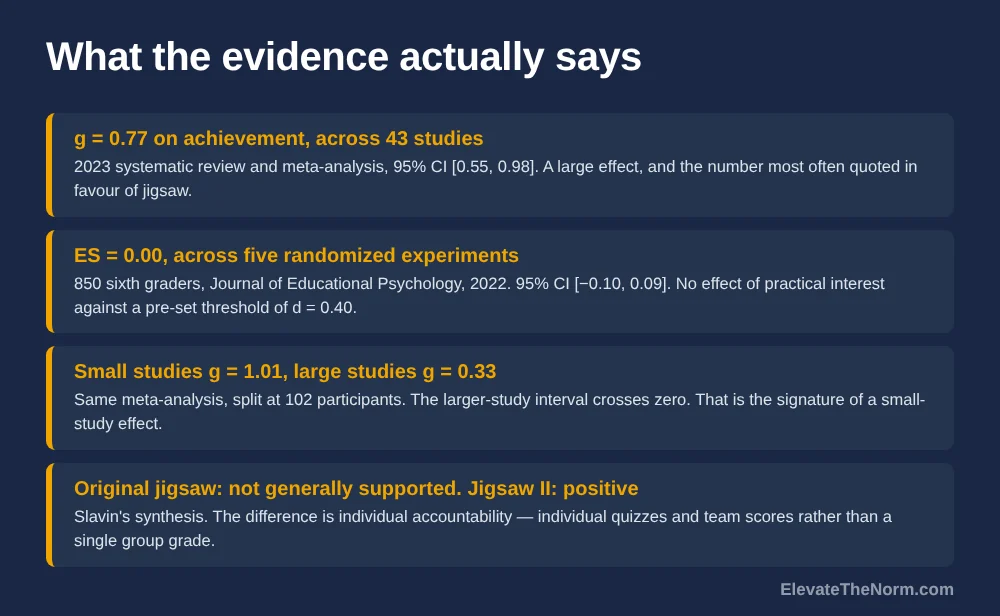
Cochon Drouet, Lentillon-Kaestner and Margas (2023) reviewed 69 jigsaw studies and meta-analysed 43 of them for achievement. The pooled effect was Hedges’ g = 0.77, 95% CI [0.55, 0.98], p < 0.001. By the usual rough conventions that is a large effect, and it is the number most often quoted in favour of jigsaw.
The same review found much less for everything else. Motivation came out at about g = 0.47 and was not statistically significant (p = 0.17). Social relations came out at g = 0.28, also not significant (p = 0.19). Academic self-esteem was not significant either. That is a slightly awkward result for a method invented to improve how students treat each other, though only three or four studies entered each of those analyses, which is far too few to settle anything.
The case against it
In 2022 the Journal of Educational Psychology published Stanczak and colleagues (2022): five randomized experiments with 850 students in total, two run as single sessions by researchers and three run across a semester by volunteer classroom teachers. The individual effect sizes were −0.04, 0.00, −0.07, 0.05 and 0.05. The internal meta-analysis came out at ES = 0.00, 95% CI [−0.10, 0.09], with negligible heterogeneity.
The authors are careful about what that means. They write that they “cannot conclude the absence of an effect,” but that jigsaw “did not increase learning outcomes to an extent deemed of practical interest” against the threshold they set in advance. They also think the older literature oversold it: much of it used small samples, and they note that the widely repeated d = 1.20 figure attributed to Hattie “comes from one meta-analysis of 11 studies all conducted in Turkey,” which they call unusual. If you have seen d = 1.20 on a slide at a professional development day, that is where it came from.
One important limit on this study: the participants were French sixth graders, roughly ten to thirteen years old. It is the youngest end of the grades 6–12 band and a single national context. It does not tell you what happens in an upper-level high school history class.
Why both results can be true
The meta-analysis contains the explanation for the disagreement, and it is the most useful number on this page. Split by sample size, studies with fewer than 102 participants averaged g = 1.01 [0.69, 1.33], while studies with 102 or more averaged g = 0.33 [−0.04, 0.70] — a confidence interval that crosses zero. The difference between those groups was large and highly significant, Q(1) = 52.78, p < 0.001.
That is the classic signature of a small-study effect: as studies get bigger and harder to run loosely, the effect shrinks toward nothing. The review’s own authors flag that 17 of their 43 achievement studies reported effect sizes above 1.0 as a possible concern, and heterogeneity across studies was enormous (I² = 91.03%). The five-experiment null result is, in sample terms, one of the large studies.
So the defensible summary is this: jigsaw probably does something, the something is smaller than the headline numbers, and it depends heavily on how the thing is actually run. Which brings us to the part that decides it.
What Separates a Jigsaw That Works From One That Doesn’t?
Individual accountability. Slavin’s synthesis of the cooperative learning research concluded that two elements must be present for cooperative learning to raise achievement: a group goal, and a structure in which “the success of the group must depend on the individual learning of every group member.” Jigsaw often ships without the second one.
Slavin is blunt about the original version. He writes that studies of the original jigsaw method “have not generally supported this approach,” but that studies of Jigsaw II — his own modification, which uses four- or five-member teams, a common text, individual quizzes and team scores built from individual improvement — “have shown positive effects.”
Read those two sentences together and the practical instruction is obvious. The difference between the version with weak research support and the version with better support is not the regrouping, the expert groups, or the teaching-each-other part. It is whether every individual student is separately answerable for the whole body of content at the end. Aronson knew this too — step ten of the ten steps published on jigsaw.org is a quiz, and the stated reason is “so that students see that the sessions count.”
If your jigsaw ends with a group poster and a group grade, you have built the version the research does not support. It is a one-line fix and it is the single highest-value change you can make to this activity.
How Do You Run a Jigsaw in One Class Period?
Five moves: divide the content into equal sections, assign one to each student, send same-section students to expert groups to work it out and rehearse, send them home to teach it, then quiz every student individually on all of it. In a fifty-minute period that is roughly 5 / 12 / 20 / 8 minutes with the quiz the next day.
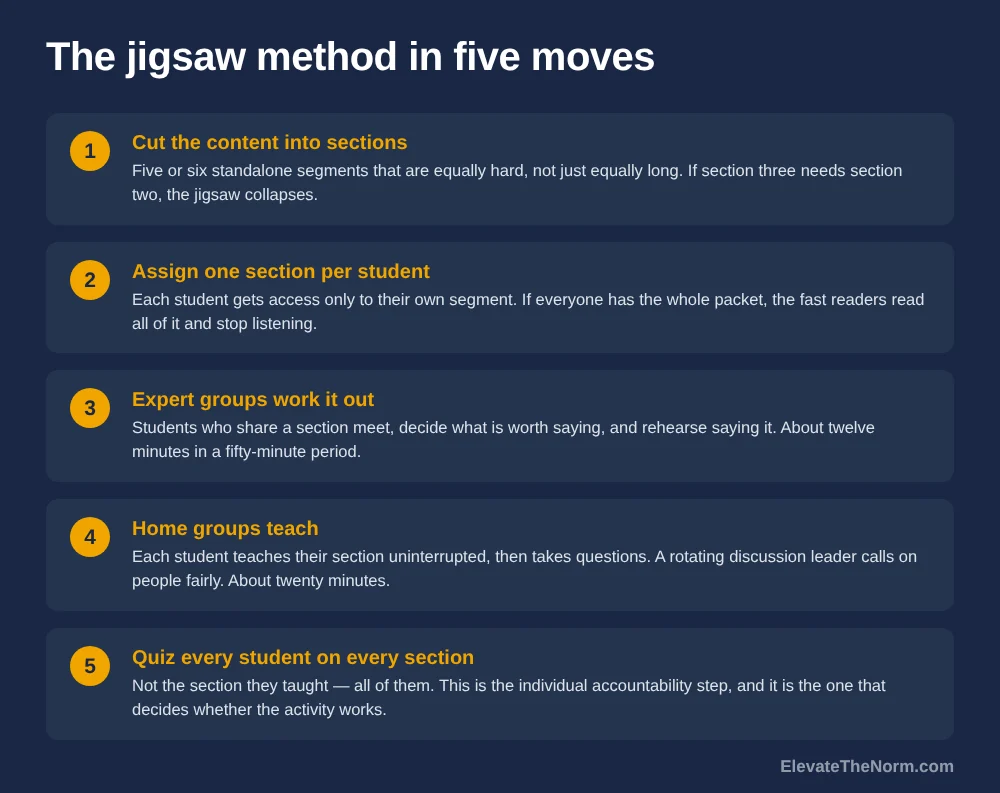
- Cut the content into sections that are genuinely separable and genuinely equal. Aronson’s step three is to divide the lesson into five or six standalone segments. If section three only makes sense after section two, the jigsaw collapses, because the student holding section three cannot become an expert on it alone. Equal difficulty matters as much as equal length.
- Assign one section per student, and give each student access only to their own. This is Aronson’s step four and it feels wrong the first time you do it. It is also what creates the dependence the method runs on. If everyone has the whole packet, the fast readers read all of it and stop listening. Assign the sections deliberately rather than by counting off — which student gets which section is the main differentiation lever this activity gives you, and it costs nothing to use it.
- Run the expert groups and do not cut them short. Students who share a section meet, argue about what it means, decide what the three or four things worth saying are, and rehearse saying them. Aronson’s own troubleshooting notes advise that they “discuss their report and modify it based on the suggestions of other members.” This is the step that gets cut when the period runs long, and cutting it is what breaks the activity.
- Send students home and have each one teach. One at a time, uninterrupted, then questions. Aronson suggests appointing a discussion leader “on a rotating basis” to call on people fairly, and floating between groups yourself rather than sitting down. If a group has a member dominating or checked out, that is the moment to deal with it.
- Quiz every student individually on every section. Not the section they taught. All of them. This is the accountability step from Slavin’s synthesis and Aronson’s step ten, and without it the activity is a social event with reading attached.
Three logistics notes that save a lot of pain. First, AdLit, the adolescent literacy project run by WETA recommends students have some experience with small-group work before you try this, which is fair — a jigsaw asks students to run two different group structures in one period. Second, plan something for students who finish the reading early, because reading speeds inside a single section vary more than you expect.
Third, your class will not divide evenly, and that is fine. With five sections and 27 students you get five home groups of five and one of two, so double up instead: give two students the same section in the larger groups and let them co-teach it. Doubling a section is harmless. Leaving a home group without one is not, because that group never receives that content at all.
The room matters more than people admit, too. A room already arranged in table groups can regroup twice in a period without losing four minutes each time. A room in rows cannot, and the transitions will eat the expert group step — which is exactly the step you cannot afford to lose.


How Is the Jigsaw Method Different From Think Pair Share or Plain Group Work?
Jigsaw is the only one of these formats where students hold different information. Think pair share, group work and stations all have students working on the same material at the same time. In a jigsaw, the information is deliberately split, which is what makes the listening non-optional and what makes the preparation expensive.
| Structure | What each student owns | Time to run | Grade fit | Main drawback |
|---|---|---|---|---|
| Jigsaw method | One section nobody else in the home group has | A full period, plus a quiz | 6–12, strongest once students can already work in small groups | One student’s misunderstanding spreads to the whole home group |
| Think pair share | The same question as everyone else | About 90 seconds | 6–12, works cold with no training | Too short to carry new content; checks thinking, does not teach a unit |
| Plain group work | Usually nothing specific | Flexible | 6–12 | One student can do the task while the rest watch |
| Stations | Every station, in turn | A period or more | 6–12 | No interdependence — students can skip a station and still finish |
| Expert panel | One topic, presented to the whole class | Multiple periods | 9–12, needs presentation stamina | Most of the class is an audience for most of the time |
The comparison also tells you when not to reach for a jigsaw. If the content is one idea rather than four parallel ones, a ninety-second discussion routine does the job in a fraction of the time. If you want students talking but the material is shared, you want a discussion protocol, not a jigsaw. Jigsaw earns its setup cost when you have a genuinely divisible body of content — four causes, five court cases, six organ systems, four accounts of the same event — and you would otherwise have lectured all of it.
That last case is where it fits a social studies or science room naturally. Four short documents on the same event, one per student, is a jigsaw that also does the work of teaching students to read a primary source.
Where Does the Jigsaw Method Break?
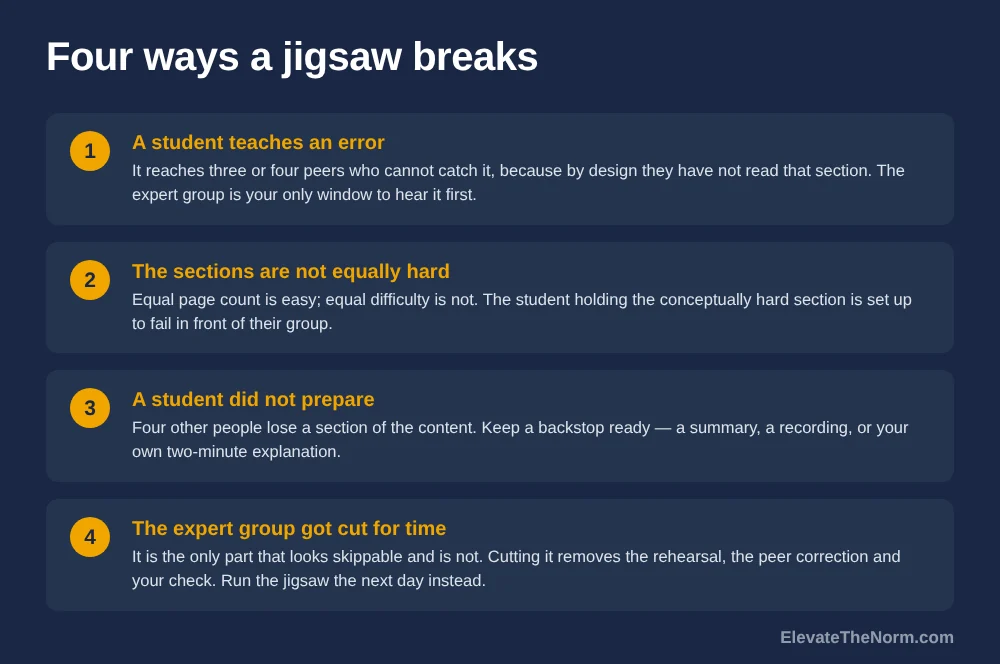
In four predictable places: a student teaches something wrong, the sections are unequal in difficulty, one student does not prepare and their group simply never learns that section, and the expert group step gets cut for time. Three of the four are design problems you can fix before the lesson starts.
1. The error that spreads
This is the one that worries teachers most, and it should. In a normal lesson a misunderstanding sits in one student’s head until a check for understanding finds it. In a jigsaw, a misunderstanding gets taught, with authority, to three or four peers who have no way to know it is wrong, because by design they have not read that section.
Aronson addresses it directly: “Teachers must make sure that students with poor study skills do not present an inferior report to the jigsaw group,” and “in the early stages, teachers may want to monitor the expert groups carefully.” That is the fix, and it is unglamorous. The expert group is your quality-control window, and it is the only one you get. Once students scatter to their home groups, whatever they believe is what gets taught.
Clay’s take, as a grades 6–12 teacher: this is the same job as circulating during any group task and catching a misconception out loud before it spreads, which is ordinary practice in a workshop-style room. The difference is the clock. In a jigsaw you have one defined window to do it in, and if you spend that window at your desk setting up the next activity, you have given up the only control you had.
2. Sections that are not equally hard
Splitting a chapter into five sections of equal page count is easy. Splitting it into five sections of equal difficulty is not. If section four is the conceptually hard one, the student holding it is set up to fail publicly, and four other students lose that content. Read your own segments as a student before you hand them out, and move the hard part.
3. The student who did not prepare
In most group work, a student who does nothing costs mainly themselves. In a jigsaw they cost four other people a section of the content, which is why the structure needs a backstop. Have the section available — a summary you can hand over, a short recording, your own two-minute explanation — so a home group is never simply missing a fifth of the material. The individual quiz handles the accountability; the backstop handles the learning.
Absence is the same problem arriving without warning, and it is more common than non-preparation. A student out sick on jigsaw day leaves a hole in one home group and comes back owing a section nobody taught them. The same backstop covers both, which is the practical argument for building it once rather than improvising on the day.
4. The expert group got cut
The expert group step is the only part of a jigsaw that looks skippable and is not. When a period runs short, the instinct is to let students read and go straight to their home groups. That removes the rehearsal, the peer correction, and the chance for you to hear what they are about to teach. If you are out of time, run the reading one day and the jigsaw the next rather than running half a jigsaw.
There is honest evidence on the difficulty question too. The 2023 review reports that qualitative studies in its set found wide differences in student ability inside a group can make peer teaching hard and can create social friction, and that the demands of the content itself may matter more than the subject area. That is not a reason to avoid mixed-ability groups — mixed grouping was the entire point in Austin in 1971 — but it is a reason to build the supports in advance rather than hoping.
Is the Jigsaw Method Worth It in Grades 6–12?
It is worth it for content that genuinely divides into parallel parts, and it is not worth it as a general-purpose engagement activity. The setup cost is real: segmenting content properly takes longer than planning a lecture on the same material, and the evidence does not promise you a payoff big enough to spend that time weekly.
One caution that comes from Aronson himself and is usually left off the enthusiastic write-ups: Aronson’s own troubleshooting notes state that “research suggests that jigsaw has its strongest effect if introduced in elementary school,” and that students who meet it later can still adapt but usually take longer. A lot of the jigsaw material online is written for elementary classrooms and quietly assumes that reality. If you are starting a jigsaw with ninth graders who have spent eight years in individual-and-competitive classrooms, expect the first one to go badly and plan a second.
Clay’s take: the method is sound and the marketing around it is not. What jigsaw does well is make listening to a peer structurally necessary instead of socially optional, and that is a real thing to want in a room full of teenagers. What it does not do is reliably raise test scores, and the number of PD slides claiming otherwise on the strength of eleven studies from a single country is a fair reason to be suspicious of effect sizes generally.
Used two or three times a unit on content that actually splits, with real expert groups and an individual quiz at the end, it is a good use of a period. Used as a way to fill a Friday, it is reading comprehension with extra transitions.
One thing worth saying to anyone above the classroom level: this is not a method to mandate. It costs nothing in materials, which makes it tempting as a district-wide initiative, but an effect that ranges from 0.77 to 0.00 depending on who measured it is not a foundation for a requirement. Make it available, train it properly, and leave it to teacher judgment about which content actually divides.
What to Do Next
Pick one upcoming lesson where you were going to deliver four or five parallel things — causes, cases, systems, perspectives — and convert that one. Do not convert a lesson with a single central idea; it will not work and you will blame the method.
- Write your sections, then read them as a student and check they are equally hard, not just equally long.
- Put the expert group on the clock and protect it. Twelve minutes is a reasonable first attempt for a fifty-minute period.
- Write the individual quiz before you teach the lesson. If you cannot write a fair quiz covering all sections, your sections are wrong.
- Spend the expert group window listening, not preparing. That is your only chance to catch an error before it is taught.
- Afterwards, ask students to assess their own contribution rather than grading the group as a unit — and if you want students to have defined jobs inside the home group as well, the evidence on handing out group work roles is thinner than you would hope.
Sources
- Cochon Drouet, O., Lentillon-Kaestner, V., & Margas, N. (2023). “Effects of the Jigsaw method on student educational outcomes: systematic review and meta-analyses.” Frontiers in Psychology, 14, 1216437. Cochon Drouet, Lentillon-Kaestner and Margas (2023). Source of the achievement effect of g = 0.77 [0.55, 0.98] across 43 studies, the non-significant results for motivation, social relations and academic self-esteem, the sample-size moderator (g = 1.01 under 102 participants versus g = 0.33 at 102 or more), I² = 91.03%, and the authors’ own flag that 17 of 43 studies reported effects above 1.0. Read in full.
- Stanczak, A., Darnon, C., Robert, A., Demolliens, M., Sanrey, C., Bressoux, P., Huguet, P., Buchs, C., Butera, F., & the PROFAN Consortium (2022). “Do Jigsaw classrooms improve learning outcomes? Five experiments and an internal meta-analysis.” Journal of Educational Psychology, 114(6), 1461–1476. Stanczak and colleagues (2022). Source of the five randomized experiments (N = 850 French sixth graders), the individual effect sizes, the internal meta-analytic ES = 0.00 [−0.10, 0.09], the pre-set smallest effect size of interest of d = 0.40, and the criticism of the d = 1.20 figure as resting on one meta-analysis of 11 studies from a single country. Read in full as the author manuscript hosted by the University of Lausanne; the published version of record sits behind the APA paywall.
- Slavin, R. E. (1991). “Synthesis of Research on Cooperative Learning.” Educational Leadership, ASCD, February 1991. Slavin’s synthesis of the cooperative learning research. Source of the finding that studies of the original jigsaw “have not generally supported this approach” while Jigsaw II showed positive effects, and of the two required elements — group goals and individual accountability. Read in full.
- Aronson, E., and colleagues. The Jigsaw Classroom — history, the ten implementation steps, and troubleshooting tips. Aronson’s own account of the jigsaw classroom, the ten steps published on jigsaw.org and Aronson’s own troubleshooting notes. Source of the 1971 Austin origin, the eight-week outcomes, the ten-step procedure, the rotating discussion leader, the instruction to monitor expert groups early, and the statement that jigsaw has its strongest effect if introduced in elementary school. This is the originator’s own account of his own method and is cited as such, not as independent evidence. Read in full.
- AdLit (WETA). “Jigsaw.” AdLit, the adolescent literacy project run by WETA. Source of the home group size of three to five, the home-group/expert-group procedure for adolescent readers, and the cautions about prior small-group experience and varied reading speeds. AdLit describes jigsaw as a well-established method but cites no studies for it, so it is used here for practice guidance only. Read in full.
What is the jigsaw method in simple terms?
A way of teaching content by splitting it up. The material is divided into sections, each student gets one section and becomes the expert on it, students who share a section meet to work it out together, and then everyone returns to their home group and teaches their piece. Nobody can finish the task without the others.
What about a student who finds presenting to their group hard?
Presenting is not optional in a jigsaw, which makes it harder than a short routine like think pair share. Give a route that does not depend on performing: let them hand over written notes and talk through those, rehearse once in the expert group first, or pair them with a co-expert for the first attempt. Rotating the discussion leader stops one student fronting every session.
Does the jigsaw method improve test scores?
The evidence disagrees with itself. A 2023 meta-analysis of 43 studies found a large effect on achievement, g = 0.77. Five randomized experiments with 850 students, published in 2022, found an effect of 0.00. Small studies in that meta-analysis averaged g = 1.01 against g = 0.33 for larger ones, which suggests the headline figure is inflated.
How long does a jigsaw take?
Plan a full class period plus a quiz, usually the next day. A workable fifty-minute split is about five minutes to set up and assign sections, twelve in expert groups, twenty in home groups teaching, and eight to close. Longer implementations are common; the 2023 review found a mean duration of 13.76 hours across studies.
How do you stop a student from teaching their group something wrong?
Listen in on the expert groups, which is the only window you get. Aronson’s own guidance is that teachers must make sure students with weak study skills do not bring an inferior report to their home group, and that expert groups should be monitored carefully early on. Once students scatter, whatever they believe is what gets taught.
What happens if a student does not prepare, or is absent?
Four other students lose a section of the content, which is harsher than most group work. Keep a backstop ready for both cases: a summary, a short recording, or your own two-minute explanation of that section. An individual quiz on all sections handles accountability separately, so the backstop can stay focused on the learning.
Is the jigsaw method only for elementary school?
No, but a lot of the published material about it is. Aronson’s own site states that research suggests jigsaw has its strongest effect if introduced in elementary school and that older students take longer to adapt. In grades 6 to 12, expect the first attempt to be rough and plan a second rather than writing the method off.
Should a jigsaw get a group grade?
No. Slavin’s synthesis found cooperative learning raises achievement when group success depends on the individual learning of every member, and that studies of the original jigsaw, which lacked that, did not generally support it. Quiz every student individually on every section. A group poster and a group grade build the version the research does not back.