By Clay Shumate
Think pair share is a three-step discussion routine: students think alone about a question, talk it over with a partner, then share with the class. In grades 6–12 a full cycle fits in about 90 seconds. The evidence is stronger for participation and thinking time than for test scores, and the learning results are mixed.
Key Takeaways
- Think pair share is a 90-second routine, not a lesson. Students think alone, compare answers with one partner, then report to the class. It works as a check on one question, not as a way to teach a unit.
- The think step does the real work. Teachers typically wait about one second after asking a question; the IRIS Center recommends three to five. A silent, written think step builds that pause into the routine.
- The learning evidence is thin and mixed. A college nursing study found larger critical-thinking gains with the routine. A high school chemistry comparison found no significant difference in learning gain.
- The participation evidence is more encouraging. In a study of ninth graders, adding a pair step produced more hand-raising than asking for volunteers cold, and it helped shyer students most.
- Most failures are design failures. One partner dominates, nobody thinks first, or the share hides what the pairs said. Each has a specific fix, and none of the fixes costs more than a minute of preparation.
Think pair share is one of the first routines most teachers learn and one of the easiest to run badly. The usual version is a question, a vague instruction to “turn to your partner,” and three volunteers who would have answered anyway. That version takes two minutes and tells you nothing you did not already know.
This guide covers what the routine is, a version tight enough to run in about 90 seconds, what the research does and does not support, and where it breaks. The timings and steps are compiled from the sources at the end and from the structures those sources describe. Read them as recommendations, not as a record of any one classroom.
What Is Think Pair Share?
Think pair share is a cooperative discussion strategy in which a teacher poses a question, students think about it individually, discuss it with a partner, and then share their thinking with the whole class. It is usually credited to Frank Lyman and colleagues at the University of Maryland in 1981.
Kaddoura’s 2013 study in Educational Research Quarterly describes the three phases this way: think, where students spend a few minutes alone with the prompt; pair, where they compare notes and identify the strongest answers; and share, where pairs report to the class. The structure is the point. A routine that skips the first step is a partner chat. A routine that skips the last is a private conversation the teacher never hears.
It also sits in a family of structures that are easy to confuse. The table below separates the ones teachers most often swap for each other.
How think pair share differs from the formats near it
| Format | Typical length | Group | Individual thinking first? | Best when you want |
|---|---|---|---|---|
| Think pair share | About 90 seconds | Pairs, then whole class | Yes, by design | A quick check of one idea, with every student answering |
| Cold call | Under a minute | One student | No | Accountability for one answer |
| Small-group discussion | Five to fifteen minutes | Three to five students | Sometimes | A task with several parts that students split |
| Socratic seminar | A full period or a large part of one | Whole class | Prepared in advance | Sustained discussion of a text or question |
If you want the long version of whole-class talk, that is a different page: the guide to Socratic seminar covers it, and student discourse covers the broader question of how to get students talking to each other in the first place. If what you need is accountability for a single answer, cold calling is the tool. Think pair share is the 90-second structure in between.
How Do You Run Think Pair Share in 90 Seconds?
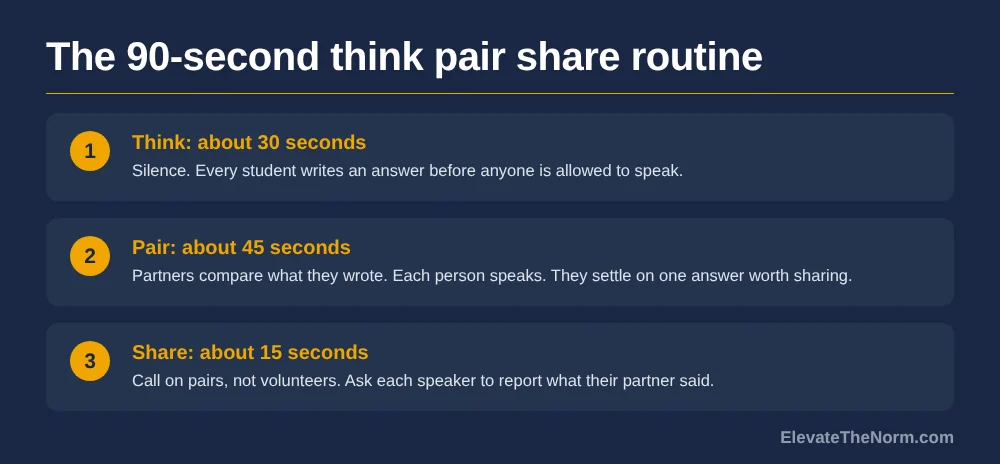
Ask one question, give about 30 seconds of silent, written thinking, give partners about 45 seconds to compare, then spend about 15 seconds calling on pairs. Name the partner, the question, and the clock before you start, and keep the timer visible.
- Choose a question worth ninety seconds. A question with one correct answer is a quiz, and a pair has nothing to settle. Ask something with more than one defensible answer, or with a reason that has to be stated.
- Fix the partners before the question. Assign pairs in advance, even if it is only the person next to them. Looking for a partner is where the first 20 seconds go.
- Start the clock and make the think step silent and written. Thirty seconds, a sentence on paper. Silence is what separates this from a conversation, and writing is how you can later see who thought.
- Tell students what the routine is for. One sentence is enough: you want everyone to have a chance to think before the loudest answer lands. Students who understand the purpose are less likely to treat it as busywork.
- Tell partners who speaks first. “The person closer to the window starts.” Without it, the more confident student starts every time, and the other student agrees.
- Pair for about 45 seconds. The job is to compare answers, say why, and settle on the best one or agree on the difference. Walk the room while they do it and listen to a few pairs, not all of them.
- Call on pairs, not volunteers. Ask a speaker to report what their partner said. That one move gives every student a reason to listen to the person beside them.
- Close the loop on the same question. Say what the best answers had in common, fix a misconception if you heard one, and move on. If you ask a question and then do nothing with the answers, students correctly conclude it did not matter.
Those timings are a starting point. A question that asks students to compare two documents will need longer than one that asks them to pick a side. The point of a number is that the routine ends; a think pair share with no clock grows into five minutes of unstructured talk.
Does Think Pair Share Actually Work?
The honest answer is partly. Studies show it can increase participation and, in one college trial, critical-thinking gains. A comparison in a high school chemistry class found no significant difference in learning gain. Almost none of the evidence is from a randomized trial in grades 6–12.
Here is what each study measured, and on whom:
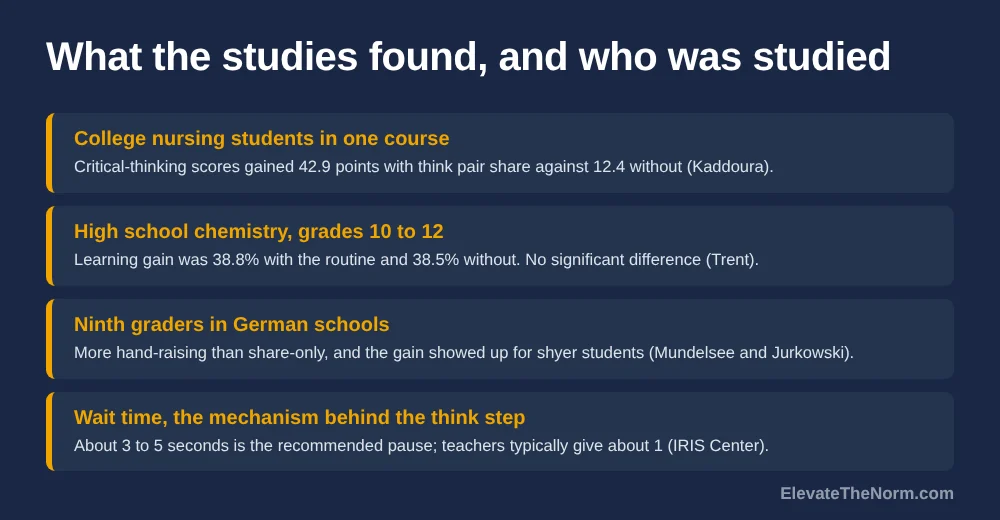
- College nursing students. Kaddoura compared two sections of one Health Assessment course over 17 weeks, with the routine added to one. Critical-thinking scores gained 42.9 points in the think pair share section and 12.4 in the other, a significant difference. The sample is about ninety sophomore nursing students at one college; the paper gives 91 in the abstract but 86 in its method section, and which section got the routine was decided by a coin flip rather than by randomizing students. The author notes the single-program limit himself. This is not a secondary-school result.
- High school chemistry. In a master’s thesis at Louisiana State University (Trent, 2013), a class using the routine was compared with a comparison class of chemistry students in grades 10 to 12; the thesis describes which material each group used inconsistently. Both groups improved. Learning gain was 38.8 percent with the routine and 38.5 percent without, and the difference was not significant. The sample was small, 14 students analyzed in the comparison class and 32 in the other, the groups were not randomized, and the comparison students were also talking with partners informally.
- Ninth graders. Mundelsee and Jurkowski compared share-only, think-then-share and full think pair share in German schools. The full routine produced more hand-raising than share-only, and the benefit was larger for students who reported being shyer. I read a summary of this study, not the paper. It measured voluntary participation, not learning.
Read together, the pattern is consistent and modest. Adding a pair step makes it easier for students to speak. It has not been shown to make every group learn more than they would have with another well-run discussion routine. That is a reasonable thing to adopt a routine for, as long as you say so out loud and do not borrow a claim about test scores.
Why Does the Think Step Matter?
Because it forces a pause that most classrooms skip. The IRIS Center recommends waiting three to five seconds after a question and notes that teachers typically wait about one second. Longer waits are linked in that literature to longer answers and more participation from lower-performing students.
The IRIS Center fundamental skill sheet on wait time traces the idea to Rowe’s research from the early 1970s and says later work has confirmed it. It also reports that the highest-performing students tend to get about two seconds and the lowest-performing less than one. That is the reason the think step is silent and written. A teacher who asks a question and takes the first hand is, without meaning to, picking the students who already think fastest.
One caution from the same sheet: the pause feels like dead time at first, and teachers drift back to fast pacing within a few weeks. Putting a timer on the board is a cheap defence against that. It also removes the temptation to rescue students from the silence by answering your own question.


Where Does Think Pair Share Break?
It breaks at four predictable points: one partner dominates, students do not actually think before talking, the share stage shows only what volunteers want to say, and the teacher cannot hear every pair. Each is fixable with structure rather than with more enthusiasm.
Ben Crockett, writing for the Durrington Research School, lists most of these and is careful about what he does not know: he says the evidence base is limited and that many of his concerns come from reflection rather than data. He points to research suggesting the rich conversation that happens in pairs often does not make it into the whole-class share. His proposed fix is to make pair thinking visible, for example with mini whiteboards, so the teacher can see it and use it.
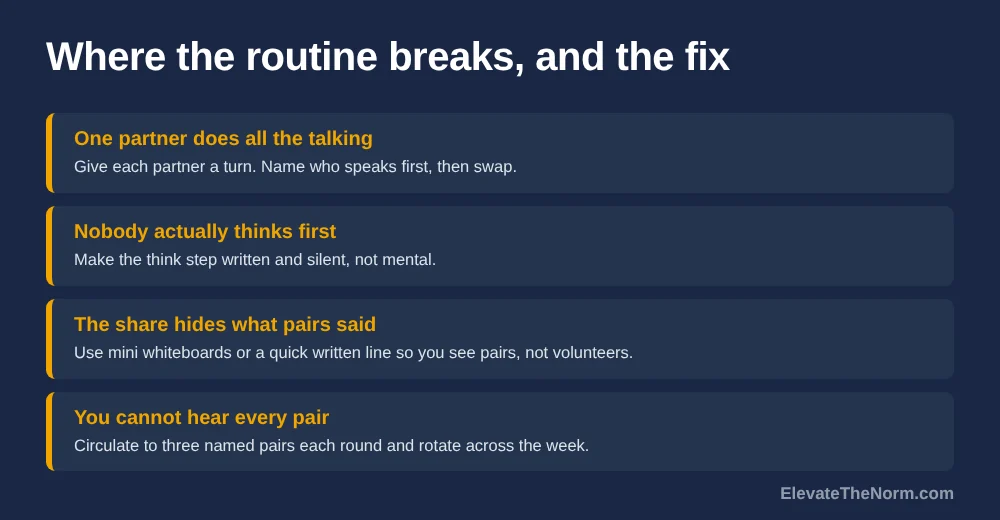
- One partner does the talking. Name who speaks first and give each partner a turn. Ask each speaker to report their partner’s idea so listening counts.
- Nobody thinks first. The think step has to be written and silent. A mental think step is the first thing students skip.
- The share hides the pairs. Use a mini whiteboard or one written line per pair so you see all of them, not only the volunteers. Then pick two pairs whose answers differ and have them respond to each other.
- You cannot hear every pair. Circulate to three named pairs each round and rotate across the week, so every pair is heard on a schedule rather than by luck.
- The question is too easy. If every pair says the same thing in ten seconds, the question was a recall check. Use a one-sentence quick write or a hand-raise instead, and save the routine for a question with real disagreement in it.
A related warning appears in Watson’s summary of the German study at Learning & the Brain. Without any accountability, a student with a partner can simply reuse the partner’s idea instead of thinking. That is why the written think step and the “report your partner’s answer” move matter: they are the accountability. For the broader picture of structured pair and group work, see what cooperative learning is, and the catch.
Who the routine can leave out
Two groups need a plan before you start. Students who find speaking to a peer hard, whether from anxiety, a language barrier or a speech difference, should have a way to take part that does not depend on talking: they can read what they wrote, or hand it to their partner. The German study suggests the pair step helps shyer students, but it measured hand-raising, so do not assume it helps every student who struggles to speak. And pairs need to be fair. Rotate partners so no student is stuck beside the same person all semester, and do not pair students who are in an active conflict.
What Makes a Good Think Pair Share Question?
A good question has more than one defensible answer, can be answered in a sentence or two, and gives pairs something to settle. Questions that ask students to choose, rank, predict, or justify work better than questions that ask them to recall.
- Choose and defend. “Which of these two sources would you trust more, and what would change your mind?”
- Rank. “Put these three causes in order of importance and be ready to say why the first one is first.”
- Predict. “Before we run this, what do you think will happen, and what would surprise you?”
- Find the error. “This worked solution has one mistake. Where is it?”
- Apply. “Where would this rule break?”
These are compiled from common practice, not from a study of question types. They share one property: a pair can disagree with itself usefully. If you are using the routine mainly to find out what students already know, checking for understanding has more options, and the guide to a talkative class covers what to do when the pair step gets away from you.
Is Think Pair Share Worth It? My Take
Worth it as a participation and thinking-time routine, not worth selling as an achievement booster. It is cheap, it can be dropped into almost any lesson, and the evidence that it helps students speak is better than the evidence that it raises scores.
The thing I would hold to is the structure, because the structure is the teacher’s job. If a student has nothing to say in the pair step, I treat that as a planning problem before I treat it as a character problem: the question was too hard to start, the partner was a bad match, or the think step was too short. A routine that depends on the best students carrying the rest is not a routine, it is a rescue.
At the school level it costs nothing but a timer and a shared expectation, which is also its risk: a mandated routine with no attention to question quality produces compliance, not thinking. Do not grade the think step. Collect it occasionally as evidence of what students were thinking, and ask a colleague or instructional coach to time one round and count how many pairs actually spoke.
The other part is respect for the timer. If you tell a class they have 30 seconds to think, take 30 seconds and not ten, and if you say pairs will be called on, call on pairs. Students notice quickly whether the clock and the promise are real. A think pair share that works the first week and gets abandoned in the third has taught them that the routine is optional.
What to Do Next
Pick one question in tomorrow’s lesson that has two defensible answers. Pair students in advance, put 30, 45 and 15 seconds on the board, and call on pairs, not volunteers. Run it three times in a week before deciding whether think pair share is working, because the first run mostly teaches students the routine.
If you want to go deeper on student talk, start with student discourse, then the Socratic seminar guide for the long-form version.
Sources
- Kaddoura, M. (2013). Think pair share: A teaching learning strategy to enhance students’ critical thinking. Educational Research Quarterly, 36(4), 3–24. Quasi-experimental, college nursing students in one program; sample size reported inconsistently within the paper (91 and 86). Not a secondary-school study. Read in full.
- Trent, K. S. (2013). The effects of the peer instruction technique Think-Pair-Share on students’ performance in chemistry. Master’s thesis, Louisiana State University. Non-randomized comparison in grades 10–12; small samples; a thesis, not a peer-reviewed paper. Read in full.
- Mundelsee, L., & Jurkowski, S. (2021). Think and pair before share: Effects of collaboration on students’ in-class participation. Learning and Individual Differences, 88, 102015. I read a summary, not the paper: Watson, A. (2023, March 26). Think, pair, share: Does it help? If yes, why? Learning & the Brain. The summary does not report the sample size.
- Crockett, B. How effective is think pair share? Durrington Research School. A practitioner blog; the author says the evidence is limited and that many concerns are reflection, not data. Read in full.
- IRIS Center, Vanderbilt University. Fundamental skill sheet: Wait time. A summary of the wait-time literature, including Rowe’s early work; Rowe’s original studies were not read. Read in full.
Think pair share and the jigsaw sit at opposite ends of the same spectrum. Think pair share takes ninety seconds and every student works on the same question; the jigsaw method takes a full period and deliberately gives every student different information. Reach for the first to check thinking, the second when the content genuinely divides.
What is think pair share in simple terms?
A three-step discussion routine. The teacher asks a question, students think about it alone, they compare answers with a partner, and then pairs share with the class. A full cycle can run in about 90 seconds, which makes it one of the cheapest ways to get every student answering the same question.
How long should think pair share take?
About 90 seconds for a single question: roughly 30 seconds of silent thinking, 45 seconds with a partner, and 15 seconds of sharing. Those timings are a starting point rather than a research finding. Harder questions need longer, and a routine with no clock tends to grow into unstructured talk.
Does think pair share improve test scores?
Not reliably. A college nursing study found larger critical-thinking gains, but a comparison in high school chemistry found no significant difference in learning gain. The better-supported benefit is participation: a study of ninth graders found more hand-raising when students paired before sharing, especially shyer students.
How do you stop one student from doing all the talking?
Name who speaks first, give each partner a turn, and ask speakers to report what their partner said. That last step gives both students a reason to listen. Pairing students in advance also helps, because the more confident student otherwise starts every time and the other tends to agree.
What if students just talk about something else in the pair step?
Shorten the pair step, use a written think step so each student has something to compare, and walk the room. If it keeps happening, the question is probably too easy or too vague. A question with real disagreement in it keeps pairs on task better than a longer timer does.
Is think pair share different from turn and talk?
The names overlap, and teachers use them loosely. The distinguishing feature of think pair share is the individual thinking step before anyone speaks, followed by a share. A quick turn and talk with no think step and no share is a lighter routine and does not give the same pause.
Does think pair share work in high school, or only in lower grades?
The evidence is not specific to a grade band. The studies here cover ninth graders, high school chemistry students in grades 10 to 12, and college students. The routine is short and scales with question difficulty, so it fits secondary classes, but none of this evidence settles how large the effect is in your room.
What about students who are anxious or find speaking to a partner hard?
Give them a route that does not depend on speaking: reading what they wrote, handing it to their partner, or writing a reply. Rotate partners so nobody is stuck with a bad match, and avoid pairing students in conflict. The ninth-grade study found the pair step helped shyer students, but it measured hand-raising only.